

What Is Substance Abuse Treatment? It's a structured clinical continuum that matches the level of care to the person's need, and in the U.S. about 52.6 million people age 12 and older needed substance use treatment in 2024 while only about 10.2 million received it, roughly 19.3% (SAMHSA national data). If you just got a DUI in Georgia, that's the practical answer behind the court form, the DDS requirement, and the clinical evaluation you've probably been told to schedule.
A lot of people hear “treatment” and think of a single counseling visit or a lecture about alcohol. That's not what it is. Substance abuse treatment is a formal health-service system built to stop immediate harm, treat the underlying substance use disorder, and help someone rebuild daily routines so the pattern doesn't keep coming back. For a first-time DUI client, that can mean a clinical assessment, a recommendation for a specific level of care, and then a program that fits that recommendation instead of a one-size-fits-all class.
What Substance Abuse Treatment Really Means
Substance abuse treatment is clinical care, not just advice to “quit” or a promise to stay sober on willpower alone. It usually includes assessment, a treatment plan, therapy, and, when appropriate, medication and recovery supports. In Georgia, that matters because a DUI referral usually comes with a real deadline, a real document trail, and a real expectation that the person will complete a program rather than just talk about changing.
A simple way to think about it is this. Treatment is the system that takes someone from problem recognized to problem addressed to life stabilized. The person might be a first-time DUI offender, someone whose probation officer ordered a clinical evaluation, or a spouse who's worried because the same pattern keeps showing up at home, at work, and behind the wheel.
What the system is trying to do
Most programs are working toward the same three goals, even if they use different words. First, they try to reduce immediate risk, which may include unsafe use, withdrawal, or driving impaired. Second, they treat the underlying disorder, which can mean therapy, medication, or both. Third, they help the person rebuild routines around work, family, transportation, sleep, and decision-making so the old pattern doesn't just return after the paperwork is finished.
That's why treatment is more than a lecture and less than a miracle. It's a structured response to a health problem that affects behavior, mood, relationships, and safety. Georgia readers often run into this system through a court order or a DDS requirement, but the same basic model exists in general healthcare too.
Practical rule: if the plan only gives you a class date and never asks about history, severity, home life, or prior attempts to cut back, you're probably not looking at real treatment.
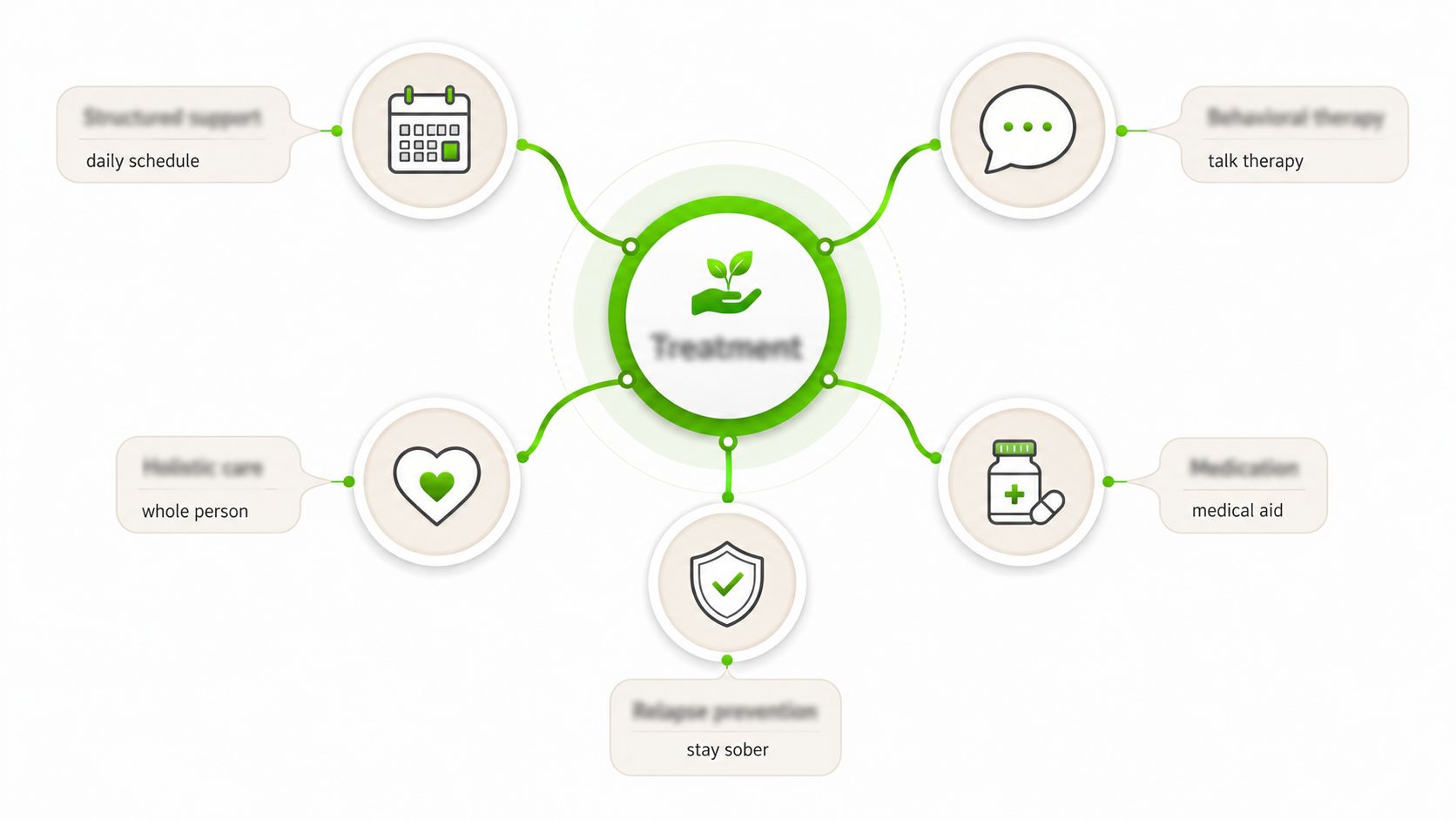
The image above is a useful mental model. Structure, behavioral therapy, medication, relapse prevention, and whole-person support all sit inside one care plan. That's why the phrase what is substance abuse treatment has a real answer, it's not a single service, it's a coordinated clinical process.
ASAM Levels of Care Explained Simply
The clearest way to understand treatment is to look at the ASAM continuum of care. The American Society of Addiction Medicine defines five levels, from early intervention (Level 0.5) through medically managed intensive inpatient care (Level 4), and it sets intensive outpatient programming at about 9 hours per week, with a range of 6 to 30 hours depending on clinical need (ASAM levels of care). That matters because two people can both have a DUI and still need very different care.
ASAM Levels of Care at a Glance
| Level | Typical Setting | Hours per Week | Typical Referrer |
|---|---|---|---|
| Level 0.5 | Early intervention, education-focused | Varies | Court, school, employer, counselor |
| Level I | Standard outpatient | About 9, sometimes less or more based on need | Clinical evaluator, probation, self-referral |
| Level II | Intensive outpatient or partial hospitalization | 6 to 30 | Evaluator, physician, court, probation |
| Level III | Residential or inpatient | Full-time structure | Clinical team, hospital, justice system |
| Level IV | Medically managed intensive inpatient care | Full-time, hospital-level care | Emergency or medical referral |
For a lot of Georgia DUI clients, Level I outpatient is the relevant lane. That's the level where a person lives at home, keeps working if possible, and attends scheduled sessions around the rest of life. If you want a plain-English overview of how that level fits a DUI case, this Georgia ASAM Level 1 treatment guide is a good place to see the local pathway in context.
What each level feels like in real life
Level 0.5 is the “something is starting to go wrong” stage. A clinician may recommend education or brief intervention before the pattern gets worse. Level I outpatient fits people who need regular therapy but don't need around-the-clock supervision. Level II is more intensive, with more contact and tighter structure. Level III and Level IV are for people whose risks are high enough that home-based care isn't safe or realistic.
If you've heard people say, “Just send them to rehab,” that phrase hides a lot of clinical judgment. Severity, withdrawal risk, mental health, family stability, and legal pressure all affect the recommendation. A good evaluator doesn't guess, they match the intensity to the need.
For readers trying to understand the hours and structure of more intensive care, this intensive outpatient care explained resource gives a helpful plain-language comparison to standard outpatient treatment.
Core Treatment Modalities That Actually Work
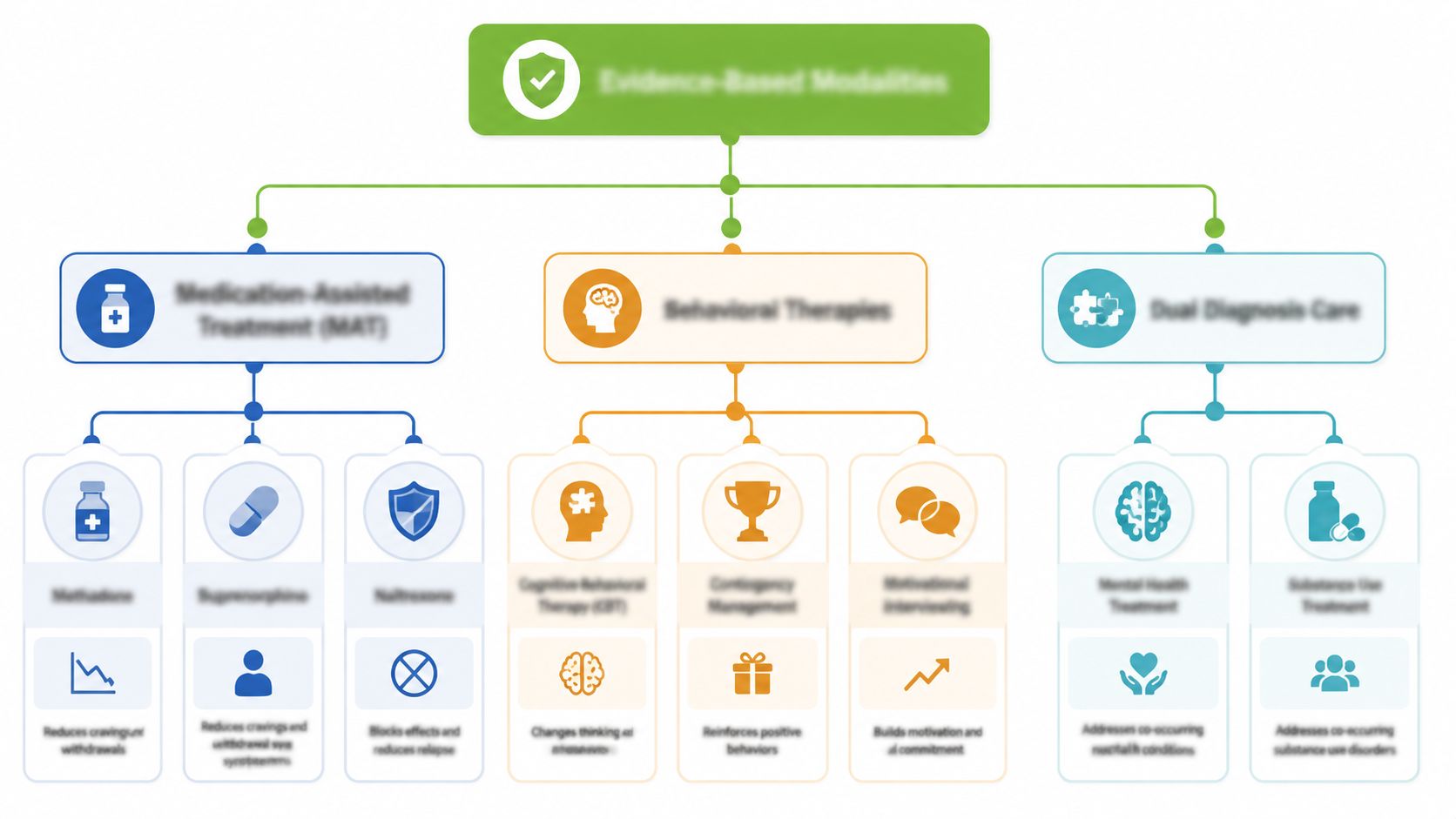
Modern treatment usually combines medication, therapy, and recovery support rather than relying on one tool. The clinical literature says FDA-approved medications are limited to nicotine, opioid, and alcohol use disorders, and the most common evidence-based behavioral interventions include motivational interviewing, cognitive behavioral therapy, contingency management, and twelve-step facilitation (evidence-based modalities). That mix exists because substance use changes both the brain and the person's habits, triggers, and routines.
What medication does and doesn't do
Medication-assisted treatment, or MAT, is often misunderstood. It doesn't mean the person is being “replaced” by another drug. It means a physician uses a medication that's shown to reduce cravings, support stability, or lower relapse risk for the specific disorder being treated. For opioid use disorder, that can be part of a structured plan instead of a standalone fix. If you want a deeper look at that piece, this MAT for opioid use disorder resource explains the medical side in accessible terms.
What therapy looks like in the room
CBT usually focuses on the thoughts, cues, and habits that push a person toward use. A counselor may ask what happened before the last drink, what the person told themselves in the moment, and what could be done differently next time. Motivational interviewing is different. It works with ambivalence, which is common, instead of pretending the person is already fully convinced.
Contingency management adds structure and reinforcement. Twelve-step facilitation helps people connect with peer recovery traditions when that approach fits them. Group therapy often becomes the social engine of outpatient care, because clients hear other people describe the same triggers, excuses, and setbacks in plain language.
A first appointment usually feels less dramatic than people expect. The clinician asks about use patterns, safety, sleep, mental health, medications, and what the person wants to change. The point isn't to catch someone out. The point is to build a plan that fits.
Most people do better when treatment combines clinical care and behavior change, not when it asks them to depend on motivation alone.
For Georgia clients who can't attend in person every time, a structured telehealth substance abuse treatment option can be part of how care stays consistent when the schedule gets tight.
What Happens During Intake and the First Weeks
The first phone call is usually the least stressful part, even though it feels intimidating. Staff typically gather basic information, explain the next appointment, and tell the client what to bring. In a real Georgia DUI case, that first step is often tied to an evaluation that produces a recommendation, not the treatment itself, and people confuse those two all the time.
When the person arrives, the clinician usually moves through paperwork, a biopsychosocial interview, and sometimes screening tools or drug testing depending on the program. The questions are broader than “How much do you drink?” They cover family background, past treatment, medical history, mental health, stress, and legal issues because substance use rarely sits alone.
Intake feels clinical for a reason
A good evaluator is trying to answer one question, what level of care matches this person's actual need? That's why the visit is structured. The program isn't judging character, it's building a record that supports the recommendation. In England, 329,646 adults were in contact with drug and alcohol treatment services between April 2024 and March 2025, the highest figure since reporting began, and 169,542 people newly entered treatment that year (England treatment data). That scale shows intake is a normal operational process, not a rare event.
The first weeks are about routine
Once treatment starts, the early weeks usually focus on showing up, learning the program rules, and beginning the work of change. Clients may attend group sessions, individual counseling, or both. They may also get a referral for medication evaluation if the clinical picture calls for it. If a court or probation officer is involved, the provider documents attendance and completion according to the program's rules and the legal situation.
Confidentiality still matters here. In Georgia, treatment providers can't just hand over everything they hear. Records are handled under federal privacy rules, and the client should know what can be shared, with whom, and under what circumstances before signing anything.
Costs, Insurance, and Court-Ordered Treatment in Georgia
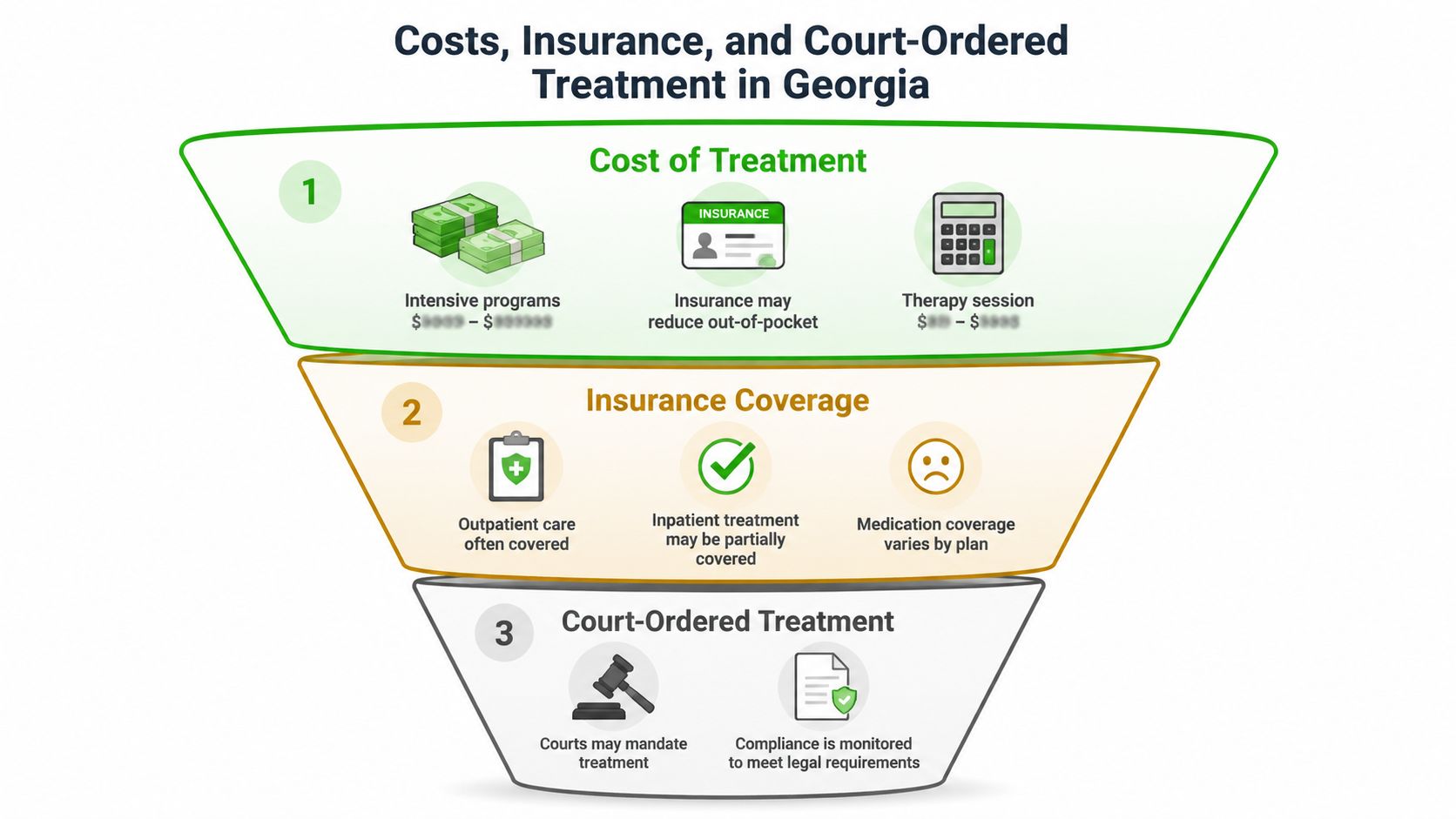
Money is one of the biggest reasons people delay care. Some programs are billed through insurance, some are self-pay, and some offer sliding-scale fees or payment plans. The exact price depends on the level of care, the provider, and whether the person needs medication, group sessions, or more intensive monitoring.
Court-ordered care adds another layer. A judge, probation officer, or DDS-related process may require a clinical evaluation, a treatment recommendation, and proof of completion. That paperwork trail matters because the legal requirement is usually about compliance, not just attendance.
What the Georgia paperwork trail usually includes
A DUI client often has to coordinate several things at once. The Risk Reduction course sits alongside the clinical process, not instead of it. A treatment provider may document attendance, communicate the recommendation, and issue completion records that help answer court or licensing questions. A lawyer or probation officer may ask for verification, so it helps to choose a program that already understands Georgia documentation.
The local system also needs to account for equity barriers. SAMHSA's equity brief says American, Latin American/Hispanic, and Indigenous groups are about 37% less likely to complete treatment than White counterparts, a gap linked to cultural, psychological, and socioeconomic barriers rather than motivation alone (SAMHSA equity brief). That's why transportation, childcare, scheduling, and culturally responsive care aren't side issues, they can decide whether someone finishes.
What to ask before you pay
A cautious shopper should ask whether the program provides the level of care recommended by the evaluator, whether the clinician is licensed, and whether the provider understands Georgia court and DDS requirements. The billing office should also explain what insurance can be used, what's self-pay, and what happens if a session is missed.
If you want a practical billing overview for mental health and treatment services, this mental health billing with Happy Billing resource is useful for understanding how claims and documentation usually fit together.
Georgia DUI Schools also offers clinical evaluations and ASAM Level 1 treatment, which can matter when a local client needs a compliant path from assessment into treatment without bouncing between disconnected providers. That kind of coordination is often what keeps a court requirement from turning into missed appointments and extra delays.
Warning Signs and How to Find Compliant Care
You don't need a diagnosis to notice trouble. The warning signs are often behavioral and practical before they're clinical. A person may start hiding use, needing more to get the same effect, driving after drinking or using, struggling with money, or having repeated conflict at home or work. A DUI or drug charge can become the moment that turns those patterns into an official requirement for help.
Signs that deserve a closer look
- Hiding substance use: keeping bottles, pills, or other substances out of sight, or lying about where they've been.
- Using larger amounts: needing more than before, or saying one drink or one dose “doesn't do it anymore.”
- Driving impaired: getting behind the wheel after use, even when they promised not to.
- Money problems: unexplained spending, borrowing, or missing bills.
- Trouble with family: arguments, trust breakdown, or repeated promises that don't last.
Research on access barriers identifies adolescents, women, men of color, veterans, low-income people, people with serious mental illness, people involved in the criminal justice system, and people experiencing homelessness as groups whose access is shaped by program location, culturally competent clinicians, and individualized care (treatment-access barriers). That's one reason a website that sounds polished isn't enough. You need a program that fits the person in front of you.
How to check whether a Georgia program is usable
Start with the basics. Verify that the program offers the right level of care, that it knows how to document for Georgia DDS or court use, and that its clinicians are licensed to do the work they're advertising. Be careful with promises of instant approval or language that makes treatment sound like a shortcut instead of a clinical process.
For DUI clients, it also helps to know whether the provider can coordinate with ASAM Level 1 outpatient expectations, whether sessions are instructor-led or live virtual when allowed, and whether the full compliance picture includes the Risk Reduction course and the Victim Impact Panel when those are required. A client looking for a local starting point can review this Georgia substance abuse warning signs guide before deciding what kind of help makes sense.
Realistic Timelines and What Success Looks Like
Most outpatient treatment isn't a weekend fix. A Level I program usually stretches across weeks or months because the goal is changed behavior, not a signed attendance sheet. Progress often looks like consistent attendance, fewer crisis decisions, better follow-through, and more honest planning around triggers, not perfect feelings every day.
Setbacks don't automatically mean failure. If someone misses a week, needs a higher level of support, or has to adjust the plan, the response should be clinical and practical, not shame-based. Successful treatment is the person staying engaged long enough to complete the required steps, stabilize their life, and reduce the behaviors that put them at risk.
For a Georgia DUI client, success can mean finishing the required course, completing the treatment recommendation, keeping documentation in order, and moving toward license reinstatement or other legal goals. The next concrete step is simple, choose a compliant program, get the evaluation, and follow the plan instead of trying to improvise one from random internet advice. If you're in Georgia and need a clear path from evaluation through completion, visit Georgia DUI Schools to review the DUI, Risk Reduction, and treatment options that match a court or DDS requirement.
Frequently Asked Questions About Treatment
Can a treatment provider tell my court everything I said? Not automatically. Providers work under privacy rules, and clients should know what can be shared for compliance before they sign forms.
Can family members be part of treatment? Often, yes. Family involvement can help, especially when the home environment affects recovery or the legal process.
What if someone slips once during treatment? One mistake doesn't erase the plan. The provider usually adjusts care, documents the issue, and decides whether the current level is still appropriate.
Should I choose online or in-person care? Choose the format that you can complete. If the program is supposed to satisfy a Georgia requirement, make sure the format matches what the court, DDS, or evaluator will accept.
Georgia DUI Schools offers structured DUI and Risk Reduction education, clinical evaluations, ASAM Level 1 treatment, and Victim Impact Panels for drivers who need a compliant path from intake to completion. If you're facing a DUI, a court order, or a DDS-related requirement in Georgia, reviewing the right program now can save you time and keep the process moving.