

You've got the order, the deadline, and the uneasy question that always comes next, will an online class count? In Georgia, that answer usually turns on paperwork, instructor credentials, and whether the provider can prove completion in a way the court or probation office will accept. The class content matters, but the certificate and the verification trail often matter just as much.
What Court Approved Online Anger Management Classes Actually Are
A court-approved online anger management class is not the same thing as a general self-help course you find in a search result. It's a structured, court-supervised intervention that's usually built around Cognitive Behavioral Therapy techniques, delivered online, and closed out with a certificate that shows the hours, date, provider, and credentials the court can verify. Georgia judges still decide whether that online format satisfies the order, so acceptance is never automatic.
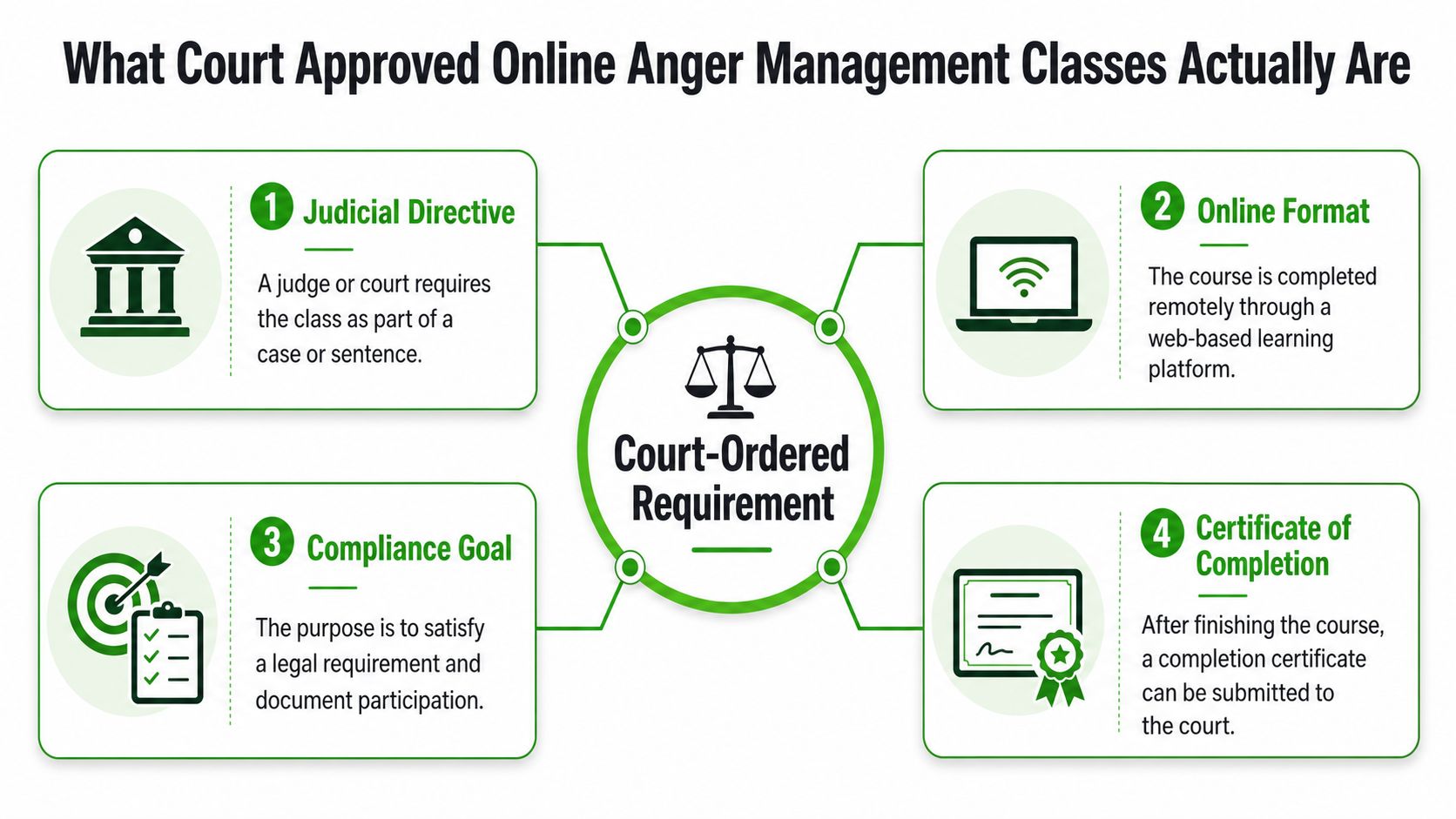
A defendant often hears “take anger management” and assumes any internet course will do. That's where people get tripped up. The court usually wants a program that can show a real chain of responsibility, a licensed or certified instructor, tracked attendance, and a completion record that can survive review by a clerk or probation officer.
The difference between a course and a court order
General anger courses are often marketed for personal growth. Court-approved classes are narrower, because they exist to satisfy a legal requirement. That means the provider has to think like a compliance vendor, not just an educator.
If you're sorting through options after being served or ordered by a judge, resources like navigating court paper service can help you understand why the wording of court notices matters. For a Georgia-specific example of where these classes are marketed locally, see anger management classes in Atlanta.
Practical rule: if the provider can't explain exactly how the court will verify completion, keep looking.
The safest mental model is simple. The judge orders the requirement. The provider delivers the class. The certificate proves the work was done. If any one of those three links is weak, the class can fail even when the lessons themselves are solid.
The Three Checks That Make a Class Court Usable
The first thing to verify is the instructor's license or certification. Courts and probation departments care less about polished ads and more about whether a qualified behavioral health professional is tied to the program. In Georgia, that usually means looking for a clinician whose credentials can be checked, because judges want a provider who looks accountable, not anonymous.
Check the curriculum, not just the headline
A court-usable class should be grounded in an evidence-based structure, most often CBT. The content should address anger triggers, distorted thinking, de-escalation, and communication skills in a way that fits a court order, not a generic wellness webinar. That matches the compliance guidance that says courts look for licensed or certified professionals, evidence-based methods, verifiable certificates, and attendance tracking, while some courts still require in-person attendance for certain cases or written approval before enrollment, according to the court-compliance guide on online anger management acceptance.
The third check is the one many people overlook, the certificate format. Independent guidance says a reliable completion certificate should show the course hours, completion date, provider name, and verifiable credentials, and more stringent standards may also expect the participant's legal name, clinician license number, provider business details, and the assessment basis for the assigned hour length, as noted in the provider guidance on court-approved anger management classes.
A certificate that looks nice but lacks auditable details can still be rejected.
Georgia readers should also keep one local reality in mind. There isn't a single statewide roster that automatically blesses every anger management provider for every case. The judge or probation officer is the final gatekeeper, so the provider's paperwork has to stand on its own.
A smart first filter is easy. Ask whether the class is taught by a licensed professional, whether the curriculum is CBT-based, and whether the certificate includes traceable identifiers. If the answer to any of those is vague, stop and ask for proof before you enroll.
How the Curriculum Is Built and Why Hours Vary
A court-approved anger management class is usually built in a CBT-based chain. The sequence starts with trigger detection, moves to cognitive reappraisal, and then shifts to behavioral interruption. In plain terms, the participant learns to spot what sets off the anger, challenge the thought that pushes the reaction higher, and stop the response before it becomes conduct the court is reviewing.
What the class usually teaches
The curriculum commonly covers the physiology of anger, identifying cognitive distortions, deep breathing, progressive muscle relaxation, and communication or problem-solving scripts. Those items are not decorative add-ons. They are the parts that help reduce impulsive escalation by changing both how a person reads a situation and how quickly that person reacts.
A class that looks simple on the surface can still have different documentation requirements underneath. Some providers structure the lessons so a clinician can tie the assigned hours to observed needs, while others build the class around a fixed court order and document progress session by session. That paperwork trail matters because a judge or probation officer wants to see how the hour total was assigned, not just what topics were discussed.
The assigned hour total varies because courts use it as a risk-management proxy. Provider guidance explains that jurisdictions often assign 4, 8, 12, 16, 26, or 52 hours, depending on offense severity and history, and many court requirements are structured as 8, 12, 26, or 52 hours delivered over 4 to 12 weeks in weekly sessions of about 1 to 2 hours each (source, source). A court can also amend the order upward or downward if it wants more or less documentation.
The hour count is not just a classroom schedule. It also tells the court how much observation, practice, and follow-through it expects to see. A shorter program may satisfy a limited order, while a longer one gives the court a broader record of attendance and participation. The curriculum can still follow the same general structure in both cases, but the legal purpose is different.
Georgia DUI Schools also offers a court ordered mental health evaluation when the court wants a separate clinical review before or alongside treatment.
A useful way to read the order is this, the number is part of the court's documentation plan. Once you know the hour total, you can choose a provider that offers that exact course length and issues a certificate that reflects it accurately. A platform such as Tutorbase helps readers compare scheduling and record-keeping features, which is the same kind of administrative detail courts look for when they review completion paperwork.
How to Verify Court Approval Before You Enroll
Call the court clerk, the probation officer, or your attorney before you pay. That simple step prevents a lot of expensive mistakes. If the answer is “yes, online is fine,” ask for that confirmation in writing, because verbal permission can get lost when a file changes hands.
What to ask before you register
Ask whether your specific case allows online delivery, whether the provider must be on a county list, and whether the class needs to be live or can be self-paced. California is a good example of how strict the details can get, because court-approved online anger management there typically requires an active California license, CAAMP directory listing, and live instructor-led video rather than a self-paced recording, according to California court-approved online anger management guidance. Other states may be more flexible, but your case controls the answer.
Use a provider that can prove the basics. One useful comparison resource for verifying platforms is Tutorbase's Teachworks comparison, since it helps readers think about scheduling, tracking, and administrative controls rather than just lesson content. That kind of administrative structure matters because courts care about records, not marketing language.
Georgia doesn't run through one universal anger-management registry, so documentation and provider credentials carry extra weight. If you're unsure whether the provider is appropriately licensed, check the relevant behavioral health board and ask the provider to show you the license details they'll place on the certificate.

A fast verification checklist
- Written acceptance: get the court or probation office to confirm online delivery before you enroll.
- Provider license: make sure the instructor's professional credentials can be checked.
- Delivery format: confirm whether the class must be live, instructor-led, or whether asynchronous work is allowed.
- Paper trail: save emails, screenshots, and the program description with your case file.
For readers who want a Georgia-oriented screening step, anger management assessment is a useful phrase to look for when a provider offers a pre-enrollment evaluation tied to the assigned hour length.
If the court's answer is conditional, treat that condition like part of the order.
That means you don't just ask, “Can I take it online?” You ask, “Can I take this provider's online class for this case, and what proof do you want me to bring back?” The difference sounds small. In practice, it's the difference between a clean completion and a rejected certificate.
What Enrollment Completion and Cost Typically Look Like
A defendant often learns the practical side of the process only after the court order is in hand, and that is where small details start to matter. The legal name on the enrollment account should match the name on the court record, because a mismatch can create problems when the certificate is reviewed later. After signup, the assigned hours are completed through video lessons, written exercises, quizzes, or live sessions, depending on how the provider delivers the class.
The normal timeline from signup to certificate
A shorter order can sometimes be finished in a few sittings if the program is self-paced. A longer order, especially one built around live weekly meetings, follows the schedule set by the court or probation office. Some providers issue the completion certificate soon after the final requirement is marked finished, while others wait until the attendance record and any required review step are closed out.
The timeline also depends on whether the class is designed for immediate completion or for paced participation across several sessions. In Georgia matters, and in cases elsewhere with similar paperwork rules, the key question is not just how long the lessons take, but whether the provider can produce a certificate that the court can audit. That is why pre-enrollment written confirmation matters, especially when a judge, clerk, or probation officer has a specific format in mind. The same principle is explained in SendItFax on binding documents, which is useful for understanding why written records carry so much weight.
Cost is usually lower online than in person because the provider does not have to maintain classroom space or physical scheduling overhead. The exact price still depends on the hour total and whether a live instructor is involved, so the safer comparison is the certificate requirement, not the headline fee. A low price does not help if the court later asks for a document the program never planned to issue.
Some classes add checkpoints or a short assessment before the final certificate is released. That can feel like extra paperwork, but it exists because courts want proof that the participant worked through the material. In some cases, a clinical evaluation or in-person sign-off is also part of the approval path, so the certificate may be necessary without being the only item the court wants to see.
What you should expect to receive
- Completion certificate: shows the hours finished, date completed, and provider identity.
- Instructor information: may include clinician credentials or license number.
- Provider contact details: useful if probation needs to verify the record.
- Supporting records: attendance log, progress notes, or assessment basis if the court asks for them.
The best practice is to collect the certificate and the backup records together, then save them in the same case file. That makes it easier to answer a follow-up question from the court, probation, or the attorney handling the matter. If the document package is thin, a reviewer may treat it like an incomplete filing even when the class itself was finished.
The cost of the class is not only the fee paid at enrollment. It also includes the time spent gathering the right proof, the effort avoided if the certificate is accepted the first time, and whether the program closes the loop without a resubmission.
Submitting Your Completion to the Court or Probation Officer
A defendant on probation in Georgia usually needs to know who receives the completion record the moment the last lesson ends. In some cases, the probation officer gets it first. In others, the clerk of court also wants a copy, and the defense attorney may need one for the case file. The safest approach is to follow the written instructions exactly, then keep proof of every delivery.
The paperwork matters because the court is not just checking that the class was finished, it is checking that the record can be verified. A certificate that looks complete on the surface can still be rejected if it does not match the case file or if the provider cannot be identified clearly. That is why the submission step should be handled like a final filing, not a casual email attachment.
What gets rejected most often
The rejection list is frustratingly basic. A certificate can fail if the legal name does not match the court record, if the hours do not match the order, if the document is unsigned, or if the clinician license number is missing when the court expects one. Those are not small details. They show whether the course record can be traced back to a real provider and a real completion.
| Certificate Element | What It Proves | Common Reason for Rejection |
|---|---|---|
| Legal name | The participant matches the case file | Nickname or misspelled name |
| Course hours | The order was completed as written | Hours do not match the court order |
| Completion date | The work was finished on time | Date is absent or unclear |
| Instructor credentials | A qualified professional ran the class | No license number or no credential detail |
| Provider contact details | The court can verify the record | Generic certificate with no office information |
The hard part is not usually finishing the class. It is getting the certificate into the right hands in a form they trust. A secure portal upload, sealed PDF, mailed original, or attorney handoff can all be acceptable, depending on the court's instructions. The method matters because a document that cannot be tracked may be treated as if it was never submitted.
For readers dealing with document transfer and proof of delivery, SendItFax on binding documents is a useful reminder that a document's legal effect often depends on how it is signed, transmitted, and preserved. The same logic applies when you submit completion paperwork to a court or probation office. A certificate that is complete but poorly delivered can still create a compliance problem.
Keep a personal copy before you send anything. If the original gets lost in transit, you will still have the record.
A good habit is to ask for a receipt, upload confirmation, or email acknowledgment the same day you submit. If the court or probation office later says the document never arrived, that confirmation can close the gap fast. Keep the confirmation with the certificate and any provider contact information in the same file, so you can answer a follow-up without searching through old messages.
Frequently Asked Questions for Defendants Attorneys and Probation Officers
Are online anger management classes accepted in Georgia?
Sometimes, yes, but only if the judge, probation officer, or court order allows an online format. Acceptance turns on the specific case, the provider's credentials, and the documentation the provider can produce. Georgia does not use a one-size-fits-all approval rule for this topic, so written confirmation from the provider matters before anyone relies on the class.
Can a judge reject the certificate after I finish?
Yes. A court can still reject a certificate if it leaves out the participant's legal name, the course hours, the provider information, or the credential trail that shows who delivered the class. The class may be complete, but the record still has to be complete enough for court review.
How long does an 8-hour or 12-hour program take in practice?
That depends on whether the class is live or self-paced and whether the provider spreads the hours across weekly meetings. Some court-ordered programs run over several weeks in sessions of about 1 to 2 hours each, while other providers compress the work into a shorter schedule when the court allows it. As noted earlier, the assigned hours control the pace, so the court order and the provider format should match before enrollment.
What happens if I miss a session or fail an assessment?
Most providers require the missed material to be made up before they issue the certificate. If the class uses assessments, you may need to retake the quiz, complete an extra assignment, or wait until attendance is verified. Courts usually focus on whether the requirement was completed, so a missed lesson should be treated as a paperwork problem until the provider confirms it has been corrected.
How does this relate to Georgia DUI Risk Reduction or other court-ordered education?
It is a different requirement, but the compliance logic is similar. Georgia DUI Schools provides DUI and Risk Reduction education, defensive driving, clinical evaluations, ASAM Level 1 treatment, and victim impact panels, so a case involving more than one ordered program may require separate documents for each completion. The common thread is the same. The court wants a record it can verify without guessing how the requirement was handled.
What should attorneys and probation officers ask providers for?
Ask for the legal name on the certificate, the completed hour total, the completion date, the instructor's credential details, and the provider's business information. If those items are missing, the record may be too thin for court use. A good provider should be able to produce a clean, auditable file without making staff chase down missing details.