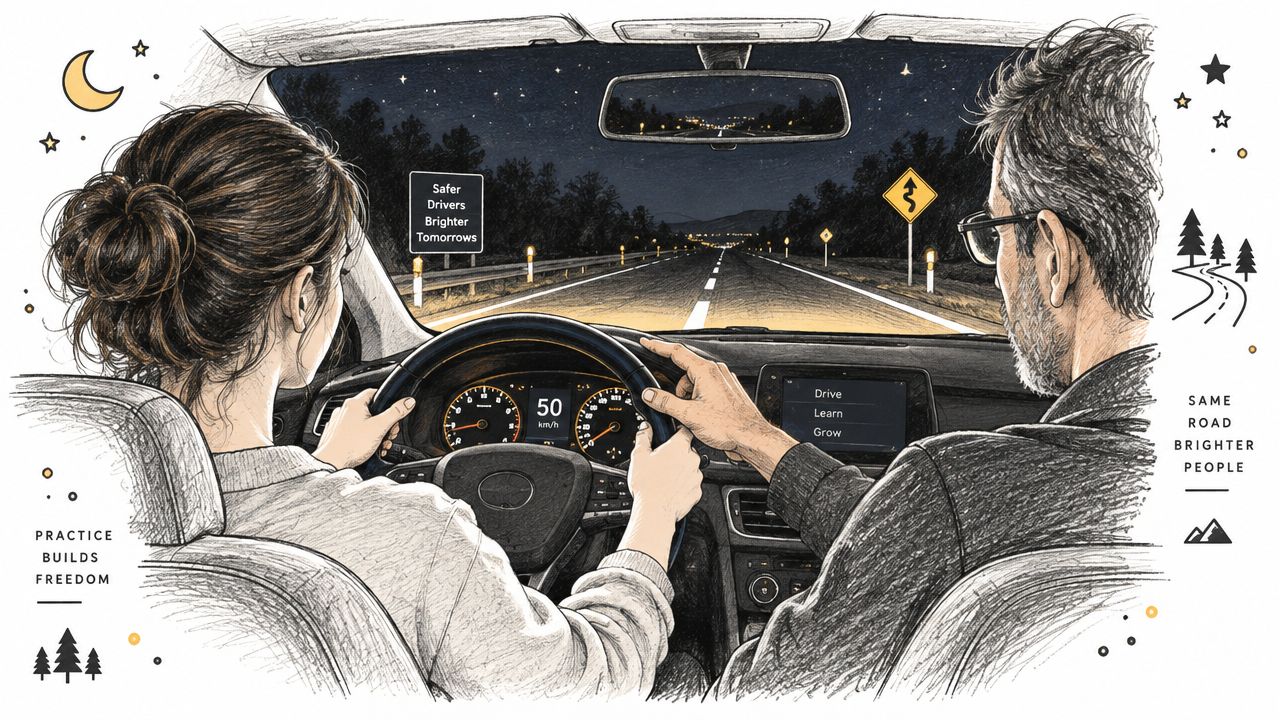
Night driving is a small part of a young driver's experience, yet it can carry a much larger share of the danger. In one U.S. study, 16- and 17-year-old drivers made only 14% of their trips by miles between 9 p.m. and 5:59 a.m., but 39% of their fatal crashes occurred during those hours. The finding is documented in this peer-reviewed review of nighttime driving risk.
That imbalance is why night driving lessons shouldn't be treated as a casual confidence exercise. Darkness changes what the driver can see, how quickly hazards appear, and how much fatigue affects judgment. A useful lesson plan prepares the vehicle, trains low-light scanning, manages glare, protects pedestrians and cyclists, and increases difficulty only when the learner can handle the previous stage consistently.
Why Night Driving Demands Its Own Lesson Plan
A familiar road becomes a different driving task after sunset. Headlights reveal only part of the roadway, shadows conceal objects beyond the beam, and glare can briefly wash out lane markings. Peer-reviewed research links limited illumination with a shorter sight distance and greater difficulty judging road conditions, traffic situations, and travel direction. It also reports that nighttime crash probability is about 1 to 1.5 times the daytime probability, while the fatality rate per kilometre is roughly three times higher at night. See the peer-reviewed research on nighttime visibility and crash risk.
Inexperienced drivers face a narrower margin for error because they are still learning to identify hazards and judge speed from limited visual information. A European Road Safety Observatory report on novice drivers reports that, in Great Britain, young drivers' collision-involvement risk was eight times higher between 2 a.m. and 4 a.m. on weekdays and weekends. It also records that 37% of young driver fatalities and serious injuries occurred between 9 p.m. and 6 a.m. in 2019, compared with an average of 36% across 2010 to 2019 for that same nine-hour window.
| Time of Day | Share of Driving | Share of Fatal Crashes | Risk Multiplier |
|---|---|---|---|
| Daylight | About three-quarters of driving exposure | About half of driver fatalities | Lower relative exposure risk |
| Dark hours | About one-quarter of driving exposure | About half of driver fatalities and more than half of traffic deaths | Disproportionately higher |
The comparison comes from AAA's nighttime driving position statement. It does not mean every trip after dark is unsafe. It means a lesson must assess more than lane position. The learner needs to spot hazards early, recover from glare without drifting, and select a speed that fits the visible stopping distance.
Instructor's principle: If the road looks familiar but the available visual information has changed, the lesson has changed too.
A staged plan also fits Georgia DDS-approved Risk Reduction and broader defensive driving education. Practice should build from vehicle preparation and low-light control to glare recovery, fatigue awareness, and supervised travel before independent night driving.
Preparing Your Vehicle and Yourself Before Sunset
A qualified instructor doesn't begin a night lesson by turning onto the road. The first few minutes belong to preparation, because a dirty lens, poorly adjusted mirror, or tired learner can create problems before technique has a chance to help.
Start outside the vehicle
Walk around the car and check every exterior light. Confirm that the low beams, high beams, brake lights, turn signals, reverse lights, and rear lamps work. Clean the headlight lenses, windscreen, mirrors, and side windows. A hazy headlight lens or smeared glass scatters light and makes contrast harder to read.
Fog or auxiliary lights need proper aim and lawful use. They're not substitutes for ordinary headlights, and a learner should know which switch controls each lighting function before leaving the parking area. If the lenses look cloudy, a practical restore cloudy headlights guide can help explain why restoration matters for nighttime visibility.
Set up the cockpit
Dim the instrument panel until it remains readable without glowing brightly in the learner's peripheral vision. Excessive dashboard brightness creates a high-contrast foreground that makes the dark roadway harder for the eyes to process.
Adjust the mirrors before moving. The interior mirror's night setting can reduce reflected glare, while correctly positioned side mirrors limit the amount of headlight from following traffic entering the driver's view. Set the seat, steering wheel, and headrest so the learner can maintain a relaxed posture and make frequent, deliberate visual checks.
The preparation checklist should include:
- Clear the view: Remove papers, bags, phone mounts, or other objects that block the windscreen or mirrors.
- Plan the route: Begin with a quiet area, then use a route that adds mixed lighting, such as a calm arterial near a commercial strip.
- Check alertness: The learner should be rested, hydrated, and free from alcohol or medications that impair driving.
- Confirm controls: Locate the headlight, high-beam, demister, hazard-light, and dashboard-dimmer controls.
- Choose an exit plan: Know where to pull over if anxiety, weather, or fatigue makes continuing unwise.
Good preparation supports the braking and space-management skills reinforced in defensive driving brake training. It also gives the instructor a baseline. If the learner struggles to see clearly before the car moves, the solution isn't to drive faster and hope the eyes adjust.
Core Techniques for Low-Illumination Driving
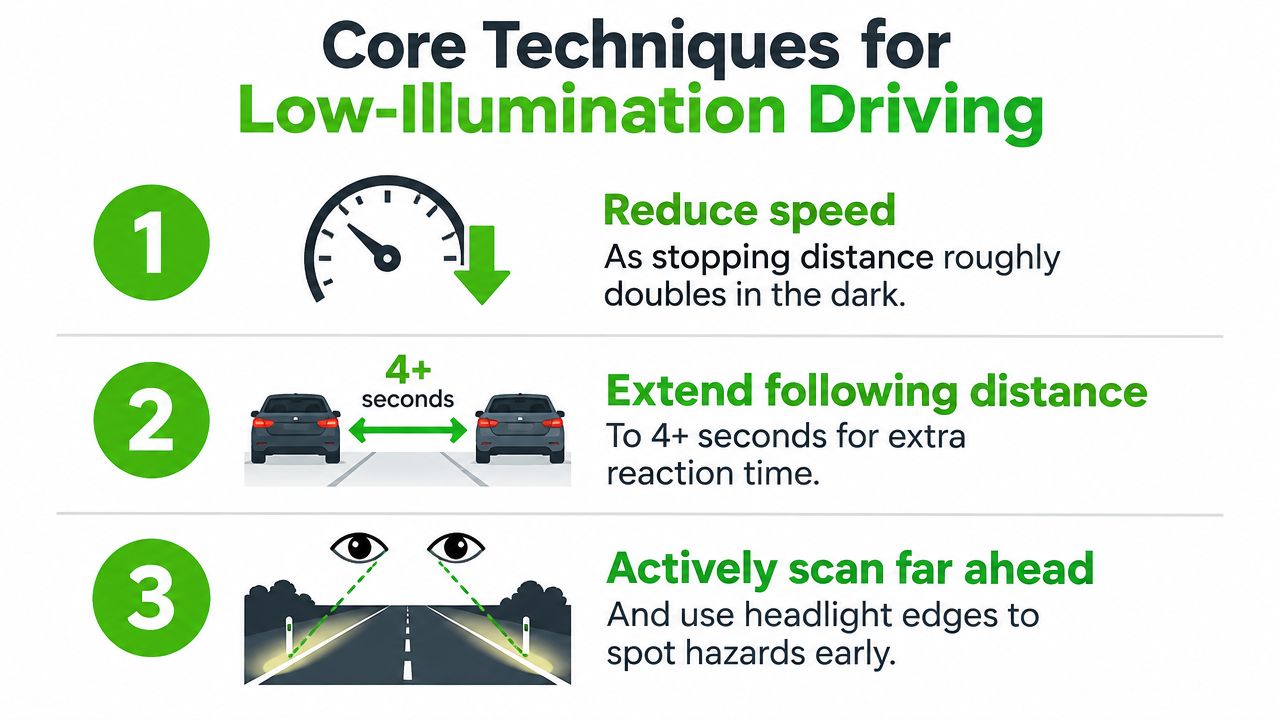
Night driving lessons usually become calmer once the learner stops trying to see everything at once. The task is to manage speed, create time, and keep the eyes moving through the useful parts of the scene.
Control speed before the hazard appears
On an unlit road, the driver's effective sight distance is limited by the headlight beam. Reduced peripheral vision and slower hazard recognition can make stopping space feel shorter than it does in daylight. In practical training, that means easing off the accelerator before bends, crests, junctions, parked vehicles, and sudden lighting changes.
Don't use a fixed speed reduction as a universal rule. The posted limit is a ceiling, not a promise that the road can be driven safely at that speed under every lighting condition. If the lane markings disappear, pedestrians are nearby, or the road surface is wet, slow enough to keep the visible stopping distance under control.
Build a larger time gap
A learner who follows closely at night loses the chance to interpret what the vehicle ahead is doing. Tail lamps can show direction and movement, but they don't reveal every obstacle, pothole, pedestrian, or cyclist beyond them.
Use a time-based gap rather than guessing by car lengths. Begin with the normal daytime rule, then expand it when darkness, glare, rain, or uncertainty reduces visibility. The correct gap is the one that leaves enough time to recognize brake lights, understand the developing situation, and stop smoothly.
Scan instead of staring
The vanishing point is useful for general direction, but staring at it can pull the car toward the centre of the visual tunnel. Train the eyes to move between the lane edges, the road ahead, signs, side streets, and possible movement beyond the headlight beam. Looking toward the right edge line during difficult moments can help maintain lane position without looking directly into oncoming glare.
Useful scanning habits include:
- Read signs early: Overhead signs may appear suddenly against a dark background, so check them before reaching the decision point.
- Expect hidden junctions: Unmarked intersections, driveways, and side roads can be difficult to see until another vehicle's lights reveal them.
- Use taillights as clues: The glow and movement of vehicles ahead can help estimate road direction and traffic flow in dark areas.
- Check the edges: Pedestrians, cyclists, animals, and disabled vehicles often appear at the margins before they enter the lane.
- Reassess after lighting changes: Leaving a bright commercial road for an unlit stretch requires a deliberate speed adjustment.
These are the same observation habits developed through practical driving-skills instruction. The difference is that night driving gives the learner less visual information, so each habit has to be more intentional.
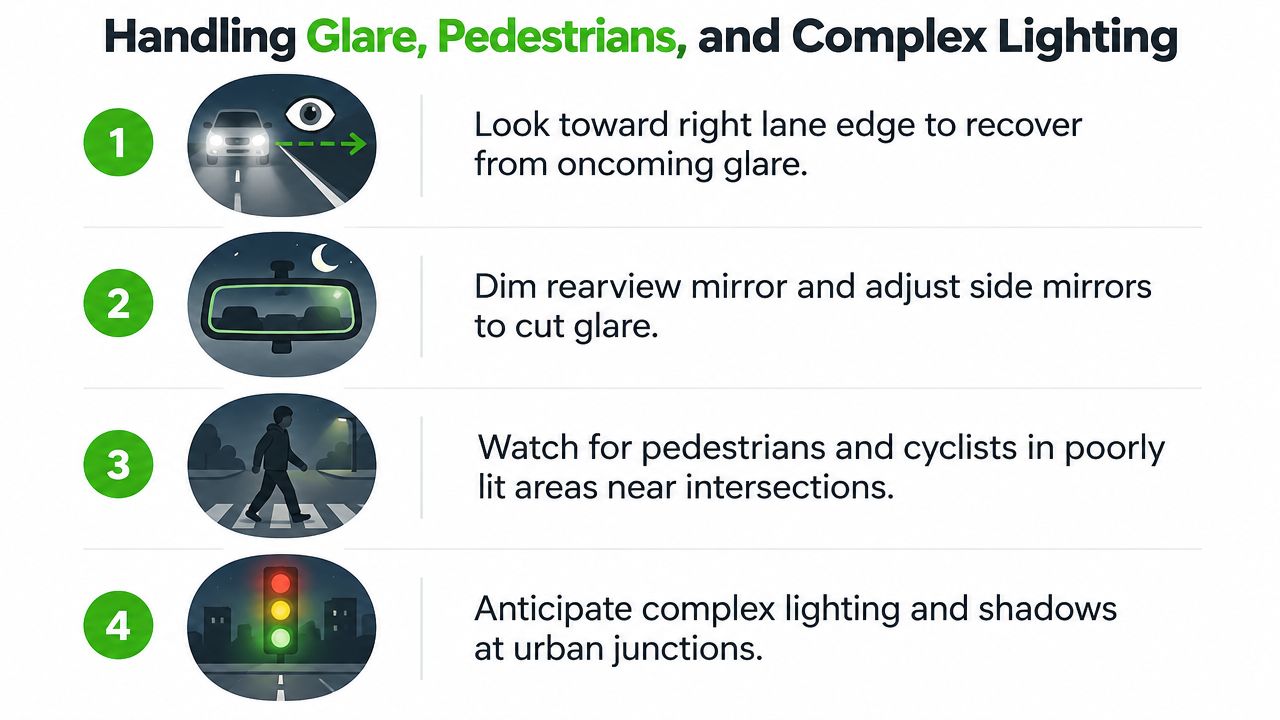
Handling Glare, Pedestrians, and Complex Lighting
Glare creates a short period when the driver sees less clearly. The danger lies in what may be missed while vision recovers, including a lane edge, pedestrian, cyclist, or vehicle. Avoid staring into oncoming headlights. Shift attention toward the right edge of the lane, keep steering inputs small, and maintain a steady forward reference.
Set the interior mirror for nighttime use and angle the side mirrors to limit unnecessary reflections. Do not close your eyes or turn your head away. If the vehicle's headlights are cloudy, a restore cloudy headlights guide can help address a source of reduced illumination before practice begins.
Protect the vulnerable road user
Pedestrians and cyclists are hardest to detect when their clothing blends with the background. Someone in a dark hoodie may merge visually with a hedge or parked vehicle. A cyclist near the fog line may remain hidden until the headlight beam reaches the bicycle.
Use a three-distance scan:
- Far range: Look for movement, silhouettes, crossing patterns, and openings between vehicles.
- Middle range: Check lane edges, parked cars, driveways, and the space around crossings.
- Near range: Confirm that the intended path is clear before steering, turning, or passing.
At a dim parking structure, a pedestrian can step between parked SUVs with little warning. Near an unlit intersection, someone may enter a crosswalk outside the strongest light. Give a slow cyclist extra space early, rather than waiting for a last-second lane change.
Read changing light as a warning
Commercial strips, construction detours, mixed LED and older street lighting, and parking facilities can produce alternating bright and dark zones. The eyes need time to adapt, while an overly bright instrument panel can make the darker area harder to read.
Treat each sharp transition as a prompt to review speed. A vehicle leaving a brightly lit highway for an unlit ramp may lose depth cues just as the curve tightens. Slow before the transition, check the lane edge, and avoid assuming the road remains as wide as it appeared under the previous lighting.
As noted in nighttime driving guidance, glare can reduce visibility, while glare by itself does not establish the full crash risk. That distinction keeps training practical. The goal is not to eliminate every reflection. The learner should reduce speed, protect lane position, and continue scanning as lighting becomes more complicated.
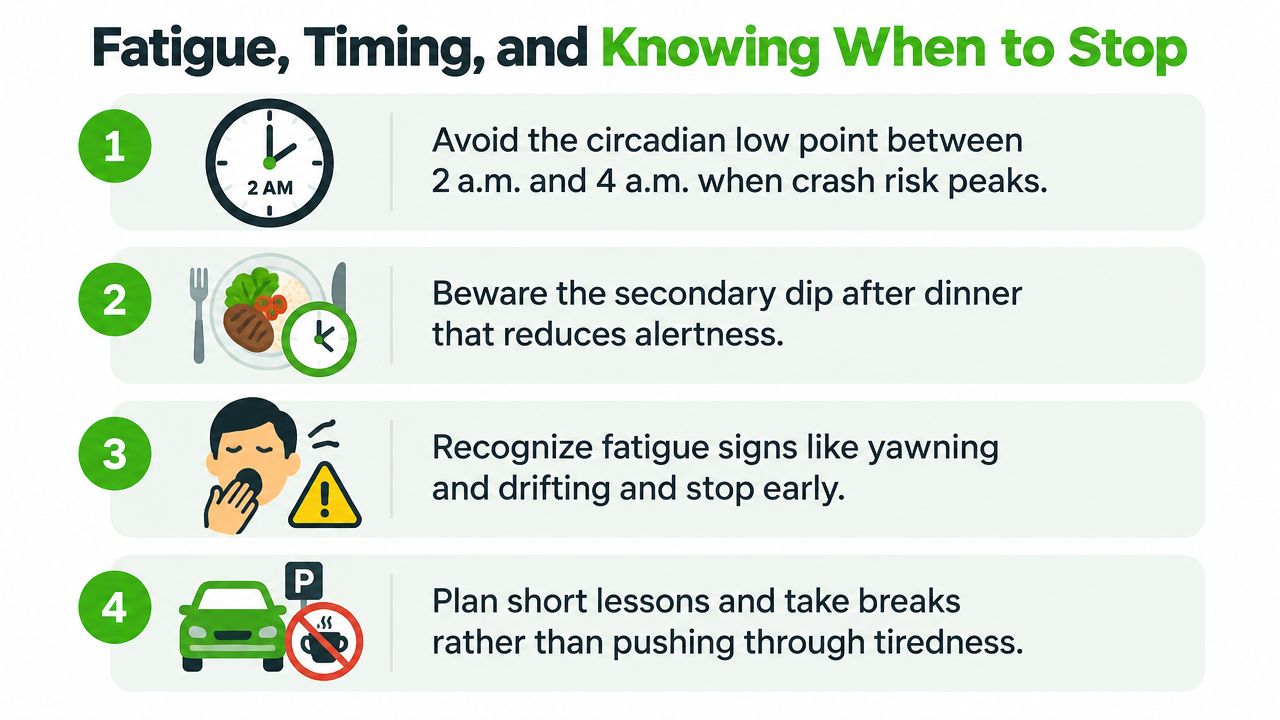
Fatigue, Timing, and Knowing When to Stop
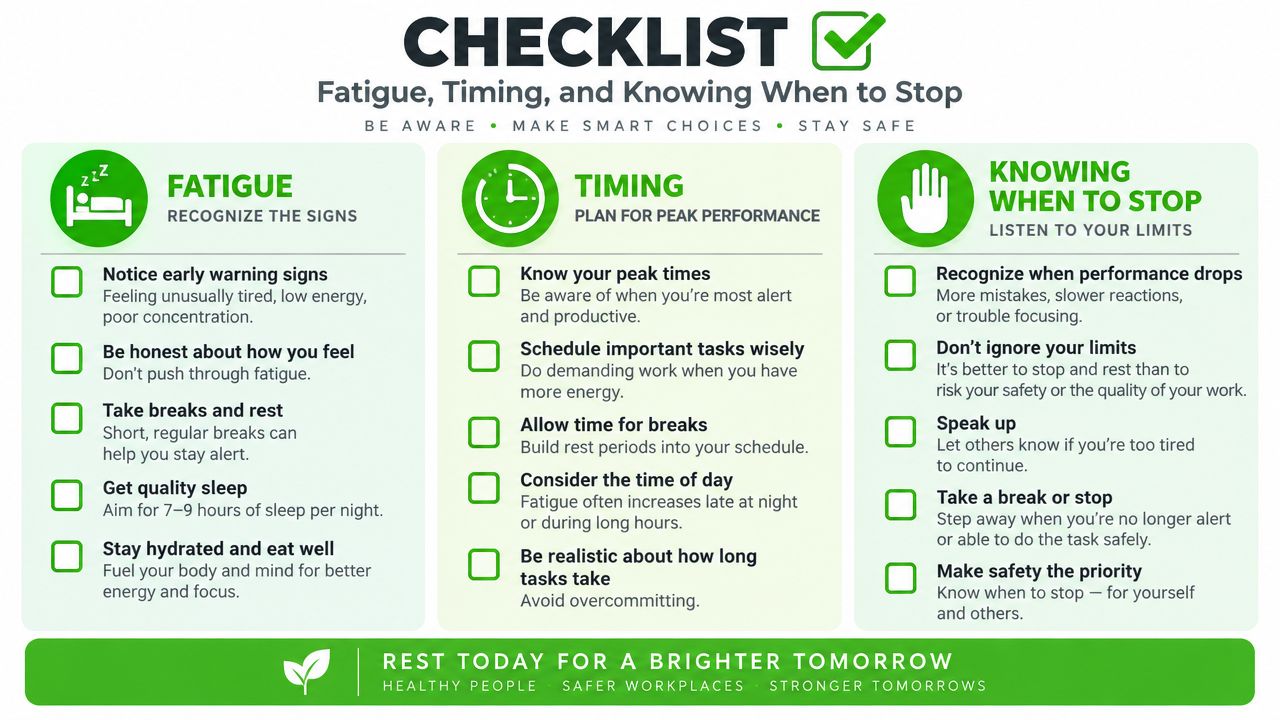
Darkness and tiredness can create similar driving errors. A learner may miss a sign, drift within the lane, brake late, or struggle to hold a steady speed. The cause may be reduced visual information, fading attention, or both at once. Treat these problems like two warning lights on the same dashboard: either one calls for a closer check.
Alertness commonly falls late at night and after a long day of school, work, or other activity. The risk is greater during the circadian low point between 2 a.m. and 4 a.m., so novice drivers should not use those hours for early independent practice. A lesson that begins around dusk allows the eyes and attention to adjust gradually.
Use a stop decision, not a willpower test
End a night lesson when performance declines, not when the planned route is complete. Watch for repeated yawning, wandering lane position, missed exits, delayed responses, unusual irritability, or difficulty maintaining a fixed speed. These signs are like a vehicle's warning indicators. Continuing does not make the problem disappear.
Keep early sessions short, avoid driving after a heavy meal, and never practice after alcohol or while using an impairing medication. The National Safety Council advises attention to reduced visibility, clean windshields, vision care, and avoiding driving when awake for 16 hours or more. Its night driving safety guidance explains why fatigue and vision deserve attention alongside headlights.
Stop rule: If you have to ask whether you're too tired to drive, you're too tired to continue.
An instructor should pull over when weather changes, the route becomes unexpectedly complex, or anxiety overwhelms the learner's ability to process instructions. After a close call, take a 15-minute break before deciding whether to resume. Park somewhere safe, review what happened calmly, and continue only if alertness and judgment have clearly returned.
Progressing From Supervised Practice to Independent Night Driving
Night driving practice should increase complexity gradually. A learner who handles a quiet residential street may still struggle with glare, merging traffic, or an unlit rural intersection. The passenger should add one challenge at a time and record what the driver can perform consistently.
| Stage | Conditions | Hours Required | Pass Criteria |
|---|---|---|---|
| One | Quiet residential area, beginning at dusk | Two dusk sessions | Stable lane position, correct low-beam use, and deliberate scanning |
| Two | Moderate traffic, signalized intersections, and a highway merge segment | A 30-minute merge segment | Smooth gap selection, controlled speed, and timely mirror checks |
| Three | Rain, construction, and multi-lane roundabouts | Supervised practice | Calm decisions, glare recovery, and early hazard anticipation |
| Four | Mixed routes with an instructor assessment | A logged checklist of 10 supervised night hours | Consistent performance without repeated prompting |
The hours and conditions in this progression are a practical training framework, not a substitute for the current requirements that apply to a particular licence or insurance policy. A licensed adult should remain in the passenger seat during each stage, especially when weather, construction, or unfamiliar road design is introduced.
Use competency checkpoints
- Speed control: The learner reduces speed before visibility drops, rather than braking only after a hazard appears.
- Gap selection: The learner leaves a clear time cushion and doesn't follow closely because the road feels empty.
- Glare recovery: The learner looks toward the right lane edge, maintains position, and avoids abrupt steering.
- Hazard anticipation: The learner identifies likely pedestrian, cyclist, intersection, and roadside risks before they enter the lane.
Keep a simple log with the date, route type, lighting conditions, weather, skills practiced, and any instructor intervention. Families should confirm what documentation their insurer or the Georgia Department of Driver Services requires. Accurate records support honest progress reviews, but they don't turn unsafe practice into qualifying experience.
Putting It All Together in Georgia
Georgia learners should confirm their permit or licence status and applicable supervision rules directly with the Georgia Department of Driver Services. Once the legal conditions are clear, choose routes that increase difficulty without creating unnecessary pressure. Local practice might begin on a quiet suburban arterial, then move toward a controlled section of SR 316, a suitable I-285 perimeter segment, or roads near home where the learner already understands the daytime layout.
A practical four-week plan can look like this:
- Week one: Complete three dusk lessons on quiet residential roads. Check low-beam operation, mirror positioning, lane placement, and basic scanning.
- Week two: Add full darkness on familiar suburban arterials. Practice sign reading, following gaps, unmarked driveways, and pedestrian detection.
- Week three: Introduce a carefully selected highway merge and busier intersections. Avoid adding rain, construction, and complex junctions on the same first attempt.
- Week four: Move toward rural roads with unlit intersections only after the learner remains calm and consistent. Finish with an instructor assessment and a review of the practice log.
Georgia drivers also need to understand the difference between skill development and remedial education. The state's DUI, Alcohol or Drug Use Risk Reduction Program is mandatory for people convicted of DUI, illegal drug possession, underage possession of alcohol while operating a motor vehicle, or boating under the influence. The program has an assessment component and an intervention component, and both must be completed to receive a certificate of completion, according to the Georgia DDS DUI FAQ.
Defensive driving serves a different purpose. Georgia law requires defensive driving clinics to provide a uniform six-hour instruction program designed for rehabilitation of problem drivers, with standards covering course content, instructor qualifications, attendance, and examinations. The requirements are described in Georgia Code Section 40-5-83. Drivers facing repeated suspensions should also understand Georgia's habitual violator rules. The state can suspend a licence after a third suspension within five years and when a driver accumulates 15 or more violation points in any consecutive 24-month period, as described in the Georgia DDS court reference manual.
Night driving lessons build the practical habits. Formal Georgia courses address the legal, behavioural, and risk-reduction responsibilities that surround those habits. Together, they give a driver a clearer path from supervised practice to safer decisions after dark.
Georgia DUI Schools offers Georgia DDS-approved DUI and Risk Reduction courses, defensive driving options, clinical evaluations, ASAM Level 1 treatment, and Victim Impact Panels through online, live virtual, and classroom formats. If nighttime driving concerns are connected to a licence requirement, court order, points, or a need for structured safety education, visit Georgia DUI Schools to choose the course and support that fit your situation.