
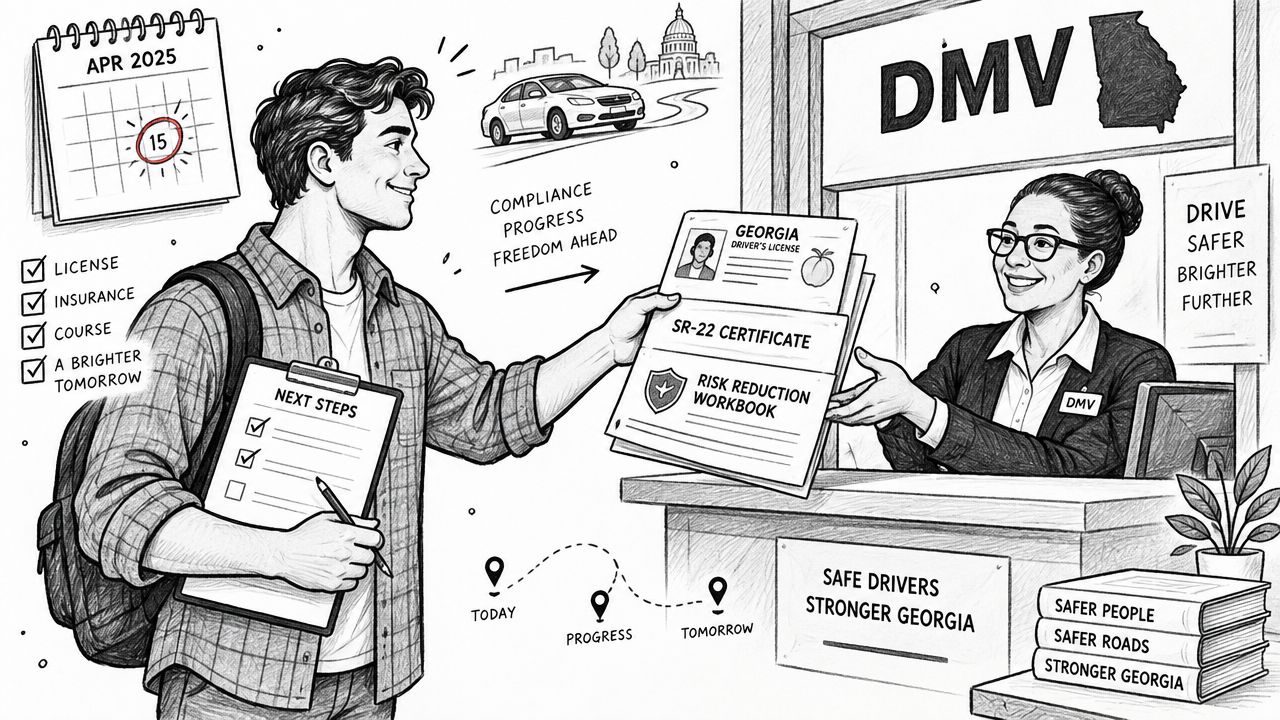
You've received a Georgia suspension notice, your car insurance company is asking questions, and your work schedule won't wait for a government process. The most common mistake at this point is assuming that completing the suspension period automatically restores your license. It doesn't. Georgia DUI reinstatement is a compliance process, and the Georgia Department of Driver Services, or DDS, must have the required program certificate, payments, insurance filings, and any additional approvals connected to your case.
A first-time DUI can involve a 120-day suspension for drivers age 21 and over, but the waiting period is only one part of the process. Georgia DDS also requires a certificate from a certified DUI Alcohol or Drug Use Risk Reduction Program and payment of reinstatement fees before the driving privilege can be restored. Georgia DDS explains the first-offense DUI reinstatement requirements.
The safest approach is to verify your status first, complete the correct approved course, preserve the original Certificate of Completion, address clinical or insurance requirements when they apply, and confirm that DDS has cleared every hold. This Georgia license reinstatement guide follows that sequence so you can move from uncertainty to a documented plan.
Introduction to DMV DUI Reinstatement in Georgia
A driver in Atlanta can finish the court portion of a DUI case, serve the suspension period, and still find that DDS has not restored the license. The unresolved item may be a Risk Reduction certificate, a reinstatement payment, a clinical evaluation, or proof of financial responsibility. Court compliance alone does not confirm that every DDS requirement is complete.
Court penalties and DDS driving-privilege requirements are related but separate. A court may order education, treatment, or other conditions. DDS decides whether the state driving privilege remains suspended, becomes restricted, or is reinstated under its licensing rules. Completing a court condition does not automatically clear a DDS hold.
For a first DUI involving a driver age 21 or over, Georgia DDS identifies a 120-day suspension. The reinstatement path also requires a Certificate of Completion from a DDS-approved DUI Alcohol or Drug Use Risk Reduction Program and payment of the applicable reinstatement fees. The Georgia DDS first-DUI FAQ provides the general pathway, while your suspension notice and DDS record control the details of your case.
Practical rule: Do not treat the final day of suspension as the finish line. Have each required item ready for DDS before that date.
Four questions organize the process: What exactly is suspended? Has the required period been served? Which approved education, evaluation, treatment, device, or insurance condition applies? How will DDS receive the proof and payment?
Local scheduling affects execution. A driver in Athens may choose an in-person classroom schedule. Someone working throughout metro Atlanta may need an online or live virtual option. The provider still must meet DDS rules, and the certificate must match the driver's specific case. Before enrolling, use this Georgia license reinstatement guide to organize the sequence and documents.
The remaining work is administrative as much as legal: confirm eligibility, complete the Risk Reduction course, protect the original certificate, submit financial-responsibility filings when required, and identify clinical requirements for repeat offenses. Small errors in provider approval, certificate handling, payment, or submission can leave a license on hold.
Understanding Your Suspension and Eligibility to Reinstate
A suspension notice can leave a driver unsure whether the remaining issue is the waiting period, a required course, a clinical evaluation, insurance filing, or payment. Start by comparing your DDS record and notice with the court disposition before enrolling in any program. Record the suspension reason, effective dates, restriction or interlock language, outstanding fees, and instructions for submitting proof.
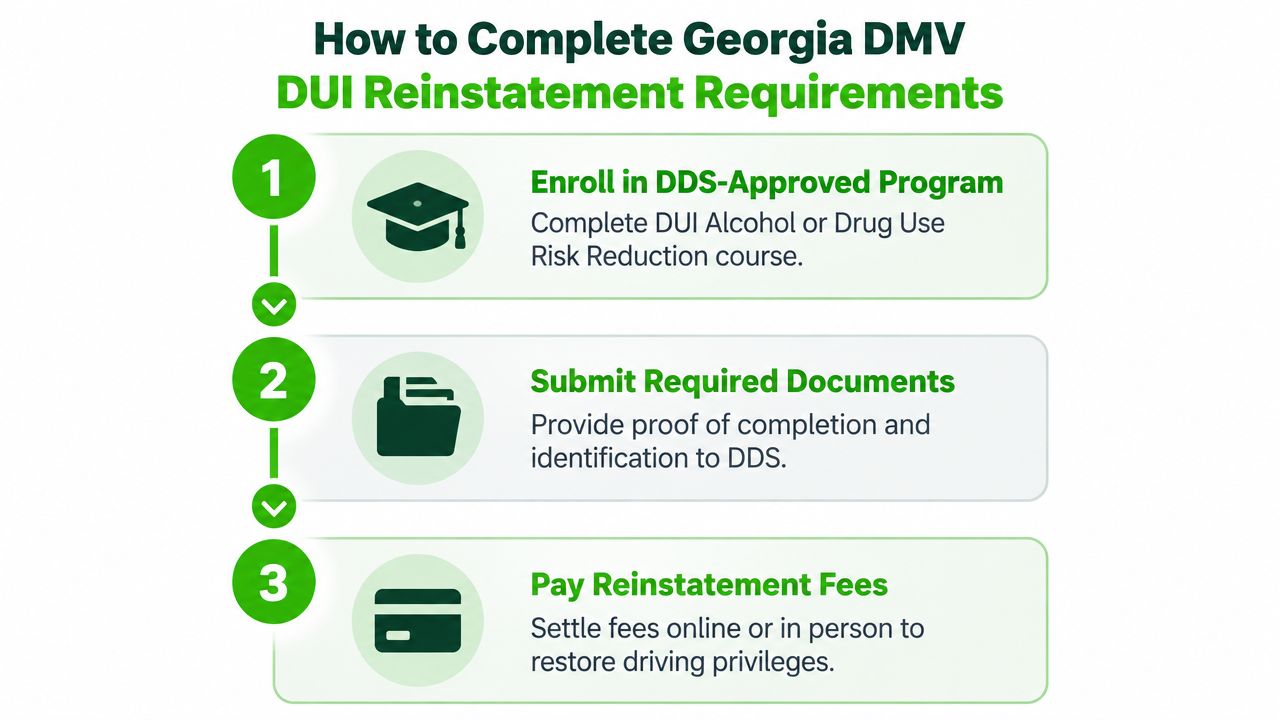
For a first DUI involving a driver age 21 or over, Georgia DDS states that the suspension is 120 days. Reinstatement requires a certificate from a DDS-approved DUI Alcohol or Drug Use Risk Reduction Program and payment of the applicable reinstatement fees. DDS's reinstatement page confirms that the program must come from a certified provider. A convenient class from an uncertified school will not satisfy the licensing requirement.
Check the source of every hold
Sort each obligation into the category that controls it:
- DDS requirements: The suspension period, approved Risk Reduction completion, reinstatement fees, and required documentation.
- Court requirements: The sentencing order may require education, treatment, a Victim Impact Panel, or another condition.
- Case-specific licensing conditions: Repeat offenses and other facts may trigger a clinical evaluation, treatment, ignition interlock, SR-22, or additional DDS approval.
This distinction prevents a common delay. Completing a court-ordered class does not guarantee DDS acceptance if the provider was not certified for Georgia licensing purposes. The DDS court reference manual states that only DDS-certified driving schools are approved for Driver Education, Defensive Driving, and DUI programs, and that uncertified classes are not accepted for licensing, reinstatement, or court requirements.
Gather documents before you pay
Keep the suspension notice, court paperwork, identification, enrollment information, insurance records, and payment receipts together. Before paying, confirm whether DDS requires an original certificate, how the provider issues it, and when it will be available. The provider's location can affect scheduling. A driver in Athens may use an in-person class, while someone working across metro Atlanta may need an online or live virtual option. In either case, the provider must meet DDS rules and the certificate must match the case.
If you have two or more DUI convictions within the past 10 years, do not assume the first-offense pathway applies. The Georgia DDS DUI FAQ identifies documented proof of a completed state-approved clinical evaluation as a reinstatement requirement for that situation, rather than an optional counseling recommendation.
Drivers dealing with an ignition interlock, SR-22, or another restriction should resolve that condition before relying on a standard reinstatement payment. If the DDS record is unclear, contact DDS or a qualified provider before paying for a course. This guide to a suspended license for DUI in Georgia can help organize the initial records and eligibility questions.
How to Complete Georgia DMV DUI Reinstatement Requirements
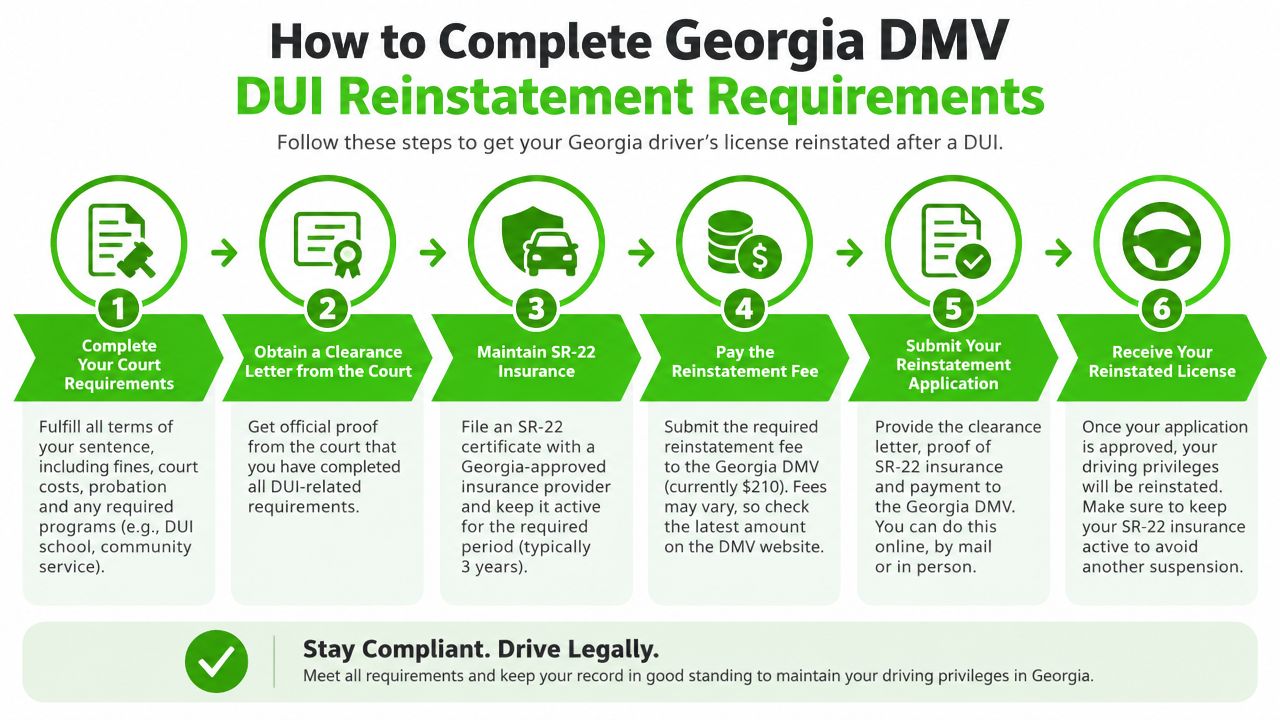
The order matters because each document supports the next decision. Begin with the course that DDS recognizes, preserve the completion evidence, identify any insurance filing, and then submit the required proof and payment through the channel DDS accepts.
Enroll in a DDS-approved DUI Alcohol or Drug Use Risk Reduction Program. Don't select a class solely because it appears first in a search result or has a convenient schedule. Verify that the school is certified for the program you need and that the format fits your case and any court instructions. Georgia DDS states that uncertified schools aren't accepted for DUI licensing, reinstatement, or court requirements.
A driver in Atlanta may choose an in-person classroom course near work or home. Someone in Athens may prefer a local classroom schedule, while a driver elsewhere in Georgia may need an online or live virtual option. The useful question isn't which format sounds easiest. It's whether the provider is certified, the completion record will be issued correctly, and the schedule allows you to finish without missing required sessions.
Protect the original certificate
After successful completion, obtain the original Certificate of Completion and check it for accurate identifying information. Georgia DDS court-reference materials specifically refer to submission of an original certificate when the court orders completion of the approved Risk Reduction Program. Don't leave the original in a glove compartment, send it without tracking, or assume a phone photograph will replace the required document.
Make a copy for your records, then store the original in a secure folder. Record the completion date, provider name, certificate details, and the delivery method you use. If a Customer Service Center accepts the document, request confirmation of submission. If you mail it to DDS in Conyers, use a delivery method that gives you proof it arrived and retain the receipt.
Address financial responsibility requirements
Ask DDS and your insurer whether your case requires proof of financial responsibility. The specific filing depends on the case and jurisdiction, so don't substitute one form for another based on advice from a friend or a generic online checklist.
California, for example, requires SR-22 proof for three years after full DUI reinstatement, while Florida uses an FR-44 filing for certain convictions after October 1, 2007. Florida's stated FR-44 coverage is $100,000/$300,000 for bodily injury and $50,000 for property damage, maintained for three years after reinstatement, with reinstatement-related fees that can range from $150 to $500 depending on subsequent violations. Florida's official process information should be used for Florida cases, not Georgia assumptions.
California also requires completion of the full suspension or restriction period, a DUI program, SR-22 proof for three years, and payment of reinstatement fees. California DMV's first-offender document illustrates why financial responsibility and administrative payment must be tracked separately from program completion.
Colorado uses another model. Its reinstatement sequence can include ignition interlock installation, SR-22 insurance, reinstatement-fee payment, and alcohol education or therapy enrollment. Colorado permits early reinstatement with interlock in some cases, but eligibility depends on offense type, the minimum restraint period, and approval status. Colorado DMV reinstatement information shows why a driver should follow the rules for the state that issued the suspension.
Submit proof and confirm clearance
Georgia DDS guidance identifies certificate submission and reinstatement payment as core components for a first DUI. Follow the instructions attached to your notice or provided by DDS, and don't drive until the record shows that your privilege is valid.
Use a simple completion log:
| Requirement | What to retain |
|---|---|
| Approved Risk Reduction course | Original Certificate of Completion and a copy |
| DDS submission | Delivery or Customer Service Center confirmation |
| Reinstatement payment | Receipt and transaction date |
| Insurance filing, if required | Insurer confirmation and filing details |
| Additional conditions | Court or DDS documentation showing completion |
The final check is just as important as enrollment. Confirm that every listed condition has been satisfied, rather than assuming DDS will contact you about a missing item. A single unresolved requirement can keep a license suspended after the period has ended.
Clinical Evaluations Treatment and Additional Requirements for Repeat Offenses
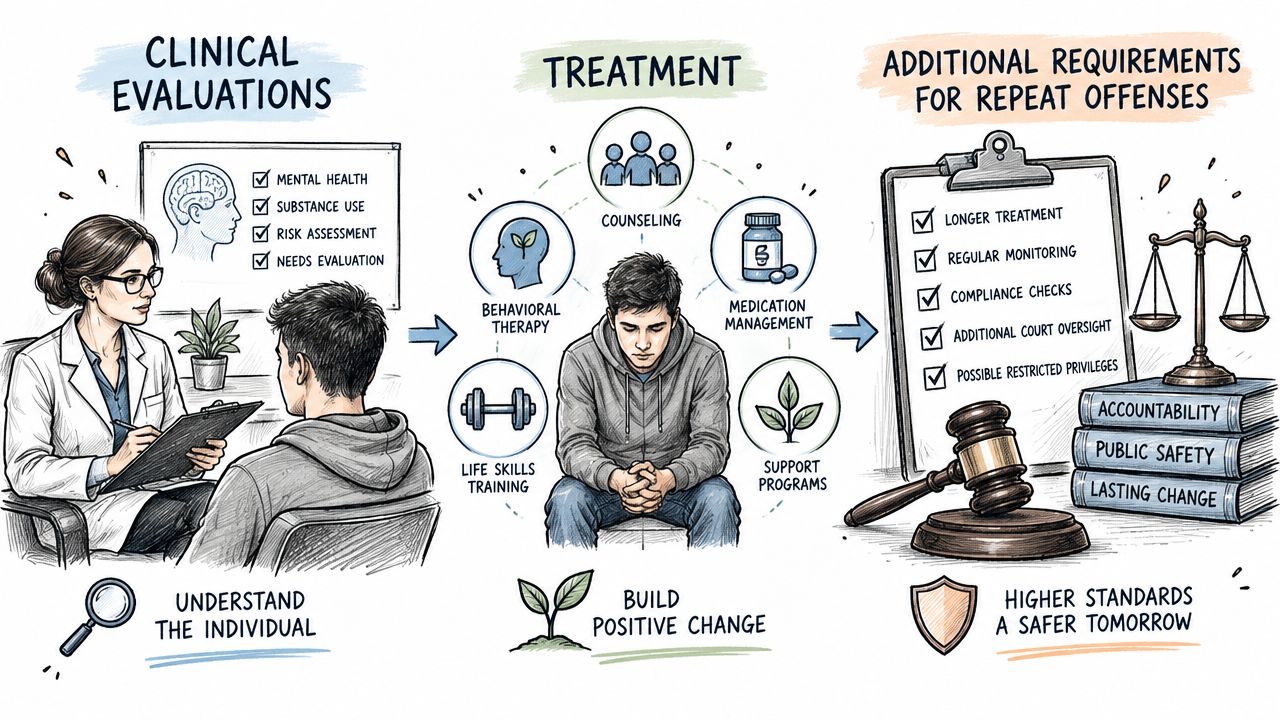
A first DUI and a repeat DUI require different reinstatement plans. For a first offense, the licensing work may focus on the suspension period, an approved Risk Reduction certificate, and the reinstatement payment. A driver with two or more DUI convictions within the past 10 years must also provide documented proof of a completed state-approved clinical evaluation. Georgia DDS identifies that evaluation requirement.
The evaluation does not automatically mean treatment is required. It determines whether additional services are recommended. Depending on the evaluator's findings and the applicable court or licensing order, the driver may need ASAM Level 1 services, a Victim Impact Panel, or other documentation. Complete the evaluation before deciding that treatment is unnecessary or enrolling in services that may not match the case.
Compare the two pathways carefully
For a first DUI, confirm that the provider is approved for the required Risk Reduction program, complete the course, protect the certificate, and satisfy the DDS payment and documentation instructions. Court obligations can still apply, but the licensing checklist is often more limited.
A repeat-offense case needs a clinical review before the driver assumes the Risk Reduction course is enough. The course may remain required, while DDS also expects proof of the evaluation. The court may add education, treatment, or panel conditions. Atlanta and Athens drivers should confirm that a local provider's credentials and documents match the order before scheduling services.
Use this sequence when the case requires each step:
- Risk Reduction education: Complete the program through a DDS-certified provider and retain the original certificate.
- Clinical evaluation: Schedule a review with a state-approved evaluator and obtain the documentation required for DDS or the case.
- Recommended treatment: Complete treatment if the evaluation, court, or licensing pathway requires it, then keep the completion records.
- Victim Impact Panel: Attend when ordered or required and retain proof of attendance.
- DDS submission: Send each document through the form or channel specified for the suspension.
- Final verification: Confirm that the driving record is clear before driving.
Don't confuse defensive driving with Risk Reduction
A defensive driving course serves a different purpose from the DUI Alcohol or Drug Use Risk Reduction Program. Georgia DDS allows a licensed resident to request a reduction of up to 7 points once every 5 years after completing a certified 6-hour Driver Improvement course. DDS requires the original certificate, which may be submitted in person at a Customer Service Center or mailed to DDS in Conyers. Georgia DDS explains the point-reduction process.
That course can address eligible points, but it does not replace a DUI Risk Reduction certificate when reinstatement requires one. Choosing the wrong class first can consume time and money without satisfying the suspension condition.
A certificate only helps when it proves completion of the program DDS and the court actually require.
Before enrolling, verify the provider's certification and the exact program name. Georgia DDS court materials state that an uncertified school's class will not be accepted for licensing, reinstatement, or court purposes. Drivers who need clinical services should confirm that the evaluation and treatment records meet the instructions attached to their case. A Georgia DUI clinical evaluation may form part of that repeat-offense pathway, but compare the service with the DDS and court requirements before proceeding.
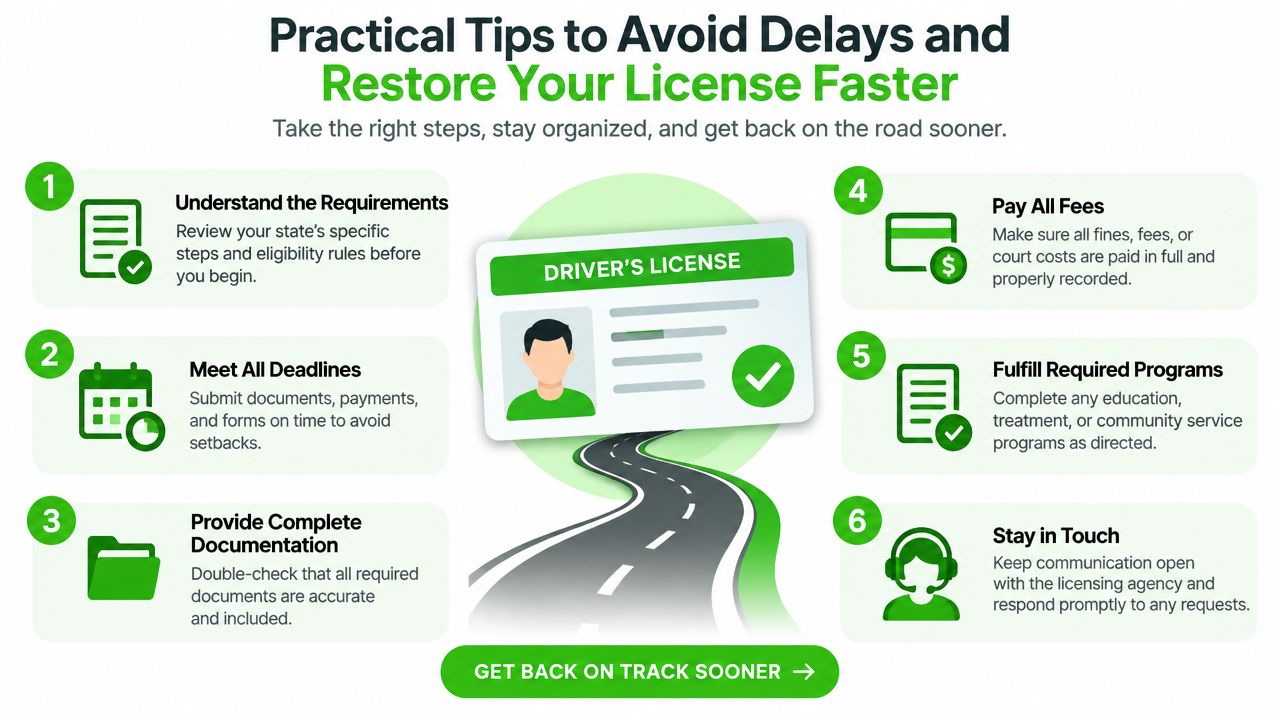
Practical Tips to Avoid Delays and Restore Your License Faster
Most delays come from incomplete execution, not from the existence of a complicated form. A driver completes the class but loses the original certificate. Another pays a fee but never files the required insurance proof. Someone else takes a defensive driving class when the case calls for Risk Reduction.
Use a case folder, whether paper or digital, with separate spaces for the suspension notice, court order, certificate, insurance filing, receipts, and DDS correspondence. Name scanned copies clearly and keep the original certificate protected. That system gives you evidence if DDS, an insurer, a probation officer, or the court asks for confirmation.
Remove avoidable friction
- Verify certification first: Confirm that the provider is DDS-certified for DUI Alcohol or Drug Use Risk Reduction before paying.
- Match the course to the requirement: Don't use a defensive driving certificate as a substitute for Risk Reduction.
- Protect original documents: Make copies, store the original safely, and keep delivery confirmation.
- Coordinate with your insurer: If DDS requires SR-22 or another filing, ask the insurer to confirm the filing was sent and accepted.
- Schedule around real life: Courses available on weekdays, weekends, or seven days a week can reduce the chance of missed sessions. Choose the format you can complete.
- Check before driving: A completed class isn't proof that every DDS hold has cleared. Verify the license status first.
A point-reduction course can be useful when you're eligible under DDS rules, but it should be treated as a separate tool. The correct priority is the requirement that blocks reinstatement, followed by any lawful point-management option that applies to your record.
Local access can make the process easier to manage. Drivers near Atlanta may want an in-person classroom close to work, while Athens drivers may prefer a local session or a virtual format that eliminates travel. Georgia DUI Schools offers instructor-led Risk Reduction and defensive driving options through 18 locations, along with online and live virtual formats, clinical evaluations, ASAM Level 1 treatment, and Victim Impact Panels. Those services should be evaluated against your DDS notice and court order, not selected because they're convenient.
The fastest lawful route is the route with no rejected certificate, missing filing, or unverified hold.
Get Back on the Road With Confidence
DMV DUI reinstatement in Georgia is complete only when the required conditions are satisfied and DDS has restored the driving privilege. Waiting out the suspension period doesn't replace the approved Risk Reduction course, the original Certificate of Completion, reinstatement payment, or any clinical, treatment, panel, insurance, interlock, or court requirement that applies to your case.
A first DUI for a driver age 21 or over involves the 120-day suspension framework, but the practical work should begin as soon as you understand the notice. Verify the record, choose a certified provider, complete the correct program, protect the original certificate, submit the evidence through the proper channel, and confirm clearance before driving.
Repeat offenses require closer document review because DDS requires documented proof of a completed state-approved clinical evaluation for two or more DUI convictions within the past 10 years. The right provider can help organize education and clinical services, but no provider can replace DDS verification or change the requirements in your order.
Georgia DUI Schools serves Atlanta, Athens, and surrounding Georgia communities through 18 locations, with online and live virtual options, seven-day scheduling, Risk Reduction courses, defensive driving, clinical evaluations, ASAM Level 1 treatment, and Victim Impact Panels. Select the option that matches your suspension and start gathering the documents you'll need for reinstatement.
Georgia DUI Schools can help you complete the DDS-approved Risk Reduction course and coordinate clinical services when your case requires more than education. Visit Georgia DUI Schools to choose an Atlanta, Athens, classroom, online, or live virtual option and begin your reinstatement plan.