

You've just left a Georgia courtroom, opened a DDS notice, or read a probation checklist that says clinical evaluation. You may already know about the Risk Reduction course, so it's easy to assume the evaluation is another version of DUI school. It isn't. Georgia treats the evaluation as a separate clinical step that can determine whether you need education, treatment, or a more structured level of care.
The fastest way to avoid confusion is to understand what the evaluator must do, what documents you need, what the report means, and which requirement comes next. The process is regulated, and missing paperwork or relying on an unqualified provider can create delays with the court, probation, or the Georgia Department of Driver Services.
What a Georgia DUI Clinical Evaluation Actually Is
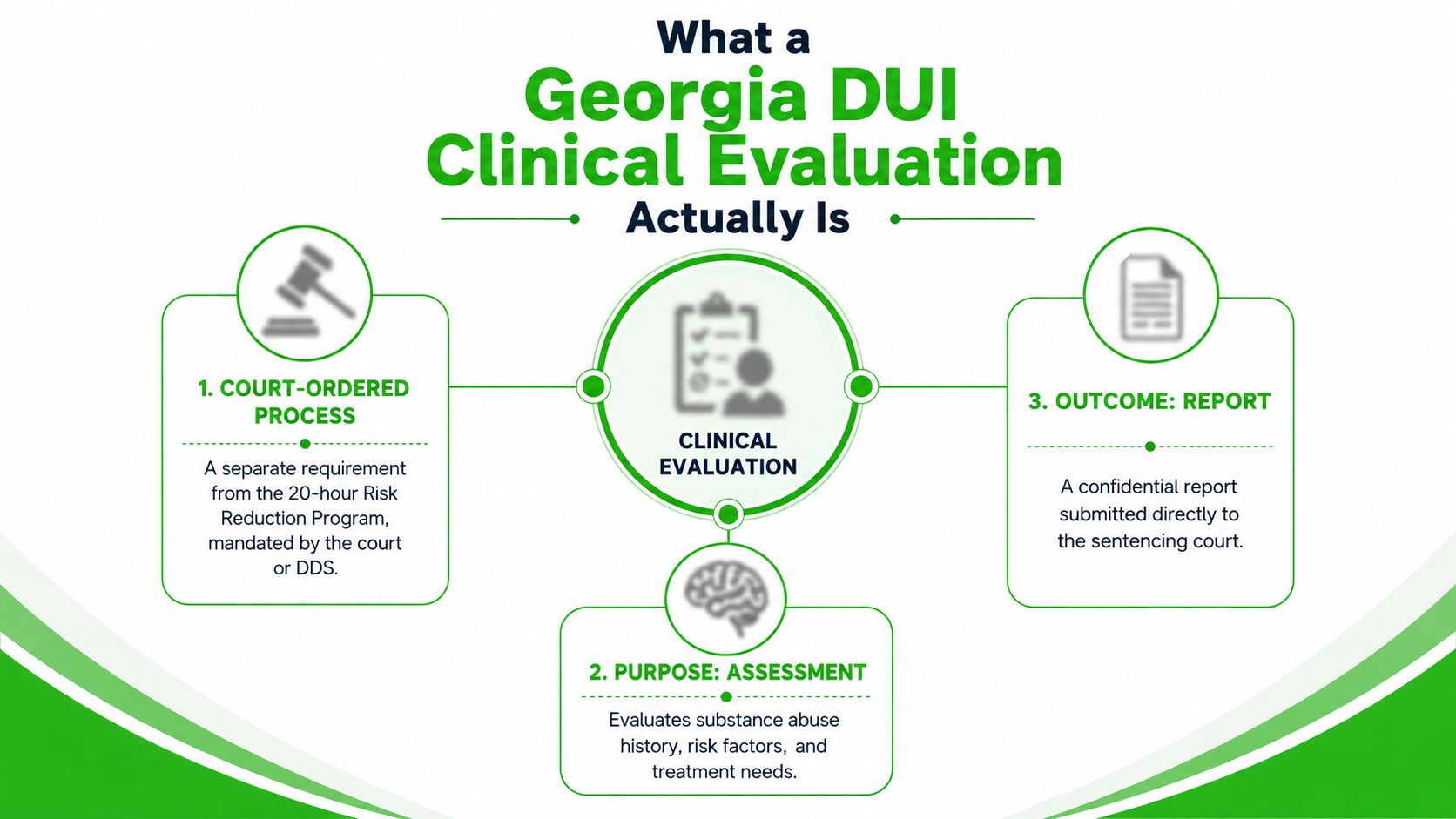
The court paperwork may use one short phrase, Georgia DUI clinical evaluation, but the appointment contains several required parts. The evaluator conducts a clinical interview, reviews a standardized screening instrument, examines your alcohol and drug history, and determines whether the information supports a substance-related diagnosis under current DSM criteria. The evaluator then recommends an appropriate ASAM level of service. Georgia's administrative rules require a written report within 7 days of the interview.
That report is the practical result you need to track. It records the evaluator's clinical findings and placement recommendation for the court, probation officer, or DDS. If treatment is recommended, the evaluator must also provide a list of approved treatment providers.
The evaluation operates separately from the Risk Reduction Program. Risk Reduction addresses impaired driving, alcohol and drug risk, and related education. Its assessment component uses a 130-question screening instrument, and the program fee is $95 set by law. DDS explains the standardized Risk Reduction pathway. Completing Risk Reduction does not replace a clinical evaluation when your court paperwork, probation terms, or DDS requirements call for one.
What the evaluator is deciding
The evaluator is not deciding guilt. The criminal case or administrative process addresses that question. The evaluation focuses on whether your alcohol or drug history supports a diagnosis, whether treatment fits your circumstances, and which treatment level matches the clinical findings.
Georgia's rules organize the recommendation into two broad pathways:
- Short-term treatment: You need no higher than ASAM Level I.
- Longer-term treatment: You require ASAM Level I or higher.
The evaluation is therefore an interview, screening review, diagnosis, placement decision, and report. Bring the order or referral paperwork, answer the questions directly, and confirm where the completed report will be sent. Treat the appointment as an official compliance requirement, not an informal counseling visit.
Who Is Required to Get a Clinical Evaluation
Georgia DUI clinical evaluations usually begin with paperwork from a court, probation officer, or the Department of Driver Services. The issuing authority determines why the evaluation is required and which deadline governs your case.
A court order is the most common trigger. A judge may require an evaluation in a plea agreement, sentencing order, probation condition, or another case directive. A probation officer can also request an updated evaluation when supervision terms call for current clinical information. Provide the evaluator with the latest order, even if you completed an evaluation in an earlier case. Confirm the report format and delivery instructions before the appointment.
DDS creates a separate pathway. A person seeking reinstatement after a suspension tied to two or more DUI convictions within 10 years must provide proof of a completed state-approved clinical evaluation. The evaluation then becomes part of the license-recovery process, alongside any other requirements stated by DDS.
Habitual violator status can impose more serious license consequences. Georgia defines a habitual violator as someone convicted three or more times within a five-year period for qualifying offenses, including DUI. State guidance describes a five-year license revocation, with driving limited to a person eligible for a probationary license or someone who receives a new DDS license after the revocation period. Review the Georgia's habitual violator guidance alongside your own order.
| Trigger | Who Orders It | When It Happens | What It Gates |
|---|---|---|---|
| Court or probation condition | Judge or probation officer | During the criminal case, sentencing, or supervision | Treatment compliance, probation reporting, or case resolution |
| DDS reinstatement requirement | Georgia DDS | Before eligible license reinstatement | Submission of proof for license recovery |
| Multiple DUI history | Court, probation, or DDS depending on the order | After qualifying convictions or during reinstatement | More restrictive license consequences and treatment documentation |
| Risk Reduction pathway | Certified program and applicable authority | As part of the required DUI program process | Completion of the state-regulated education requirement |
Georgia law permits a clinical evaluation after the assessment and intervention portions of a certified DUI Alcohol or Drug Use Risk Reduction Program. The evaluator must hold a license from the Georgia Department of Behavioral Health and Developmental Disabilities. Read the statutory requirements for certified evaluators. Check your referral carefully, because the required evaluation, report recipient, and deadline can vary by case.
Preparing for Your Evaluation Day
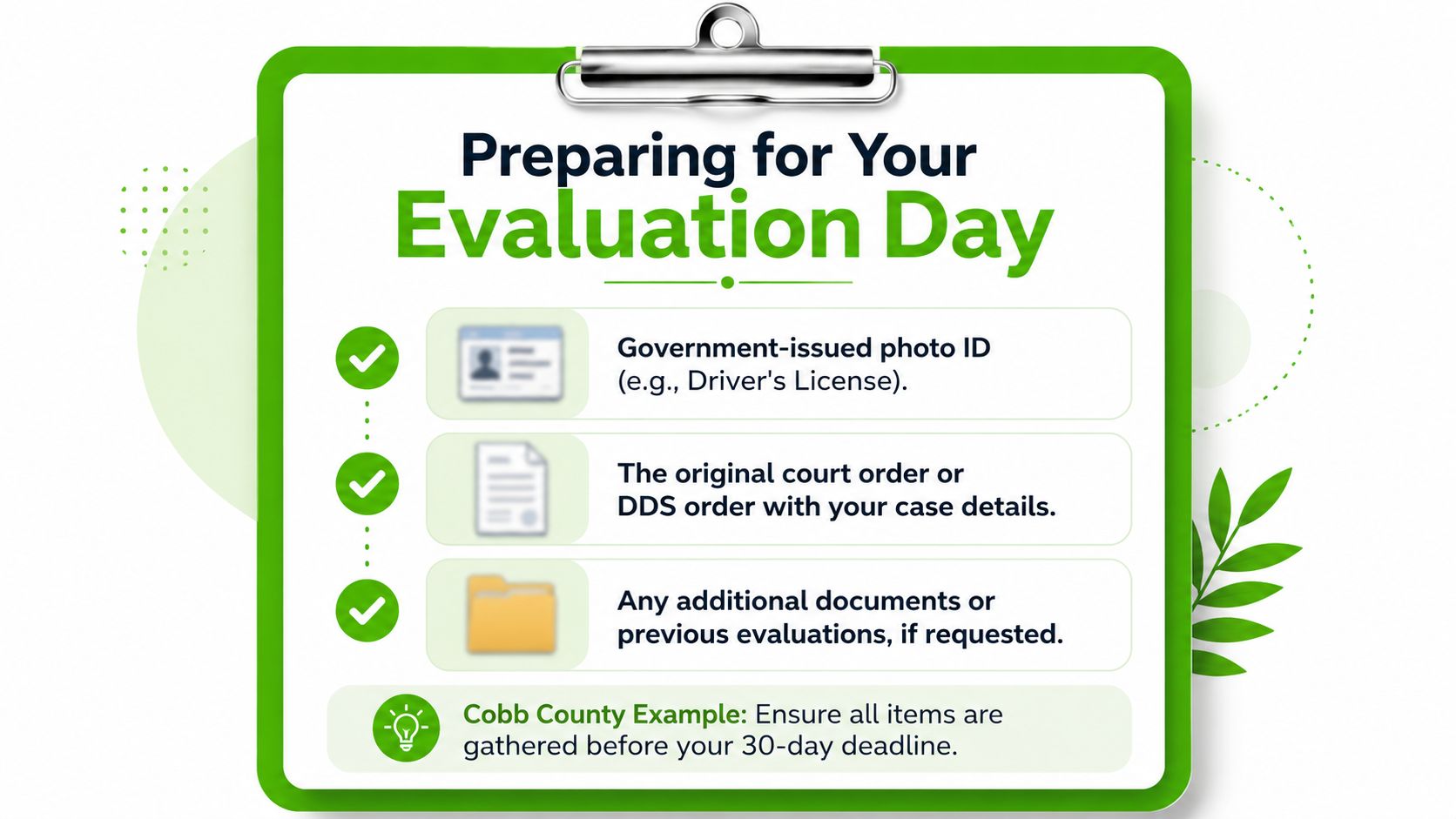
Suppose you're in Cobb County and your judge gives you a written order with a 30-day deadline. Don't wait for the deadline to become urgent. Start by confirming that the provider is approved for the type of evaluation your order requires, then ask how the completed report will be delivered.
Bring a government photo ID and the court or DDS order. Add any driving or criminal history documents you have, a current medication list, an insurance card if you plan to ask about coverage, and the required payment. If the evaluator requests prior treatment records or an earlier assessment, bring those too. Missing the order is especially avoidable, and it can force staff to stop the intake while they verify the referral.
What the appointment feels like
Most appointments begin with an identity check, forms, releases, and payment arrangements. You may meet in a private office with a desk, or use an approved telehealth platform when remote completion is allowed for your situation. The evaluator will ask about alcohol and drug history, family background, mental health, trauma, medications, driving history, and the legal circumstances connected to the referral.
The screening instrument is usually completed separately from the conversation. Georgia DDS identifies the assessment component used in the Risk Reduction Program as a 130-question instrument. Answer every item as accurately as you can, and don't try to guess which answer produces the easiest recommendation.
- Bring the order: The evaluator needs the exact referral language and deadline.
- Bring medication information: Include prescriptions and other medications you currently take.
- Bring supporting records: Prior evaluations or treatment documents can provide useful context.
- Plan for privacy: Choose a quiet location if an approved remote appointment is permitted.
- Be honest: The point is accurate diagnosis and placement, not rehearsed answers.
The best preparation is practical, not strategic. If you want more detail on how to approach the questions, review this guide to passing a drug and alcohol evaluation in Georgia, but don't treat it as a script. The evaluator needs your real history.
The Evaluation Process From Scheduling to Report
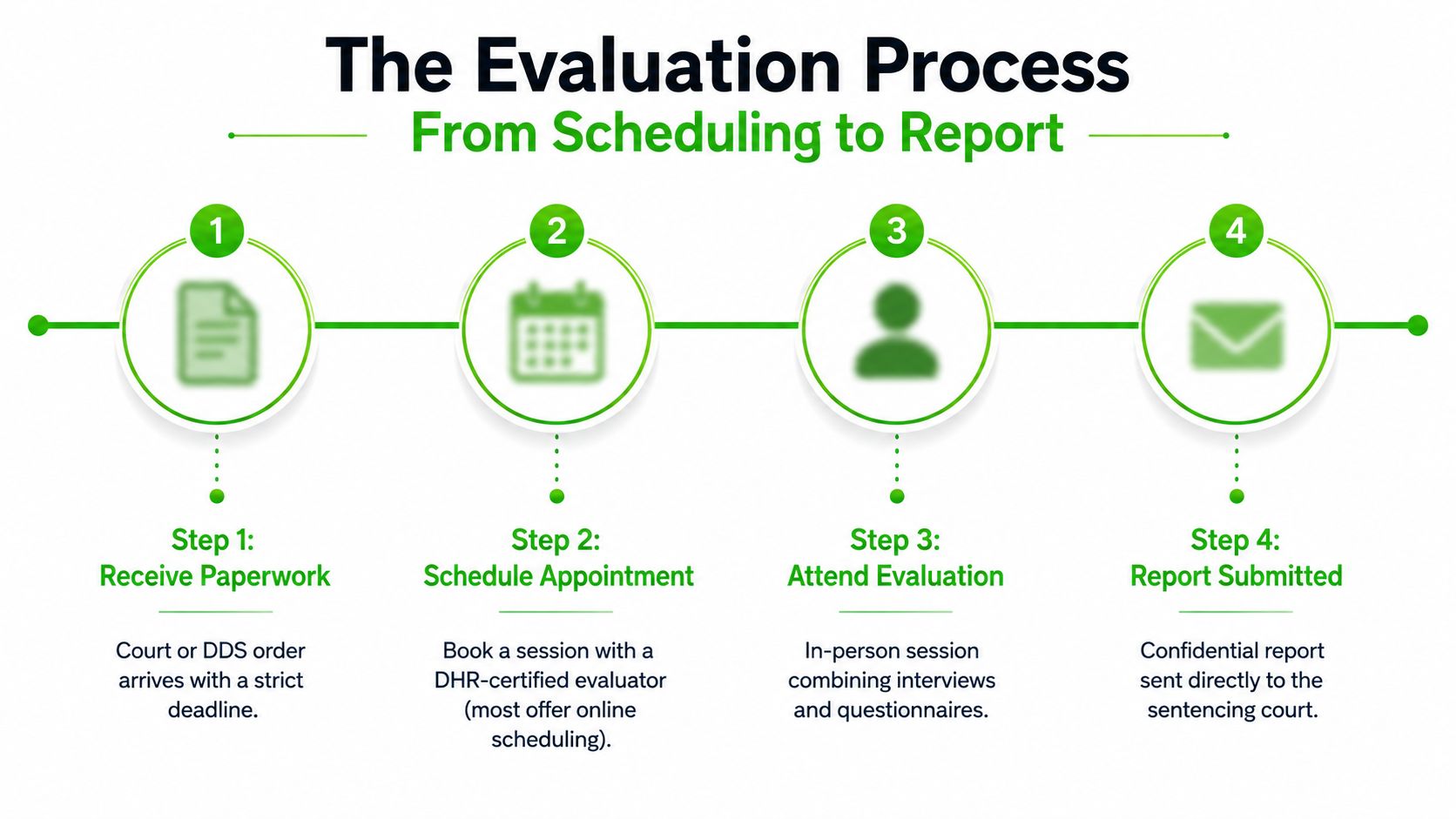
Once you receive the court or DDS paperwork, start with the deadline. Contact a qualified evaluator, provide the exact referral language, and ask whether the office can complete every required part in time: the clinical interview, 130-question instrument, DSM-based diagnosis, ASAM placement recommendation, and written report. Do not book first and explain the order later.
At intake, the provider verifies your identity, reviews referral documents, collects releases, and confirms payment arrangements. The clinical interview then examines the information a questionnaire cannot fully capture, including prior treatment, family history, mental health, medications, and the circumstances surrounding the DUI. Your answers should remain consistent across the interview and screening.
Why the sequence matters
The evaluation has several connected steps, and skipping one can delay the report or produce an incomplete picture.
- Read the referral: Confirm who ordered the evaluation, what must be submitted, and the deadline.
- Verify the provider: Confirm the evaluator has the required Georgia qualifications and approval.
- Schedule promptly: Send the order before the appointment so the office can follow the correct requirements.
- Complete both parts: Attend the interview and finish the screening instrument carefully.
- Confirm delivery: Ask whether the report goes to the court, probation, DDS, or multiple recipients.
Georgia requires the written report within 7 days of the interview. The governing rule makes that interview date significant, but scheduling at the last possible moment is a bad plan. Missing records, unsigned releases, or questions from the referring authority can slow completion.
Tell the evaluator about earlier DUI matters, treatment, and relevant mental health history. Embarrassment is not a reason to leave out information. Incomplete or conflicting answers can make the report less useful and lead to a recommendation that does not fit your circumstances.
Law offices managing several deadlines may also use a virtual assistant for law firm case evaluation to track documents and appointments. That administrative support does not replace your duty to attend, answer accurately, and provide requested records.
Reading Your Evaluation Report and ASAM Recommendation
Your report should answer four practical questions. Who are you, what does the clinical information support, what risks or needs did the evaluator identify, and what level of service should you receive?
Look first for identifying information and referral details. Check your name, case information, date of interview, and the authority that requested the evaluation. Then review the substance-related diagnosis, including whether the evaluator diagnosed or ruled out a disorder under current DSM criteria. The report may also discuss severity and risk factors such as prior consequences, treatment history, mental health concerns, family history, or patterns connected to alcohol or drug use.
The ASAM recommendation translates the clinical findings into a treatment setting. The label isn't a punishment. It describes the intensity of support the evaluator believes is appropriate.
| ASAM Level | Typical Setting | Weekly Hours | Approx. Program Length |
|---|---|---|---|
| Level 0.5 | Early intervention or education-focused service | Varies by provider and order | Varies by individual recommendation |
| Level 1 | Outpatient treatment | Set by the treatment provider and order | Often structured over a sustained outpatient track |
| Level 2.1 | Intensive outpatient treatment | More frequent contact than Level 1 | Depends on clinical needs and provider schedule |
| Level 2.5 | Partial hospitalization | Highly structured daytime care | Depends on clinical needs and program design |
Don't rely on a generic chart to determine your obligation. The evaluator's written recommendation and the receiving program's schedule control the actual attendance requirements. A Level 1 recommendation can involve group and individual sessions over a sustained outpatient period, while a higher level may require substantially more contact and structure. Georgia DUI Schools' explanation of ASAM treatment levels can help you understand the terminology before you enroll.
The report drives the next decision
If treatment is recommended, Georgia rules require the evaluator to distinguish between short-term treatment for someone needing no higher than Level I and longer-term treatment for someone requiring Level I or higher. The report should also lead you to an approved provider list.
Read the recommendation before registering for a class. A Risk Reduction certificate won't prove completion of clinical treatment when the report calls for ASAM services. Your report is the prescription for the next compliance step, so keep a copy and confirm where the original must be sent.
Costs, Fees, and Payment Realities in Georgia
Cost questions are reasonable, but don't choose a provider on price alone. The first issue is whether the evaluator is qualified and whether the report will satisfy the court, probation officer, or DDS. A low fee doesn't help if the report lacks the required elements or arrives after your deadline.
Georgia DDS sets the Risk Reduction Program fee at $95 by law. The DDS DUI FAQ distinguishes that regulated program fee from the separate clinical evaluation process. Evaluation pricing can vary by provider, location, documentation needs, and whether additional administrative work is requested, so ask for a written fee agreement before scheduling.
Common payment arrangements include full payment at intake, a split payment connected to the appointment and report, or limited financial-assistance options at some certified clinics. Insurance questions also need a direct answer from the provider and your plan. Court-related services may be handled differently from ordinary medical treatment, and coverage cannot be assumed.
| Scenario | Typical Fee Range | Common Add-Ons |
|---|---|---|
| First-offense adult referral | Provider-specific | Extra document copies or report delivery |
| Underage referral | Provider-specific | Additional referral paperwork if required |
| Habitual violator matter | Provider-specific | More records, coordination, or treatment planning |
| Out-of-state referral handled in Georgia | Provider-specific | Special court format or delivery instructions |
Ask these questions before paying
- Approval: Is the evaluator qualified under Georgia requirements?
- Scope: Does the appointment include the interview, standardized screening review, diagnosis, and ASAM recommendation?
- Deadline: Can the written report be completed within the time required by the order?
- Delivery: Who receives the report, and do I receive a copy?
- Add-ons: Are attorney copies, rush handling, records review, or additional forms charged separately?
- Payment: Is payment due in full, or is a split arrangement available?
Keep receipts and confirmation emails with your court paperwork. A clean record of scheduling, attendance, payment, and report delivery makes it easier to answer questions if a clerk, probation officer, or DDS representative says something is missing.
Next Steps After the Evaluation Is Complete
The report is not the finish line. It tells you what to do next, and you should follow the recommendation rather than enrolling in a convenient program that doesn't match the assigned level.
If the evaluator recommends ASAM Level I, contact an approved treatment provider and ask for the earliest available intake. If the recommendation is higher, ask the provider to explain the schedule, attendance rules, documentation, and completion standard before you commit. Georgia rules require the evaluator to give a list of approved treatment providers when treatment is recommended, so use that list as your starting point.
Keep the requirements separate:
- Clinical evaluation: Determines diagnosis and recommended level of care.
- ASAM treatment: Addresses the treatment recommendation in the report.
- Risk Reduction Program: Provides the state-regulated DUI education component.
- Victim Impact Panel: Satisfies a separate requirement when ordered by the court or required by the case.
- Completion documents: Prove that each required step was finished.
A Cobb County example might look like this. You receive the order, complete the evaluation, enroll in the recommended treatment, attend the Victim Impact Panel if required, complete the Risk Reduction Program, collect the treatment completion letter and certificates, and file the required documents with the court. You then submit the appropriate proof to DDS and follow its reinstatement instructions.
Do not assume the court automatically sends everything to DDS. Ask the clerk, probation officer, treatment provider, and DDS which documents each office needs and whether delivery must come directly from the provider. Georgia requires proof of a completed state-approved clinical evaluation for certain reinstatement applications, including suspensions tied to two or more DUI convictions within 10 years. DDS lists that reinstatement requirement.
A law office managing many client deadlines may also use a hire legal receptionist service to organize calls and appointment follow-up, but administrative support doesn't replace your attendance or compliance. For a separate court-required assessment pathway that may appear in employment-related matters, review the SAP program information. For your DUI case, rely on the exact order and the evaluator's ASAM recommendation.
Use a checklist, save every completion letter, and request confirmation when documents reach the court or DDS. If the report recommends treatment, start that enrollment promptly. Delaying the next step is the most common way a completed evaluation fails to move a case forward.
Georgia DUI Schools offers Georgia State and DHR-approved clinical evaluations, ASAM Level 1 treatment, Victim Impact Panels, and DDS-approved Risk Reduction courses through flexible options. If your paperwork requires a ga dui clinical evaluation or the treatment and education steps that follow it, visit Georgia DUI Schools to review available services and schedule the next appointment.