
A DDS-approved defensive driving class in Atlanta is a 6-hour Driver Improvement course that can reduce up to 7 license points once every 5 years and may qualify you for an insurance discount. That 5-year reset clock makes the class a one-shot intervention, so spend it deliberately rather than burning it on the first provider you find.
Maybe a speeding citation from I-285 is sitting on your passenger seat. Maybe a court order is clipped to your dash, or your insurer just sent a renewal notice that made you look twice at your record. Enrolling is the easy part. What decides the outcome is whether the court, the DDS, or your carrier accepts the certificate, and which paperwork each one expects.
Georgia's most recent fatality data shows speeding remains a leading factor in deadly crashes, which this guide examines below. Use the sections ahead to pick a certified course, submit the certificate where it counts, and protect your license status without preventable delays.
Why Atlanta Drivers Sign Up for a Defensive Driving Class
A defensive driving class is often prompted by a specific problem, not a general interest in road safety. Atlanta drivers usually start looking after a court order, points accumulating on a license, or pressure to discuss an insurance premium. Those situations overlap, but they are not interchangeable. A course accepted by a court may not automatically update your DDS record or secure an insurance discount.
Start with the reason you need the course
If a judge or court has ordered you to take Driver Improvement, check the order for deadlines and submission instructions before enrolling. Courts set their own requirements, so don't assume a certificate from any driving school will satisfy the order. Ask the clerk or your attorney which course is acceptable and whether the certificate must arrive before a hearing or another deadline.
If points are the concern, your goal is different: you need a DDS-certified course and must follow the process for requesting a point reduction. Taking a class without submitting the required documentation can leave your record unchanged. If your concern is a premium, call your insurer before booking. Course completion may qualify you for consideration, but the insurer's rules determine whether a discount applies.
Practical rule: Name the outcome you need before you pay. “I need a class” is not enough. Ask whether you need court compliance, reinstatement support, a point reduction, or an insurance discount.
A provider's certification matters more than a polished brochure. Georgia DDS warns that courses from uncertified schools won't be accepted for licensing, reinstatement, or court requirements (DDS information on certified regulated programs). Verify the specific course is approved, not merely that the school offers other DDS programs.
Drivers comparing how citations affect people in another state can also consult this guide for Florida drivers facing citations. For your Atlanta situation, though, follow Georgia DDS and the instructions from your own court or insurer.
How the Georgia DDS Defensive Driving Program Works
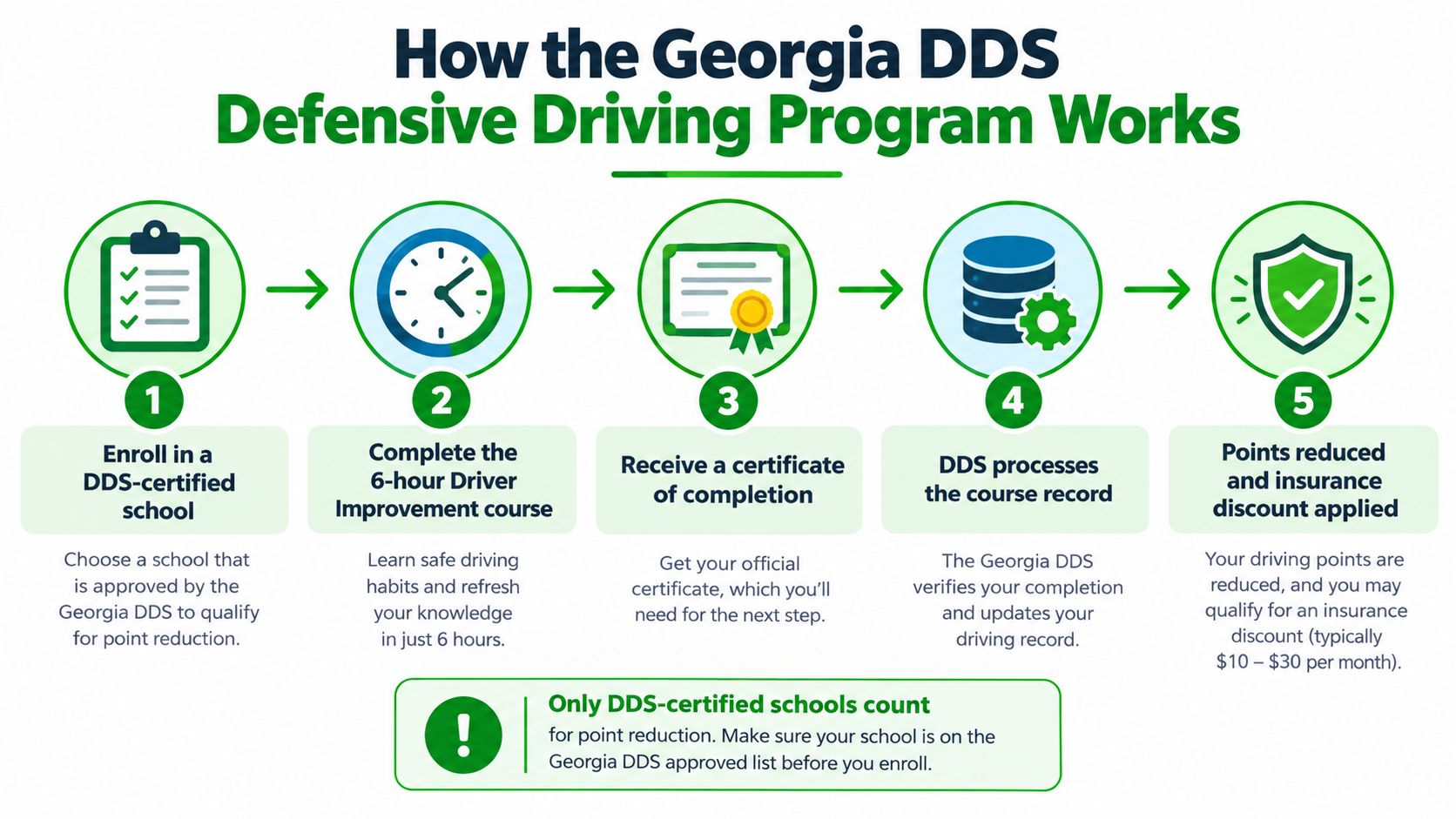
Georgia DDS defines defensive driving as a certified 6-hour Driver Improvement course. The point-reduction rule comes from O.C.G.A. § 40-5-86: an eligible licensed Georgia resident may request a reduction of up to 7 points once every 5 years (Georgia DDS defensive-driving FAQs). That five-year clock is the part drivers miss. Retaking the class next year earns you another certificate, not another reduction, so spend your one eligible request when it does the most good for your record.
Class completion and record changes are separate steps
Finishing the course gives you documented completion. Getting DDS to act on it is a second transaction you have to initiate yourself. To request the reduction, submit the original completion certificate to DDS and follow its procedure (DDS guidance on points and point reduction).
Keep the paperwork chain simple:
- Confirm the purpose. Ask the court, DDS, or insurer what it will accept.
- Verify certification. Check that the provider is DDS-certified for Driver Improvement.
- Complete the course. Make sure you receive the completion certificate.
- Send the original certificate where required. Keep a copy for your records, and confirm delivery and processing.
The difference between "attended," "completed," and "record updated" trips people up. A class can satisfy an educational requirement while a separate DDS request sits unfinished. Before you enroll, review the Georgia Driver Improvement course requirements and ask the provider how it issues documentation.
Treat the course as a one-shot intervention, then follow through on the paperwork. A possible insurance discount depends on your carrier's rules, and a point reduction happens only if you file the request while eligible. The class is what you buy. The result on your record is what you do next.
Online, Live Virtual, or In-Person Classroom
Atlanta drivers can choose among self-paced online study, live virtual instruction, and a traditional classroom. The practical choice depends on your schedule and how you learn, but court acceptance should be confirmed before choosing a format. A course's delivery method doesn't replace the requirement to use an approved provider or meet the particular court's instructions.
| Format | Schedule | Court accepted | Best for |
|---|---|---|---|
| Self-paced online | Work through lessons on your own schedule | Confirm with the court and provider | A busy professional who needs flexibility |
| Live virtual | Join an instructor-led online session at a set time | Confirm that the specific course meets the order | Drivers who want structure without traveling |
| In-person classroom | Attend at a scheduled location and time | Confirm that the specific course meets the order | Learners who prefer a classroom and fewer home distractions |
Match the class to your habits
Self-paced online learning can suit a Buckhead professional juggling work and family responsibilities. You can usually study at a time that fits your day, but flexibility requires discipline. If you tend to leave online tasks unfinished, a scheduled session may be a better choice.
Live virtual instruction gives you a set class time and access to an instructor without a commute. It can work well for a Georgia Tech student or another driver who wants more accountability than an independent online course provides. Check whether the session is instructor-led and whether the certificate will satisfy your specific requirement.
An in-person classroom removes the temptation to pause and return later. It also means planning around travel and the class schedule, whether you're coming from Midtown, Decatur, or farther across metro Atlanta. A parent who wants a clear start and finish, away from household screens and interruptions, may prefer this format.
Before you book: Ask the court or referring agency to confirm the course type and format it will accept. Don't rely on a general claim that a class is “court-approved” without checking your own case requirements.
What Atlanta Traffic Demands From Defensive Drivers
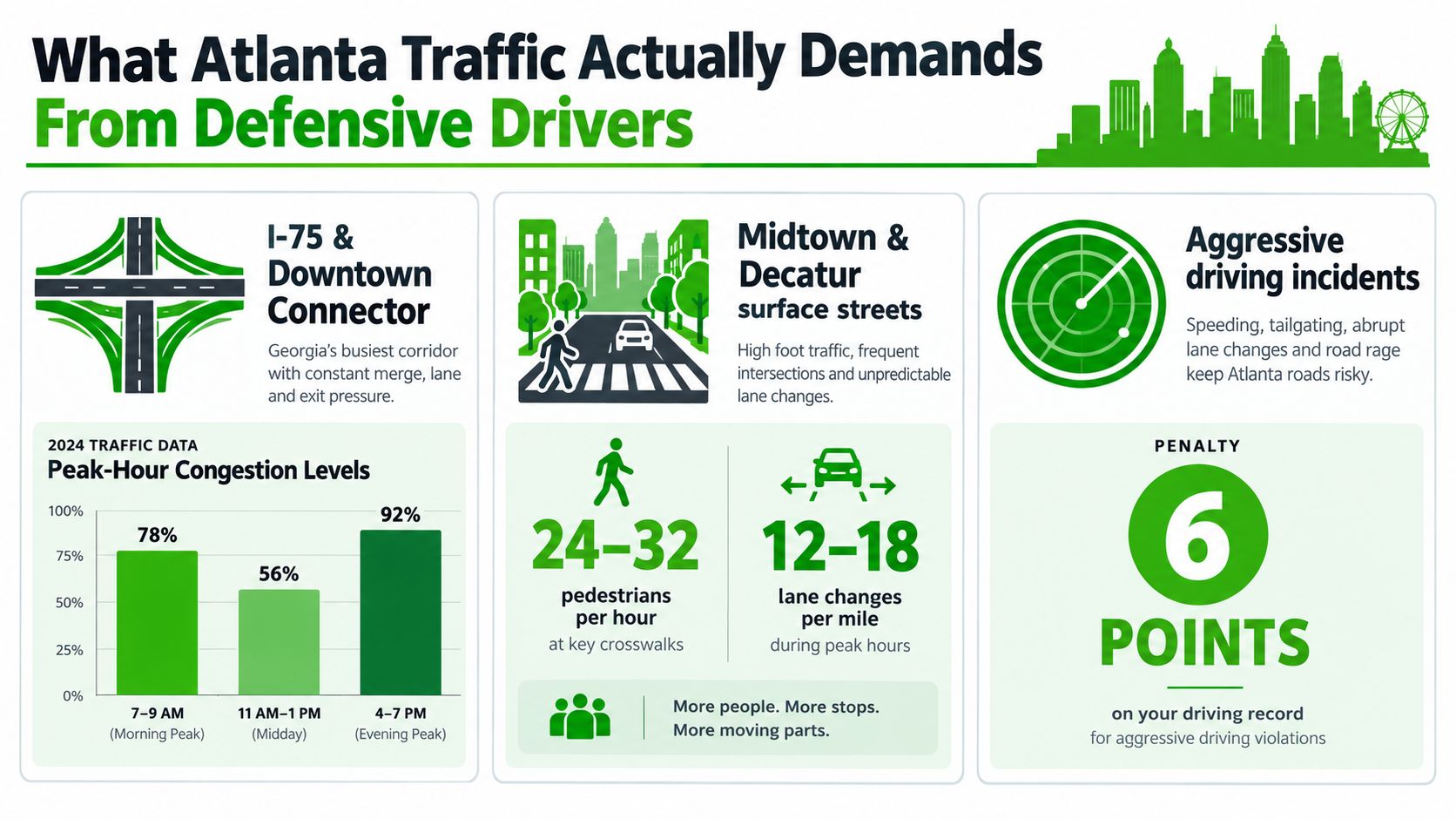
Atlanta roads punish passive drivers. On I-75 and the Downtown Connector, speed management matters most when traffic compresses, lanes merge, and drivers swerve to avoid missing an exit. On surface streets in Midtown and Decatur, you're watching for turning vehicles, pedestrians, cyclists, and traffic flow that shifts block by block.
Georgia's 2024 preliminary data recorded 339 fatalities associated with speeding, equal to 24% of all traffic deaths, compared with 22% in 2023 (Georgia's 2024 preliminary traffic-fatality data). Not every speeding driver causes a fatal crash. But speed keeps showing up as a serious risk factor, and that 24%-to-22% shift moved in the wrong direction. On crowded roads, choosing a speed that leaves room to react is the decision that matters.
Look for behaviors you can practice
Georgia's Department of Transportation says 81% of crash fatalities involve unsafe driving behaviors, including distraction, impairment, or driving too fast for conditions (Georgia DOT's Drive Alert Arrive Alive campaign). A worthwhile course goes past generic reminders and hands you concrete ways to manage risk after class. Ask for them by name:
- Manage speed in changing traffic. Ease off before a merge or slowdown instead of braking hard at the last moment.
- Leave a usable following distance. Give yourself room when stop-and-go traffic on I-75 suddenly tightens.
- Keep the phone out of reach. Set navigation before moving and stash it somewhere you won't grab it.
- Scan ahead and around you. Check mirrors and blind spots before changing lanes, especially near busy exits.
- Make deliberate choices. Don't drive impaired or push through fatigue when your attention is fading.
One more thing. DDS limits how often you can use this class for point relief, so treat it as a one-shot reset rather than a routine errand. A certificate is paperwork. Judge the class by whether you leave with habits you'll use on the Connector.
Point Reduction and the Path Back to a Clean Record
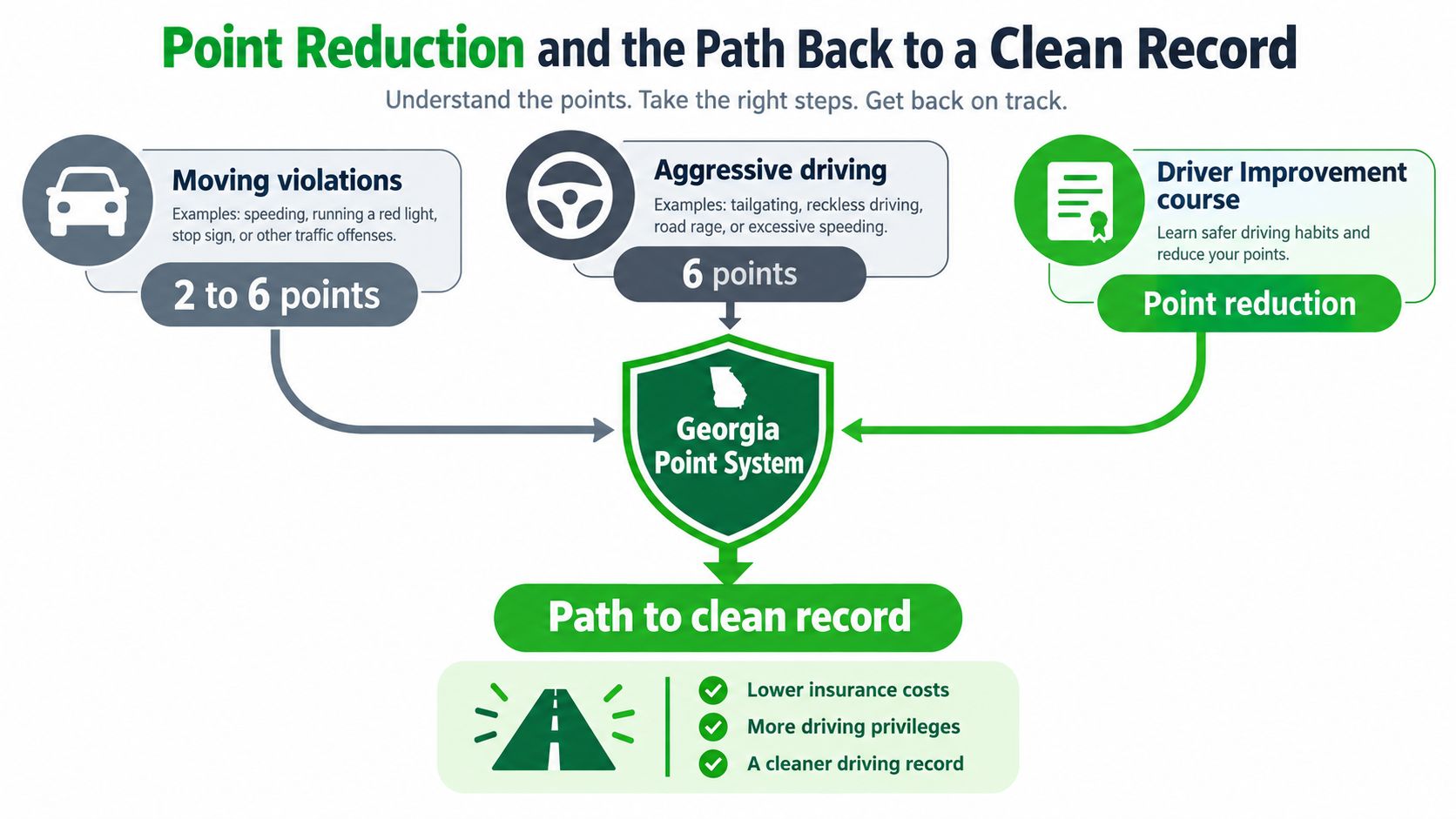
Say you're carrying 9 points from two violations and a recent citation. A certified course can remove up to 7 of them, leaving 2 on your record. That math is why timing matters. Individual moving violations can carry 2 to 6 points, and aggressive driving carries 6 points (Georgia DDS Driver's Manual). The reduction cannot push your balance below zero, so a driver with a small balance leaves part of the benefit unused.
Make the timing deliberate
DDS allows this reduction once every five years. Spend it on a nearly clean record and you've burned your reset for half a decade. Spend it when points are stacking toward suspension and the same certificate does real work.
Pull your driving record before you enroll. Confirm when you last received a reduction and what your current eligible balance is, then decide whether this is the moment to use your one shot. A driver sitting at 4 points gains little. A driver approaching the suspension threshold has a real reason to act now.
The payoff can also go beyond a lower balance. DDS says a certified course can support immediate reinstatement eligibility for certain first point suspensions for drivers age 21 and older (see the DDS Driver's Manual cited above). That outcome differs from a routine point-reduction request, and it comes with its own document requirements. Ask DDS which applies to your suspension instead of assuming the certificate fixes it.
Don't let "clean record" language blur three different questions: whether a court accepts the certificate, whether DDS can reinstate your license, and whether DDS will reduce points on your record.
For the administrative path, review these Georgia point reduction options and the steps for removing points from a Georgia driving record. Use them to build your question list, then confirm the answers with DDS or the court handling your case.
Insurance Discounts and What to Verify With Your Carrier
A DDS-certified Driver Improvement certificate can support a discount request. The carrier decides whether it pays. Under Georgia's insurance statute (O.C.G.A. § 33-9-42), insurers may reduce premiums for drivers who complete an approved course, and each company sets its own eligibility rules, discount size, and duration. Treat the certificate as a request the carrier can approve or deny, and get the terms before you count on any savings.
Call the insurer before you enroll. Ask a direct question: "Will a DDS-approved Driver Improvement certificate qualify me for a discount on my current policy, and what do you need from me to apply it?" Then get specific. Does the discount start at renewal or mid-term? Does your age, violation history, or policy type change the answer? How do they want the certificate submitted, and how many renewal cycles will they honor it? Write down the representative's name, the date, and any reference number they give you.
Timing matters here the same way it does with point reduction. If your policy renews soon, ask whether a completion dated before that renewal earns the discount sooner. Hold the certificate until you know exactly where it belongs and how the carrier wants it delivered.
Treat the course as a behavior intervention
Premium savings are the short-term return. Changed habits are the lasting one. The driver who grabs a phone at every red light can put it in the glove box before starting the engine. The driver who crowds bumpers on the Downtown Connector can pick a fixed roadside marker and rebuild following distance every time traffic bunches.
No insurer discounts commitment, and no course guarantees a crash-free record. The certificate proves you sat through the material. What you do afterward decides whether the class was a checkbox or a reset. For the mechanics of the discount itself, review this guide to using a defensive driving course to lower insurance, then verify every term with your own carrier.
Defensive Driving Is Not the Same as the DUI Risk Reduction Course
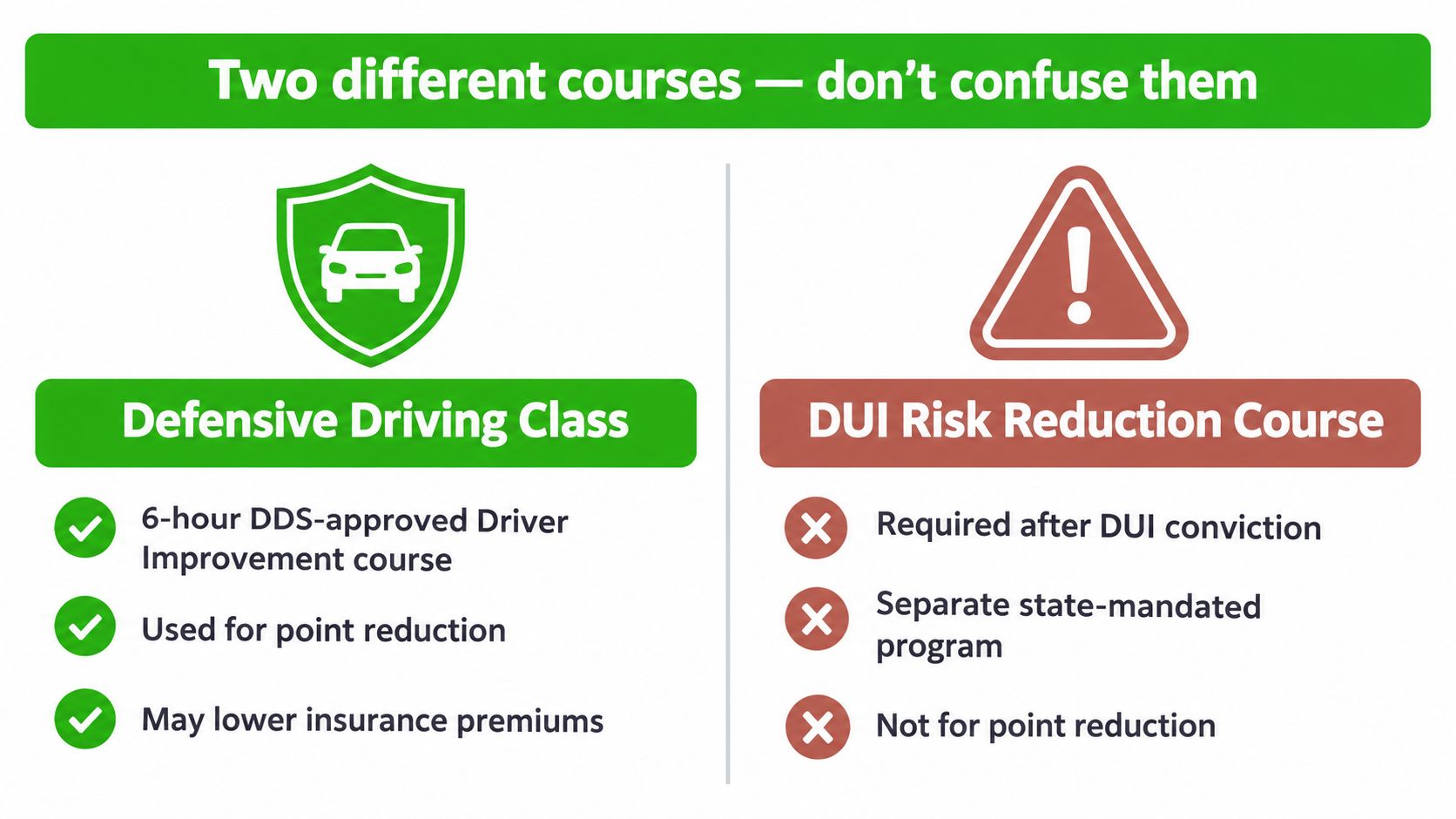
Confusing these two programs is the most expensive paperwork mistake Atlanta drivers make. A defensive driving class is a 6-hour Driver Improvement course used for point reduction, possible insurance-premium reduction, court orders, and personal education. The DUI Alcohol or Drug Use Risk Reduction program is a separate requirement for people convicted of DUI, illegal drug possession, Boating Under the Influence, or certain underage alcohol offenses involving a motor vehicle. That program has two required parts: a 130-question assessment and a 20-hour intervention delivered through multiple sessions that include group lessons, therapeutic education, and peer-group counseling (Georgia DDS DUI program FAQs). Both parts must be completed successfully before DDS issues the certificate.
Check the requirement before paying
No defensive driving certificate substitutes for Risk Reduction, and no Risk Reduction completion counts toward point reduction. Separate tracks, separate certificates.
Read the court paperwork, probation instructions, or DDS notice and identify the exact program named. If it says Driver Improvement, a defensive driving course is what you need. If it specifies DUI Alcohol or Drug Use Risk Reduction, enrolling in a standard defensive driving class will not satisfy the order, and you lose the fee plus the weeks you cannot get back.
Before paying, confirm the course name with the court or probation officer and verify the provider's DDS certification for that exact program. Schools often hold approval for more than one course type, but approval for one doesn't automatically establish approval for another. Ask which specific course each certification covers.
Booking the Right Class in Atlanta and Making It Count
Treat booking as a compliance decision, not a search-results decision. First, verify that the school is DDS-certified for the course you need. Next, match the format to your schedule, and ask the court, DDS, or insurer whether it accepts that specific course and delivery method.
Then settle the paperwork plan before class day. Find out whether the provider issues a certificate directly to you, whether DDS requires the original, and whether the court has its own filing deadline. Keep a copy and confirm that the intended agency received the document. These basic checks can prevent the common mistake of finishing a class but missing the separate submission required for your case.
Instructor qualifications also matter, especially when you're choosing a DUI or Risk Reduction program. Georgia requires those instructors to complete at least 32 hours of continuing education during each four-year period, including at least 16 hours of Department-designated refresher training (Georgia DDS instructor qualification rule). That's a useful indicator of ongoing oversight, though it doesn't replace checking certification for your specific course.
Georgia DUI Schools offers defensive driving in self-paced online, live virtual, and classroom formats, so Atlanta-area drivers can compare delivery options before booking. Make your next move a verification call: confirm the right course, the required format, and where your certificate must go.
Georgia DUI Schools offers DDS-approved defensive driving courses in online, live virtual, and classroom formats for drivers who need a compliant course and clear completion documentation. If you've confirmed that Driver Improvement is the course you need, visit Georgia DUI Schools and choose the format that fits your schedule.