
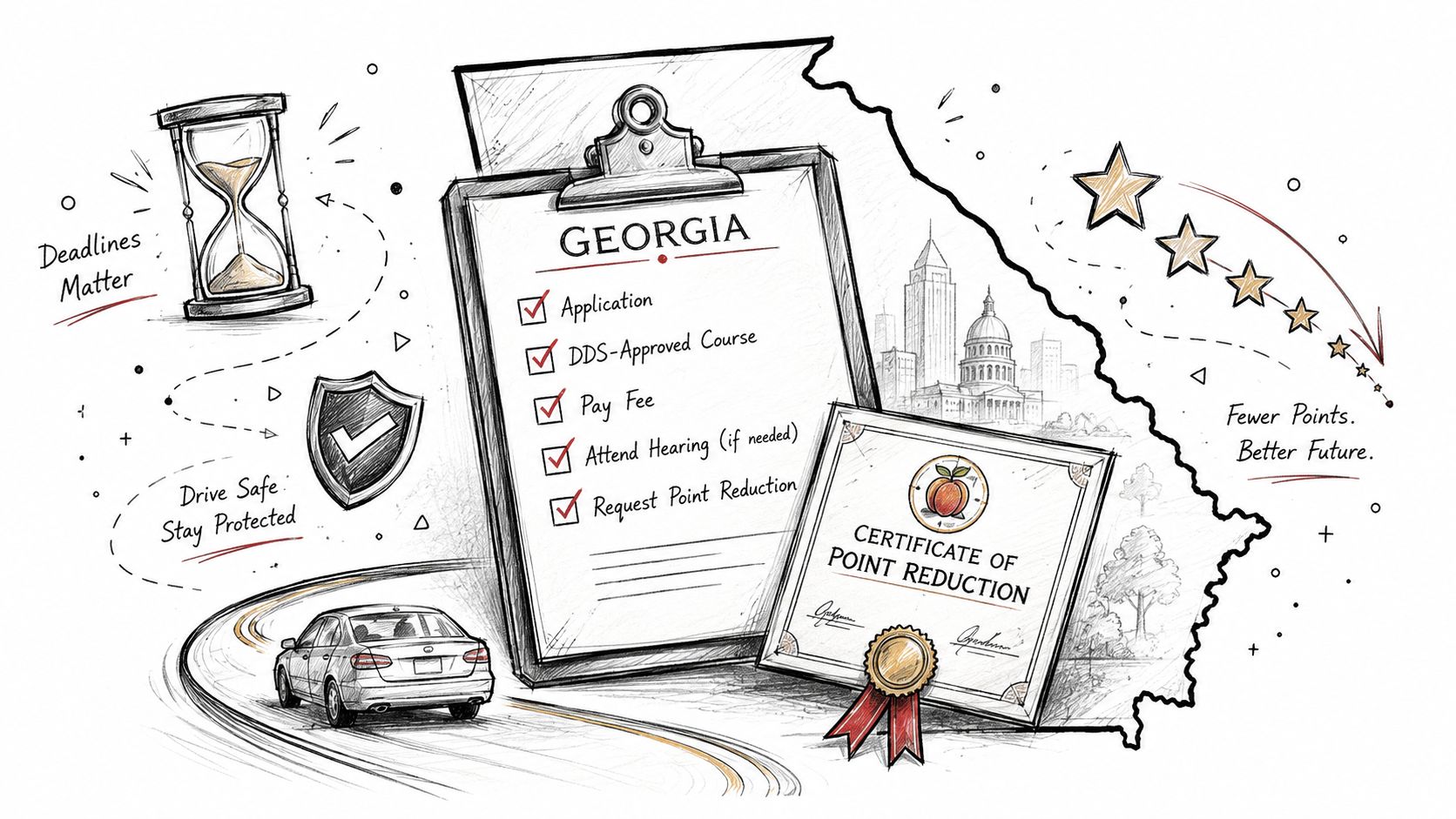
You open your mailbox after a traffic stop and find a notice from the Georgia Department of Driver Services, or DDS. Maybe a court letter says you must complete a driver improvement class. Maybe you're trying to lower points, protect your license, or restore driving privileges after a DUI. The confusing part is that defensive driving and DUI Risk Reduction are different programs, and completing the wrong one can leave a Georgia driver out of compliance.
Georgia's requirements depend on why you're taking the course, who ordered it, which agency needs proof, and what deadline applies. A voluntary point-reduction class isn't the same as a court-directed course, and neither should be confused with the DUI-related Risk Reduction Program. The right answer starts with identifying the exact requirement on your DDS notice, court order, or reinstatement checklist.
Understanding Georgia Defensive Driving Course Requirements
A Georgia driver can finish a course, receive a certificate, and still fail to meet the actual requirement. The common cause is choosing a Driver Improvement Course when the case calls for a DUI Risk Reduction Program, or assuming that a certificate accepted by one agency will satisfy another.
Georgia drivers often use “defensive driving,” “driver improvement,” and “DUI school” as if they were interchangeable. They are not. The Georgia Department of Driver Services generally uses Driver Improvement Course for the standard safety class. A DUI case involves a separate Risk Reduction Program, connected to DUI sentencing and reinstatement. DDS states that Risk Reduction includes both an assessment component and an intervention component, and both are required for a completion certificate (Georgia DDS DUI FAQs).
That difference can affect a traffic-court filing, a DDS transaction, or a reinstatement package. A moving-violation case may involve a Driver Improvement Course. A DUI-related suspension may require Risk Reduction instead. Completing the first course does not substitute for the second.
Start with the reason for enrollment
Consider two drivers in Macon. One received a citation and wants to know whether the court will accept a defensive driving certificate. The other is completing DUI reinstatement steps. Both might search for a “Georgia driving course,” but their compliance paths are different.
For a standard course, identify four details:
- Who ordered it: DDS, a court, or you voluntarily?
- What result is required: Point reduction, court consideration, insurance documentation, or reinstatement?
- Which provider is acceptable: Does the school have current Georgia approval?
- Where proof must go: DDS, the court, or another organization?
Georgia requirements do not automatically match those in Florida, Alabama, or another state. An online certificate that works elsewhere may not satisfy a Georgia court or DDS. Read the exact wording of the notice, then verify acceptance with the named agency. If the notice is unclear, use the Georgia DDS online services portal or contact DDS before enrolling and keep the confirmation with your records.
The basic compliance questions
Course format can affect scheduling, identity checks, and court acceptance. The instruction requirement still determines whether the course is complete. Alberta, for example, requires a minimum of 6 hours for both online and classroom defensive driving and includes an exam with 30 questions and an 80% passing score. That comparison shows why a driver should not assume every jurisdiction uses Georgia's standards (Alberta defensive driving requirements).
Before paying, confirm your eligibility, the accepted format, the required course, and the filing deadline. These checks address the main Georgia compliance gap: completing a legitimate course that solves a different legal or administrative problem.
Who Must Take a Defensive Driving Course in Georgia
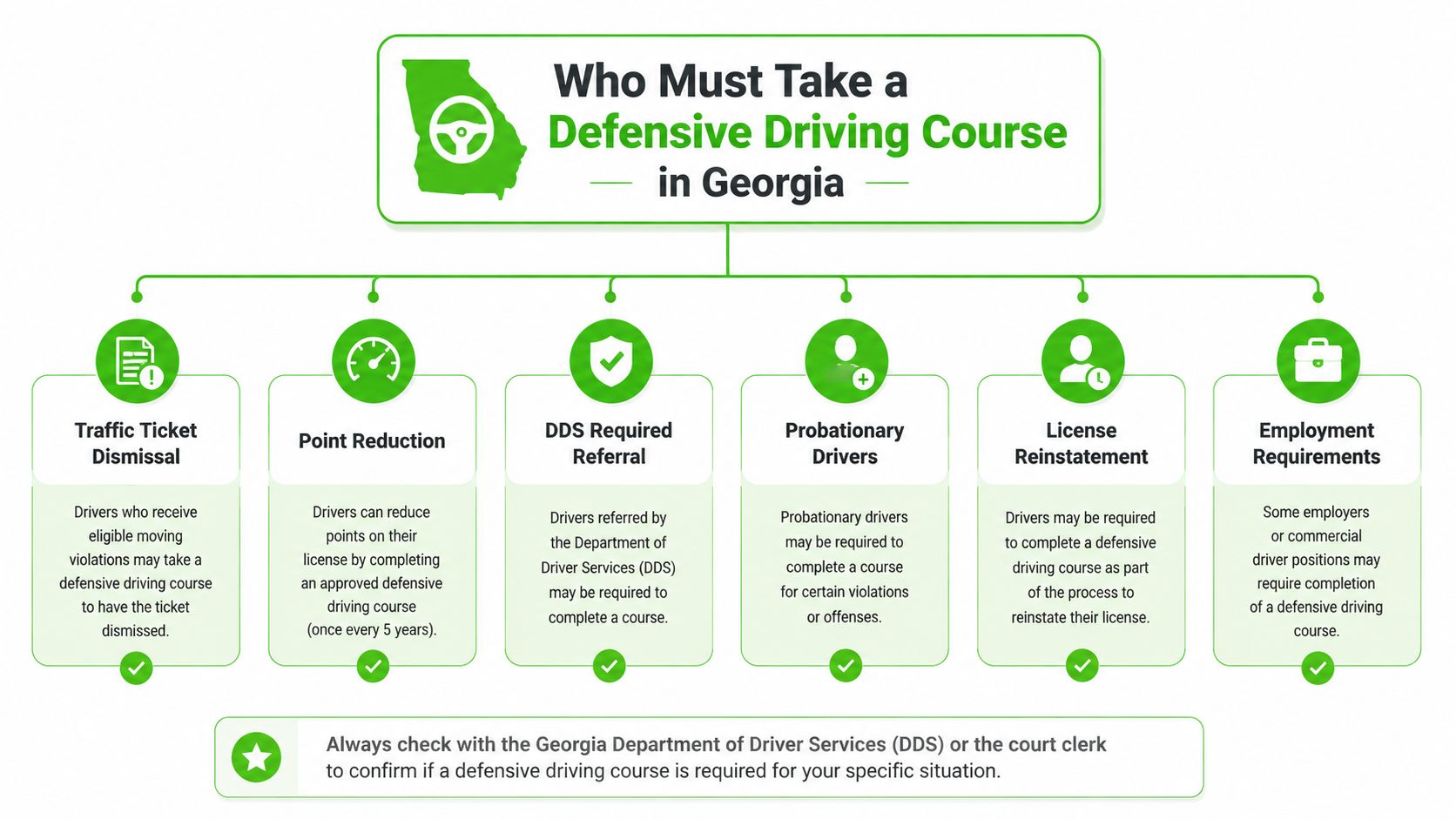
A Georgia driver may encounter a Driver Improvement Course requirement for several reasons, but the trigger determines what the course can accomplish. A judge may direct a driver to complete a class after a moving violation. DDS may require education in connection with a driving-record issue or reinstatement. Another driver may enroll voluntarily to pursue an available point-reduction benefit or ask an insurer about a possible discount.
The first step is to separate traffic-related driver improvement from DUI-related Risk Reduction.
Driver Improvement situations
A standard course may be relevant when:
- A court orders education: Some courts use a driver improvement course as part of a traffic-case resolution. The court handling the citation decides whether it will accept the course and what documentation it requires.
- Points create concern: Georgia law permits a licensed driver to reduce up to 7 points once every 5 years after completing a certified 6-hour Driver Improvement course and submitting the original certificate to DDS (Georgia DDS points and points reduction).
- Reinstatement instructions name driver improvement: A reinstatement checklist may require an approved driver improvement certificate as one item among several.
- Voluntary prevention: A driver may take the class before reaching a suspension problem, provided the intended use is allowed and the driver follows the submission process.
The course doesn't automatically dismiss a citation, eliminate every consequence, or guarantee an insurance change. The court and DDS control the outcome within their own systems.
Situations that need closer review
Drivers under 21 can face separate consequences for violations carrying points, so they shouldn't rely on the adult rules without checking the specific notice. Out-of-state drivers who receive a Georgia citation also need to follow the Georgia court's instructions, even if their license record is maintained elsewhere.
A habitual violator case is more serious than an ordinary traffic-ticket matter. Georgia law defines a habitual violator based on a third or subsequent qualifying conviction occurring within a five-year period measured from arrest dates (Georgia habitual violator statute). That status can trigger a statutory revocation process, not merely a routine traffic penalty.
The most important self-check is simple. If the paperwork mentions DUI, alcohol or drugs, Risk Reduction, clinical evaluation, treatment, or a victim impact panel, stop treating the matter as a regular defensive driving requirement. Contact the court or DDS and confirm the exact program before registering.
Approved Course Formats and Minimum Hours
Georgia drivers usually choose among in-person classroom instruction, live virtual instruction, and an approved online course for standard defensive driving education. The convenient format isn't automatically the compliant format. Approval comes first, then scheduling.
A classroom course gives you direct contact with an instructor and a fixed attendance structure. A live virtual class provides real-time instruction from a remote location, but it may still require attendance checks and uninterrupted participation. A self-paced online course can fit around work or family responsibilities, yet identity verification, pacing controls, and completion tracking still matter.
Compare the practical differences
| Format | Minimum Hours | Scheduling Flexibility | Identity Verification | Court Acceptance | Typical Cost Range |
|---|---|---|---|---|---|
| In-person classroom | 6 hours | Fixed sessions | In-person attendance | Confirm with court | Varies by provider |
| Live virtual classroom | 6 hours | Scheduled remote sessions | Provider attendance checks | Confirm with court | Varies by provider |
| Approved online course | 6 hours | More flexible access | Provider verification methods | Confirm with court | Varies by provider |
For the standard Driver Improvement Course, Georgia's required instruction time is 6 hours, and changing the delivery method doesn't turn a shorter class into an acceptable substitute. The provider must also be approved for the purpose you need. Georgia's regulatory approach in another jurisdiction shows why approval bodies may review course materials, instructor guides, student manuals, and final exams rather than accepting any course marketed as defensive driving (Alberta course approval document).
Practical rule: Ask the court or DDS whether it accepts your selected format before you pay.
The Risk Reduction Program is separate and has its own rules. Don't assume that a standard online Driver Improvement Course can replace a DUI program. If format is your main concern, review whether online defensive driving courses are legitimate and then confirm the provider's current approval and your court's acceptance.
Point Reduction and Insurance Discount Benefits
A driver may finish a defensive driving class expecting the points to disappear automatically. Georgia treats the course certificate more like a key that starts the DDS review process. It does not change the record until the required action is completed through DDS.
Under Georgia DDS guidance, a licensed driver may reduce up to 7 points once every 5 years by completing a certified 6-hour Driver Improvement course and submitting the original certificate. See the Georgia DDS points and points reduction guidance for the rule and eligibility details. Submission instructions are covered in Enrollment Steps and Filing Your Certificate, because the agency receiving the certificate and the required document format matter.
Point reduction also has a narrower effect than many drivers expect. It lowers the point count under the DDS process, but it does not erase the citation or rewrite the event that produced it. A court may accept a course for an eligible traffic matter, while another court may give different instructions. The course also does not guarantee a particular legal outcome.
Point reduction and insurance are separate decisions
Point reduction concerns the driving record. An insurance discount is a decision made under the driver's policy and the carrier's underwriting rules. Completing an approved class may support a discount review, but the driver must ask whether the carrier accepts that course and whether the policy qualifies.
An insurer may request practical proof such as a copy of the completion certificate, the policy number, and the course completion date. Some carriers may ask for different documentation or require the request within a particular policy process. Confirm those requirements before enrolling if insurance savings are the main goal. Georgia drivers can also review how using a defensive driving course may lower insurance costs before contacting their carrier.
| Benefit Type | Details | Limitations |
|---|---|---|
| Point reduction | Up to 7 points may be reduced once every 5 years through the certified course process | The reduction is not automatic, and the violation remains on the record |
| Court-related use | A court may accept a course for an eligible traffic matter | Acceptance depends on the court's instructions |
| Insurance consideration | A carrier may review completion documents for a possible discount | Discounts depend on the insurer and policy |
| Voluntary enrollment | A driver may enroll before a suspension problem develops | The course guarantees neither a legal nor an insurance result |
The compliance gap is usually simple: a driver completes the wrong program, uses a provider the court does not accept, or assumes a certificate serves both DDS and the insurer automatically. Standard Driver Improvement and DUI Risk Reduction programs are separate, so match the course to the requirement before paying.
Enrollment Steps and Filing Your Certificate
A driver can finish a class and still have a compliance problem. The usual cause is a mismatch between the program, the approving agency, and the document submitted. Before choosing a date, identify who requested proof and confirm that the provider offers the exact course required. “Georgia defensive driving” in an advertisement does not by itself prove that DDS or a court will accept it.
Follow the document trail
- Read the order or notice carefully. Look for terms such as Driver Improvement, point reduction, court submission, reinstatement, DUI, or Risk Reduction.
- Confirm the provider. Check current DDS approval, then ask whether the court accepts that provider and its delivery format.
- Register with accurate information. Your name and identifying details should match the records used by DDS or the court.
- Complete the entire course. Standard Driver Improvement requires 6 hours, as noted earlier in the discussion of Georgia's point-reduction process.
- Request the certificate. Ask when and how the provider issues the Georgia DDS completion document.
- Submit what the agency requires. Follow the instructions for DDS, the court, or both. Keep a clear copy or scan.
- Confirm delivery. Save mailing evidence, submission confirmations, and messages showing that the receiving agency got the certificate.
The course name matters. Standard Driver Improvement and DUI Risk Reduction are separate programs. A Driver Improvement certificate may address a traffic-court or point-related requirement, while a DUI matter may require Risk Reduction. Treating them as interchangeable is like bringing the right form to the wrong office. Check the order before paying.
Avoid preventable filing problems
Problems often appear after completion. A driver may use an unapproved online vendor, miss a court deadline, send a photocopy when an original is required, or assume the school filed the document automatically. A genuine certificate can still fail if it reaches the wrong office or arrives late.
If you are comparing delivery options, review online defensive driving course choices and ask how the provider handles identity checks, completion records, and certificates. Georgia agencies apply documentation standards, so treat the certificate with the same care required in other licensing systems. New York City's TLC requirements, for example, specify that a renewal certificate must be no more than 3 years old and identify the course type, date, instructional hours, instructor details, and official seal (New York City TLC defensive driving requirements). Georgia's process differs, but the practical lesson is the same: agencies review the document, not merely your statement that you attended.
Habitual Violator Rules and Reinstatement Requirements
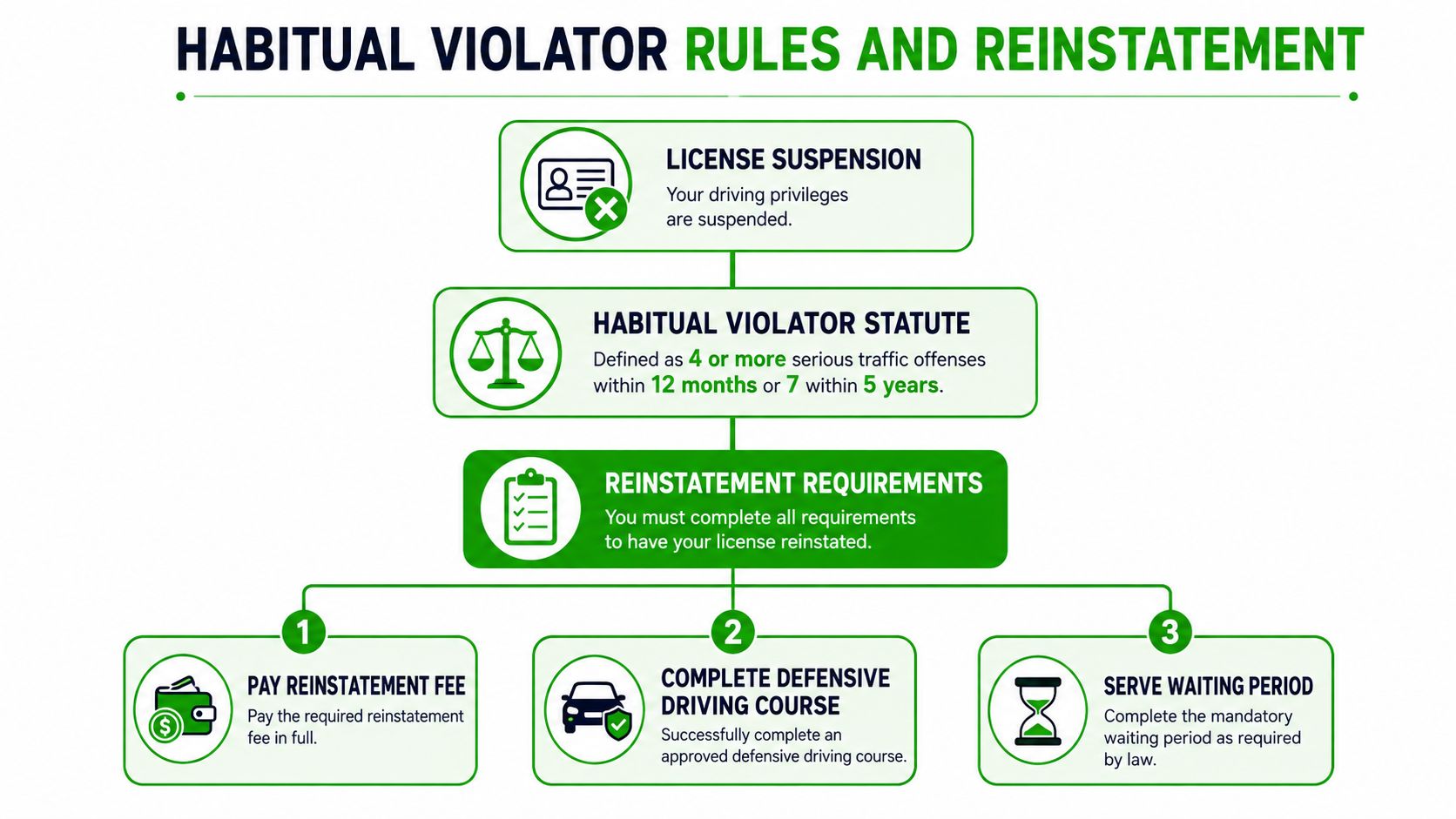
A habitual violator case changes the question from “Can I take a class?” to “Which conditions must I satisfy before DDS can restore driving privileges?” Georgia law treats a third or subsequent qualifying conviction occurring within five years, measured from arrest dates, as a habitual violator situation (Georgia habitual violator statute).
A Driver Improvement Course may appear in a reinstatement plan for a qualifying non-DUI offense, but it isn't a universal cure. It won't independently undo a revocation, replace a required DUI program, or authorize someone to drive before DDS restores the privilege.
Read the reinstatement checklist as a sequence
Georgia DDS lists multiple requirements for habitual violator reinstatement. The official DDS document identifies a five-year waiting period and distinguishes requirements based on whether the predicate offenses involved DUI. For non-DUI predicate offenses, approved driver improvement clinic certificates may be required. For DUI predicate offenses, the process can include:
- Risk Reduction completion: The DUI alcohol or drug use Risk Reduction program must be completed.
- Clinical evaluation and treatment: A clinical evaluation and treatment may be required if recommended.
- Ignition interlock proof: Documentation may be required when applicable.
- Testing: The driver must pass testing for the relevant license class.
- Payment: DDS identifies a reinstatement fee of $410, or $400 by mail, for revocations imposed on or after July 1, 2009 (Georgia DDS habitual violator reinstatement document).
The distinction between the six-hour Driver Improvement Course and DUI Risk Reduction is essential. A driver may need one, the other, or both, depending on the record and the court or DDS checklist. Treating them as interchangeable creates a paperwork gap at the exact point when reinstatement already requires careful coordination.
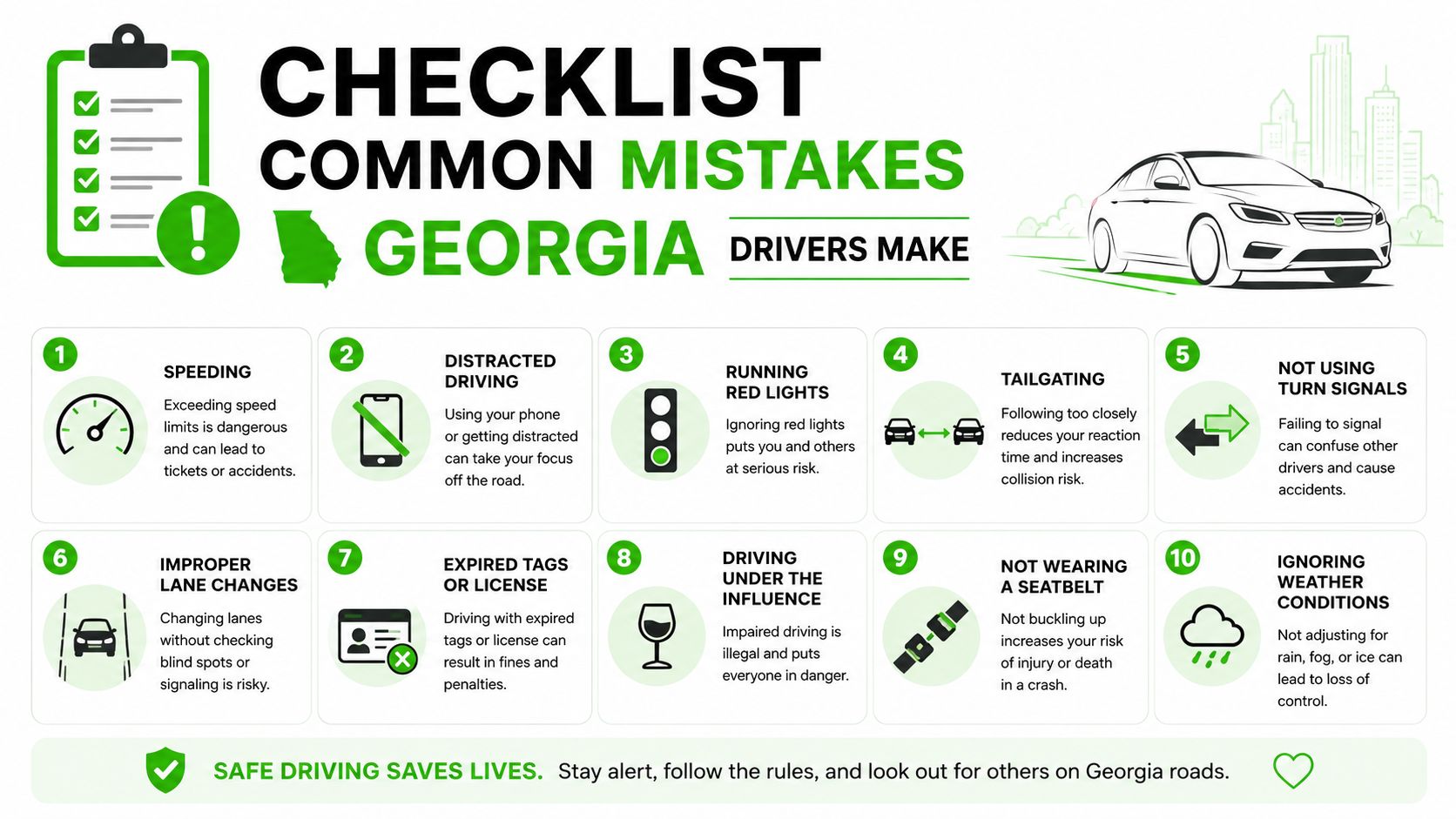
Common Mistakes Georgia Drivers Make
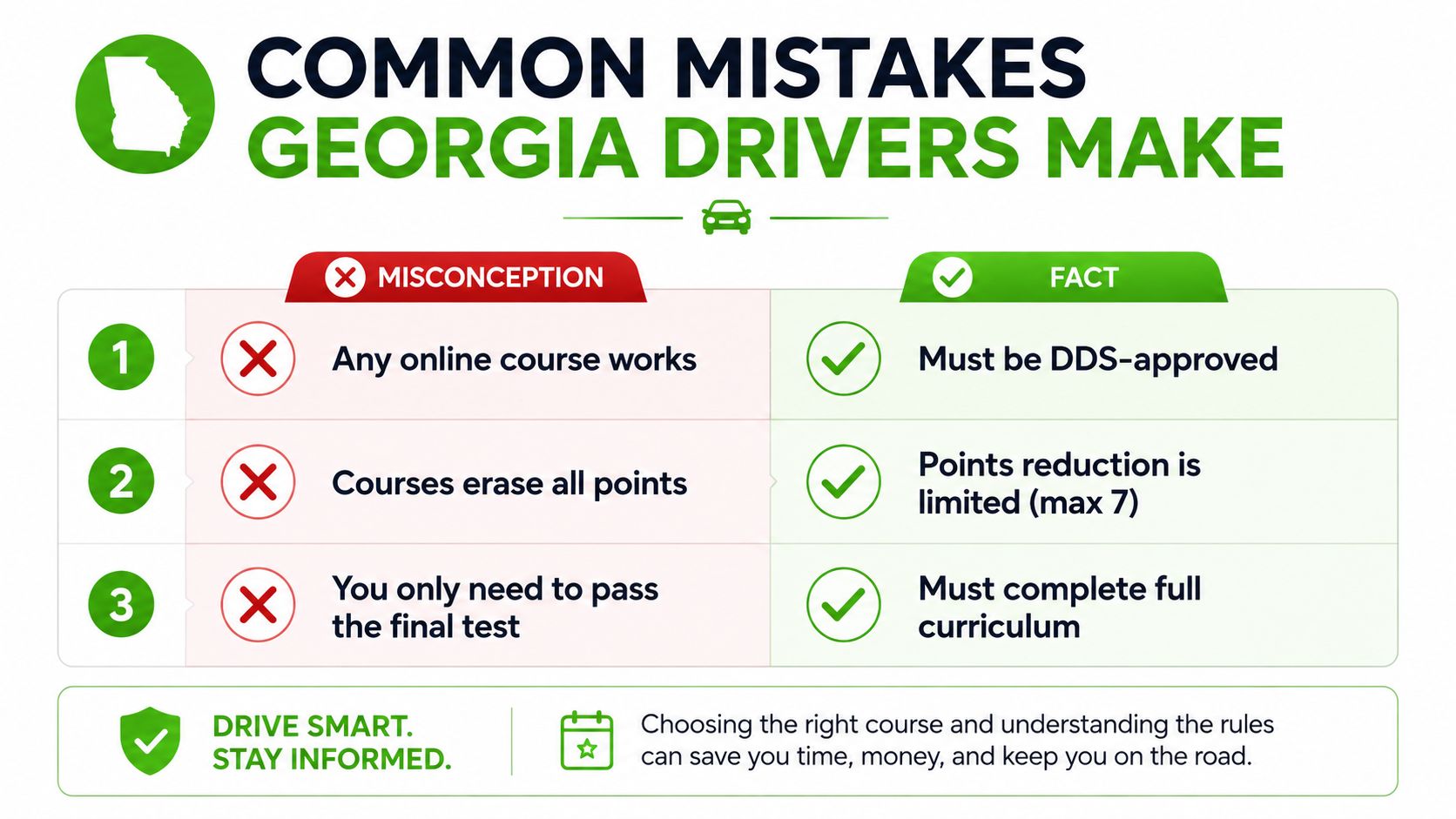
A driver receives a court notice naming a program, finds an online class labeled “defensive driving,” and enrolls without checking the details. That shortcut can leave the requirement unsatisfied. Georgia drivers should confirm that the provider is DDS-approved and that the court accepts the course format before paying.
Another mistake is treating point reduction as a reset of the driving record. The benefit is limited to up to 7 points once every 5 years, and the required certificate and request must still be submitted. The violation itself remains on the record. See Point Reduction and Insurance Discount Benefits above for the applicable process.
Mistakes to catch before a deadline
- Choosing Driver Improvement when the paperwork calls for DUI Risk Reduction, or assuming the two programs are interchangeable.
- Paying for an online format that the court or DDS will not accept.
- Leaving before completing required content, attendance checks, or identity verification.
- Assuming a certificate expires under the same rules used in a neighboring state. Confirm how long the document remains usable for the specific court or DDS requirement.
- Assuming an insurance discount applies without asking the carrier.
- Sending a certificate to the wrong agency or failing to keep delivery proof.
- Treating a standard course as sufficient for reinstatement when the checklist also names evaluation, treatment, testing, or ignition interlock documents.
Deadlines create another common gap. A court date, DDS appointment, and certificate-processing delay can overlap, so drivers should start early. If the paperwork mentions DUI, use the earlier explanation of the assessment and intervention components. Both components are required for a Risk Reduction completion certificate, as noted earlier.
Georgia DUI Schools offers DDS-approved defensive driving education online, live virtually, and in classrooms, plus DUI Risk Reduction and related services. Review Georgia DUI Schools, match the program to the DDS or court paperwork, and choose a format that fits the deadline.