
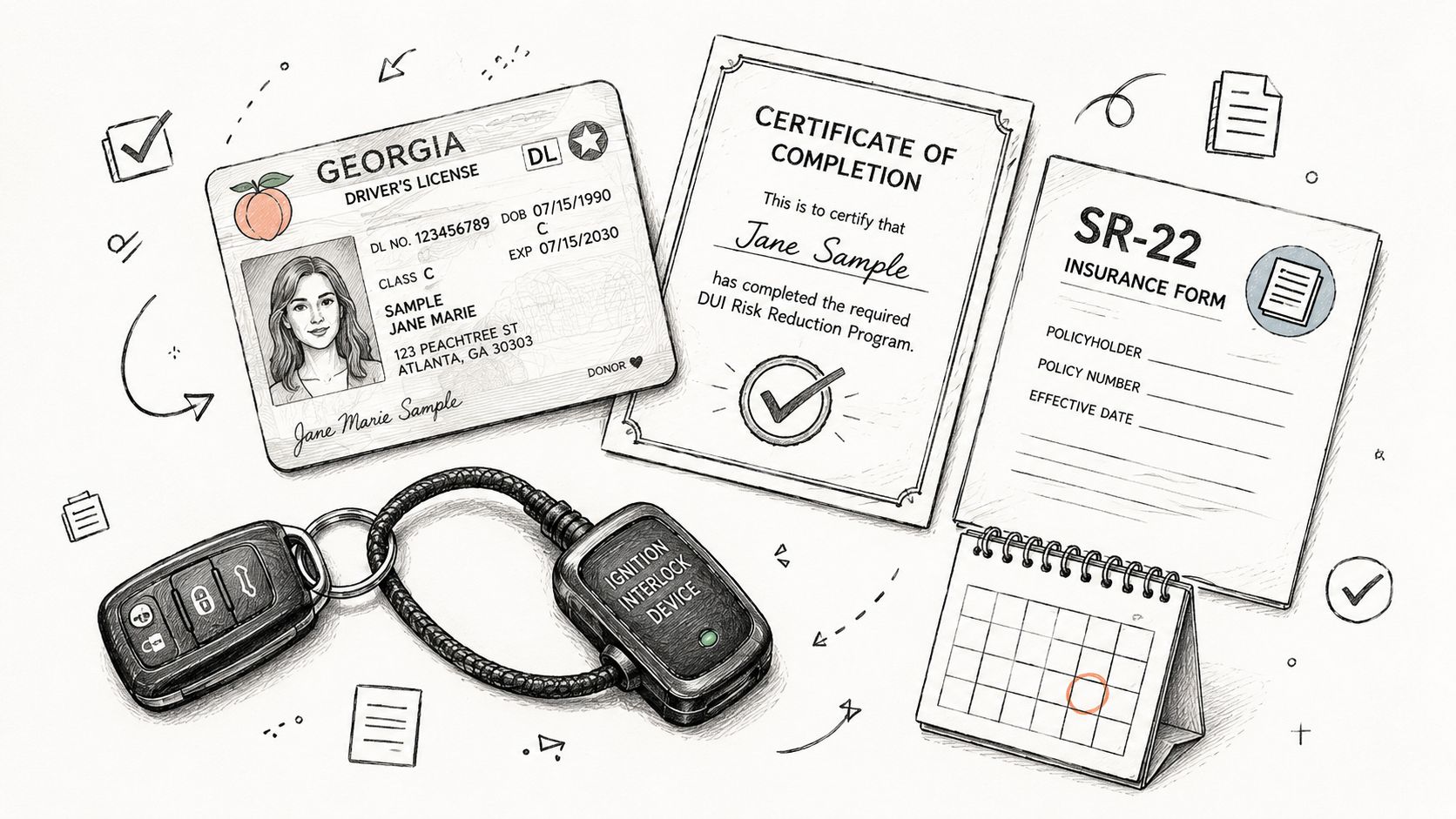
You checked the suspension notice. The end date has passed, your fines may be paid, and you've completed what you thought was the required DUI class. Then you visit a Georgia Department of Driver Services customer service center expecting a license and leave with another checklist.
That experience is common because license reinstatement after DUI in Georgia isn't a waiting period alone. It's a compliance process. The suspension clock tells you when a restriction may end. The reinstatement clock tracks whether DDS has the documents, filings, treatment records, and fees needed to restore your driving privilege.
The Moment You Realize Eligibility Is Not the Same as Reinstatement
A driver in Forsyth County might receive a notice showing a suspension end date, complete the court's requirements, and assume the license will reactivate automatically. At the DDS counter, the employee may still need proof of a Risk Reduction course, an insurance filing, an ignition interlock record, or a clinical document tied to the driver's case. The date on the notice answers one question, but it doesn't answer whether every reinstatement condition has been satisfied.
Georgia drivers often confuse two separate clocks:
- The suspension clock measures the administrative or court-imposed period during which the license is suspended or revoked.
- The reinstatement clock measures the work required to prove compliance, including education, treatment, insurance, interlock conditions, and payment of fees.
Georgia's first-offense framework illustrates the problem. For drivers age 21 and over, the Georgia Department of Driver Services identifies a 120-day suspension and requires a Certificate of Completion from a DDS-approved DUI Alcohol or Drug Use Risk Reduction Program before reinstatement. The Georgia DDS first-offense DUI guidance shows why the process isn't “wait 120 days, then drive.”
The four proofs DDS may need
Most reinstatement files are built around four categories of proof:
- DDS Certificate of Completion, confirming the approved Risk Reduction course.
- Clinical clearance, when a clinical evaluation or treatment requirement applies.
- SR-22 filing, showing that the required insurance certificate is active in the DDS record.
- Ignition interlock proof, when the offense, court order, or reinstatement pathway requires a device.
The correct order matters. A certificate issued by the wrong provider won't solve the problem. An insurance policy without the required SR-22 filing may not satisfy DDS. A completed class won't replace a separate clinical evaluation when the case carries that condition.
Practical rule: Treat the reinstatement file like a compliance audit. Every requirement needs a document, a certificate number, an electronic record, or a payment confirmation.
This guide focuses on the gap between being legally eligible and being operationally reinstated. Your goal isn't merely to reach the end of the suspension. Your goal is to arrive at DDS with a complete, current file that proves each condition has been met.
How Georgia Suspends Your License and Where the Hearing Fits
Georgia uses two suspension tracks that can affect the same driver. The first is the administrative license suspension, commonly called an ALS, arising from the implied consent process under OCGA 40-5-67.2. The second is the court-imposed suspension that can follow a DUI conviction under OCGA 40-5-63.
The ALS can begin because of a chemical-test result or a refusal. For a first failure, the administrative suspension is generally 120 days. A refusal or a second failure can produce a 12-month administrative suspension. Those administrative consequences are separate from the criminal case, so the driver may be dealing with an ALS before the court reaches a final result.
What the DDS hearing decides
A driver with the right to challenge the ALS must act quickly. The administrative hearing request generally must be made within 10 business days of the arrest. Missing that window can remove the opportunity to contest the administrative suspension through the DDS process.
The hearing has a narrow purpose. It addresses issues such as:
- Whether the officer had reasonable grounds for the DUI-related action.
- Whether the driver refused the requested chemical test.
- Whether the driver tested above the applicable limit.
The hearing doesn't retry the criminal DUI charge. It doesn't replace a plea, trial, or sentencing proceeding. It also can't reduce a court-ordered suspension imposed after conviction.
The hearing may affect the administrative lane, but it usually won't erase the conviction-based work that controls full reinstatement.
Why the two suspensions matter
Administrative and court suspensions may run concurrently or consecutively depending on the case and the governing order. That detail changes the earliest date you can qualify for relief and the documents DDS will expect.
A successful ALS challenge may shorten or vacate the administrative suspension. It won't automatically remove a conviction suspension. Conversely, serving the administrative period doesn't prove that court conditions, Risk Reduction, treatment, insurance, or interlock requirements are complete.
Pull both records before you plan your reinstatement visit. Review the DDS notice, court disposition, sentencing order, and current license status. If you see only one suspension while the other remains active, you're building the wrong checklist.
Risk Reduction, NEEDS Assessment, and the DDS Certificate of Completion
Georgia DUI cases commonly involve two educational or assessment steps that drivers mistakenly treat as the same requirement. The DUI Alcohol or Drug Use Risk Reduction Program is the approved educational course. The NEEDS Assessment is a separate screening component used to identify potential alcohol or drug concerns and determine whether further evaluation or treatment may be appropriate.
The Risk Reduction path includes a standardized assessment and the classroom or educational program itself. Georgia guidance describes the assessment as part of the Risk Reduction Program, while also warning that it shouldn't be confused with a separate drug-and-alcohol evaluation ordered for probation, court, or reinstatement. The distinction is explained in this overview of what Georgia Risk Reduction involves.
What the course proves
A convicted driver generally needs a completion record from a DDS-approved Risk Reduction provider. The provider issues a DDS Certificate of Completion, commonly associated with Form DS-1018 or an equivalent certificate record, which DDS can verify electronically.
The certificate should identify the participant, provider, completion date, and certificate information. Don't leave the course assuming DDS has everything needed. Ask the provider whether the completion was uploaded or otherwise made available for DDS verification, and keep the paper or digital copy for your records.
Georgia rules also define the clinical evaluation as a separate department-designated process. The evaluation must be performed at an approved location by an approved clinical evaluator and can involve an interview, review of the standardized screening instrument, and an approved assessment instrument. The Georgia DUI resource collection from 24-7 Best Bonding can help drivers locate related information about DUI education and compliance steps.
Avoid the timing trap
Don't enroll too early without checking eligibility dates. The Risk Reduction course can't be started until the permitted period before license eligibility, which is at least 120 days under the requirement described for Georgia reinstatement planning. A certificate that doesn't align with the case timeline may create another DDS problem.
Before leaving this stage, have three items documented:
- A valid certificate number, not just a class registration.
- The completion date, checked against the suspension and eligibility records.
- Provider confirmation, showing that DDS can verify the completion.
The NEEDS Assessment may be completed through the Risk Reduction process, but a separate clinical evaluation can still be required. If a court order, probation condition, or DDS record calls for clinical clearance, completing the classroom course alone won't close the file.
Clinical Evaluation, ASAM Level 1, and the Victim Impact Panel
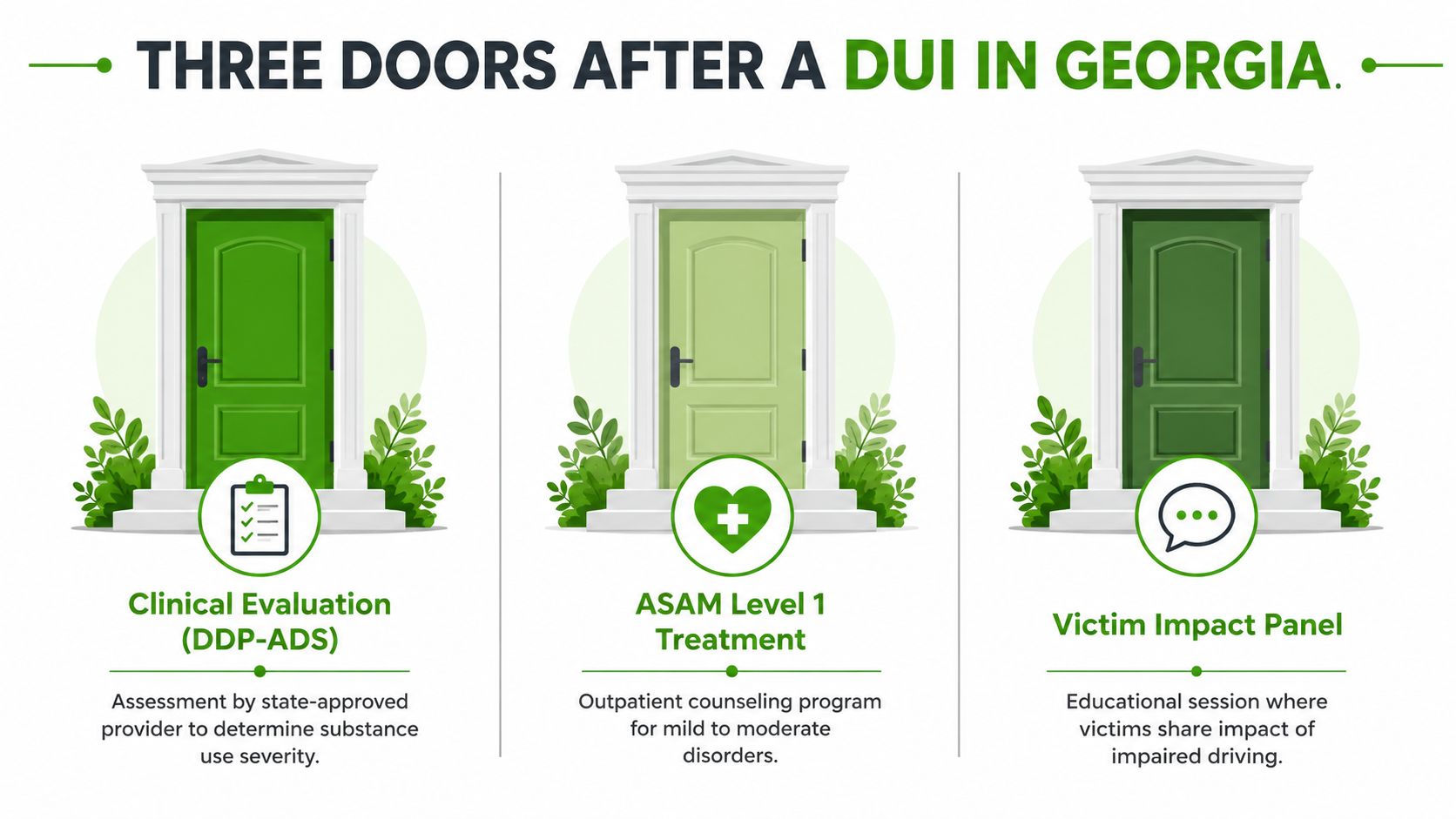
A Georgia DUI case can open three different compliance doors. They aren't interchangeable. A clinical evaluation assesses substance use concerns, ASAM Level 1 treatment provides outpatient services when treatment is indicated, and a Victim Impact Panel addresses the consequences of impaired driving through an educational session.
Georgia rules describe a clinical evaluation as a department-designated process that can diagnose substance abuse or dependence and refer the person to appropriate treatment. Approved evaluators use a clinical interview, review the Risk Reduction screening instrument, and at least one approved assessment instrument to determine whether a DSM-based substance-related disorder exists and what ASAM level of service may be appropriate. The Georgia DUI Schools explanation of ASAM Level 1 treatment helps separate outpatient treatment from the initial evaluation.
Three requirements, three records
A clinical evaluation produces an assessment and recommendation. If the evaluator recommends treatment, the driver may need to complete the recommended service and obtain a treatment completion certificate. ASAM Level 1 is outpatient care for a person whose evaluation identifies a need for that level of service. It isn't the same document as the Risk Reduction certificate.
The DS-286 affidavit and treatment completion records may become part of the reinstatement file. The exact record depends on the court order, the driver's history, and DDS requirements. A court can impose a condition that DDS also tracks, and DDS can require proof that isn't satisfied by a court receipt alone.
The Victim Impact Panel is different again. A judge or prosecutor often orders attendance, rather than DDS directly. Even so, the panel can remain a practical reinstatement hurdle if the court makes completion part of probation or license-related compliance.
Don't ask whether you “did the DUI class.” Ask which door your case opened, who ordered it, and which certificate proves completion.
First offenders may have no treatment requirement after evaluation, while another driver with a similar arrest may receive a clinical referral because of prior history, case facts, or an existing court order. Refusal, a high BAC, injury allegations, and multiple alcohol violations can create more individualized pathways. Colorado guidance, for example, describes persistent-drunk-driver consequences tied to a BAC at or above 0.15 or a chemical-test refusal, with possible interlock, SR-22, education, therapy, and testing requirements in that state. Those rules aren't Georgia rules, but they demonstrate why national checklists should never replace a case-specific Georgia review.
SR-22, Ignition Interlock, Forms, and Fees at the DDS Window
Insurance proof is one of the most misunderstood parts of reinstatement. An SR-22 isn't a special insurance policy. It's a state-required liability filing made by an insurer to show that the required coverage is in place. DDS expects the filing to appear in the driver's record, not merely a standard insurance card carried in a wallet.
The duration and exact conditions depend on the case. Ask the insurer to file the SR-22 directly with Georgia and confirm that the filing is active before visiting DDS. If the policy cancels, the insurer may report the lapse, creating a new compliance problem.
Ignition interlock requirements also vary by offense and pathway. A first-offense interlock-restricted route may differ from the conditions attached to second or third convictions. The device must be installed through an approved process, and DDS may require installation verification, permit paperwork, or proof that the driver has maintained the restriction. Details about the restricted-license pathway are available through Georgia DUI Schools information on ignition interlock restricted licenses.
Build the folder before you pay
Common documents include the DS-286 affidavit, DS-285 materials where applicable, the SR-22 filing, Risk Reduction certificate, clinical evaluation or treatment certificate, Victim Impact Panel proof, and interlock documentation. The exact form set can change with the suspension type and offense history, so verify the current requirement with DDS rather than relying on an old checklist.
| Item | Form or Document | Purpose / What It Proves | Typical Fee |
|---|---|---|---|
| Risk Reduction completion | DDS Certificate of Completion, DS-1018 or equivalent | Proves completion of the approved DUI education program | Provider charge varies |
| Clinical requirement | Clinical evaluation and treatment certificate | Shows evaluation results and completion of required services | Provider charge varies |
| Affidavit | DS-286 | Supports the driver's reinstatement compliance record | Verify with DDS |
| Insurance | SR-22 filing | Confirms required liability coverage is filed with Georgia | Insurer charge varies |
| Interlock pathway | IID installation or verification records | Proves compliance with a device-based restriction | Provider charge varies |
| Standard reinstatement | DDS payment record | Shows payment of the reinstatement charge | $210 standard fee, verify with DDS |
| IID permit | IID permit payment record | Supports an interlock-restricted license pathway | $200 IID permit fee, verify with DDS |
The $210 standard reinstatement fee and $200 IID permit fee are the prevailing figures identified for this planning context, but don't assume your total will match the table. Outstanding fines, multiple suspensions, offense history, and pending holds can change the amount. Confirm the balance through DDS before submitting payment.
Why Eligible Drivers Stay Stuck and the Pitfalls to Avoid
Being eligible doesn't mean a driver has completed reinstatement. California DMV research found that only about 54.0% of eligible first offenders and 36.0% of eligible second offenders had fully reinstated driving privileges 3.8 to 4.8 years after arrest. The same analysis reported that by five years after eligibility, roughly 46% of first offenders and 64% of second offenders still hadn't fully reinstated, despite being eligible to do so (California DMV reinstatement study).
That California data doesn't establish Georgia's rate. It does expose the practical mistake drivers make everywhere: they treat eligibility as an automatic restoration event. A peer-reviewed study likewise found that 42% of first offenders and 55% of multiple offenders delayed reinstatement for more than one year, while up to 75% continued driving while unlicensed and about one-third had no record of reinstatement within five years of eligibility (PubMed-indexed reinstatement study).
The Georgia mistakes that create repeat trips
- Trusting the end date: The date on a notice doesn't confirm that every condition has been cleared.
- Bringing an incomplete file: Arriving without DS-286, current clinical records, or treatment proof can force another DDS visit.
- Treating SR-22 as optional: Ordinary insurance coverage doesn't necessarily replace the required state filing.
- Missing interlock deadlines: A device requirement can remain open even after the suspension period ends.
- Ignoring court balances: Unpaid fines or surcharges can leave a hold on the driving record.
- Confusing course and evaluation: Risk Reduction completion doesn't automatically satisfy a separate clinical evaluation.
The California DMV analysis tied reinstatement to concrete compliance steps, including fees, treatment requirements, and administrative holds. Georgia drivers should use the same operational mindset. One missing record can delay the process, and an insurance lapse can create a separate problem that outlasts the original suspension.
A Sample Reinstatement Timeline and the Next Step to Take
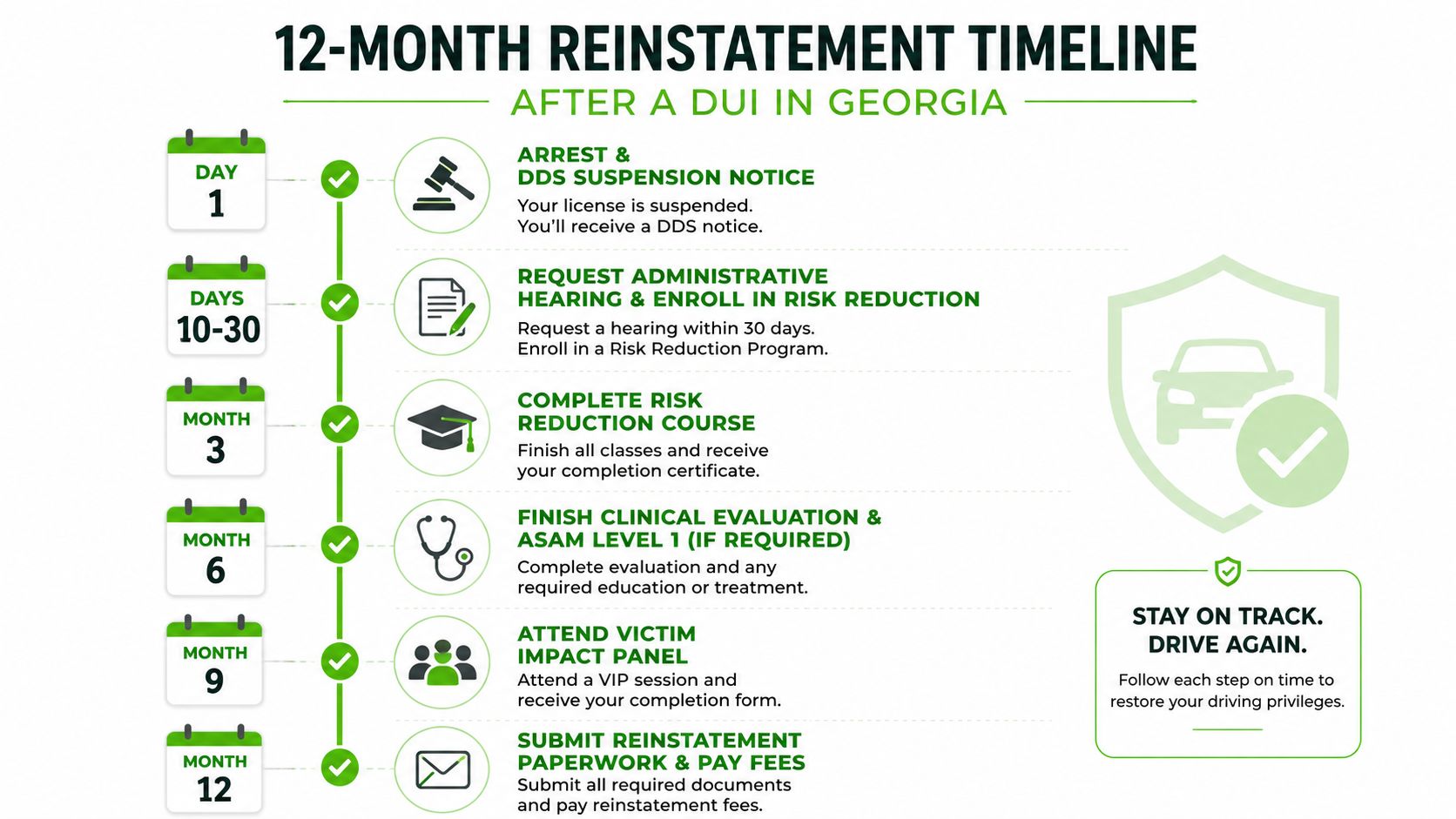
A first-offense case can require planning across a long period, especially when administrative and court conditions overlap. The timeline below is a working framework, not a substitute for the suspension notice, court order, and current DDS record.
Document each milestone
- Day 1, arrest and notice: Keep the DDS notice, implied consent paperwork, citation, and court information together. Record whether the notice describes an administrative suspension, a court action, or both.
- Days 10 to 30, hearing and enrollment: If eligible, request the DDS administrative hearing within 10 business days. Begin Risk Reduction planning only after confirming the permitted enrollment window and eligibility date.
- Days 30 to 120, education and assessment: Complete the approved Risk Reduction Program, retain the certificate number, and confirm provider reporting. Complete the NEEDS Assessment and any separately ordered clinical evaluation.
- Days 120 to 180, conditional requirements: If the case requires it, arrange ignition interlock installation and obtain verification. Bind the SR-22 through an insurer and confirm that DDS receives the filing.
- Day 365, eligibility review: For the sample first-offense arc, review whether hardship or full reinstatement eligibility has arrived. Don't treat this date as proof that the record is clear.
- After Day 365, DDS submission: Bring the required DDS forms, certificates, insurance proof, interlock records, court compliance documents, identification, and payment confirmation. A current checklist about court requirements for DUI license return can help you compare court obligations with the DDS file, but Georgia DDS remains the controlling source for Georgia processing.
The single most useful next action is to confirm the type of suspension on your current DDS record. Determine whether it is administrative, court-ordered, or both. That answer tells you which paperwork comes first and prevents you from spending time on a course, filing, or payment that doesn't address the active hold.
Georgia DUI Schools provides a DDS-approved Risk Reduction Program and related clinical services, including clinical evaluations, ASAM Level 1 treatment, and Victim Impact Panels, with online and classroom options for Georgia drivers. Review the available requirements-focused programs and choose the next course or service through Georgia DUI Schools.