
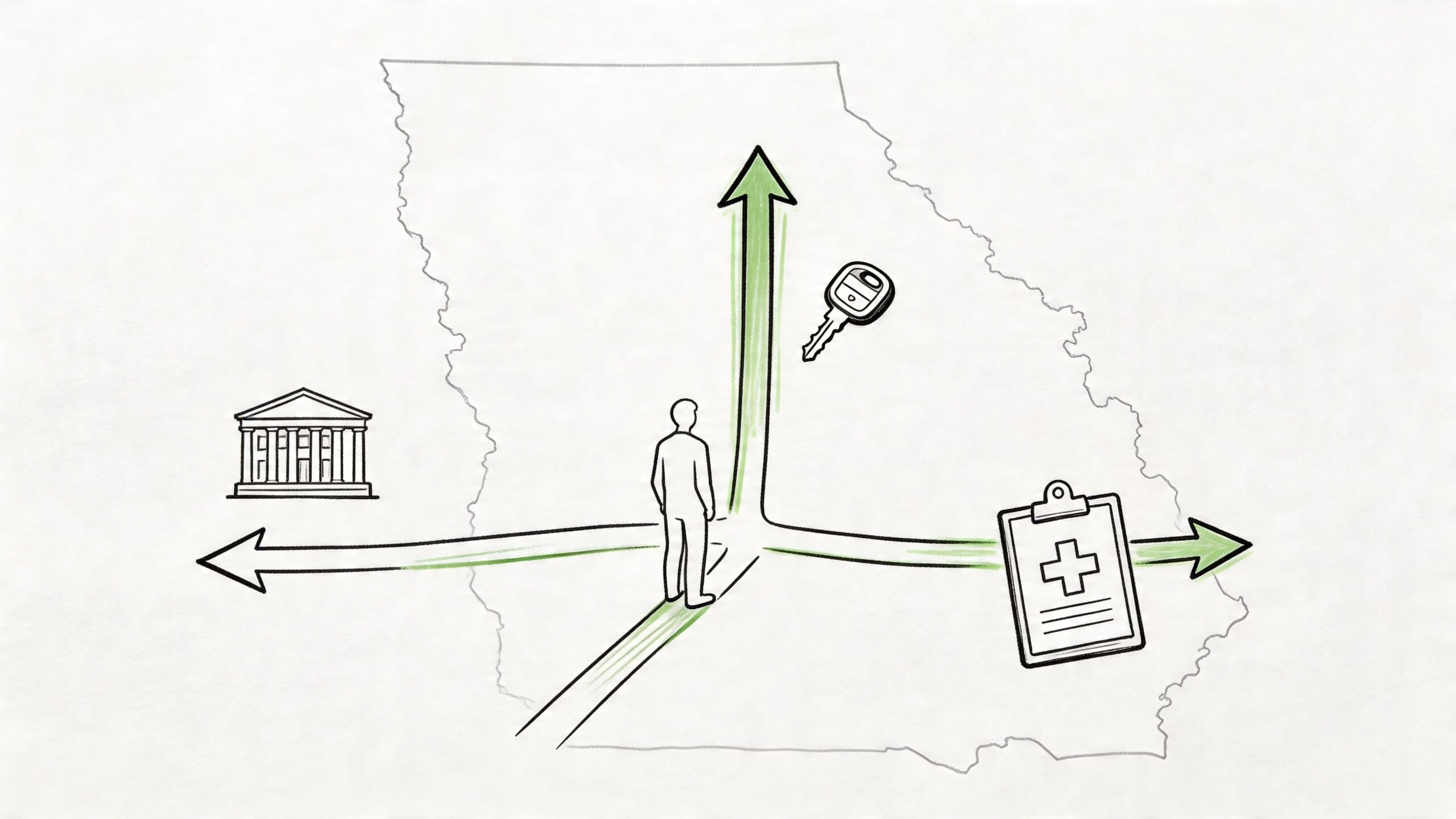
Getting told you need ASAM Level 1 treatment can feel like the moment everything becomes more confusing. You may already be dealing with court dates, probation instructions, a suspended license, work pressure, and family questions. Then someone hands you paperwork with a term that sounds clinical and vague, and you're left wondering what it means, how long it takes, and what you're supposed to do next.
That reaction is normal. Many people in Georgia first see the phrase after a DUI, a drug-related driving charge, or a court-ordered clinical evaluation. They don't need more jargon. They need a clear path.
Navigating Your ASAM Level 1 Requirement in Georgia
A common Georgia scenario looks like this. Someone finishes a court hearing or a clinical evaluation in Atlanta, Decatur, Marietta, Athens, or another local community. They leave with instructions that mention ASAM Level 1, probation compliance, or license reinstatement, but nobody has explained it in plain language.

The first thing to know is this. An ASAM Level 1 requirement doesn't mean the system has decided you need the highest level of care. It usually means a clinician found that outpatient treatment is appropriate, structured, and manageable while you continue living at home and handling daily responsibilities.
What most people are worried about
Usually, the questions come fast:
- Will this delay my license getting reinstated? You need to know how treatment fits with the rest of your DDS and court requirements.
- Am I in trouble if I don't understand the paperwork? Confusion is common, but missing deadlines or failing to enroll can create bigger problems.
- What exactly am I supposed to sign up for? The wording on court documents often assumes you already know the process.
- Is this counseling, a class, or something else? It can include structured outpatient treatment services, often with group sessions and other clinical components.
If you haven't had a formal assessment yet, the starting point is often a court-ordered substance abuse evaluation. That evaluation usually determines whether Level 1 is the right fit.
Practical rule: Don't guess based on what a friend did after their DUI. Your evaluator's recommendation, your court order, and your DDS requirements may not match someone else's.
What to do first
Before you call any provider, gather your documents in one place. That usually means your court order, probation paperwork if you have it, your clinical evaluation report if one has already been completed, and any notes related to license reinstatement.
Then ask four direct questions:
- What exactly was I ordered to complete?
- Has my clinical evaluation already recommended ASAM Level 1?
- Who needs proof when I'm done?
- What can I do now so I don't lose time?
When people understand the path, the panic usually settles down. The issue becomes less about an unfamiliar acronym and more about completing a defined process correctly.
Demystifying ASAM Level 1 Outpatient Treatment
ASAM stands for the American Society of Addiction Medicine. Their criteria help clinicians match a person to the right level of substance use treatment instead of using the same approach for everyone.
A simple way to think about it is physical therapy. Some people need hospital-level care. Some need a more intensive rehab schedule. Others can recover with regular outpatient appointments while continuing work, school, and family routines. ASAM Level 1 is that outpatient category.
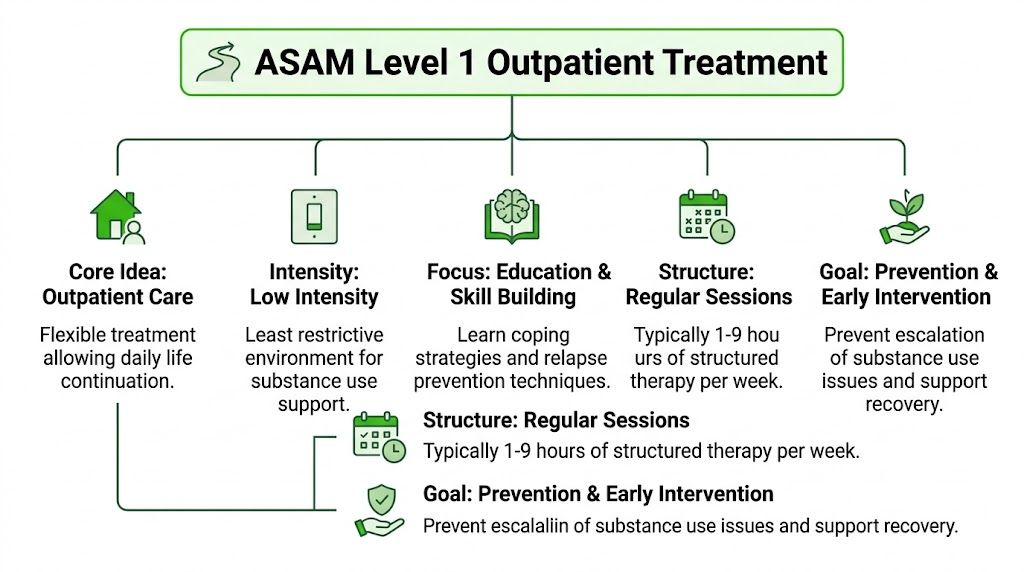
In Georgia, asam level 1 treatment georgia refers to the lowest intensity outpatient service within the ASAM framework. It provides structured, non-residential care at less than 9 hours per week, which allows many people to keep up with normal responsibilities while addressing mild to moderate substance use concerns, according to American Addiction Centers' overview of ASAM levels of care.
What Level 1 usually means in real life
Level 1 isn't residential treatment. You don't move into a facility. You live at home and attend scheduled treatment sessions.
That matters for people trying to keep a job in metro Atlanta, manage childcare in Gwinnett, commute from Cobb County, or maintain class attendance in Athens. The structure is still serious, but it is designed to fit around daily life rather than remove you from it.
Here are the core features people often find reassuring:
- Outpatient format: You attend treatment and then return home.
- Lower intensity than higher ASAM levels: It's meant for people who don't need around-the-clock care.
- Structured support: This isn't casual advice. It's a clinical program with scheduled treatment hours.
- Practical focus: Sessions often center on understanding substance use, building coping skills, and reducing the risk of future problems.
How clinicians decide on Level 1
The placement isn't supposed to be random. Clinicians use six ASAM dimensions to decide which level fits your situation.
| ASAM dimension | Plain-language meaning |
|---|---|
| Acute intoxication or withdrawal | Are you dealing with current withdrawal risks or immediate substance-related instability? |
| Biomedical conditions | Do you have medical issues that affect treatment needs? |
| Emotional, behavioral, or cognitive conditions | Are there mental health or behavioral concerns that need attention? |
| Readiness to change | How willing and prepared are you to participate in treatment? |
| Relapse or continued use potential | How likely are you to keep using or return to use without support? |
| Recovery environment | Does your home and social environment support recovery, or make it harder? |
A person with stable housing, manageable symptoms, and no need for intensive monitoring may fit Level 1 well. Someone with more severe instability may need a higher level of care instead.
The purpose of the ASAM system is to match treatment intensity to actual need, not to assign the harshest option automatically.
Why the phrase sounds more intimidating than it is
The wording can make it sound like a punishment category. It isn't. It's a clinical placement level. In many Georgia DUI-related situations, it becomes part of a legal requirement, but the underlying recommendation comes from an assessment process meant to place people appropriately.
That distinction matters. It helps you understand why two people with similar charges may receive different treatment recommendations.
Why Courts and the DDS Mandate ASAM Level 1 in Georgia
Individuals typically don't get ordered into ASAM Level 1 out of nowhere. There is usually a chain of events behind it. A DUI arrest, a court case, probation conditions, or a license issue triggers a clinical evaluation. That evaluation then helps determine whether substance abuse treatment is required.
Georgia uses a structured system for this. The decision isn't supposed to depend only on a judge's impression or a provider's personal preference.
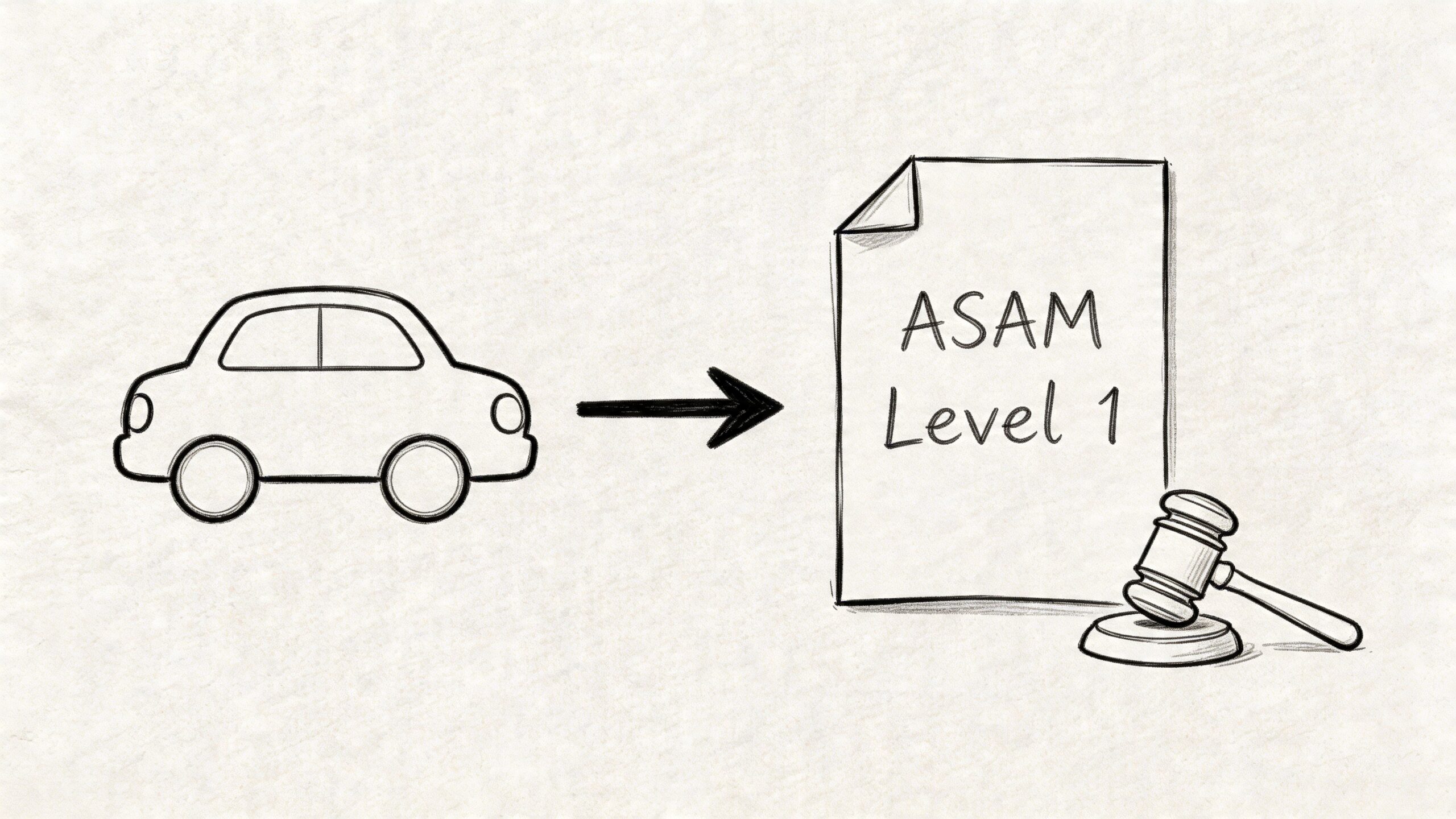
In Georgia, the Council of Accountability Court Judges has formalized adoption of ASAM criteria and standardized training so placement is more consistent statewide. That means a Level 1 recommendation, defined as less than 9 hours of outpatient care weekly, is tied to a structured assessment across six dimensions, not just a quick impression, as described in this Georgia-focused ASAM Level I and II overview.
The legal path usually looks like this
For many DUI-related cases, the sequence is fairly predictable:
- An arrest or court issue happens. This may involve alcohol, drugs, or a driving-related offense.
- A clinical evaluation is required. The evaluator reviews your history, current circumstances, and risk factors.
- The evaluation recommends a level of care. If the recommendation is ASAM Level 1, that becomes a treatment requirement in many cases.
- The court, probation office, or DDS expects proof of completion. Your treatment isn't just for personal benefit. It often has compliance consequences.
It's common for people to get frustrated. They think, "I already have to do the Risk Reduction course, so why is there treatment too?" The answer is that the state treats education and clinical intervention as different things.
Risk Reduction is not the same as Level 1 treatment
The Georgia DUI or Risk Reduction course focuses on education tied to impaired driving. ASAM Level 1 addresses substance use concerns identified in a clinical evaluation.
Those are related, but they aren't interchangeable. One doesn't automatically satisfy the other.
A court or DDS may also require other items such as a Victim Impact Panel. That's why reading your paperwork carefully matters. If your order lists multiple requirements, each one usually needs separate proof.
Why the state uses this system
The logic is straightforward. A DUI can be a one-time legal event, but it can also point to broader substance use risk. Courts and DDS don't try to answer that question by guesswork. They rely on the clinical evaluation and ASAM placement process.
What this means for you: If you've been assigned Level 1, the state is saying outpatient treatment is the right intervention for your assessed level of need, and completion may be necessary to move your case forward.
Where confusion usually starts
The hardest part for many drivers isn't accepting the need for treatment. It's understanding which agency controls what.
A few examples:
- The court may care about probation compliance and documented completion.
- Probation may monitor attendance, progress, and deadlines.
- DDS may focus on reinstatement requirements and approved documentation.
- The treatment provider handles clinical services and records, but doesn't decide every legal outcome.
When those roles get blurred, people assume one certificate fixes everything. Often it doesn't. You need the right documents, delivered to the right place, at the right time.
A Look Inside Your Treatment Program What to Expect
Once you're enrolled, the mystery usually fades quickly. ASAM Level 1 is structured. You won't be showing up to something random and trying to figure it out on the fly.
Georgia regulations require a minimum of 3 hours per week of structured clinical services, and self-help attendance such as 12-step meetings does not count toward that minimum. Providers can extend treatment beyond the evaluator's initial recommendation if clinically appropriate, but the total treatment period can't go beyond 1 year, according to the Georgia rules governing DUI intervention programs and clinical services.
What your weekly schedule may look like
The exact format depends on the provider and your treatment plan, but many people in Level 1 can expect a routine built around scheduled clinical contact. That often includes group sessions, and in some programs it may also include individual counseling, family-focused work, or other clinical services.
A typical week feels more like a standing appointment than a crisis response. You arrange your work schedule, transportation, childcare, and calendar around recurring sessions.
Here are common parts of the experience:
- Group counseling: Many outpatient programs use group sessions to address patterns, accountability, decision-making, and support.
- Individual clinical work: Some treatment plans include one-on-one counseling to review progress and personal challenges.
- Educational content: You may cover addiction education, relapse prevention, triggers, and behavior change.
- Skill-building: The work often centers on practical habits, not abstract theory.
What you'll talk about
People often worry they'll be forced to tell strangers every detail of their life on day one. That's not how well-run outpatient treatment usually feels. The content is more organized than that.
You may discuss:
- how substance use affects judgment and daily routines
- situations that raise your risk of continued use
- how stress, relationships, work pressure, or isolation affect choices
- better responses when you're triggered, frustrated, or tempted
- what accountability looks like outside the classroom
Some programs use cognitive-behavioral approaches or motivational techniques. In plain language, that means looking at how thoughts, habits, and environments shape behavior, then practicing healthier responses.
Attendance at peer support meetings can still be helpful, but under Georgia rules those meetings don't replace your required clinical hours.
What can change your timeline
Many clients want to know the exact finish date before they begin. That's understandable, but treatment duration can vary. The evaluator's recommendation sets the starting point, and the provider then tracks attendance, participation, and clinical progress within Georgia's regulatory limits.
Several things can affect how smooth the process feels:
| Factor | How it affects completion |
|---|---|
| Consistent attendance | Helps you stay on schedule and avoid make-up issues |
| Missed sessions | Can create delays, additional requirements, or compliance concerns |
| Honest participation | Makes sessions more useful and keeps treatment focused |
| Paperwork issues | Can slow reporting to courts, probation, or DDS if documents are incomplete |
What helps people do well
The clients who handle Level 1 best usually treat it like a legal and clinical responsibility at the same time. They don't disappear between sessions. They don't wait until the final week to ask about documents. They stay in contact.
A good practical mindset is simple:
- Show up on time.
- Keep your paperwork.
- Ask questions early.
- Don't assume another agency has already received your records.
That approach reduces stress more than anything else.
How to Enroll and Successfully Complete Your Program
You get the evaluation, read the recommendation, and see "ASAM Level 1." Then a primary question comes to mind. What do I do first, and how do I make sure this is recognized for court, probation, or my license process?
Start with your paperwork. Read the exact language in your court order, probation instructions, or evaluation report, and match it to a provider that offers Georgia-approved ASAM Level 1 outpatient treatment and can issue the records you will need at the end. If you have not completed the step that leads to the treatment recommendation, review the online drug and alcohol evaluation process in Georgia.

Georgia DUI Schools is one example of a provider that offers clinical evaluations and ASAM Level 1 outpatient programming through in-person and online options for eligible Georgia participants. The key point is not the brand name. The key point is fit. Your provider must be able to deliver the level of care you were assigned and document completion in a way the receiving agency accepts.
A good enrollment process works like checking in for a flight. If one item is missing, the whole trip can stall. Before you register, gather the documents and details that keep the process on track:
- Court order, probation referral, or DDS-related paperwork: This shows what you were told to complete.
- Clinical evaluation report: If treatment was recommended, the report should say so clearly.
- Government-issued ID and current contact information: Your attendance record has to match your file.
- Your real availability: Work shifts, childcare, transportation limits, and court dates all affect scheduling.
Ask scheduling questions before you commit. If you live in metro Atlanta or commute from places like Marietta, Decatur, or Lawrenceville, traffic and travel time can turn one missed session into a larger delay. Evening, weekend, virtual, and in-person options can make the difference between steady progress and repeated rescheduling.
What enrollment should sound like
A clear intake call should answer practical questions, not leave you guessing. You should be able to ask:
- Does my paperwork specifically match your ASAM Level 1 program?
- When can I start?
- How often do sessions meet?
- What happens if I miss because of work, illness, or a court appearance?
- What document will I receive when I finish?
- Who sends that document to the court, probation, or DDS?
That last point trips people up all the time. Some agencies want records sent directly from the provider. Others may expect you to keep copies and submit them yourself. If you do not ask, you can finish treatment and still be stuck waiting because the paperwork never reached the right desk.
How to stay on track after you enroll
Successful completion usually comes from simple habits done consistently.
Show up on time. Answer calls or emails from the provider. Tell staff early if your schedule changes. Keep copies of every document you receive, including intake forms, payment receipts, attendance records if available, and your final completion paperwork.
It also helps to treat the program as both a clinical requirement and an administrative process. One part is the counseling work. The other part is making sure each step is recorded properly. Missing either side can slow down your progress.
Common mistakes that delay completion
Several problems show up again and again:
- Waiting to enroll after receiving the requirement: Delay can create problems with court or probation deadlines.
- Signing up for the wrong service: Similar program names do not always mean the same thing.
- Missing the first sessions: Early absences can affect your standing quickly.
- Assuming someone else handled the records: Never assume the court, probation office, and DDS all received what they need.
A better approach is steady and plain. Confirm the requirement. Enroll with the right provider. Attend consistently. Verify where your paperwork is going before your final session, not after it.
If you feel stressed, that reaction makes sense. The process can seem bigger than it is because several agencies may be involved at once. Break it into the next step in front of you, then the one after that. That is how people finish the program and clear the path for the rest of their Georgia compliance requirements.
Managing Costs, Insurance, and Documentation for Compliance
The money side of treatment is stressful because it shows up while you're already paying for other consequences. You may be dealing with court costs, transportation problems, insurance issues, and lost work time. That makes it even more important to ask direct billing questions up front.
One important access point is insurance. Verified Georgia coverage information shows that Georgia Medicaid covers ASAM Level 1 outpatient treatment services. If you think you may qualify, ask the provider what information they need to verify benefits and whether any limits or cost-sharing rules apply under your plan.
Ask financial questions before your first session
Don't wait until you're already enrolled to ask how billing works. A short phone call can prevent a lot of confusion.
Use questions like these:
- Do you accept my insurance plan? If yes, ask what services are covered and what records you need to provide.
- Do you work with Georgia Medicaid for ASAM Level 1 services? This is especially important for clients trying to manage court obligations on a tight budget.
- Are there payment arrangements if I'm paying out of pocket? Many people need a clear plan.
- What happens financially if treatment is extended within the allowed clinical framework? You need to understand how schedule changes affect cost.
The administrative side matters just as much as the treatment itself. If your records are disorganized, you can finish services and still run into delays.
Sample Documentation Checklist for Court and DDS
| Document | Purpose | Who Needs a Copy |
|---|---|---|
| Court order or referral | Shows exactly what was required | Provider, your own records |
| Clinical evaluation report | Confirms the recommendation for treatment | Provider, sometimes probation or court |
| Proof of enrollment | Shows you started the required program | Probation officer or court, if requested |
| Attendance or progress records | Documents ongoing participation if oversight is active | Probation officer, sometimes court |
| Certificate or completion letter | Shows you finished the required treatment | Court, probation, DDS, depending on your case |
| Risk Reduction completion record | Supports separate DUI education compliance if required | DDS, court, your own records |
| Victim Impact Panel proof | Documents completion if separately ordered | Court, probation, your own records |
Keep your records organized
A simple folder helps more than people expect. Use one paper folder and one digital folder. Save every receipt, enrollment document, attendance note, and completion record.
If your case also touches employment transportation issues, interstate return-to-duty issues, or safety-sensitive job questions, it may help to understand related compliance systems such as the SAP program overview. That won't apply to everyone, but for some drivers and workers it answers a second layer of questions.
Bring a copy of every important document to your first appointment, even if you already emailed it. Administrative delays often happen when one missing page holds up the file.
Frequently Asked Questions and Taking the Next Step
You open the court paperwork, see "ASAM Level 1," and the first thought is usually simple: What do I do now?
Start there. Do not guess, and do not wait until a deadline is close. A good next step is to call the provider or school handling your case and ask three direct questions: What exactly am I required to complete, what documents do I need to bring, and who receives proof when I finish? Those three answers usually clear up a large share of the confusion.
What happens if I miss a session
A missed session can affect your timeline and, in some cases, your compliance status. The result depends on the program rules and on whether the court, probation, or DDS is monitoring your progress.
Ask before the problem happens. Find out whether make-up sessions are allowed, how quickly you must reschedule, and whether the provider reports absences. One missed class is often manageable. One missed class with no communication can create a paperwork problem.
Can I finish faster if I'm motivated
Motivation helps, but it does not erase the treatment recommendation. ASAM Level 1 works more like a course with attendance and clinical requirements than a task you can rush through in a weekend.
If time matters for license reinstatement, work, or court dates, ask the provider for a realistic completion window based on your evaluation and schedule. That gives you a calendar you can plan around instead of relying on hope.
Is ASAM Level 1 confidential if it's court-related
Treatment records still involve privacy rules. At the same time, court-related cases often require limited reporting for compliance.
In plain terms, the provider may share items such as enrollment status, attendance, progress updates, or completion documents if your case requires it and the proper releases are in place. Ask for a clear explanation in writing. You should know what is shared, with whom, and for what purpose.
How do I know whether a provider is a good fit
Start with practical questions, not marketing language. Does the provider explain the process clearly? Do they understand Georgia court and DDS requirements? Can they tell you what paperwork you will receive at enrollment and at completion? Do they answer phone calls in a way that leaves you less confused, not more?
That last point matters more than people expect.
A good program should feel organized, respectful, and clear about expectations. If a provider cannot explain attendance rules, reporting steps, fees, or documentation, that is a warning sign. You are not just choosing counseling hours. You are choosing a program that must help you meet a legal and administrative requirement correctly.
What should I keep after I finish
Keep everything. Save your enrollment paperwork, payment receipts, attendance records if provided, your completion certificate or letter, and any related court or DDS forms.
Treat it like keeping tax records. You may not need every page later, but if DDS, the court, or probation asks for proof, having a complete file can save days or weeks of delay.
The next step that helps most
The process gets easier once you turn a vague requirement into a checklist. Confirm what was ordered. Verify whether the court, probation, or DDS needs proof directly from you or from the provider. Put your dates on a calendar. Keep a folder for every document.
Many people begin this process focused on one goal: get it over with and get back on the road. That is understandable. The best result usually comes when you treat the program as both a requirement and a reset point, a structured period to build safer habits while also clearing the legal steps in front of you.
If you are holding paperwork right now, do one thing today. Contact Georgia DUI Schools to confirm your next step, ask what records to bring, and make a plan for meeting your court or DDS deadlines without last-minute surprises.