
You walk out of court holding a piece of paper that says you need an alcohol assessment. Your next thought usually isn't clinical. It's practical. Where do I go, how fast do I need to do this, and is this the same thing as the DUI class?
That confusion is normal in Georgia. I see it all the time. People search court ordered alcohol assessment near me because they want one clear answer and the system tends to hand them three different terms at once. Clinical evaluation. Risk Reduction course. NEEDS assessment. Sometimes probation adds another instruction, and suddenly a simple next step feels harder than the case itself.
The good news is that this part can be handled in an orderly way. If you know what the court is asking for, choose an approved provider, bring the right paperwork, and follow the recommendation without delay, you can keep the process moving and avoid the most common setbacks.
Your Guide to Navigating a Georgia Court Order
A typical Georgia DUI case leaves people stuck on the same question: "I was told to get an alcohol assessment. What exactly counts?"
Usually, the problem starts right after court. You may have a judge's order, a probation instruction, or paperwork tied to license reinstatement. The wording often sounds simple, but the requirement isn't something you should guess at. If you book the wrong service, you can lose time, miss a deadline, and end up paying twice.
In Georgia, the fastest path is to treat the assessment like a compliance task with a sequence. Read the order carefully. Confirm whether it asks for a clinical evaluation, a DUI Risk Reduction course, or both. Then verify that the provider you choose is approved for the specific service the court wants.
Practical rule: If your paperwork uses terms like "clinical evaluation," "substance abuse evaluation," or "alcohol and drug assessment," don't assume your 20-hour DUI class covers it.
That matters because the clinical side and the education side serve different purposes in Georgia. One helps the court understand whether treatment is recommended. The other satisfies the state's DUI education requirement when applicable. Mixing them up is one of the easiest ways to delay your case.
A straightforward path looks like this:
- Read the order line by line. Look for deadlines, agency names, and whether results must go to the court, probation, or DDS.
- Choose an approved evaluator. Approval matters more than convenience.
- Schedule quickly. Waiting rarely helps your case.
- Bring complete paperwork. Missing records often slows down the report.
- Follow through on recommendations. The report is not the finish line.
If you're trying to handle this with minimal stress, think in terms of completion, not debate. The court wants documentation from the right provider, delivered the right way, by the right deadline.
What a Court-Ordered Assessment Entails in Georgia
The biggest point of confusion in Georgia is this: the court-ordered clinical evaluation is separate from the NEEDS assessment inside the DUI Alcohol and Drug Use Risk Reduction Program. They are related, but they are not interchangeable.
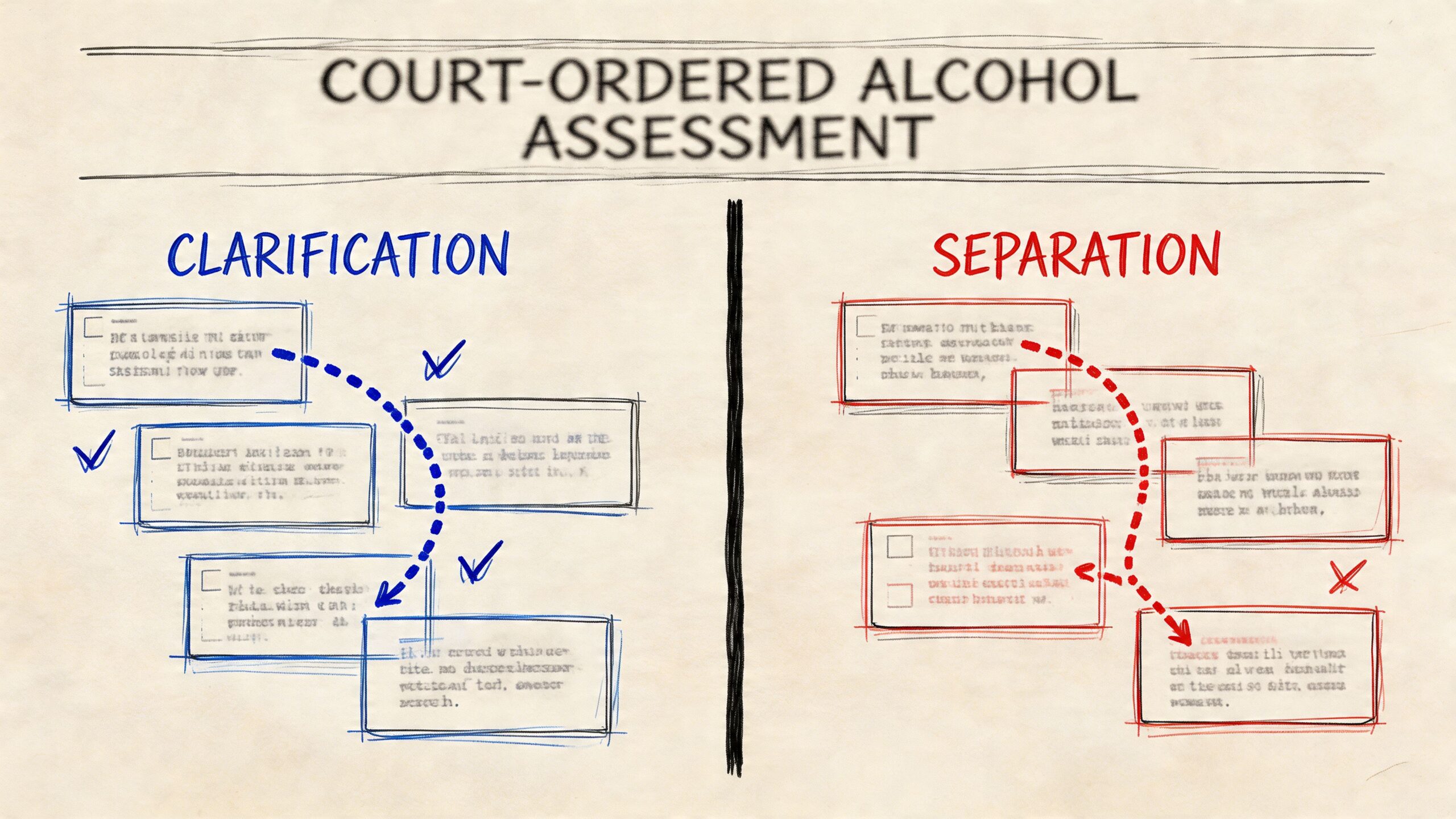
Georgia providers regularly have to clear this up because many people assume that once they register for the 20-hour Risk Reduction class, they've handled the assessment requirement too. That isn't always true. As noted by North Buckhead Driving and DUI School's explanation of Georgia court-ordered alcohol and drug evaluations, the clinical evaluation required in many Georgia DUI cases after July 1, 2008 is distinct from the NEEDS assessment used in the Risk Reduction course.
The clinical evaluation
This is the more formal piece. You meet with a DBHDD-certified counselor or clinician who reviews your history and applies accepted screening methods to determine whether education only is appropriate or whether treatment should be recommended.
This evaluation is built to answer a court question: what level of intervention, if any, fits the facts of your case and your substance use history?
The NEEDS assessment
The NEEDS assessment belongs to the 20-hour Risk Reduction course. It helps place you within that program. It is not a substitute for a separate court-ordered clinical evaluation when the court or DDS requires one.
That's where a lot of people get tripped up. They hear the word "assessment" twice and assume both labels refer to the same appointment. They don't.
If your court paperwork requires a clinical evaluation, taking the Risk Reduction class alone usually won't satisfy that order.
Why the distinction matters
The difference affects your next steps, your timeline, and sometimes your license reinstatement path. A clinical evaluation may lead to an ASAM-based recommendation for additional services. The Risk Reduction course has its own completion requirement. In many Georgia cases, you need both done properly and documented separately.
A quick comparison helps:
| Requirement | What it is | Who uses it | What it can affect |
|---|---|---|---|
| Clinical evaluation | One-on-one substance use assessment by a certified clinician | Court, probation, DDS | Treatment recommendations, case compliance, reinstatement steps |
| NEEDS assessment | Intake component within the Risk Reduction program | DUI course program | Placement within the 20-hour course |
What works and what doesn't
What works is calling the provider before you book and asking one direct question: "Is this the court-ordered clinical evaluation, or just the assessment that comes with the Risk Reduction course?"
What doesn't work is relying on general phrases from search results, assuming all DUI services are bundled together, or signing up based only on the words "alcohol assessment near me." In Georgia, the label matters less than whether the service matches the order.
Locating a DDS-Approved Alcohol Assessment Provider
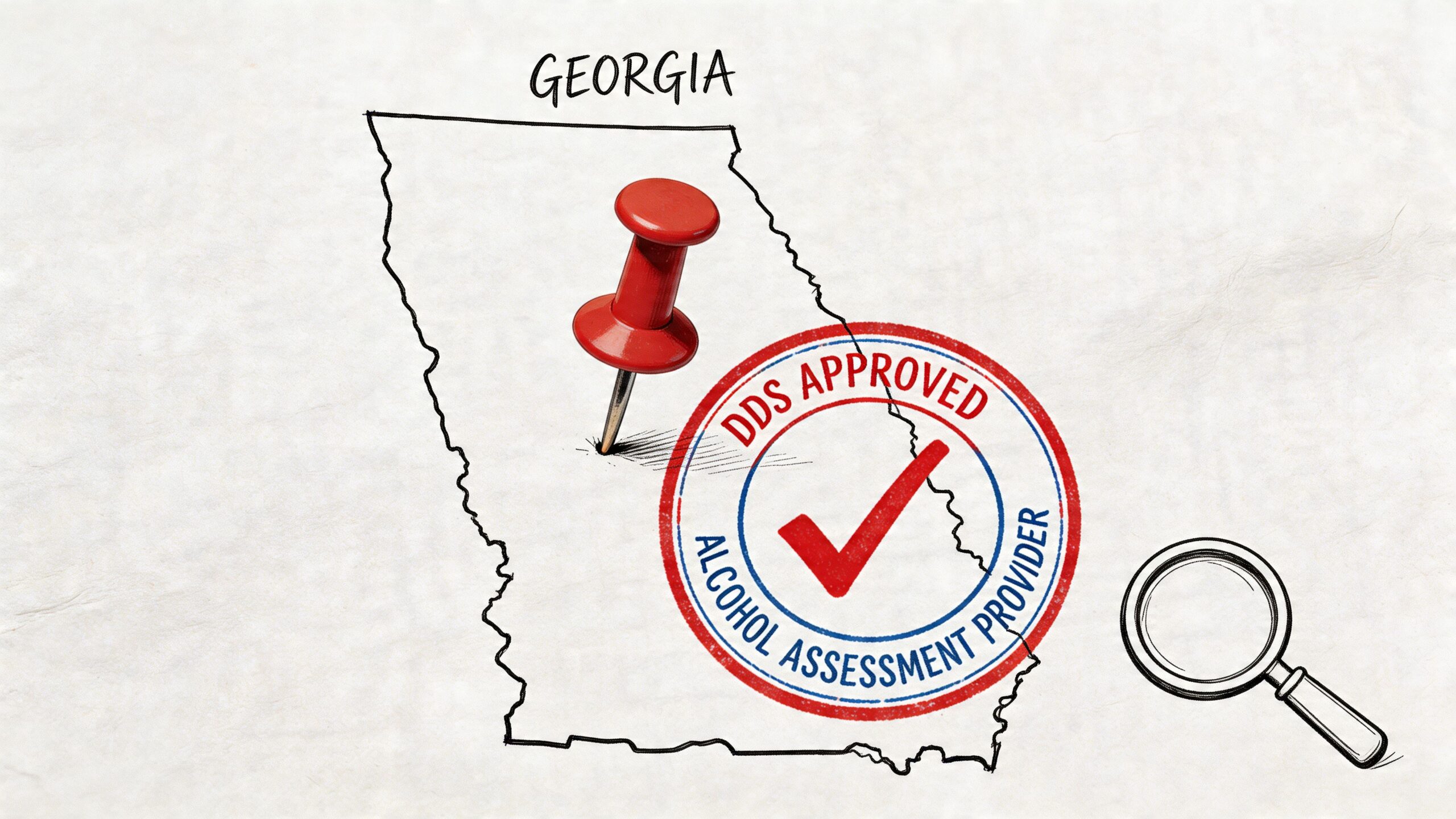
When people search court ordered alcohol assessment near me, they usually start with distance. In Georgia, start with approval status instead. A nearby provider isn't useful if the court won't accept the evaluation.
Start with the right kind of provider
For a Georgia DUI-related clinical evaluation, you want a provider whose clinicians are approved for this work. If the provider can't clearly explain their approval status and the kind of report they issue, keep looking.
A smart search process is simple:
- Check state alignment first. Make sure the provider handles Georgia court and DDS requirements, not just general counseling.
- Ask whether the evaluation is accepted by your court or probation office. Don't assume.
- Confirm whether results can be sent where they need to go. Some cases require direct submission.
- Verify appointment format. Many people now use virtual appointments because they remove travel and scheduling problems.
If you need a place to compare in-person availability across metro Atlanta and surrounding areas, Georgia DUI Schools locations lists available locations for Georgia services.
In-person versus virtual
This is a real trade-off, not a marketing point. In-person works well for people who want face-to-face structure, need help with paperwork at the desk, or don't have a private space at home. Virtual works well if transportation is a problem, your work schedule is tight, or you live outside metro Atlanta.
Neither format fixes a bad provider. The better question is whether the provider is organized, responsive, and used to working with court timelines.
Local reality: In metro Atlanta, traffic and courthouse deadlines can create more problems than the evaluation itself. A virtual slot can save a full day of disruption if the court accepts it.
Ask these questions before you book
You don't need a long consultation. You need direct answers.
- What exact service am I scheduling? Make them say whether it's a clinical evaluation.
- What paperwork should I send before the appointment?
- How are results delivered?
- Do you offer virtual and in-person options?
- What happens if the evaluator recommends treatment?
The strongest providers answer those questions without hedging.
Cost and testing issues
Pricing can vary depending on the type of service and whether testing is involved. In broader court-related markets, TALCADA's Santa Monica testing overview describes common ranges such as $49 to $79 for a urine 5-panel, $79 to $129 for a 10-panel, $79 to $125 for EtG alcohol tests, $150 to $300 for hair follicle testing, and $99 to $149 for DOT compliance. Georgia providers may structure services differently, so the practical move is to ask for a clear breakdown before the appointment.
One Georgia option many people use is Georgia DUI Schools, which offers clinical evaluations at multiple locations and online statewide. That kind of setup can help if you're balancing court dates, probation reporting, and work hours.
Red flags that usually lead to trouble
Some mistakes show up over and over:
| Red flag | Why it causes problems |
|---|---|
| The provider is vague about approval | Courts may reject the report |
| Nobody can explain the difference between evaluation and DUI class | You may book the wrong service |
| No one tells you what to bring | Your report may be delayed |
| You only compare by price | Cheap do-overs usually cost more than doing it right once |
The provider should make the process clearer the moment you call. If the call leaves you more confused, move on.
Navigating the Assessment Appointment
By the time your appointment arrives, anxiety usually comes from uncertainty, not from the interview itself. Individuals do better once they know the sequence and stop expecting a trap.
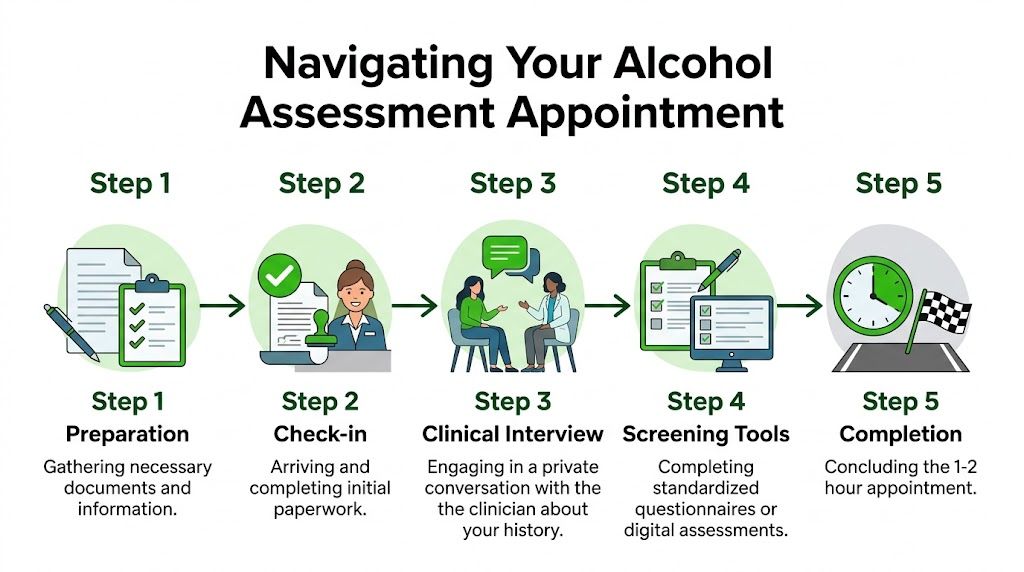
A court-ordered alcohol assessment generally follows a structured method. According to Sana Lake's outline of the court-ordered alcohol evaluation process, it typically lasts 1 to 2 hours and moves through five phases: screening, clinical interview, standardized screening tools such as the SASSI-4, toxicology testing, and recommendations.
What to bring
The smoothest appointments usually happen when the paperwork is complete before you log in or walk in. In Georgia DUI cases, that often means bringing or sending:
- Court paperwork that states the requirement
- Arrest report or citation information if available
- Driver history or MVR if your case involves reinstatement issues
- Probation contact details if results must be shared
- Any prior evaluation or treatment records if they exist
If something is missing, don't panic. Just tell the provider ahead of time. Silence creates more delay than an incomplete file does.
What the interview feels like
The clinical interview is usually a private conversation, not an interrogation. The counselor will ask about the DUI event, your alcohol or drug history, family context, work, health, and whether substance use has affected other parts of your life.
People often hurt themselves here by trying to sound "safe" instead of sounding accurate. That doesn't work well because trained clinicians compare what you say with records, screening answers, and the overall pattern of the case.
The fastest way through the appointment is plain honesty. Minimizing obvious facts tends to create more questions, not fewer.
Screening tools and consistency
Part of the process may include standardized questionnaires or computer-based screening tools. Those tools help the clinician test consistency and identify patterns that don't always show up in a short conversation.
If you need a remote option, Georgia DUI Schools online drug and alcohol evaluation scheduling is one example of how some Georgia providers handle evaluations through a virtual format.
A simple walkthrough
Most appointments follow this rhythm:
Check-in and identity verification
You confirm who you are and provide documents.Review of legal requirement
The evaluator confirms what the court or agency ordered.Clinical interview
This is the core conversation.Questionnaires or screening tools
You complete structured items designed to support the report.Possible testing and closing instructions
The evaluator explains what happens next and how the report is handled.
What helps and what doesn't
What helps is showing up on time, answering directly, and reading every form before you sign it. What doesn't help is rehearsing a story, arguing about whether the charge was fair, or treating the appointment like a hearing.
The evaluator isn't deciding guilt. The evaluator is deciding what recommendation fits the information in front of them. If you keep that distinction in mind, the appointment usually feels much more manageable.
Understanding Your Assessment Results and Recommendations
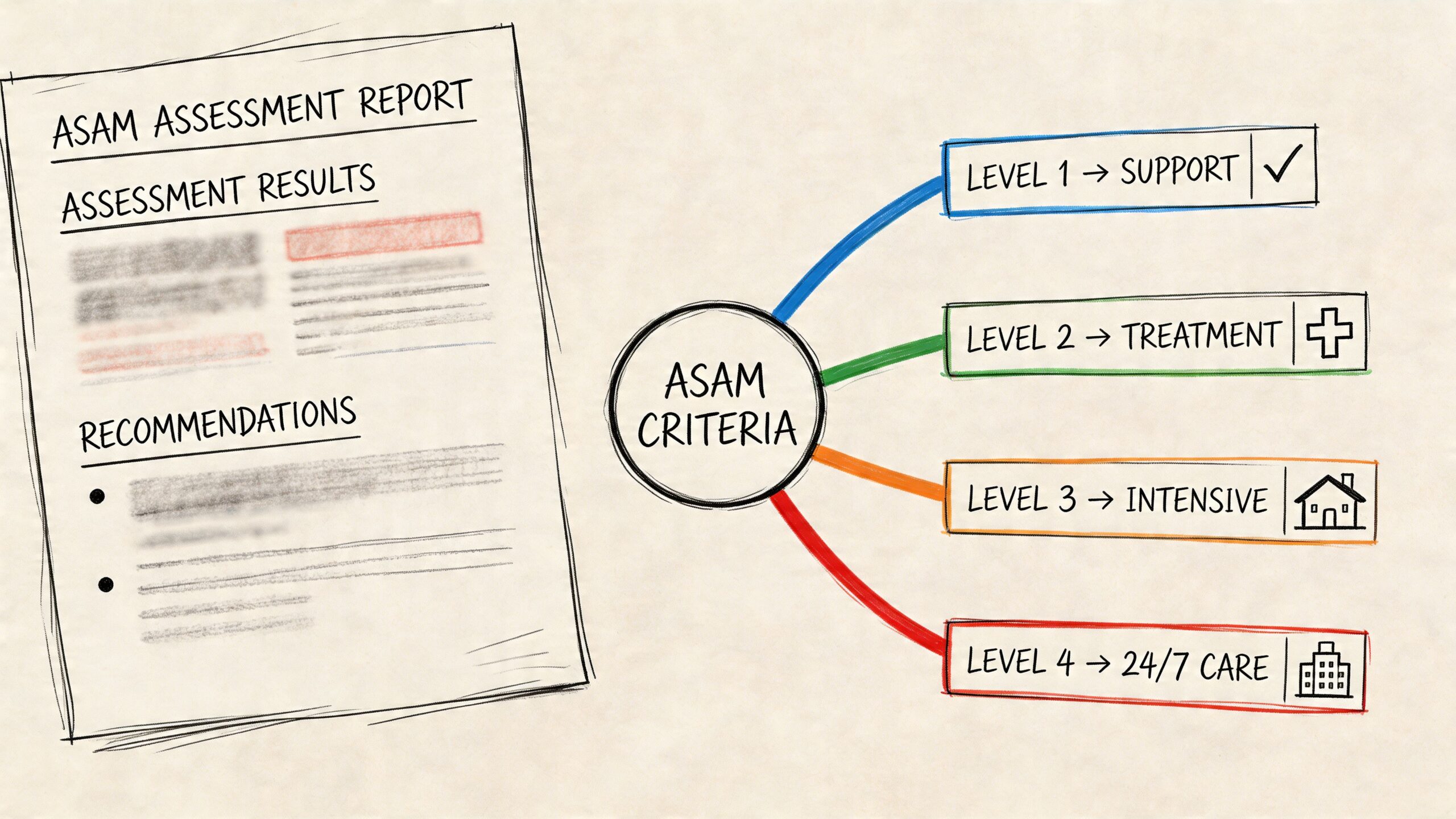
Once the appointment is done, the next source of stress is the report itself. People hear terms like ASAM Level 1 and assume the recommendation is a label that will define them. It isn't. It's a practical recommendation that tells the court what kind of education or treatment may be appropriate.
What the court is looking for
The report usually summarizes your history, the evaluation findings, and the clinician's recommendation. In plain language, the recommendation answers a basic question: does this case point to education only, or does it point to treatment and monitoring?
For some people, the recommendation is limited and manageable. For others, it includes outpatient treatment. The important thing is not to guess what the wording means. Read it carefully and ask the provider to explain it in everyday terms.
Why follow-through matters
The recommendation matters because completion matters. AACS Counseling's discussion of court-ordered alcohol and drug evaluations notes that 70% of participants avoided re-arrest within 1 year when they adhered to evaluator recommendations. The same source also highlights common pitfalls, including denial or minimization in 45% of cases and 35% dropout before completion, with non-completion linked to 2x recidivism compared with completers.
Those numbers line up with what counselors see in practice. People who finish what the report requires tend to move their case forward. People who delay, argue, or half-comply tend to stay tangled in the system longer.
Important takeaway: Your assessment result isn't the problem. Ignoring the recommendation usually becomes the bigger problem.
Reading common recommendation language
A few broad patterns show up often:
| Recommendation type | What it usually means for you |
|---|---|
| Education-focused recommendation | You may need to complete a required class or related program |
| Outpatient treatment recommendation | You need scheduled counseling sessions and proof of attendance |
| Additional monitoring or follow-up | The evaluator found issues that need more than one step |
If you run across unfamiliar treatment language and want context on workplace or clinical evaluation terminology, this overview of what the SAP program is can help clarify how formal assessment and recommendation systems work in related settings.
What not to do after you get the report
Don't leave the report sitting in your email or glovebox while you wait to "figure it out." Don't assume your lawyer, probation officer, and provider are all sending the same paperwork to each other automatically. And don't treat the recommendation like a suggestion if the court has made compliance part of your case.
The report should lead to an action step. If it recommends education, enroll. If it recommends treatment, start promptly. Delay rarely improves the outcome.
Fulfilling Your Requirements and Moving Forward
The evaluation is only valuable if it turns into completed compliance. That's the piece many people underestimate. They feel relief after the appointment, then lose momentum while the deadline keeps moving closer.
In Georgia, the cleanest approach is to close the loop immediately. Confirm where the report is being sent. Ask for your copy. Verify whether the court, probation officer, attorney, or DDS needs anything directly from you. Then complete whatever the recommendation requires.
The sequence that keeps cases on track
A practical checklist looks like this:
- Confirm report delivery. Don't assume it was sent.
- Keep your own copy. Save it digitally and on paper.
- Enroll in any recommended service right away. Waiting sends the wrong message.
- Track completion records. Certificates and attendance documents matter.
- Submit final proof where required. Courts and agencies want documentation, not verbal updates.
If your recommendation includes treatment, treat that as part of the court order in real terms. Missing sessions, starting late, or dropping out can create more trouble than the original scheduling issue.
Why prompt action pays off
Courts and probation officers don't expect perfection. They do expect movement. When you schedule fast, attend consistently, and turn in proof, you show that you're taking the process seriously.
That matters in Georgia, where DDS-approved programs like Georgia DUI Schools have served over 100,000 participants in 38 years according to the provided business context. That long-term volume reflects something practical, not abstract. Clinical evaluations and ASAM Level 1 treatment have become a routine part of helping drivers satisfy requirements tied to reinstatement and reduced repeat problems.
What successful completion usually looks like
Successful completion is rarely dramatic. It's paperwork done on time, attendance logged correctly, and no confusion about what still remains. The people who get through this with the least stress are usually the ones who stop looking for shortcuts and start following the sequence.
If you're sitting on a court order right now, the best move is simple. Book the right evaluation, comply with the recommendation, keep your records, and finish every requirement in writing.
If you need to complete the Georgia DUI education step after your evaluation, Georgia DUI Schools offers the state-required Risk Reduction course along with related clinical services so you can move from assessment to documented completion without extra guesswork.