

Risk Reduction and Driver Improvement are the two distinct Georgia DDS-approved driver-education tracks, and the right choice depends on why you need the course. A 20-hour Risk Reduction Program serves DUI and related court or reinstatement requirements, while a 6-hour Driver Improvement course can reduce up to 7 points on an eligible Georgia driving record.
You may be reading this because a court order says “Risk Reduction,” your license record shows points, or an insurance representative told you to take defensive driving. The names sound similar, and some schools advertise both programs on the same website. That overlap can lead you to enroll in the wrong class, receive a certificate DDS won't accept, and lose time while a suspension or court deadline continues.
Georgia's rules make the distinction important. The Georgia Department of Driver Services points and points-reduction guidance describes the 6-hour certified defensive-driving course used for point relief, while DDS separately describes the DUI Alcohol or Drug Use Risk Reduction Program as a legally mandated program with an assessment and intervention component.
Why Georgia Drivers End Up Confused at the DDS Counter
At a DDS service center in Conyers or Lithonia, a driver might stand at the counter with a defensive-driving flyer in one hand and a court order marked “Risk Reduction” in the other. They aren't asking whether they should become a safer driver. They're asking a narrower question: Which certificate will DDS accept for my situation?
The confusion starts with familiar labels. A provider may use “driver ed,” “defensive driving,” “DUI school,” or “risk reduction” in nearby advertising, even though Georgia treats the programs differently. One course lasts 6 hours, while the other requires 20 hours, and that difference isn't a minor scheduling detail. It reflects a different legal purpose.
The labels don't tell you enough
A teen and an adult may both search for driver ed in Georgia, but their needs can be unrelated. Joshua's Law concerns the education and driving requirements for certain teen licensing paths. Adult point reduction generally involves the separate Driver Improvement course. A DUI-related court order points to Risk Reduction, not a standard defensive-driving certificate.
Out-of-state online certificates create another trap. DDS says online DUI completion certificates aren't accepted for DDS purposes, so a course that looks legitimate online may still fail the Georgia licensing requirement.
Practical rule: Read the exact wording on your court order or DDS notice before comparing prices, schedules, or online options.
DDS counter staff can explain agency procedures and document requirements, but they can't select a course for you or interpret every court order. You have to identify the track first. By the time you finish this guide, you should be able to decide whether your situation calls for Risk Reduction, Driver Improvement, or a separate teen licensing course before you pay a provider or wait in line.
The Two Georgia Tracks You Need to Know About
Georgia's two main adult driver-education paths have different jobs. Risk Reduction is tied to DUI and certain related legal matters. Driver Improvement, often marketed as defensive driving, is primarily an administrative safety course for licensed drivers seeking point relief or possible insurance benefits.
A side-by-side comparison
| Feature | Risk Reduction Program | Driver Improvement Course |
|---|---|---|
| Main purpose | DUI-related compliance, court orders, and reinstatement | Point reduction and driver education |
| Required length | 20 hours, as described by Georgia DDS and approved program materials | 6 hours, under the Georgia DDS point-reduction framework |
| Assessment | Includes a required risk assessment before intervention | Doesn't use the DUI risk-assessment structure |
| Typical trigger | DUI, qualifying drug-related matter, underage alcohol possession while operating a motor vehicle, or BUI | Eligible Georgia driving-record points or voluntary insurance education |
| Certificate use | Court compliance and license reinstatement when required | Administrative point relief and possible insurance discount |
| Online caution | DDS doesn't accept online DUI completion certificates for its purposes | Delivery options depend on whether the provider and course are DDS approved |
| Behind-the-wheel training | No driving lesson is created by the program | No behind-the-wheel lesson is created by the course |
The biggest mistake is using a Driver Improvement certificate to satisfy a court-ordered Risk Reduction requirement. The courses may be offered by the same category of licensed provider, but the certificate isn't interchangeable. A rejected certificate can leave the driver out of compliance and delay reinstatement.
The legal framework also differs. Risk Reduction is associated with OCGA 40-5-83, while Driver Improvement operates under DDS rules governing approved driver-improvement programs. Before enrolling, compare the course name in your notice with the provider's exact program description. The Georgia driver-education course information from Georgia DUI Schools can help you see how providers separate these offerings, but your court order and DDS instructions control the decision.
Who Georgia Law Actually Requires to Take Risk Reduction
Risk Reduction isn't just an advanced defensive-driving class. Georgia requires it in specific legal situations, and the exact trigger usually appears in a court disposition, suspension notice, or reinstatement requirement.
A common trigger is a first-offense DUI conviction for a driver age 21 or older. Georgia DDS explains that the driver faces a 120-day suspension before early reinstatement eligibility, and reinstatement requires proof of a DDS-approved Risk Reduction Program plus the applicable reinstatement fee. The certificate must show that the program was completed after the violation date, as stated in the DDS first-offense DUI guidance.
Other situations can trigger the program
Risk Reduction may also be ordered or required in connection with:
- Underage alcohol possession: A court may require the program for a qualifying underage alcohol matter involving a motor vehicle.
- Drug-related cases: A judge may impose Risk Reduction after an illegal-drug possession conviction or related disposition.
- BUI cases: Georgia DDS includes boating-under-the-influence matters among the situations covered by the program.
- Out-of-state convictions: Georgia may treat an out-of-state DUI as equivalent under applicable interstate rules, making Georgia compliance necessary.
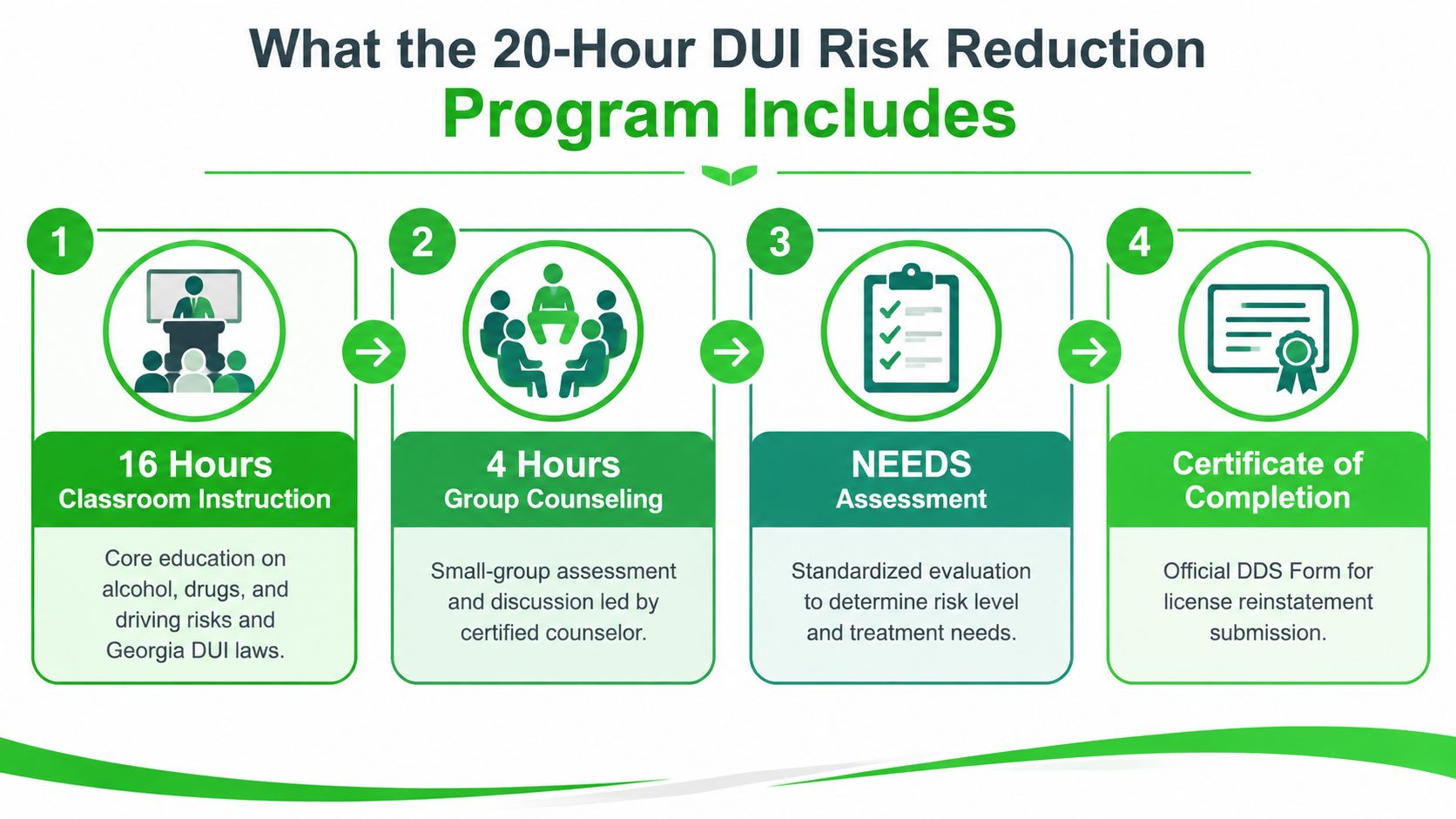
The state program has two required components, an assessment and an intervention component. Georgia law and the Georgia legislative program document require the assessment before intervention, and the intervention includes 20 hours of instruction. Completing only an evaluation doesn't produce the required certificate.
Confirm the deadline from your documents
Don't assume that completing the class automatically resolves every part of a case. A court may impose deadlines, probation may require separate paperwork, and DDS may require the certificate before reinstatement. If you miss a required deadline, the license consequence can continue until the agency receives acceptable proof and the driver completes the reinstatement process.
The provider should explain how the certificate is transmitted and what the court expects, but you should still keep your enrollment records, completion documents, and court order together. The exact filing method can depend on the program and agency instructions, so verify it before leaving the provider.
What the 20-Hour DUI Risk Reduction Program Includes
The 20-hour Risk Reduction Program combines education with an assessment process. It isn't a behind-the-wheel lesson, and it isn't satisfied by attending a shorter defensive-driving class.
Georgia DDS requires an assessment and an intervention component before issuing the Certificate of Completion. The intervention portion must include the mandatory 20 hours of instruction, and the assessment must occur in the required sequence.
Education, assessment, and personal impact
Approved programs address impaired-driving risks, alcohol and drug effects, decision-making, Georgia law, and consequences. The Victim Impact Panel is designed to expose participants to the human cost of impaired driving through accounts from people affected by crashes and related harm.
A clinical evaluation is a separate part of the process. A qualified assessor reviews the participant's circumstances and may identify treatment needs beyond the educational course. If additional services are recommended, completing the class alone may not satisfy every court or probation condition.
Attendance affects the certificate
You must complete both required components to receive the Certificate of Completion. A missed session, incomplete assessment, or course taken through a provider that DDS doesn't recognize can create a compliance problem even if you paid for instruction.
Ask these questions before the first session:
- Provider status: Is the school currently DDS certified for Risk Reduction?
- Course identity: Does the enrollment confirmation name Risk Reduction, not Driver Improvement?
- Assessment sequence: When and where will the required assessment occur?
- Certificate handling: Who submits proof to DDS and the court?
- Additional care: Could the assessment recommend treatment beyond the class?
The right provider will answer those questions without treating the assessment as an optional add-on. Your objective is not merely to attend hours. It's to complete the legally required sequence and make sure the resulting certificate reaches the agency that needs it.
How the 6-Hour Defensive Driving Course Works in Georgia
The Driver Improvement Course is the path often referred to as “defensive driving” for point reduction. Georgia DDS states that an eligible licensed Georgia resident can request a reduction of up to 7 points once every 5 years after completing a certified 6-hour course and submitting the original completion certificate to DDS under its points-reduction rules.
That course doesn't erase a DUI conviction, replace Risk Reduction, or undo every suspension. It addresses a different administrative problem, namely eligible points on a Georgia driving record.
What the class is designed to teach
A compliant course generally focuses on defensive decision-making, traffic-law awareness, hazard recognition, collision avoidance, and safer driving habits. Delivery may be available in a classroom or through an online option, but the provider and format must meet DDS requirements.
The course can also support insurance-related requests. DDS recognizes a legally required minimum 10% premium reduction for certain licensed drivers 25 or older who complete a qualifying defensive-driving course, as explained in the Georgia DDS driver-improvement program guidance. The insurer still controls its documentation process and eligibility review.
Choose it for points, not DUI reinstatement
| Feature | Driver Improvement | Risk Reduction |
|---|---|---|
| Course length | 6 hours | 20 hours |
| Primary use | Eligible point reduction and possible insurance benefit | DUI-related court or reinstatement compliance |
| Assessment | Not the DUI assessment process | Required assessment plus intervention |
| Certificate purpose | Driving-record administration | Legal and licensing compliance |
| Suitable substitute for the other course | No | No |
Before paying, ask whether the provider can submit the original certificate as DDS requires or explain the exact submission process. For a practical review of eligibility and course requirements, consult the Georgia defensive-driving course requirements. Don't enroll in Driver Improvement because the shorter schedule looks convenient if your notice specifically says Risk Reduction.
Real Georgia Scenarios That Show How the Rules Apply
A few realistic situations make the distinction easier to apply. These aren't legal case studies or predictions. They're examples of how a driver should sort the facts before enrolling.
An Atlanta first-offense DUI
A 27-year-old Atlanta driver receives a first-offense DUI conviction. The driver wants early reinstatement after the 120-day suspension period, but DDS requires proof of a DDS-approved Risk Reduction Program and the reinstatement fee before driving privileges can be restored, as described in the DDS first-offense DUI rules.
The correct first question isn't whether a six-hour class is available. It's whether the provider offers the 20-hour Risk Reduction Program, completes the required assessment sequence, and issues acceptable proof after the violation date. A Driver Improvement certificate won't answer that reinstatement requirement.
An Athens driver with points
A 45-year-old Athens driver sees several points on the Georgia record and wants an administrative reduction. That driver should investigate Driver Improvement eligibility, not enroll in DUI Risk Reduction unless a court or DDS notice separately requires it.
The DDS points guidance allows an eligible resident to request up to 7 points of relief once every 5 years after completing a certified six-hour course. The driver still needs to follow DDS submission instructions and confirm that the reduction applies to the record.
A student in southwest Georgia
A 19-year-old community-college student in rural southwest Georgia receives a court order requiring Risk Reduction. Work and transportation make scheduling difficult, so the student searches for an online option.
Approval and format require careful checking. DDS says online DUI completion certificates aren't accepted for DDS purposes, so the student shouldn't assume that any remote course meets the order. The student needs to verify the current provider and delivery method with the court and DDS before paying, especially if the certificate must support reinstatement.
Insurance, Points, and Reinstatement Benefits After Completion
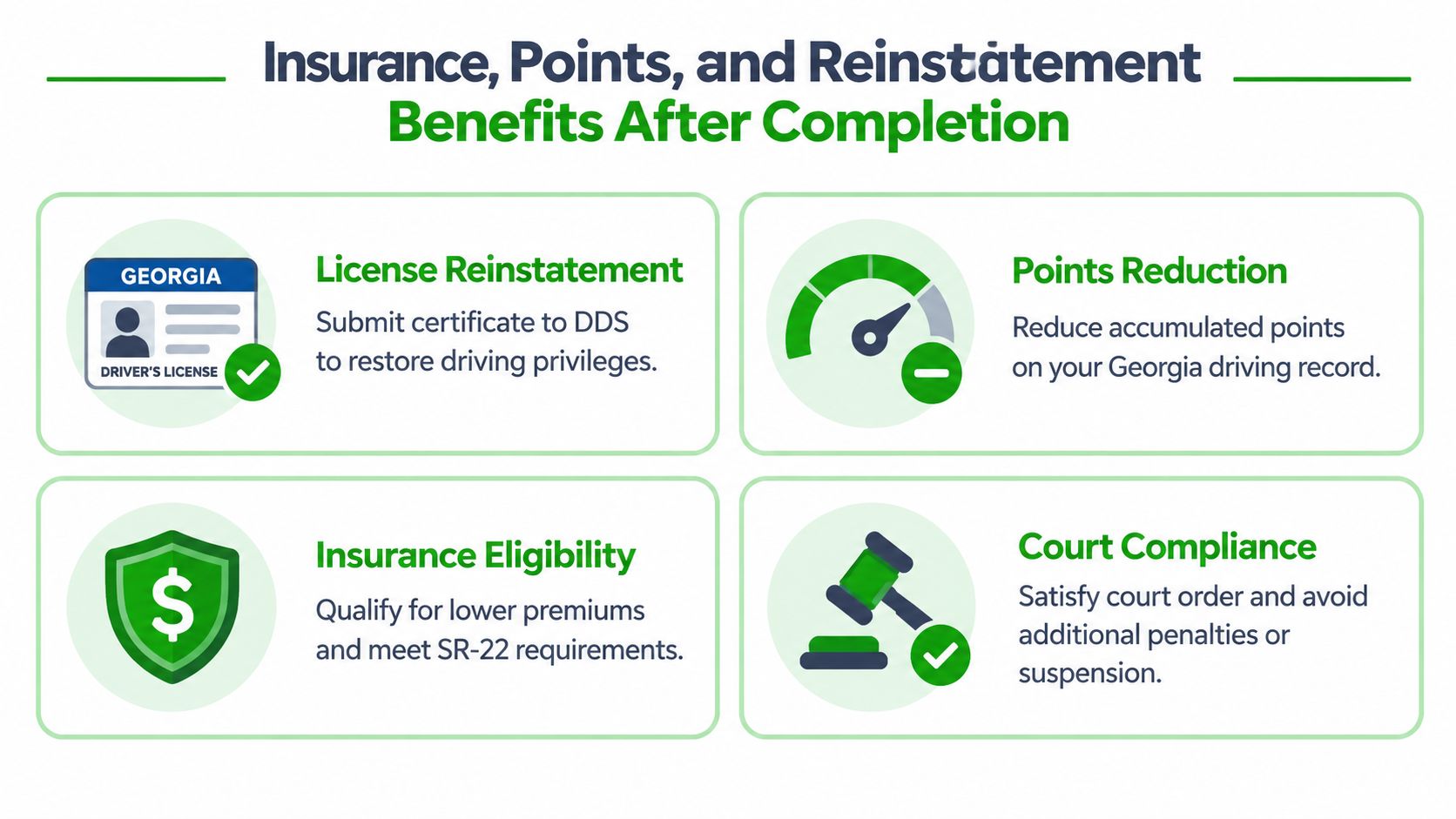
The value of the course depends on the outcome you need. Driver Improvement can support point relief and an insurance request. Risk Reduction can satisfy a DUI-related legal or licensing condition. Neither benefit exists merely because a driver attended a class, because DDS or the relevant court must accept the documentation.
For Driver Improvement, Georgia's administrative rule allows an eligible driver to request a reduction of up to 7 points once every 5 years after a certified six-hour course under DDS points-reduction guidance. The course doesn't guarantee that every point issue disappears, and it doesn't replace a suspension process when the record is otherwise ineligible.
Four outcomes to keep separate
- License reinstatement: Risk Reduction proof may be one required part of restoring privileges after a qualifying DUI suspension.
- Point relief: Driver Improvement may reduce eligible points when the driver satisfies DDS rules.
- Insurance eligibility: Certain licensed drivers 25 or older may qualify for a legally recognized minimum 10% premium reduction after a qualifying course, subject to the DDS framework and insurer procedures described by Georgia DDS.
- Court compliance: A court order may require Risk Reduction, an assessment, treatment, or other conditions beyond course attendance.
The financial consequence of choosing incorrectly can exceed the enrollment price. A rejected certificate may mean another enrollment, another appointment, more transportation problems, and continued licensing restrictions. Before submitting proof, ask the Georgia DDS driver-improvement program guidance or your provider how the certificate must be handled, then confirm with your insurer or court what additional paperwork it requires.
Enrollment Checklist and How to Avoid a Rejected Certificate
Treat enrollment as a document-control task, not just a class booking. Start with the notice that created the requirement, then match its wording to the provider's program name.
Complete these checks before paying
- Read the legal document. Identify whether it says Risk Reduction, Driver Improvement, defensive driving, assessment, treatment, or reinstatement.
- Verify the provider. Check the current DDS-approved provider listing before paying. Don't rely only on search advertising or a third-party directory.
- Gather your records. Have your Georgia license or permit information, court order, citation or disposition, and any prior completion records available if the provider requests them.
- Confirm the format. Ask whether the course is classroom, live virtual, or another delivery method accepted for your specific purpose. Online DUI certificates aren't accepted for DDS purposes, so this question matters.
- Review the certificate. Check your legal name, completion date, program type, provider information, and any identifying details before assuming the record is complete.
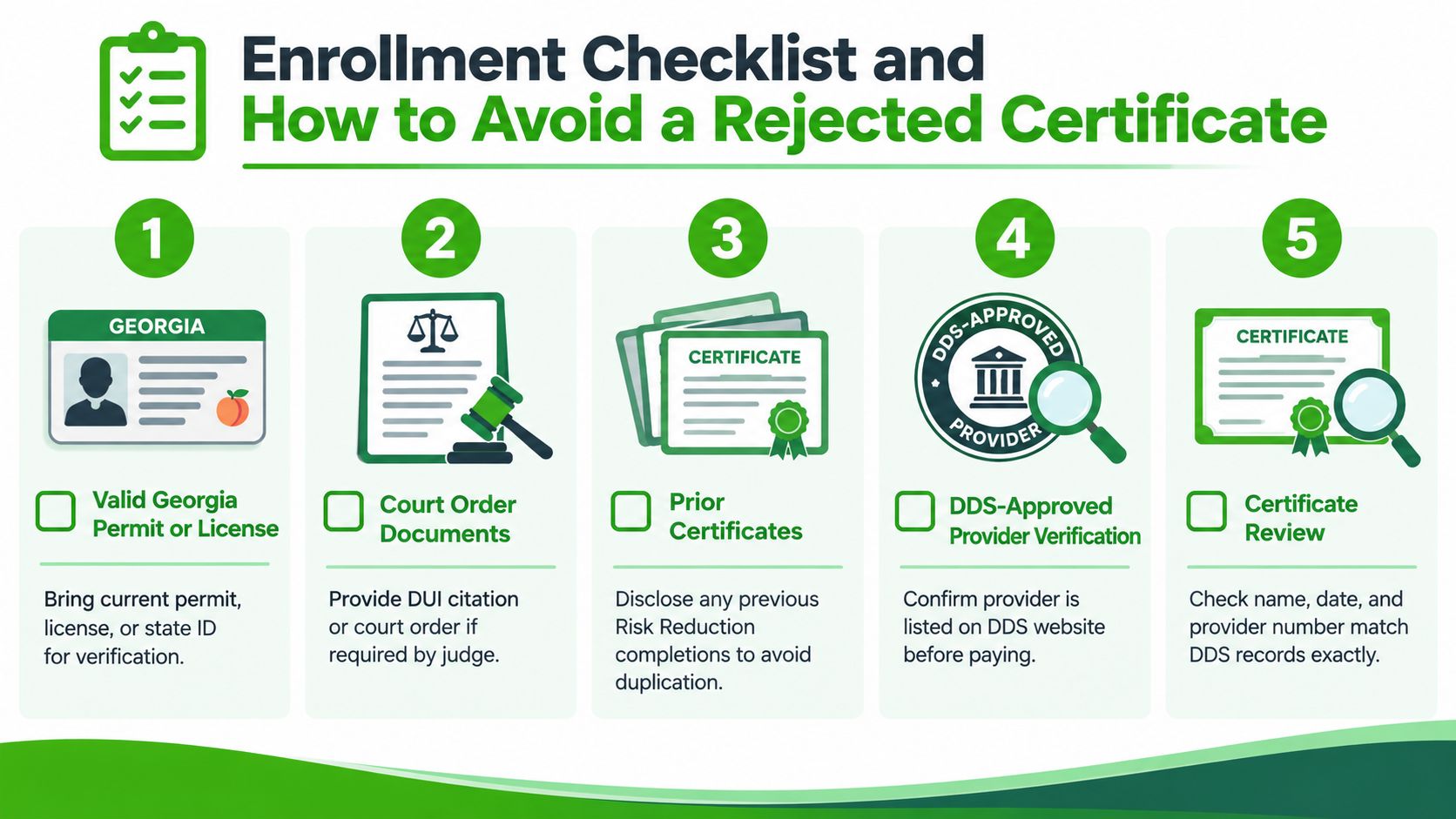
Common problems include a spelling mismatch, the wrong course title, incomplete attendance, an unapproved provider, or submission to the wrong agency. If a certificate is rejected, contact the provider first and ask for the specific correction process. Keep copies of every document, including the court order, enrollment confirmation, certificate, and submission receipt.
Before you rely on completion: Confirm that DDS has received and accepted the certificate, rather than assuming the provider's attendance record automatically closes the matter.
Georgia's driver-ed system becomes much easier to handle when you make the first decision correctly. DUI or related court and reinstatement requirement means Risk Reduction. Eligible points or a defensive-driving insurance request means Driver Improvement. A teen licensing path involving Joshua's Law is a separate question and shouldn't be confused with either adult program.
Georgia DUI Schools offers DDS-approved DUI/Risk Reduction, clinical evaluation, Victim Impact Panel, and defensive-driving options, with classroom and flexible online formats available for Georgia drivers. Review your notice first, then visit Georgia DUI Schools to choose the course and compliance support that match your requirement.