
A Georgia DUI often feels less like one case and more like ten separate problems at once. You may be dealing with a court date, a license suspension notice, work transportation, insurance questions, and pressure from family members who need you to keep moving. Individuals aren't confused because they aren't trying. They're confused because Georgia splits the process between the court system and the Department of Driver Services, and those are not the same thing.
That's where an ignition interlock restricted license starts to make sense. It gives some drivers a controlled path back onto the road instead of leaving them with a total loss of mobility. The key is understanding what belongs to the judge, what belongs to DDS, and what belongs to you.
Your Path Back to Driving After a Georgia DUI
A common Georgia scenario goes like this. Someone is arrested for DUI, gets out, and immediately starts asking the same questions: Can I still drive to work? Do I need a class first? Is the judge the one who gives me the permit? What if DDS says something different from the court?
Those questions are reasonable. A DUI affects basic daily tasks fast. Getting a child to school, showing up for a shift in Atlanta traffic, making a treatment appointment in Athens, or just keeping a job becomes harder the moment your license is at risk.
An ignition interlock restricted license exists because many states no longer treat pure suspension as the only answer. State programs in places like Pennsylvania describe this model as a way to allow limited driving only after installation of a breath-based ignition interlock device, which reflects a broader shift toward monitored driving instead of total inactivity (Pennsylvania DMV).
That matters in Georgia because the practical question usually isn't, “Was I punished?” It's, “What exactly do I need to do next so I can legally drive again?”
If you're also comparing how different states handle DUI cases, this overview of DWI dismissal in Texas can help you see how much procedure varies by state, especially between criminal court outcomes and license consequences.
Before you chase paperwork in the wrong order, it helps to understand the broader compliance path, including treatment-related steps that can affect your return to driving through the return-to-duty process.
What Is a Georgia Ignition Interlock Restricted License
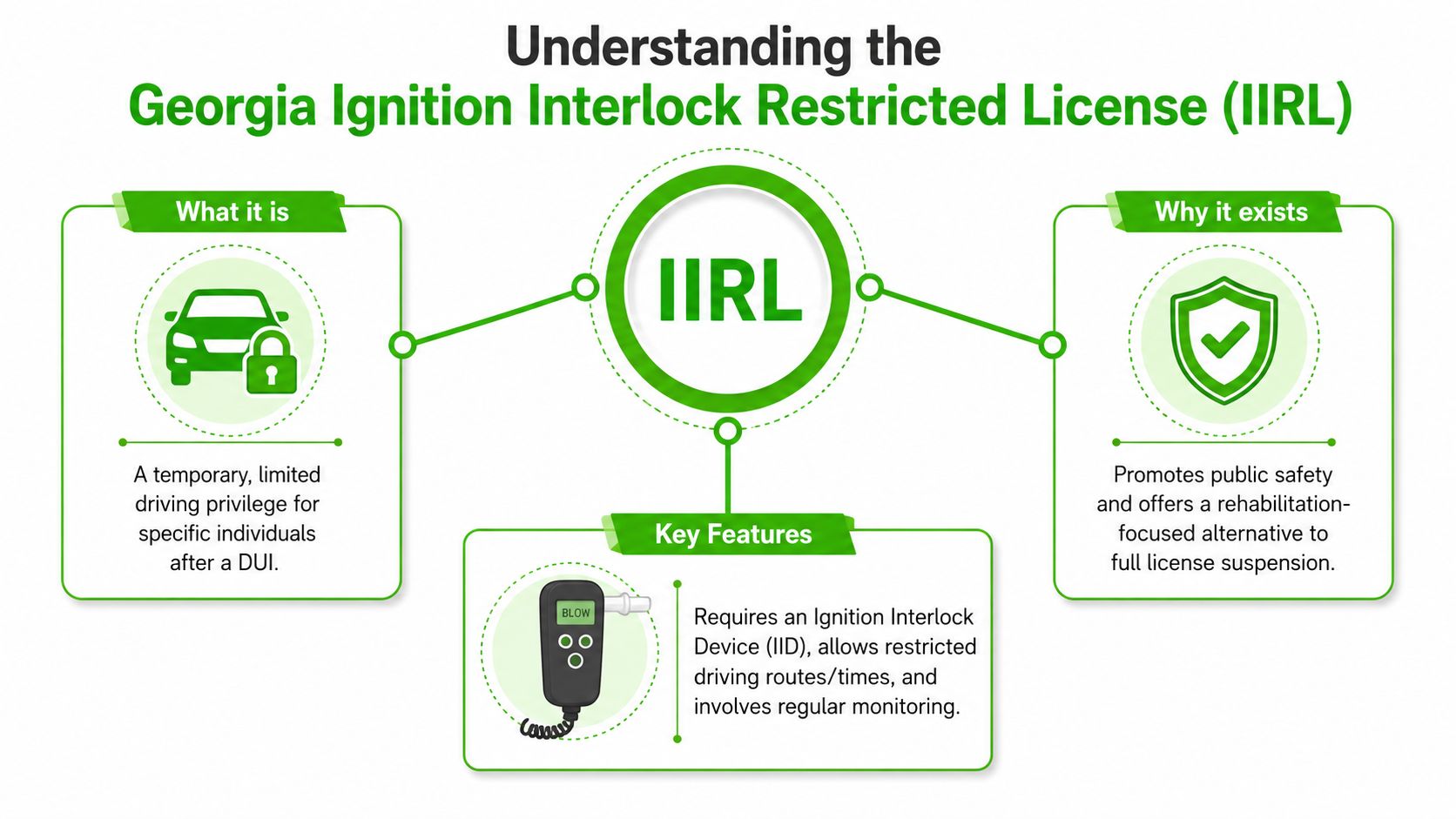
A Georgia ignition interlock restricted license gives you a limited legal way to drive after a DUI, but only if you meet a specific equipment condition. DDS is not giving full driving privileges back early. DDS is allowing driving under supervision, with an ignition interlock device installed on the vehicle you use.
How the restriction actually works
The restricted license functions much like a regular license in day-to-day use, except that your legal ability to drive is tied to an ignition interlock device, or IID. Before the car starts, the device requires a breath sample. If it detects alcohol above the programmed limit, the car will not start.
That arrangement is not just a formality. The CDC states that ignition interlocks reduce repeat impaired-driving behavior by about 70% while the device is installed and reduce alcohol-impaired driving rearrest rates by a median 67% while installed (CDC ignition interlocks).
In practical terms, the license and the device go together. If the restriction requires interlock, you do not have a usable driving privilege without a properly installed and maintained IID.
Practical rule: Treat the restricted license as supervised driving authority, not as a return to normal driving.
What drivers often misunderstand
A Georgia ignition interlock restricted license does not restore full privileges. It also does not cancel anything the court ordered. You still have to follow every licensing rule, every device rule, and every court condition that applies to your case.
This distinction is critical, as many drivers make their first big mistake here. They leave court with paperwork, assume that paperwork alone lets them drive, and then find out DDS has not issued the restricted privilege or the device has not been set up correctly.
There is also a real-world problem people overlook until late in the process. If you do not own a car or do not have reliable access to a vehicle that can accept an interlock, the restricted license may be harder to use than it sounds on paper. Georgia may allow the restricted privilege, but compliance still depends on having an approved vehicle, proper installation, and regular service records. For many students, that is the difference between being technically eligible and successfully getting back on the road legally.
Confirming Your Eligibility and Navigating the Court
You leave court with paperwork in hand, relieved that the hearing is over, and assume you can start driving again soon. Then DDS says your status is not eligible yet, or the order does not say enough for them to act on it. That is one of the most common Georgia interlock problems I see.
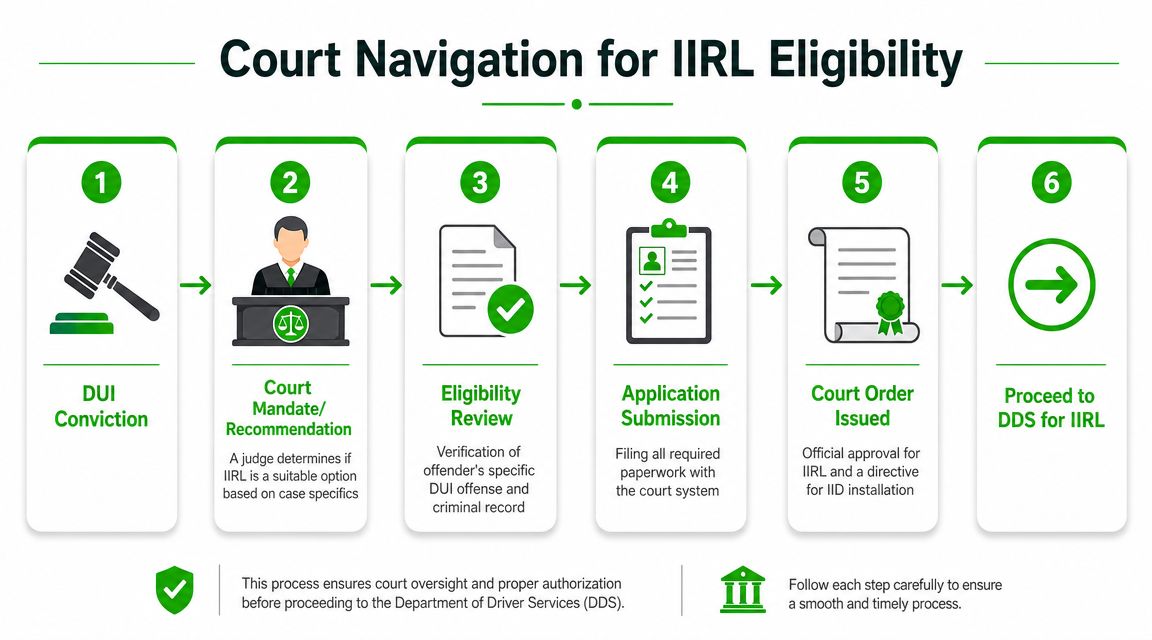
The court and DDS do different jobs. The court handles the criminal case and can order conditions tied to your DUI. DDS decides whether your driving privilege can be issued, restricted, or restored. If you treat those as the same process, delays usually follow.
What the court usually handles
In Georgia, the court side usually answers these questions:
- What was ordered in the DUI case
- Whether ignition interlock is part of the sentence or a condition tied to limited driving
- Whether you must complete DUI school, a clinical evaluation, or treatment
- What written language appears in the final order
That last point causes more trouble than drivers expect. DDS and interlock vendors work from the written order, not from what someone remembers hearing in the courtroom.
A judge can require an interlock device. That does not automatically create a valid restricted license. You still have to confirm that your DDS record, suspension basis, and paperwork line up with that order.
What to confirm before you leave court
Before you walk out of the courthouse, get clear answers to these points:
Is interlock required because of this sentence, or because it is part of the path to limited driving?
Those can overlap, but they are not always the same issue.Do you have a signed written order that clearly states the requirement?
Verbal instructions are not enough for later paperwork problems.Does the order match your exact case status?
Wrong dates, missing case details, or vague wording can slow DDS processing.Were other conditions ordered before you can lawfully drive?
Drivers often focus on the device and overlook DUI school, evaluation, treatment, or insurance requirements.If you do not own a car, what is your actual compliance plan?
Georgia can allow the restricted privilege on paper, but you still need lawful access to a vehicle that can have an approved device installed and serviced.
That last issue gets missed all the time. A person may be eligible for interlock and still have no workable vehicle. If you rely on a family member's car, ask early whether that vehicle will be available for installation, monthly service visits, and daily use without causing insurance or household problems.
Separate legal eligibility from practical readiness
Court eligibility is only one part of the process. Practical readiness is what keeps people from getting stuck.
Check these points while the case details are still fresh:
- Which vehicle you will drive
- Whether that vehicle can be fitted with an approved interlock
- Whether you have any other holds, suspensions, or unresolved DDS issues
- Whether an employer vehicle creates separate restrictions or paperwork questions
- Whether your documents are organized well enough for DDS to review them without sending you back
I tell students to keep one folder, paper or digital, with every item tied to the case. Include the court order, any DDS notice, your driving record information if available, class paperwork, and any insurance or reinstatement documents you have already been told to provide. If you need help sorting out identity and driving paperwork, this guide to documents needed to legally drive in Georgia is a useful starting point.
Repeat offenses, refusals, and other case details that change the answer
Georgia drivers get in trouble when they assume every DUI follows the same interlock path. It does not. A prior DUI, an implied consent refusal, or a separate administrative suspension can change what DDS will allow and when.
Do not rely on a friend's timeline. Do not assume that because court mentioned interlock, DDS will issue the same type of restricted privilege in your case. The reason for the suspension matters, and so does the exact wording of your order.
If something in your history is not straightforward, slow down and verify it before you drive. One extra call and one corrected document are a lot easier than explaining a new violation later.
Your Step-by-Step Georgia DDS Application Guide
Once the court side is clear enough to move forward, DDS becomes the center of the process. This is the part that feels bureaucratic, but it's manageable if you treat it like a checklist instead of a debate.
Start with document control
Bring your paperwork together before you contact DDS. That usually means gathering:
- Court paperwork that shows the interlock-related requirement or authorization
- Personal identification documents accepted by DDS
- Proof connected to your driving status if DDS has asked for reinstatement-related items
- Any required class or compliance records if they are already part of your path back
If you're unsure what Georgia accepts as legal driving paperwork and identity support documents, use this guide on documents needed to legally drive before you make the trip.
Keep the DDS side separate from the court side
Here's the cleanest way to approach it:
Confirm your current DDS status first
Don't assume your status changed because court ended.Match the DDS requirement to the exact court paperwork you have
Small wording problems create big delays.Ask what form or permit process applies to your case
Georgia updates forms and instructions over time, so use the current DDS process.Submit only what DDS needs
Extra papers don't always help. Sometimes they create confusion.
What usually slows people down
Most delays come from one of four problems:
| Problem | Why it causes trouble | Better move |
|---|---|---|
| Incomplete court order | DDS can't tell what privilege is authorized | Get corrected language before applying |
| Wrong timing | Driver applies before satisfying a required condition | Verify sequence first |
| Missing identity documents | DDS can't issue the credential | Build a document packet in advance |
| Assuming vendor installation equals permit approval | Device installation alone doesn't create legal driving status | Wait for DDS confirmation |
Fill out forms carefully, not quickly
A lot of drivers rush through forms because they're tired of the process. That's understandable, but sloppy answers create avoidable setbacks. Use the same name format across every document. Make sure your address matches your supporting records. Read any restriction language twice.
Bring copies of everything and keep the originals organized. If DDS asks a follow-up question, you want to answer it in one trip, not three.
If something in your case involves a second issue, such as an unresolved suspension from another event or an insurance filing that hasn't posted yet, address that before assuming the ignition interlock restricted license will be issued. Georgia's system tends to move once every condition is aligned. Until then, it doesn't.
Choosing and Installing Your Ignition Interlock Device
Paper approval is only half the job. The other half is installing the device correctly, with the right vendor, in the right vehicle.
What the device actually does
An IID is a breath-alcohol starter interlock. You blow into it before the engine starts, and the device immobilizes the vehicle if alcohol is detected above its programmed limit. Texas also describes an important practical feature used in many programs: rolling retests during operation, which means compliance continues while you're driving, not just when you start the car (Texas DPS ignition interlock devices).
That one point changes how you should think about daily use. This isn't just install it and forget it. It becomes part of your routine.
How to choose a vendor without making this harder
You want a Georgia-approved provider, clear service scheduling, and a location you can realistically reach for regular maintenance. Fancy sales language matters less than reliability, appointment availability, and technician competence.
Use these criteria when comparing vendors:
- Distance from home or work. If servicing is inconvenient, missed appointments become more likely.
- Scheduling flexibility. Early morning and late-day appointments help working drivers.
- Training quality. You need a technician who explains lockouts, retests, and what to do if the device prompts while driving.
- Support response. If the unit alerts or malfunctions, you need help quickly.
Georgia DDS-Approved IID Vendor Comparison Estimates
| Vendor | Estimated Installation Cost | Estimated Monthly Monitoring Fee | Key Feature |
|---|---|---|---|
| Intoxalock | Varies by vehicle and service location | Varies by program terms | Broad service network and frequent appointment availability |
| Smart Start | Varies by vehicle and service location | Varies by program terms | Straightforward interface and established service model |
| LifeSafer | Varies by vehicle and service location | Varies by program terms | Known for technician-guided onboarding |
| Draeger | Varies by vehicle and service location | Varies by program terms | Focus on device training and compliance support |
Because vendor pricing and package terms change, confirm actual cost directly with the provider before installation. Don't rely on a friend's old receipt.
What happens at installation
The appointment usually includes:
- Vehicle inspection and setup
- Physical installation of the IID
- Basic training on how to provide a sample
- Instruction on retests, lockout warnings, and service dates
- Documentation for your compliance file
A good technician will also explain what to do if you drive more than one vehicle, whether an employer-owned vehicle creates extra issues, and what counts as a violation. If they don't explain those things, ask.
One practical point from years of seeing students struggle with this step: choose the service center you can return to consistently. The “cheapest” option becomes expensive fast if it causes missed visits, confusion, or repeat travel.
Living with the IID and Staying Compliant
Most interlock problems don't start with deliberate misconduct. They start with routine sloppiness. A missed service date. A bad assumption about a borrowed car. A driver who thinks one failed test “won't matter.”
That's not how interlock compliance works.
What compliance actually means
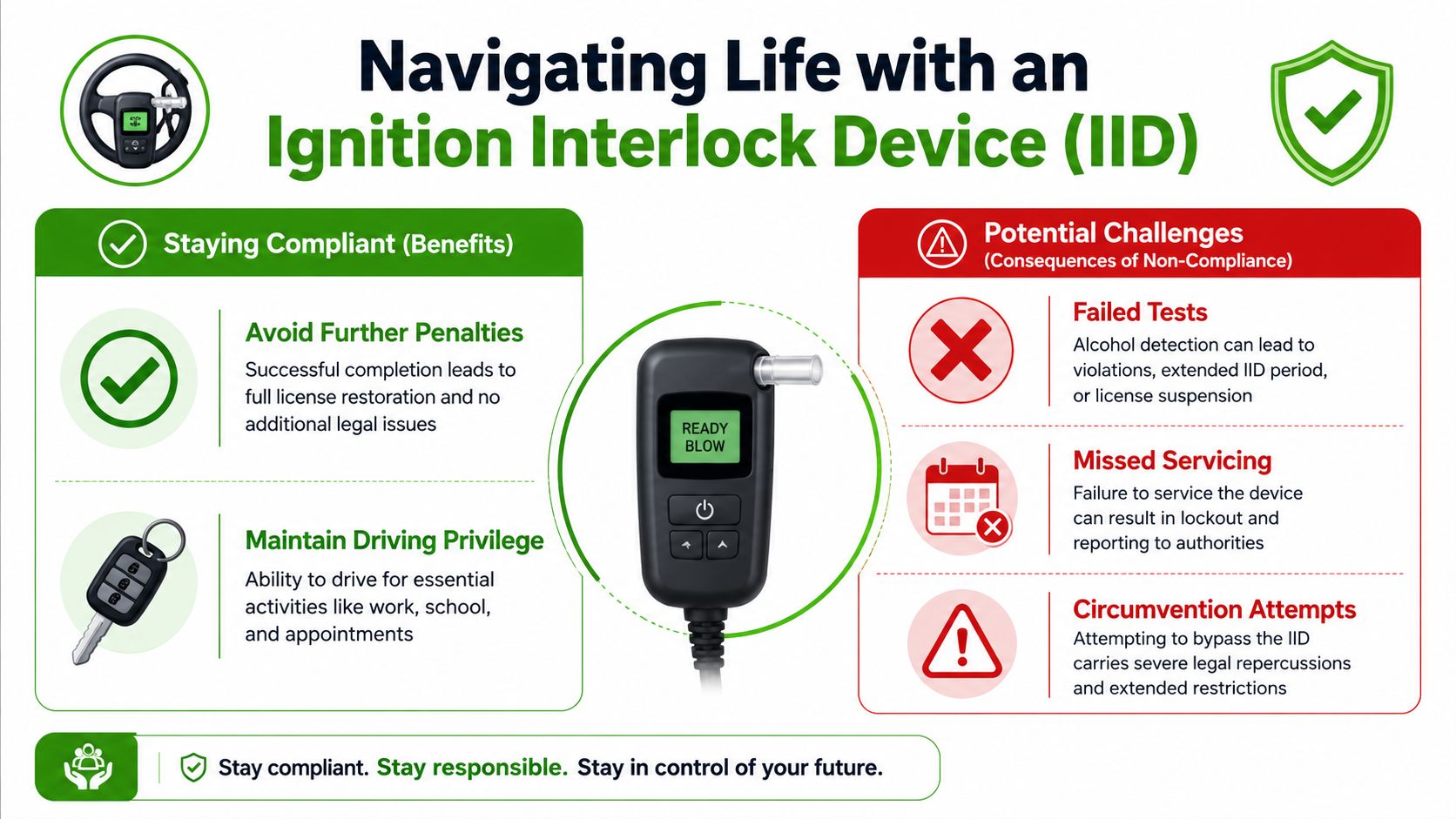
Compliance is more than carrying the license card. Utah's public guidance makes the larger rule very clear: compliance is measured through installation, clean testing, uninterrupted service, and proper vehicle coverage, and violations such as tampering or driving an unequipped vehicle can lead to fines, imprisonment, and extension of the IID period (Utah IID guidance).
That's a useful framework for Georgia drivers because it reflects how these programs are managed in practice.
Daily habits that help
Use habits, not hope.
- Wait before testing if you've used anything strong in your mouth. Mouthwash, some sprays, and certain products can create trouble.
- Build in extra morning time. If you're already late, you're more likely to rush and make mistakes.
- Treat service dates like court dates. Missing one can create a lockout or a report.
- Keep your vehicle plan simple. If you aren't sure whether you may drive a particular car, don't drive it until you verify.
A clean interlock record usually comes from boring consistency. Same vehicle. Same routine. Same attention every day.
What does not work
Some approaches fail over and over:
- Trying to “beat” the machine. That creates bigger legal trouble.
- Letting someone else handle your sample. That can be treated as circumvention.
- Ignoring prompts or warnings. The device records events.
- Assuming missed maintenance can be explained away later. By the time you explain it, the violation may already be logged.
If something goes wrong
If the device gives an unexpected reading, don't panic and don't improvise. Follow the vendor's instructions exactly. Document what happened. Get to your service appointment or support contact quickly.
Drivers also need to remember that an ignition interlock restricted license usually applies to the privilege to drive, not just to one favorite car. If your permitted driving is tied to an equipped vehicle, then driving an unequipped vehicle can create a serious setback even if your main vehicle is compliant.
The Complete Picture SR-22 DUI Courses and Evaluations
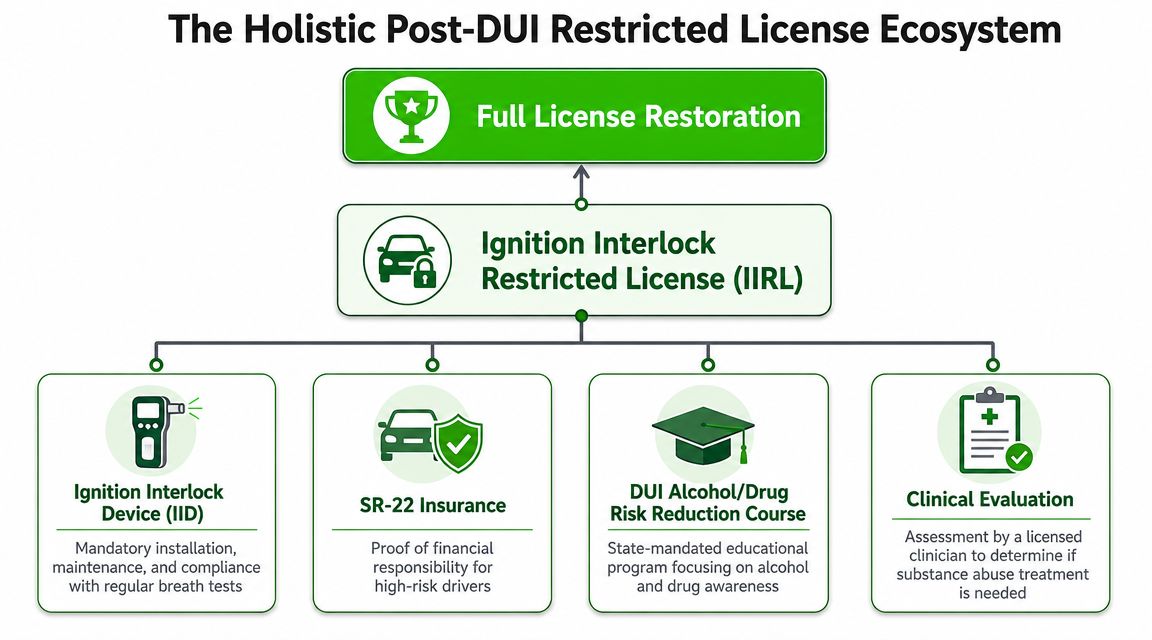
An ignition interlock restricted license is only one part of getting back to full legal driving. Many Georgia drivers focus on the device because it's visible, but the less visible requirements often decide how long the process takes.
The four pieces people usually juggle
| Requirement | Why it matters |
|---|---|
| IID compliance | Controls restricted driving privileges and ongoing monitoring |
| SR-22 or high-risk insurance filing | Shows financial responsibility when required |
| Georgia DUI or Risk Reduction course | Often necessary for reinstatement and court compliance |
| Clinical evaluation or treatment | May be ordered by court or needed based on assessment results |
The practical problem is that drivers often complete one item and assume the system will “know” they're done. It usually won't unless the right agency, court, insurer, or provider has processed the record.
Don't overlook the course and evaluation side
Georgia drivers regularly underestimate the education and clinical side of a DUI case. The device may get you moving again, but a missing course certificate or incomplete evaluation can stop license restoration just as fast as a paperwork problem.
If your case includes work-related substance testing, treatment oversight, or return-to-duty questions, this explanation of what the SAP program is helps separate that process from ordinary DUI class requirements.
Georgia DUI Schools is one DDS-approved option for DUI/Risk Reduction courses, clinical evaluations, ASAM Level 1 treatment, and Victim Impact Panels, which matters when you're trying to complete multiple obligations through providers that meet state requirements.
The fastest path back is usually the most organized one. Keep proof of every completed requirement and confirm where it has to be sent.
Mobility issues go beyond your own car
One issue many drivers don't expect is that DUI consequences can affect more than licensing. They can spill into practical travel problems, including rental access. If that's part of your situation, this breakdown of the impact of DUI on car rentals is worth reviewing before you make assumptions about business trips or vacation plans.
Common Pitfalls and Your Next Steps
The most overlooked problem is the no-car issue. Many drivers assume that if they don't own a vehicle, they don't have to worry about interlock compliance yet. That assumption can be wrong. Guidance from Pennsylvania's DUI Association highlights a point that applies broadly to how these programs are designed: the restriction is often placed on the person's driving privilege, not just on a personally owned car, and even non-owners may still need to obtain and hold the restricted interlock license (Pennsylvania DUI Association).
That same logic should shape how Georgia drivers think. If you may need to drive a borrowed vehicle, a family car, or in some situations an employer vehicle, ask the question early. Don't wait until after your permit is issued to learn that the vehicle itself creates a compliance problem.
Other common mistakes are simpler, but just as damaging:
- Missing the difference between court approval and DDS issuance
- Installing a device before confirming the exact administrative step
- Driving a vehicle that isn't properly covered by the restriction
- Treating service appointments like optional maintenance
- Finishing the interlock part while ignoring the class, insurance, or evaluation part
The drivers who get through this cleanly aren't always the ones with the easiest cases. They're usually the ones who stay organized, keep copies, ask questions before acting, and don't try to shortcut the process.
If you need to complete the education side of a Georgia DUI case so you can move toward license restoration, start with the state-required DUI/Risk Reduction course at Georgia DUI Schools.