
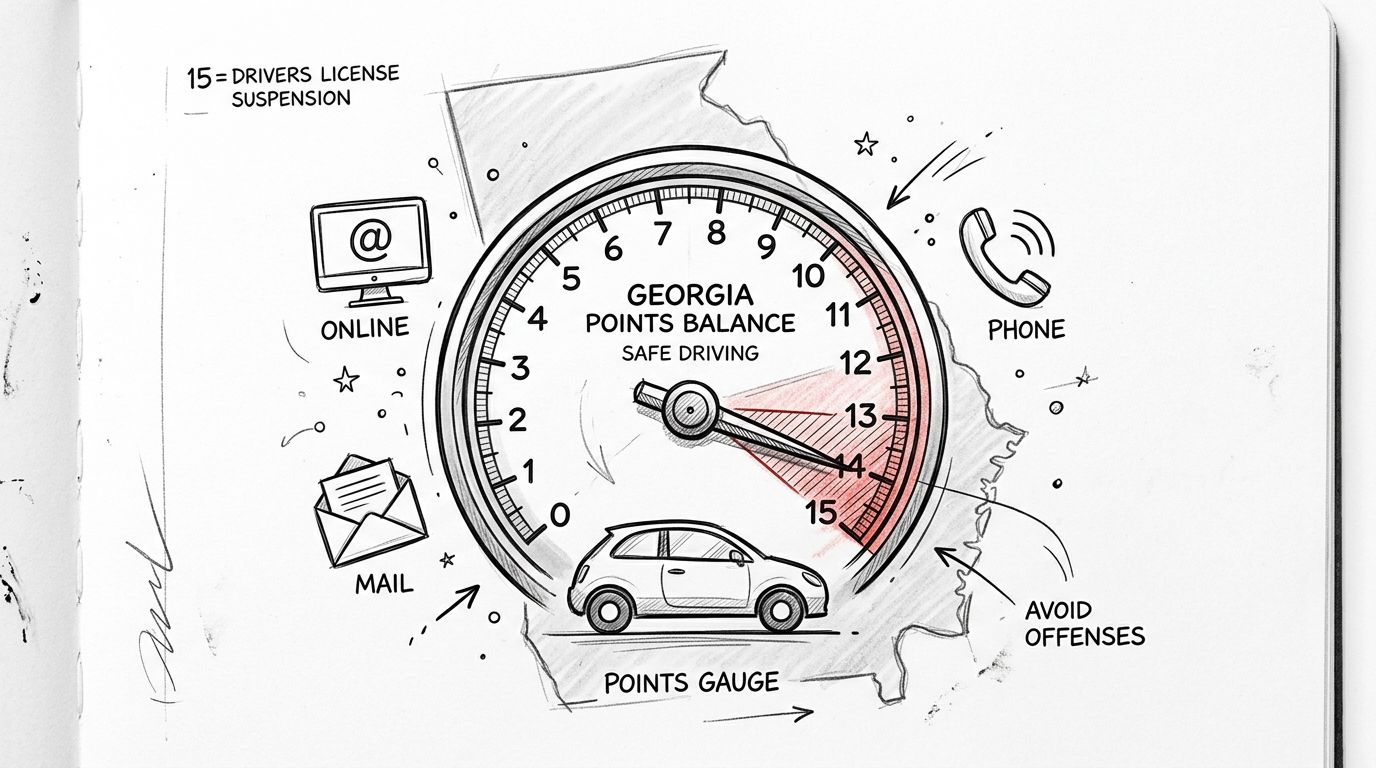
A lot of Georgia drivers start paying attention to their safe driving points balance after the second ticket, not the first. One citation feels manageable. Then another one lands, and the question changes from “How much is this going to cost me?” to “Am I getting close to losing my license?”
That's the right question.
In Georgia, your point balance isn't just a line on a record. It's a risk meter. If you know where you stand early, you have options. If you wait until DDS flags a suspension problem, your choices narrow fast. I tell drivers this all the time. Don't treat points like background noise. Treat them like something to manage on purpose.
Understanding Georgia's Driver Point System
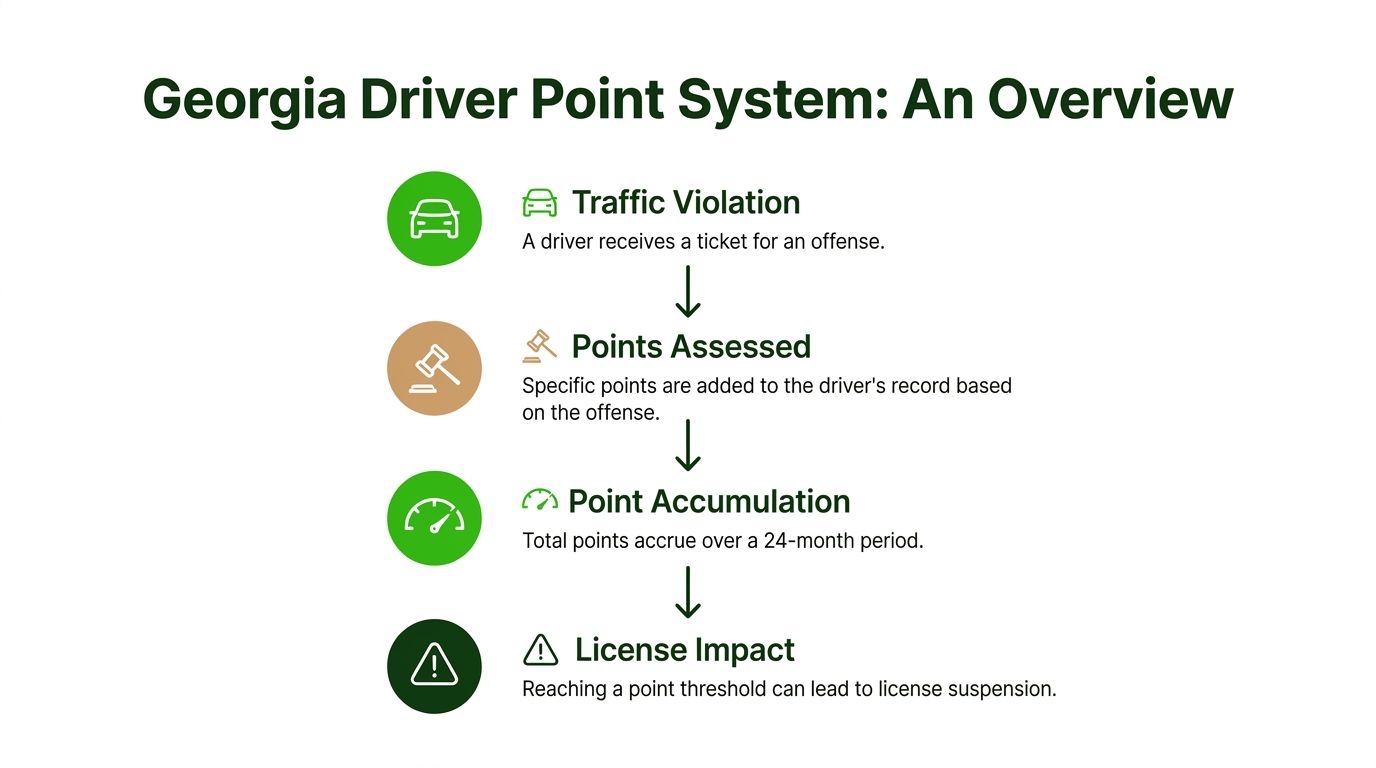
A second ticket is usually when the point system stops feeling abstract. A driver pays one fine, shrugs it off, then gets cited again months later and realizes DDS is tracking a pattern, not just a single mistake. Your safe driving points balance functions as a risk indicator for the state. If that number keeps rising, the problem shifts from cost to license security.
What points actually mean
Georgia assigns point values to many moving violations based on severity. Lower-level offenses add less. More dangerous behavior adds more. In practice, that means one careless stretch of driving can matter a lot more than drivers expect, especially if there is already a prior conviction on the record.
The key is to stop looking at tickets one by one. DDS does not view your record that way. It looks at the total pattern over time. I tell drivers this often in class. A fine is temporary. A point history can keep causing problems after the court date is over.
Practical rule: Judge every ticket by two questions. What will it cost today, and what will it add to your record?
Why drivers need to watch the balance
Drivers often focus on the payment deadline, court appearance, or insurance increase. Those matter. Your point balance is the piece that can put your license at risk, which is why checking it after any conviction is a smart habit.
That risk-management mindset matters more than people realize. Two ordinary-looking violations in different counties can combine into a much bigger DDS problem. The earlier you catch that trend, the more options you usually have to respond before suspension becomes a real concern.
If you have driven elsewhere and want a comparison, how Florida license points impact drivers shows how another state tracks repeat violations. The systems are different, but the lesson holds up. Drivers who monitor their record early usually have more room to correct course.
For added context on violations that can affect your record, review Georgia driving laws and traffic rules. That helps explain why some citations carry heavier consequences and why managing your points balance should be an ongoing habit, not a last-minute reaction.
How to Check Your Georgia Safe Driving Points Balance
You can't manage what you haven't verified. Many drivers guess at their point total based on memory, and that's where mistakes start. If you're worried about your license, get your actual driving record and work from that.
Check online first
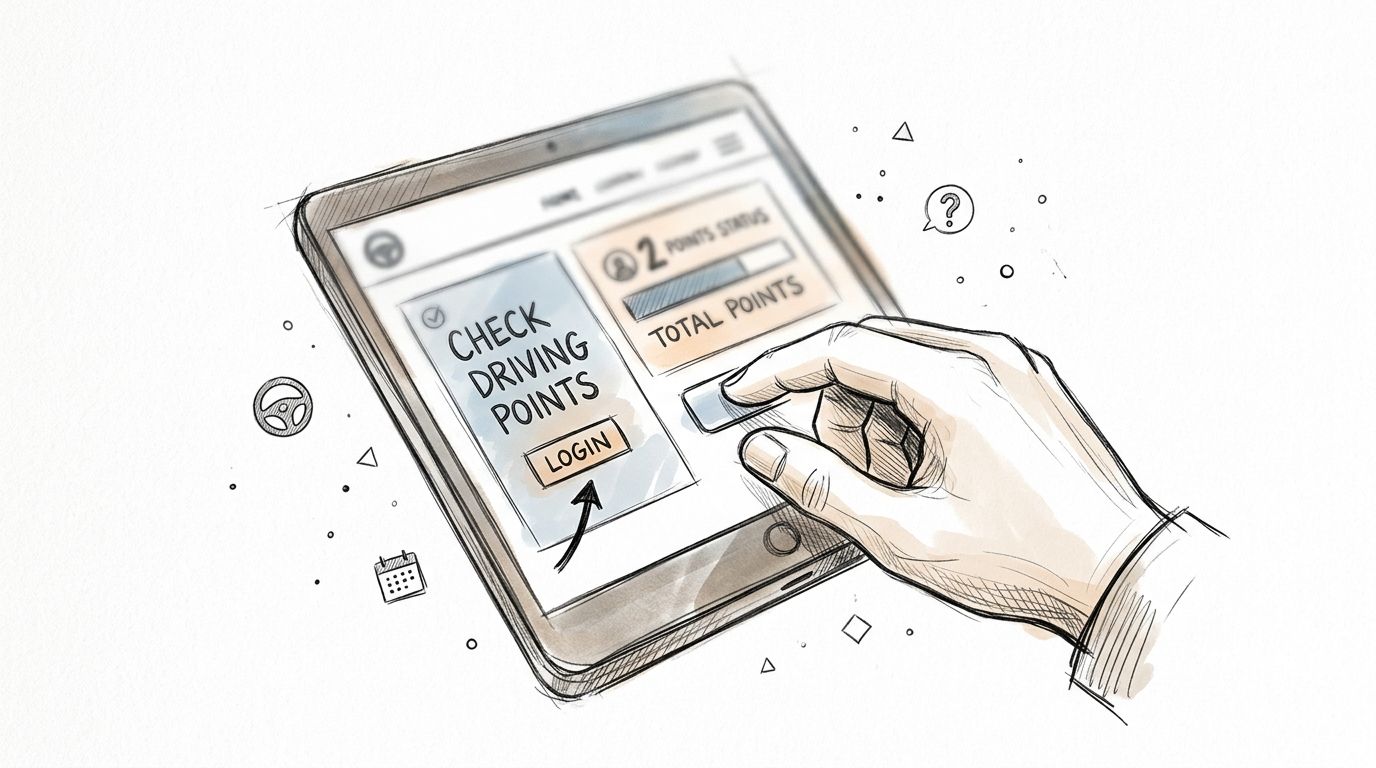
Often, the fastest route is the DDS online system. Have your license information and personal identifying details ready before you begin. Use the official DDS channels so you're looking at the same record the state uses.
What you're looking for isn't just a list of tickets. You want the full picture:
- Current point total so you know your present risk level
- Conviction entries so you can match each violation to what's on file
- Dates because timing affects how DDS views your record
Check by mail if you want paper records
Some drivers prefer to request records by mail, especially if they want a paper trail for an attorney, employer, or court matter. If you go this route, make sure every identifying detail is accurate. Mailing errors slow everything down.
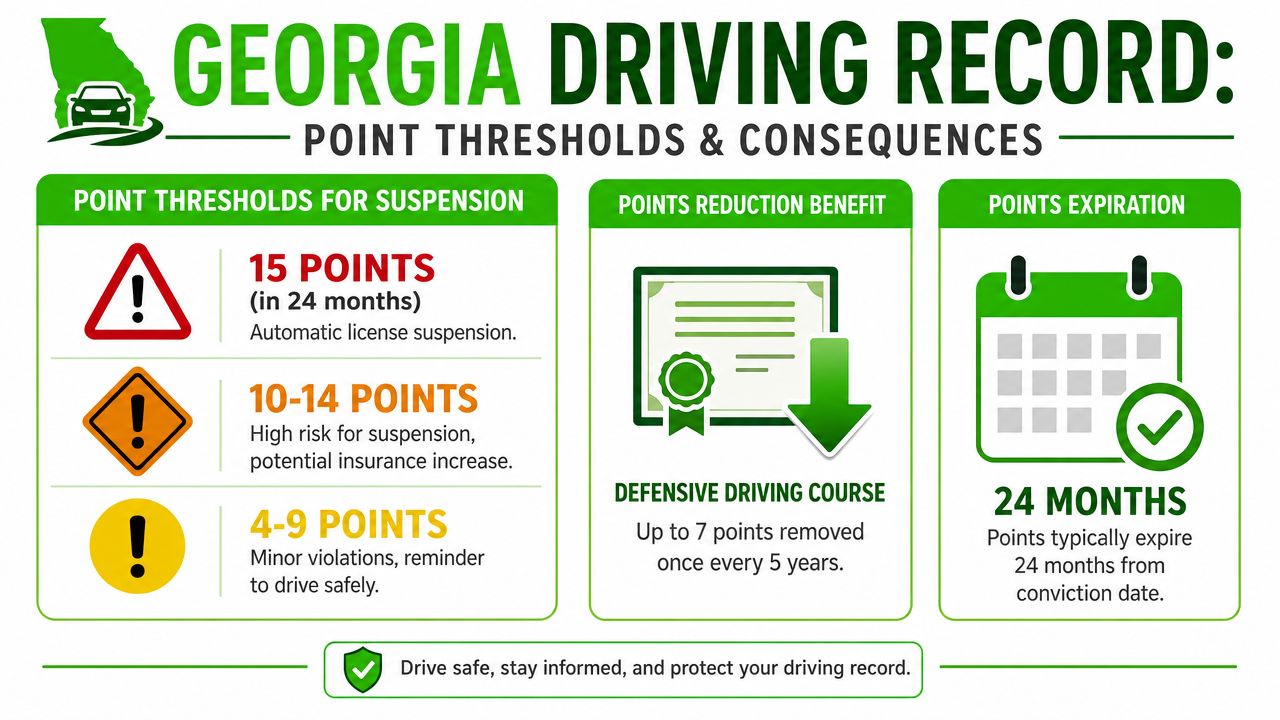
One point worth knowing now: for drivers age 21 and over, Georgia DDS imposes automatic license suspension at 15 or more points within a 24-month period, and a driver who completes a certified defensive driving course must send the original certificate to DDS at P.O. Box 80447, Conyers, Georgia 30013 to reduce the balance, as explained in this Georgia DMV point system guide.
If your point total is climbing, don't wait to “see what happens.” DDS already has a system for what happens next.
Go in person when you need clarity
An in-person DDS visit can help if your record seems confusing or you need to confirm what was received and posted. This is often the best option for drivers who've moved recently, have name changes, or are trying to line up paperwork before a deadline.
Before you go, it helps to review Georgia DDS contact information, including customer service center details. Showing up with the right documents saves time and lowers the chance of making a second trip.
What to look for on the record
Once you have your driving record, slow down and read it carefully. I'd focus on three questions:
- Which convictions are carrying points
- Whether those points place you near a suspension threshold
- Whether you need to act now instead of later
That last question matters most. A safe driving points balance only helps you if you use it to make a decision.
Interpreting Your Driving Record and Point Thresholds
Once you have the record in hand, the next step is judgment. Not panic. Judgment. A driver with a low point total needs awareness. A driver close to the limit needs a plan.
The thresholds that matter most
Georgia uses different suspension standards depending on age. According to Georgia guidance on removing points from a driving record:
Drivers age 21 and older face automatic suspension upon accumulating 15 or more points within any 24-month period.
Drivers under 21 are suspended if they receive a single conviction worth 4 or more points or accumulate 4 points within any 12-month period.
For adult drivers, the danger zone isn't only the suspension number itself. It's the territory right below it. If an adult driver is sitting at 14 points, that driver isn't “probably okay.” That driver is one more qualifying conviction away from automatic suspension.
Reading risk, not just totals
Here's a simple way to interpret your record:
| Balance range | What it usually means |
|---|---|
| Lower balance | You still have room to correct habits before DDS action becomes urgent |
| Mid-range balance | You need to drive carefully and stop adding violations |
| Near-threshold balance | You should treat every trip as if your license depends on it, because it might |
For younger drivers, the margin is much tighter. A single serious conviction can trigger immediate problems. That's why families in places like Marietta, Decatur, or Athens need to pay attention early when a teen or college-age driver gets cited.
A driving record doesn't just tell you what happened. It tells you how close you are to a licensing problem.
The Consequences of Exceeding Point Limits
Once a driver crosses the line, life gets harder in practical ways fast. Work commutes become a problem. School schedules get complicated. Family responsibilities don't stop because DDS says your driving privilege is suspended.
This is why I push proactive action instead of last-minute scrambling. Suspension is not a paperwork nuisance. It interrupts daily life, and getting back on the road often takes more effort than drivers expect.
What point reduction does not do
A lot of drivers misunderstand this part. They assume reducing points means cleaning up the entire record. It doesn't work that way.
As explained in this discussion of DMV point mechanics, a common misconception is that safe driving points erase convictions. They don't. They offset negative point totals, but the underlying conviction remains visible on the driving record, which can still affect insurance even after the point balance improves.
Why acting early works better
Waiting until suspension is already in motion usually means more stress, less flexibility, and more administrative headaches. By contrast, a driver who checks the record early and takes the right approved course has a chance to reduce risk before DDS takes the next step.
That's the trade-off. You can spend a little time now dealing with the point balance, or you can spend a lot more time later dealing with a suspended license and everything that comes with it.
Proactively Reducing Your Points with Defensive Driving
A lot of Georgia drivers wait too long on this step. They watch the balance rise, hope nothing else lands on the record, and only start looking for options when suspension feels close. A defensive driving course works better as early risk control.

What the course can do
Georgia allows eligible drivers to complete a certified Driver Improvement course for a point reduction. As noted earlier, that reduction has limits under state rules. You cannot use it over and over to offset every new ticket, so timing matters.
I tell drivers to treat this option like a reserve tool. If your record is climbing and you still have time to act, using the course before the balance becomes dangerous gives you more room to absorb a mistake later. If you wait until another citation posts, you may lose that margin.
What actually helps
Three habits make the course useful:
- Enroll while you still have options, not after DDS letters start piling up.
- Choose a state-certified course so DDS can accept it for point reduction.
- Submit your completion paperwork the right way and keep a copy until the record updates.
That last step matters more than drivers expect. I have seen people finish the class, assume the job is done, and then find out the reduction never posted because the paperwork was incomplete or sent incorrectly.
What the course will not do
The course can reduce points. It does not remove the conviction itself from the driving history. That means insurance can still react to the ticket even if your DDS point balance improves.
That trade-off is real. The class helps protect your license. It does not erase the event.
If you are comparing programs, make sure you pick the one that matches the problem. A standard defensive driving class is for point management. A DUI case usually leads to a different requirement. Georgia drivers who need that separate program can review how the Risk Reduction course works in Georgia.
For drivers in Gwinnett, Fulton, Clarke, or anywhere else in the state, the goal is simple. Lower the balance while you still control the timing. That is how you manage point risk instead of reacting to it.
DUI Convictions and the Mandatory Risk Reduction Program
Many drivers often get confused. A defensive driving course for point reduction is one path. A DUI or drug-related case is a different path entirely.
If your issue involves a DUI-related license problem, you're not just choosing a helpful class. You're dealing with a mandatory Risk Reduction Program. That program is separate from the standard point-management process.
What the Risk Reduction Program includes
Georgia's DUI Risk Reduction Program has two mandatory components. According to Georgia Risk Reduction program requirements, the first is a 130-question Assessment Component called the NEEDS assessment that costs $100. The second is a 20-hour Intervention Component that costs $235 plus a $25 workbook, for a state-mandated total of $360.
This isn't optional pricing and it isn't a menu of add-ons. The state requires that structure.
Why drivers mix this up
A driver with points from traffic convictions may hear “driving school” and assume every course does the same job. It doesn't. Defensive driving helps eligible drivers reduce a point balance. Risk Reduction is tied to DUI and certain drug-related cases and is generally part of what a person must complete to move toward reinstatement and compliance.
If you need a clear explanation of that program and how it fits into Georgia requirements, review what the Georgia Risk Reduction course is. That distinction matters because signing up for the wrong course wastes time and can delay getting your license issue resolved.
Some drivers also need additional follow-up after completion, such as a clinical evaluation, depending on their case. That's another reason it's important to identify the right requirement first instead of assuming all classes serve the same purpose.
If you need help choosing the right course for a point problem, a DUI-related requirement, or a license reinstatement step, Georgia DUI Schools' defensive driving course is the most practical place to start.