Call (678) 413-8400 for Georgia DDS customer service during 8:00 AM to 5:00 PM, Monday through Friday. But the fastest Georgia DDS contact method depends on why you're reaching out, especially if you're dealing with a license reinstatement, DUI-related paperwork, or a time-sensitive suspension issue.
If you're reading this because your license is suspended, your court date has passed, or you're trying to figure out what DDS wants from you, you're not alone. A lot of drivers assume the answer is only “call DDS.” Sometimes that works. Often, it doesn't solve the problem by itself.
What usually helps is knowing which contact path fits your issue. A routine status check is different from a DUI reinstatement. An address update is different from a medical review. And an in-person visit without the right documents can waste half a day and still leave you stuck.
I've worked with enough Georgia drivers to know the pattern. People wait on hold, drive to the wrong office, or bring only half the paperwork. Then the stress gets worse. This guide keeps it practical. You'll see the official contact options, when to use each one, and how to handle the situations that cause the most confusion, especially after a DUI or suspension.
Why Contacting the Georgia DDS Can Be Complicated
The hard part isn't just finding a phone number. The hard part is figuring out what DDS can answer immediately, what has to be handled online, and what still requires an appointment and documents in hand.
Take a common situation in Atlanta or Athens. You get a notice connected to a suspension, or your attorney tells you to clear a reinstatement issue before you can legally drive again. Your first instinct is to call. That's reasonable. But if your issue involves court paperwork, a completed Risk Reduction course, or a missing document in the system, one phone call may only tell you what step is missing.
Georgia DDS handles a very high volume of public contact. The agency reported over 816,500 calls through its Contact Center in FY2023, which works out to more than 2,200 calls per day on average according to the Georgia DDS FY2023 annual report. That tells you two things. First, plenty of other drivers are trying to get answers at the same time. Second, you need to be organized before you make contact.
Practical rule: Don't contact DDS until you can say your issue in one sentence. For example, “I need to confirm what is still missing for DUI license reinstatement,” is far better than “I have a lot going on with my license.”
DDS also isn't just a switchboard. The annual report notes that the agency has a Help Desk function that responds to citizen inquiries and handles problem resolution. So the contact system matters operationally. It's not just clerical.
That matters for people handling legal or compliance documents too. Some drivers still ask whether they should fax paperwork because another office, court, or employer asked for it. If you're sorting out how faxing still fits into modern document workflows, this overview of faxes in 2026 for businesses gives useful context.
What makes drivers lose time
A few mistakes come up over and over:
- Calling before checking whether the task is self-service. Some tasks are faster online or through an automated line.
- Showing up without an appointment. That creates delays immediately.
- Using the wrong issue description. “My license is suspended” is too broad. DDS will usually need the cause, not just the result.
- Assuming email is available. Many people waste time searching for an email address that isn't part of DDS's public contact structure.
If you treat Georgia DDS contact as a strategy instead of a single phone call, the whole process gets easier.
Georgia DDS Contact Methods Quick Reference
For Georgia DDS contact, a quick decision is usually needed more than a long explanation. Start with the task, then match it to the channel.
Best Georgia DDS contact method by task
| Task | Best Contact Method | Notes |
|---|---|---|
| General customer service question | Main phone line | Use this for broad licensing, ID, and service questions during business hours. |
| Check license status | Automated phone line | Best for quick status checks without waiting for a live agent. |
| Update or manage a routine service online | Online services | Often faster than calling for standard account actions. |
| Schedule an office visit | Online services | Important before any in-person trip. |
| Complex suspension or reinstatement issue | Phone first, then in-person if needed | Especially true when documents, court requirements, or DUI-related steps are involved. |
| Submit paperwork that requires physical review | In-person or written correspondence | Bring copies and supporting identification. |
| Immediate fraud concern about a suspicious DDS message | Official DDS channel only | Don't reply to the message itself. Verify through an official number or portal. |
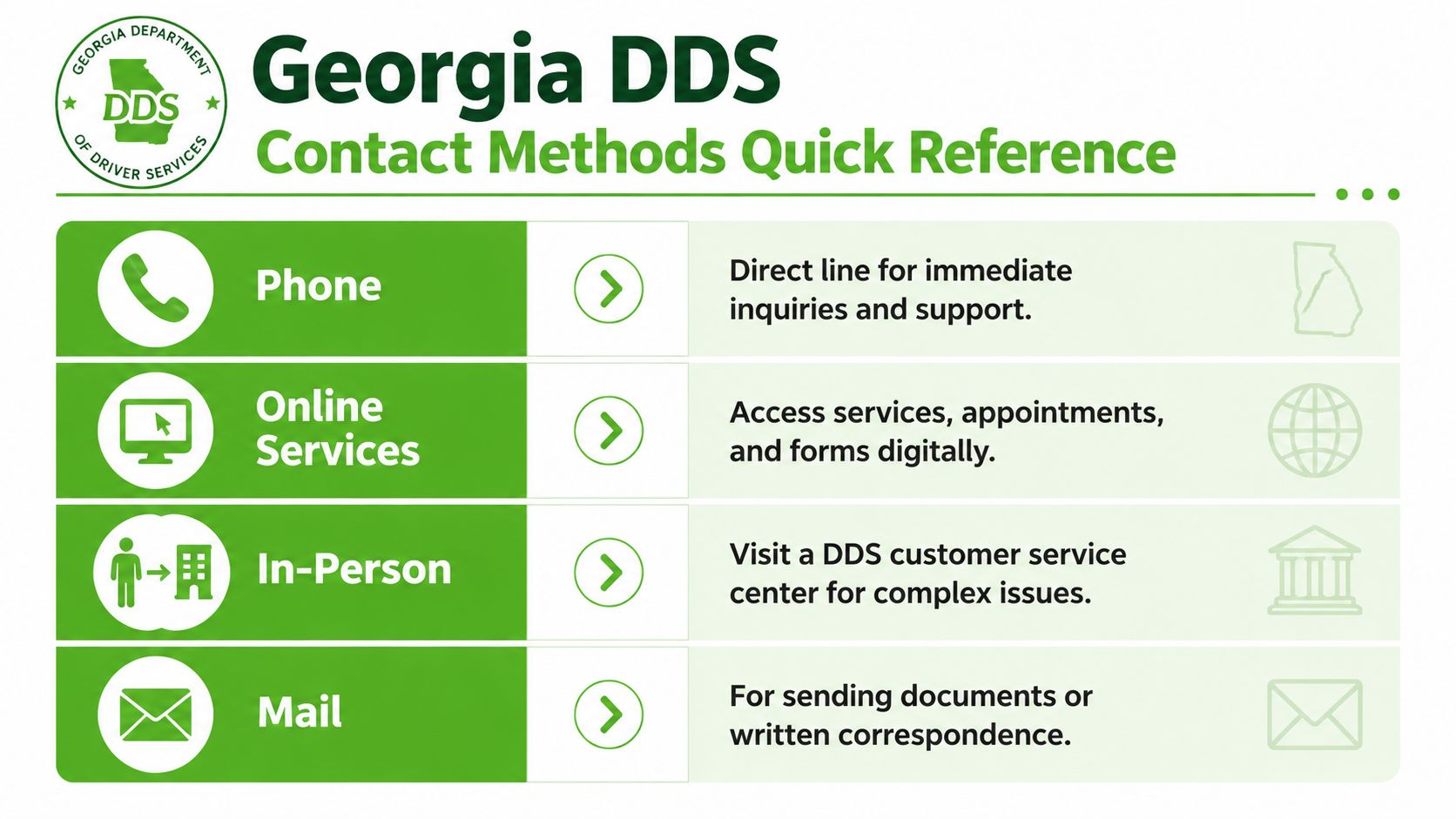
Four ways to think about the contact system
Instead of asking, “How do I reach DDS?” ask which lane your issue belongs in.
- Phone. Best when you need clarification, not just a transaction.
- Online. Best for tasks you can complete without an agent.
- In-person. Best for document-heavy situations and identity-sensitive issues.
- Mail or written correspondence. Best when a process requires formal paperwork rather than a live conversation.
If your problem involves a deadline, don't pick a contact method based on habit. Pick the one that gives you proof, confirmation, or the next required step.
A simple decision filter
Use this quick filter before you do anything:
- Do you only need status information? Use self-service first.
- Do you need someone to explain a requirement? Use phone support.
- Do you need DDS to inspect identity or supporting documents? Prepare for an appointment.
- Are you dealing with a DUI or reinstatement? Expect the answer to involve both DDS contact and completion of outside requirements.
That last point is where many drivers get tripped up. DDS can tell you what is required. DDS usually isn't the place where you complete the educational or clinical requirement itself. You still have to satisfy those steps through approved providers and then circle back with the proper proof.
Key DDS Phone Numbers and Department Lines
A driver often reaches for the phone when the problem feels urgent. The trick is calling the right line for the right purpose, because DDS does not route every issue the same way.
Georgia DDS lists its main public numbers on the official DDS Contact Us page. The two general customer contact numbers are 1-800-GEORGIA and (678) 413-8400, with business hours of 8:00 AM to 5:00 PM Monday through Friday.
Main customer service line
For practical purposes, (678) 413-8400 is the number many drivers should try first. It works best when you need an explanation, not just a status check. Common reasons to call include:
- License or ID questions
- General service guidance
- Figuring out whether you need an office visit
- Clarifying the next step in a records, suspension, or compliance issue
If your case involves several moving parts, write down your question before you call. A short note like "DUI suspension, finished school, need reinstatement steps" gets you farther than a broad question like "What's going on with my license?"
That is especially true for reinstatement cases. DDS can explain what it still needs from you, but DDS does not provide the DUI class or clinical evaluation itself. If you are trying to complete one of those requirements, it helps to handle the outside step first through an approved provider and then call DDS with your completion details ready.
Automated license status line
DDS also publishes a 24/7 automated line for license status checks at (404) 657-9300.
Use that line when your question is narrow and factual:
- Whether your license is valid, suspended, or limited
- Whether you need a quick status check outside business hours
- Whether you want basic information without waiting for a live agent
This line works like a vending machine, not a caseworker. It can give you status information, but it will not sort out a complicated DUI reinstatement question or tell you how to satisfy a treatment or school requirement.
If your next step depends on testing or scheduling, make sure you are not mixing systems. DDS phone support handles agency questions. A separate process may apply if you need help with a Georgia driving test booking process, especially if your issue is about appointments rather than a suspension hold.
No public DDS email
DDS does not maintain a public contact email.
This causes confusion, as drivers often search for an email address after sitting on hold or after getting a suspicious text or message. If someone tells you to send license documents to a random inbox, slow down and verify the instruction through an official DDS number or portal first.
A missing public email is part of the agency's setup. DDS pushes people toward phone support, online tools, and in-person service when identity or legal status is involved. That structure can feel clunky, but it reduces the chance that sensitive documents get sent to the wrong place.
Administrative address
DDS lists its administrative location as 2206 East View Parkway, Conyers, GA 30013. Treat that as the agency's headquarters address, not as a default walk-in solution for every driver.
For many people, the smarter move is to call first, confirm which office or unit handles the issue, and then decide whether an in-person visit is worth the time. The same principle shows up in other appointment systems too. The Formzz scheduling software comparison is a useful outside example of how organized booking tools reduce confusion before someone ever shows up at a desk.
Using DDS Online Services to Skip the Line
A lot of DDS problems feel like they require a phone call when they really don't. If your issue is procedural rather than disputed, online service is often the cleanest path.

When online is the smarter move
Use the online route when you're trying to avoid hold times and office delays for a task that doesn't require face-to-face review. Common examples include:
- Appointment scheduling for an in-person visit
- Routine account management tasks that can be completed digitally
- Emergency contact updates
- Customer feedback submissions
- Checking whether a step can be handled without calling first
DDS has also promoted online tools alongside its public messaging, which tells you something important. The agency expects drivers to use digital self-service where possible, not just the phone.
If scheduling is part of your problem, it's worth noticing how much smoother things get when appointment systems are built well. This review of Formzz scheduling software comparison is a useful outside example of what organized booking systems try to solve.
Best use cases for online DDS contact
Online service is usually strongest when the issue is straightforward. Good candidates include:
| Situation | Why online helps |
|---|---|
| You need an appointment | You can book without waiting on the phone |
| You need to handle a basic account action | The process may be available directly through self-service |
| You want to avoid office congestion | You can prepare before traveling |
| You need to verify whether a road test or related booking step is next | You can review the process before calling |
If you're preparing for a driving test or helping a teen or adult driver with that process, this guide to driving car test booking in Georgia can help you line up the practical next step.
Where people get confused
The most common misunderstanding is this: online services can reduce contact friction, but they don't erase underlying requirements.
For example, if your license is suspended after a DUI-related case, going online may help you schedule, verify, or pay for parts of the process. It won't replace a required course, evaluation, or court condition. That's why some drivers feel like DDS “keeps sending them in circles” when the reason is that one required item hasn't been completed yet.
Online tools are best for movement. They help you book, check, submit, and verify. They don't substitute for legal compliance steps.
Use the portal to save time. Use phone support when your issue still isn't clear after you've checked your status and requirements.
Visiting a DDS Customer Service Center In Person
Some issues still need an office visit. If your case involves identity review, original documents, or a problem that can't be fixed by self-service, an in-person trip may be necessary. The key is making sure the visit resolves something.
Appointments are not optional
Georgia DDS has stated publicly that all customers must schedule an appointment for in-person services, and customers without one may experience longer wait times, as noted in this DDS appointment notice.
That's the first thing to understand before you leave home. If you show up because your case feels urgent, you may still not get handled efficiently.
Local examples that matter
Office schedules aren't always what people expect. Many centers follow a Tuesday through Friday pattern with some Saturday availability, rather than opening on Monday in the way drivers assume.
A few local examples help:
- Atlanta Whitehall Street CSC is listed at 400 Whitehall Street SW
- Athens CSC is listed at 1505 US Highway 29 North
- Albany CSC is listed at 2062 Newton Rd
Some high-traffic locations also open as early as 7:30 AM and close as late as 6:30 PM on weekdays in independent office listings referenced in that public appointment notice. That can make a real difference if you're trying to fit a visit around work, probation reporting, or treatment obligations.
If you're deciding which location is realistic for you, this page listing Georgia driving testing centres can help you think geographically before you book.
What to bring so you don't make two trips
People often lose time because they prepare emotionally, not administratively. Bring the paperwork that proves the issue can be resolved.
A practical checklist includes:
- Current identification if you have it
- Any DDS notice or suspension letter
- Court paperwork tied to the issue
- Proof of completed requirements if your case involves classes or evaluations
- Payment method if a fee must be handled during the process
- Printed confirmation of your appointment
Bring copies of anything you can't easily replace. Keep the originals separate so you don't hand over your only version by mistake.
When in-person is worth it
An office visit makes the most sense when the issue is document-heavy, identity-sensitive, or too specific for a general phone answer. If your question is still only “What do I do next?” start remotely first. If your question becomes “Here are my papers, what's still missing?” then an appointment is often the better move.
How to Contact DDS for License Reinstatement After a DUI
Georgia DDS contact, in such cases, transitions from a customer service question to a compliance workflow. If your license issue is tied to a DUI, calling DDS matters. But the call is only one part of the reinstatement path.
Start with the DDS notice, not your memory
Many drivers rely on what they think the court said, what a friend went through, or what they remember from a stressful hearing. That's how mistakes happen.
Pull together every piece of paper connected to the DUI case. Look at the suspension notice, court order, and any probation or treatment documents. Then contact DDS using the official channels to confirm what remains outstanding on the DDS side.
Your goal isn't to ask a vague question like “Can I get my license back?” Your goal is to ask, “Which reinstatement requirements are still open on my record?”
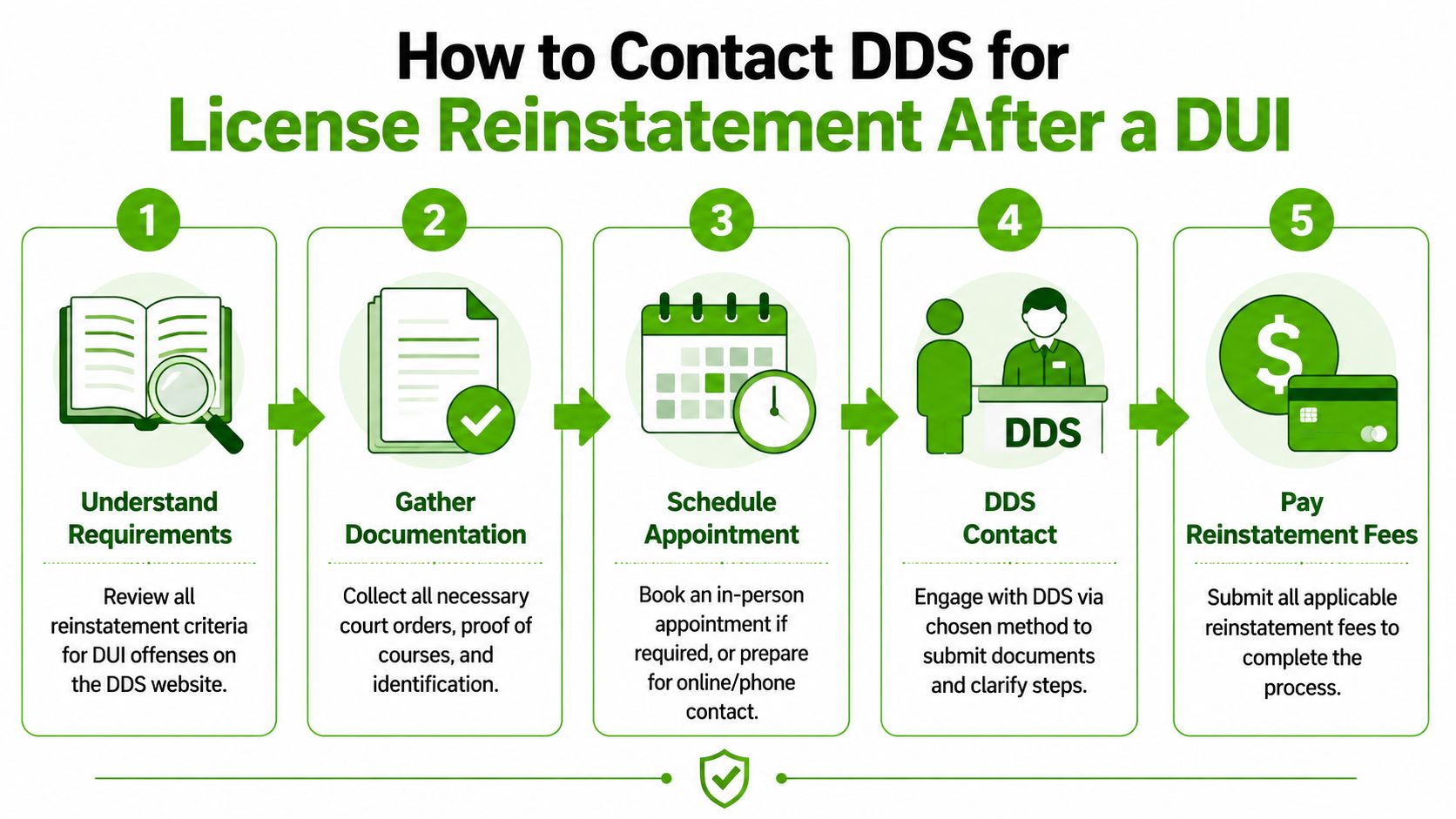
The usual DUI reinstatement sequence
The exact path depends on your case, but the workflow often looks like this:
Review the triggering issue
Find out whether the hold is tied to suspension, revocation, court noncompliance, or missing documentation.Complete the required education step
In many DUI-related cases, that means the state-required 20-hour Risk Reduction course.Complete any required clinical step
Some drivers also need a clinical evaluation, and in some cases the evaluation may lead to treatment recommendations or additional conditions.Collect proof of completion
Keep certificates, evaluations, discharge paperwork, and court-related proof organized in one folder.Contact DDS to verify submission and next action
At this point, you're no longer calling for general advice. You're confirming whether DDS has what it needs and whether an appointment, payment, or additional verification is still required.
Where people get stuck
Most reinstatement delays happen in one of three places:
- The course was never completed
- The clinical requirement was misunderstood
- The driver contacted DDS before collecting proof
If you need to complete the educational or clinical side, approved providers handle that part, not DDS itself. One factual example is Georgia DUI Schools license reinstatement support, which includes Georgia DDS-approved Risk Reduction courses and related clinical services such as evaluations.
What to say when you contact DDS
Keep your language tight. You want an answer that points to the next step.
Try this approach:
- “I'm calling about DUI-related license reinstatement and need to confirm what's still required on my DDS record.”
- “I have completed my course and have documentation. Is there anything else DDS needs from me?”
- “Does my case require an in-person appointment, or can the remaining step be handled another way?”
That wording works because it separates completed requirements from remaining DDS action items.
If the person you speak with uses terms you don't understand, ask them to repeat the exact name of the missing item. Write it down word for word.
Keep the process in the right order
A lot of frustration comes from doing steps out of sequence. Drivers often try to pay or schedule something before they know whether all supporting requirements are finished. Others finish a class but never confirm whether DDS has recognized the completion.
Treat reinstatement like a checklist, not a conversation. Confirm the cause. Complete the requirement. Gather proof. Contact DDS. Then finish the final administrative step.
That order saves time, and it lowers the risk of showing up at a Customer Service Center only to hear that one missing document is still holding everything up.
Specialized DDS Contacts and Complex Procedures
Not every Georgia DDS contact issue fits the usual categories of renewal, suspension, or reinstatement. Some matters involve medical fitness, legal disputes, or formal review processes. Those cases require more precision and a calmer approach.
Medical and vision-related concerns
If a driver's ability to operate a vehicle is affected by a medical or vision issue, DDS may require review, documentation, or follow-up before driving privileges are cleared or continued. These cases often create anxiety because the driver feels the issue is personal, while DDS treats it as a public safety matter.
In practice, the most important step is to keep your paperwork organized and current. If a doctor, specialist, or vision provider has supplied records, don't assume DDS already has them in usable form. Keep copies, dates, and names together before contacting the agency.
These cases also tend to be less suitable for a casual phone call. A short general inquiry can still help you identify the right lane, but the primary work usually turns on documents and compliance.
Administrative License Suspension and hearing issues
Some drivers need to deal with an Administrative License Suspension, often called an ALS matter, where timing and exact procedure matter more than long explanations.
If you're trying to challenge or respond to a suspension, focus on:
- The deadline listed in your notice
- Whether a hearing request or other formal filing is required
- Which supporting records your attorney or representative needs
- What DDS records or confirmation should be obtained
In these situations, DDS contact is often only one piece of a larger legal process. If you have counsel, coordinate before contacting DDS on your own so everyone is working from the same facts.
In a complex suspension case, the best question often isn't “What happened?” It's “What filing, record, or proof is required next?”
Attorney, court, and third-party coordination
Lawyers, probation officers, employers, and court staff sometimes need DDS-related information tied to a client's compliance path. That doesn't mean DDS becomes a general case manager. It means multiple institutions may be touching the same driver's record for different reasons.
That is why drivers should keep a single file containing:
| Document type | Why it matters |
|---|---|
| DDS notices | Shows the agency's stated issue |
| Court paperwork | Connects the legal outcome to the administrative requirement |
| Course proof | Helps establish completion of required education |
| Evaluation or treatment records | Supports clinical compliance where required |
| Appointment confirmations | Prevents missed visits and confusion |
How to stay organized under pressure
When a case is unusual, people often react by making more calls. That's understandable, but repeated unstructured contact rarely fixes a documentation problem.
A better approach is to build a timeline:
- What notice did you receive first
- What requirement did that create
- What have you completed since then
- What written proof do you have
- What agency or office still needs something from you
Once that timeline is clear, your DDS contact becomes far more productive.
Tips for Faster Service and How to Avoid Scams
Good preparation shortens almost every DDS interaction. It also helps you spot bad information before you pay the wrong person or respond to a fake message.

How to make contact smoother
Before you call or go in person, have these ready:
- Your identifying information so the conversation can start cleanly
- The exact reason for contact in one sentence
- Any notice, case paper, or completion certificate
- A pen or notes app to record what DDS tells you
- A clear next-step question such as “What is still missing?” or “Does this require an appointment?”
If you want to improve the way you handle important service calls in general, this article on call handling best practices for 2026 offers practical communication habits that apply well to government calls too.
Scam warning signs
Georgia DDS has issued public warnings about scam messages demanding payment for supposed traffic tickets or license problems, as shown in this DDS scam warning post. That's a major reason to be careful whenever a text or message creates urgency around payment.
Watch for these red flags:
- A demand for immediate payment
- A message claiming your license is in danger unless you click now
- A link that doesn't come from an official DDS path you intentionally used
- A request to pay through an unfamiliar service
- A message that pressures you before you've even received formal paperwork
The safer way to verify
If you get a suspicious text or message, don't reply to it. Don't click the payment link. Don't assume that because the message mentions DDS, it came from DDS.
Do this instead:
- Stop and screenshot the message
- Use an official DDS contact method you looked up yourself
- Check whether your issue can be confirmed through the published line or portal
- Only make payments through official channels you intentionally accessed
A real problem can still exist at the same time a fake message arrives. Verify through official DDS contact methods, not through the message that startled you.
One final practical point
People under stress often bounce between court staff, probation, class providers, and DDS. That's normal. But if your case involves a DUI or other license-holding issue, the fastest route usually comes from finishing the required education or clinical step promptly, keeping your proof organized, and then contacting DDS with a specific question instead of a general plea for help.
If your Georgia DDS contact issue is tied to a DUI, license suspension, or reinstatement requirement, the most useful next step may be completing the required course work and related compliance items first. You can review the appropriate program options through Georgia DUI Schools.