

Those seeking a DUI school in Canton, GA are likely dealing with more than one deadline at once. Court dates, probation instructions, license questions, and class enrollment can all hit at the same time. Individuals often aren't confused because the process is impossible. They're confused because every website seems to answer a different question.
Some pages talk about convenience. Others talk about Zoom classes. Others sound local but are located outside Canton. When you're trying to satisfy Cherokee County court requirements and the Georgia DDS, the first question isn't which page ranks highest. It's whether the program you choose will count.
This guide is written the way I'd explain it to a student on the phone. One step at a time. No legal jargon where plain English will do.
Your Guide to Navigating DUI Requirements in Canton
A lot of people in Cherokee County start in the same place. They type in "dui school canton ga," open several tabs, and quickly realize that the words on those sites don't all mean the same thing. One page says "online." Another says "virtual." Another says "Canton" even though the office is somewhere else.
If you've recently been arrested or charged, you're also likely dealing with immediate practical issues such as release conditions, transportation, and upcoming court instructions. For that part of the process, these Express Bail Bonds DUI bail resources can help you understand the bail side in clearer terms.
What most Canton drivers need first
The first real task is simple. Separate marketing language from state compliance.
A school can advertise to Canton residents and still be located in Woodstock, Kennesaw, or another nearby area. That doesn't automatically make it a bad option. It just means you need to verify what the ad doesn't always make obvious. Is the provider approved for the Georgia DUI/Risk Reduction requirement? Will the certificate be accepted for the purpose you need it for?
Practical rule: Don't enroll because a page says "near Canton." Enroll because the provider and class format satisfy your actual court and DDS requirement.
A calmer way to approach it
When students feel overwhelmed, I tell them to reduce the process to three decisions:
- Confirm the right type of class
- Verify the provider is DDS-approved
- Choose the format that fits your schedule and obligations
That approach prevents the most common mistake, which is paying for something that sounds right but doesn't solve the problem in front of you.
What Is a Georgia DUI Risk Reduction Program
A lot of people reach this step with the same question: "Do I need a DUI class, a defensive driving class, or something else?" In Georgia, those are different programs with different purposes. If your paperwork says DUI school, Risk Reduction, or DUI/Risk Reduction, you are looking for one specific state-regulated program.
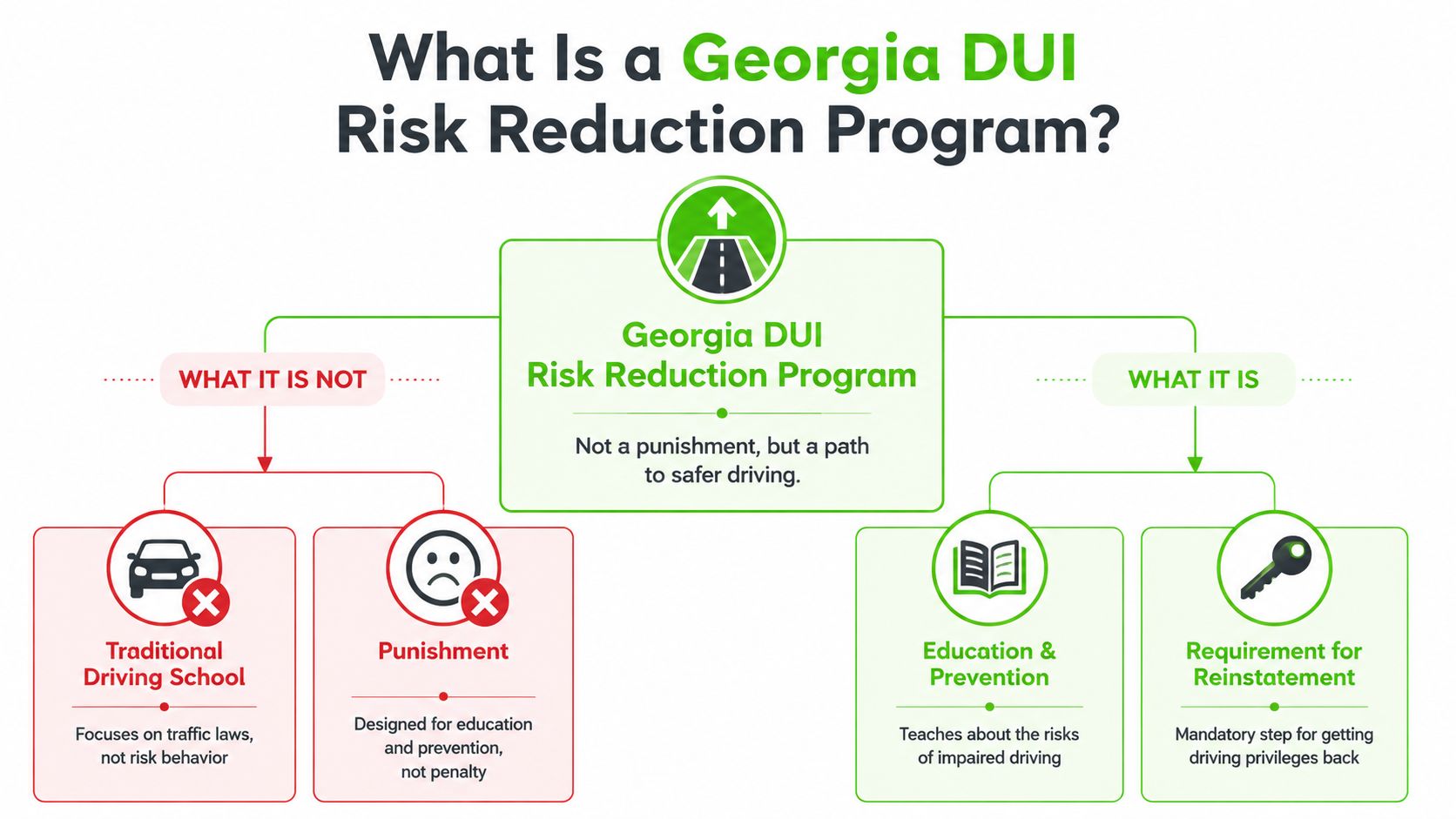
A clear overview appears in this explanation of what a Georgia risk reduction course is.
What the program includes
Georgia's DUI/Risk Reduction requirement follows a set structure. It includes an initial assessment, a workbook component, and a scheduled class session. That is why enrolling is not the same as buying a seat in a general traffic class. There is a defined process, and the certificate at the end only counts if the program itself meets state requirements.
This is the part that trips people up. A student may search for "dui school canton ga," find a nearby option, and assume any alcohol-related class will work. It will not. The correct program is the one tied to DUI-related court, probation, or DDS reinstatement requirements.
What it is not
These course types often get mixed together, even though they solve different problems:
- Defensive driving for point reduction, ticket-related purposes, or some insurance situations
- Driver's education for learning basic driving skills and road rules
- DUI/Risk Reduction for DUI-related legal or licensing compliance
Getting this distinction right ensures you enroll in the correct program.
If your court notice, probation instructions, lawyer, or DDS paperwork calls for DUI/Risk Reduction, another course type usually will not satisfy that requirement.
Why the state requires it
The program is designed as an educational requirement focused on impaired driving risk, decision-making, and repeat-offense prevention. Courts and the DDS use it as a formal compliance step, not as a general driving refresher.
It helps to view the program the way you would view a required document in a larger file. If one piece is missing or the wrong form is used, the whole process can stall. The class itself matters, but so does taking the right class through the right type of provider.
That is why this guide keeps separating marketing from compliance. Before you spend time or money, make sure the program you choose is the actual Georgia DUI/Risk Reduction course required for your case.
Finding a DDS-Approved School for Cherokee County Courts
This is the step that saves people the most frustration. A page can look polished, local, and convincing, and still leave out the one fact you need most. Is the school approved?
Finding a DUI school in Canton, GA presents a common challenge: search results often show marketing pages first. The Georgia Department of Driver Services maintains the official provider list, and that list is the reliable place to verify whether a school's certificate will be accepted. It matters because some businesses market to Canton even when they're physically based elsewhere. You can check that status through the Georgia DDS certified DUI schools list.
What to verify before you register
Use this short checklist before you pay anything:
- Provider approval: Confirm the school appears on the DDS list.
- Exact location: Check whether the office is in Canton or serving Canton from a nearby city.
- Class format: Make sure the format being offered matches what the provider is approved to deliver.
- Acceptance question: If your case involves Cherokee County court or probation oversight, ask directly whether the certificate issued is the one normally used for that purpose.
A good provider should answer those questions clearly. If the answers are vague, keep looking.
Why local wording can be misleading
A page might say "Canton DUI school" because it serves Canton residents. That can be fine. Many students in Cherokee County attend programs outside the city itself or use remote attendance options from home.
The problem starts when a student assumes that "serving Canton" and "approved by DDS" are the same thing. They aren't.
If a school's page spends more time talking about convenience than certification, slow down and verify the approval yourself.
A practical example for Cherokee County residents
Say a Canton resident finds two options. One has a page full of neighborhood references and quick-sign-up buttons. The other is less polished but easy to verify through the DDS list. The second option is safer because it answers the compliance question first.
That doesn't mean every polished site is unreliable. It means approval comes before convenience. Once approval is confirmed, then you can compare location, schedule, and whether the class works with your court timeline.
If you want one provider example in the broader Georgia market, Georgia DUI Schools is a DDS-approved provider offering DUI/Risk Reduction and related services in Georgia. Even then, the same rule applies. Confirm the specific class and service fit your requirement before enrolling.
Comparing In-Person vs Virtual DUI Class Options
After you've narrowed your choices to approved providers, the next decision is format. The word "online" often trips up many students when considering format.
In Georgia, a virtual class can be compliant, but that doesn't mean a self-paced course will count. One provider explains that DUI/Risk Reduction courses may be taken remotely by Zoom, but they are not "online courses" in the self-paced sense. The class is live and scheduled, with an instructor, as described on this page about Georgia virtual DUI classes.
For a closer look at the live-virtual format, this overview of online DUI school options in Georgia helps clarify how remote attendance works.
The biggest point of confusion
Students often say, "I want to do it online as fast as possible."
What they usually mean is one of two things:
- They want to attend from home
- They want to complete the course on their own time
Only the first idea fits the live-virtual model discussed above. The second describes a self-paced online course, which is a different concept and not the same as a live Zoom-based DUI/Risk Reduction class.
In-Person vs Virtual DUI Class Comparison
| Feature | In-Person Class | Live-Virtual (Zoom) Class |
|---|---|---|
| Attendance style | You go to a physical classroom | You join a scheduled live session remotely |
| Commute | Requires travel to the school location | No drive to class |
| Class structure | Face-to-face instructor setting | Real-time instructor-led setting |
| Environment | Useful for students who focus better away from home | Useful for students balancing work, childcare, or transportation issues |
| Technology needs | Minimal beyond basic registration communication | Requires reliable device access and ability to participate live |
| Common misunderstanding | Students may assume only local offices count | Students may assume "virtual" means self-paced |
How to choose the better fit
Pick in-person if you do better with a formal classroom routine and fewer home distractions.
Pick live-virtual if the obstacle is travel, scheduling, or getting across Cherokee County and nearby areas without reliable transportation.
A live virtual class isn't a shortcut. It's the same compliance task delivered through a different classroom format.
The right choice is the one you'll complete on time, with full participation, through an approved provider.
Step-by-Step Enrollment Process and Cost Breakdown
A lot of people get stuck here because enrollment feels bigger than it is. You may be looking at court papers, DDS steps, class options, and payment details all at once. The simpler way to handle it is to treat enrollment like a checklist. Finish one item, confirm it, then move to the next.
For a Georgia DUI/Risk Reduction program, the cost is often split into three parts rather than one flat fee. In the Canton area, that commonly means an assessment fee, a class fee, and a workbook fee. Seeing those pieces separately helps you compare schools more carefully and avoid paying for the wrong service twice.
Step one: gather the documents the school will ask for
Start with your identification and any paperwork that explains why you need the class.
Keep these items together before you call or register:
- Photo ID: A driver's license or other government-issued identification
- Court paperwork: Any document showing the charge, sentence, or court requirement
- Probation instructions: Written directions from a probation officer, if you have them
- Current contact information: An email address and phone number you check regularly
This step sounds basic, but it prevents one of the most common delays. A school cannot confirm the right requirement if the student gives partial information.
Step two: complete the assessment in the order the provider requires
The assessment is part of the process, not a side form to fill out later. Some students try to lock in a class date first and deal with the intake piece afterward. That can slow everything down if the provider requires the assessment before class enrollment is finalized.
A good rule is simple. Ask, "What has to be completed before I am officially placed in class?" That question clears up the order right away.
Step three: review the full price before you pay
Cost confusion usually comes from schools advertising one number while leaving out the other required items. Ask for the total amount and ask what that total includes.
A common Canton-area example looks like this:
| Item | Cost |
|---|---|
| Assessment | $100 |
| Class | $235 |
| Workbook | $25 |
| Total | $360 |
Use the table like a receipt preview. If a provider quotes a class price only, ask whether the assessment and workbook are separate. That one question can save you time, extra calls, and a surprise balance later.
Step four: choose a class schedule you can keep
The best schedule is the one you can attend from start to finish without scrambling. For some students, that means evenings. For others, it means weekends or a live virtual option that removes the drive across town.
As noted earlier, some Canton-area providers offer weeknight and weekend scheduling, live virtual attendance, and fast certificate delivery after completion. Those details matter if you are trying to meet a court date, probation deadline, or DDS reinstatement step.
Enrollment advice: Before you pay, ask two direct questions. "What must I finish before class starts?" and "How and when will I get my completion certificate?"
Step five: confirm how proof of completion will be sent
Do not wait until the last day to ask about your certificate. Some students assume they will receive paper documents by mail, then find out a court, lawyer, or probation officer expected faster proof.
Ask whether the school issues a digital certificate, when it is released, and whether you need to send it yourself or keep it for your records. That is the last check in the process, and it helps you avoid finishing the class but still missing a deadline.
Clinical Evaluations and Other Required Services
For some people, the DUI/Risk Reduction class is not the only item on the list. A student may also be told to complete a clinical evaluation, treatment, or a Victim Impact Panel. Such requirements often lead to worry that something was overlooked earlier. Usually, it's not a mistake. It's a separate requirement tied to the case, the assessment result, or a court instruction.
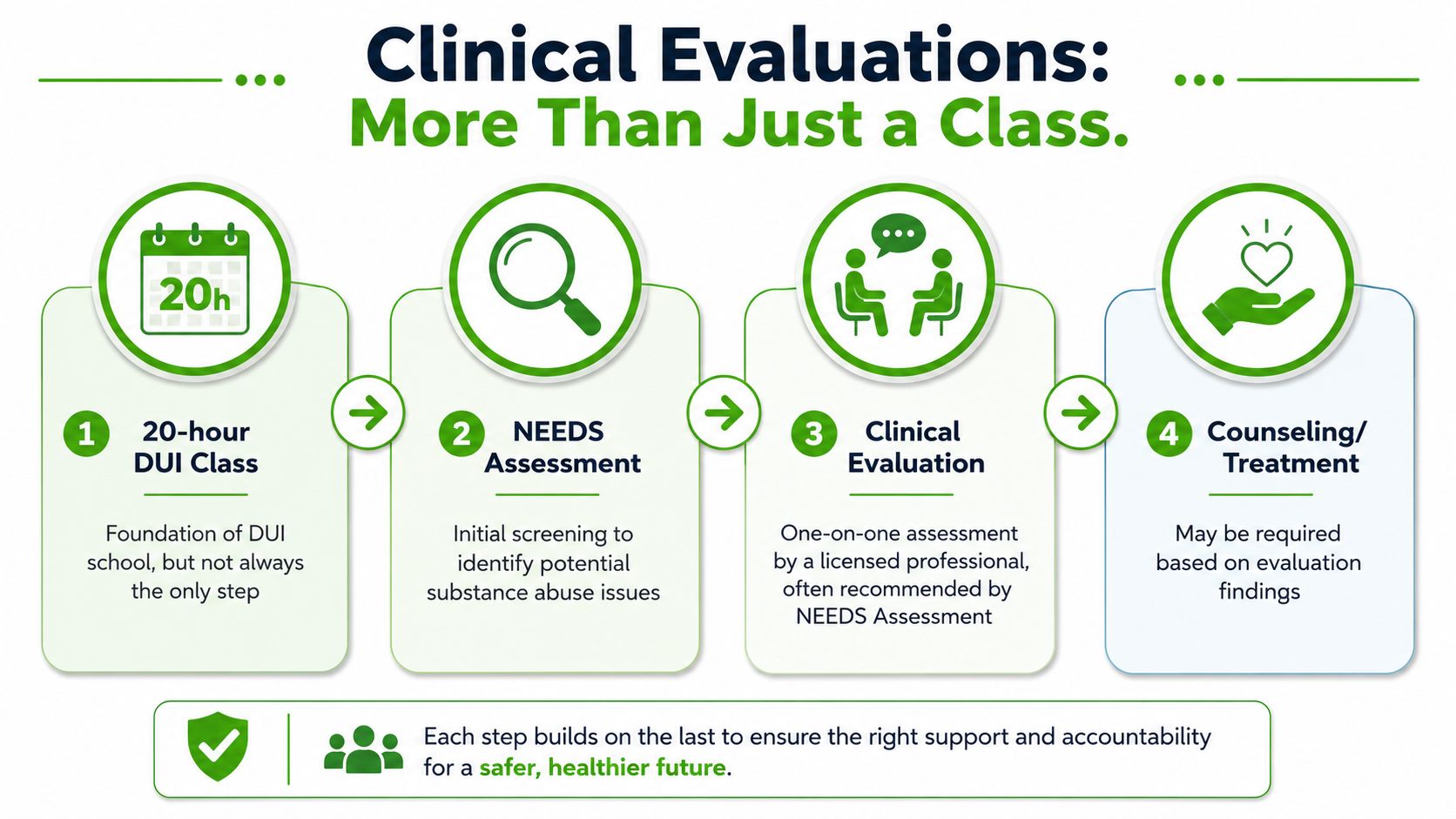
What a clinical evaluation usually means
A clinical evaluation is generally a one-on-one meeting with a qualified professional who reviews substance use history, circumstances, and related concerns. It isn't the same as the classroom program. It's more individualized.
If you're told you need one, ask three things right away:
- Who is requiring it
- What deadline applies
- Where the results need to be sent
That keeps the task manageable and prevents duplicate appointments.
Other services people may encounter
Some students in the DUI process also hear terms like ASAM Level 1 treatment or Victim Impact Panel.
These are different services with different purposes:
- ASAM Level 1 treatment: Ongoing counseling or treatment support when further intervention is required.
- Victim Impact Panel: An educational setting where participants hear about the actual-world harm caused by impaired driving.
- Additional documentation: Some courts or supervising agencies may want proof of attendance or completion separate from your class certificate.
How to stay organized if you have more than one requirement
Use a written checklist. Keep one line for each item, the due date, and the person or office that needs proof.
For example:
| Requirement | Who asked for it | What proof do they need |
|---|---|---|
| DUI/Risk Reduction class | Court, DDS, or probation | Certificate of completion |
| Clinical evaluation | Court or counselor referral | Evaluation paperwork or recommendation |
| Victim Impact Panel | Court or probation | Attendance confirmation |
If someone says, "You also need an evaluation," ask whether that is in addition to the class or part of the same process. That one question clears up a lot of confusion.
Your Next Steps to Reinstating Your Driving Privileges
The process becomes less daunting once it is broken down into separate actions. Verify the provider. Pick the class format that matches your schedule. Complete the required steps in the order the school gives you. Keep every document you receive.
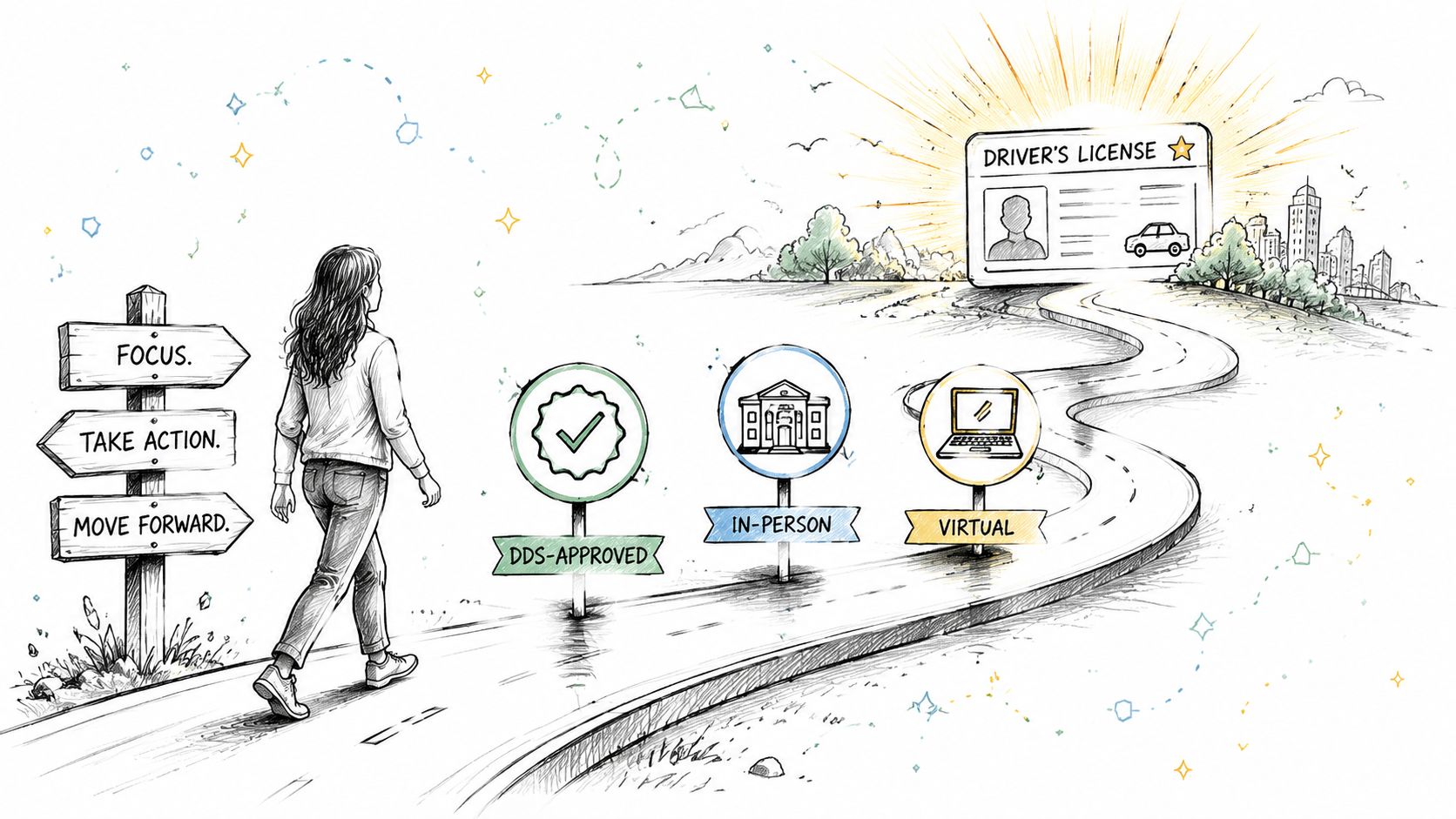
If your end goal is getting back on the road legally, the class certificate is only useful when it's attached to the right provider and the right requirement. This page on Georgia license reinstatement steps can help you connect the class requirement to the broader reinstatement process.
Call to Action
| Immediate move |
|---|
| Check the DDS approval status of any school you're considering |
| Ask whether the class is in-person or live virtual |
| Gather your ID and court paperwork before calling |
| Confirm how and when your completion certificate will be issued |
You don't need to solve everything today. You do need to take the next correct step. For most Canton drivers, that means choosing a verified program and getting enrolled before confusion turns into delay.
If you're ready to handle the DUI/Risk Reduction requirement with a clear, compliant next step, review the course options from Georgia DUI Schools.