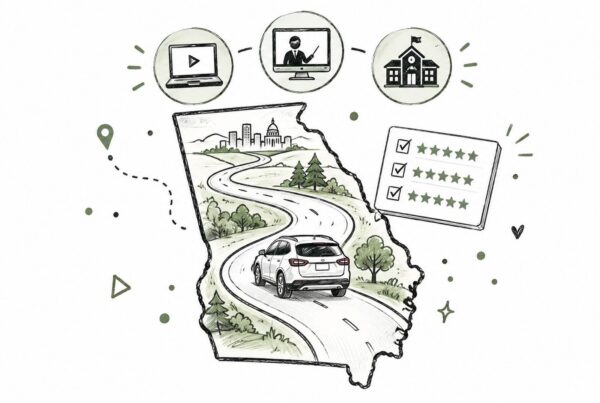
A defensive driving insurance discount is a reduction in your car insurance premium, typically 5% to 15%, for completing a state-approved driving safety course. In Georgia, the same kind of course can also help with point reduction, which is why many drivers use it for both savings and record management.
A lot of Georgia drivers land here after the same moment. The renewal notice shows up, the premium looks too high, and you start asking a practical question: is there anything legitimate I can do right now to lower this bill?
Often, there is.
If you live in Atlanta, Athens, or one of the surrounding metro communities, a defensive driving course can do more than check a box. It can help you present yourself to your insurer as a lower-risk driver, and in Georgia it can also connect to DDS-related point reduction rules. That combination is what makes this worth understanding carefully. Not every course counts the same way, not every insurer handles the discount the same way, and not every driver needs the course for the same reason.
Some people take it after a ticket. Some take it before a renewal. Some are trying to clean up a driving record before it causes more expensive insurance problems. Others want to avoid letting a manageable issue turn into a long-term cost.
The key is knowing who does what. Your insurance company decides whether it will apply a discount. The Georgia DDS controls course approval and license-related rules. If a court is involved, the court order may have its own separate requirement. Those three pieces can overlap, but they are not the same thing.
Your Path to Lower Car Insurance Premiums
A driver in Georgia gets a renewal notice. Nothing else changed. Same vehicle, same address, same daily route on I-285 or GA-316, but the premium still feels too high. The first reaction is usually frustration. The second is looking for shortcuts.
A defensive driving course isn't a shortcut. It's one of the few clean, structured steps that can help.
When drivers ask me about a defensive driving insurance discount, they're usually hoping for one clear answer. They want to know whether taking a class will actually save money or whether it's just another promise that doesn't show up on the bill. The honest answer is that it can help, but only if you handle the process correctly from the start.
Why this matters in Georgia
Georgia drivers often have two goals at once:
- Lower the premium: You want your insurer to recognize course completion and apply any available discount.
- Manage license points: You may also want the DDS side handled correctly if you're taking the course for record-related reasons.
- Stay compliant: If a court, employer, or insurer asks for proof, the certificate has to come from the right kind of provider.
That last part is where people get tripped up. They assume any online driving class will work. Sometimes it won't.
Practical rule: If you're taking a course with insurance or DDS consequences in mind, verify acceptance before you enroll, not after you finish.
In Georgia, this works best when you treat the course as part of a small paperwork system. You confirm eligibility with the insurer, choose a DDS-approved option, complete the class, keep your certificate, and follow up until the discount is reflected on your policy.
That sounds simple, and it is. But simple isn't the same as automatic.
Understanding the Defensive Driving Discount
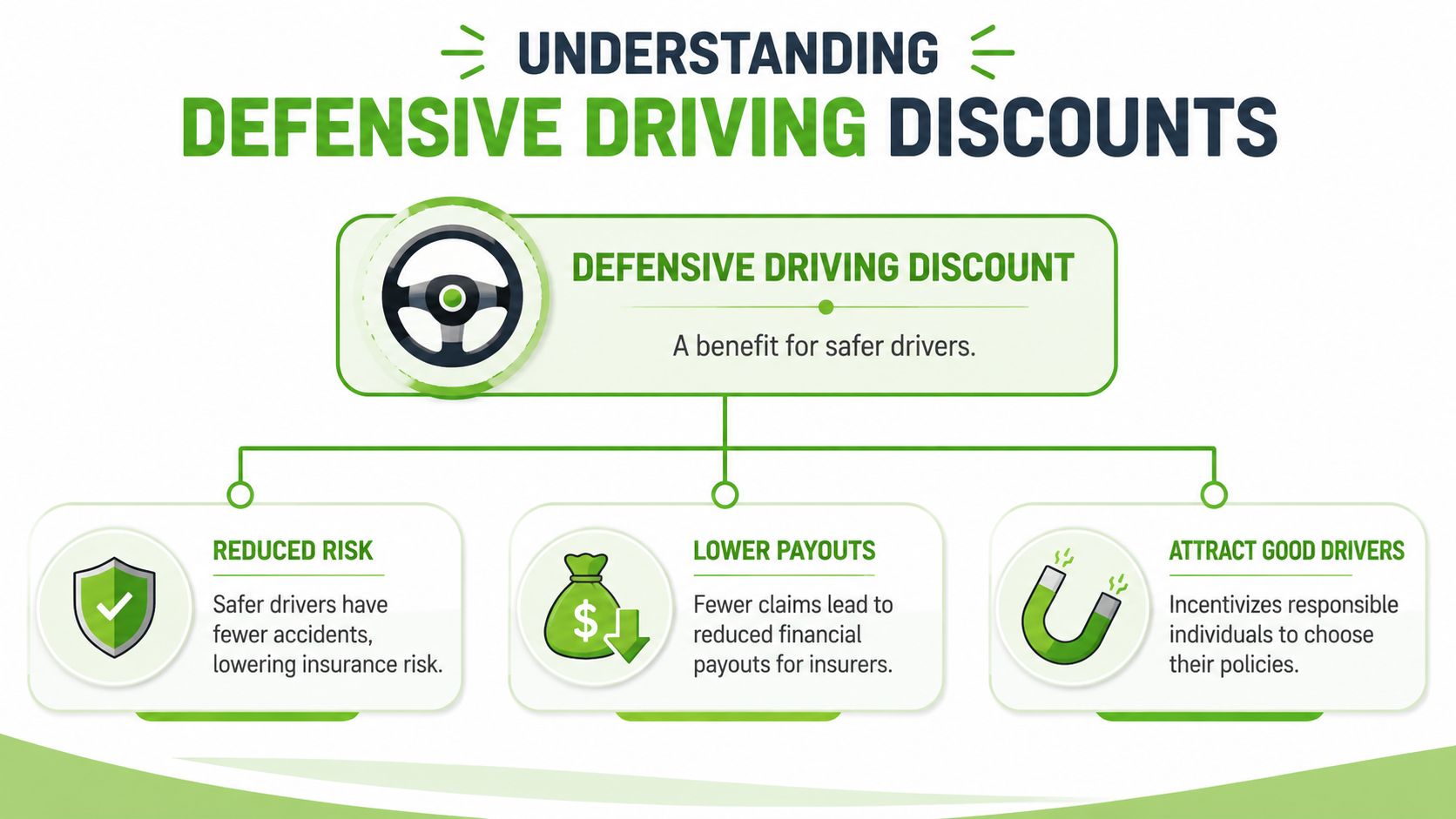
Insurance companies don't hand out this discount as a random coupon. They use it because course completion can signal that a driver is paying attention, refreshing road rules, and taking safer driving seriously.
It's comparable to a good student discount, but for drivers. The insurer is looking at behavior that suggests lower risk. Completing a recognized safety course doesn't guarantee you will never have a claim, but it gives the insurer one more reason to classify you more favorably than a driver who hasn't done the same work.
What the discount really is
A defensive driving insurance discount is usually an underwriting credit tied to a current completion certificate, not a permanent change to your policy. In major U.S. markets, it often ranges from about 5% to 20%, and many carriers apply it for a limited term of roughly 2 to 5 years before requiring renewal or re-verification, according to Progressive's explanation of defensive driving discounts.
That point matters more than most guides admit. Drivers often think, "I took the class once, so I'm set." Usually, you're not. If the certificate ages out under your insurer's rules, the discount can disappear even though you completed the course in the past.
Why state approval matters
Insurers want proof that the course wasn't just a generic video with a printable completion page. State approval adds structure. It tells the insurer that the course provider operates within a recognized framework and that the completion certificate has some credibility behind it.
That is why Georgia drivers should care about DDS approval. The insurer may apply the discount, but state approval often helps establish that the course is valid for insurance and license-related purposes.
If you want a deeper look at why these programs matter beyond the discount itself, this overview of the benefits of defensive driving is a useful next read.
A defensive driving discount makes the most sense when you see it as a reward for current, documented safe-driving education, not as a lifetime benefit.
What it is not
It isn't the same as every other insurance discount. It's different from:
| Discount type | What it depends on |
|---|---|
| Multi-policy | Bundling home, renters, or another policy |
| Good student | Academic performance |
| Vehicle safety feature discount | Equipment on the car |
| Defensive driving discount | Completion of an approved safety course |
This is why your insurer may accept one discount automatically and require paperwork for another. The defensive driving discount usually has to be earned, documented, and kept current.
Georgia's Rules for Defensive Driving Courses
Georgia drivers need to separate three different systems that often get lumped together: the Georgia DDS, the court system, and the insurance company. They can all care about the same course, but they care for different reasons.
The DDS is the state's gatekeeper for approval. If you're taking a course because you want it to count in a Georgia driving context, start by confirming that the provider is DDS-approved. That is the compliance piece. Without it, you can end up with a certificate that looks official but doesn't solve the actual problem you were trying to fix.
The DDS role versus the insurer role
The DDS doesn't set your premium. Your insurer does.
Your insurer doesn't control your license points. The DDS does.
A court can also require a course, but a court order doesn't automatically create an insurance discount. This is one of the biggest misunderstandings I see. Drivers assume that if a judge, probation officer, or clerk says "take a driving course," that same course will automatically lower insurance. Sometimes it can help. Sometimes the insurer will want separate confirmation.
Here is the cleaner way to consider this:
- DDS approval answers whether the course is recognized in Georgia.
- Insurance approval answers whether your carrier will grant the discount.
- Court acceptance answers whether the class satisfies the order in your case.
Those are related questions, but they are not interchangeable.
Why Georgia drivers should pay attention to course format
Other states show how structured these programs can be. New York's PIRP requires approved courses to meet strict standards, allows classroom or online formats, provides a 10% insurance reduction for three years, uses a classroom course length of 320 minutes, and requires retraining every 36 months to maintain benefits, as described by the Delaware insurance page summarizing these state frameworks. That same source also notes Progressive's guidance that a four-hour course is enough in many states.
Georgia has its own system, and the lesson for Georgia drivers is practical: don't assume the course rules in one state apply here just because the class title sounds similar.
The point reduction connection
In Georgia, defensive driving is often discussed for two reasons at once. One is the possible insurance discount. The other is point reduction.
That overlap is useful. If you're trying to protect your driving record after a violation, a DDS-approved defensive driving course may help with the record side while also giving you a certificate you can present to your insurer. But those benefits still move through separate channels. You don't send one email and expect the court, DDS, and insurer to sort it out for you.
If your goal includes both insurance savings and point reduction, keep copies of every document and submit them to each required party separately.
For a lot of Georgia drivers, that simple habit is the difference between "I took the class" and "I got the result."
How Much You Can Actually Save on Insurance
Most drivers don't want theory here. They want the actual range.
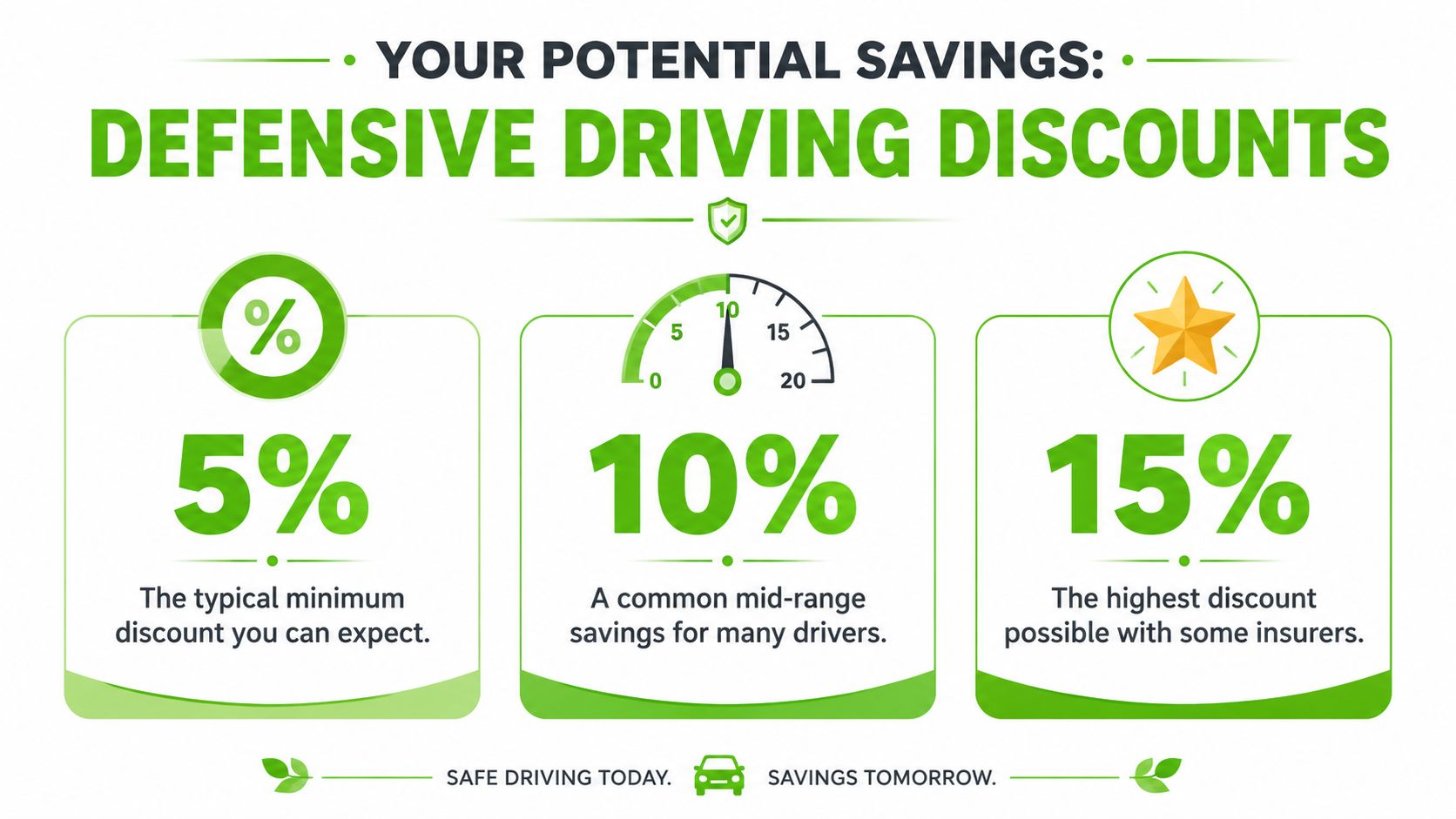
In major U.S. markets, defensive driving discounts are usually modest but meaningful. Nationwide says the discount usually runs around 5%, Delaware law allows up to 10% off a portion of auto insurance for three years after an approved course, New York's PIRP reduces the base rate by 10% each year for three years, and Delaware allows a refresher path that can raise the discount to 15% for another three years under certain conditions, according to Nationwide's summary of defensive driving discount examples.
What those numbers mean in practice
The first thing to understand is that this discount is usually a percentage of premium, not a flat dollar amount. So two Georgia drivers can complete the same type of course and save different amounts because their premiums are different.
That also means expectations need to stay realistic. For many people, this won't transform the entire policy. It helps. It stacks well with other lawful discounts. It may be one of several ways to cut the total cost.
If you're trying to find auto insurance savings beyond defensive driving alone, it also makes sense to review other missed discounts on your policy so you're not leaving easy savings untouched.
Why one driver gets more than another
A few factors can affect the actual value:
- Your insurer's rules: Some carriers are more generous than others.
- Your policy structure: The discount may apply to part of the premium rather than every coverage component.
- Your role on the policy: Some discounts apply most cleanly to the principal operator.
- Your renewal timing: The discount may not appear until the next billing cycle or renewal processing window.
That is why you should never enroll based only on a guessed savings figure. Confirm first, then calculate.
The expiration issue drivers miss
A defensive driving insurance discount usually doesn't last forever. In the verified state examples, the savings are tied to a defined period and renewal cycle. New York requires retraining every 36 months to keep the reduction, and Delaware's structure also works in repeating periods with refresher timing built in, as noted in the linked Nationwide discussion above.
If you want a practical checklist for keeping premiums down after the class is done, this guide on how to lower car insurance rates is a good companion resource.
Your Step-by-Step Guide to Getting the Discount
This part is where people either save money or waste time. The process itself isn't hard. The mistake is doing the steps in the wrong order.
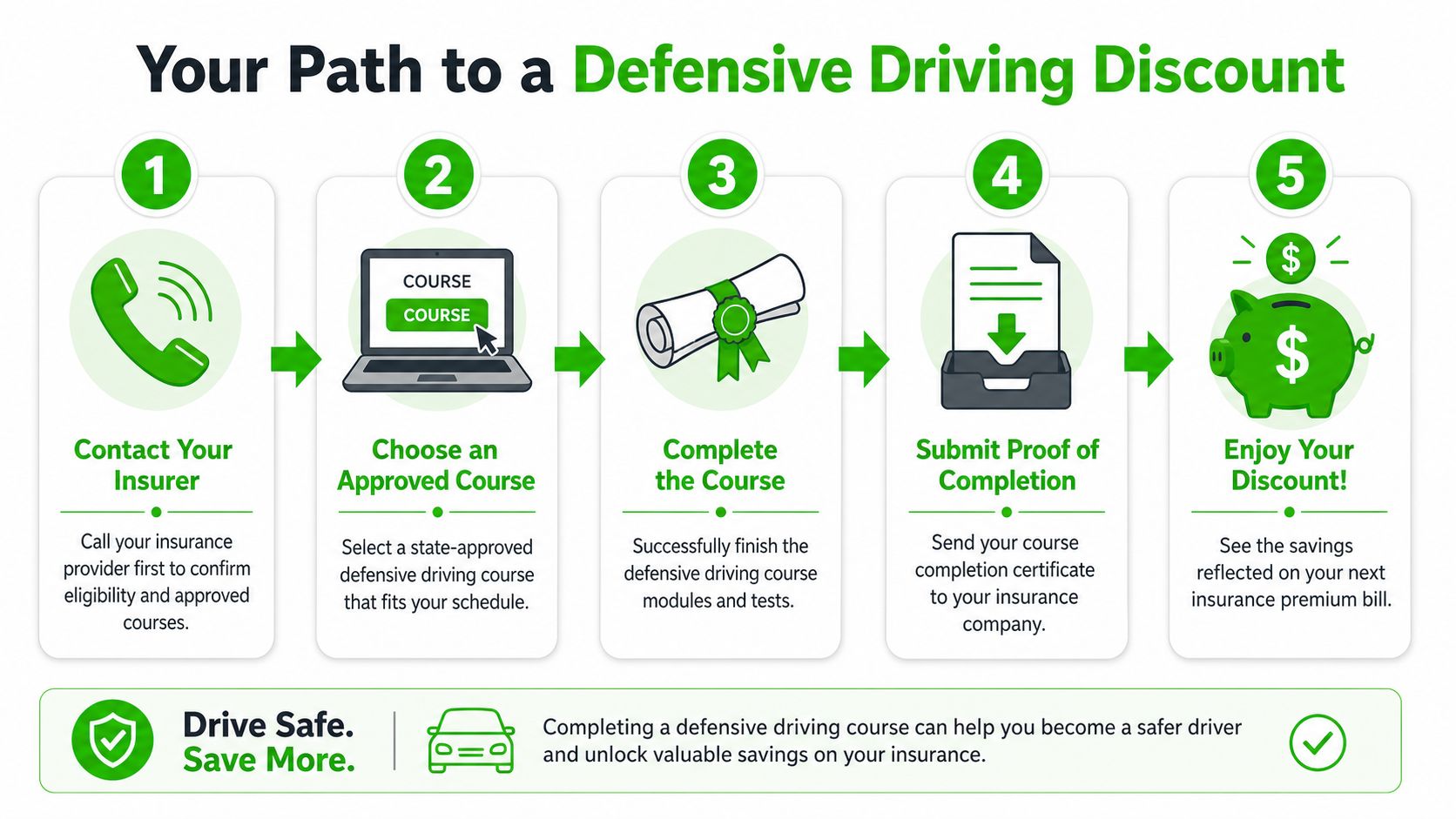
Step one starts with your insurer
Call your insurance company before you register for anything. Ask direct questions in plain language:
- Do you offer a defensive driving insurance discount?
- Does the course need to be Georgia DDS-approved?
- Will an online course qualify, or do you require classroom completion?
- Who on the policy can use the discount?
- How do I submit the certificate?
Write down the representative's name, the date, and what they told you. If the company has a customer portal message center, send a short follow-up there so you have a written record.
Keep it simple: "I'm in Georgia and planning to complete a defensive driving course. What exact proof do you need to apply any available discount to my policy?"
Choose the right Georgia course
Once you know what the insurer wants, choose a DDS-approved course that fits your needs. Some Georgia drivers need a course for insurance only. Others also need point reduction support. Still others are balancing work, family, or a court deadline and need online, live virtual, or classroom flexibility.
One Georgia option is Georgia DUI Schools' point reduction guidance, which connects the course decision to the DDS record side many drivers are trying to manage at the same time.
When comparing providers, check these basics:
- Approval status: Make sure the provider is recognized for Georgia defensive driving purposes.
- Delivery format: Confirm whether you need online, virtual live instruction, or in-person attendance.
- Certificate timing: Ask how and when proof of completion is issued.
- Use case: If you also have a court or DDS objective, verify the same course fits that purpose too.
Finish, submit, confirm
After you complete the course, don't assume the provider sends everything everywhere for you. Usually, you need to move the certificate yourself.
A clean process looks like this:
- Save the certificate immediately: Download the digital file and keep a backup.
- Send it exactly as instructed: Upload, email, or submit it through the insurer's requested method.
- Ask when it should appear: Get a rough timeline for billing or renewal recognition.
- Follow up if needed: If the next bill arrives without the discount, contact the insurer again and reference your earlier submission.
- Handle the DDS side separately: If you're also pursuing point reduction, keep that paperwork organized on its own track.
Drivers in Atlanta often juggle this between long commutes, work schedules, and court dates. Drivers in Athens may be doing the same around class schedules or family obligations. The paperwork still works the same way. Clear confirmation beats assumptions every time.
Common Questions and Your Next Step in Georgia
A few questions come up over and over because Georgia drivers are usually dealing with more than one issue at once.
Common points of confusion
Does a DUI or Risk Reduction course count for an insurance discount?
Don't assume it does. A DUI or Risk Reduction course serves a different purpose from a defensive driving course. Your insurer may treat them differently, and the course that satisfies a license reinstatement issue may not be the one that supports an insurance discount.
If I switch insurance companies, does the old certificate still help?
Maybe, but you need to ask the new carrier. Each insurer has its own rules for acceptance, timing, and documentation.
Does online count in Georgia?
Often it can, but only if the insurer accepts it and the course fits Georgia requirements for your purpose.
If the course helps with points, will the insurer know automatically?
No. DDS-related outcomes and insurance discounts usually don't flow automatically between systems. You need to submit proof to the insurer.

The most practical move is to stop treating this as one single process. It isn't. It's a coordinated set of small steps involving the insurer, the DDS, and sometimes a court. When you handle each one directly, the results are much more predictable.
If you're trying to save money, reduce points, and stay compliant in Georgia, the next step is straightforward. Confirm your insurer's rules, choose a DDS-approved defensive driving course, complete it, and keep your certificate moving to every place that needs it.
If you're ready to act, review the Georgia DUI Schools defensive driving course options and choose the format that fits your schedule, whether you need the class for insurance questions, point reduction, or both.