

A DUI evaluation is a state-required clinical assessment used after a DUI to determine whether you have a substance use issue and what education or treatment is necessary for court and license reinstatement. It commonly uses structured criteria such as the DSM's 11 diagnostic criteria, where 2 to 3 symptoms indicate a mild disorder, 4 to 5 moderate, and 6 or more severe, and tools like the MAST, which uses 25 questions scored from 0 to 24, with 5 or more points potentially indicating alcoholism.
If you're reading this, there's a good chance you're dealing with paperwork, deadlines, and a lot of uncertainty. Maybe the court told you to get a clinical evaluation. Maybe you're trying to figure out what Georgia DDS will want before you can move forward. Either way, the phrase itself can sound intimidating.
Individuals often hear "evaluation" and think it's some kind of test they're supposed to pass. That's not really what it is. A DUI evaluation is a formal assessment that helps a qualified professional decide what kind of next step fits your situation. For some people, that means education. For others, it means treatment. For many, the hardest part is understanding what the process is asking for.
Your Guide to the Georgia DUI Evaluation
A common Georgia scenario goes like this. You were arrested for DUI, you've talked to your attorney or the court, and now someone tells you that you need a clinical evaluation. At that moment, common questions arise. What is a DUI evaluation? What am I supposed to say? What happens if I say the wrong thing?
The first thing to know is that this process is serious, but it's manageable. You're not walking into a room where someone is trying to trap you. You're meeting with a trained professional who is gathering information in a structured way so the court or licensing authority can decide what requirements apply.
What the evaluation is really for
In plain language, a DUI evaluation helps answer three basic questions:
- Is there a substance use problem: The evaluator looks at alcohol or drug use patterns, not just one arrest.
- How serious is the concern: The assessment uses clinical standards, not guesswork.
- What happens next: The recommendation may involve a class, counseling, treatment, or another required step.
That last part matters most for people in Georgia. The evaluation often becomes the document that connects your DUI case to the next required service.
Practical rule: A DUI evaluation isn't about "winning." It's about getting an accurate recommendation that the court and DDS can use.
Why people get confused
Part of the confusion comes from the fact that this is both a legal process and a clinical process. The court may require it. DDS may require it. But the actual appointment is handled like an assessment, not a hearing.
That mix can make people nervous. If that's where you are right now, take a breath. Once you understand what the evaluator is reviewing, what questions usually come up, and what your result means, the process starts to feel much more manageable.
Why a DUI Evaluation Is Required in Georgia

Georgia doesn't require DUI evaluations just to add another task to your list. The reason is public safety and formal decision-making. A DUI case raises questions about alcohol or drug use, driving risk, and what kind of intervention is appropriate before someone regains full driving privileges or satisfies court requirements.
A useful reference point is Georgia's legal alcohol threshold. A BAC of 0.08 g/dL is the legal per se limit in Georgia and most of the United States, and the National Highway Traffic Safety Administration says drivers at that level are about 4 times more likely to crash than sober drivers. NHTSA also reports that about 30% of all U.S. traffic crash fatalities involve drunk drivers. That is why states use DUI evaluations as a way to assess risk and require intervention when needed, according to NHTSA's drunk driving overview.
The two Georgia reasons people usually need one
Most Georgia drivers run into this requirement for one of two reasons:
Court compliance
A judge, probation officer, or attorney may tell you that you need a clinical evaluation as part of a DUI case. In that setting, the evaluation helps the court decide whether education alone is enough or whether treatment should be added.License-related requirements
Some drivers need the evaluation because they are working through Georgia DDS requirements tied to reinstatement or other driving privilege issues. The evaluation becomes part of the documentation used to show what steps are required before moving ahead.
Why the state uses an evaluation instead of assumptions
A DUI arrest by itself doesn't tell the whole story. Two people can be charged with the same offense and have very different backgrounds. One person may have made a one-time bad decision. Another may have a longer pattern of alcohol or drug misuse. The state uses a clinical assessment because it creates a structured way to sort that out.
If you're trying to understand the bigger legal context, this overview of understanding court-mandated treatment gives helpful background on why courts connect legal outcomes with treatment recommendations.
The evaluation functions less like punishment and more like a formal screening tool. It helps the system decide what kind of education, monitoring, or treatment fits the person in front of them.
That doesn't make the process easy. But it does explain why Georgia takes it seriously.
What Happens During a Clinical Evaluation
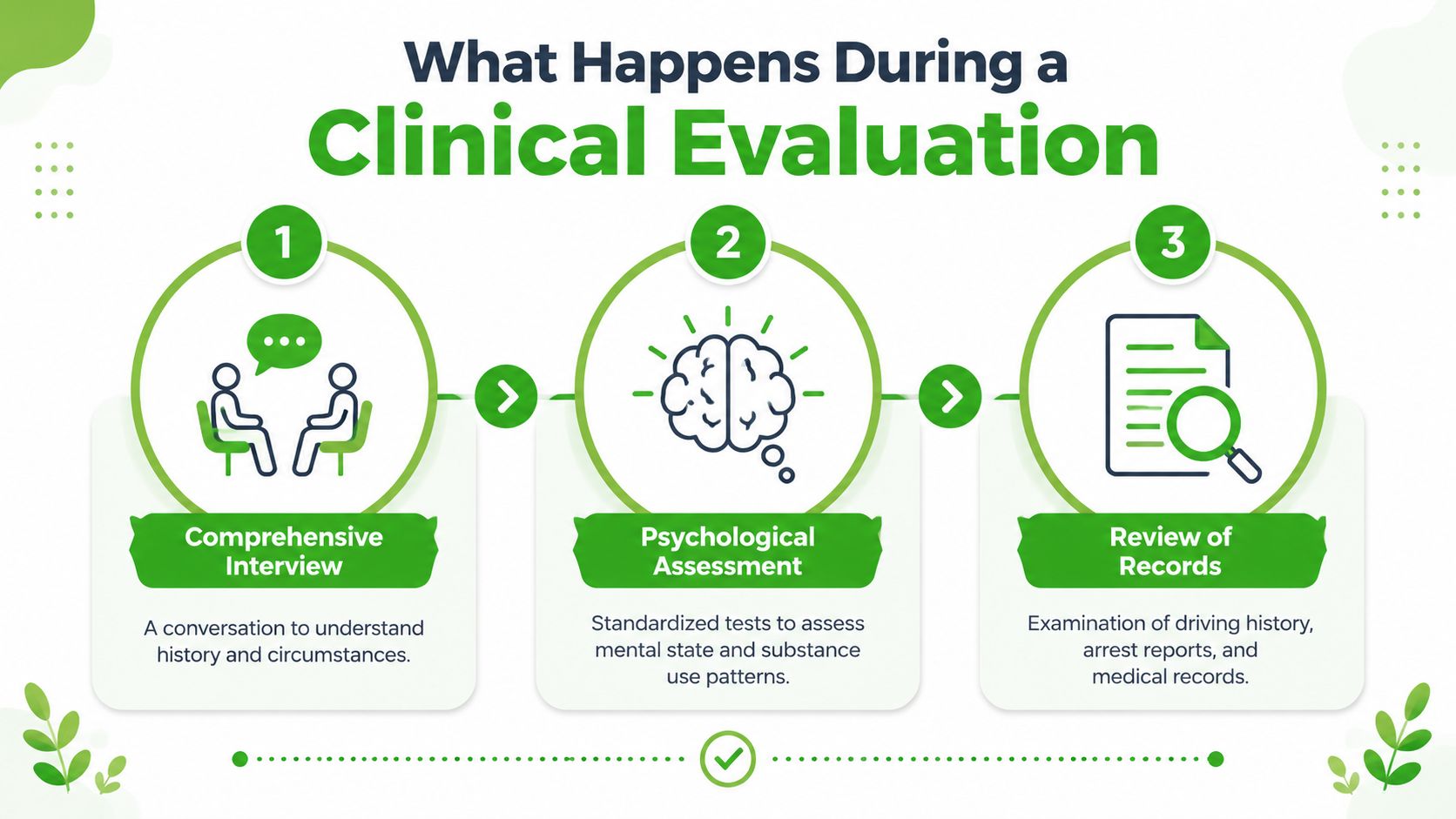
This aspect often causes concern. Individuals want to know what occurs once they're in the room. The short answer is that a DUI evaluation is a structured, multi-phase clinical risk assessment, not a casual chat. One university training presentation describes it as including a detailed substance-use history, an objective test, and even a truthfulness scale that can flag guarded or minimizing responses in this clinical evaluation training material.pdf).
The interview portion
The interview is usually the longest and most personal part. The evaluator may ask about your alcohol use, drug use, prior treatment, family history, mental health background, and the events surrounding your DUI.
Some questions feel straightforward. Others can feel repetitive. That's normal. Evaluators often ask similar things in different ways because they're checking for consistency and trying to understand the full picture.
You may be asked about:
- Your use history: When you first started drinking or using substances, how often you use them, and whether that pattern has changed.
- The DUI event: What happened before the arrest, what you consumed, and what you remember.
- Past consequences: Prior legal issues, work problems, family conflict, blackouts, or attempts to cut down.
- Treatment background: Counseling, classes, support groups, rehab, or previous evaluations.
The objective testing portion
Most evaluations also include a standardized tool. This is one reason the process is more formal than people expect. It isn't based only on your conversation with the evaluator.
A common example is the MAST, a screening tool with 25 questions scored from 0 to 24, where 5 or more points can indicate alcoholism, as explained in this overview of drug and alcohol assessment tools. The same source notes that many substance-use evaluations also rely on the DSM framework's 11 criteria, which clinicians use to classify severity.
The records review
The evaluator may also review paperwork tied to your case. Depending on the provider and the situation, that can include court paperwork, driving history, chemical test results, or related documentation.
This matters because the recommendation isn't supposed to come from one source alone. The evaluator is comparing what the documents show, what the screening tool shows, and what you report in the interview.
| Part of the evaluation | What it helps determine |
|---|---|
| Interview | Your history, current use patterns, and context |
| Objective test | Standardized screening results |
| Record review | Whether the case documents match the history provided |
People often get anxious about being judged. In practice, the evaluator is trying to build a reliable picture, not argue with you.
What the evaluator is looking for
The evaluator is usually trying to answer a few practical questions. Is there evidence of a substance use disorder? If so, how serious does it appear to be? Is education enough, or does the pattern suggest treatment is needed?
That means honesty matters. So does accuracy. If you're unsure about a date or detail, it's better to say that clearly than to guess and create inconsistencies.
Understanding Your Evaluation Results and ASAM Level
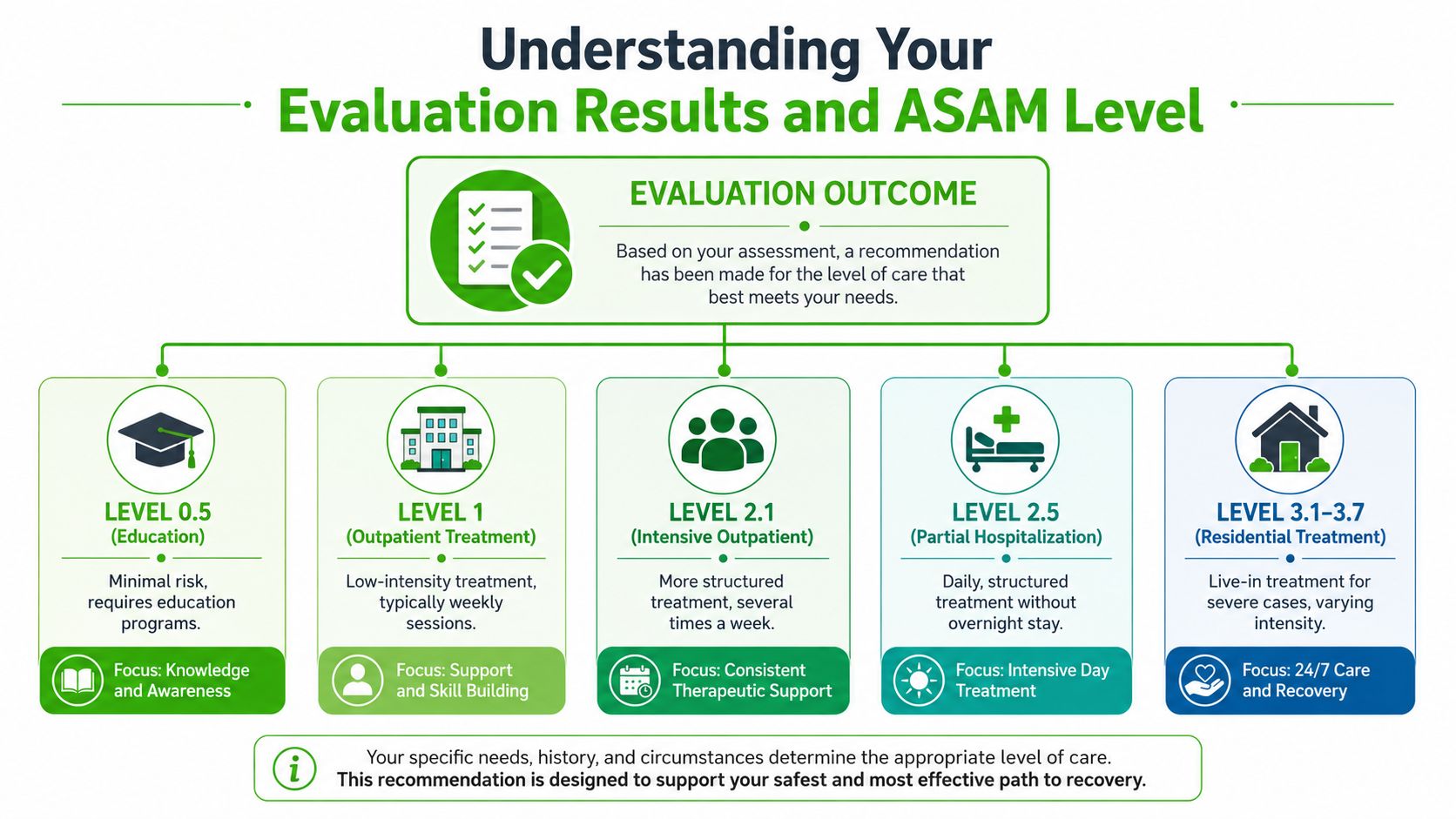
When the evaluation is finished, you usually don't get a simple yes-or-no result. You get a recommendation. That's where many people feel lost, because the paperwork may mention an ASAM level and expect you to know what that means.
ASAM refers to a treatment placement framework used to match a person with the right intensity of care. For Georgia drivers, the most important issue is usually whether the recommendation points toward education or treatment.
Education versus treatment
A lower-level recommendation often points to education, such as the state-required DUI or Risk Reduction path. A treatment recommendation means the evaluator believes more support is needed than a class alone can provide.
Here is the practical difference:
- Level 0.5 style recommendation: Usually points toward education-focused intervention.
- Level 1 recommendation: Usually means outpatient treatment, often in a short-term format.
- Higher levels: Suggest more structured care when the issues are more serious.
That doesn't mean a treatment recommendation is a moral judgment. It means the evaluator believes your history and assessment results show a need for more than information alone.
How to read the result without panicking
Many people hear "Level 1" and assume the worst. That's not always accurate. It generally means outpatient care, not the most intensive setting. If your paperwork mentions Level 1 and you need help understanding what that looks like in Georgia, this page on ASAM Level 1 treatment in Georgia gives a useful overview of that next step.
A simple way to think about the recommendation is this:
| Recommendation type | What it usually means in practice |
|---|---|
| Education-focused | You may need a class or structured educational program |
| Outpatient treatment | You may need counseling sessions over time |
| More intensive treatment | You may need a higher level of structured care |
Your result is a placement decision. It's meant to answer "what support is appropriate," not "what kind of person are you."
Why the recommendation matters so much
In Georgia, this recommendation often controls what you must complete next to satisfy legal or licensing demands. That is why people shouldn't treat the evaluation as a formality. The report can shape the rest of the process.
If something in your result is unclear, ask questions right away. You want to understand whether you're being directed toward a Risk Reduction course, outpatient treatment, or another requirement before deadlines start piling up.
How to Prepare for Your DUI Evaluation
Preparation won't change your history, but it can make the process smoother and more accurate. That's the ultimate goal. You want the evaluator to have a clear picture of your situation, and you want to avoid delays caused by missing paperwork or confused answers.
One training source notes that in a state like Georgia, the evaluation will typically include a face-to-face interview that can last from 30 minutes to a few hours, plus a review of driving history, chemical test results, and an objective test. The same material emphasizes that bringing your documents and being ready to discuss your history openly is the best way to handle the process, as outlined in this evaluation process summary.
What to gather before the appointment
Try to collect anything the provider asked you to bring. Exact document lists vary, but people are often asked for items tied to the DUI case and their identification.
A practical checklist includes:
- Photo ID: Bring a current government-issued ID.
- Court paperwork: Any order, referral, or case document related to the DUI.
- Driving record information: If requested by the provider.
- Chemical test information: Breath, blood, or refusal-related documents if you have them.
- Prior treatment records: Only if the evaluator asks for them.
How to answer questions well
The best approach is simple. Be honest, be calm, and don't try to "game" the process.
Some people minimize because they're afraid treatment will be recommended. Others overshare in a panicked way and create confusion. Neither helps. The evaluator is trained to look for consistency, context, and reliability.
A few habits help:
- Answer directly: Don't wander away from the question.
- Admit when you don't know: Approximate carefully if you're unsure of dates.
- Stay consistent: If your account changes repeatedly, the evaluator will notice.
- Don't rehearse a perfect story: It usually comes across as guarded.
Keep this in mind: evaluators have heard every version of "I barely drink" and "I don't remember anything." Clear, straightforward answers carry more weight than polished ones.
A common fear that doesn't help
People often ask if they can fail a DUI evaluation. The better way to think about it is that the evaluation identifies what requirement fits your case. It isn't a school exam with a passing score.
If you're worried about what to say and how the process works, this guide on how to pass a drug and alcohol evaluation can help you prepare in a realistic way.
The more organized you are, the easier it is for the evaluator to focus on the actual assessment instead of chasing missing information.
Completing Your Requirements with Georgia DUI Schools

Once you understand what a DUI evaluation is, the path gets simpler. First comes the assessment. Then comes the recommendation. After that, you complete the service the recommendation calls for.
For Georgia drivers, that usually means one of a few tracks. Some people need a Risk Reduction course. Others need ASAM Level 1 treatment. Some may also have additional requirements tied to their court case or reinstatement process.
Keeping the process in one place
One practical option is to work with a provider that can handle more than one step. Georgia DUI Schools offers state-approved clinical evaluations as well as related services tied to common DUI requirements, including Risk Reduction and treatment options. That kind of setup can make life easier when you're trying to keep documents, scheduling, and completion records organized.
If you also need to review broader class options, including state-related course formats, this page on Georgia driving classes and related course options can help you sort through what's available.
What matters most now
At this point, the most important thing is movement. Not perfect wording. Not endless worrying. Movement.
- Schedule the evaluation
- Bring the right paperwork
- Follow the recommendation
- Complete each required step on time
That approach keeps a confusing process from turning into a longer one.
If you're ready to take the next step, schedule a clinical evaluation with Georgia DUI Schools and get clear guidance on what your court or DDS requirement means and what to do next.