

You got a court notice, a probation instruction, or a license reinstatement checklist, and now you're searching for a substance abuse assessment near me because something in the system says you need one. Those in that spot are not calmly comparison-shopping. They're trying to avoid missing a deadline, turning in the wrong paperwork, or showing up to court without what was ordered.
In Georgia DUI cases, that stress is normal. The language can be confusing. One document says “clinical evaluation.” Another says “alcohol and drug assessment.” A third mentions treatment, classes, or DDS requirements. People often assume it's just another form to fill out. It isn't. It's a formal step that can affect what happens next in your case.
This isn't a rare situation. In the United States, 48.4 million people aged 12 and older met criteria for a substance use disorder in 2024, equal to 16.8% of that population, according to American Addiction Centers' addiction statistics overview. That matters because an assessment is often the first structured way a court system, treatment provider, or state agency decides what kind of response fits the person in front of them.
Your Guide to Navigating a Required Assessment
A common Georgia scenario goes like this. Someone is arrested for DUI, gets through bond, then starts hearing new terms from a lawyer, probation officer, or court clerk. They know they need to complete requirements, but they're not sure what order to handle them in. They search “substance abuse assessment near me” because it sounds urgent and local, and they're right on both counts.
The first practical point is simple. An assessment is not random paperwork. It's one of the clearer steps in an otherwise messy process. If a judge, probation office, or licensing authority wants a clinical evaluation, that requirement needs to be handled by the right provider and handled on time.
Why this step matters early
Waiting until the last minute causes most of the problems I see. People delay because they assume the assessment will be quick, informal, or interchangeable with any counseling intake. Then they find out the court wants a specific kind of evaluation, sometimes from a provider with the right approval or credentials, and now the clock is working against them.
A better approach is to treat the assessment as your starting point for decision-making. Once it's complete, you usually have a clearer answer to questions like:
- What does the court need: A brief screening, a full clinical evaluation, or proof of follow-up services.
- What comes next: Education, outpatient counseling, treatment referral, or no added treatment recommendation.
- What paperwork must be turned in: A report, certificate, recommendation, or compliance update.
Practical rule: If a court or agency ordered an assessment, assume they expect a document they can review, not just proof that you talked to someone.
A requirement does not mean the same outcome for everyone
People often walk in thinking the evaluator has already decided what they'll recommend. That's not how a proper process works. The purpose is to gather enough information to make an individualized recommendation, not to hand every DUI client the same result.
That distinction matters in Georgia because legal requirements and clinical needs sometimes overlap, but they are not identical. The court cares about compliance. The evaluator is looking at substance use history, current functioning, risks, and whether additional services make sense. When those pieces are handled correctly, the process becomes more manageable and far less mysterious.
What Is a Substance Abuse Assessment
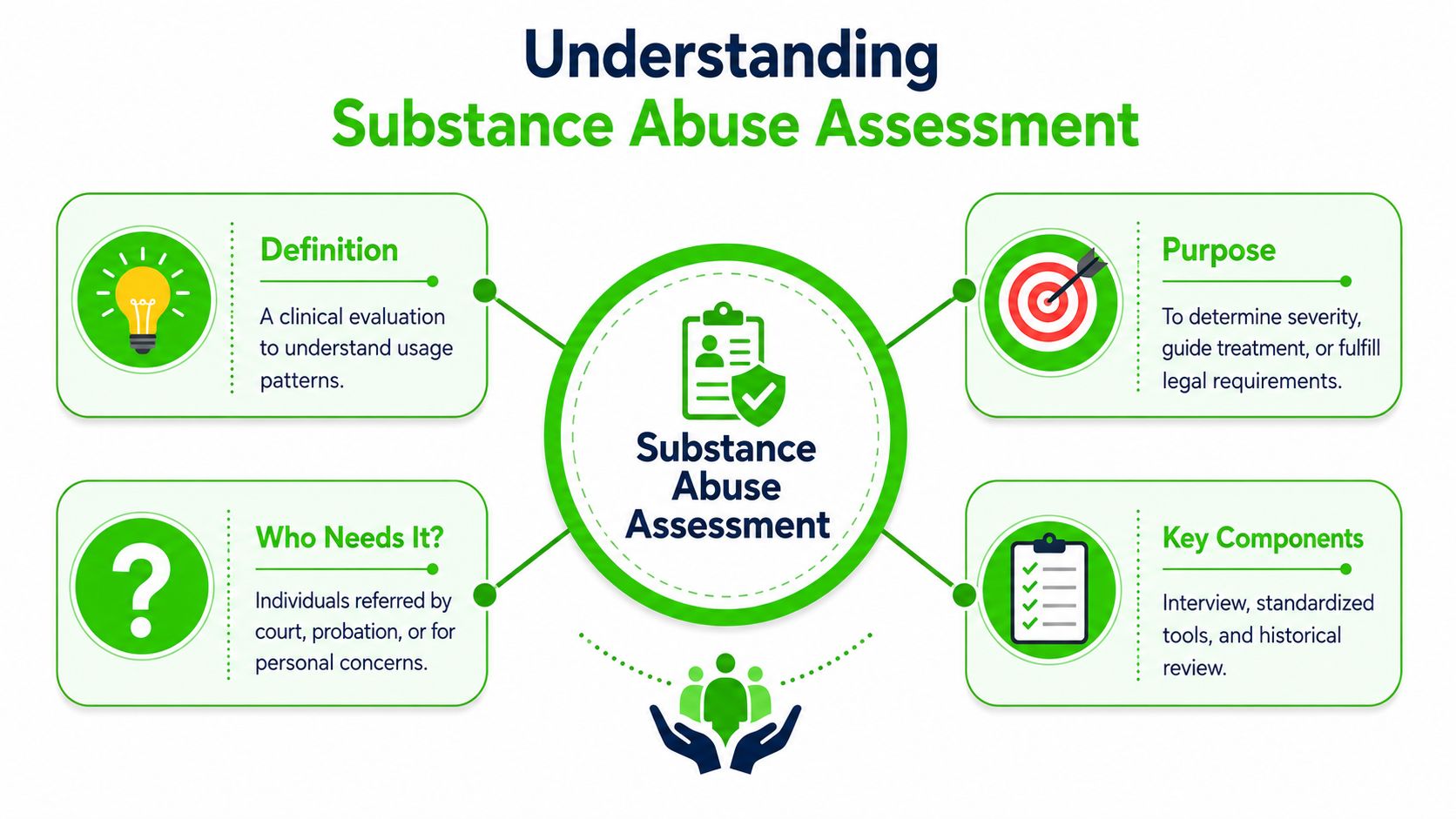
You get paperwork from court, and one line jumps out: complete a substance abuse assessment. At that point, many Georgia DUI clients assume they are being sent to a class or a quick questionnaire. In practice, the assessment is a clinical evaluation used to determine whether alcohol or drug use is a concern, how serious that concern appears to be, and what kind of follow-up, if any, makes sense.
A proper assessment gathers information in a structured way. The evaluator looks at substance use history, current habits, prior consequences, mental health factors, medical background, and day-to-day functioning. In a Georgia DUI case, that matters because the final recommendation often becomes part of the documentation a court, probation office, or other authority reviews.
Assessment versus screening
A screening is brief. It flags whether a person may need a closer look.
An assessment goes further. It involves a fuller interview and a more detailed review of history, symptoms, behavior, and the effect substance use may be having on work, family, driving, legal problems, or daily responsibilities. That distinction matters in Georgia because clients often bring in an order that says "assessment" but show up with paperwork from something much narrower.
I tell clients to pay attention to the purpose of the appointment. If the result needs to support a court file, probation requirement, or DDS-related step, the provider usually must do more than ask a few standard intake questions. The provider needs to produce an evaluation that addresses the issue clearly enough for an outside agency to rely on it.
A useful comparison is the broader mental health intake process. If you want a plain-language explanation of how a clinician gathers information across symptoms, history, and functioning, insights on psychiatric evaluations from Refresh Psychiatry help clarify why these appointments are structured the way they are.
What the evaluator is trying to determine
The evaluator is usually working toward a few practical conclusions:
- whether a substance use disorder appears to be present
- how serious the problem appears to be
- whether education, counseling, treatment, or monitoring is appropriate
- what recommendation should be documented for the referring court, probation officer, employer, or agency
That process is individualized. One DUI arrest does not automatically lead to the same recommendation for every person. A client with no prior history, limited use, and stable functioning may be evaluated very differently from someone with repeated incidents, signs of dependence, or a pattern of alcohol or drug-related problems.
This is also where legal and clinical goals start to overlap without becoming the same thing. The court wants usable documentation. The clinician has to make a professional judgment based on the interview, records provided, and any other relevant information. If those two pieces line up, the assessment does what it is supposed to do. It gives the Georgia DUI client a clear, defensible next step.
Why Assessments Are Required for Georgia DUIs
In Georgia, the word “required” usually comes from one of three places. A court orders it. Probation requires it. Or a driver needs documentation that fits a DDS-related or reinstatement-related process. The exact trigger matters because it affects what kind of provider you should use and what paperwork that provider must produce.
The DUI context in Georgia
After a DUI arrest or conviction, people often assume the Risk Reduction course and a clinical evaluation are the same thing. They aren't always the same thing, and that confusion causes delays. Georgia's DUI process can involve multiple moving parts, and one requirement doesn't automatically satisfy another.
A judge may want a separate clinical evaluation even if you're already enrolled in or planning to complete other DUI-related obligations. Probation can also add conditions based on the facts of the case, prior history, or concerns about alcohol or drug involvement.
Here's the practical takeaway. If your paperwork uses terms like “clinical evaluation,” “drug and alcohol assessment,” or “substance abuse assessment,” don't assume a class registration alone will satisfy it.
Legal wording and clinical wording are not interchangeable
Courts use broad language. Clinicians use more precise language. That mismatch creates problems when someone goes to a provider that offers general counseling but does not produce the kind of evaluation report the court expects.
The same issue shows up in administrative matters tied to driving privileges. If the Georgia DDS, a probation department, or a court needs a recognized evaluation, the provider has to fit that purpose. A local search result by itself doesn't tell you that.
Consider these common situations:
| Situation | Why an assessment may be required |
|---|---|
| DUI case | The court wants clinical information before setting or reviewing conditions |
| Probation | The officer needs documentation of compliance or treatment need |
| License matters | An agency may require evaluation-related documentation before processing next steps |
| Custody or related legal disputes | A party or court may want a formal substance use review |
The real reason courts ask for this
From a practitioner's standpoint, the court isn't usually asking for an assessment just to create another hoop. The court wants a structured answer to a specific question: does this person need more than basic legal compliance?
That's why the language in the order matters so much. If it asks for an evaluation, the safest move is to confirm exactly what authority requested it, what kind of report they expect, and where it must be sent.
What to Expect During Your Evaluation
A Georgia DUI evaluation usually feels more straightforward once you know what the appointment is for. In most cases, you are meeting one-on-one with a clinician who has to gather enough information to make a recommendation the court, probation, or DDS can use. The setting is professional and structured. It should not feel like a cross-examination.
For Georgia clients, the practical question is not just what the evaluator asks. It is what kind of report comes out at the end and whether it will satisfy the requirement attached to your case. That is why I tell people to treat the evaluation as both a clinical appointment and a compliance step.
How the appointment usually unfolds
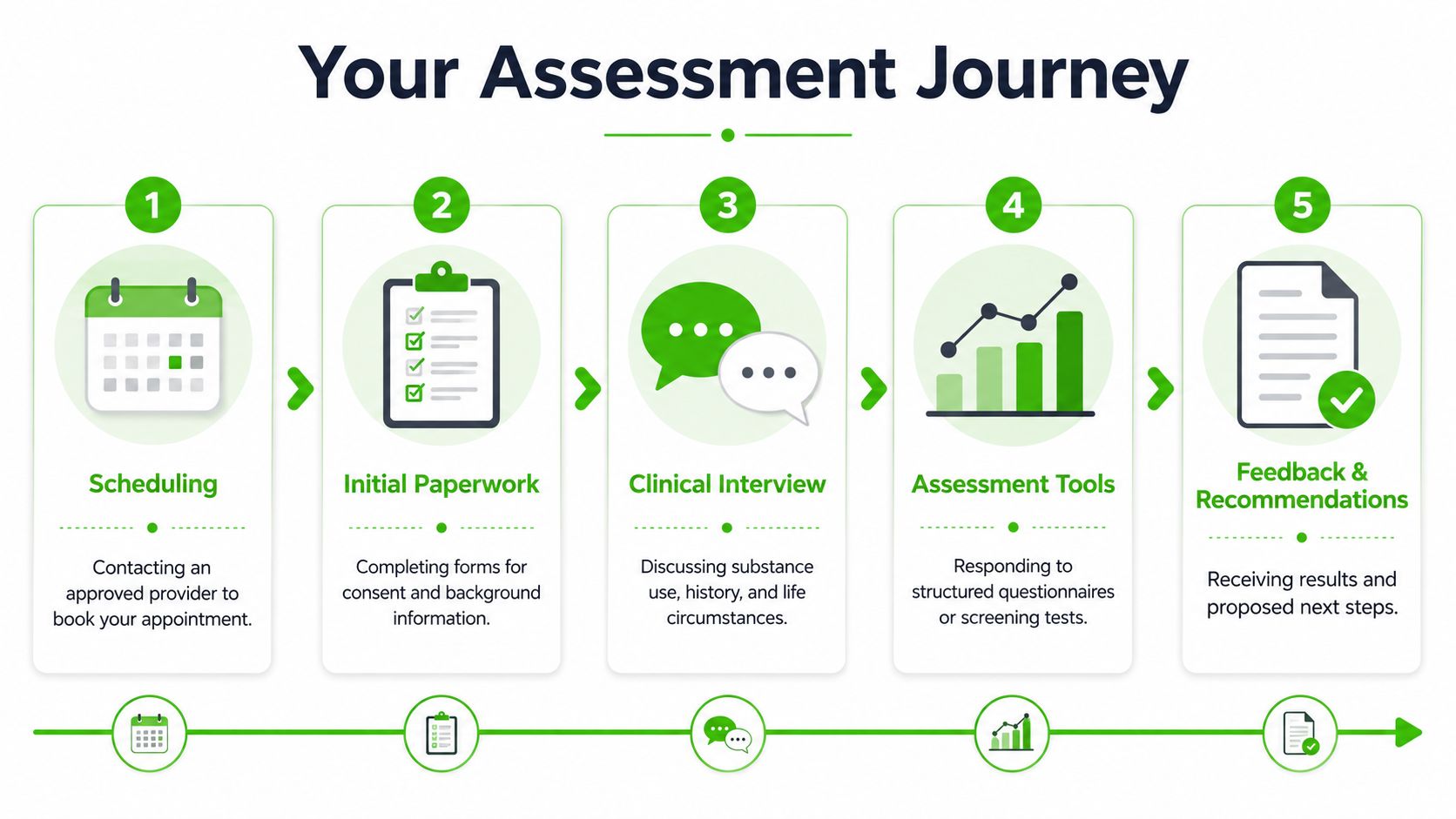
Providers have their own workflow, but the evaluation often moves through the same core stages.
Check-in and paperwork
Expect to provide identification, referral information, and signed releases. If your case involves a DUI, bring the court order, probation instructions, arrest paperwork, or any document that explains why you were sent. Missing paperwork can delay the report or force a follow-up visit.
Interview about your history
This is the main part of the appointment. The evaluator will ask about alcohol or drug use, past legal issues, treatment history, medical conditions, prescriptions, and mental health symptoms. They are also listening for consistency. If the paperwork says one thing and your account says another, that usually needs to be clarified before the evaluation is finalized.
Screening tools or written questionnaires
Many evaluators use standard forms to support the interview. These tools help organize the history, but they do not replace clinical judgment. In court-related cases, they also help explain how the evaluator reached the recommendation.
Assessment findings and recommendations
Some providers give you a verbal summary at the end. Others send the written report later, depending on their process and where it has to go. The recommendation may be education, treatment, monitoring, or no added clinical service beyond what is already required.
What you will likely be asked
The questions are usually direct. A Georgia DUI case does not automatically mean the evaluator assumes you have a substance use disorder. The evaluator is trying to determine whether the arrest looks like an isolated event, a pattern of risky use, or part of a larger clinical issue.
Expect questions in areas such as:
- Substance use history: what you used, how often, how recently, and in what settings
- Prior consequences: arrests, crashes, family conflict, work problems, or health concerns
- Past services: counseling, DUI classes, detox, outpatient treatment, or support groups
- Mental health factors: anxiety, depression, trauma history, sleep problems, and medication use
- Daily stability: housing, work, transportation, and support from family or others
If you want a Georgia-specific explanation of how the process works, Georgia DUI Schools' overview of what a drug and alcohol evaluation is gives a useful summary tied to DUI compliance.
One practical point matters more than people expect. Evaluators are not only documenting what happened on the arrest date. They are assessing your current risk, your history, and whether any treatment recommendation is likely to be appropriate and defensible.
What helps the process go smoothly
Show up on time. Bring every document you were given. Answer questions plainly.
If you do not remember an exact date or detail, say so. If you had prior counseling, disclose it. If you have anxiety, depression, trauma, or medication changes in the background, mention that too. Those facts can affect the recommendation and may explain behavior the court would otherwise read too narrowly.
Trying to minimize obvious facts usually backfires. I have seen clients create bigger problems by denying prior use that was already documented in records, police reports, or earlier treatment paperwork. A consistent, honest account gives the evaluator a clearer basis for a report that fits both the clinical facts and the legal requirement.
In some cases, clients also need follow-up behavioral health support after the evaluation is complete. If that applies to you, virtual addiction psychiatry care may be worth considering when local scheduling or transportation is a problem.
Finding a State Approved Assessment Provider in Georgia
If your assessment is tied to a DUI, probation, court order, or driving matter, provider choice is not a cosmetic detail. It can determine whether the report is accepted at all.

Why credentials matter more than location
People often search for “substance abuse assessment near me” and pick the nearest office with a decent map listing. That's understandable, but it's risky in legal cases. A provider can be local, licensed, and still be the wrong fit for your referral.
New York's OASAS notes that only specific, certified providers can conduct impaired-driver clinical screenings and related services that will be accepted in that system, which shows the larger point that provider credentials can determine whether a DUI-related evaluation is accepted. Georgia clients should use the same mindset. Before booking, confirm that the provider's evaluation will satisfy the court, probation office, or agency that sent you.
Questions to ask before you book
A short phone call can save a lot of trouble. Ask direct questions.
- Will my court accept this evaluation: Don't settle for “we do assessments.” Ask whether they handle court-ordered or DUI-related evaluations specifically.
- What documents do you need from me: Court order, arrest paperwork, probation instructions, ID, prior treatment records.
- What report do you issue: You need to know what the finished product looks like and how it's delivered.
- Can you provide follow-up services if recommended: This matters if treatment is part of the result.
If the referring authority can reject the report, you need to verify the provider before the appointment, not after it.
One practical Georgia option
For people who need a court-related alcohol or drug evaluation in this state, Georgia DUI Schools' court-ordered alcohol assessment service is one Georgia option that offers clinical evaluations and related follow-up services for DUI and compliance needs. That can simplify the process when an assessment recommendation leads into ASAM Level 1 treatment or other required next steps.
Some clients also need a separate medical or psychiatric layer of support, especially when substance use and mental health concerns overlap. In those cases, learning how virtual addiction psychiatry care works can help you understand when a clinical evaluation should be paired with psychiatric treatment planning.
What usually goes wrong
The biggest mistakes are predictable:
| Mistake | Result |
|---|---|
| Booking with a generic counseling office | The court may not accept the evaluation format |
| Waiting until the deadline is close | Less time to fix issues or complete follow-up |
| Not asking who receives the report | Paperwork ends up in the wrong place or delayed |
| Ignoring treatment recommendations | Compliance may remain incomplete |
The right provider is the one that fits the legal purpose, not just the closest address.
How to Prepare for Your Assessment and Next Steps
Preparation doesn't need to be complicated. It needs to be deliberate. When clients come in organized, the evaluation tends to move more smoothly and the report is easier to complete without delays.
Bring the right information
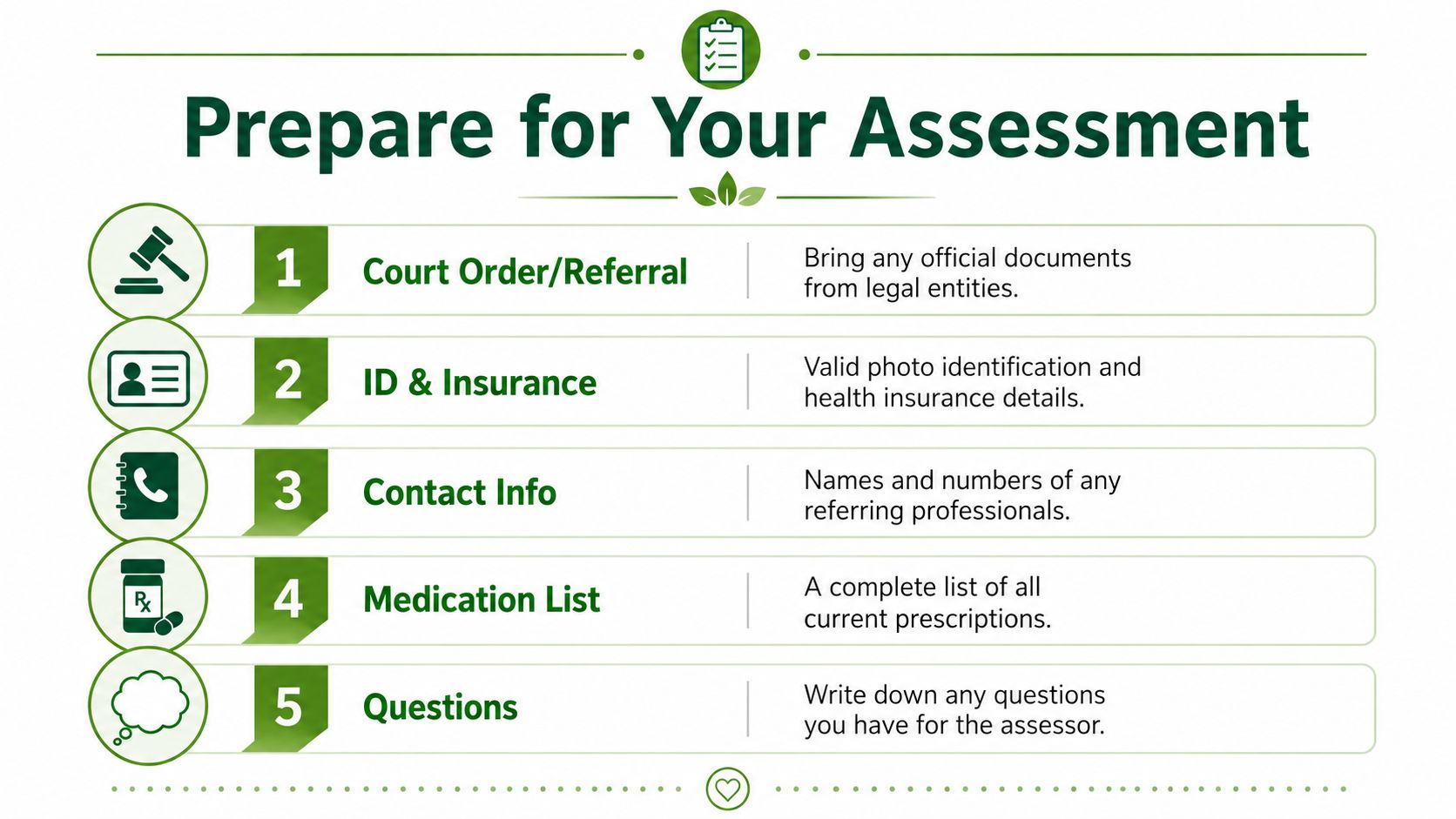
Use a short checklist before your appointment:
- Court paperwork: Bring the order, referral, probation instruction, or any letter telling you why the assessment is required.
- Identification: A valid photo ID is standard.
- Case details: If you have arrest paperwork or related records, bring them.
- Medication list: Include current prescriptions and relevant treatment history.
- Contact names: Write down your attorney, probation officer, court contact, or case manager if someone may need the report.
Be accurate, not polished
People sometimes prepare by rehearsing what they think sounds safest. That usually backfires. The better plan is to be factual. If your history is limited, say so. If there were prior incidents or treatment efforts, disclose them.
If treatment is recommended after the evaluation, ask what that recommendation means in practical terms. Some people need education. Some need outpatient counseling. Some need a more coordinated treatment plan. If you want to understand how clinicians typically turn assessment findings into structured care goals, Simbie AI treatment plan templates offer a useful example of how recommendations are organized after an evaluation.
For a Georgia-specific preparation guide, this advice on how to pass a drug and alcohol evaluation in Georgia can help you avoid the common mistakes that make the process harder than it needs to be.
Show up ready to tell the truth, not ready to “win” the interview.
Once the evaluation is done, follow through quickly on any recommendation. In DUI and probation matters, the assessment is often only the first compliance step, not the last one.
Georgia Substance Abuse Assessment FAQs
Can I get a substance abuse assessment done online in Georgia
Sometimes, yes, depending on the provider and the purpose of the evaluation. The key question isn't whether online scheduling or virtual access exists. The key question is whether the referring court, probation office, or agency will accept that format. Always confirm acceptance before booking.
How quickly can I get an appointment
That depends on provider availability, but fast access matters. Public behavioral health systems have increasingly moved toward same-day assessment and referral, with the District of Columbia Department of Behavioral Health stating that its sites provide same-day assessment and referral services. That reflects a broader shift toward getting people evaluated and directed to the right services quickly, rather than leaving them on a waiting list with no next step.
How much does a clinical evaluation cost
Fees vary by provider, location, and whether the evaluation is routine, court-related, or bundled with other services. The practical move is to ask for the full cost before you schedule and ask whether there are separate fees for the report, missed appointments, or follow-up paperwork.
What if I already took a class
A class does not automatically replace a clinical evaluation. In Georgia DUI matters, those are often separate requirements. Read the wording of your order closely and ask the provider whether your existing class documentation satisfies anything beyond that class itself.
What if the evaluation recommends treatment
Then the next step is compliance. Get clear on what was recommended, where you can complete it, how completion is reported, and what deadline applies. Don't assume the assessment alone closes out your case.
If you need a Georgia provider for the next required step after an assessment, review the available DUI and Risk Reduction course options at Georgia DUI Schools. That gives you a direct path for handling a common court and DDS requirement without guessing which course fits your situation.