Online defensive driving courses are legitimate only when the provider is state-approved or DDS-listed, and Texas alone dismissed 304,934 tickets in fiscal year 2025 through state driving safety courses, with annual completions ranging from about 411,791 in 2023 to roughly 410,000 to 630,000 per year from 2019 to 2023. A course can be perfectly valid for an insurance discount and still be useless for a court order, so the key question is always, legit for what purpose?
I've sat across from plenty of Georgia drivers who were staring at a deadline, a citation, and a flashy ad promising “certified in 2 hours.” The frustration is real, because the certificate matters only if the state, the court, or the insurer accepts it, and that's where people get tripped up.
The Honest Answer Most Articles Skip
The driver in the parked car usually wants one simple answer. The honest answer is yes, online defensive driving can be legit, but only when the course matches the exact state rule, approval record, and use case you need.
Legitimacy is a match, not a label
A polished website can look convincing and still fail the basic test. The safer way to judge any course is to ask four questions in order. Is the provider state-approved? Is the course valid for your exact purpose? Does it meet the required length and fee rules? Can you verify the certificate after completion?
That last part matters more than people think. A certificate with no traceable provider number, no clear completion record, or no state approval can look official and still be rejected. The same course can be fine for a Georgia insurance discount and wrong for a court filing or a DUI-related compliance step.
Practical rule: if the course doesn't match your state and your reason for taking it, the certificate may be clean, but it still won't help you.
Georgia drivers usually ask the wrong question first. They ask whether the course is legit in general. The better question is whether it's legit for ticket dismissal, insurance, point reduction, or a court-ordered requirement. Once you ask it that way, the answer gets much clearer.
The Four Legitimacy Tests Every Course Must Pass
A real course has to clear a practical filter, not just a marketing filter. The most reliable test is whether the provider can survive four checks without hand-waving.
Start with state approval and use-case fit
First, the provider needs to appear in the relevant government directory or approval list. For Georgia drivers, that means checking the DDS-approved status before paying. A course that's fine for an insurance company may still be wrong for a court deadline, and that's a common mistake people make when they assume “approved online” means approved for everything.
Second, match the course to the reason you need it. Ticket dismissal, insurance discounts, point reduction, and a court order are not interchangeable. A valid course for one purpose can be rejected for another.
Then confirm length, fee, and certificate details
Texas offers a useful fraud-control benchmark here. Texas defensive driving must be at least 6 hours and includes a mandatory $25 state certificate processing fee (Texas defensive driving statistics, Texas course guide). That pattern, a required minimum length plus a mandatory state fee, is a strong sign that an authentic program has real compliance obligations behind it.
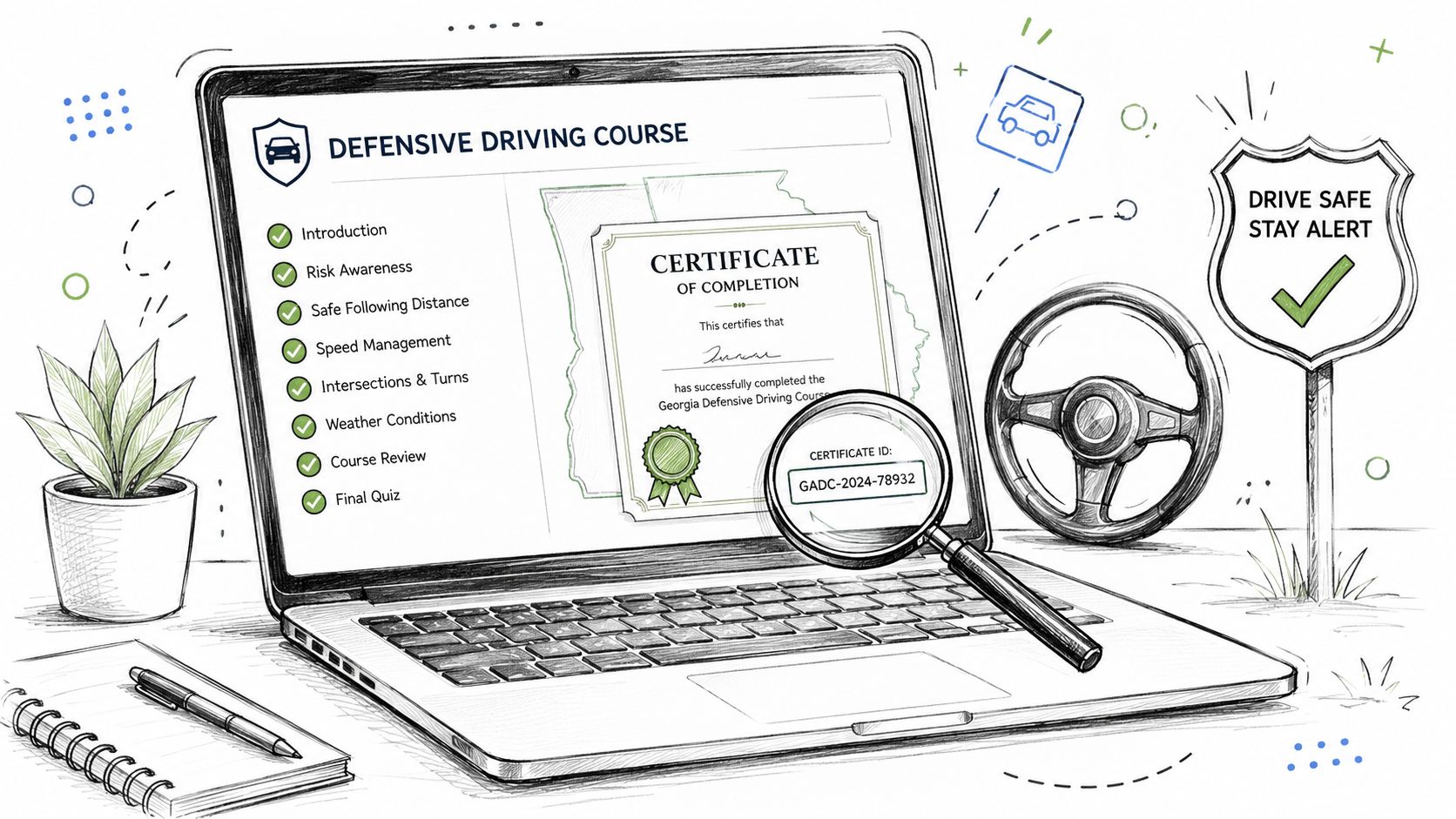
A course promising completion in 2 or 3 hours should make you pause. So should a landing page that hides fees until checkout. The certificate itself should show the provider name, a provider or license number, and a completion timestamp you can verify later.
A legit provider makes the approval path boring. If the sales pitch is doing all the work, the paperwork usually won't hold up.
Georgia Defensive Driving vs DUI Risk Reduction
Georgia drivers often lump every traffic course into one bucket. That's where trouble starts. Georgia defensive driving and Georgia DUI/Risk Reduction are separate pathways, and they serve very different legal needs.
Defensive driving handles ordinary traffic issues
A defensive driving course is the fit for routine moving violations where the court allows it, point reduction, or an insurance discount. CarTalk's Texas guide makes the same basic distinction for Texas, noting that defensive driving is for minor moving violations and not for major offenses like drunk driving (CarTalk Texas defensive driving guide). That distinction matters in Georgia too, because the offense decides the path.
If you got a speeding ticket in Atlanta, you're usually looking at defensive driving. If you were arrested for DUI, that's a different lane entirely.
DUI cases call for the DDS Risk Reduction path
Georgia DUI-related cases move through the DUI/Risk Reduction framework, not a generic defensive driving class. Georgia DUI Schools describes that pathway as including DUI and DUI laws, Risk Reduction courses, defensive driving, online and in-person classroom formats, clinical evaluations, ASAM Level 1 treatment, and Victim Impact Panels. That combination shows why a DUI case often needs more than a traffic-school certificate.
A defensive driving certificate won't satisfy a reinstatement or DUI-related requirement if the DDS or court ordered Risk Reduction. Likewise, a Risk Reduction certificate won't replace a basic defensive driving class when the issue is a minor traffic ticket or an insurance discount.
How to Verify a Georgia Provider Before You Pay
The fastest way to avoid a bad purchase is to verify before you type in a card number. Georgia drivers can do that with a short, disciplined check.
Use the state list, then cross-check the provider's own page
Start with the DDS-approved provider list and confirm the provider appears there. If the name isn't listed, stop there. A provider can call itself “nationally accredited” all day long, but that doesn't replace Georgia approval.
Next, look at the provider's website. You want a DDS provider number, a business address that you can verify, course length stated in hours rather than minutes, and clear information on how completion is reported. If the site avoids those basics, treat that as a warning sign.
Make two confirmation calls
Call the provider's published business number and ask for the license number directly. A legitimate office can answer that without getting defensive. If the person on the phone won't share it, or gives you a vague answer about “approval everywhere,” keep your wallet closed.
You can also look for recent court filings or references to the provider name in the local record if you want another layer of comfort. That won't replace DDS approval, but it can help you see whether the provider is being used in real Georgia cases.
For drivers comparing online options, the relevant Georgia course page is Georgia DUI Schools online driving class. That kind of exact page matters more than a homepage when you're checking whether the program fits your use case.
Ask one blunt question before paying, “What exact approval makes this certificate valid for my reason?” Legit providers answer that cleanly. Scams dodge it.
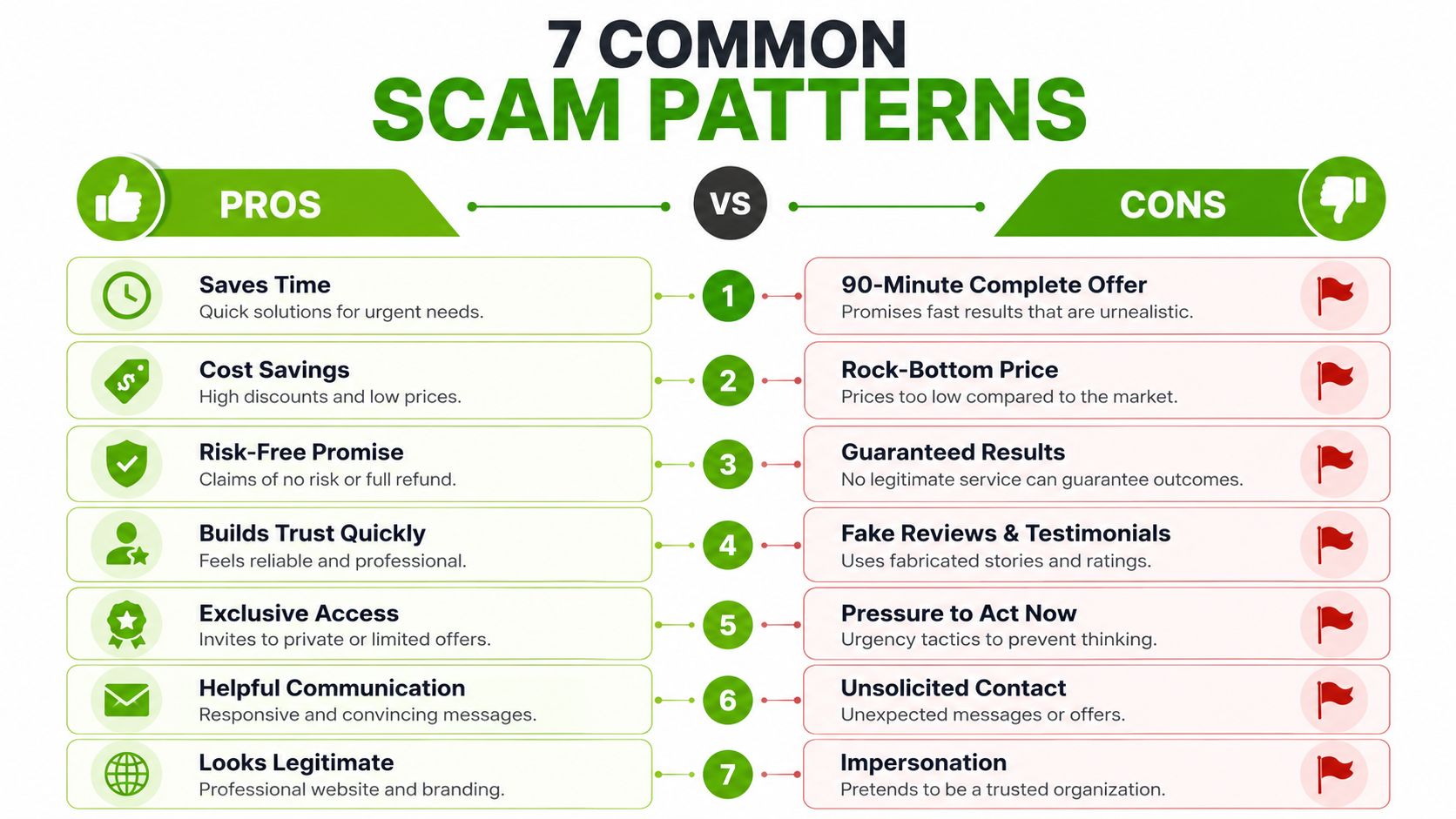
Red Flags That Signal a Defensive Driving Scam
Scam language is usually slicker than the course behind it. Once you know the patterns, the pitch starts to sound familiar.
Speed and price are the loudest warning signs
A claim that you can finish in under 90 minutes is a major red flag when the state requires much more time. So is a rock-bottom price that seems to ignore required state fees or add-on charges. In Texas, that's especially obvious because of the required 6-hour minimum and the $25 state certificate fee (Texas course guide).
The same goes for the phrase “we report directly to the DMV so you don't have to.” That often sounds reassuring, but it can mean very little if the provider isn't clearly approved for your state and your purpose.
Watch for vague authority claims and hidden add-ons
“Nationally accredited” is not the same thing as state-approved. Neither is “100% acceptance.” A real provider talks about its approval status, its course length, its filing process, and any state-specific fees up front.
The other pattern I see all the time is the upsell into a “premium” certificate after the base price looked cheap. That's where the true cost shows up. Good providers disclose the complete fee structure early, including any reporting, filing, or certificate-related charges.
- No Georgia business address: If you can't verify where the provider operates, assume you're dealing with a weak compliance setup.
- No license number on request: Legit providers give it quickly.
- Only minutes, never hours: That's usually a shortcut pitch, not a real compliance course.
- Pressure language at checkout: Real programs don't need to rush you past verification.
If a sales page sounds too clean to be true, it usually is. Speed helps convenience, but it doesn't create approval.
Online, Live Virtual, or In-Person Classroom
Once the course is legitimate, format becomes the next decision. The right answer depends on how tightly your schedule runs and where the certificate needs to land.
Compare the formats by use case
| Georgia Defensive Driving Formats Compared | Schedule Flexibility | Accountability | Best For |
|---|---|---|---|
| Self-paced online | Highest, you can log in around work or family obligations | Lower, you're on your own to finish | Insurance discounts and routine ticket dismissal when self-motivation is strong |
| Live virtual instructor-led | High, but tied to a class time | Higher, attendance is visible in real time | Drivers who want structure and a recorded session |
| In-person classroom | Lowest flexibility | Highest, with direct supervision | Court-sensitive situations and drivers who need the most structure |
Self-paced online is the easiest to fit into a busy week. Live virtual adds accountability without requiring a commute. In-person classroom still feels the safest choice for drivers who want the clearest attendance record and the most face-to-face structure.
Georgia DUI Schools offers a live, remote, instructor-led defensive driving format that is DDS-approved, which is useful for drivers who want an online feel without losing real-time class control. That kind of format is different from self-paced video lessons, and the distinction matters when a court or insurer is checking how the course was taken.
The format doesn't make the course legitimate. Approval does. Format only helps you choose the version that matches your deadline and the entity that needs to see your certificate.
Certificates, Filing, and Getting the Outcome You Need
A certificate is only useful if someone accepts it for the right reason. That's where the filing step comes in, and that's where some drivers lose time they don't have.
What a real certificate should show
A usable Georgia certificate should clearly identify the provider, the DDS provider number, the course hours, and the completion date. If the document can't be verified, or if the provider can't confirm completion later, that's a problem even if the class itself was legitimate.
The next step depends on where the certificate has to go. Courts want filing instructions tied to the case number. The DDS may require a specific submission path for point reduction. Insurers often want the certificate plus a discount request form or other internal step before they'll adjust a premium.
Match the paperwork to the outcome
If you're sending it to a court, use the exact filing method the court gave you, paper or electronic, and include the case number. If you're sending it to an insurer, ask what they want before you assume the certificate alone is enough. If you're using it for a point-related administrative step, follow the DDS instructions exactly.
For insurance-focused drivers, this defensive driving course to lower insurance path is the relevant one to review. It's a different goal from ticket dismissal, and the paperwork should match that goal.
One common mistake is filing with the wrong court office. Another is assuming the insurer will act without a request form or follow-up. The course can be valid and still fail to produce the result you wanted if the last step is sloppy.
Keep the certificate, the filing proof, and the contact name together. When something gets delayed, that paper trail saves a lot of backtracking.
Your Next Step and the Right Course for Your Situation
If your issue is a routine traffic ticket or an insurance discount, pick a DDS-approved defensive driving option that matches the filing purpose. If you're facing a DUI arrest, a reinstatement requirement, or anything tied to DUI laws, you need the Risk Reduction path, not a generic traffic class. If you want help choosing the right Georgia option, review the course that fits your exact situation and make sure the provider is approved for that use.
Georgia DUI Schools offers DDS-approved DUI/Risk Reduction and defensive driving education, including online and classroom options, plus clinical evaluations, ASAM Level 1 treatment, and Victim Impact Panels. If you need a Georgia course that fits a court, a reinstatement step, or a traffic ticket, visit Georgia DUI Schools and match the enrollment path to the requirement you have.