
After 5 years, 15.8% of offenders who attended a Clarke County victim impact panel were rearrested, compared with 33.5% of offenders who did not attend, and the rearrest rate in the panel group was roughly 17.7 percentage points lower. If you've been handed Savannah paperwork, the first thing to verify is whether your court order calls for an in-person, state-approved panel in the Savannah, GA or Chatham County jurisdiction, and whether your judge or probation officer will accept that exact provider.
That's the part people miss when they're stressed and trying to move fast. A victim impact panel is not just “any class with victims speaking.” In Georgia, it sits inside a broader victim-services system, and the local paperwork has to match the local requirement before you pay anyone or show up expecting the certificate to count.
Understanding the Victim Impact Panel in Savannah
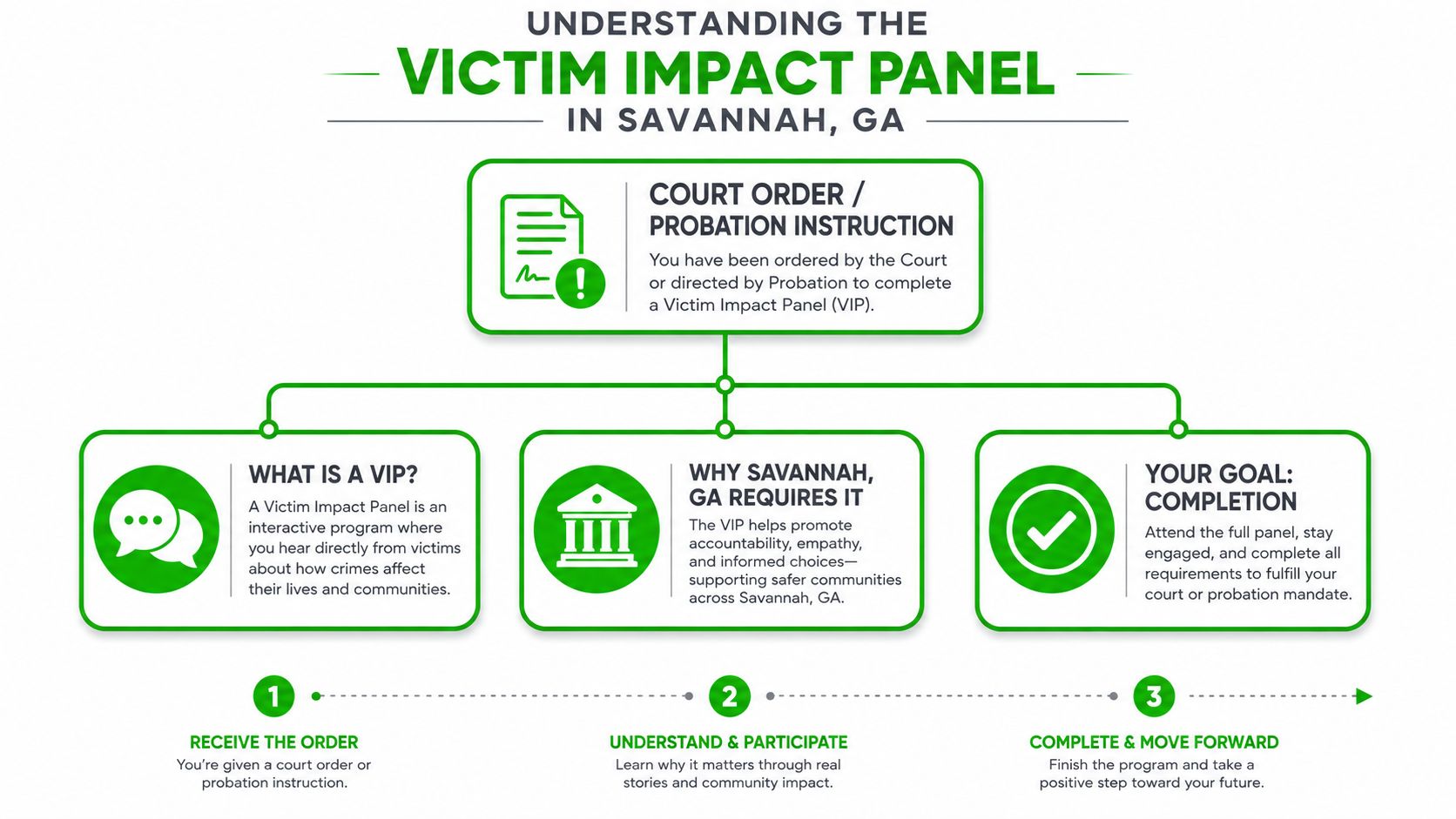
You may have just seen Victim Impact Panel on a court order, a probation note, or a DUI checklist, and the wording probably left you with more questions than answers. In plain English, a VIP is a structured offender-education session where people harmed by impaired driving and other violent offenses share how the offense changed their lives. The point is not to shame you, it's to make the harm real enough that the court sees a response to the offense, not just a box checked.
Georgia's victim-support structure helps explain why Savannah panels are treated seriously. The state's Georgia Crime Victims Services Division and the Georgia Commission on Family Violence both operate at the statewide level, with published victim-services and family-violence information and hotline systems such as 404-657-1956 and 404-657-2222 listed by the state (Georgia victim services information). That matters because the panel isn't a random local lecture, it's part of a long-running framework for victim services, accountability, and court compliance.
What that means for a Savannah case
If your paperwork says VIP, the safe assumption is that the court expects you to attend a recognized, documented session and bring back proof. That proof is what turns the experience into compliance. If you need a plain explanation for a spouse, parent, or attorney, you can say, “It's a court-ordered session where victims describe the consequences of impaired driving or violence, and I have to complete the exact version my court accepts.”
For Savannah-area readers, the local program description is easiest to understand when you keep one question in mind, what exactly did the court order require? That question is more important than the general idea of a panel, because the acceptance rules can differ by jurisdiction and by case type. A useful local overview is posted at Georgia DUI Schools' Savannah VIP page, which is where many people start when they're trying to decode the paperwork.
Practical rule: if the certificate won't match the order, the attendance doesn't help you.
Why Georgia Courts Use Victim Impact Panels
Georgia courts use a victim impact panel because it gives judges a structured way to address harm without turning the case into a full treatment program by itself. The panel is meant to change perspective, not replace DUI school, probation, or any clinical requirement that may also be ordered. That's why you sometimes see a VIP added on top of the larger DUI/Risk Reduction process rather than standing alone.
The strongest Georgia example in the public record comes from Clarke County. In that study, after 5 years, 15.8% of offenders who attended a panel were rearrested, compared with 33.5% of offenders who did not attend, and the difference was statistically significant (Clarke County VIP study). That doesn't mean every panel will produce the same result in every court, but it does show why the program has stayed part of Georgia's sentencing toolbox.
Why the panel sits beside, not inside, DUI school
The panel is usually short and focused. Georgia's DUI/Risk Reduction course is a separate requirement with its own screening and intervention pieces, so judges can order both because they serve different purposes. The panel addresses the human impact of the offense. The DUI school addresses alcohol or drug use, risk, and decision-making in a formal course setting.
That distinction helps when you're trying to understand your order. If the judge or probation officer says you need both, they usually mean exactly that, one requirement doesn't satisfy the other. The panel is a compliance step with an educational purpose, and Georgia courts like it because it fits a sentencing plan without becoming a drawn-out treatment track.
A lot of Savannah-area clients relax once they understand that the panel is not designed to trap them. It's designed to make them stop, listen, and connect the paperwork to real people. The legal system may feel cold on the page, but this requirement is one of the few parts that asks you to face the injury behind the offense.
Who Must Attend a Savannah Victim Impact Panel
If you're asking whether this applies to you, start with the most common Savannah cases. A VIP is often ordered in first-offense and repeat DUI matters, especially when the court wants more than a fine and a standard class. It can also show up when a DUI involved injury, when a child was in the car, or when probation adds it as a supervision condition.
Common Savannah triggers
- DUI cases: Judges and probation officers often use a VIP when a DUI file needs an accountability component beyond the usual school requirements.
- Probation conditions: A probation officer may add the panel as a specific compliance step, especially when the supervision plan calls for extra education.
- Violent-offense matters: Savannah judges can also order a panel in domestic-violence and other violence-related cases, usually alongside treatment or counseling.
That said, the most important rule is still the same, read the exact order. The court's wording controls the requirement, not the general category of case. If the order says a specific provider, format, or deadline, that language wins. If it says the panel must be in-person, virtual attendance won't automatically count just because the topic is the same.
Booking before confirmation is where people get burned. Call the Chatham County clerk, your probation officer, or the ordering attorney before you pay, especially if the paperwork is vague or newly issued.
The confusion usually comes from treating all victim-impact education as interchangeable. It isn't. A Savannah DUI case, a probation case, and a family-violence case can all use the same label while still carrying different acceptance rules. If you're unsure, the safest move is to ask the person who can reject the certificate before you spend money on the wrong one.
Savannah Locations, Schedules, and Session Format
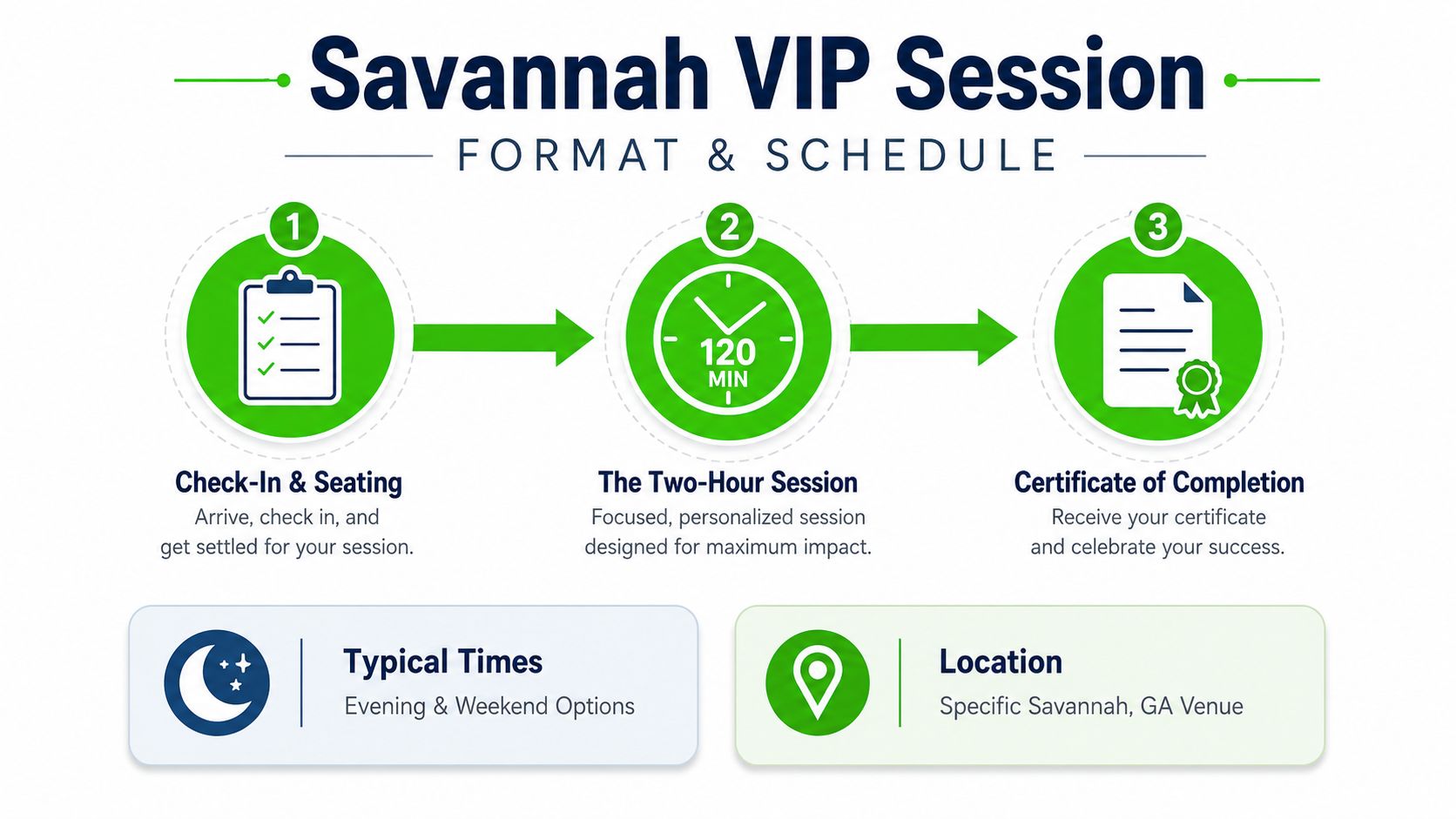
Most Savannah attendees are trying to fit the panel into work, childcare, or transportation plans, so the schedule matters. Georgia DUI Schools cites a single two-hour session with immediate certificate issuance, which is why the program is easier to manage than a multi-session course (Victim Impact Panel format details). The main point is simple, you're booking a discrete compliance event, not signing up for weeks of instruction.
Planning the trip without adding stress
If you're coming from Pooler, Richmond Hill, or the Islands, confirm the session date before you drive. Check the provider's calendar, then verify the address, because the wrong date is a common reason people miss a court deadline. Arrive early enough to handle check-in without rushing, wear normal courtroom-appropriate clothes, and bring the documents you need so you're not digging through a glove box at the door.
The Savannah venue footprint can vary by provider, so don't assume every listing uses the same room or the same parking setup. If the site gives directions, read them all the way through. A quick call before you leave can save you from circling a lot, arriving after seating starts, or showing up at the wrong entrance.
Georgia DUI Schools also keeps the VIP discussion connected to broader local class options through its Savannah driving-school page, which is useful if you're handling more than one court requirement at once. You can review that local information at driving schools in Savannah, Georgia, then use the specific panel page to verify the VIP booking details.
What the Panel Itself Is Like
The room is usually quieter than people expect. A facilitator opens the session, explains the ground rules, and keeps the group moving so the speakers can be heard without interruption. The stories are short, prepared, and personal, which is exactly why they land hard.
Inside the room
The session takes place in a fairly small group, not a big auditorium. You'll hear from victims or survivors who talk about the practical fallout of the offense, the fear, the cost, the disruption, and the ripple effect on families. Cross-talk isn't part of the format. Nobody is there to argue with the speakers, and nobody is there to debate your case.
The point is reflection, not discussion.
That emotional weight is the design of the program. If you're the kind of person who shuts down when a room gets heavy, just keep your focus on listening, breathing, and getting through the session respectfully. You don't need to perform agreement or say much of anything beyond what the facilitator asks. Most first-timers do best when they sit still, keep their phone away, and let the session work the way it was built to work.
Why the certificate handoff matters
At the end, the certificate is handed out right away when the provider uses immediate issuance. That sounds like a small detail, but it matters when a court deadline is close. Once you've got the certificate, you can move straight to the next paperwork step instead of waiting days for proof to arrive in the mail.
If you've never sat through a victim-impact session, expect a serious room, not a lecture hall. It's a controlled setting with one purpose, completion. That's why arriving calm and leaving with the document in hand is the cleanest outcome for a Savannah case.
Cost, Payment, and What to Bring
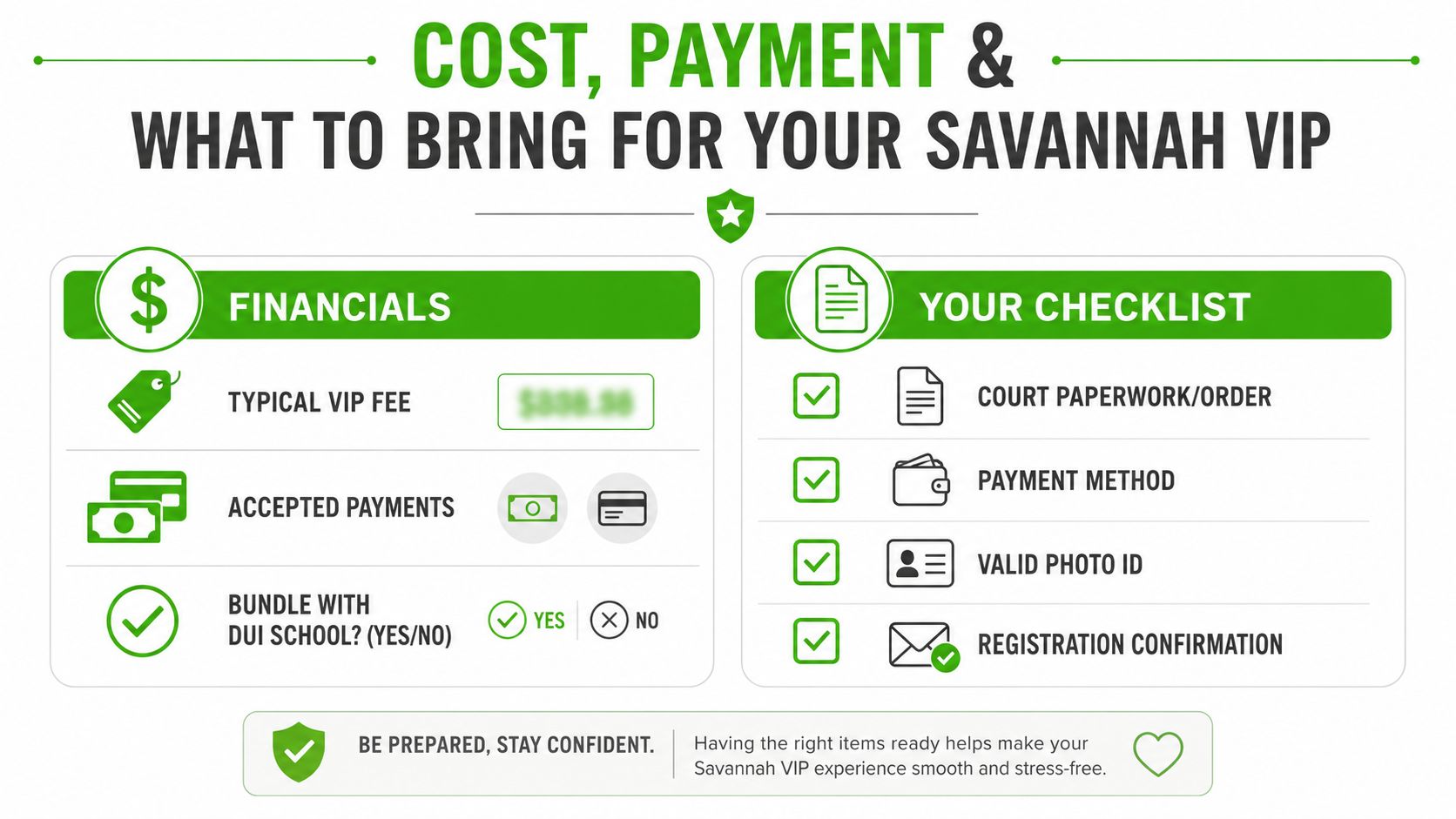
People usually want the price first, then the paperwork. For the panel itself, the exact fee depends on the provider, so the right move is to confirm the current charge before you book. If you're also handling the broader Georgia DUI/Risk Reduction course, the state-set total is $355, broken into $100 for assessment, $235 for intervention, and $20 for the workbook (Georgia DUI/Risk Reduction cost details). That number is useful context, because it shows why some Savannah clients are budgeting for more than one requirement at the same time.
What to bring with you
- Photo ID: Bring a valid government-issued ID so the provider can match your registration to you.
- Court paperwork: Bring the court order or probation letter that names the VIP requirement.
- Prior certificate: If you already completed a panel before, bring proof in case the provider needs to verify it.
- Payment confirmation: Keep your receipt or registration confirmation handy.
Some Savannah attendees can ask about fee reductions based on income, and the provider can tell you whether that applies before the session. If you're booking the panel through a DUI-school provider, you may also see it listed alongside other compliance services. Georgia DUI Schools' victim-impact panel offering is described on its MADD and VIP class page, which you can review at MADD DUI victim impact panel class.
Bring the order, not just the memory of the order. The provider needs the actual language if there's any question about format or acceptance.
The smartest habit is to arrive with a simple folder. One pocket for paperwork, one for payment proof, one for your ID. That keeps the day calm and gives you less chance of leaving without the document that proves you completed the right version of the panel.
Getting Your Attendance Verification to the Court
Once the panel ends, don't assume the certificate is the last step. In a Savannah case, the provider's certificate needs to line up with what the Chatham County court or probation officer ordered, and that's why you should confirm acceptance before booking, not after. If the certificate format doesn't match the order, the paperwork can become a problem even when you attended the whole session.
Simple filing checklist
| Step | What to Confirm | Who to Contact |
|---|---|---|
| Verify the order | Does the judge require in-person, virtual, or a specific provider? | Probation officer, attorney, or clerk |
| Complete the panel | Does the provider issue the certificate right away? | Session provider |
| Deliver proof | Does the court want a copy filed, emailed, or brought in person? | Chatham County clerk |
| Keep your copy | Do you need it later for license or record questions? | Your own records, and DDS if needed |
Paperwork habits matter here, because a certificate is only useful if someone can read and accept it. If your provider uses digital signatures or e-signing for attendance records, a practical reference is the eSignature guide for Georgia businesses. That kind of document helps you understand how electronic completion records are handled, which can be useful when a court office or probation staff ask how the paperwork was signed.
Keep a personal copy for your records. If a license reinstatement question comes up later, you'll be glad you didn't hand over your only copy without saving one first. The most common mistake is attending a panel the court never approved, then discovering too late that the session, provider, or delivery format didn't match the order.
Common Questions Savannah Attendees Ask Before Booking
A Savannah DUI order often raises the same practical questions, and the safest answer is to match the panel to the exact wording on the paperwork. A valid Victim Impact Panel is not just any session that sounds close, it has to fit the court's required format, the approved provider, and the verification language the Chatham County court or probation officer expects.
A common example is a court order that says, “Attend a provider-approved victim impact panel and submit a completion certificate to probation.” That wording tells you three things at once. The session must come from an approved provider, the format must match what the order allows, and the certificate has to show enough detail for the office reviewing it to accept it.
The same rule applies to a virtual or online VIP. If your paperwork says in-person only, an online session will not match the order even if the content is the same. If the order allows online attendance, ask the provider whether the certificate identifies the delivery method clearly, because that detail can matter when the court compares the certificate to the order.
To determine if a MADD panel satisfies your requirement, compare the provider's name and format to the exact wording in your court order. A panel that meets one county's rules may not satisfy another county's paperwork. The question is not whether it sounds similar, it is whether the court recognizes that specific provider and session type.
If you lose the certificate, contact the provider and request a duplicate right away. Ask whether the replacement will look the same as the original and whether it will show the same completion details. A paper that cannot be matched to your attendance record can create a problem later, even when you completed the session.
If you miss the session, rebook with the provider directly and tell the court or probation officer you are correcting it. Some offices want to see the new appointment before they note the file as complete. The sooner you address the missed date, the less likely it is to turn into a larger compliance issue.
A certificate also has a limited purpose. It proves completion for the court or probation office, but it does not answer every license or record question on its own. If you need to know how long it stays valid, confirm that timeline with the ordering authority so you do not rely on an assumption that does not match your case.
The easiest way to avoid delays is to book only after the court language is clear. If the order names a specific provider or delivery method, use that exact version. If it leaves room for choice, ask before you register, because one short check now is easier than a rejected certificate and another court appearance later.
Georgia DUI Schools provides Victim Impact Panel service for Georgia cases, along with completion documentation that can help you satisfy the order cleanly. If you need to verify the right format for your Savannah case and book the panel that matches it, visit Georgia DUI Schools and choose the Victim Impact Panel option that fits your court paperwork.