

You open your paperwork after court, scan the probation terms, and see Victim Impact Panel listed among everything else you now have to finish. That moment is stressful for a lot of people. You may be wondering whether this is the same as DUI school, whether it has to be in person, what happens during the session, and who gets your certificate afterward.
If you're searching for victim impact panel ga, you probably don't need a lecture. You need a clear path from court order to completion. That's what this guide is for.
Some people also find themselves juggling court deadlines, work calls, and missed messages at the same time. If you're trying to stay reachable while handling legal obligations, a practical tool like Recepta.ai for effortless call routing can help you avoid missing important follow-up calls from probation, your lawyer, or a class provider.
Navigating Your Victim Impact Panel Requirement
A Georgia Victim Impact Panel, often called a VIP, is a court-ordered educational session tied to DUI and related cases. It isn't the same thing as the Risk Reduction course, and it doesn't replace fines, license consequences, or any other sentence requirements. It's its own separate item, and courts expect you to complete it exactly as ordered.
Most confusion starts with paperwork. A judge may say you must complete a VIP as a condition of probation, but the order may not explain the full process. That leaves people guessing about timing, registration, approved providers, and what proof the court wants.
What usually causes confusion
- Different requirements can sound similar. A Victim Impact Panel, DUI school, clinical evaluation, and treatment are separate items.
- Format rules can vary. Some courts accept virtual attendance. Others may want in-person participation.
- Completion isn't the last step. You still have to get the certificate to the right person or office.
Practical rule: Treat the VIP like any other court deadline. Don't assume your attendance alone closes the requirement.
A simple way to think about the process is this:
| Stage | What you need to do |
|---|---|
| Court order | Confirm that a VIP was specifically required |
| Registration | Choose a DDS-approved provider and verify accepted format |
| Attendance | Show up on time, follow the rules, complete the session |
| Proof | Secure your certificate and submit it where instructed |
People often feel better once they realize the process is structured. It's serious, but it isn't mysterious. If you handle it in order, keep your records, and confirm each detail before the class date, you can satisfy the requirement without last-minute problems.
Understanding the Purpose of a Victim Impact Panel
A Victim Impact Panel isn't built around punishment in the usual sense. It's built around restorative justice, which means helping a person understand the human consequences of impaired driving through direct exposure to people who have lived through it.
Instead of hearing abstract warnings, attendees hear from victims, survivors, family members, and sometimes first responders. In Georgia, VIPs were pioneered by Mothers Against Drunk Driving (MADD) and are designed to confront the idea that DUI is a victimless offense. The panel puts names, faces, and life changes in front of the listener.
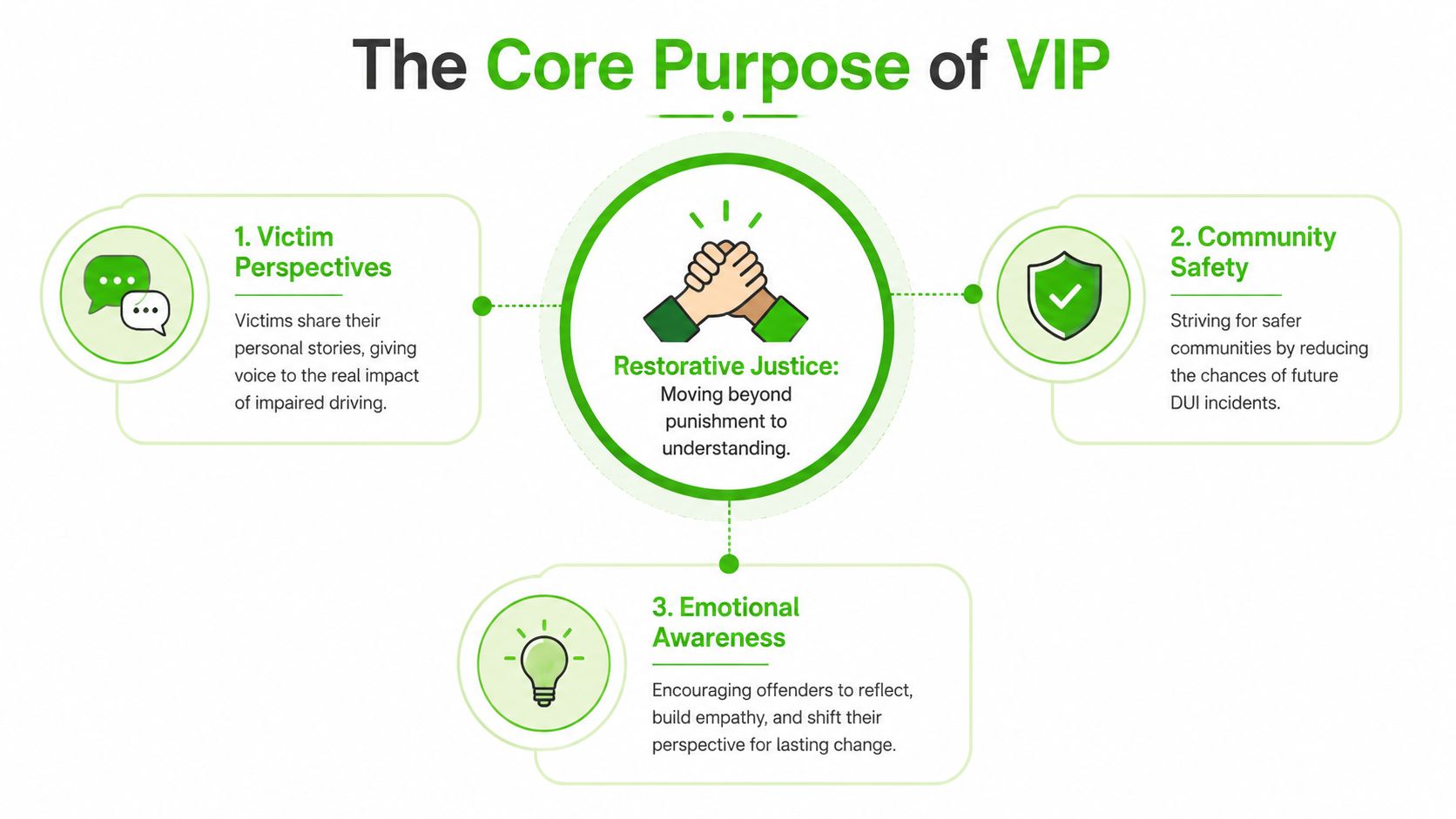
Why courts keep using this requirement
Georgia courts don't assign VIPs just to add another box to check. The idea is that hearing real stories can change how a person thinks about alcohol, drugs, driving, and harm.
One strong example comes from Clarke County. A rigorous 5-year study found that 15.8% of VIP attendees were rearrested within five years, compared with 33.5% of a similar group who did not attend, according to the Clarke County Victim Impact Panel study summary. That difference is why many people in the court system view a well-run panel as more than symbolic.
What the session is trying to change
The panel isn't asking you to argue your case again. It isn't there to relitigate what happened. It asks you to listen and absorb what impaired driving can do to strangers, families, and communities.
That approach is common in other regulated learning settings too. If you're curious how organizations build education that people remember, Learniverse compliance training insights offer a useful comparison. The same broad principle applies here. People retain more when the lesson feels real and personally relevant.
The most useful mindset is simple. Don't attend looking for a loophole. Attend ready to listen.
A person who goes in expecting a scolding may be surprised. A person who goes in willing to hear difficult stories usually understands very quickly why courts keep ordering this class.
Who Is Required to Attend a Georgia VIP
You finish court, gather your paperwork, and notice one more item buried in the order: complete a Victim Impact Panel. That line can feel small on the page, but it carries real consequences. A Georgia VIP is usually a court-ordered requirement tied to sentencing or probation, not an optional class you can handle whenever it feels convenient.
In practice, the people most often required to attend are those convicted of DUI in Georgia, including cases involving alcohol or drugs. Some courts may also order a VIP in other driving cases where impairment or serious harm is part of the facts. The deciding factor is the court order itself. If the judge includes a VIP in your sentence, probation terms, or compliance checklist, you are the person required to attend.
That distinction matters because people sometimes treat a VIP like a recommendation instead of a condition. A better comparison is a checklist item for closing out your case. If one required step is left undone, the case is not fully resolved from the court's point of view.
What the order means in real life
Read the exact language in your sentencing or probation papers. Look for terms such as "Victim Impact Panel," "VIP," "MADD panel," or a direct instruction to attend and submit proof of completion. Courts do not always use the same wording, which is why careful reading matters.
If your paperwork says you must attend, act on that early.
Waiting too long can create avoidable problems. You may miss a deadline, choose a provider the court does not accept, or reach the end of probation and still be missing proof. The panel is meant to support accountability and reflection, but from a practical standpoint, it is also a box the court expects you to check correctly and on time.
Requirements often come as a package
A VIP is often only one part of the larger court process. The same order may also require DUI school, probation reporting, fines, community service, or a clinical evaluation. If your paperwork also mentions an assessment and you are unclear about that separate step, this guide to a drug and alcohol evaluation online in Georgia explains what that process usually involves.
One point causes confusion for many people. Being "interested" in a panel is not the standard. Being ordered by the court is the standard.
Missing a required class can become a probation issue, even if the original mistake was only delay or poor planning.
If any part of your order is unclear, do not guess. Ask your lawyer, probation officer, or the court contact three direct questions: Is the VIP required in my case, when is it due, and what proof do I need to turn in? Those answers will tell you exactly whether attendance applies to you and how to complete the requirement without setbacks.
A Step-by-Step Guide to the VIP Session Experience
Your court date is over, the order is in your hand, and now there is a practical question: what happens once you walk into a Victim Impact Panel? Knowing the flow ahead of time can lower stress and help you avoid the small mistakes that lead to missed credit.

A VIP session is usually straightforward. You can expect a scheduled check-in, a formal presentation, and rules about attention and conduct. If you want to see how a court-approved Georgia Victim Impact Panel class works, it helps to view the session as part administrative requirement and part accountability exercise. The court wants proof of attendance. The panel also wants you to hear, without interruption, how impaired driving affects real people long after a case is closed.
What happens when you arrive
The first stage is simple but important. You sign in, confirm your identity, and listen to the provider's instructions. This works a lot like checking in for an exam. If you arrive late, bring the wrong information, or ignore the rules, you may be present physically but still fail to get credit.
Plan for a quiet, orderly setting. Staff may tell you where to sit, when phones must be put away, and whether food, drinks, or breaks are allowed. Follow those directions carefully. Attendance records and completion decisions are usually handled by the provider staff in the room.
A few preventable errors cause problems again and again: arriving after the session starts, forgetting identification, leaving early, or treating the panel like an optional lecture. It is a court requirement, so the safest approach is to arrive early, bring what the provider asked for, and stay until you are formally dismissed.
What you'll hear during the panel
The heart of the session is the speaker portion. Attendees usually hear from people affected by impaired driving, such as injured survivors, family members of someone killed, or others whose lives changed after a crash.
Their stories tend to follow a clear pattern. You hear what life looked like before the incident, what happened, and what daily life has required since then. For some speakers, that means surgeries, rehabilitation, grief, fear, lost routines, or a permanent change in the future they expected.
Many attendees expect a lecture about rules or penalties. What they often hear instead is the human cost. That difference matters. A DUI case can feel like paperwork, deadlines, and classes. The panel places real-world consequences back in view.
How to conduct yourself during the session
Good conduct is not complicated, but it does matter. The provider is watching for participation problems because the court expects honest attendance, not partial attendance.
Keep these habits in mind:
- Arrive early enough to check in without rushing
- Silence and put away your phone before the session begins
- Do not talk over speakers or side-converse with other attendees
- Stay awake, attentive, and in your seat unless staff gives instructions
- Remain until the session officially ends
If you are nervous about the emotional tone, that is normal. You are not expected to speak, defend yourself, or participate in a group discussion unless the provider specifically says otherwise. Your job is to be present, listen, and complete the session in the way the court ordered.
By the end, the process usually feels more manageable than it did beforehand. The format is structured. The expectations are clear. And if you come prepared, you can complete this part of your court obligation without confusion.
Registering for Your Court-Approved VIP Class
Registration is where small errors turn into big delays. The provider has to be approved, the format has to match what your court allows, and your personal information has to be accurate enough for your certificate to count.
MADD notes that VIPs are offered by various state-approved providers across Georgia's 159 counties, including providers with 18 metro Atlanta locations and virtual access for statewide attendance, as described in the MADD Georgia Victim Impact Panel listing. That accessibility helps, but it doesn't remove your responsibility to confirm that your specific court accepts the format you choose.
The registration checklist
Use this sequence before paying for anything:
Read your order carefully
Check whether the court specifically says Victim Impact Panel, VIP, in-person attendance, or a deadline.Confirm acceptance with the right authority
If the paperwork isn't clear, ask your probation officer, attorney, or court clerk whether virtual attendance is allowed in your case.Choose a DDS-approved provider
Georgia courts generally want approved programs. Don't assume that any online class with a certificate will count.Match your schedule realistically Pick a date you can keep. Rescheduling can create extra stress, and missed classes can raise compliance issues.
Register with exact legal information
Use your correct name, contact information, and any case details the provider requests.Save every confirmation
Keep the email receipt, payment record, class date, start time, login instructions if virtual, and provider contact details.
Fees and format
Verified Georgia pricing places VIP sessions in a $50 to $68 range depending on provider, and one statewide provider course page lists a $55 session price, while other approved providers listed in the verified data include A-1 Driving School at $55 and 2 Wings DUI School at $68 for a 2.5-hour class. Those details appear in the verified source set, but the more important issue for most readers is acceptance, not shopping for the lowest fee.
One option people often use is the Georgia DUI Schools Victim Impact Panel course, which is offered as a state-approved VIP course. It fits the common need for a court-recognized, scheduled session, but it's still wise to verify your court's format rules before booking.
Common registration mistakes
| Mistake | Why it causes trouble |
|---|---|
| Registering before checking court format rules | You may pay for a class the court won't accept |
| Using an unapproved provider | The certificate may be rejected |
| Typing your name incorrectly | Your completion record may not match court paperwork |
| Waiting until the deadline week | Fewer class options and more pressure if anything goes wrong |
If you want the process to stay simple, confirm first, register second, and save every document the provider sends you.
Documentation and Fulfilling Your Court Obligation
Finishing the session is only part of the job. The court usually gives you credit when the certificate of completion reaches the correct person or office in the correct way.
Most providers issue proof of completion right after the class. As soon as you get it, check that your name is correct and that the document is readable. Then make copies for yourself before submitting anything.
What to do with your certificate
- Keep a personal copy. Store a paper copy and a digital copy if possible.
- Confirm the recipient. Your probation officer, lawyer, or court clerk may be the one who needs it.
- Ask about the deadline. Some offices want it immediately, others by a specific compliance date.
- Document your submission. Save email records or get a stamped receipt if you hand-deliver it.
Don't assume the provider sends everything automatically. Ask who is responsible for filing proof in your case.
People with multiple requirements should also keep their records organized by category. A VIP certificate is different from treatment paperwork, Risk Reduction completion, or substance-related assessments. If your case also involves workplace or return-to-duty questions in another setting, the broader concept of structured compliance often overlaps with programs such as the SAP program overview, but your court file will still require its own separate proof for the VIP.
The safest approach is simple. Submit early, save proof, and follow up if you don't get confirmation.
Frequently Asked Questions About Georgia VIPs
What happens if I miss my scheduled session
Treat a missed class seriously. Contact the provider right away and ask about rescheduling. Then notify your probation officer or attorney if your court supervision requires it.
In closely monitored programs, missed attendance can trigger serious consequences. The Clarke County model described in the verified data treated missed sessions as probation violations, which led to court appearances and possible jail time. Your local process may differ, but the lesson is the same. Don't ignore the absence and hope it goes away.
Are online VIPs accepted everywhere in Georgia
No. Some courts accept virtual attendance, and some may require in-person participation. The safest move is to verify acceptance before registration with the court, probation officer, or lawyer handling your case.
What if I lose my completion certificate
Contact the provider where you attended the panel and ask for a replacement. Providers can often help verify attendance and issue another copy, though the exact process depends on their records and policies.
Do I need to prepare emotionally
It's wise to. The content can be difficult because the speakers are describing real harm, not hypothetical examples. Show up ready to listen respectfully and stay focused through the full session.
If you need to complete a court-ordered Victim Impact Panel in Georgia, Georgia DUI Schools offers a direct path to register for a compliant course and get the documentation you need to move your case forward.