

A lot of Georgia drivers first hear about Alive at 25 in a stressful moment.
A teenager gets a speeding ticket in Milton, a parent hears from the court clerk that their child may need to “take a class,” or a young driver in Gwinnett is told a course could help with a citation. Then the questions start. Is this the same as defensive driving? Is it the DUI class? Will it help with points? Will it satisfy a court order?
That confusion is common, especially because Georgia has several different driving-related programs that sound similar but serve very different legal purposes. If you choose the wrong one, you can waste time, money, and sometimes miss a court or license deadline.
This guide is for young drivers and parents who are trying to sort out alive at 25 ga options without getting lost in legal jargon. I'm going to explain what the course is, who it helps, and where it does not apply, especially if a case involves a DUI, a drug offense, or license reinstatement. Those situations usually involve a different path entirely.
Your Guide to Navigating Young Driver Courses in Georgia
Let's start with a situation I see all the time.
A 17-year-old gets cited after a bad driving decision. Maybe it was speeding on the way to school. Maybe it was following too closely in traffic near Alpharetta or Milton. The family hears three different phrases in one day: Alive at 25, defensive driving, and DUI school. To someone new to the system, those can sound interchangeable. They are not.
Why the names confuse people
Part of the problem is that all three courses deal with driving behavior. But they exist for different reasons.
- Alive at 25 is aimed at younger drivers and focuses on choices, attitude, peer pressure, and risk.
- Defensive Driving, also called Driver Improvement, is commonly used for point reduction and sometimes for insurance purposes.
- Risk Reduction Program is the state-mandated course often tied to DUI cases, drug offenses, and some license reinstatement situations.
That last point matters most. If someone has a DUI-related issue, taking Alive at 25 instead of the required program usually won't fix the problem.
Practical rule: If a court, probation officer, or DDS paperwork says Risk Reduction, you need Risk Reduction, not a youth driving class.
Where Alive at 25 fits
Alive at 25 can make sense for a younger driver who made a poor choice but is not dealing with a DUI-type requirement. It may be recommended by a court, school, or family. In some situations, it may also overlap with point-reduction goals, though the details should always be confirmed with the authority asking for the class.
If you're still trying to understand where a standard point-reduction course fits, this overview of the benefits of defensive driving helps explain the separate role that defensive driving can play in Georgia.
The question to answer first
Before signing up for anything, ask one direct question:
What is this class supposed to do for my case?
If the answer is “help a young driver make better decisions,” Alive at 25 may be the right fit. If the answer is “satisfy a DUI-related requirement” or “reinstate a suspended license after a DUI or drug offense,” you need to stop and verify the exact state-mandated course.
What Exactly Is the Alive at 25 Program
A 17-year-old gets told to "take a driving class" after a traffic problem. The family signs up for the first course name that sounds familiar. That is where confusion starts in Georgia, because Alive at 25 is a very specific kind of class.
Alive at 25 is a youth driver course built to improve judgment, decision-making, and behavior behind the wheel. It is aimed at the choices that often lead younger drivers into trouble, such as speeding to impress friends, reacting to pressure from passengers, driving distracted, or making fast emotional decisions.
The National Safety Council describes Alive at 25 as a highly interactive four-hour course structured in four 60-minute modules. The program uses Reality Therapy and Choice Theory to help students examine why they make risky choices, and it covers state laws, distracted driving, and peer pressure. For Georgia residents, the course is available for around $50 per student through the National Safety Council's Atlanta program, according to the National Safety Council Alive at 25 page.
What matters most is the course's purpose.
It is not the class Georgia uses for DUI cases, drug-related offenses, or many license reinstatement requirements. If a driver needs the state DUI-related course, they should verify the rules for the Georgia Risk Reduction Program and what it covers before enrolling anywhere. Alive at 25 works more like a judgment class than a legal remedy for a DUI-type case.

What the course is really trying to change
Young drivers usually know the basic rules. The problem often shows up in the moment the rule gets tested.
A passenger says, "Hurry up."
A phone lights up.
Someone cuts them off.
They feel embarrassed, angry, or rushed.
Alive at 25 teaches students to pause in those moments and make a better choice before the situation turns into a crash, a ticket, or a court problem. A good comparison is this: regular driver training teaches the controls of the car, while Alive at 25 works on the driver's judgment under pressure.
How the class feels different from regular driver training
A standard driving course often centers on road signs, right of way, stopping distance, parking, and other operating skills. Alive at 25 spends more time on why a young driver took the risk in the first place.
That difference can be easy to miss, but it matters. A student may know how to change lanes correctly and still make a poor decision because friends are watching, they are late, or they believe nothing bad will happen. Alive at 25 is built around those common human mistakes.
Here is the basic shape of the course:
| Course element | What it means for the student |
|---|---|
| Four-hour format | Usually completed in one sitting |
| Interactive teaching | Students talk through scenarios instead of only listening to a lecture |
| State law coverage | Shows how risky choices can lead to legal consequences |
| Distracted driving focus | Connects phone use and split attention to real crash risk |
| Peer pressure discussion | Helps young drivers respond to passengers and social pressure |
The course treats risky driving as a behavior problem that can be corrected, not just a lack of technical skill.
Why parents often like it
Parents are often looking at two separate problems. One is the paperwork side. The other is the driving habit that caused the problem.
Alive at 25 can help with that second issue. It gives students a clearer way to talk about common patterns such as showing off, rushing, driving while upset, or assuming they can handle more than they really can. For many families, that makes the class feel more practical than a rulebook review.
What students should expect
Students should expect discussion, examples, and everyday driving scenarios. The class often feels more personal than a standard traffic school session because the instructor is asking students to examine their own choices, not just memorize rules.
For the right young driver, that can make the lesson stick. They do not just finish a class. They leave with a better sense of how bad decisions start, and how to stop them earlier.
Alive at 25 vs Georgia Risk Reduction and Defensive Driving
A 19-year-old gets told by a court clerk to "take the class and bring back proof." He signs up for Alive at 25 because the name sounds familiar and the class is quick. A week later, he learns the court required Georgia's Risk Reduction Program. He paid for the wrong course, lost time, and still has not met the legal requirement.
That mix-up happens because these course names sound similar, but they do very different jobs in Georgia. The easiest way to avoid a mistake is to sort them by purpose first, not by title.
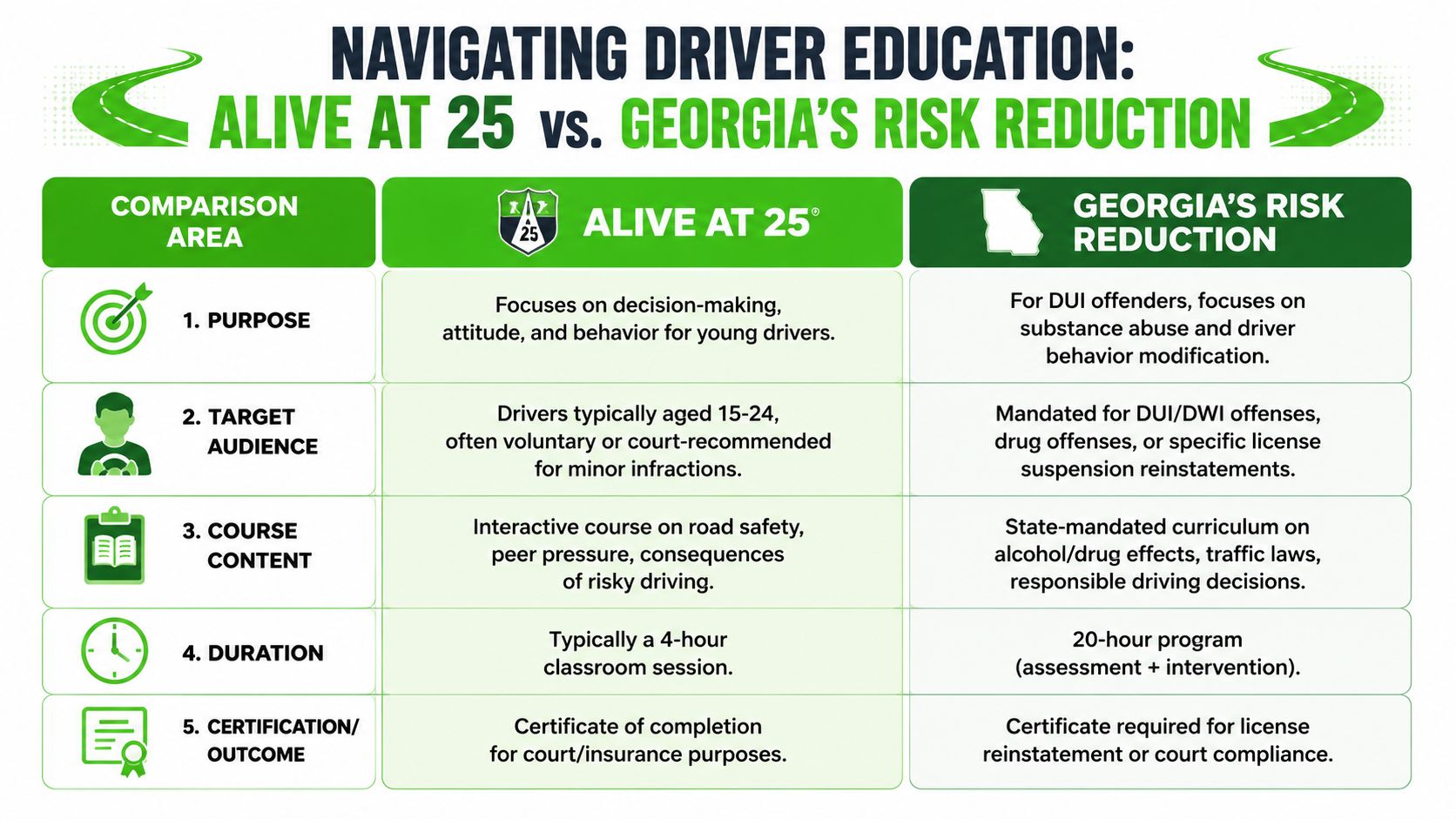
The fast answer
Alive at 25 is a youth-driver course built around judgment, decision-making, and risky driving behavior.
Georgia Risk Reduction Program is the state-required course commonly connected to DUI cases, drug-related driving matters, and some license reinstatement situations.
Defensive Driving is a broader driver improvement course often used for point reduction, court requests in routine traffic cases, or insurance-related purposes.
A simple way to separate them is this: Alive at 25 addresses how a young driver thinks behind the wheel. Risk Reduction addresses a legal requirement tied to alcohol, drugs, or reinstatement. Defensive Driving addresses general driving improvement.
Side-by-side comparison
| Feature | Alive at 25 | Risk Reduction Program (DUI School) | Defensive Driving (DDI) |
|---|---|---|---|
| Main purpose | Improve judgment and behavior in younger drivers | Meet a state-mandated requirement tied to DUI, drug, or reinstatement matters | Improve driving habits and address point or insurance issues |
| Typical audience | Drivers ages 15 to 24 | Drivers ordered into the state DUI-related program | Drivers of many ages |
| Main focus | Peer pressure, risky choices, traffic safety decisions | Substance use education and behavior change tied to high-risk legal situations | Safer driving habits and traffic-law awareness |
| Length | 4 hours | State-mandated program with assessment and intervention components | Varies by approved provider and format |
| Legal role | May be court-suggested or accepted in specific youth-driver situations | Required in qualifying DUI and related cases | Often used for point reduction or general court and insurance purposes |
Where Alive at 25 can matter legally
Alive at 25 is not only a voluntary safety class. In some cases, it can affect a young driver's record or help satisfy a court expectation.
The DDS-approved course under O.C.G.A. §40-5-86 can allow up to a 7-point license reduction once every 5 years, according to the Safety Council program page for Alive at 25 in Georgia. That same source also notes that some courts, including Gwinnett County, may require the course for citation dismissal, and that fees often fall in the $40 to $50 range.
That does not make it interchangeable with every other Georgia driving course. It just means the class can have real value when the issue fits the course.
The mistake that causes the most trouble
The biggest point of confusion is DUI.
If the paperwork mentions a DUI, a drug-related driving offense, or a license reinstatement step, stop and verify the exact course name before registering. Alive at 25 does not replace Georgia's state-mandated Risk Reduction Program in those situations. For a clearer breakdown of that separate requirement, read this guide on Georgia's Risk Reduction Program and when it applies.
Parents often get tripped up here too. They see a teen or college student and assume a youth course must be the right fit. Age alone does not decide it. The legal reason for the class decides it.
A practical way to choose
Ask the same question a driving instructor would ask first: What problem is the course supposed to solve?
- If the issue is a youth-driver citation, risky driving habits, or a court referral aimed at immature driving behavior, Alive at 25 may fit.
- If the issue is a DUI case, a drug-related offense, or a reinstatement requirement, Risk Reduction is usually the course to confirm.
- If the issue is a routine traffic matter and the goal is point reduction or general driver improvement, Defensive Driving may be the better match.
Read the order line by line. Look for the exact course name. In Georgia, choosing the wrong class is like bringing the wrong key to a locked door. You still showed up with something, but it will not open what the court or DDS requires.
Who Should Take an Alive at 25 Course in Georgia
A 17-year-old gets a ticket after following too closely on GA 400. Her parent sees the word "course" on the paperwork and starts searching online. That is where many families get tripped up. In Georgia, the right class depends on the reason for the referral, not just the driver's age.
Alive at 25 fits young drivers who need better judgment behind the wheel. It is often a good match for a teen or young adult who picked up a minor traffic citation, was referred by a court, or needs a structured safety class that speaks directly to risky choices common in this age group. The program is aimed at decision-making problems such as speeding with friends in the car, following too closely, distraction, and treating routine driving like it carries no consequences.
One common example is a high school or college-age driver who made a careless mistake, not a DUI-related mistake. A court may allow or recommend Alive at 25 because the issue is immature driving behavior. Another example is a parent who wants outside help before a pattern gets worse. A young driver may ignore the same warning at home five times, then listen when an instructor connects that behavior to real crashes, court trouble, and insurance costs.

Why courts and parents pay attention to this age group
Young drivers have less experience and less margin for error. The City of Milton notes that motor vehicle crashes are the leading cause of death for Americans aged 15 to 24, and drivers in that age group are 1.7 times more likely to be in a crash (according to the Milton Alive at 25 driver safety information). The same source lists common causes such as following too closely (28%), failing to yield (23%), and speeding (13%).
Those are not exotic mistakes. They are ordinary bad habits. That is part of the point. A lot of young-driver trouble starts with everyday choices that feel small in the moment.
Drivers who are usually a good fit
- Teens and young adults with a minor traffic issue: especially if a court, school, or local program names Alive at 25 specifically.
- Young drivers showing risky habits before a major incident happens: tailgating, speeding, phone distraction, or showing off with passengers.
- Parents looking for a structured outside voice: some students respond better when the message comes from an instructor instead of from home.
- Newer drivers who need judgment training more than vehicle-handling practice: this course focuses on choices, consequences, and hazard awareness.
Some families also compare Alive at 25 with a standard driver education class. They are not the same tool. Driver education teaches the basics of operating a vehicle and learning road rules. Alive at 25 addresses attitude, risk, and decision-making. If a teen still needs basic instruction, a Georgia online driver education course may make sense alongside, not instead of, the right court-approved class.
Who should stop and verify before enrolling
A driver with a DUI, a drug-related driving offense, or a license reinstatement requirement should verify the exact course name on the paperwork before signing up. Alive at 25 is a youth safety program. It does not automatically satisfy a state-required course tied to DUI or reinstatement.
A simple way to sort it out is to ask, "What is the class supposed to fix?" If the answer is immature or risky everyday driving, Alive at 25 may fit. If the answer is a DUI case or a reinstatement step, the required course is often something else entirely.
That difference matters because taking the wrong class can cost time and money, while leaving the actual requirement unfinished.
How to Find and Enroll in a Georgia Alive at 25 Class
You get a court paper, read the words too fast, and sign up for the first driving class that looks familiar. Then the clerk says it does not count. That is the mistake to avoid here.
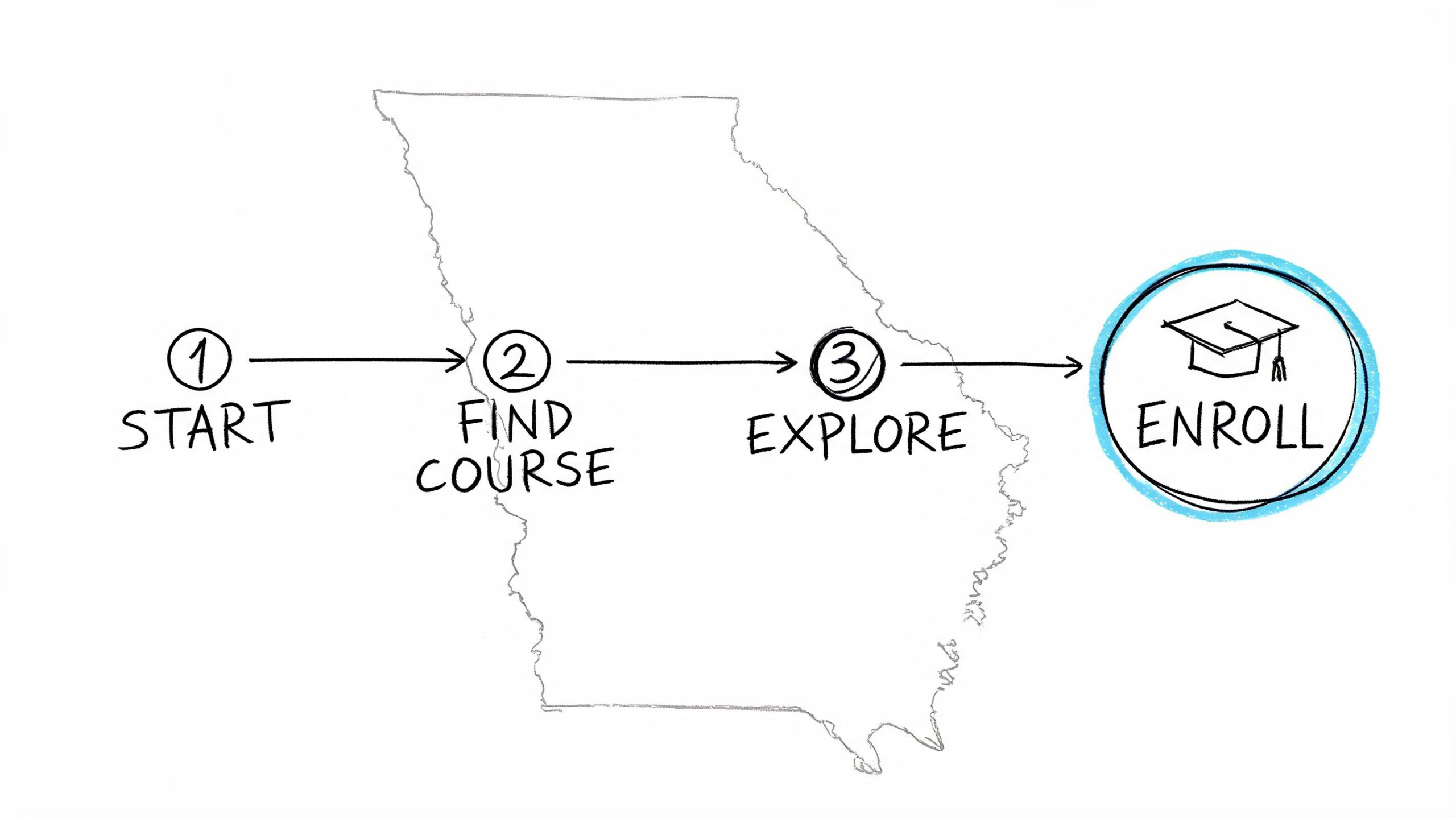
Alive at 25 works like a specific key for a specific lock. If your paperwork calls for Alive at 25, register for that exact program through an official provider. If your paperwork mentions DUI, Risk Reduction, or license reinstatement, stop and verify before paying. Those are different courses, and the wrong choice can leave your real requirement unfinished.
Start with the exact course name
Begin with your referral source. That might be a court order, a school, a probation office, or a parent who wants a structured safety course. Read the document line by line and look for the exact title.
Then check an official provider, such as the National Safety Council of Atlanta. Official providers in Georgia list classes for around $50 (as noted on the Alive at 25 Georgia enrollment information). Some courts and schools, including those in Forsyth County, also use the program for compliance and may place limits on how often a driver can use it for ticket dismissal.
That detail matters because many drivers see "driver improvement," "defensive driving," or "DUI school" online and assume the classes are interchangeable. They are not.
A practical enrollment checklist
Match the course title to your paperwork
If the document says Alive at 25, search for Alive at 25. Do not substitute Defensive Driving or Risk Reduction because the names sound related.Confirm the class format before you pay
Some providers offer in-person classes. Some may offer virtual options. The court, school, or referring office must accept that format for your situation.Choose a date with enough buffer time
Waiting until the deadline week creates avoidable stress. You may need time to finish the class, receive proof of completion, and turn it in.Ask where your certificate must go
Finishing the class is only part of the job. Some students must submit the certificate to the court. Others need to give it to a school, probation office, or insurance company.Keep a copy for yourself
Save the confirmation email, payment record, and certificate. If paperwork gets misplaced, your copy can save time.
A good rule is to treat enrollment the same way you would treat a road sign at night. Slow down, read carefully, and make sure you are following the right direction.
Questions to answer before you click register
| Common question | What to check |
|---|---|
| Does this class satisfy my requirement? | Compare the exact course name on your paperwork |
| Is the provider legitimate? | Use an official Alive at 25 provider |
| Can I take it online? | Confirm that your court or referral source accepts that format |
| What happens after I finish? | Ask who needs the certificate and when it is due |
If your family is also sorting out general teen driver training, a Georgia online driver education course can help with basic driving knowledge, but it does not replace a class ordered for a ticket or legal requirement.
If your situation involves a crash with injuries and you need legal guidance beyond course selection, speaking with a local personal injury attorney may help you understand that separate issue.
Making the Right Choice for Your Driving Record
The main takeaway is simple. Alive at 25 GA is a targeted course for younger drivers who need help with judgment, attitude, and risky decision-making. It can be useful for minor traffic cases, court requests, and families who want a strong intervention before a worse crash or citation happens.
But it is not the universal answer to every Georgia driving problem. If your case involves a DUI, a drug offense, or a state-required reinstatement step, you need to verify the exact mandatory program instead of guessing. That's where many drivers lose time.
If your situation also involves injuries from a crash, it may help to speak with a local personal injury attorney who can explain the legal side separate from any class requirement.
For drivers facing a more serious legal requirement, the safest move is to follow the wording on your court or DDS documents exactly. Youth safety education, defensive driving, and Risk Reduction each serve a different purpose. Choosing the right one protects both your record and your timeline.
Frequently Asked Questions About Georgia Driving Courses
A parent gets a court paper that says "take a driving class." A teen searches online, sees Alive at 25, Defensive Driving, and DUI School, and assumes they are all close enough. That is how people end up in the wrong classroom.
These are the questions students and parents ask when they want to avoid that mistake.
| Question | Answer |
|---|---|
| Is Alive at 25 the same as Georgia DUI School? | No. Alive at 25 is a youth driving course built around judgment, peer influence, and risky choices. Georgia Risk Reduction is the state-required program for DUI-related cases and some license reinstatement requirements. |
| Can Alive at 25 dismiss a DUI charge? | Do not count on that. If the case involves DUI, follow the exact course named by the court or DDS. |
| Is Alive at 25 the same as Defensive Driving? | No. Defensive Driving usually focuses on safer driving habits and may be used for point reduction or court purposes. Alive at 25 is aimed more directly at young-driver decision-making. |
| Who usually takes Alive at 25? | Young drivers, often ages 15 to 24, especially when a court, school, or parent wants a class that addresses immaturity, distractions, and peer pressure. |
| Can parents sign up a teen even without a court order? | Yes, if the provider accepts voluntary enrollment. Some families use it early, before a minor ticket turns into a bigger pattern. |
| Will the course help with insurance? | Sometimes, but the answer depends on the insurance company. Ask the insurer what course they accept and what proof they require. |
| Does this course replace Joshua's Law? | Do not assume that it does. Joshua's Law and Alive at 25 serve different purposes, so the right answer depends on the driver's age and licensing stage. |
| What proof do students receive? | Students usually receive a completion certificate. Keep a copy the same way you would keep a receipt for a payment you may need to prove later. |
| What if the court clerk used a vague phrase like “take a driving class”? | Ask for the exact course name before you register. One phone call can prevent wasted time, extra fees, and a rejected certificate. |
| Can someone take Alive at 25 and Risk Reduction for the same issue? | A person may end up taking both for different reasons. One course does not automatically satisfy the other requirement. |
Here is the safest rule. Match the class to the paperwork, not to the course title that sounds familiar.
If alcohol, drugs, or license reinstatement are part of the problem, verify the required program first and register after that. Georgia DUI Schools offers state-certified help for drivers who need the proper DDS-approved course, along with related services for court and reinstatement compliance.