
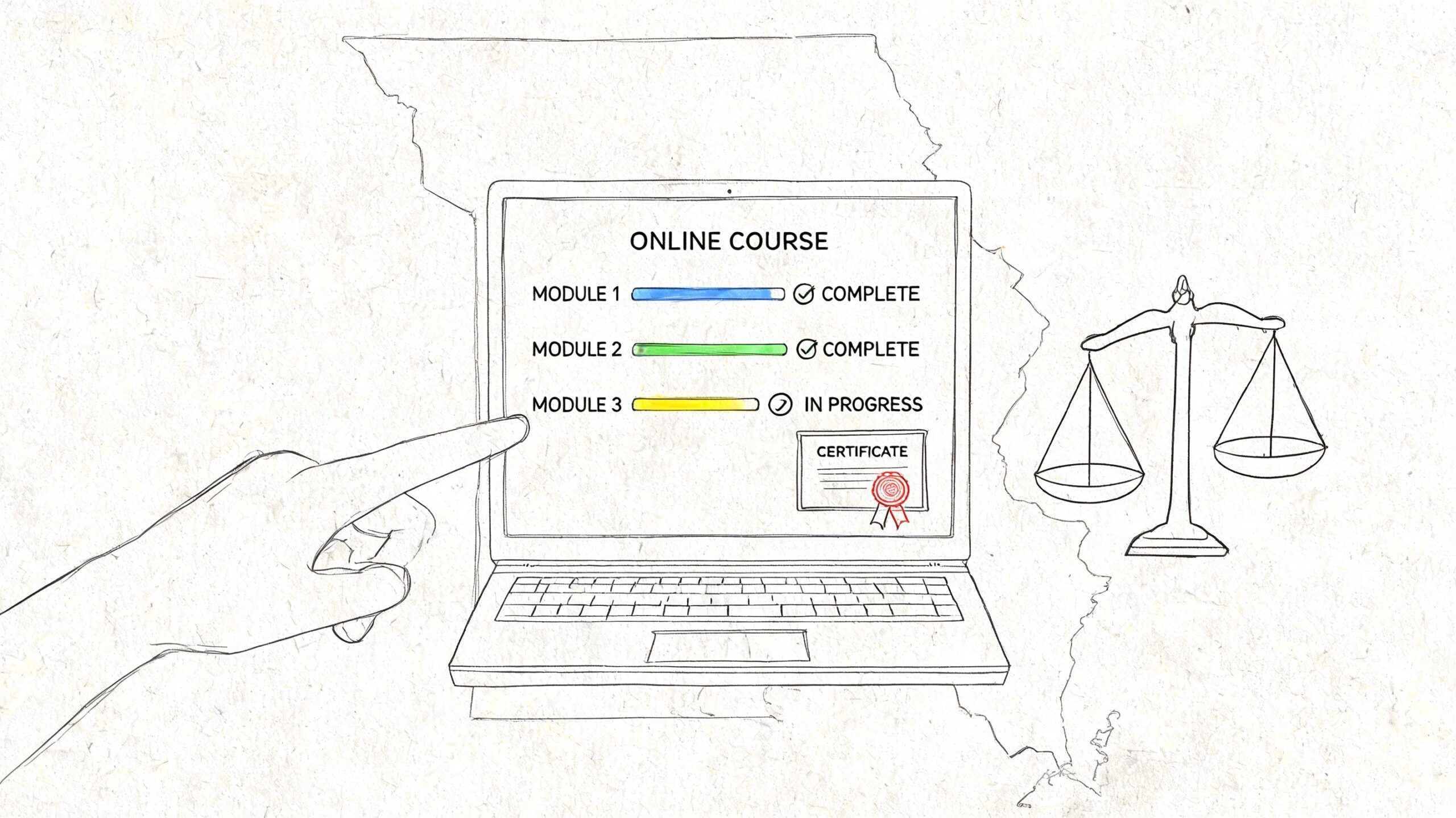
You open a court paper, probation instruction, or DDS notice and see words like alcohol education, Risk Reduction, evaluation, certificate, reinstatement. It is common to feel uninformed in that moment. You feel behind.
If that's where you are, take a breath. The biggest mistake isn't being confused. The biggest mistake is signing up for the wrong class and finding out later that Georgia won't accept it. An alcohol education program online can be a practical solution, but only if it matches your actual requirement.
In Georgia, that detail matters more than many individuals realize. A generic alcohol awareness class might be useful for personal learning, but it may do nothing for your court case, your probation terms, or your driver's license. What counts is whether the program meets Georgia rules.
Your Guide to Online Alcohol Education Programs
A lot of Georgia drivers start in the same place. They search late at night, type in something like “online alcohol class” or “DUI school online,” and get flooded with websites that all sound similar. Some offer quick certificates. Some promise convenience. Some never clearly say whether they meet Georgia requirements.
That's where people get tripped up.

What this term usually means in real life
In plain language, an alcohol education program online is a course that teaches participants about alcohol use, risk, decision-making, and consequences. But in Georgia, the name alone doesn't tell you whether it satisfies a legal requirement.
Two courses can both call themselves alcohol education. Only one may count for your situation.
Here's the practical split:
- Generic online alcohol classes may cover awareness topics, but they can be rejected by courts or DDS if they aren't state approved.
- Georgia-compliant programs are designed around specific legal standards and documentation requirements.
- Related services like evaluations or treatment may also be required, depending on your case.
If you've been researching how online education is built more broadly, this overview of top eLearning platforms for creators gives useful context on how digital courses are structured. That's helpful background, but legal compliance is a separate question.
The question to ask first
Before you enroll anywhere, ask one thing: What exactly did the court, probation officer, or DDS require?
That answer changes everything.
Practical rule: If your paperwork involves a DUI, license reinstatement, or a Georgia court order, don't assume any online certificate will work.
A person in Athens might need a state-approved Risk Reduction course after a DUI. Someone in Atlanta might need a clinical evaluation first. A student in a smaller county might only need proof of a defensive driving class for a separate issue. The words sound similar, but the requirements are different.
Why people feel overwhelmed
Most readers aren't confused about learning online. They're confused about acceptance. They want to know:
- Will the court accept this
- Will DDS accept this
- Will I have to do it all over again if I choose wrong
Those are the right questions. In Georgia, the safest path is always to match the class to the exact legal requirement, not to the most convenient ad you found online.
Who Needs an Alcohol Education Program in Georgia
Not everyone searching for an online alcohol class needs the same thing. In Georgia, the right course depends on why you were told to take one.
The most common group
The clearest case is a driver dealing with a DUI-related requirement. If a court or DDS has told you to complete a program connected to alcohol or drug use and driving, you usually need more than a general awareness class. You need the Georgia-approved option tied to your case.
That's also true for many people whose offense involved drugs rather than alcohol. The state's process often treats alcohol and drugs together in the broader Risk Reduction framework.
Other situations that confuse people
Some drivers don't have a fresh Georgia DUI conviction, but they still need an approved course because of a related issue. These situations can include:
- Out-of-state matters with Georgia consequences where a driver must satisfy a Georgia-equivalent requirement before moving forward.
- Court-ordered follow-up after a drug offense where the judge wants education, evaluation, or both.
- Underage driver cases involving alcohol, where the legal standard is strict and paperwork must be handled carefully.
- Probation compliance when a probation officer names a specific type of class rather than a general online course.
If your case may involve screening or follow-up recommendations, it helps to understand how a drug and alcohol evaluation online fits into the process.
What doesn't always require the same program
Readers often overcorrect here. They hear “alcohol class” and assume every driving-related issue uses the same course. That's not how Georgia works.
A defensive driving course can help in very different situations, such as point reduction or possible insurance savings, but it is not the same as a DUI-related program. The purposes are different. The documentation is different. The state treatment of each course is different.
Some training categories overlap in topic, but they don't overlap in legal effect. Convenience doesn't replace the right approval.
For readers curious about how training systems can track rules and required steps, this piece on AI for compliance training is a useful example of how compliance-focused learning is becoming more structured online. That broader trend makes sense, but your Georgia requirement still comes down to the exact course the state accepts.
A simple way to sort your situation
Ask yourself which description matches your case:
I have a DUI or drug-related driving issue.
You likely need a Georgia-approved Risk Reduction path.A court ordered an evaluation or follow-up service.
You may need education plus clinical steps.I only need a general driving improvement course.
You may be looking for defensive driving instead, not a DUI class.
If you aren't sure which one applies, don't guess based on course titles alone. In Georgia, the title on a website matters less than the approval behind it.
Why Georgia DDS Approval Is Non-Negotiable
You sign up for an online class late at night because you want this problem handled fast. The site looks professional, the checkout is easy, and a certificate is promised at the end. Then you find out the course does not count for your Georgia DUI requirement. That mistake costs time, money, and often another round of enrollment.
That is why Georgia DDS approval comes first. Before price. Before schedule. Before how polished a website looks.
What DDS approval actually means
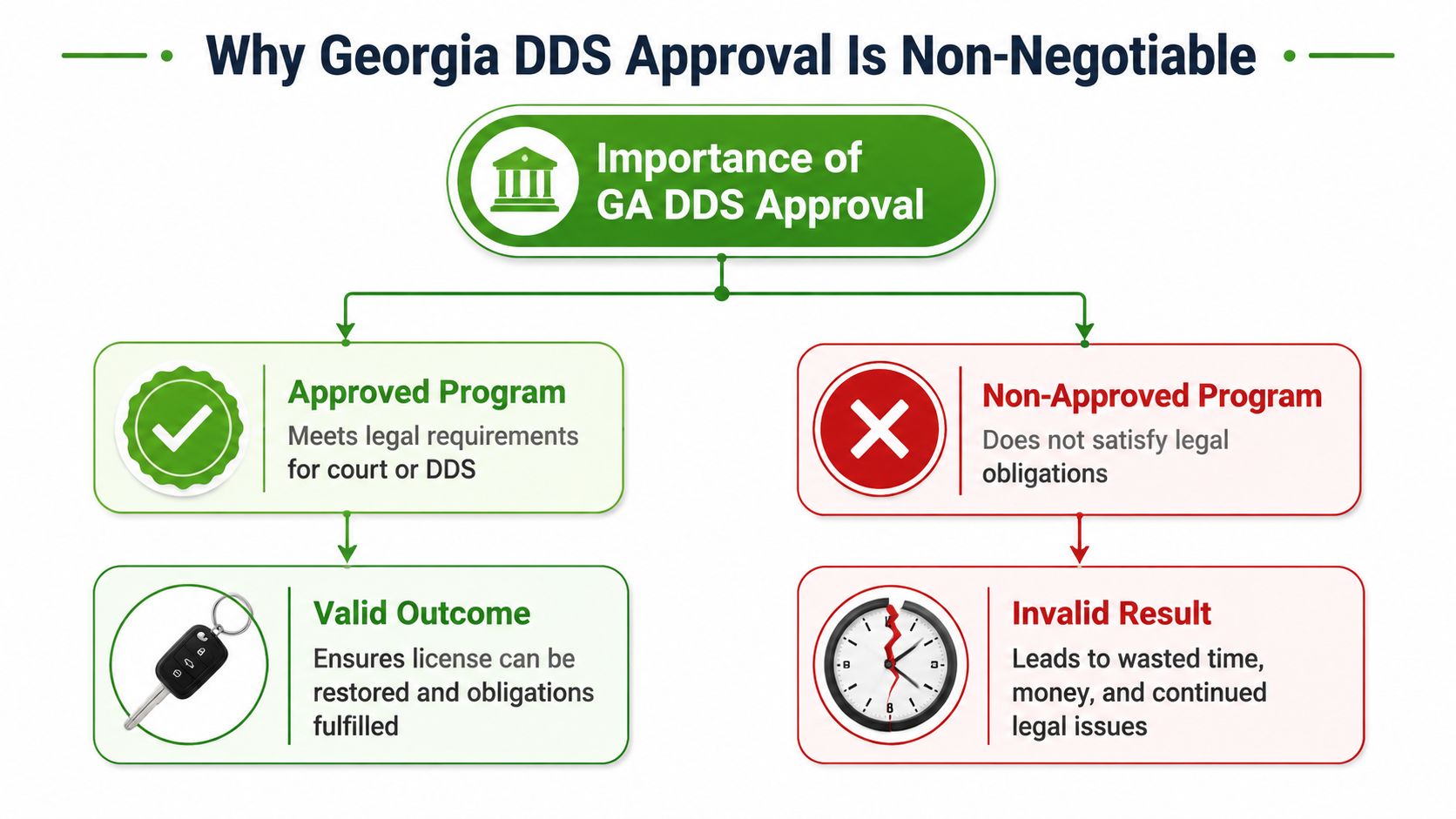
In Georgia, the course title alone does not make a program acceptable. The state accepts specific Risk Reduction programs that meet Georgia requirements for DUI-related cases. A generic alcohol awareness class may be informative, but that is different from a Georgia-approved program that satisfies DDS, court, probation, or reinstatement expectations.
A simple comparison helps here. A store receipt proves you bought something. It does not prove you bought the exact item required by the state. In the same way, a completion certificate only helps if it comes from the right kind of provider.
That difference matters because Georgia is looking for more than attendance. The state expects a documented program with the correct approval, required steps, and a certificate that can be used.
Why generic classes create real problems
A non-approved class often creates three separate problems:
- Lost time because you may need to start over with the correct provider
- Lost money because many outside providers do not refund a course that Georgia will not accept
- Delayed compliance with deadlines tied to license reinstatement, court orders, or probation terms
For stressed drivers, the third problem is usually the hardest. You may believe you are finished and only learn later that the certificate cannot be used.
Bottom line: If you need to satisfy a Georgia DUI-related requirement, state approval is the requirement.
Why the required structure exists
People often get nervous when they hear words like "assessment" or "final exam." That reaction is understandable. It can sound like the course is designed to catch you making mistakes.
It is there for verification. Georgia uses a structured process so the provider can confirm identity, document participation, and show that the participant completed the required educational work. That structure protects the value of the certificate. It also protects you from finishing a class that does not hold up when it matters.
In some cases, screening results may show that a person needs more than education alone. If that happens, the next step is not random. It follows the state process tied to the participant's situation.
A common point of confusion
Online does not mean unofficial. Approval is what makes the difference.
That is why local guidance matters. A Georgia provider understands the state rules, the paperwork, and the difference between DUI Risk Reduction and other driving courses. If you have been comparing options and accidentally wandered into programs like Georgia online driver education courses, pause and check the purpose of the class. Driver education serves a different role than a DUI-related Risk Reduction requirement.
The safest choice is the program Georgia accepts, from a provider that works with Georgia requirements every day.
Inside a DDS-Approved Online Curriculum
You sign up expecting a few videos and a quick quiz. Then you see terms like assessment, intervention, and final exam, and the whole thing suddenly feels heavier than you expected.
That reaction is common. A DDS-approved course in Georgia follows a set structure, and it helps to know what each part is doing before you begin.
What the curriculum usually includes
A state-approved online program teaches the connection between alcohol or drug use, decision-making, driving behavior, and public safety. It also covers how impaired choices can lead to legal, financial, and personal consequences. The material is practical. It is written for adults who need to understand the topic clearly, not for people with a medical or counseling background.
The course usually moves in an ordered sequence. That matters because the structure works like a checklist. You are not guessing what comes next or wondering whether you missed something important.
In many Georgia programs, participants complete:
- educational modules on alcohol, drugs, and impaired driving
- a screening or assessment component
- guided questions or reflection activities
- a knowledge check or final exam
- identity and participation verification tied to completion
Why the format is more structured than a general online class
A generic alcohol awareness course may give information. A Georgia DUI Risk Reduction course has to do more than that because it must satisfy state requirements tied to DUI-related cases.
That is the difference people often miss when they search online in a hurry. One course may be informative. Another is built to meet Georgia DDS rules and produce the documentation that matters for your case. If you want to see what that looks like in practice, review the Georgia DDS-approved online DUI school program.
The assessment piece
The assessment section causes the most stress, mostly because the word sounds clinical or high-stakes. In plain terms, it is a screening tool. Georgia uses it to sort out whether education alone fits the situation or whether the participant may need a different level of follow-up under the state process.
It is not a trick.
You are not being asked to perform, guess hidden answers, or present yourself a certain way. You are completing a required part of the program so the provider can document the proper outcome under Georgia rules.
What the final exam is actually for
The final test is there to confirm that you completed the learning portion and understood the main concepts. It is closer to a checkpoint than a trap. If the course teaches that alcohol affects judgment, reaction time, and risk perception, the exam checks whether those ideas were absorbed.
That structure protects your certificate. If a course had no verification, no assessment, and no final check, it would be much harder for Georgia agencies to rely on the completion record.
What people usually find easier than expected
Once participants begin, three things often calm them down:
- The material is direct and readable.
- The steps follow a clear order.
- The course has a defined finish line tied to completion requirements.
This kind of curriculum serves two primary functions. It satisfies a legal requirement, and it helps participants understand how everyday decisions around alcohol, drugs, and driving can lead to serious consequences faster than they expected.
How to Enroll and Complete Your Program
The process feels easier once you stop treating it like a mystery and start treating it like a checklist. Participants can move through it without trouble once they know the order.
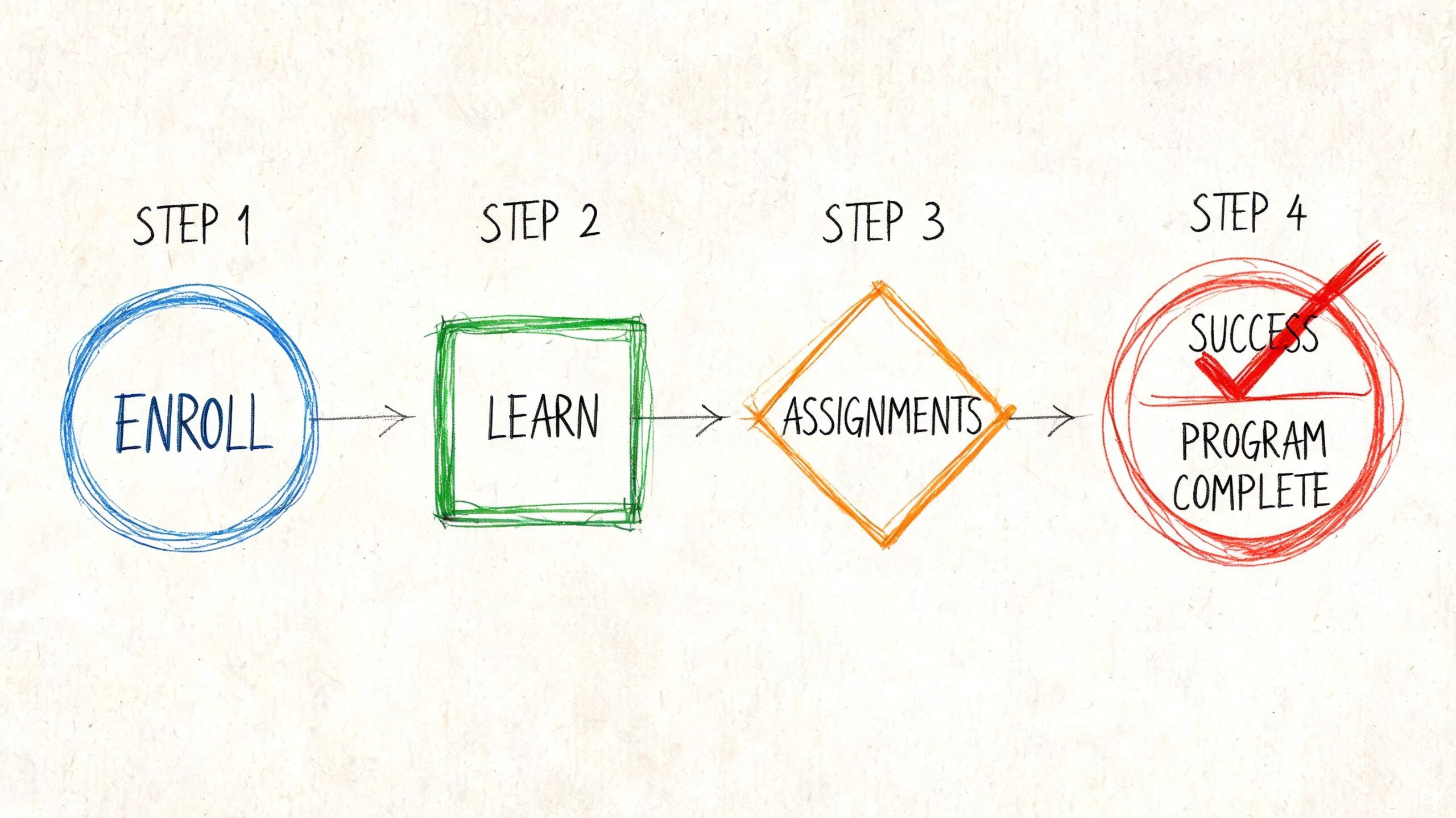
Step one to step four
Confirm your exact requirement
Read the court order, DDS instruction, or probation paperwork carefully. Don't rely on memory. If the paperwork mentions Risk Reduction, DUI, drug and alcohol education, evaluation, or reinstatement, write down the exact wording.Choose the correct format
Some participants do best with a self-paced online option. Others prefer a live virtual class because a real-time schedule helps them stay on track. The best format is the one that fits your legal requirement and your ability to finish on time.Register with accurate information
Use your legal name exactly as it appears on your documents. Small errors can slow down verification or certificate processing.Complete every assigned component
Don't assume watching most of the material is enough. If the program includes assessments, quizzes, or a final exam, all of it matters for certification.
The technology question
Many stressed readers assume they need special equipment. Usually, they don't. Modern online alcohol education programs are built for accessibility. Verified benchmark data reports 92% completion rates in formats that are mobile-responsive and use interactive exercises, according to this online alcohol course benchmark summary.
That doesn't mean every device is ideal for every student, but it does mean online completion is realistic for people using common technology.
A simple setup usually works best:
- Reliable internet
- A phone, tablet, or computer
- A quiet place to focus
- Enough uninterrupted time to finish each required segment
How to avoid delays
Most completion problems come from avoidable mistakes, not from hard coursework.
- Don't wait until the deadline week. Technical issues feel bigger when you're out of time.
- Don't skip emails or messages from the provider. They often include instructions about next steps.
- Don't assume the certificate appears automatically before all requirements are met.
Start early enough that a minor issue stays minor.
What happens at the end
After successful completion, the provider issues the documentation tied to that program. Keep your copy. If a court, probation office, or DDS process requires submission, follow those instructions exactly.
The payoff comes from choosing the correct approved course. When the program matches the requirement, the completion document has a clear purpose. When the program doesn't match, the certificate may be little more than a receipt.
Comparing Cost and Convenience of Programs
When people ask about classes, they usually ask about price second. The first question is acceptance. The second is, “How hard is this going to be on my schedule?”
That's a fair concern. A driver dealing with fines, missed work, transportation problems, or family obligations needs practical answers, not vague promises.
What to watch for on cost
Affordability can become a real barrier to compliance. Verified public information shows that some programs charge $150 or more just for the class, with possible added fees for related items, according to this DASEP pricing example. The exact issue isn't only price. It's unclear pricing.
When a provider makes you guess about total cost, trust drops fast.
Look for providers that state costs clearly and explain whether there are separate charges for related services, scheduling changes, or certificate handling. That transparency matters when you're already paying legal and reinstatement expenses.
Online and in-person side by side
The better choice depends on your life, not on a universal rule.
| Feature | Online / Virtual Program | In-Person Classroom |
|---|---|---|
| Travel | No commute. Helpful if you live outside Atlanta, Athens, or another class location. | Requires getting to the classroom on time. |
| Schedule fit | Often easier for people balancing work, childcare, or school. | Better for people who prefer a fixed routine and face-to-face accountability. |
| Learning environment | Comfortable for people who focus well at home and like digital tools. | Helpful for people who learn better in a physical room with fewer home distractions. |
| Access needs | Requires internet and a working device. | Requires transportation and enough time to travel and attend. |
| Stress level | Can reduce pressure tied to commuting and parking. | Can feel more structured for participants who dislike screens. |
How to decide honestly
Choose online or virtual if your biggest obstacle is logistics. That includes distance, work shifts, family obligations, or not wanting to lose more time driving to class.
Choose in person if your biggest obstacle is focus. Some people do better when they sit in a room, put the phone away, and give the course their full attention.
The right format is the one you can complete correctly and on time.
Related services can affect the total picture
Some participants only need the course. Others also need a clinical evaluation, treatment follow-up, or a Victim Impact Panel depending on the case. That's why comparing programs by advertised class cost alone can be misleading.
A low headline price doesn't help if the provider can't guide you through the rest of the required process.
Common Questions about Online Alcohol Education
You may be staring at a court paper, a DDS notice, or something from probation and asking the same question many Georgia drivers ask first: “Which online class counts?”
That question matters because two very different things get called “online alcohol education.” One is a general educational course. The other is a Georgia DDS-approved Risk Reduction program tied to DUI and related requirements. If you mix those up, you can spend time and money on a class that does not satisfy your case.
Is an online course really accepted by Georgia courts
Sometimes, yes. The deciding factor is not the word “online.” The deciding factor is whether the course is the specific program your court, probation officer, or DDS requires.
A simple way to look at it is this. “Online” describes the format. “DDS-approved Risk Reduction” describes whether it meets a Georgia requirement. Format alone does not make a course acceptable.
If your paperwork mentions DUI, license reinstatement, or Risk Reduction, verify that requirement before enrolling.
Are online programs legitimate or just easier versions
Online programs can be fully legitimate. What matters is how they are approved, monitored, and completed.
For Georgia DUI-related cases, the key question is not whether online learning is real education. It is whether the provider is offering the correct Georgia-approved program, with the steps and completion standards your case requires. A generic online alcohol awareness class may still be educational, but that does not automatically make it acceptable for DDS or court compliance.
That distinction trips people up all the time.
What if I fail the final exam
Do not panic. The exam is usually there to confirm you completed and understood the material.
Ask the provider how retesting works before you start. Then, if you need another try, slow down and review the course instead of guessing your way through. That approach usually saves time and stress.
How quickly do I get my certificate
That depends on the school's process and whether every required part of your program is finished correctly.
Ask this before you enroll.
If you have a court date, probation deadline, or reinstatement deadline, be specific. Tell the provider the exact date and ask when proof of completion is issued, how it is delivered, and whether you need to submit it yourself.
What technology do I need
Usually, you need a reliable internet connection and a device that can run the course without freezing or disconnecting.
If technology makes you nervous, say that up front. A good school should explain the process in plain language and tell you what to test before class starts. It is much easier to fix a login issue early than halfway through a required session.
What if I'm not sure whether I need a class, an evaluation, or both
Start with your paperwork, not memory. Stress makes details blur, and Georgia requirements can sound similar even when they mean different things.
Look for exact terms such as Risk Reduction, clinical evaluation, treatment, or Victim Impact Panel. Each one points to a different step. If the wording is unclear, call and read the document line by line with the provider. That is often the fastest way to avoid enrolling in the wrong service.
People usually get delayed for one reason. They signed up for the wrong requirement first.
If you need help sorting out a Georgia DUI-related requirement, Georgia DUI Schools can explain the difference between a general online alcohol class and the DDS-compliant Risk Reduction process so you can choose the correct program the first time.