

You open your paperwork after court, scan the list, and realize one item doesn't sound like the others. You understand fines. You've probably heard of DUI school. A clinical evaluation at least sounds self-explanatory. Then you see Victim Impact Panel and start wondering whether it's a class, a lecture, an online video, or another appointment you can accidentally do wrong.
That confusion is common in Georgia DUI cases. The problem isn't only the panel itself. It's that one wrong assumption, especially about whether an online-only panel will count for your court or probation officer, can create a fresh compliance problem when you're already trying to get through the first one.
Navigating Your DUI Requirements
A DUI case in Georgia often leaves people juggling several separate obligations at once. One person might need a Risk Reduction course, another may also need a clinical evaluation, and someone else may have probation instructions that include a MADD DUI victim impact panel class. These requirements can arrive in a stack of paperwork with very little explanation about how they fit together.
The Victim Impact Panel matters because it serves a different role from the rest. The Risk Reduction course focuses on laws, substance use, and decision-making. The panel is there to confront the personal fallout of impaired driving through the stories of people who've lived through it.
Why this requirement catches people off guard
Many drivers assume every DUI requirement works the same way. It doesn't. A panel may be ordered by the court, monitored through probation, and treated as a separate item from DUI school. That means finishing one requirement doesn't satisfy the others unless your order specifically says so.
A typical situation looks like this:
- You read the sentence quickly and assume “class” means the standard DUI course.
- You register for the wrong program because the names sound similar.
- You choose an online option before checking whether your court accepts it.
- You complete the session but still have trouble because the right office never received proof.
Practical rule: Read the exact wording in your court paperwork, then verify the format and submission instructions before you pay for anything.
If you're also trying to understand the bigger legal picture after an arrest or conviction, it can help to compare your next steps with broader defense guidance like Law Office of Bryan Fagan's DWI advice. Even though every case is fact-specific, seeing how attorneys frame deadlines, evidence, and compliance can help you ask better questions in your own case.
What Is a MADD Victim Impact Panel
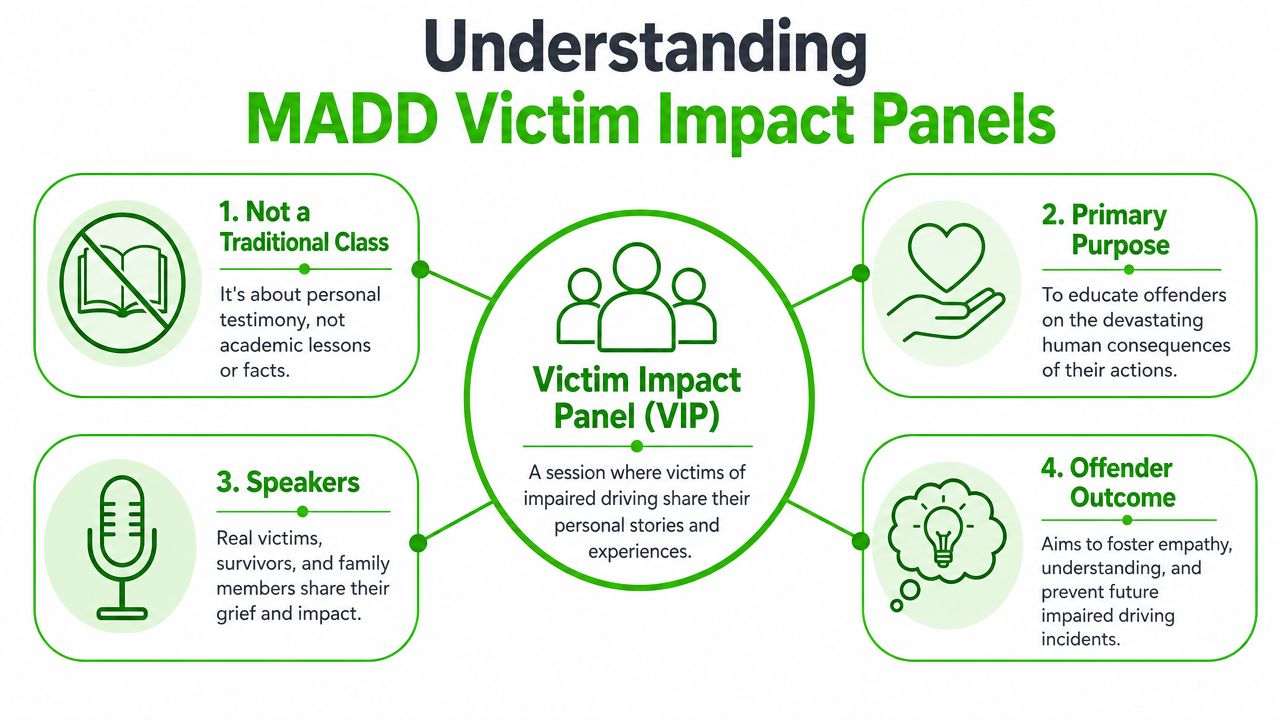
A MADD DUI victim impact panel class isn't a traditional classroom lecture. You're not there to take notes on statutes, answer quiz questions, or debate the facts of your case. You're there to listen.
According to the Resource Training MADD Victim Impact Panel program description, the program is “a structured, one-time two-hour awareness intervention” where three to four victims of drunk/drugged driving or their family members share the lasting consequences of the offense to deter future recidivism.
How it differs from DUI school
Think of the two programs this way.
| Program | Main focus | What you do |
|---|---|---|
| DUI Risk Reduction course | Rules, substance education, and risk awareness | Learn structured material |
| Victim Impact Panel | Human consequences of impaired driving | Listen to personal testimony |
That difference matters. If DUI school is the textbook part of the process, the panel is a firsthand account. The point isn't technical instruction. The point is exposure to what impaired driving did to actual people.
What happens in the room
The panel usually features people directly affected by drunk or drugged driving. They may be injured survivors. They may be family members speaking about a loved one who was killed. In some settings, speakers describe the medical, emotional, financial, and family aftermath that continued long after the crash itself.
Your role is passive but important:
- Show respect: Stay quiet and attentive.
- Don't interrupt: This isn't a discussion group.
- Don't argue your case: The panel isn't a place to explain, defend, or relitigate what happened.
- Stay present: Courts expect actual attendance, not partial attention.
The panel is built around impact, not instruction. If you expect a normal class, the emotional weight can catch you off guard.
Some people leave thinking it was harder emotionally than any other DUI requirement. Others find it sobering in a different way. Either reaction is part of why courts keep using it.
Georgia Court and DDS Acceptance
In Georgia, the Victim Impact Panel has a legal function, not just an educational one. According to Georgia Criminal Defense on Victim Impact Panels, a Victim Impact Panel in Georgia is a mandatory two-hour educational program for individuals convicted of DUI, where offenders listen to personal testimonies from victims of drunk driving or their families.
That's the first point to keep straight. If your sentence, probation terms, or compliance checklist requires a panel, this is not optional.
The real problem for Georgia drivers
The most common point of confusion right now isn't whether the panel exists. It's whether an online-only panel will satisfy your particular court or any related DDS expectation tied to your case processing.
Background materials in this area point to a real ambiguity. Courts in many places may allow approved online VIPs, but there's no definitive statewide Georgia answer that clears up acceptance across all courts and DDS contexts in one simple rule. That leaves drivers making guesses when they should be getting direct approval.
Here's what that means in practical terms. Two people with very similar DUI cases can receive different treatment based on:
- The judge's order
- The county court's local practice
- The probation officer's instructions
- Whether the class provider and format match what the court expects
How to verify before you enroll
Don't rely on assumptions, online comments, or what “usually counts.” Verify your own requirement directly.
Use this checklist:
- Read your sentencing or probation paperwork carefully. Look for words like “Victim Impact Panel,” “VIP,” “MADD,” “in person,” or any provider-specific language.
- Call your probation officer if you have one. Ask whether an online panel will be accepted in your case.
- If you don't have probation, contact the court clerk and your attorney. The clerk may explain filing procedure, while your attorney can help interpret the order.
- Ask for written confirmation when possible. An email is better than a verbal “it should be fine.”
- Keep the proof. Save the email, screenshot, or written note with the date and name of the person who answered.
Don't register first and ask later. If your court rejects the format, you may need to take the panel again and pay again.
Why this matters so much
A rejected panel can delay probation compliance, slow down case closure, and create stress that was avoidable. The safe approach is simple. Treat format approval like part of the assignment itself.
What to Expect During Your Session
Attendees often feel less anxious once they know the flow. A Victim Impact Panel isn't unpredictable in structure, but it can be intense in tone.

According to the Broward Safety benchmark page for MADD sessions, the program is typically 90 minutes to 120 minutes, and physical attendance includes a mandatory 15-minute pre-session check-in window. Even though that source is outside Georgia, it gives a useful benchmark for how these panels are commonly run.
Before the panel starts
Expect to check in first. Bring a government-issued ID and any paperwork your court, attorney, or probation officer told you to bring. If your provider gave you registration confirmation, keep that available too.
Punctuality matters. If the provider requires early arrival and you stroll in at the last minute, you may not be admitted. If that happens, your legal problem doesn't disappear just because you meant well.
A practical prep list:
- Photo ID
- Court paperwork or case details
- Payment confirmation if applicable
- A charged phone for logistics only, not for use during the session
For people trying to understand how these panels are sometimes discussed in testing or prep materials, Victim Impact Panel quiz answers guidance can give context on the themes that come up most often, even though your live session is about listening, not passing a test.
During the presentations
You'll usually sit with other attendees while a moderator introduces the speakers. Then the stories begin. The speakers may describe the crash, the injuries, the funeral, the hospital stay, the years of grief, or the daily limitations that followed.
The emotional tone is often direct and unfiltered. Some stories are quiet. Others are raw. The session may be uncomfortable, and that's part of why the courts use it.
Your job is simple. Listen without interrupting, stay off your phone, and remain respectful through the end of the session.
How the session usually ends
After the final speaker, the moderator explains closing instructions. That may include attendance verification, certificate distribution, or reminders about what you must submit afterward.
Don't leave early unless you've been expressly told to do so. In many court-ordered settings, partial attendance won't count.
Registration Cost and Scheduling in Georgia
You do not want to learn about a format problem after you have already paid, attended, and taken time off work.
In Georgia, scheduling the panel is not just picking a date. It is matching the right session to the right authority. A court may accept one format while a probation officer or another local requirement expects something else. Treat registration like filing a legal document. Small errors can create larger problems later.
What to gather before you register
Have your paperwork in front of you before you open the registration form. Guessing from memory is how people end up with the wrong case number, the wrong court name, or a certificate that does not match their file.
Keep these details ready:
- Your full legal name exactly as it appears on court records
- Court case number
- Name of the court handling your case
- Probation officer information, if you have one
- An email address and phone number you regularly check
If your DUI case includes other class requirements, it can help to compare deadlines with related programs such as online alcohol education options. Just keep the categories straight. An alcohol education course does not replace a Victim Impact Panel unless your court specifically says it does.
How to schedule without creating a compliance issue
Use this order.
- Ask who must accept the panel. That may be the judge, clerk, probation officer, defense lawyer, or a local DUI court program.
- Ask whether online-only attendance is accepted in your case. This is the part that causes confusion for Georgia drivers. Some courts approve online panels. Others want in-person attendance or want you to use a specific provider.
- Ask what proof they want. Some offices only need the certificate. Others may want the provider name, completion date, or direct submission.
- Write down the answer. Save the email, note the name of the person you spoke with, and record the date.
- Register only after you confirm the format. Then check every entry before payment.
- Save your confirmation right away. Keep the receipt, confirmation email, and any login instructions in one folder.
A simple phone call now can save you from having to repeat the class.
Cost and timing questions to ask before you pay
Fees, rescheduling rules, and session availability can change by provider. Some programs also limit transfers or refunds if you miss your assigned time. That matters if you are balancing work, childcare, or transportation.
Before you submit payment, confirm:
- The total price
- Whether the fee is refundable or transferable
- How far in advance you must register
- What happens if you miss the session
- How and when the completion certificate is issued
That last point matters more than people expect. Fast certificate delivery helps only if the format itself is accepted by your court or supervising agency.
A practical way to avoid the common mistake
Use a two-check rule. First, verify that the session fits your schedule. Second, verify that it fits your case requirements.
If either answer is unclear, pause and confirm before registering. In the Georgia DUI system, the wrong panel can waste money, delay compliance, and create a problem you thought you had already handled.
Your Certificate of Completion and Next Steps
Finishing the session is only half the task. The second half is proving you finished it.
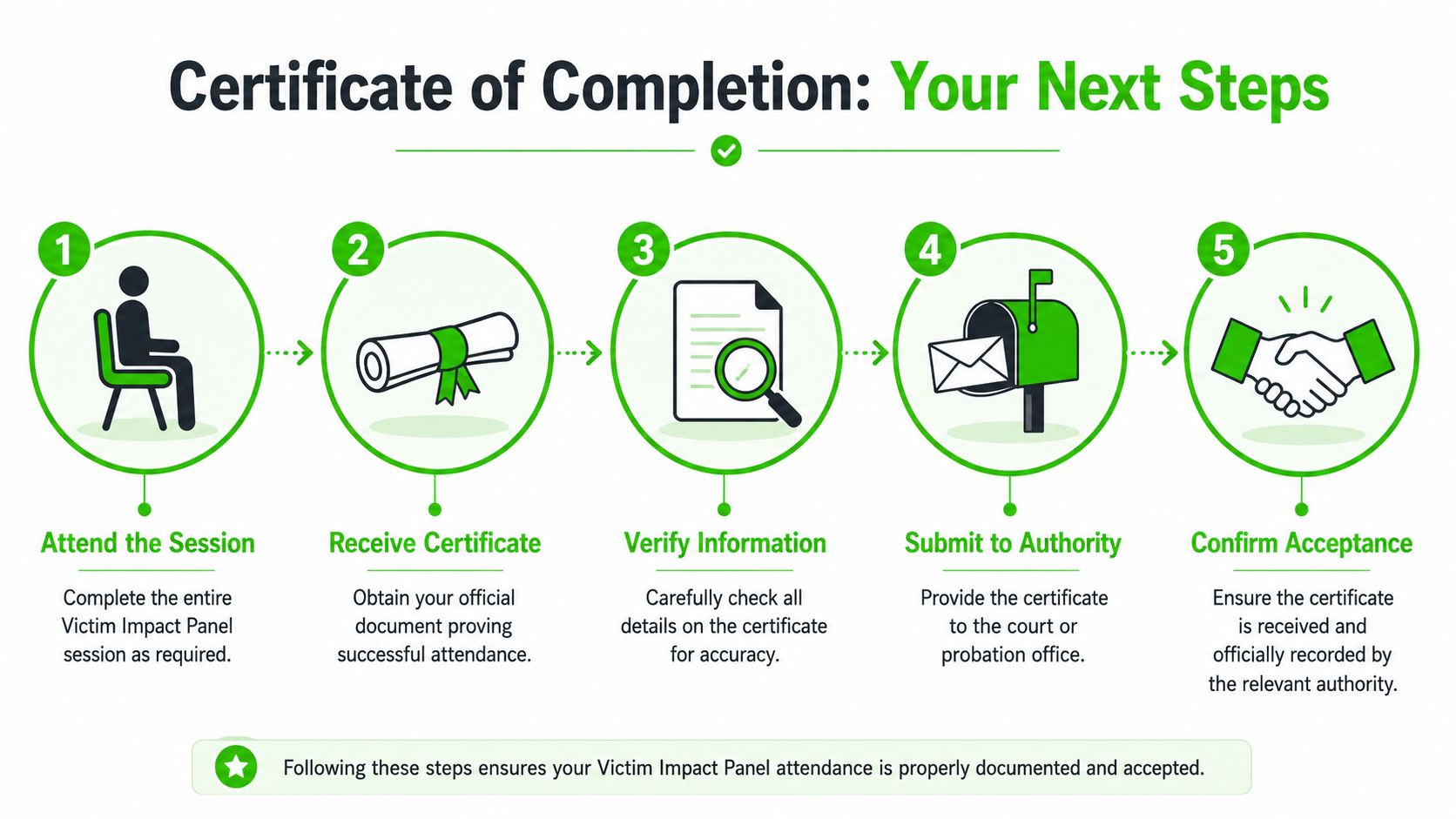
Your Certificate of Completion is the document that turns attendance into compliance. If your court or probation officer requires proof and you don't submit it correctly, you can still end up treated as noncompliant even though you sat through the whole session.
According to Los Angeles Criminal Lawyer on the MADD Victim Impact Panel, VIP attendance is a common condition of probation, and failure to attend or submit proof can result in formal probation violations and reduced leniency during sentencing.
What to do the moment you receive it
Don't shove the certificate into your glove box and assume you'll remember later. Handle it right away.
Use this sequence:
- Inspect it immediately: Make sure your name is spelled correctly and the completion details look right.
- Make copies: Keep both a paper copy and a digital photo or scan.
- Follow your case instructions: Submit it to the probation officer, attorney, or court clerk, depending on what your paperwork says.
- Document the handoff: Save the email, upload confirmation, or stamped receipt.
- Confirm it was recorded: If possible, verify that the receiving office marked it as received.
A certificate you can't prove you submitted may not protect you if a compliance question comes up later.
Don't assume one office will notify another
Courts, probation departments, attorneys, and providers don't always share documents automatically in the way people expect. You need to know who is responsible for filing what in your case.
If you're organizing multiple case expenses and educational requirements, reviewing related cost questions through resources like how much driving school costs in Georgia can help you track the full compliance picture. Just keep your panel certificate separate and easy to find.
The right mindset after the panel
Treat the certificate like legal evidence, because for your case, that's what it is. Store it carefully. Submit it promptly. Confirm receipt.
That step closes the loop.
Frequently Asked Questions About VIP Classes
Are there alternatives to a MADD-affiliated panel
Sometimes, but never assume that means any victim panel will work. The safe rule is that MADD is the standard reference point, and any alternative should be approved in advance by your judge or probation officer. If the order names a specific type of panel, follow that wording closely.
What happens if I miss my scheduled panel
Act fast. Contact the provider to ask about rescheduling, then contact your probation officer or attorney if your deadline may be affected. Some providers note that fees are non-refundable, so missing the session can mean paying again.
A missed panel is not just a scheduling inconvenience. In a probation case, it can become a compliance issue if you stay silent and let the deadline pass.
Do these panels actually reduce repeat DUI offenses
The honest answer is that the research is mixed. According to the Washington Traffic Safety Commission review of Victim Impact Panels, some studies showed slight short-term recidivism reduction, and long-term data in certain jurisdictions found non-VIP participants were 1.8 times more likely to reoffend. But other studies found no significant association, and some even showed negative effects, so the overall statistical case remains inconclusive.
That doesn't make the panel meaningless. It means the panel's legal and educational role is clearer than its universal research result. Courts use it because it confronts offenders with the human consequences of impaired driving in a way standard coursework doesn't.
If my court paperwork is vague, what's the safest move
Get clarification in writing before you register. That's especially important for online-only attendance. A quick phone call can help, but an email you can save is better.
Can I treat this as the same thing as DUI school
No. They may both appear on the same case checklist, but they serve different functions and are often tracked separately.
If you need to complete a court-ordered Victim Impact Panel in Georgia, Georgia DUI Schools offers the specific course page you can use to review the program and register for the right next step.