

Free online alcohol classes exist, but they almost never satisfy Georgia DUI requirements. In Georgia, the state-mandated Risk Reduction Program includes a 130-question assessment, a 20-hour intervention course, and a total state-set cost of $360.
Seeking free online alcohol classes often means you're in a difficult situation. Maybe you got arrested for DUI, your license is on hold, your court date is coming up, or a probation officer told you to complete a class and you're trying to find the fastest, cheapest option. That search makes sense. It just points a lot of people in the wrong direction.
Here's the blunt truth. A free alcohol awareness course and a Georgia-compliant DUI course are not the same thing. One is education. The other is a legal requirement. If you mix them up, you waste time, miss deadlines, and end up paying for the correct program anyway.
The Truth About Free Online Alcohol Classes
The internet is full of free alcohol education. That's not the problem. The problem is that people assume “free” also means “accepted by the court” or “good enough for DDS.” In Georgia, that assumption gets people in trouble.
A lot of websites offer general awareness lessons about alcohol use, addiction, decision-making, or workplace safety. Those courses may be useful for personal learning. They are not the same as a state-approved DUI Risk Reduction program.
Why people get confused
The confusion is common because many free listings never clearly explain whether they satisfy court orders or state-specific DUI requirements. As noted by Open Path's free alcohol awareness class page, free resources often provide general awareness but don't clearly state that they fulfill legal obligations. That gap leads people to assume free equals compliant.
Practical rule: If the course page doesn't clearly say it is approved for Georgia DUI or Risk Reduction requirements, assume it will not count.
That matters because Georgia isn't asking you to “learn something about alcohol” in a general sense. The state wants a specific program with specific approval, delivery standards, and documentation.
What free classes are actually good for
Free courses can still help in the right context. If you're trying to understand your drinking patterns, support a loved one, or take an early step before treatment, they can be useful. Someone who needs more private support beyond a basic class may also look into discreet alcohol addiction care in Orange County for treatment-focused help.
But if your real goal is license reinstatement, probation compliance, or satisfying a Georgia court, stop shopping by price alone. Shop by approval status first. That's the filter that matters.
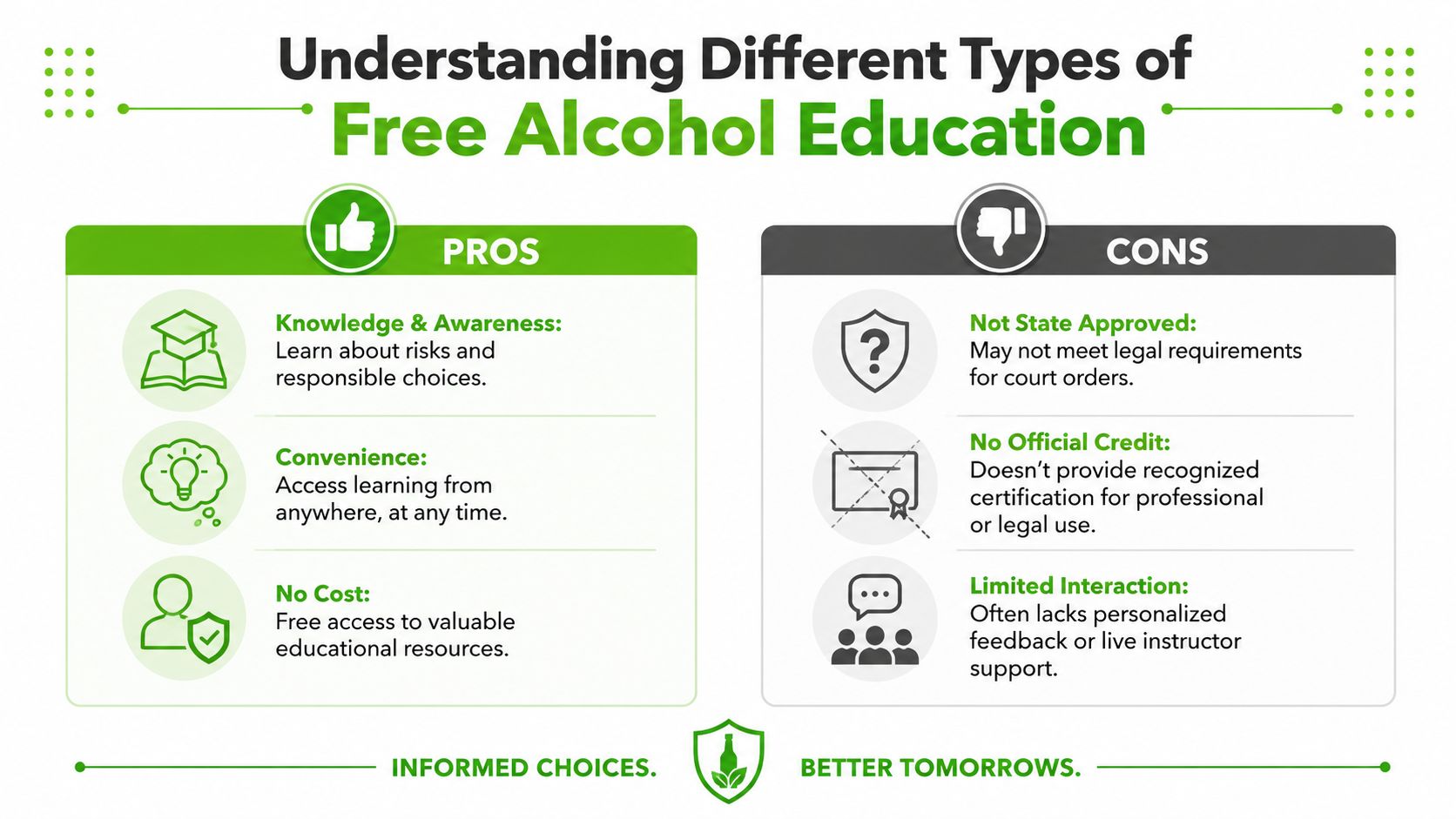
Understanding Different Types of Free Alcohol Education
Not all free alcohol education is junk. Some of it is well-designed and serves a real purpose. The problem is purpose. A free awareness class usually exists to educate, prevent, or train. It usually does not exist to satisfy a Georgia DUI sentence.
Three common categories
You'll usually find free alcohol classes in one of these buckets:
- Public awareness education: These classes explain alcohol's effects, warning signs, and safer choices. They're meant for learning, not legal compliance.
- Workplace safety training: Platforms like Workhub offer awareness-level training for employers and employees. Workhub states its training is awareness-focused and doesn't provide other qualifications on its drug and alcohol awareness training page.
- Prevention programs for youth: These are targeted programs aimed at preventing underage drinking and risky behavior before legal problems start.
A real example of a legitimate free program
One strong example is AlcoholEdu for High School, a mandatory 90-minute interactive resource offered at no cost to high schools in Florida, Texas, and New York for the 2024-2025 school year to prevent underage drinking, according to Southern Glazer's program announcement.
That program is real. It's free. It has a defined audience. It also has nothing to do with adult Georgia DUI compliance.
Free education can be valid and useful. It still may be useless for your case.
The test you should apply before enrolling
Ask these questions before you spend even ten minutes on a class:
- Who is it for? High school students, employees, the general public, or court-ordered DUI participants?
- What does it promise? Awareness, prevention, safety training, or legal acceptance?
- What proof does it give you? A generic completion certificate is not the same as state-accepted documentation.
If you need a Georgia-specific program instead of general education, start with a page built around Georgia alcohol education program options online. That keeps your search tied to actual compliance instead of random awareness content.
Georgia's Strict DUI Risk Reduction Program Requirements
You finish a free online alcohol class, print the certificate, and feel relieved for about ten minutes. Then your lawyer, probation officer, or DDS tells you it does not count in Georgia. That mistake happens all the time.
Georgia uses a specific DUI Risk Reduction process. If you need to satisfy a court, probation, or license reinstatement requirement, a free general alcohol class is the wrong tool.
What Georgia actually requires
Georgia's DUI Risk Reduction Program has two parts. First, you complete the 130-question NEEDS Assessment. Then you complete the 20-hour Intervention Component. State-approved schools also charge state-set fees for that process, which total $360, according to Barber's DUI School's breakdown of the Georgia Risk Reduction Program.
Those are not optional pieces. They are the program.
If you want a plain-English overview before you enroll, read what a Georgia Risk Reduction course covers. Then verify that the school offering it is approved in Georgia.
Why free classes fail for Georgia DUI compliance
A free class can teach alcohol awareness. It cannot replace a Georgia-approved Risk Reduction course unless it is offered through the approved state structure. Courts and DDS care about the provider, the curriculum, the assessment, the class hours, and the completion record.
That is the part many people miss. The problem is not whether the class was useful. The problem is whether Georgia will accept it.
If your case also involves the criminal side, especially handling DUI Alcohol Less Safe charges, do not create a second problem by taking the wrong class. Keep the education requirement clean, documented, and approved from the start.
Free Awareness Class vs. Georgia DDS-Approved DUI Course
| Feature | Typical Free Online Class | Georgia DDS-Approved DUI Course |
|---|---|---|
| Purpose | General awareness or workplace education | Court and DDS compliance |
| Length | Varies, often short | 20-hour intervention component |
| Assessment | Usually absent or informal | 130-question NEEDS Assessment |
| Cost | Free | $360 total state-mandated cost |
| Curriculum | General alcohol information | State-required Risk Reduction structure |
| Legal acceptance | Usually unclear or not accepted | Accepted when completed through approved providers |
| License reinstatement value | Typically none | Built for compliance documentation |
One bad assumption causes a lot of delays. People search for "alcohol classes online free" because they want to solve the problem cheaply and fast. In Georgia DUI cases, that search usually points them away from the one course the state will recognize.
What to remember
Georgia does not reward effort on the wrong course. It rewards completion of the right one.
Ask one question before you register: will this school satisfy Georgia court and DDS requirements for my case? If the answer is not clear and verifiable, do not sign up.
The Hidden Costs of Choosing a Non-Approved Course
Trying to save money with a non-approved class often creates a bigger bill later. Not always on paper first. Usually in lost time, rejected paperwork, and delayed reinstatement.

What usually happens
A person finds a free course, finishes it, prints the certificate, and thinks they're done. Then the court clerk, probation officer, attorney, or DDS says it doesn't count. That puts the person back at the starting line.
Georgia requires Risk Reduction courses to come from approved providers using the proper curriculum. As outlined on the Texas Department of Licensing and Regulation court-ordered drug and alcohol education page, unapproved free classes typically fail the legal validation threshold for state compliance because compliant DUI education must come through approved channels and specific curricula.
The costs people overlook
The true damage comes from what follows:
- Wasted time: You sit through a course that doesn't move your case forward.
- Missed deadlines: Courts and agencies don't usually care that you picked the wrong class by mistake.
- Delayed license action: Reinstatement gets pushed back while you redo the requirement properly.
- Double payment: You still have to pay for the approved course after finishing the free one.
If you're trying to budget the actual expense before you enroll, review Georgia DUI school cost details. It's better to know the proper cost up front than to lose time chasing a shortcut.
The cheap option becomes the expensive option when the certificate is worthless.
The practical takeaway
A non-approved class isn't a bargain. It's a distraction. In Georgia DUI matters, the safest move is simple. Verify approval first, then enroll once.
How to Find and Verify a Georgia-Approved DUI School
This part needs to be boring and precise. That's good. Boring and precise is how you avoid mistakes.

Step one checks
Before you register anywhere, confirm three things:
- The provider is approved for Georgia DUI or Risk Reduction requirements.
- The course is the actual Risk Reduction program, not a general alcohol awareness class.
- The provider can issue the documentation your court, probation officer, or DDS will accept.
Don't assume “online” means accepted. Don't assume “certificate included” means court-valid. Those are different claims.
What approval should tell you
A legitimate provider should be clear about what program you are buying. You should be able to tell whether it includes the state-required assessment and intervention pieces, whether it's for Georgia specifically, and whether the completion record will work for legal compliance.
If the site talks mostly about self-improvement, workplace safety, or awareness and says little about Georgia DUI law, move on.
Questions to ask before you pay
Use this checklist when you call or register:
- Ask about Georgia acceptance: Will this satisfy a Georgia court or DDS requirement for DUI Risk Reduction?
- Ask about delivery format: Is the program offered in a format currently accepted for your situation?
- Ask about documentation: What completion proof will I receive, and who recognizes it?
- Ask about next-step referrals: If I need a clinical evaluation after class, can you point me in the right direction?
A serious DUI school answers compliance questions directly. If the answers are vague, don't hand over your money.
Local reality matters
If you live in Atlanta, Athens, or another metro area, local familiarity matters. Courts, attorneys, probation officers, and drivers all deal with the same recurring issue. People sign up for classes that sound right but aren't the required program. That's why local, Georgia-specific verification beats national course directories every time.
The goal isn't to find the fastest page on Google. The goal is to find a program that closes the loop with the agencies involved in your case.
Your Next Steps After Completing DUI School
Finishing DUI school doesn't always end the process. In Georgia, a lot of people learn that only after they complete the class.
Georgia law requires DUI offenders to complete both the state-approved Risk Reduction Program and a clinical evaluation after DUI school, with that evaluation determining whether substance abuse or addiction treatment such as ASAM Level 1 is necessary, according to DUI.info's explanation of the Georgia Risk Reduction Program. That same requirement can also apply in cases involving drug possession, BUI, or underage possession while operating a motor vehicle.
What the clinical evaluation does
The evaluation is not just a formality. It helps determine whether the court or state sees a treatment need beyond the class itself. Some people complete the evaluation and move on. Others are directed into additional services based on the result.
That's why it's a mistake to think only about the class. You need to think about the whole compliance chain.
A clean path forward
Keep your next steps simple:
- Finish the approved Risk Reduction program first.
- Get the clinical evaluation done when required.
- Follow any treatment recommendation tied to the evaluation.
- Keep copies of every document for court, probation, and reinstatement purposes.
If you're also facing related requirements such as a Victim Impact Panel or other court conditions, handle them with the same mindset. Don't assume one completed task satisfies everything. Read the order, confirm the requirement, and complete the exact program named.
The people who resolve these cases fastest are usually the ones who stop looking for workarounds and start completing the exact requirements in front of them.
The search for alcohol classes online free usually starts with stress. That's understandable. But the way out of a Georgia DUI problem is accuracy, not improvisation.
If you need a Georgia-compliant path for DUI Risk Reduction, clinical evaluations, or related services, start with Georgia DUI Schools.