A defensive driving course can help with violations, but the strongest evidence doesn't show a consistent crash reduction, and the best-supported measurable effect is about a 10% drop in traffic violations after training. In Georgia, the best course isn't the one with the slickest website. It's the one that matches your exact goal first, because DDS points or license issues generally require a DDS-approved 6-hour course, while some online options may fit insurance or court use only if you confirm acceptance in advance.
That's where most defensive driving course reviews go wrong. They compare convenience and format before separating Georgia compliance from general driver-safety value. If you need point reduction, license-related help, or a court deadline tied to Georgia DDS rules, a generic online class can be the wrong purchase. If you're pursuing an insurance discount or a court-approved diversion option, the field opens up, but only after you verify the provider, format, and certificate acceptance.
Georgia also has a second line many review roundups blur. A standard defensive driving class isn't a substitute for Georgia DUI or Risk Reduction requirements, a clinical evaluation, ASAM Level 1 treatment, or a Victim Impact Panel when those are ordered. Georgia's DUI, Alcohol or Drug Use Risk Reduction Program has two required parts, the Assessment Component and the Intervention Component, and both must be completed for a certificate under Georgia DUI School and Victim Impact Panel guidance.
The seven options below separate self-paced online, live virtual, and in-person choices by compliance risk, scheduling demands, reputation, and fit for Atlanta, Athens, and statewide Georgia drivers. Before enrolling, also verify certificate timing, current pricing, and whether your use case is DDS, court, insurer, or personal education. For a related state-specific example, see defensive driving for Florida speeding citations.
1. Georgia DUI Schools
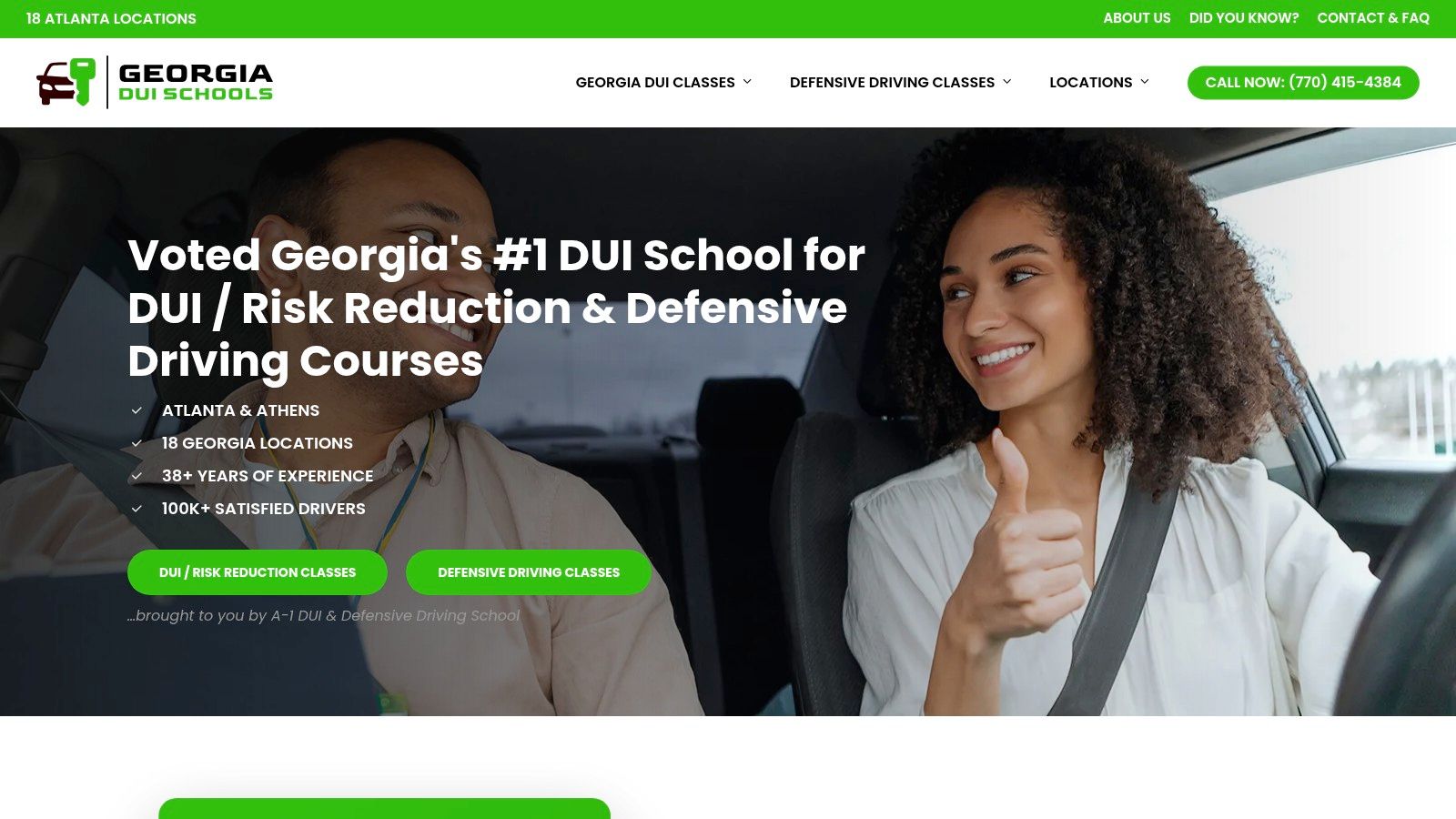
A provider tied to Georgia DUI services can be the safer choice even for a defensive driving search. The reason is simple. Georgia drivers often start with the wrong category. A standard defensive driving class may help with point reduction, a court request, or insurer preferences, but it does not replace Georgia Risk Reduction, a clinical evaluation, ASAM Level 1 treatment, or a Victim Impact Panel when one of those is ordered.
Georgia DUI Schools stands out because it covers both sides of that split. It offers Georgia DDS-approved defensive driving options in self-paced online, live virtual, and classroom formats, while also offering the other services drivers may need if a court, probation condition, or reinstatement process extends beyond a six-hour class. That service breadth lowers compliance risk for readers who are not fully sure which requirement applies.
Why it fits a different use case
It separates DDS and court needs from general safety use.
Some course providers market "defensive driving" broadly, then leave you to sort out whether your certificate works for your actual requirement. Georgia DUI Schools is more useful when the question is larger than insurance or personal education.It offers multiple formats with different tradeoffs.
Self-paced online works better for convenience. Live virtual and classroom options are easier to justify when attendance tracking, identity verification, or a formal process matters more than flexibility.It serves drivers who may need follow-on services.
If your case may involve more than one step, using one school can reduce handoff errors and scheduling delays.
A practical way to evaluate this provider is by risk, not by marketing. If you already know you only need a basic insurance-oriented refresher, its broader service menu may be more than you need. If there is any chance your issue touches DDS status, court instructions, probation terms, or DUI-related follow-up, a provider with defensive driving plus adjacent Georgia services is usually the lower-risk choice.
Their page on drivers education classes in Georgia is also useful for one reason. It shows how Georgia course categories differ, which matters because drivers often treat defensive driving, driver education, and DUI-related programs as interchangeable when they are not.
Pros
- Lower compliance risk for mixed cases: Defensive driving is available alongside Risk Reduction, clinical evaluations, ASAM Level 1 treatment, and Victim Impact Panels.
- Broad format coverage: Online, live virtual, and in-person options give drivers more ways to match the class to the requirement.
- Stronger fit for uncertain buyers: Helpful for drivers who are not sure whether they need only point reduction or a wider Georgia compliance path.
Cons
- Less focused if you only want a simple refresher: Drivers shopping strictly for a casual insurance or personal-safety course may prefer a narrower provider.
- Remote versus in-person fit will vary: In-person convenience depends on location, while statewide access will often mean choosing an online or virtual format.
- Enrollment still requires verification: You should confirm the exact course type, schedule, and certificate use before paying.
2. Georgia GoDrive Traffic School
Convenience is not the first question here. Course type is.
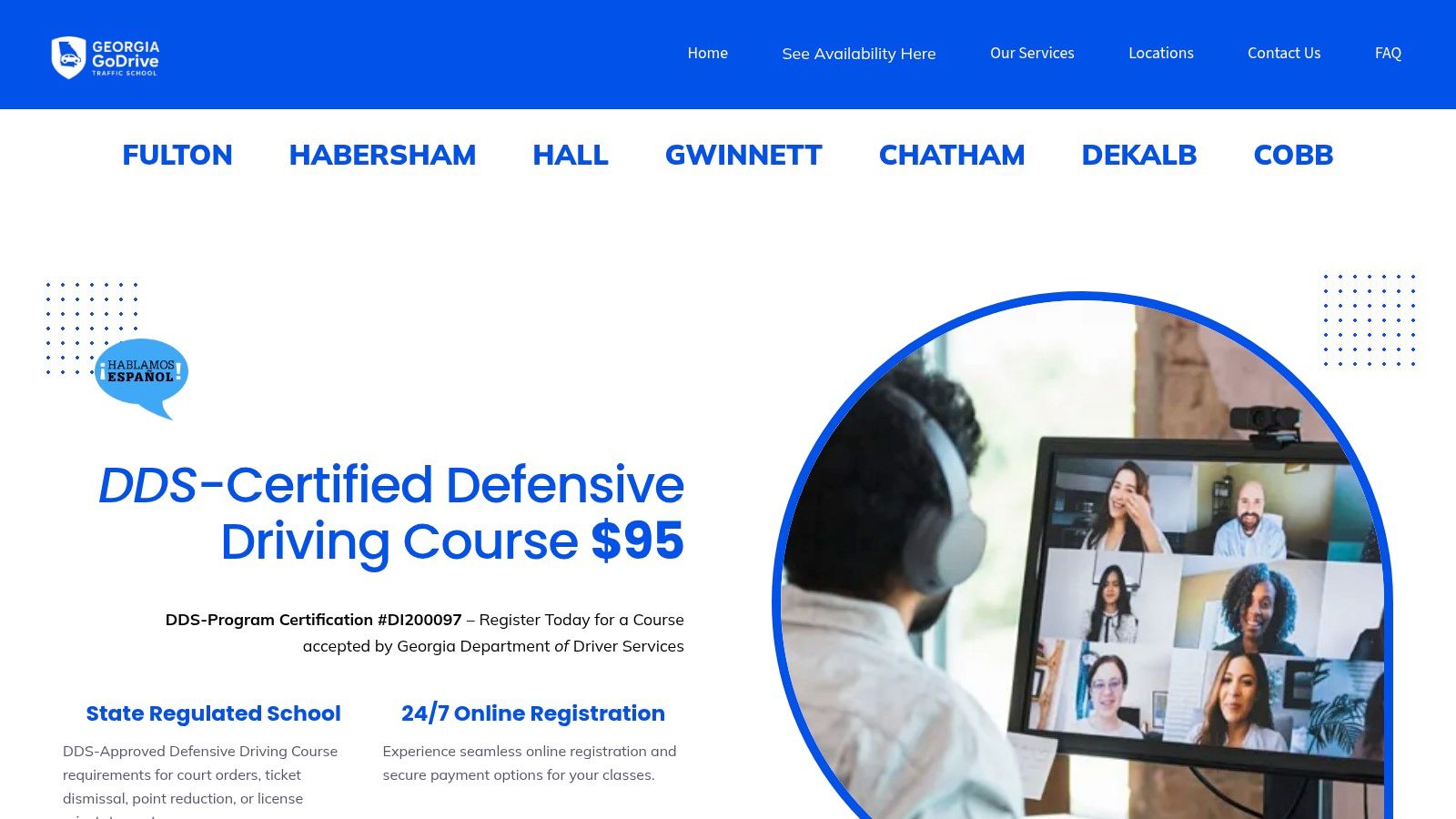
Georgia GoDrive Traffic School fits drivers who already know they need the Georgia six-hour Driver Improvement course and want a provider built around that specific requirement. That matters because Georgia buyers often use "defensive driving" to describe very different products. A court, DDS issue, or point-reduction step may call for a state-recognized format with attendance rules and identity checks, while an insurance refresher may not.
Two practical distinctions make this provider easier to assess:
- Georgia compliance use case: If your paperwork points to a Georgia Driver Improvement class, GoDrive's live remote structure reduces the risk of choosing the wrong kind of course.
- General learning use case: If you only want a flexible review for insurance or personal safety, the scheduled format may feel stricter than necessary.
Its presentation through Georgia GoDrive Traffic School suggests a narrower service model than a full-service compliance provider. That is a strength for buyers who do not want to sort through unrelated programs. It is less helpful for drivers whose situation is still unclear.
Better fit, weaker fit
Better fit
- Drivers with a DDS-related requirement
- Drivers following court instructions that specify the Georgia six-hour class
- Drivers who prefer live oversight, attendance tracking, and a defined completion path
Weaker fit
- Drivers shopping mainly for self-paced convenience
- Drivers comparing broad service stacks that include adjacent Georgia compliance categories
- Drivers who have not yet confirmed whether they need DDS acceptance, court acceptance, or only insurer approval
The main tradeoff is time control. Live virtual access removes the trip to a classroom, but it does not work like an on-demand course you can pause and finish later. For some drivers, that structure is a benefit because it creates a clearer compliance record. For others, it is less flexible.
Practical read on strengths and limits
Pros
- Lower format confusion: The course appears aimed at the standard Georgia Driver Improvement path, not a generic national refresher.
- Useful remote option for formal requirements: Live online delivery can suit drivers who need a recognized class format without traveling.
- Clearer audience fit: This works best for buyers who value compliance certainty more than casual convenience.
Cons
- Scheduling is the cost: A fixed class block can be harder to fit around work or caregiving than a self-paced course.
- Narrower service breadth: Drivers with mixed compliance questions may need more than one type of provider.
- Acceptance still needs verification: Court instructions, DDS expectations, and insurance rules are not interchangeable. Confirm which one applies before enrolling.
3. Drive Smart Georgia

Convenience is not the first question here. Georgia eligibility is.
Drive Smart Georgia stands out because it appears built for drivers who need to sort out whether they are trying to satisfy a Georgia DDS or court-related requirement, or whether they only want a course that may help with insurance or personal driving habits. That distinction gets blurred in many reviews, and it is where buyers make avoidable mistakes.
The provider offers the six-hour Georgia defensive driving or driver improvement class in a live, instructor-led format, including Zoom access through Drive Smart Georgia. The practical implication is straightforward. This is closer to a formal Georgia compliance option than a generic, self-paced refresher.
A useful way to assess this school is to separate the decision into three parts:
Compliance fit
If your issue involves a ticket, points, or a court or DDS-related instruction, a Georgia-focused provider with clearer rule explanations has an advantage. Drive Smart Georgia appears to explain approved versus non-approved use cases more directly than many broad national brands.Format tradeoff
Live virtual delivery reduces travel, but it still asks for a fixed time block. That lowers flexibility compared with on-demand courses and may improve fit for drivers who prefer a defined class structure over self-pacing.Service breadth
This is not the widest service stack in the article. Drivers who also need DUI-school-related services or multiple compliance categories may still prefer a more specialized or broader provider, depending on the exact requirement.
That combination makes Drive Smart Georgia a narrower pick than a mass-market online course, but often a safer one for readers who are still sorting out Georgia-specific acceptance questions.
Who this tends to suit
- Drivers who need to verify Georgia DDS or court relevance before enrolling
- Residents outside metro Atlanta who want remote access without shifting to a generic national course
- Buyers who value clear rule explanations more than maximum scheduling freedom
Where it may be weaker
- Drivers who want a self-paced course they can start and stop anytime
- Shoppers comparing providers mainly by service variety across unrelated programs
- Anyone assuming insurance usefulness and Georgia compliance are the same thing
Practical upside and limitation
Pros
- Stronger Georgia framing: The course appears positioned around state-specific use cases rather than broad defensive-driving marketing.
- Lower format ambiguity: Live instruction makes the delivery model easier to classify than mixed self-paced offerings.
- Good middle option: It sits between statewide institutional providers and generic national courses.
Cons
- Less schedule control: You need to attend the class when it is offered.
- Narrower scope: Some drivers will need another provider if their situation extends beyond standard driver improvement.
- Verification still matters: Court acceptance, DDS use, and insurance benefit should be confirmed separately before enrollment.
4. A-1 Driving Schools
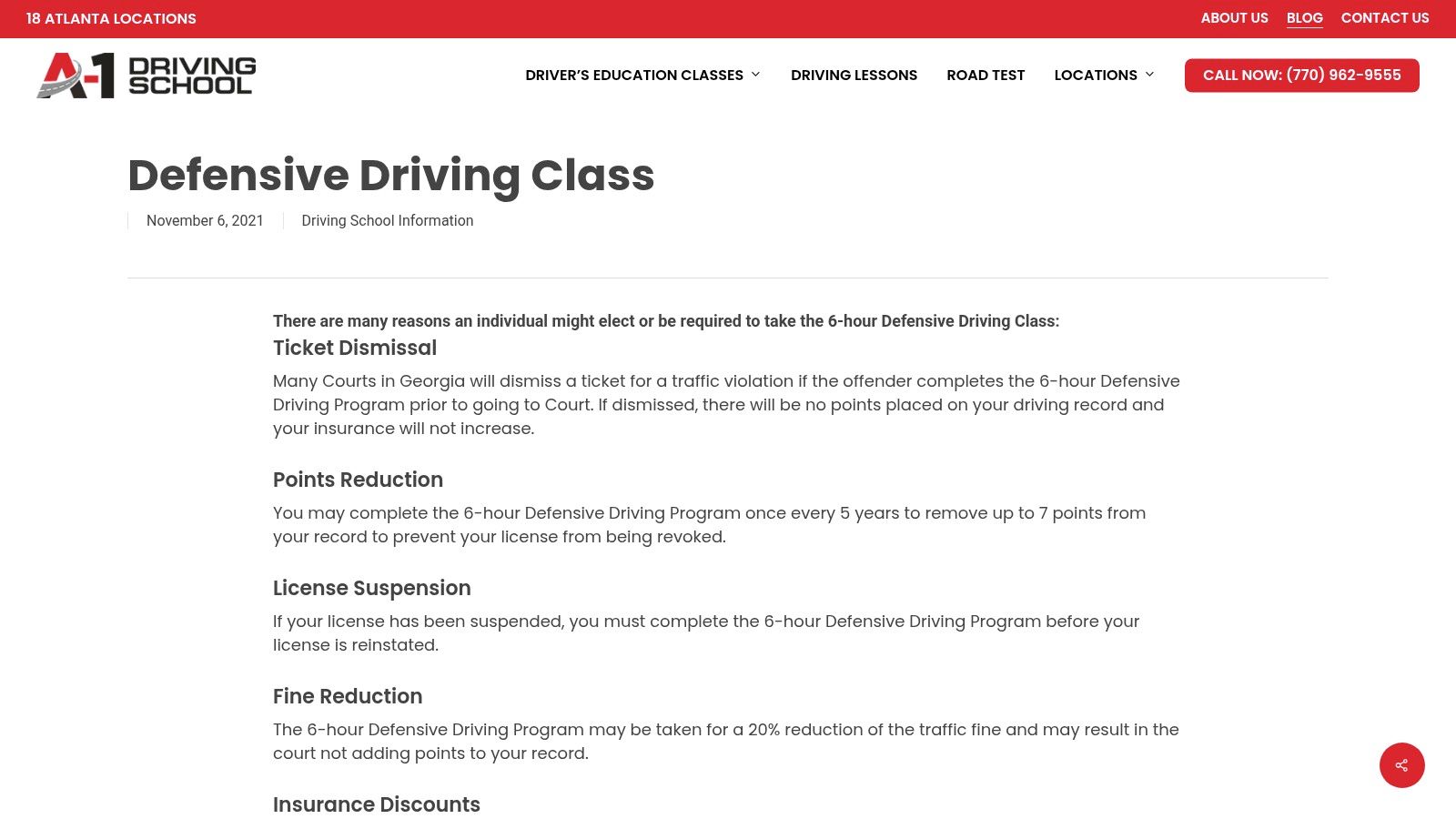
A-1 matters for a different reason than the providers above. The question here is less about online convenience and more about whether a physical classroom network reduces execution risk for a Georgia driver with a fixed deadline.
That distinction matters because Georgia use cases split in two. A course can be useful for insurance or general refreshers without fitting DDS or court needs. A-1's appeal is narrower and more practical through A-1 Driving Schools defensive driving: a six-hour, in-person Georgia course offered across multiple metro locations.
How to evaluate A-1 without overreading the brand
Start with eligibility, not convenience.
If you need a class for a court matter or another formal Georgia requirement, confirm that the specific course format and location fit that use. Do not assume that local availability and legal acceptance are the same question.Treat branch quality as part of the product.
Large school networks often solve the scheduling problem first. They can still produce uneven experiences across locations, especially on check-in, instructor pacing, and certificate processing.Use reviews differently here than you would for an online course.
For self-paced providers, reviews often focus on interface and ease of completion. For A-1, the more useful signals are whether the class started on time, whether staff handled paperwork correctly, and whether the in-person process matched the booking details.
A simple rule helps: review the location, then review the company.
Where A-1 fits in the Georgia comparison
Compared with live virtual options, A-1 asks for more travel and less schedule flexibility. Compared with generic online courses, it may lower format confusion for drivers who prefer a classroom setting and want a provider built around local attendance.
That does not automatically make it the safer compliance choice. It makes it a clearer operational choice for drivers who already know they need an in-person Georgia class.
Quick read
Pros
- Wide metro-area coverage can make last-minute enrollment easier
- In-person delivery may suit drivers who want fewer format questions
- Reviews are plentiful enough to compare branches, not just the parent brand
Cons
- Experience can vary by location and instructor
- Scheduled attendance is less forgiving than self-paced formats
- Georgia usefulness still needs separate confirmation for court, DDS, or insurance purposes
5. IMPROV Traffic School Georgia Defensive Driving
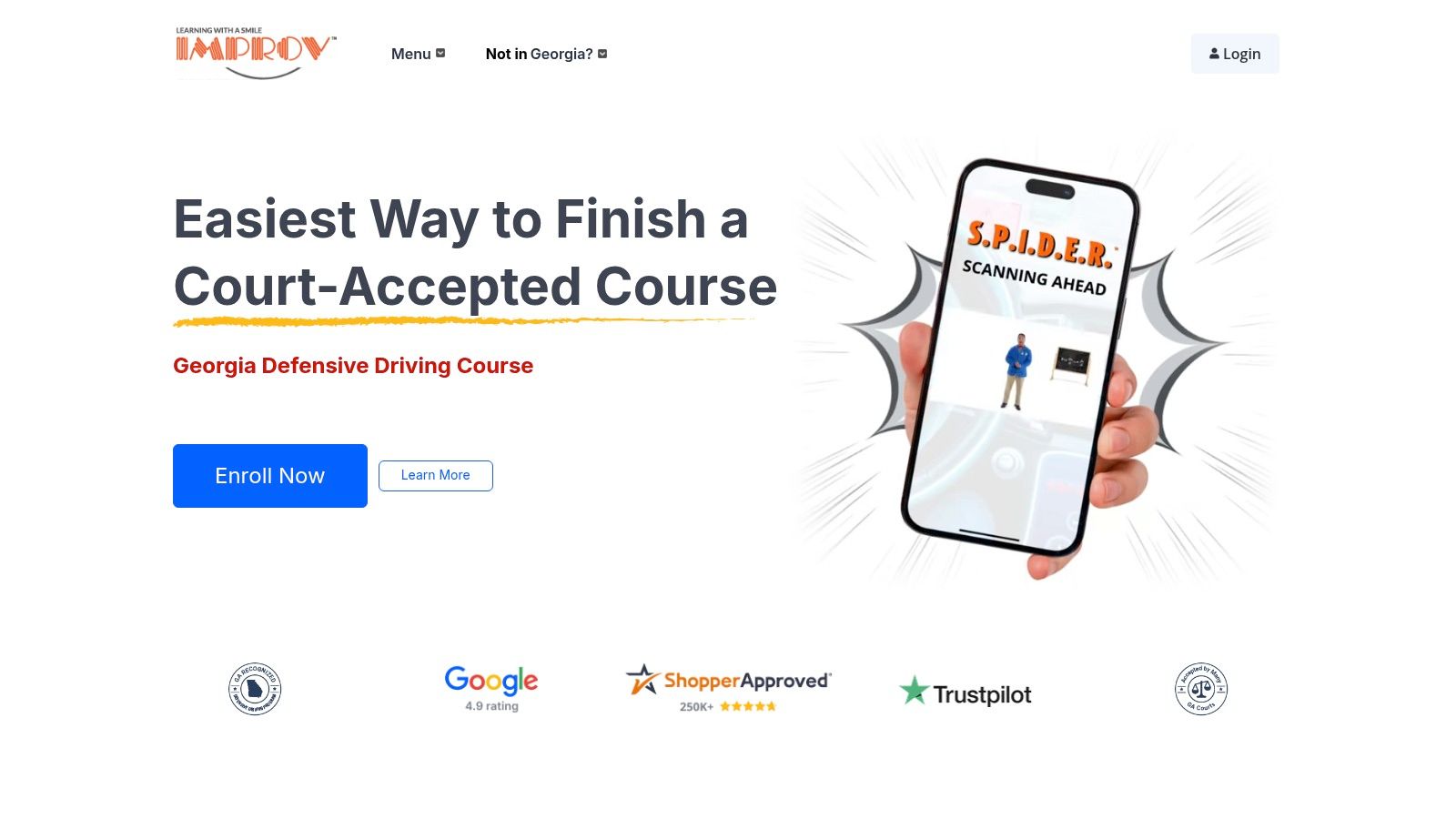
Convenience can be the wrong starting point in Georgia. With IMPROV, the first question is eligibility, not whether the course looks more entertaining than its competitors.
The provider presents a comedy-based online format through IMPROV Traffic School Georgia Defensive Driving. That format may help drivers who are more likely to stall out in a dry self-paced course. The tradeoff is narrower Georgia usefulness than the presentation style might suggest.
A practical way to assess IMPROV is to separate two use cases:
Georgia DDS or license-related goals
IMPROV is not the pick for DDS point reduction in Georgia. Drivers trying to solve a state license issue should screen it out early and focus on providers tied to the specific Georgia requirement.Court, insurance, or personal improvement goals
IMPROV can still be relevant if a court has approved an online course for your case, or if an insurer accepts this type of completion certificate. That is a different decision from DDS compliance, and mixing those categories is where drivers make avoidable enrollment mistakes.
Compared with live virtual or in-person classes, IMPROV lowers scheduling pressure. You do not need to match a class time or travel to a location. Compared with a plain, text-heavy online course, it also makes a clearer pitch to drivers who want the easiest possible path to finishing.
That convenience has a limit. In Georgia, format flexibility does not equal broad official acceptance.
How to read reviews on IMPROV
Reviews matter differently here than they do for a classroom provider. The useful signals are usually:
- whether the course is easy to complete without technical friction
- whether certificate delivery is handled clearly and on time
- whether customer support resolves access or completion issues
- whether users understood the course's Georgia acceptance limits before buying
A funny course is only useful if it fits the reason you need it.
Quick assessment
Pros
- Self-paced online format suits irregular schedules
- Humor-based presentation may improve completion for drivers who dislike standard traffic-school content
- Clear fit for users shopping for convenience first, not DDS utility
Cons
- Not appropriate for Georgia DDS point-reduction needs
- Court and insurance acceptance still require separate verification
- Service breadth is narrower than providers aimed at multiple Georgia compliance paths
6. DriveSafe Online Georgia
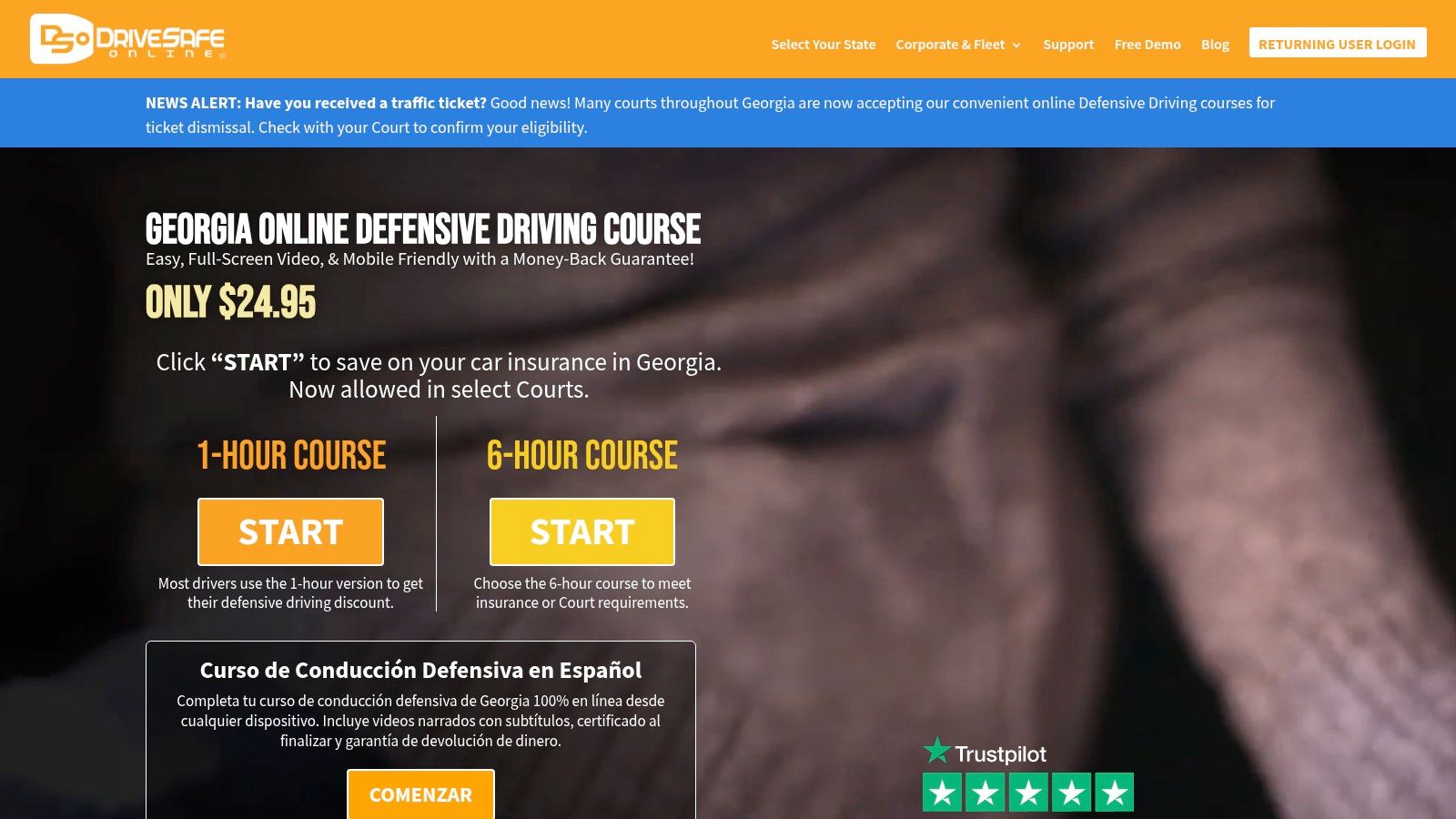
DriveSafe Online is less a Georgia compliance pick than a test of whether convenience outweighs acceptance limits. That distinction matters because online courses can be useful for insurance-related or court-approved purposes while still failing the DDS-specific use cases that many drivers assume they cover.
Start with eligibility, not reviews. For Georgia readers, the first filter is simple:
- DDS point reduction or reinstatement: This is not the right lane.
- Insurance-related completion: Potentially relevant, subject to insurer rules.
- Court use: Possible only if the court accepts it in your case.
That puts DriveSafe Online in a narrower category than some shoppers expect. Its value depends less on classroom quality and more on whether the provider handles the operational basics well after you pay.
Reviews are most useful here when they answer practical questions, not taste-based ones. Trustpilot feedback on DriveSafe Online highlights the issues that matter most for a self-paced provider: account access, progress tracking, completion processing, and whether the certificate arrives without confusion. A course can be easy to click through and still create problems if completion records or delivery steps break at the wrong time.
DriveSafe Online also benefits from being relatively clear about its Georgia role. Its Georgia insurance discount course page frames the offering around insurance use rather than DDS point reduction. That is a better signal than broad marketing language because it lowers the risk of buying the wrong format for the wrong reason. Drivers who are still sorting out whether web-based courses are valid for any Georgia purpose should review this breakdown of whether online defensive driving courses are legitimate in Georgia.
A practical way to compare formats:
- Against live virtual classes: DriveSafe Online asks less of your schedule but gives you less built-in structure.
- Against in-person schools: It removes travel and class-time friction but usually offers fewer compliance paths.
- Against broad Georgia-focused providers: It fits a smaller set of driver goals.
Best fit
- Drivers shopping primarily for self-paced convenience
- People pursuing an insurance-related certificate
- Users comfortable verifying court acceptance before enrolling
Weak fit
- Drivers who need Georgia DDS point reduction
- Anyone who wants one provider to cover multiple Georgia compliance scenarios
- Users on a short deadline who cannot tolerate technical or certificate-delivery issues
7. AARP Smart Driver
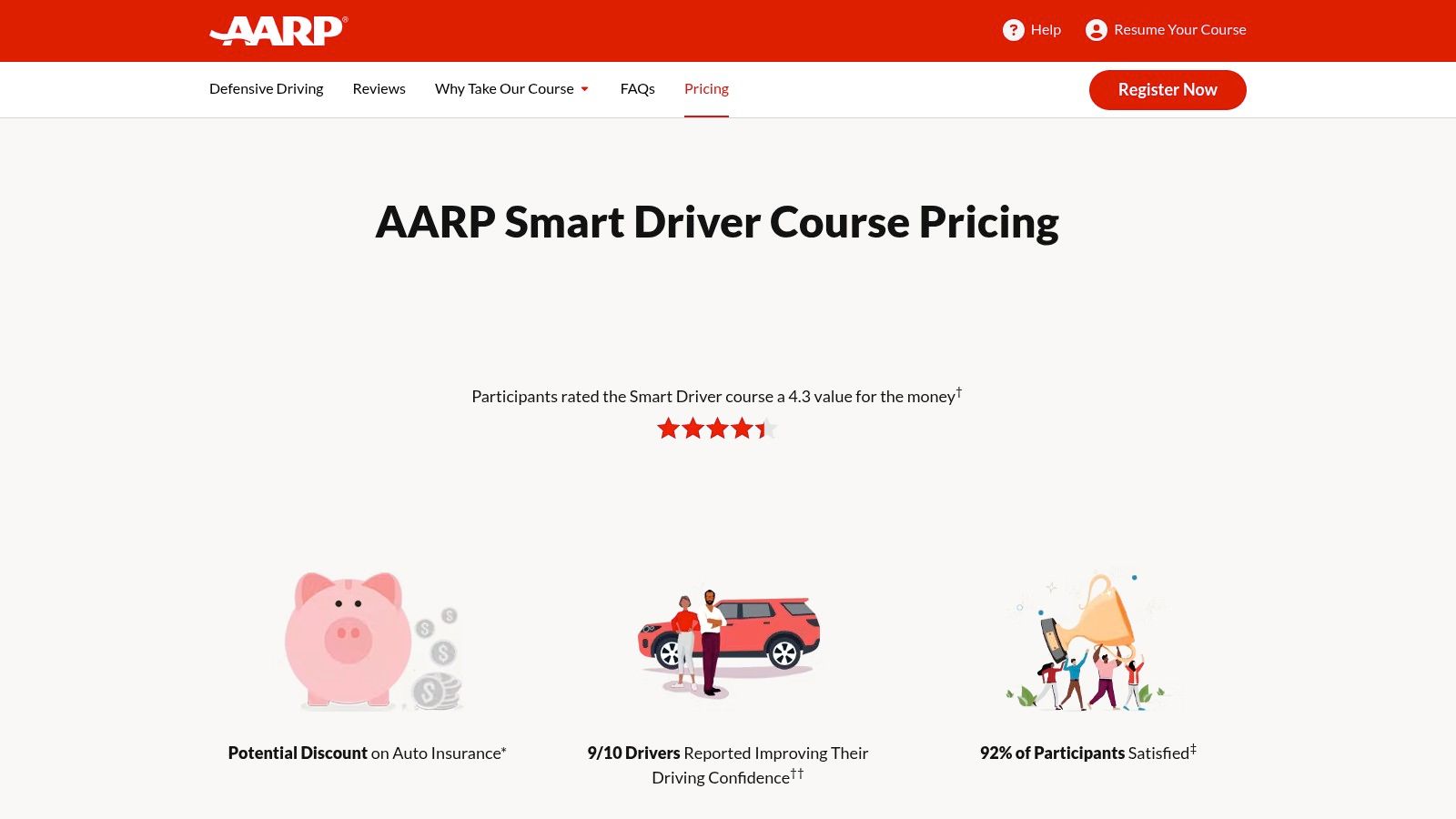
Brand recognition is not the deciding factor here. Georgia purpose is.
AARP Smart Driver is easier to place once you separate two use cases that often get mixed together. First, Georgia DDS or court-related needs. Second, insurance or general refresher value. AARP sits much more clearly in the second category, which makes it useful for some drivers and a poor fit for others.
The program is offered online and in classroom formats through AARP Smart Driver. That delivery mix helps older drivers who want either home-based convenience or a more traditional class setting. It does not change the main Georgia constraint. A widely recognized senior-focused course is still different from a DDS-certified driver improvement course.
A practical way to assess AARP in Georgia is to ask four questions:
Compliance risk
For DDS point reduction, license issues, or court instructions, this course creates more verification risk than Georgia-specific DDS providers. You may still find it useful for personal education or insurer discussions, but those are separate goals.
Scheduling demands
AARP is less rigid than fixed live classes if you choose the online version. The classroom option may appeal to drivers who prefer a slower pace, direct instruction, or less screen time.
Service breadth
Its focus is narrower. AARP is built around mature-driver education, not the wider set of Georgia record, reinstatement, or court-use scenarios covered by some state-focused schools.
Audience fit
This is the age-specific option on the list. Readers comparing senior-oriented formats can also review a more Georgia-specific guide to a defensive driving course for seniors.
Pros
- Strong fit for older drivers who want a refresher course
- Offers both online and classroom formats
- Recognizable national brand with a clear senior audience
Cons
- Poor match for Georgia DDS point-reduction goals
- Court or record-related acceptance may require extra verification
- Less useful for drivers who want one course to cover multiple Georgia compliance purposes
The non-obvious tradeoff is convenience versus legal precision. AARP may feel easier to choose because the audience and course intent are straightforward. In Georgia, that simplicity helps only if your goal is education or potential insurance-related use. If your goal touches DDS status or a court requirement, the safer choice is usually a Georgia-specific provider whose approval path is explicit.
7-Course Defensive Driving Comparison
| Program | Delivery & Format | Implementation Complexity | Resource Requirements | Legal / DDS Acceptance | Expected Outcomes | Key Advantages |
|---|---|---|---|---|---|---|
| Georgia DUI Schools | DDS-approved Risk Reduction & defensive driving; self-paced online, live Zoom, classroom; 18+ locations | Moderate, includes clinical evaluations and state-required steps | Varies by course; multiple locations; pricing not published (call/site) | Accepted by Georgia DDS for required courses | License reinstatement/compliance, points reduction, possible insurance savings | Comprehensive services from assessment to completion; long track record |
| Georgia GoDrive Traffic School | Instructor-led 6-hour classes; scheduled and remote live (Zoom) | Low–moderate, fixed 6-hour attendance with identity checks | Single 6-hour block; scheduled sessions; clear DDS program number | DDS-certified; reports directly to DDS | Ticket/points reduction, fine mitigation, potential insurance discount | Clear certification and responsive student support |
| Drive Smart Georgia | DDS-approved 6-hour instructor-led classes; statewide Zoom sessions | Low–moderate, scheduled live sessions required | 6-hour attendance; published pricing and help center | DDS-approved for Driver Improvement | Points/fine reduction, license reinstatement steps, possible insurer discount | Transparent pricing and state-focused guidance |
| A-1 Driving Schools | DDS-certified 6-hour Driver Improvement at many in-person locations | Low, frequent schedules and many sites simplify attendance | 6-hour attendance; 19+ metro locations; frequent dates | DDS-certified across locations | Points reduction, ticket dismissal, meet court/DDS deadlines | Numerous locations, frequent classes, strong third-party reviews |
| IMPROV Traffic School | 100% online, mobile-friendly, entertainment/comedy-based course | Very low, self-paced access with no timers | Short completion time; instant/fast certificate delivery | Not accepted by Georgia DDS for points/license matters | Certificate often used for court/insurer on case-by-case basis; driver education | Highly engaging format and very fast certificate delivery |
| DriveSafe Online – Georgia | Online 1-hour and 6-hour courses with immediate certificates | Very low, self-paced with insurer/court caveats | Short/6-hour options; low pricing; money-back guarantee if insurer rejects | Not DDS-accepted unless a court specifically permits | Potential insurance discounts or court acceptance if pre-approved | Low cost, quick completion, money-back acceptance guarantee |
| AARP Smart Driver | Online self-paced (60-day) and classroom options for drivers 55+ | Low, self-paced with a 60-day completion window | Time variable; member promotions; widely recognized by insurers | Not accepted by Georgia DDS for points/license | Potential insurer premium discounts; improved driving skills | Strong insurer recognition and brand trust for mature drivers |
Verify Acceptance Before You Enroll
The most useful lesson from defensive driving course reviews is that “best” depends less on marketing than on legal fit. Start by identifying the exact reason you're taking the course. Is it a Georgia DDS requirement, a court instruction, an insurance request, or personal education? Those four paths overlap in language, but they don't reliably overlap in acceptance.
Then confirm the provider and format for that exact purpose. Georgia buyers should be especially careful here because consumer complaint oversight in driver education remains active. Texas reported 84 consumer complaints in its driver education and safety category in FY2025 and 91 in FY2024, according to Texas complaint statistics for driver education and safety. That doesn't tell you what will happen in Georgia, but it does underline a broader buyer lesson. Administrative problems, acceptance disputes, and service failures aren't rare edge cases.
Also compare the scheduling burden. A live six-hour Georgia class is less flexible than a self-paced online course, but it usually carries less compliance ambiguity for DDS-related uses. Online formats are often better for insurance or approved court situations, especially as digital delivery has become a major growth channel. One industry report estimated online training at 42.3% of delivery-mode share with projected faster growth than in-person formats, according to DataIntelo's defensive-driving training technology report. Convenience matters, but only after acceptance is settled.
Keep your paperwork. Ask for the full current price, certificate timeline, refund policy, and delivery method before enrolling. Save registration emails, attendance confirmations, and the final certificate.
One more Georgia distinction matters. A defensive driving class doesn't replace DUI or Risk Reduction requirements, and it doesn't substitute for related services when they've been ordered. Georgia clinical evaluations have their own standards. State rules require a clinical interview plus review of the standardized screening instrument from the risk reduction program, and the evaluator must gather enough information to diagnose or rule out a substance-related disorder under DSM criteria and recommend an appropriate ASAM level of service under Georgia clinical evaluation rules.
For readers who need a Georgia DDS-approved defensive driving course or a broader path that may include Risk Reduction, clinical evaluation, ASAM Level 1 treatment, or a Victim Impact Panel, Georgia DUI Schools is the most relevant full-service option on this list.
If you need more than a generic online class, Georgia DUI Schools offers Georgia DDS-approved defensive driving, Risk Reduction courses, clinical evaluations, ASAM Level 1 treatment, and Victim Impact Panels through in-person, live virtual, and statewide online options. It's the best fit here for drivers who need to match the right course to a Georgia legal, court, or insurance purpose without guessing.