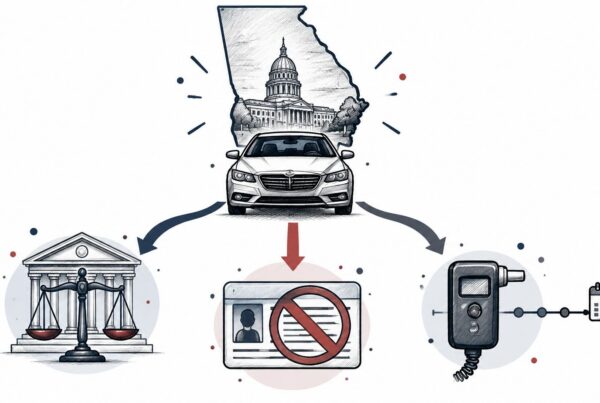
You're home after a DUI arrest, looking at a citation, release paperwork, and a court date that may seem far away. Your immediate worry is getting to work in Atlanta, taking your children to school in Decatur, or keeping a job that requires driving. The first question isn't just what will happen in court. It's whether a separate license deadline needs attention before you ever appear before a judge.
A Georgia DUI lawyer should start by sorting those papers into separate legal problems, identifying the deadlines, and explaining what you can legally do next. Hiring counsel, completing a course, and restoring a license serve different purposes. Getting the order right matters.
When a Georgia DUI Case Needs a Lawyer
A refused chemical test deserves urgent attention, even if your criminal court date hasn't arrived. Georgia DDS explains that refusing the state-administered test creates a suspension of at least one year, and a first DUI conviction following that refusal makes the driver ineligible for a limited driving permit, according to its first-DUI suspension guidance.
A lawyer's first job is to determine which suspension process applies, what paperwork has been issued, and whether an administrative challenge is still available. Waiting for a court reminder isn't a reliable strategy.
Georgia DUI situations and what each means for a lawyer
| Your situation | Georgia consequence | Lawyer priority |
|---|---|---|
| Chemical test refused | Separate refusal suspension; restricted-driving options can be unavailable | Urgent: identify administrative deadlines immediately |
| First DUI conviction within five years, BAC 0.08 or higher | DDS states that a first conviction within five years brings a 12-month suspension, with reinstatement possible after 120 days if conditions are met; NHTSA uses 0.08 g/dL as its alcohol-impairment benchmark in its alcohol-impaired-driving report | High: challenge the stop, arrest, and test while checking the applicable licensing rules |
| Two or more DUI convictions within ten years | Documented state-approved clinical evaluation required for reinstatement, according to DDS reinstatement requirements | High: plan compliance alongside the defense |
| Drug or mixed alcohol-and-drug allegation | Education and clinical requirements may apply according to the driver's record and suspension | High: preserve medication records and obtain toxicology interpretation |
The conviction-related suspension and conditional reinstatement period in the table come from DDS's first-DUI guidance. They aren't a promise that every driver with a first charge can follow that same route.
Separate deadlines require separate decisions
The administrative license case concerns driving privileges. The criminal case concerns the prosecution of the charge. Each can require action on a different schedule, so ask counsel to put both timelines in writing.
A driver who needs a vehicle for work should also ask whether any lawful permit option exists for the specific suspension. Needing to commute doesn't establish eligibility, and a court disposition doesn't automatically clear every DDS requirement.
Practical rule: Don't treat a favorable court result as permission to drive. DDS must receive the applicable documents and full payment, and your license status must actually be restored.
For someone in Atlanta, Decatur, Athens, or elsewhere in Georgia, the quick self-check is straightforward. Was a test refused? Is there a qualifying prior conviction? Are drugs involved? A yes means calling a lawyer this week, preferably immediately, with every notice available rather than waiting to assemble a perfect file.
What a Georgia DUI Lawyer Handles on Two Tracks
A Georgia DUI produces two cases at once. DDS runs the administrative track and decides whether you keep driving. The court runs the criminal track and decides whether the charge stands. Each moves on its own deadlines, so the first job of counsel is sequencing: which filing falls due first, and what has to happen before it does.

On the license track, exposure starts with implied consent. Under O.C.G.A. § 40-5-67.1, refusing a state-administered blood, breath, urine, or other chemical test can trigger a suspension of at least one year, and a refusal can carry consequences when the criminal case reaches trial as well. Counsel must examine the actual request and notice rather than assume every refusal case presents identical issues.
What counsel reviews first
Bring the documents you received, including envelopes and electronic messages. The wording of the notice and the timing of the request can matter as much as the charge listed on the citation.
- Implied-consent notice: What did the officer communicate, and when?
- Requested test: Was the request for breath, blood, urine, or another chemical test?
- Statutory compliance: Did the officer follow the requirements applicable to that request?
- Administrative challenge: What filing is needed, who will submit it, and what confirms receipt?
Each answer decides what gets filed and how fast.
On the criminal track, a lawyer should request the underlying records rather than rely on the officer's summary.
- Arrest video and body-camera footage: Preserve the interaction and the sequence of events.
- Dispatch records: Compare reported times with the investigation timeline.
- Test-machine documentation: Identify the device, testing records, and maintenance information.
- Officer training records: Check qualifications relevant to the procedures performed.
- Every DDS notice: Establish what licensing action is pending.
Independent testing has a practical window
An independent chemical test may be available after the state test. Whether it helps depends on collection, handling, and interpretation, not on the fact that a second sample exists.
An independent sample does not automatically contradict the state's result. Alcohol concentration can change between collections, so counsel may need a toxicologist to interpret the timing and the laboratory methods.
The early decision is more specific than whether to fight the DUI. Counsel should explain whether to contest the suspension, negotiate a resolution, or litigate admissibility, meaning whether particular evidence may be used. Those choices should reflect the records, the licensing exposure, and your priorities, never a promise made before anyone reviews the file.
Evidence That Decides Whether a Charge Holds
A BAC result is a measurement, not an explanation of how the measurement was produced. A useful defense review asks what was tested, how the test was performed, and what legal allegation the result is supposed to prove.
The Georgia DDS ADAP student manual identifies a BAC of 0.08 or greater, or an implied-consent refusal, as producing a minimum 12-month suspension without a limited driving permit in the first-suspension category it describes. Counsel must identify the applicable category rather than turn that statement into a universal rule for every DUI suspension.
Evidence sources a Georgia DUI lawyer checks
| Evidence source | What it shows | Question to ask |
|---|---|---|
| Breath instrument log | Calibration and maintenance history | Was the instrument certified on the test date? |
| Observation period record | Whether safeguards against mouth-alcohol contamination were followed | Was the observation period continuous and documented? |
| Blood sample chain of custody | Collection, storage, transfers, and associated laboratory records | Were handling steps and laboratory validation documented? |
| Arrest video and body-camera footage | Stop reason, field tests, and timing | Does the footage support probable cause, the legal basis for arrest? |
| Drink-to-test timeline | Possible rising BAC or post-driving drinking | Does the timeline support the reported number as evidence of the allegation? |
The specimen matters. Breath testing raises questions about the instrument, operator certification, observation period, and contamination controls. Blood testing requires attention to sample handling and laboratory analysis, including chromatograms, the records showing how the laboratory separated and measured substances.
A per se charge alleges a prohibited alcohol concentration rather than relying only on observed impairment. Counsel should establish whether the prosecution is using the result for that allegation, for impairment evidence, or in an administrative proceeding.
Reconstruct the sequence before choosing a defense
Write down the last drink, driving, stop, arrest, testing, and sample collection while your memory is fresh. Preserve receipts, messages, and other records that can establish timing without altering or deleting anything.
That sequence can help a qualified reviewer assess rising BAC, drinking after driving, mouth-alcohol contamination, or medication effects. None is a defense because it appears on a list. The explanation must fit the evidence.
Ask what specific record supports the challenge. “The machine might be wrong” isn't a substitute for identifying a procedural defect or a scientifically supported limitation.
A guide to breathalyzer testing can help you understand the terminology before a consultation. For a contested result, the stronger investment is a qualified forensic-toxicology review tied to the precise charge, especially when a small measurement issue could affect negotiation, licensing, or access to work.
How to Reinstate Your License After a Georgia DUI
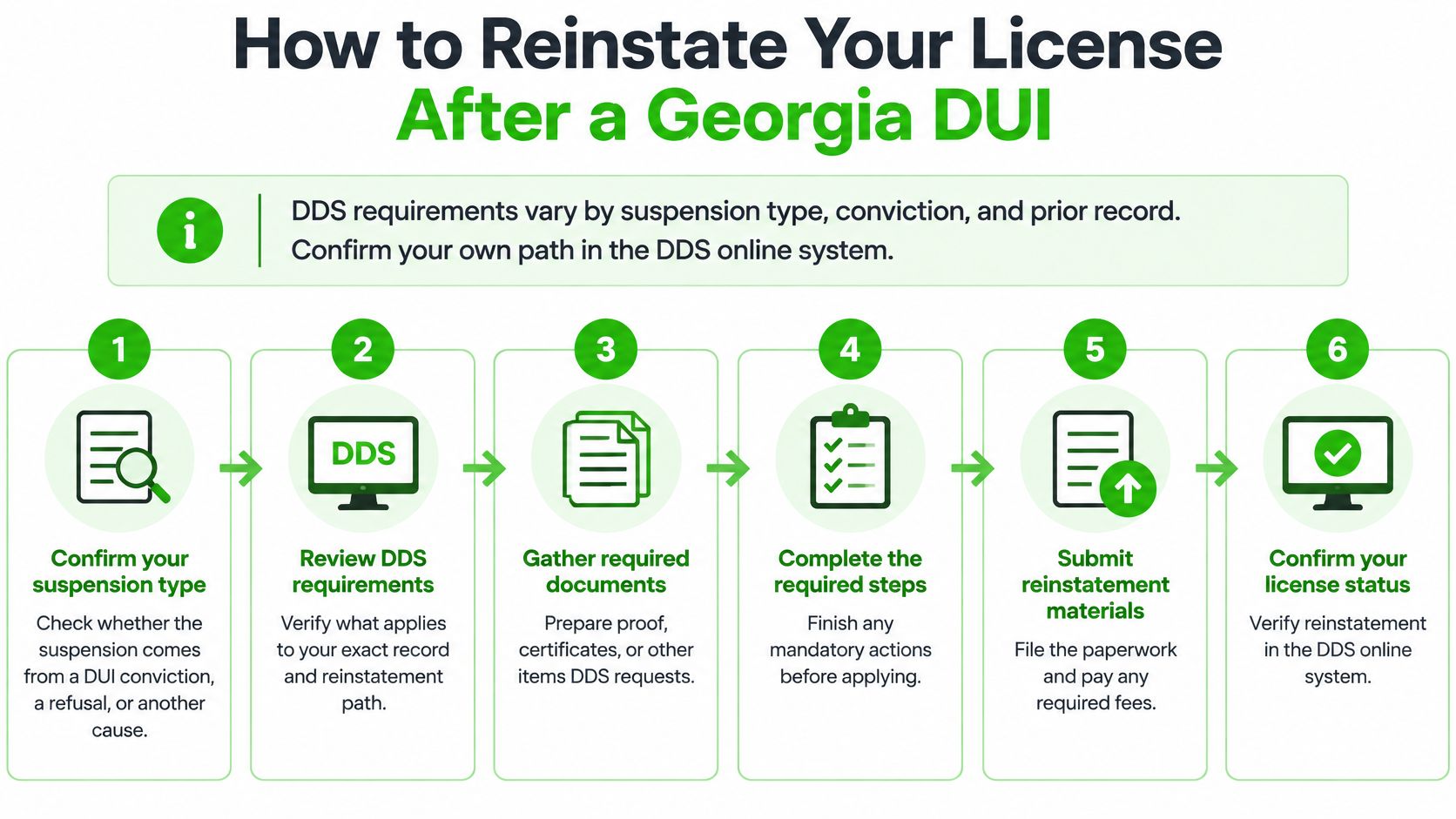
The license case runs on its own clock, separate from the criminal case. Paying fines, starting probation, or finishing your court dates does nothing at DDS until the administrative requirements are met. Match your reinstatement path to your suspension type, conviction, and prior record, starting from your individualized DDS requirements rather than another driver's checklist or the assumption that finishing court restores your license.
Put the requirements in a workable order
Confirm which suspension is active. Establish whether DDS lists an administrative suspension, a conviction-related suspension, or both. Completing requirements for one action while another still stands leaves you unable to drive legally.
Identify the appeal deadline and permit rules. Have counsel review the actual notice before you spend money on classes. A course certificate doesn't replace a required administrative filing, and it doesn't establish permit eligibility on its own.
Mark the applicable eligibility date. Use the waiting period identified in your DDS requirements, not the date you finish class. Ask counsel which documents and coursework can be prepared during the wait so nothing sits idle.
Choose a DDS-certified Risk Reduction school. The DDS DUI Alcohol or Drug Use Risk Reduction Program guidance states that certificates from uncertified providers aren't accepted for licensing, reinstatement, or court requirements. Verify certification before paying so the work produces an accepted certificate.
Complete the assessment before the class. DDS requires the Assessment Component, commonly called NEEDS, followed by the 20-hour Intervention Component of group counseling and education on alcohol and drug use and its effects on driving. The 20 hours can't be finished in one day; certified schools commonly schedule them across a weekend, such as Friday evening plus all day Saturday and Sunday, or over several evenings. The fee is set by Georgia law, so every certified school charges the same state-mandated amount: $100.00 for the assessment, $235.00 for the course, and $25.00 for the workbook.
Address any clinical-evaluation requirement. If your record triggers an approved evaluation, treat it as a separate task. The Risk Reduction assessment doesn't satisfy it.
Submit the documents, pay the applicable fee, and verify restoration. Keep proof of submission and payment, then confirm your status through DDS. Finishing the paperwork isn't confirmation that you may drive.
Take the schedule seriously. Arriving late to any intervention session can mean denied entry, no way to make up the missed time, and re-registration at the full course fee to start the program from the beginning. And if you were convicted in Georgia but live in another state, DDS requires a substantially similar intervention program certified in your home state, at least 20 hours long, with completion verified by Georgia DDS.
Avoid the online-format trap
Georgia DDS doesn't accept certificates from self-paced online DUI/Risk Reduction programs for reinstatement or court purposes. An online listing alone doesn't establish that a program uses an acceptable format, so confirm the instructional format and your DDS requirements before purchasing.
Defensive driving is a separate program with its own limits. The DDS points guidance describes Driver Improvement as a six-hour course used for court orders, point reduction, reinstatement, insurance-premium reduction, and personal education, and it isn't a substitute for DUI Risk Reduction. Self-paced online defensive-driving courses run into the same wall: DDS won't accept them for point reduction, court orders, or reinstatement, and they're generally usable only for an insurance discount after confirming with your provider.
Our certified school issues an official Certificate of Completion after both DUI components are successfully completed, which is the legal proof the court or DDS needs. Keep it with your receipts, DDS correspondence, clinical documents when applicable, and the final license-status confirmation. A step-by-step license reinstatement guide can help organize those tasks.
Plan lawful transportation for the full suspension period, whether that's rides from family, transit, or a carpool, because driving to work, class, or court is still driving. For a one-off occasion during that stretch, such as a wedding or group outing where a prearranged vehicle makes sense anyway, Atlanta Party Ride's Atlanta luxury vehicle pricing guide is a separate budgeting reference. Don't assume any trip is exempt from the suspension.
Clinical Evaluations for Repeat and Drug Cases
A common misreading is that Risk Reduction covers everything. It doesn't. Think of the class as the driving lesson and the clinical evaluation as the health check: they answer different questions, and neither should be confused with treatment.
The class provides education about alcohol, drugs, and driving. The clinical evaluation assesses the person's alcohol or drug use and helps determine whether additional substance-abuse services are appropriate. Treatment is the service that follows when required or recommended through the applicable process.
Education, evaluation, and treatment aren't interchangeable
According to the Georgia DDS DUI FAQs, reinstatement after two or more DUI convictions within the previous ten years requires documented proof of a state-approved clinical evaluation. DDS identifies the Department of Behavioral Health and Developmental Disabilities as the agency administering rules for clinical evaluations and substance-abuse treatment providers.
That means a person with qualifying convictions may need both Risk Reduction and an approved evaluation. Completing education doesn't establish that the evaluation requirement has been satisfied.
- Education answers: Has the driver completed the required alcohol-and-drug driving curriculum?
- Evaluation answers: What does the assessment indicate about the person's substance use and need for services?
- Treatment answers: What services must the person complete under the applicable recommendation or requirement?
A prescription allegation still needs an evidence-based defense
Say an Athens driver faces a new DUI allegation involving prescription medication and has a previous conviction. Counsel should obtain prescription instructions, dispensing records, reported dosing times, toxicology results, and observations of impairment.
A lawful prescription doesn't resolve whether the state can prove impaired driving. Equally, identifying a medication in a sample doesn't replace careful interpretation of what that finding means for the allegation.
The lawyer must also determine whether the driver's conviction history activates additional reinstatement obligations. That compliance analysis should proceed without treating participation in education or evaluation as a substitute for defending the charge.
Use a Georgia DUI clinical-evaluation guide to prepare questions about the approval process and documentation. Ask counsel which agency needs each document, where it must be sent, and how completion will be confirmed.
Keep separate files: One folder should hold evidence for the defense. Another should hold certificates, evaluations, and proof of compliance.
What a Georgia DUI Lawyer Costs
| Case type | What drives the price |
|---|---|
| First DUI, resolved by plea or early disposition | Evidence review, negotiation, and number of court appearances |
| Administrative license hearing added to a DUI case | Separate licensing work, hearing preparation, and filing obligations |
| DUI trial or contested breath or blood test | Motions, expert toxicology review, witness preparation, and trial time |
| Repeat DUI or case with serious injury | More extensive records, penalty analysis, and potentially longer proceedings |
| Drug-only allegation | Medication records, laboratory evidence, and toxicology interpretation |
Attorney fees depend heavily on the facts of each case, so request a written fee proposal from Georgia counsel for your specific situation before setting a budget. A headline price is useful only if you know what work it buys.
A Georgia DUI creates two separate cases: the criminal prosecution and the DDS administrative action against your license. Each carries its own deadlines and its own workload, so the first question about any quote is whether it covers both tracks. A fee that handles only the courtroom case can leave the license suspension unopposed while you wait.
Attorney fees are also separate from court costs, DDS reinstatement charges, and required program fees. Georgia law fixes the DUI / Risk Reduction program cost at $100.00 for the Assessment Component, $235.00 for the 20-hour Intervention Component course, and $25.00 for the workbook, and certified schools cannot charge more or less than that state-mandated amount. Transportation, missed work, and expert services may require their own budget as well.
Flat fees and hourly billing solve different problems
A flat fee gives you a known attorney charge for a defined scope. The agreement should say whether that scope includes the administrative hearing, contested motions, trial, and post-disposition licensing assistance.
Hourly billing charges for work performed. It can make sense when the scope is uncertain, but additional hearings, expert conferences, and document review can increase the total. Ask how the lawyer reports time and when you will receive updated estimates.
- Administrative representation: Is the license hearing included or separately priced?
- Expert review: Who retains the toxicologist, and who pays the expert?
- Trial work: Does the quoted fee cover trial preparation and trial itself?
- Reinstatement support: Will counsel review DDS requirements or only handle the prosecution?
- Payment terms: What payment is due at signing, and what triggers another charge?
Compare the scope before comparing the price
A cheaper quote that excludes the licensing matter may cost more once you add the work you actually need. Paying for extensive expert analysis makes little sense unless counsel can explain the question the expert will answer.
Ask a lawyer in Fulton, DeKalb, Clarke, or your own county to separate necessary work from optional investigation. Local familiarity helps counsel explain scheduling and procedure, though it guarantees nothing about the outcome.
The practical comparison includes the cost of being unable to drive. The administrative deadline can expire while the criminal case is still pending, so delay itself carries a price. Weigh lawful commuting options and potential missed shifts alongside each quote, and decide without assuming a higher fee automatically produces a better result.
Questions to Ask and Your Next Step
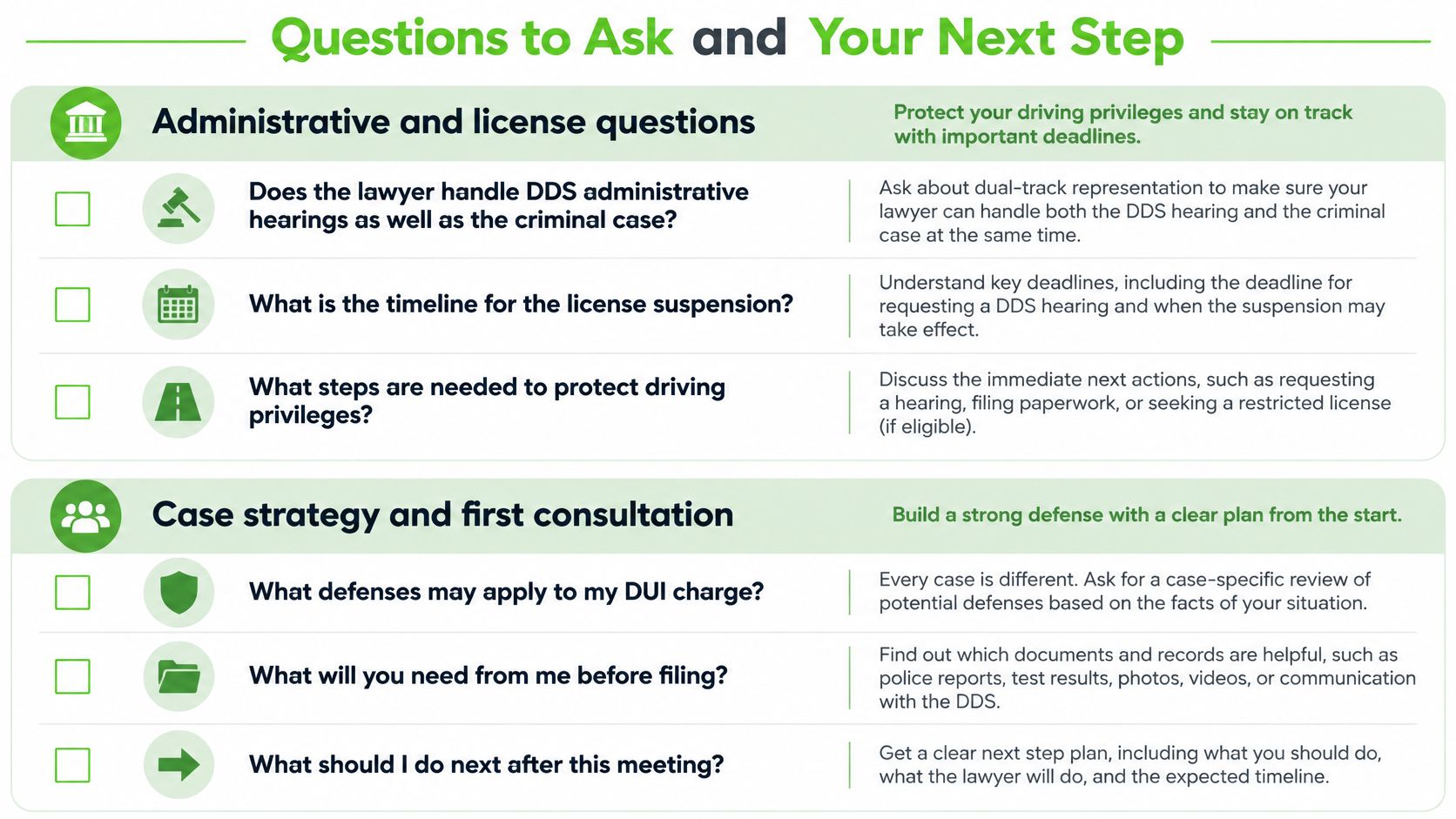
Bring a consultation checklist
Administrative and license questions
- Scope: Does the lawyer handle DDS administrative hearings as well as the criminal case?
- Timing: What is the timeline for the license suspension, and which filing needs attention first?
- Experience: How many Georgia DUI cases did the lawyer resolve in the past year?
- Immediate action: What steps are needed to protect driving privileges, and who will submit the paperwork?
Evidence and strategy questions
- Preservation: Will counsel obtain arrest video, body-camera records, and test-machine documentation early?
- Testing: Will the lawyer request raw instrument data, calibration logs, and observation-period records?
- Expert review: Who interprets toxicology findings, and what would justify retaining an expert?
- Defense: What defenses may apply to the specific charge, and what evidence would support them?
Reinstatement and drug questions
- Compliance: Will counsel explain the full DDS path, including Risk Reduction and any clinical evaluation?
- Medication experience: Has the lawyer handled prescription-medication or cannabis allegations?
- Documents: What will you need to provide before counsel files anything?
Cost and agreement questions
- Written scope: What does the flat fee include, and what triggers extra charges?
- Responsibility: Who will work on the file and attend hearings?
- Credentials: Is the lawyer an active member of the State Bar of Georgia?
- Follow-through: What should you do immediately after the meeting?
Recognize red flags before signing
Be cautious about a guaranteed outcome, pressure to sign before reviewing the agreement, unfamiliarity with DDS deadlines, or an evasive answer about who will handle the case. A useful consultation identifies uncertainties and explains how counsel will investigate them.
Bring arrest paperwork, every DDS notice, test records, and a written timeline. Keep copies of what you provide and ask for written confirmation of the next action, its deadline, and the person responsible.
Act on the administrative deadline first. Then schedule the required education. Our school is certified by Georgia DDS, and we offer in-person and online DUI classes; online instruction shouldn't be confused with an unacceptable self-paced program.
The 20-hour intervention course can't be completed in one day. It is commonly scheduled over a weekend or several evenings, such as Friday evening followed by Saturday and Sunday, so reserve the full schedule and plan transportation before enrolling.
The lawyer protects the case, the course supports the license-compliance process, and both should follow the applicable DDS order.
Georgia DUI Schools offers DDS-certified DUI/Risk Reduction instruction, along with clinical evaluations and related compliance services for drivers working through a DUI case. Visit Georgia DUI Schools to arrange the required assessment and an instructor-led course schedule that fits the requirements your lawyer and DDS identify.