
A first Georgia DUI conviction carries 10 days to 12 months of possible imprisonment, with a 24-hour minimum confinement when your alcohol concentration was 0.08 or higher. Does that mean everyone convicted in Atlanta, Athens, or Decatur serves the same amount of DUI jail time if the test result is the same?
No, and that's where most confusion starts. The statute sets a range, your conviction history sets where you fall in that range, and the judge decides how much of the term you serve in custody. Your Risk Reduction course obligation sits beside that sentence, not inside it, so you have to track both at once.
DUI Jail Time Ranges by Conviction Level
A first conviction doesn't guarantee you'll serve 10 days, and it doesn't guarantee you'll serve only 24 hours. Under Georgia Code § 40-6-391, a first DUI conviction within the relevant 10-year lookback period carries 10 days to 12 months, and a judge may suspend, stay, or probate that term.
The 24-Hour Floor for a First Conviction
That flexibility has a limit. When your alcohol concentration was at least 0.08, the judge may suspend, stay, or probate no more than the portion above 24 hours, so 24 hours of confinement is the practical minimum in that circumstance. If you're thinking about the money that comes with the sentence, review how DUI fines in Georgia are structured alongside the jail range, because fines and custody are ordered together.
The classification matters as much as the number of days. A misdemeanor and a felony don't carry the same record, the same exposure, or the same effect on work and licensing.
| Conviction | Classification | Jail Range | Key Condition |
|---|---|---|---|
| First conviction | Misdemeanor | 10 days to 12 months; at least 24 hours served if BAC was 0.08 or higher | Judge may suspend, stay or probate the term |
| Second conviction within 10 years | Misdemeanor | 90 days to 12 months (older code); 120 days to 12 months (current code listing) | Actual incarceration of 72 hours (older) or 15 days (current); part of term probated |
| Third conviction | High and aggravated misdemeanor | 120 days to 12 months | Probation generally runs 12 months minus jail time served |
| Fourth conviction within 10 years | Felony | Up to 5 years | Fine of up to $5,000 under DDS guidance |
How to Read This Table
Read the second row carefully. Sources differ on the second-offense minimum because the code listing you're looking at may reflect a different version. That isn't a small detail, since 72 hours and 15 days of actual incarceration lead to very different planning for work and family. Confirm which rule applies to your record before you assume either number controls.
Practical rule: Treat every range in the table as a legal limit, not a prediction of your sentence.
Drivers in other states face parallel license questions after arrest, and resources on license hearings after a first DWI show why the criminal case and the license case shouldn't be confused. In Georgia, your next task is reading your own written sentence, line by line, to see what's served, what's suspended, and what's probated.
Repeat Offenses and Aggravating Factors That Raise Jail Time
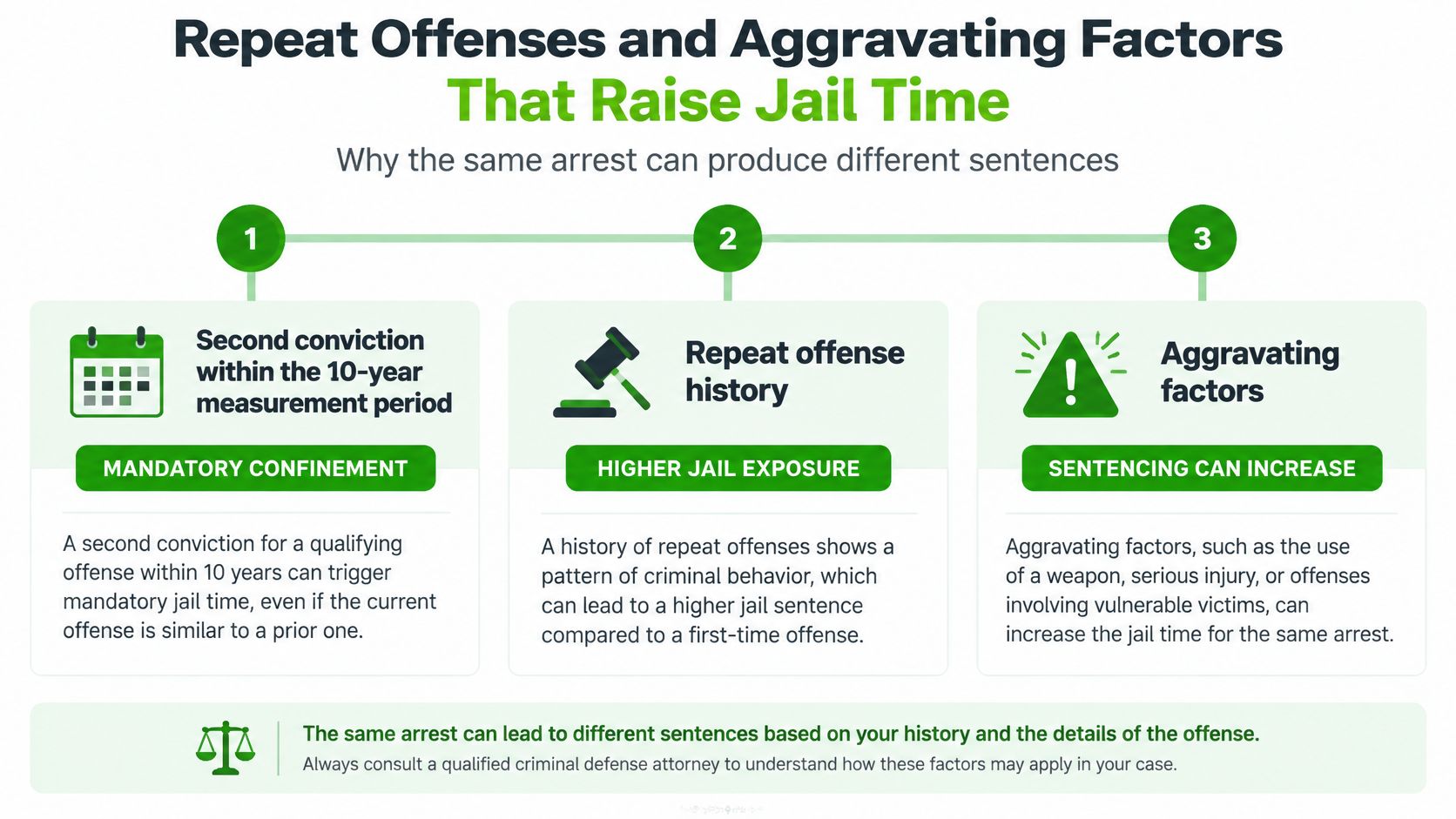
Two drivers stopped on the same night in Fulton County with the same test result can receive different sentences. Prior convictions explain much of that gap. The current Georgia code listing for § 40-6-391 reports a mandatory range of 120 days to 12 months for a second conviction and requires at least 15 days of actual incarceration, while the older formulation used 90 days to 12 months with at least 72 hours served.
What Counts Against You Besides the Test Result
Courts weigh more than alcohol concentration. The factors that commonly raise exposure include:
- Prior convictions: Each qualifying prior within the measurement period pushes you into a higher sentencing row.
- Injury to another person: Harm connected to the driving changes how a judge views custody.
- Refusal of chemical testing: Refusal can affect both the criminal case and your license position.
- A child passenger: A child in the vehicle adds seriousness beyond the driving itself.
- Additional charges: Other charges from the same stop can add separate penalties.
Say one driver has no record and another has a conviction from several years earlier. Even with identical test results, the second driver faces a higher floor because the prior conviction, if it counts, moves the case out of the first-offense row. Other states restrict driving in similar repeat cases, which is why guidance on license restrictions after a second DWI is useful context, though Georgia's own classification rules control your Georgia case.
Why Dates Matter
The 10-year measurement period makes dates decisive. A prior case just inside the window can count, while one outside it may be treated differently. The disposition matters too, since an arrest, a dismissal, and a conviction aren't the same thing.
Take three steps before any plea:
- Collect every prior case number and disposition.
- Write down each conviction date in order.
- Bring those records to a Georgia criminal-defense attorney for classification.
We can't decide how a prior conviction counts, and neither can any other course provider. That legal call belongs to your attorney, who can match your dates and dispositions to the statute before you commit to a plea.
How Judges Suspend, Probate or Convert Jail Time
Jail imposed and jail served aren't the same number. A judge can impose a term, require part of it in custody, and suspend or probate the rest on conditions. If you violate those conditions, the suspended time can come back into play.
For a first offense, Georgia DDS guidance on being in shape to ride identifies a minimum 24-hour jail term, up to one year, at least 40 hours of community service, 12 months of probation, a $300 to $1,000 fine, and completion of the state DUI Alcohol or Drug Risk Reduction Program. That list shows why focusing only on custody misses most of the sentence.
A Worked Example
Say a judge sentences you to 30 days, orders 24 hours served, and suspends the rest while you're on probation. You don't serve the remaining days if you meet every condition. You may serve them if you miss required payments, testing, community service, or course deadlines and the court finds a violation. General background on sentencing alternatives, such as criminal defense guidance for first-time offenders, can help you prepare questions, but your Georgia sentencing sheet controls.
Follow this order after sentencing:
- Get the written sentence from the court clerk.
- Confirm which days are served and which are suspended.
- List every probation condition, including fees, testing, and any treatment order.
- Calendar course, community service, and reporting deadlines with the court, your probation officer, and DDS.
Completing DUI education doesn't replace your criminal sentence. It's a separate requirement tied to probation and license reinstatement.
It's also fair to ask whether avoiding jail lowers repeat risk or only postpones it. As out-of-state context, not Georgia data, the 2025 California DMV DUI report found recidivism rates of approximately 14% for first offenders, 17% for second offenders, and 23% for offenders with three or more prior offenses, and a 2025 Utah legislative report found 77% of DUI arrestees were first-time offenders and 23% were repeat offenders within the prior 10 years. Custody alone doesn't address untreated substance use, which is why evaluation, education, and probation compliance matter after release.
How Court Orders Connect to DUI Risk Reduction Courses
Your court order and your DDS requirement meet at the DUI Alcohol or Drug Use Risk Reduction program, but they aren't interchangeable. Finishing the course doesn't erase jail, fines, or probation, and finishing jail doesn't satisfy the course. You need both tracks closed.
Assessment First, Then Intervention
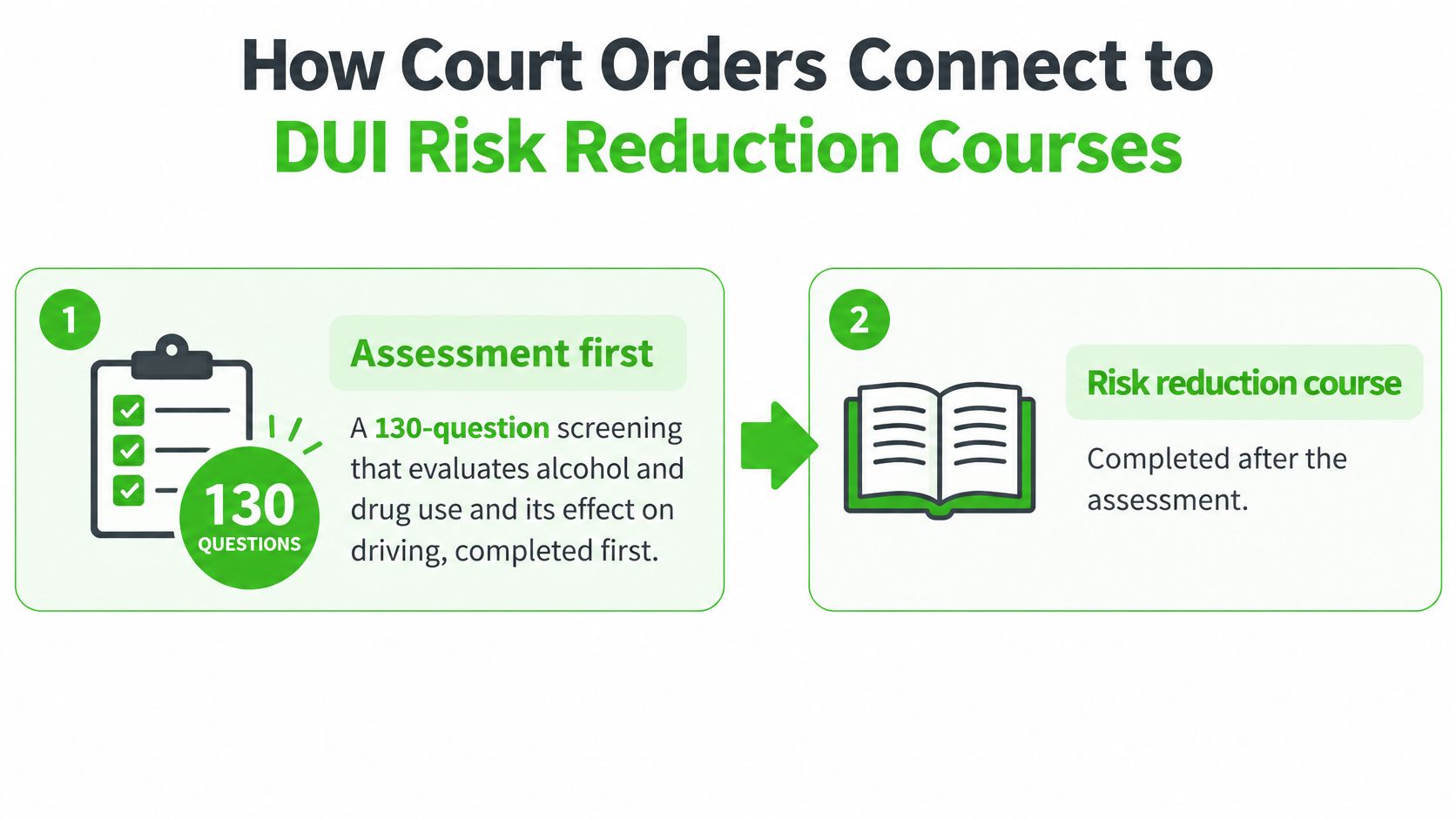
The program has two mandatory components that must be completed in order, the Assessment Component first and then the Intervention Component. According to the Georgia DDS DUI FAQs, the assessment is a 130-question screening completed first, and the 20-hour intervention course is completed afterward using group-based therapeutic education and peer counseling.
The assessment evaluates your alcohol and drug use and its effect on driving. It takes between 25 and 45 minutes, and you can't start the class before it's done. The intervention then builds on that screening in a classroom setting with a live instructor and other students.
| Component | Order | Length or Cost | Proof Produced |
|---|---|---|---|
| Assessment (130 questions) | First | 25 to 45 minutes; $100 | Completed record required before class |
| Intervention course | Second | 20 hours; $235 | Group education and peer counseling record |
| Workbook | Alongside intervention | $25 | Course materials |
| Certificate of Completion | After both components | Issued only when both are finished | Proof for court or DDS license reinstatement |
DDS lists the total at $360, made up of the amounts in the table. The fee is set by Georgia law, so a certified school can't charge more or less than the state-mandated amount. If you want the plain-language background first, read what Risk Reduction means in Georgia before you book.
From Enrollment to Certificate
Upon successful completion of both components, we issue an official Certificate of Completion, which is the legal proof needed for court or for license reinstatement by DDS. No certificate is issued until both parts are finished, so finishing the assessment alone proves nothing to DDS.
Work through these steps:
- Confirm the court or DDS requires the program in your case.
- Verify the provider is DDS-certified before you pay.
- Complete the assessment before any class session.
- Attend every hour of the 20-hour intervention.
- Collect your Certificate of Completion.
- Send it to the court and DDS before your deadline.
Certification check: Georgia DDS does not accept certificates from self-paced online DUI/Risk Reduction programs for license reinstatement or court purposes.
That last point trips up drivers from Marietta to Athens who find a cheap self-paced course online. Live virtual instruction with you present on camera for the full intervention is different from working through material alone. Verify certification first, then worry about schedule and location.
Habitual Violator Rules and Felony Exposure
The habitual violator track is separate from the sentence in your underlying DUI case. It can create a new felony even after you've already dealt with the original convictions. That distinction surprises drivers who think the worst outcome is capped by the fourth-offense row.
The Trigger and the New Offense
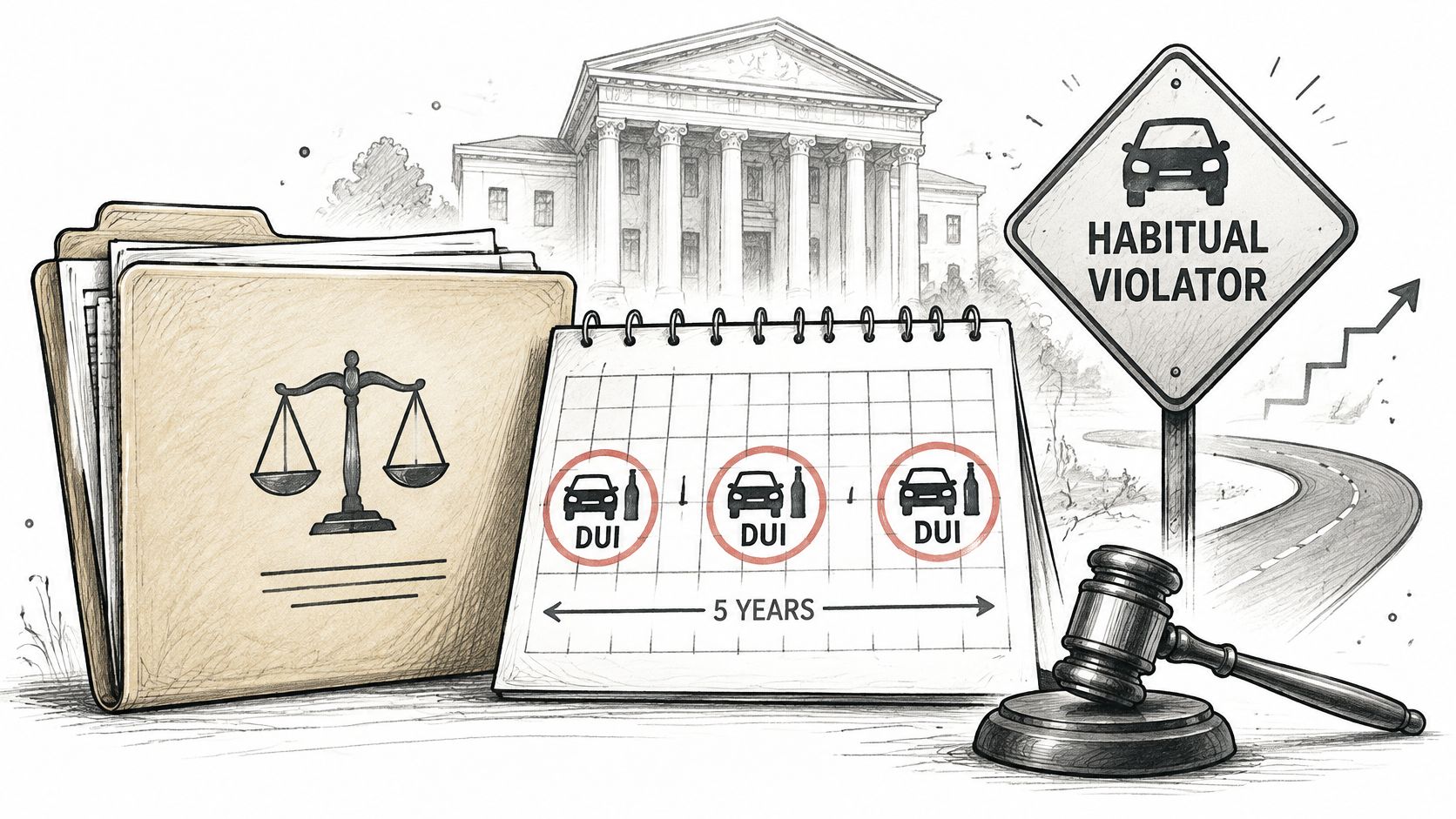
Under the Georgia legislative text on habitual violator driving, a person declared a habitual violator after three or more DUI convictions within a five-year period who then drives during the revocation period, before receiving a probationary license or before five years have elapsed, commits a felony punishable by a fine of at least $1,000, imprisonment of one to five years, or both.
Notice what triggers the felony. It isn't having three convictions. It's driving during revocation when you aren't yet allowed to drive. A short trip to work in the Atlanta metro area during that window can become a separate felony charge on top of everything else.
How This Differs From a Fourth Conviction
A fourth-conviction felony depends on the count of convictions within the longer lookback window. Habitual violator exposure depends on three or more convictions within five years plus the act of driving during revocation. You can face the second problem without a new DUI arrest, by driving too soon. If your record involves several cases, review how multiple DUI offenses build on each other and map each date before you get behind the wheel.
Use this checklist:
- Know your revocation end date: Get it in writing, don't estimate it.
- Don't drive until restored: Wait for DDS restoration or a probationary license.
- Ask about eligibility: Ask whether a probationary license is possible in your situation.
- Confirm your count: Have a criminal-defense attorney confirm how each prior case counts.
We can help with required education, clinical evaluations, and treatment referrals, but we can't lift a revocation. Only DDS and the court can restore your legal right to drive.
Special Cases That Change Jail and Course Requirements
Most Georgia drivers follow the standard assessment and 20-hour path, but a few situations change where you take the course, how strict attendance is, or what you must confirm first. Don't build your schedule around an exception until the court or DDS confirms it in writing.
The attendance rule applies to everyone. The DDS DUI/Risk Reduction policies and procedures guide states providers must ensure every student attends the mandatory 20 hours of the intervention component, so there isn't a shortened version you can finish early.
Exceptions to Handle Carefully
- Out-of-state transfer: If you were convicted in Georgia but live in another state, you must complete a substantially similar DUI intervention program in your home state that's certified there, at least 20 hours long, and verified by Georgia DDS. Get the equivalence approved before you enroll there, not after.
- Missed sessions: Students who are late for any session may be denied entry, can't make up the missed time, and must re-register and pay the full course fee again to start over. In metro Atlanta traffic, that means leaving early isn't optional.
- Underage arrest: Drivers under 21 face Georgia's zero tolerance framework, so ask the court and DDS to confirm in writing exactly which program and license steps apply to the underage case before enrolling.
- Conditional license: Limited driving options depend on your specific court and DDS status, so confirm any conditional or limited permit directly with DDS rather than assuming course enrollment creates one.
What to Confirm Before You Rely on an Exception
Some of these points turn on DDS verification and your individual court order, not on general information. Ask who must approve the out-of-state program, what proof Georgia DDS needs, and whether your home state's certificate will be accepted for reinstatement.
Write down the name of the person who confirms it and keep the written answer with your sentencing sheet. If a provider promises an exception DDS hasn't approved, you could pay for a course that doesn't count and still miss your deadline.
Choose a Certified Provider and Enroll
Once your written sentence and deadlines are clear, don't wait to enroll. Seats fill, assessments must come first, and the intervention can't be compressed into a single day. Starting early protects you if a session doesn't fit your work schedule.
Follow these enrollment steps:
- Choose a DDS-certified provider offering in-person or online DUI classes that fit your court deadline. Georgia DUI Schools offers both formats, with locations serving Atlanta, Athens, Decatur, and surrounding communities.
- Book the assessment first, since the class can't start without it. The total program cost is $360.00, covering the assessment, intervention, and workbook.
- Plan the 20-hour intervention as a fixed block. It's commonly scheduled over a weekend or several evenings, such as Friday evening, all day Saturday, and all day Sunday.
Keep other obligations out of that block and confirm the missed-session policy before you pay. A late arrival can force you to restart, which puts probation and reinstatement deadlines at risk.
Review the Georgia DUI course program and enrollment options to compare formats, pick your assessment time, and secure your seat.
If you're facing DUI jail time, probation conditions, or a license deadline anywhere from Decatur to Athens, Georgia DUI Schools can help you complete the certified Risk Reduction program, clinical evaluation, or related court requirements in the right order. Visit Georgia DUI Schools to choose an in-person or live online class, book your assessment, and get your certificate to the court and DDS on time.