
You've booked a DUI class in Atlanta, or you're sorting through paperwork after an Athens court appearance. Then you notice another requirement: a clinical evaluation report. Is that the assessment you already completed, another class, or something you need before getting your license back?
A clinical evaluation answers a different question from a course certificate: does your substance-use history show a need for treatment, and what level of care fits? Before booking, match the requirement to your court paperwork and your Georgia Department of Driver Services (DDS) reinstatement instructions.
When Georgia Requires a Clinical Evaluation Report
For license reinstatement, the Georgia DDS DUI FAQs require documented proof of a completed state-approved clinical evaluation when a person has two or more DUI convictions within the preceding 10 years. That's a specific reinstatement trigger, not a statement that every driver charged with DUI must obtain a report.
A clinical evaluation is a separate, in-depth evaluation by a medical or mental health professional who is a DBHDD-approved evaluator. The clinician determines whether the person has a substance use disorder and requires treatment. The resulting report records that clinical opinion and the reasons behind it.
A judge may also order an evaluation in addition to the DUI/Risk Reduction Program (RRP). Completing the RRP doesn't satisfy a separately ordered clinical evaluation, even when both requirements appear on the same sentencing paperwork.
Who needs a clinical evaluation report in Georgia
| Situation | Who requires it | Proof expected | What it does not replace |
|---|---|---|---|
| One DUI and no added order | Usually not DDS solely because of that conviction | Risk Reduction certificate if required | A clinical report is not automatic |
| Repeat convictions meeting the DDS lookback rule | Georgia DDS for reinstatement | Documented proof from a state-approved evaluator | The Risk Reduction certificate |
| Judge, probation, or attorney-directed evaluation | Court when ordered; confirm the authority behind other instructions | Written clinical evaluation report | Completing the Risk Reduction Program |
| Habitual violator under section 40-5-58 | DDS revocation by operation of law | Eligibility under statutory exceptions, not the report alone | The separate habitual-violator counting rule |
An attorney may advise you to obtain an evaluation without a judge having ordered it. A probation officer may be communicating an existing court condition. Ask which document creates the obligation so you know who must receive the finished report.
Match the requirement before booking
Say you live in Atlanta and your paperwork lists only Risk Reduction. Don't assume a clinical evaluation is automatically part of that enrollment. Conversely, an Athens driver whose order lists both requirements should plan for separate completion documents.
Before scheduling, gather:
- Conviction records: Use final dispositions, not your memory of when each case ended.
- The written instruction: Identify whether the requirement comes from DDS, sentencing paperwork, probation, or legal advice.
- The intended recipient: Establish who needs clinical findings and who needs proof of course completion.
- Any older evaluation: Ask whether it can be accepted before paying for another appointment.
The DDS FAQ doesn't settle every question about report reuse, expiration, or submission format. Get those administrative details confirmed for your own case.
Practical rule: Book the service named in your paperwork, not the service whose name sounds closest.
What a Court-Ready Report Must Contain
A screening identifies issues that deserve closer attention. A clinical evaluation report explains what the clinician found, how those findings support a diagnosis or rule-out, and why a particular recommendation fits.
The DUI Assessment Component is a 130-question screening instrument, often called the NEEDS assessment. It isn't a pass/fail test. Our explanation of the difference between an assessment and an evaluation can help you identify which appointment your paperwork names.
Under Georgia's clinical evaluation rules, the process requires a clinical interview, review of the Risk Reduction screening instrument, and at least one additional department-approved assessment instrument, with sufficient information to diagnose or rule out a substance-related disorder under current DSM criteria and recommend an appropriate ASAM level of service. Those rules also require department-approved evaluators and department-approved locations.
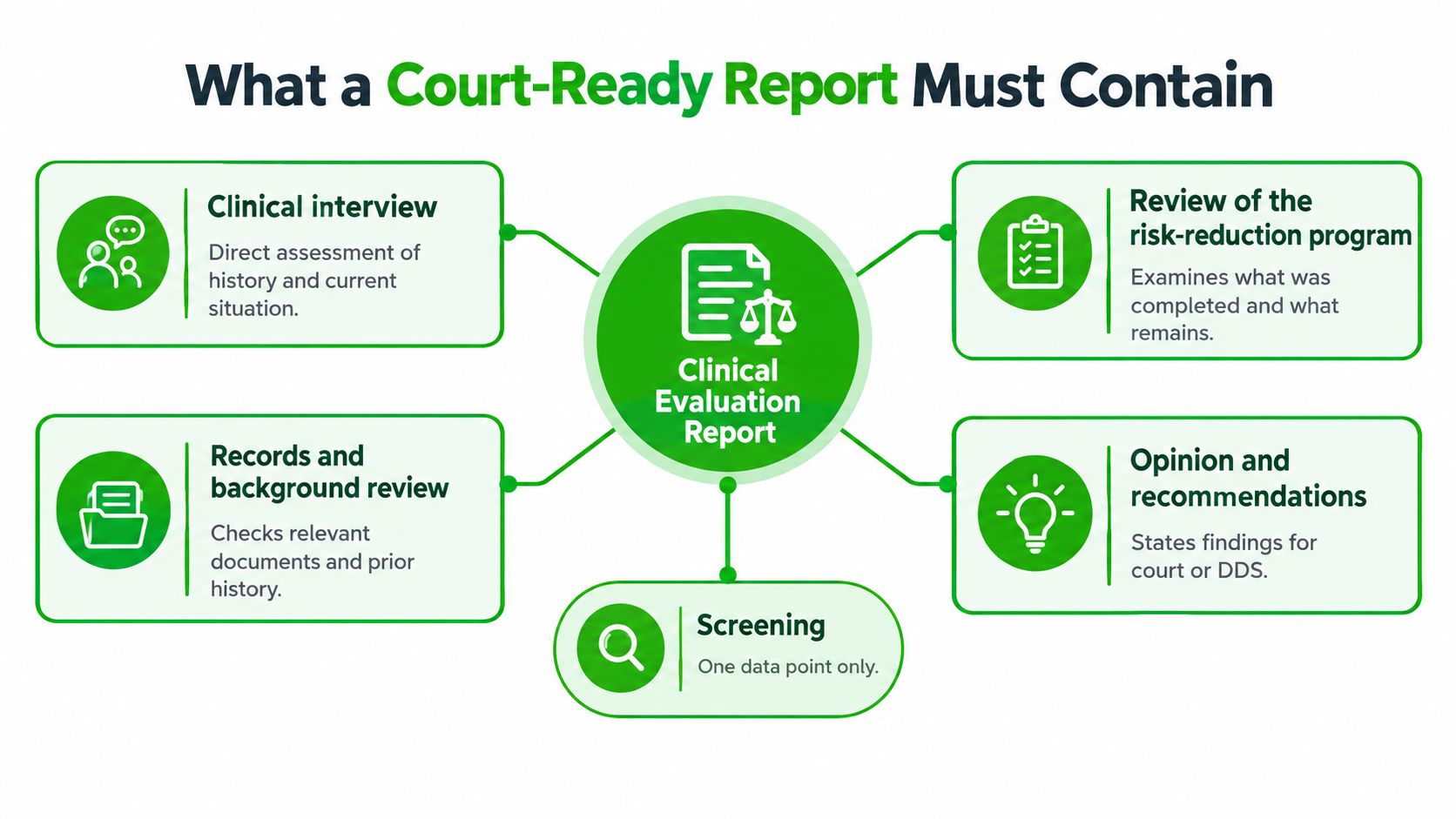
What each part of the report is for
A reviewer should be able to follow the reasoning from history to recommendation. The report shouldn't require the judge, probation officer, or DDS reviewer to guess why the clinician reached a conclusion.
| Report section | What it documents | How court or DDS uses it |
|---|---|---|
| Driving and substance history | Arrest facts, prior DUIs, substance-use pattern, and functional impact | Helps assess whether the event reflects a broader pattern |
| Screening review | Risk Reduction screening plus an additional approved instrument | Shows the evaluation goes beyond a questionnaire |
| Clinical interview | Physical health, mental health, readiness, and environment | Supports individualized diagnostic reasoning |
| Diagnosis or rule-out | A DSM substance-related disorder or a supported rule-out | Informs whether treatment is indicated |
| ASAM level of care | The least intensive setting that can safely meet clinical needs | Matches service intensity to documented risk |
| Recommendations | Education, outpatient treatment, monitoring, or higher care when indicated | Informs conditions and identifies completion tasks |
The diagnosis requires an explanation. A report should not say that someone has a disorder because an arrest occurred, or rule one out because the person has a steady job.
Connect clinical findings to practical care
The ASAM criteria FAQ describes a multidimensional approach that considers withdrawal risk, biomedical needs, psychiatric and cognitive conditions, substance-use-related risks, recovery environment, and person-centered needs when selecting an appropriate level of care.
In plain language, the evaluator considers more than how much someone drank before the stop. Relevant questions include whether stopping alcohol could cause withdrawal, whether depression affects use, whether household members support recovery, and whether transportation or work hours create treatment barriers.
Readiness to change matters too. Someone who recognizes a recurring problem may need different engagement support from someone who doesn't understand why an evaluation was ordered. Neither response substitutes for the rest of the assessment.
A placement assessment also isn't necessarily a complete treatment plan. A treating clinician may need further information before setting detailed counseling goals.
Protect sensitive information when sharing
Clinical reports contain private health information. Confirm the authorized recipient and secure delivery method before sending a copy.
If you need a redacted copy for a separate, nonofficial purpose, the PDFWix guide to secure PDF redaction explains the process. Don't alter the official submission yourself; ask the evaluator or attorney what the receiving office must receive.
How the Report Changes Sentencing and Licensing
The report can inform court conditions and licensing requirements, but those are separate decisions. A clinician recommends care. A judge determines the sentence, and DDS determines whether the driver has satisfied the applicable licensing requirements.
For court purposes, a supported rule-out may favor education without clinical treatment. A substance-related diagnosis may support counseling, outpatient treatment, or monitoring. The evaluation itself doesn't set jail time, fines, or probation length.
Court conditions and DDS proof serve different purposes
An Atlanta driver might need to demonstrate compliance with probation while also assembling a reinstatement packet. Sending clinical findings to a probation officer doesn't necessarily complete the DDS submission.
Keep a simple tracking sheet:
- Court requirement: Record the condition, recipient, deadline, and proof of acceptance.
- Licensing requirement: Track the documents DDS requests and any remaining reinstatement steps.
- Clinical recommendation: Record whether further appointments or treatment completion documentation are needed.
Our Georgia DUI license reinstatement guidance can help organize the licensing side. Don't assume an online course advertisement establishes acceptance: Georgia DDS doesn't accept certificates from self-paced online DUI/Risk Reduction programs for reinstatement or court purposes.
A favorable report doesn't cancel a revocation
Under Georgia Code section 40-5-58, habitual-violator classification can follow three or more qualifying arrests and convictions within a five-year period, measured using the relevant arrest dates, and the statute includes convictions within the United States. Once DDS determines that the definition applies, the license is revoked by operation of law, subject to statutory exceptions.
That means a favorable clinical opinion isn't permission to drive. The clinician can address treatment needs but can't erase the licensing consequence.
Out-of-state records deserve careful attention. If your situation also involves Illinois, Fiscella Law LLC's legal guidance after an Illinois license revocation provides jurisdiction-specific context. Illinois procedures aren't a substitute for Georgia instructions.
A report can support a decision about care. It isn't a driver's license or a court order.
For example, a Fulton probation officer and an Athens-Clarke attorney may need copies for different purposes. Confirm each recipient's deadline and delivery instructions rather than assuming one submission reaches everyone.
How to Prepare and Plan the Timeline
Start with your deadline and work backward. An appointment confirmation isn't a completed report, and a completed report isn't proof that the receiving office accepted it.
Use this sequence to keep the clinical visit, document review, and filing tasks separate.
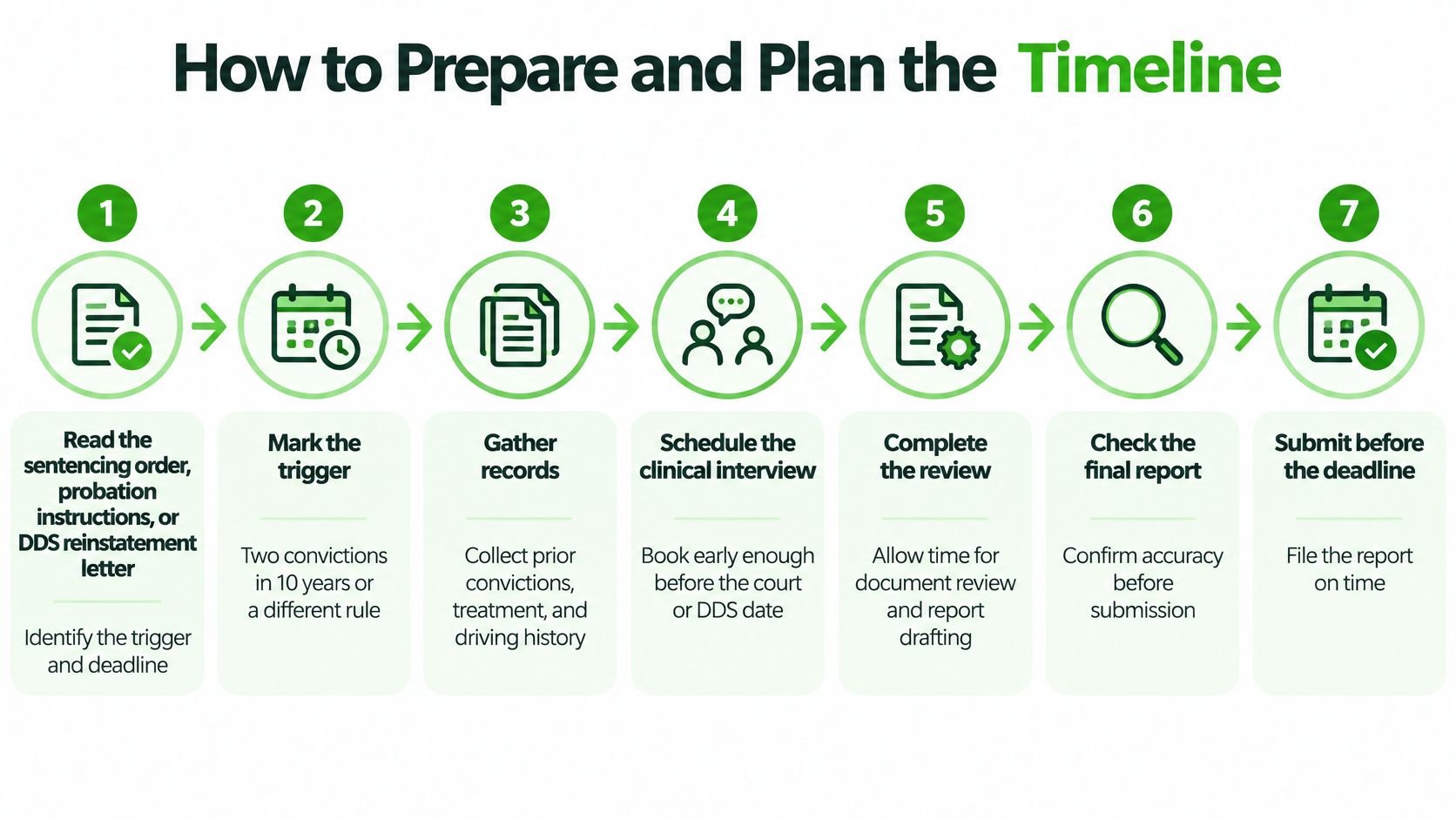
Prepare before the appointment
- Read the governing paperwork. Mark the evaluation requirement and deadline in the sentencing order, probation instructions, or DDS letter. This prevents booking only a class when the document names an evaluation.
- Verify evaluator approval. Confirm department approval and the approved location or authorized appointment arrangement. A professional license alone doesn't establish program approval.
- Gather relevant records. Bring citation or arrest paperwork, prior DUI dispositions, Risk Reduction documents, a medication list, and past treatment information. Tell the evaluator if something is missing.
- Arrange the screening review. Complete the Risk Reduction assessment first when the evaluator needs that result. Our DUI program requires the Assessment Component before the Intervention Component.
- Attend the clinical interview. Give accurate information about substance use, health, work, relationships, and prior treatment. Explain discrepancies rather than trying to make every document sound identical.
- Clarify the report process. Ask which assessment instruments are involved, how diagnostic findings will be explained, and when the recommendation will be available. Don't expect the clinician to promise a particular result.
- Submit as directed. Send the completed report to each required recipient using the specified method. Keep the submission confirmation and ask how acceptance will be acknowledged.
Our guide on preparing for a drug and alcohol evaluation addresses common concerns about the appointment. Preparation means providing useful information, not rehearsing answers to obtain a preferred recommendation.
Appointment-to-filing timeline
| Stage | Typical timing | What to confirm |
|---|---|---|
| Read order and confirm trigger | Before booking | DDS reinstatement requirement or separate court instruction |
| Risk Reduction assessment | Before the interview when needed for review | Whether the evaluator needs the screening first |
| Clinical interview | Separate appointment | Required records, approval status, and appointment format |
| Records review and written report | After the interview | A specific delivery date and any missing documents |
| Filing with court or DDS | Before the hearing or reinstatement deadline | Recipient list and copy count |
There isn't a universal report turnaround time established by the cited rules. Ask for a delivery date that leaves room to correct factual errors or supply missing records.
If you're considering an older report, settle acceptance before relying on it. A clinically useful document can still be the wrong document for a particular filing requirement.
Two Georgia Cases and What the Report Changed
These hypothetical scenarios show how similar DUI paperwork can lead to different clinical recommendations. They aren't accounts of actual defendants, and neither outcome is guaranteed.
The American Society of Addiction Medicine's overview of its criteria describes a multidimensional placement framework that connects clinical needs with an appropriate level of care. That approach explains why an evaluator must consider the person's broader circumstances rather than assign an identical recommendation to every DUI referral.

A College Park supervisor needs reinstatement proof
Say a warehouse supervisor in College Park has a second DUI eight years after a Fulton conviction. He needs clinical documentation for his DDS reinstatement pathway.
The evaluator reviews his screening, uses an additional approved instrument, and asks about drinking patterns, withdrawal history, and mental health. The supervisor describes a stable job and a supportive household, but the clinician still examines the circumstances of both impaired-driving events.
In this scenario, the full assessment supports ruling out a current substance-use disorder. The report documents low continued-use risk and recommends education rather than clinical treatment.
The useful part isn't merely the favorable conclusion. It's the explanation connecting the history, assessment results, and protective factors to that conclusion. He still completes his assigned Risk Reduction requirement and submits the clinical proof DDS needs.
An Athens student receives a treatment recommendation
Now consider a University of Georgia student with a first DUI. In this hypothetical case, the Athens-Clarke court orders an evaluation after a high alcohol reading and a prior underage possession case raise concerns.
During the interview, the student describes repeated heavy drinking, a prior blackout, and roommates who drink daily. The evaluator considers those details alongside the screening and other assessment findings.
The report diagnoses an alcohol-use disorder and identifies the household drinking environment as a recovery risk. It recommends outpatient treatment alongside the required education, with attention to class schedules and access to appointments.
The important distinction: A first DUI doesn't guarantee a low clinical need, and a repeat DUI doesn't establish a diagnosis by itself.
Compare your paperwork with these scenarios by asking what decision the report must support: documenting reinstatement eligibility, identifying treatment needs, or both. The evaluator needs the actual referral question, not just a request for a favorable letter.
Frequently Asked Questions About Clinical Evaluation Reports
Does a first DUI always require a clinical evaluation report?
No. Read the written requirements attached to your case; a separate court condition or other applicable instruction may require one even when your conviction history doesn't trigger the repeat-conviction DDS rule.
Does completing Risk Reduction replace the report?
No. A course certificate documents program completion, while the clinical report records findings and recommendations. Keep them labeled separately so the receiving office gets the document it requested.
Can an older evaluation be reused?
Don't assume it can. The official materials cited here don't establish a universal reuse or expiration rule, so obtain confirmation from the court and DDS before relying on an older report.
Does a favorable evaluation restore a habitual-violator license?
No. A clinical opinion doesn't establish eligibility to drive after revocation; the applicable licensing rules and statutory exceptions control that decision.
Who may perform the evaluation?
Use a department-approved evaluator through an approved arrangement. Verify the evaluator's registry status and location approval before attending, rather than relying only on a professional title.
Does the report decide jail time or fines?
No. Those are judicial decisions, although a judge may consider clinical findings when determining appropriate conditions.
What if the court and DDS want different things?
Track each instruction separately and ask each office to confirm its required document and deadline in writing. Don't resolve conflicting directions by choosing whichever requirement seems easier.
What should I do if the report contains an error?
Notify the evaluator promptly about incorrect dates, medication names, or other factual details. Ask for a corrected official copy rather than editing the clinical report yourself.
What if I disagree with the recommendation?
Ask the clinician to explain how the findings support the recommendation. If you still have concerns, speak with your attorney about an appropriate review process rather than ignoring the recommended next step.
Schedule a Clinical Evaluation the Court Will Accept
Book a clinical evaluation because your reinstatement instructions or case requirements call for one, not merely because you've been assigned a DUI class. The right appointment begins with a clear referral purpose.
Before scheduling, have your court or DDS paperwork ready. Include prior dispositions and a current medication list, and identify any records you'll need help obtaining. For an Atlanta employee or an Athens student, sorting out those documents early is more useful than choosing an appointment solely because it fits a free afternoon.
Make the booking specific
Explain who requested the report and who must receive it. Confirm the evaluator's department approval, the authorized appointment arrangement, and the expected delivery date before your court or reinstatement deadline.
Bring a short checklist:
- Purpose: State whether the report is for court, probation, DDS, or more than one recipient.
- Documents: Identify the records available and anything still outstanding.
- Delivery: Confirm who sends the official report and how you receive a copy.
- Follow-through: Ask how recommended treatment would be arranged and documented.
Georgia DUI Schools offers DUI classes in person or online, plus Clinical Evaluations, ASAM Level 1 Treatment, and a Victim Impact Panel. If your order includes a panel, schedule it as its own requirement rather than assuming the evaluation covers it.
Plan the filing as carefully as the visit
Keep your course certificate visibly separate from your clinical report. Store the final documents where you can retrieve them for an attorney or receiving office without searching through appointment emails.
For general document organization, FaxZen's guide to filing court documents can help you prepare a submission checklist. Your clerk's instructions still control the accepted filing method, required copies, and any confidentiality procedures.
Don't treat submission as the final confirmation. Keep evidence of delivery, check whether the office accepted the document, and follow up promptly if it requests a correction or additional proof.
Georgia DUI Schools offers clinical evaluations and DUI/Risk Reduction education to help you complete the distinct requirements on your paperwork. Visit Georgia DUI Schools to arrange the clinical evaluation service, and confirm the evaluator is department-approved before your court or reinstatement deadline.