

You're staring at a court paper, a probation checklist, and a voicemail from a treatment provider, and they all seem to use the words assessment and evaluation like they're the same thing. They're not. If you're trying to get your Georgia license back, that difference can decide whether you move forward cleanly or waste weeks fixing a preventable mistake.
The safest rule is simple. Assessment gathers information. Evaluation makes a judgment. In a DUI case, that distinction affects which form you need, which program you enter, and what gets sent to the court or the DDS.
| Attribute | Assessment | Evaluation |
|---|---|---|
| Main purpose | Gather information for feedback and planning | Decide whether a standard has been met |
| Timing | Ongoing or repeated | Periodic or end-point |
| Output | Notes, findings, recommendations, guidance | Judgment, placement, compliance decision |
| Tone | Improvement-oriented | Decision-oriented |
| DUI impact | Helps identify needs and next steps | Can determine treatment level, completion, or reinstatement path |
Why the Terminology Confusion Matters for Your DUI Case
A Georgia driver gets three different messages in the same week. The judge says “complete your evaluation,” the probation officer says “finish your assessment,” and the treatment provider says “come in for a screening before class.” That's how people end up signed up for the wrong service, missing deadlines, and getting stuck waiting on license reinstatement.
The problem isn't just language. In real DUI compliance work, the term you hear often decides what happens next. If you treat a clinical evaluation like a casual intake conversation, you can walk out with the wrong ASAM placement or incomplete paperwork. If you treat a course-based assessment like a final judgment, you can panic over a step that was only meant to guide the next one.
A stressed driver doesn't need vague reassurance. They need a clean path. If a provider, attorney, or officer is using the words loosely, pause and ask one direct question, “Is this gathering information, or is this the decision that determines placement or completion?” That question cuts through most confusion fast.
There's a reason this matters in other regulated settings too. The same kind of terminology slippage shows up when families are trying to understand responding to a CPS visit from Law Office of Bryan Fagan PLLC, where a label can mean a very different procedure depending on who is asking for it and why. DUI compliance works the same way. One word can send you to the wrong next step.
Practical rule: If the document changes your status, placement, or reinstatement path, you're probably dealing with an evaluation. If it's collecting information to help someone decide what comes next, you're in assessment territory.
Defining Assessment and Evaluation in Clinical and Legal Contexts
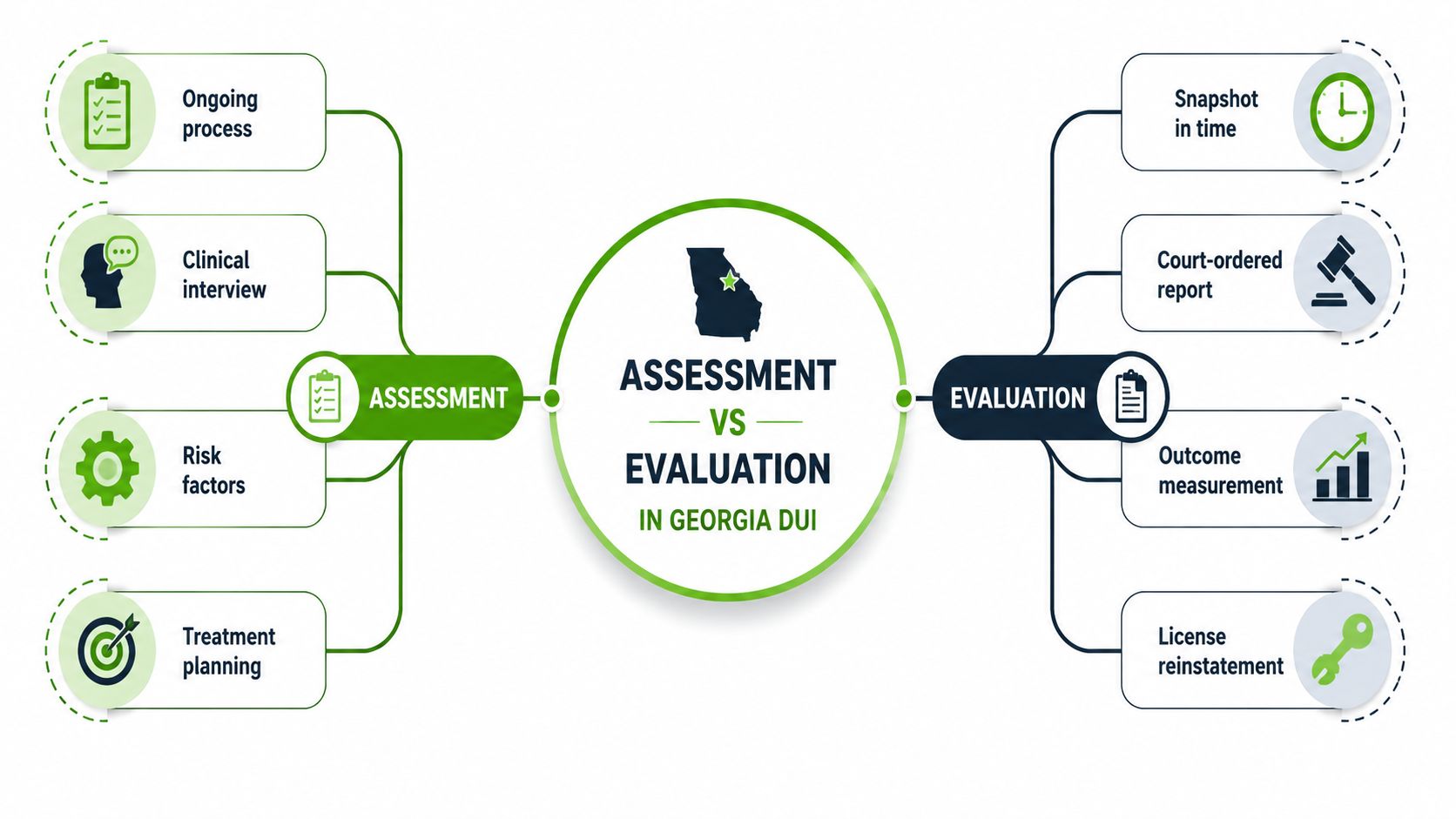
A Georgia DUI case can turn on a single word. A probation officer may ask for an assessment, a court may order an evaluation, and a treatment provider may use both terms in the same conversation. If you are trying to get your license back or satisfy a court requirement, that difference matters.
Assessment means gathering facts so the provider can understand your condition, risks, strengths, and needs. In DUI work, that usually includes history, drinking pattern, prior treatment, mental health concerns, and the practical details that shape the next step. The broader measurement framework treats assessment as the appraisal process, while evaluation assigns value against a criterion or standard, as described by the National Collaborative on Childhood Obesity Research's overview of measurement, assessment, and evaluation.
Evaluation is the decision step. In the behavioral and education literature, evaluation means deciding whether a standard has been met, a level of achievement has been reached, or a requirement has been satisfied. The NIH/PMC framing is direct, assessment supports feedback and improvement, while evaluation makes a quality judgment against standards and documents the level attained.
How that plays out in a DUI file
A provider may ask about alcohol use, prior treatment, mental health concerns, work schedule, and family stability. That is assessment work. The provider then applies criteria, decides what level of treatment fits, and writes a report that can be used by the court, DDS, or the treatment program. That second step is evaluation, because the provider is deciding what the facts mean for your case and your next requirement.
If you want the cleanest way to read the paperwork, use this rule. Assessment gathers the facts. Evaluation turns those facts into a placement, completion, or compliance decision. That matches the way Georgia DUI compliance works on the ground, and it matches the clinical use of the terms in what is a drug assessment.
As the Lumen Learning open educational resource explains, the same process can function as placement or documentation depending on how the result is used. That matters in DUI work because a file can start with information gathering and still end with a formal decision that affects your standing.
If you are dealing with more than one provider, the distinction becomes even more practical. A good intake process can support coordinating care with addiction assessments because the clinician needs the right information before anyone settles on a treatment path.
Side by Side Comparison of Goals Methods and Outcomes
Georgia DUI paperwork becomes much easier to read once you stop treating assessment and evaluation as interchangeable words. In a DUI file, they can overlap, but they serve different jobs. One gathers facts. The other uses those facts to make a decision that affects your next step.
| Attribute | Assessment | Evaluation |
|---|---|---|
| Purpose | Gather information and guide improvement | Judge whether a standard has been met |
| Timing | Ongoing, continuous, process-oriented | Periodic, end-point, decision-oriented |
| Who uses it | Clinician, instructor, program staff | Court, provider, DDS, probation, program reviewer |
| Output | Feedback, notes, recommendations, placement guidance | Judgment, pass/fail outcome, level decision, compliance status |
| Effect on next step | Shapes what happens next | Determines whether the current requirement is satisfied |
| DUI use case | Screening, check-ins, learning progress | Clinical report, completion determination, reinstatement review |
The practical difference shows up in how the work is carried out. Assessment is usually continuous and formative, so the provider is still collecting information while the driver moves through the process. Evaluation is usually periodic or final, so someone reviews the collected information and decides what it means. That is why assessment usually feels conversational and corrective, while evaluation feels formal and final.
A Georgia DUI file can start with assessment and end with evaluation in the same process. That happens when the result is used for placement, documentation, or a compliance decision. The same review may serve a clinical purpose first, then become the record that a court, DDS, or probation officer uses to decide whether the requirement has been met. The open educational resource from Lumen Learning describes that same dual use, and DUI cases create that exact gray area.
If the result gets used to place you in a program, satisfy a court order, or support license reinstatement, treat it like an evaluation even if someone casually called it an assessment.
Risk Reduction classes create another point of confusion. A class may use ongoing assessments during instruction, but those checks are there to improve understanding and spot gaps before the class ends. A clinical evaluation ordered before or after the class serves a different job. It supports a placement decision or a compliance decision, and that difference changes what the paperwork means for your license.
For stressed drivers, the rule is simple. Ask what the document does, not what someone calls it. If it gives feedback and shapes the next session, you are looking at assessment. If it decides placement, completion, or reinstatement status, you are looking at evaluation. That is the distinction that matters in Georgia DUI compliance, and it is exactly where how bail affects costs here becomes a useful reminder that labels only matter when they change the result.
Real Georgia DUI Scenarios Showing the Difference in Action
A first-time DUI driver in Georgia often gets sent for a clinical evaluation before or around the same time as the Risk Reduction course. That evaluator is not there to cheerlead or punish. The job is to gather information, apply criteria, and decide whether the person can proceed with the standard pathway or needs something more structured, such as ASAM Level 1 treatment. The evaluation is the decision point. It does not just collect facts, it translates those facts into placement.
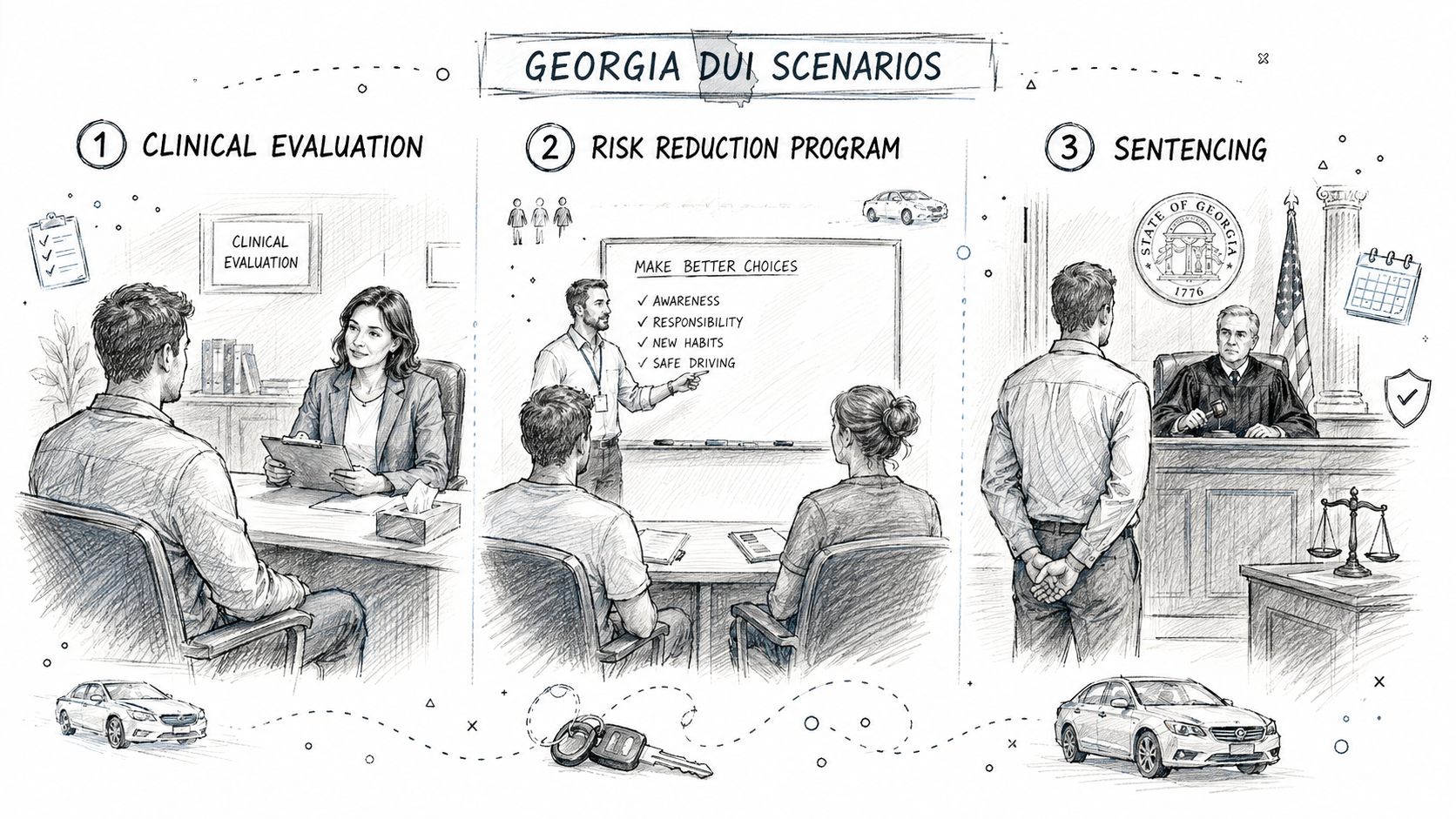
A second driver is already inside the Risk Reduction program. The instructor checks participation, looks at whether the person understands the material, and adjusts the group discussion when someone clearly needs more help on a topic. That is assessment in its purest form. It is ongoing, corrective, and meant to improve performance before the class ends.
A third driver is a repeat offender or someone with stricter court conditions. In that setting, the program's review can determine whether requirements have been met for reinstatement, or whether another step is still missing. That is evaluation. It is tied to a legal consequence, and it matters because it can affect whether the court or DDS sees the file as complete.
The confusion often peaks when the same review is used for placement. One source in the brief makes this point plainly, if the result is being used for program placement or documentation, the assessment can function as an evaluation. That's common in DUI compliance because courts, probation officers, and providers are not just trying to understand the driver. They're trying to decide the next legal and treatment step.
For people comparing paperwork and worrying about costs, a related issue comes up in other legal processes, including how bail affects costs here from Cherokee Bail Bonds. The point is the same. A label can hide the consequence if you don't stop and look at what the decision changes.
What to Expect During Your Clinical Evaluation
A clinical evaluation is not a pop quiz. It's a structured interview and review process, and you should show up prepared. Bring your court order, arrest record or citation, prior treatment history if you have any, your ID, insurance card if relevant, and any referral form from your attorney or DUI court. If you have a written substance use timeline, bring that too. The cleaner your paperwork, the faster the evaluator can work.
What the evaluator is looking for
Expect questions about alcohol or drug history, prior arrests, mental health concerns, work schedule, family responsibilities, and any treatment you've already tried. The evaluator uses that information to apply placement criteria, including ASAM considerations, and determine whether the standard DUI path is enough or whether you need a higher level of care. That's where the clinical judgment happens.
A good evaluation does two things at once. It gathers the story accurately, and it tests that story against the standards your case has to satisfy. If you leave things out, the placement can come out wrong. If the placement is wrong, your next step can be wrong too, and that creates delay.
The process is usually done in person, though some providers offer online options when the rules allow it. Don't assume any online appointment counts for every court or every case. Verify that the provider is DDS-approved and that the format fits your exact requirement before you book.
Use this rule during the interview:
Be honest, not strategic. A cautious half-answer can create more trouble than a messy but complete explanation.
Georgia DUI Schools has a direct guide on how to pass a drug and alcohol evaluation in Georgia, and the reason that topic matters is simple, accuracy beats performance. The evaluator is trained to spot gaps, contradictions, and missing context. Give the full picture the first time.
If the report recommends treatment beyond the standard Risk Reduction course, don't argue with the paperwork before you understand it. Ask what part of the history drove the recommendation, what level was assigned, and what the next compliance step is. That's the only way to keep the file moving.
Choosing the Right DDS Approved Provider for Your Requirements
A lot of DUI delays start with one bad provider choice. A driver signs up for the wrong class first, or books with a place that cannot produce the paperwork the court, probation officer, or DDS wants. Then the file gets stuck, the appointments stack up, and the whole case slows down for no good reason.
Choose a provider that is DDS-approved, can complete the clinical evaluation if your case requires one, and can also handle the Risk Reduction course if that is part of your order. If the provider offers ASAM Level 1 treatment or a Victim Impact Panel, that gives you a cleaner path through the process and keeps you from bouncing between offices just to finish one DUI requirement.
What a sensible checklist looks like
- Approval status: Confirm the provider is approved for Georgia DUI requirements, not just general counseling.
- Service range: Check whether they offer evaluation, Risk Reduction, and any follow-up treatment in one place.
- Scheduling: Look for weekday, weekend, and online options if your job or probation schedule is tight.
- Completion paperwork: Make sure they can issue the certificate or report your court expects.
- Location access: Multiple locations help when transportation is a problem.
One option in Georgia is Georgia DUI Schools, which offers DUI/Risk Reduction education, clinical evaluations, ASAM Level 1 treatment, and Victim Impact Panels. That matters because many drivers need more than one service, and using separate providers for each step only adds extra calls, extra paperwork, and extra chances for someone to reject the file.
Start with a provider page like court ordered alcohol assessment near me when you need a provider that understands the compliance side of the process and can match the service to the order. You do not need a random appointment. You need a provider who can connect the evaluation to the license reinstatement path and keep the paperwork aligned with what Georgia requires.
The wrong provider costs more than money. It costs momentum, and in a DUI case, that delay can keep your reinstatement stuck longer than it should be.
Frequently Asked Questions About DUI Assessments and Evaluations
Can I take the Risk Reduction course before my clinical evaluation? Sometimes, but don't assume it's wise just because it's possible. If your court order or provider expects the evaluation first, do the evaluation first. Otherwise you risk finishing the wrong step in the wrong order and having to repeat paperwork.
What happens if my evaluator recommends ASAM Level 1 treatment? You follow the recommendation unless your attorney or court tells you otherwise. The recommendation is part of the evaluation judgment, and it can change your compliance path. If you ignore it, you can stall reinstatement and create a new violation problem.
How long does the evaluation report stay on file with DDS? Treat the report as a compliance document, not as something to casually discard or ignore. Keep your own copy and confirm with your provider or attorney how it will be transmitted and what you need to retain for your records.
Can I transfer my evaluation to a different provider if I move? Sometimes the paperwork can travel with you, but don't rely on that without confirmation. Ask whether the new provider will accept the prior report, whether a new assessment is required, and whether the court or DDS wants an updated version.
What's the difference between the evaluation and the assessments during the class? The evaluation is the formal decision about placement or completion. The class assessments are ongoing checks that help the instructor see what you understand and where you still need work. One affects your compliance status, the other helps you learn and stay on track.
If you're stuck between a court order and a provider schedule, don't guess. Call the office, ask whether your next step is an assessment, an evaluation, or both, and write down the answer before you book anything.
Georgia DUI compliance gets easier when you stop letting the labels blur together. Georgia DUI Schools helps drivers move through the Risk Reduction process, clinical evaluation, and related completion steps with clear, DDS-approved options. Visit Georgia DUI Schools to find the right course or evaluation path and get your file moving the right way.