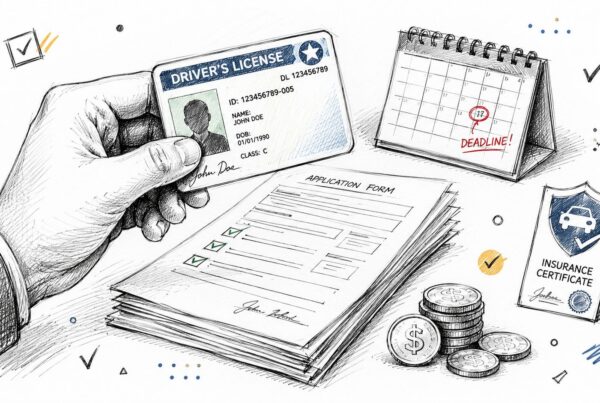
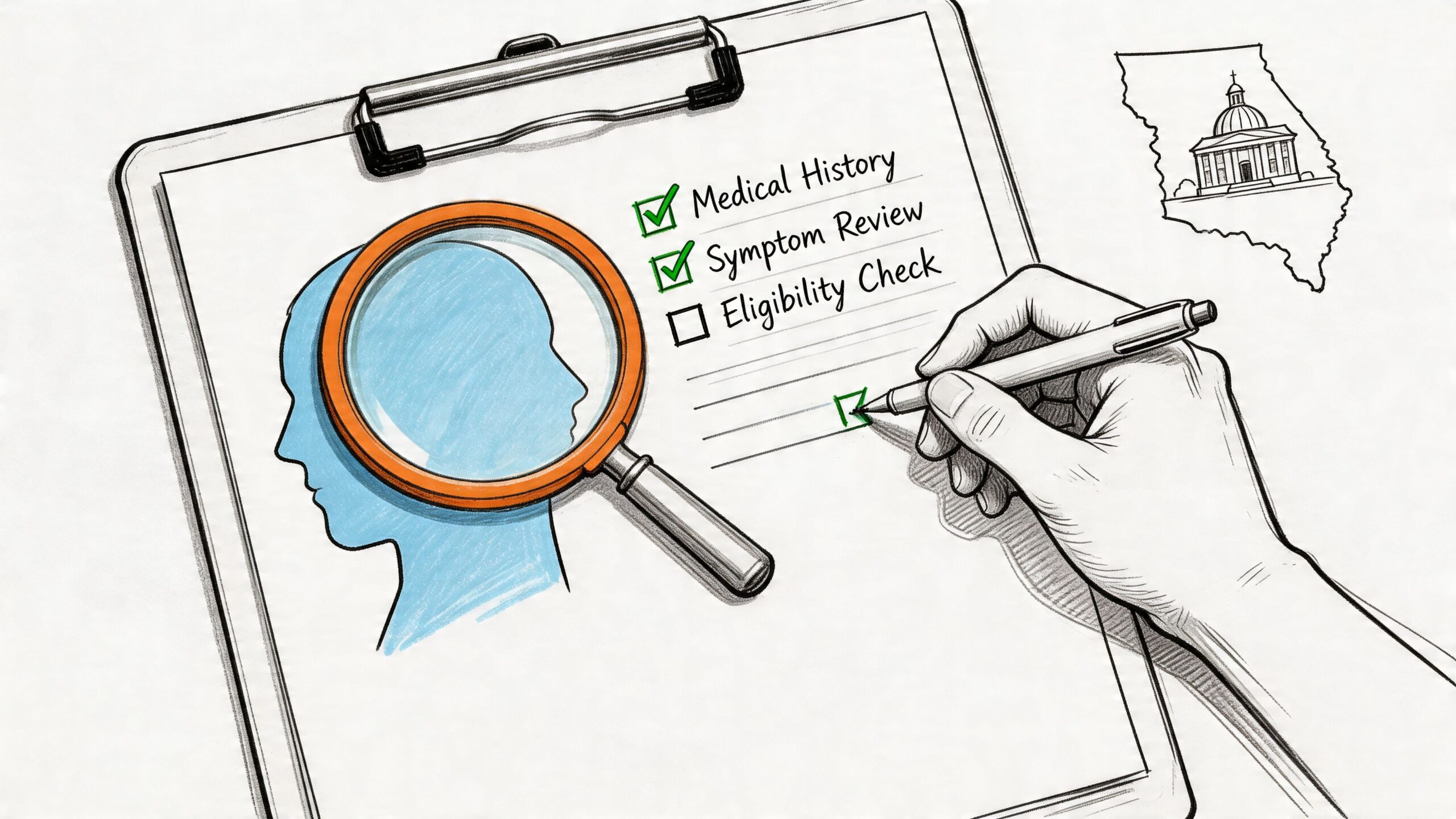
A drug assessment is a professional evaluation used to identify whether a substance use disorder is present, how severe it is, and what level of help fits best. In Georgia DUI cases, this usually means a Clinical Evaluation, and for many drivers it becomes a required step in getting driving privileges back.
If you were recently told you need a “drug assessment,” you’re probably dealing with two kinds of stress at once. One is personal. You may be worried about what the evaluator will think, whether you’ll “pass,” or whether this means someone already assumes you have a serious problem. The other is practical. You’re trying to sort out what the court wants, what the Georgia DDS wants, and whether those are even the same thing.
That confusion is common.
A drug assessment isn’t just a punishment tool. It’s a structured clinical review done by a trained professional. The evaluator looks at your substance use history, current patterns, health background, mental health concerns, and life circumstances to decide what kind of education or treatment, if any, makes sense. In a general setting, that can apply to probation, treatment entry, workplace concerns, or personal referrals.
In Georgia DUI matters, though, the language matters. What many people casually call a drug assessment is often a Georgia DUI Clinical Evaluation. That label matters because DDS and court systems may require a specific kind of evaluation from an approved provider, not just any general screening from any counselor.
That’s where people lose time.
Some readers also come to this topic because they work in transportation or safety-sensitive jobs and are mixing up DUI evaluations with workplace testing rules. Those are different systems. If you also need to understand employer and federally regulated screening rules, this guide to DOT drug testing requirements is useful because it explains a separate process with different goals and standards.
The good news is that this process is manageable when you break it into steps. Once you understand what the evaluation is, who must perform it, and how the result affects your next requirement, the whole thing becomes far less mysterious.
Introduction What Is a Drug Assessment and Why Do I Need One
You get a notice after a Georgia DUI and start looking up “what is a drug assessment.” The wording makes it sound like one quick test. In practice, it is a formal clinical review that can affect what Georgia wants from you before you can finish certain DUI-related requirements.
At the basic level, a drug assessment is a meeting with a qualified evaluator who gathers enough information to judge whether substance use is part of a larger problem and what response fits. That can include your history, current use, health, mental health, and records tied to the case. It works like a sorting process in an emergency room. The goal is to place the person in the right lane, not to treat every case the same way.
For Georgia drivers, that last point matters a lot.
People often use “drug assessment” as a catch-all phrase, but Georgia DUI cases often involve a specific type of evaluation tied to the DDS or court process. If you complete the wrong kind of assessment, the problem is not just technical wording on a form. It can delay reinstatement steps, lead to extra appointments, and force you to pay twice for paperwork that does not meet the state’s requirement.
That is why this topic causes so much anxiety. You are not just asking what the evaluation is. You are also asking why the state requires it and how to avoid making an expensive mistake.
The short answer is that Georgia uses the evaluation to decide what kind of follow-up, if any, fits your situation. One person may be directed toward education. Another may be referred for treatment. The evaluation helps the state and the clinician decide what happens next based on more than the arrest itself.
A typical assessment may look at:
- substance use history, including patterns and context
- health and mental health background
- family, work, and daily functioning
- court or DUI-related records
- screening tools or other clinical methods the evaluator uses to check risk and consistency
Some readers confuse this process with workplace drug testing, especially if they also drive commercially or work in a safety-sensitive job. Those are separate systems with different rules and goals. If that applies to you, this guide to DOT drug testing requirements explains the employment side, which is different from a Georgia DUI Clinical Evaluation.
If you feel overwhelmed, focus on one simple idea. In Georgia, the name on the requirement matters almost as much as the appointment itself. Getting clear on that point early can save you time, money, and frustration.
Understanding Your Mandate Clinical Evaluation vs General Assessment
A common Georgia DUI mistake starts with one phone call. Someone books a standard substance abuse assessment, shows up, pays for it, and later learns the paperwork does not match what the court or DDS expects. The appointment was real. The problem is that it was the wrong type of evaluation for the job.
That distinction matters.
A general drug assessment is a broad clinical tool. It may be used for treatment intake, probation requirements, family concerns, or personal decision-making. It can be useful and professionally done, but usefulness is not the same as acceptance for a Georgia DUI case.
A Georgia DUI Clinical Evaluation serves a narrower purpose. It is built for a specific system. In plain terms, it works like using the correct key for a locked door. A house key and a car key are both real keys, but only one opens the door in front of you. For a DUI-related requirement in Georgia, the state usually wants the key that fits its own process.
Why the wording matters
The phrase "clinical evaluation" can sound interchangeable with "assessment," which is where many drivers get tripped up. Clinically, both involve gathering information about substance use, history, and functioning. Legally and administratively, though, Georgia may treat them very differently depending on why you need the document and who must accept it.
That is why it helps to ask whether you need a Georgia court ordered substance abuse evaluation rather than a general intake or screening appointment.
The clinical piece
This is still a real evaluation, not a casual conversation. The evaluator reviews your history, asks structured questions, looks for patterns, and uses professional judgment to decide whether education, treatment, or no further service is appropriate. The goal is not to label you based on one arrest. The goal is to assess risk and make a recommendation that the Georgia DUI process can use.
If clinical language feels intimidating, reduce it to one idea. The evaluator is trying to answer, "What level of response fits this person’s situation?" Sometimes that answer is educational. Sometimes it involves treatment. Sometimes the key issue is documenting the basis for that recommendation clearly enough for the Georgia system to accept it.
The Georgia-specific piece
Georgia adds a second layer that a general assessment may not address well. The evaluation has to fit the DUI and reinstatement process, not just clinical practice in the abstract. That is the difference many people miss.
Before you schedule, ask direct questions and get direct answers:
- Is this appointment specifically for a Georgia DUI Clinical Evaluation?
- Will the report satisfy DDS or court expectations in a DUI-related case?
- Does the written report include clear recommendations if follow-up is required?
- Can the provider explain how the evaluation connects to Risk Reduction or reinstatement requirements?
Those questions can save you from paying twice.
Here is the clearest comparison:
| Feature | Georgia DUI Clinical Evaluation | General Drug Assessment |
|---|---|---|
| Primary purpose | Meet Georgia DUI or DDS-related requirements and provide clinical recommendations | Evaluate substance use for treatment, court, family, or personal reasons |
| Who usually needs it | Drivers handling a Georgia DUI-related mandate | People referred in many different settings |
| Main focus | DUI-related compliance plus recommendation for education or treatment | Broader screening and treatment planning |
| Provider choice | Must fit Georgia requirements for the case | May be clinically valid but still not accepted for Georgia DUI purposes |
| Outcome | Report used for next steps in the Georgia process | Report used for general treatment or monitoring decisions |
Keep one rule in mind. "Assessment" is the broad category. "Georgia DUI Clinical Evaluation" is the specific version many drivers need.
If you are unsure which one applies to you, do not guess. Confirm the exact requirement before you book. In Georgia DUI matters, the right appointment is not just about getting evaluated. It is about getting a report the state will recognize.
The Georgia DUI Clinical Evaluation Process Step by Step
You may have a court date in one hand, a DDS notice in the other, and advice from three different people that does not match. That is a normal place to start. The key is to treat the Georgia DUI Clinical Evaluation like a checklist tied to a specific state process, not like a general counseling appointment.
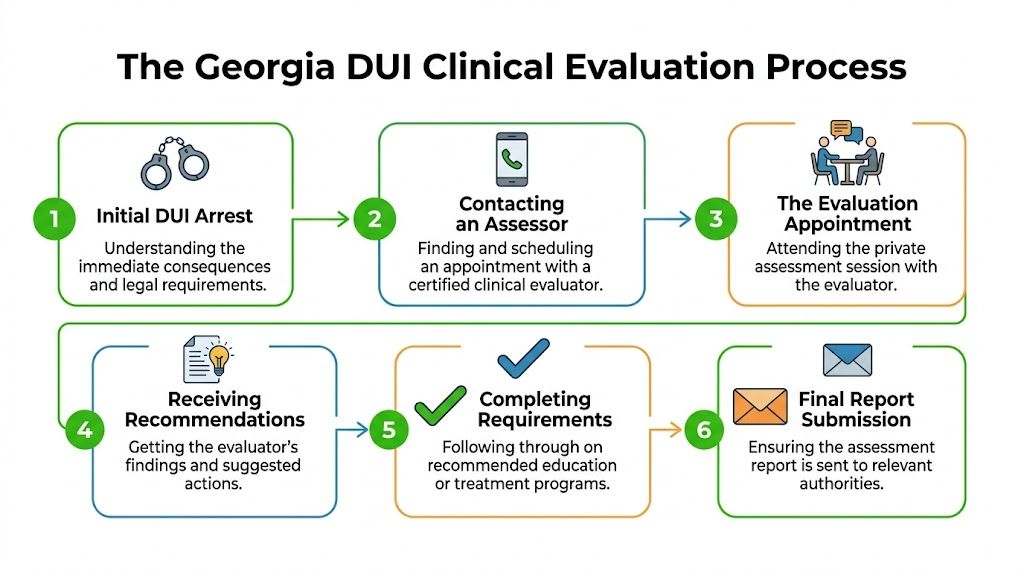
A good way to understand the process is to picture an inspection lane. Before the state lets you move to the next stage, it checks whether you completed the right step, with the right provider, and sent the right paperwork to the right place. If one item is off, the line stops.
Step 1: Identify who is requiring the evaluation
Read every notice carefully and find the exact source of the requirement. It may come from the court, the Georgia DDS, or both. Those are not always interchangeable, and confusion starts when a driver assumes one document covers everything.
Look for wording such as clinical evaluation, substance abuse evaluation, DUI evaluation, reinstatement requirement, or treatment recommendation. If the language is unclear, call the issuing agency or your attorney and confirm what is required before you book anything.
Step 2: Book the Georgia-specific evaluation
Next, choose a provider that handles this type of Georgia DUI requirement, not just a general drug or alcohol assessment. A generic intake can be clinically useful and still fail to meet what your case requires.
One example is a court ordered substance abuse evaluation in Georgia, which is set up for this kind of state-related need.
This is the step where many delays begin. The problem is often not refusal by the court or DDS. The problem is that the person booked the wrong service.
Step 3: Gather your documents before the appointment
Bring the papers that explain why you are there. That usually includes photo ID, any court order, DDS paperwork, arrest or charging documents, and anything the provider specifically asked you to bring.
Treat this like bringing documents to the DMV. The appointment may still happen if something is missing, but missing paperwork can slow down the report or create follow-up calls you could have avoided.
Step 4: Complete the interview and screening process
During the appointment, the evaluator reviews your background, asks about the DUI event, and works through a structured clinical process. Some providers also use screening tools or questionnaires.
The evaluator is building a report that can be defended if a court, DDS, or another decision-maker asks how the recommendation was reached. That is why the questions may feel detailed or repetitive.
Step 5: Receive the written recommendation
After the evaluation, you receive a recommendation based on the information gathered. That recommendation may point to no further action, education, treatment, or another follow-up step tied to your case.
This part matters because the evaluation itself is not always the finish line. In many Georgia DUI cases, it is the gate that opens or closes the next required step.
Step 6: Submit or complete what your case requires
Once the report is finished, make sure it goes where it needs to go. Some cases require you to provide it to an attorney, court, probation officer, treatment provider, or another agency. Some cases also require you to complete follow-up before reinstatement or final compliance is recognized.
Use this short roadmap:
- Read the notice and identify the agency involved.
- Confirm you need a Georgia DUI Clinical Evaluation, not a general assessment.
- Schedule with a provider who handles Georgia DUI-related requirements.
- Bring all requested documents.
- Attend the appointment and answer carefully and truthfully.
- Follow the written recommendation and submit records where required.
One practical rule helps here. Do not assume completion equals compliance. Completion means you attended the evaluation. Compliance means the correct evaluation was done, the recommendation was handled, and the documentation reached the right place.
What to Expect During Your Drug Assessment Appointment
It is common to feel nervous before the appointment because one doesn’t know what the room will feel like or what kinds of questions are coming. In reality, the setting is usually much more ordinary than one might expect. Think private office, seated conversation, paperwork, and structured follow-up questions.

What the evaluator is actually doing
The evaluator isn’t trying to win an argument with you. They’re trying to gather enough reliable information to make a defensible recommendation.
That usually includes questions about:
- Your use pattern such as what you used, how often, and how recently
- The DUI event itself including what happened before, during, and after the arrest
- Daily functioning like work, school, relationships, sleep, and stress
- Past history including prior treatment, prior legal issues, or past assessments
- Health and mental health concerns that may affect risk or treatment needs
Some providers also use standardized tools such as the ASI, SASSI, or similar screening instruments. Those questionnaires can feel repetitive, but that’s intentional. They help the clinician look for patterns, not just isolated statements.
Why testing may be part of the appointment
For some readers, the most stressful possibility is a biological screen. Court-ordered assessments can include testing as part of the evaluation process.
The Olympic Behavioral Health explanation of court-ordered assessments states that these assessments use validated protocols like structured interviews and biological tests, including urine screens with 95%+ accuracy, to build individualized plans. That same source notes that individualized plans can improve recovery outcomes by 25-35% and that untreated anxiety can double relapse risk.
That sounds clinical because it is. The purpose of testing is to verify current substance information, not to add drama to the appointment.
If you want a Georgia-accessible option that lets you start with a remote-friendly process, some drivers look for a drug and alcohol evaluation online when their case and provider setup allow it.
Answer honestly, even when the answer feels uncomfortable. The evaluator is trained to notice when the paperwork, the timeline, and the self-report don’t line up.
What it feels like from your seat
Expect direct questions. Some are easy. Some may feel personal. A few may sound repetitive.
That doesn’t mean the evaluator thinks you’re lying. It usually means they’re checking context. If you say you rarely drink but describe repeated alcohol-related consequences, they need to understand the mismatch. If you say the DUI was a one-time mistake, they may ask follow-ups to see whether the records support that.
The best mindset is simple: you’re there to give accurate information so the result reflects reality.
Understanding Your Assessment Results and Recommendations
When the appointment ends, people often want a yes-or-no answer. Passed or failed. Clear or not clear. That’s not usually how this works.
A drug assessment produces a recommendation, and that recommendation becomes part of your compliance path. It may say you need education, treatment, further monitoring, or another specific step. In some cases, the evaluator may not find enough evidence to recommend added treatment beyond what your legal situation already requires.

What the recommendation usually means
In Georgia DUI matters, one common outcome is a recommendation tied to ASAM Level 1. In plain language, that generally points to outpatient-style help rather than residential care. It’s designed for people who need structured intervention but can still live at home and manage ordinary responsibilities.
The recommendation is supposed to connect the level of need to the level of response. That’s why the evaluator spends time looking at risk, prior history, and current functioning instead of only focusing on the arrest.
How to read the result without panicking
Use this checklist:
- Look for the actual recommendation rather than trying to interpret every sentence in the report
- Ask whether the recommendation is required for your DDS or court matter
- Find out what completion proof you’ll need later
- Clarify whether your next step is education, treatment, or both
Some readers worry that any treatment recommendation means the evaluator “went too far.” Not necessarily. A recommendation is the evaluator’s judgment about what level of follow-up fits the information they reviewed.
If your result includes treatment, flexibility may matter. For readers comparing formats, this overview of online addiction treatment for recovery can help you understand why some people prefer remote treatment access when it’s appropriate and accepted for their situation.
The report isn’t the finish line. It’s the map for what the finish line requires.
A good way to stay grounded is to ask one practical question: “What must I complete, and who needs proof?” Once you know that, the recommendation becomes much less abstract.
How to Prepare for Your Drug Assessment
Preparation isn’t about trying to outsmart the process. It’s about making sure the evaluation is accurate.
If you show up rushed, defensive, or missing documents, you make the evaluator’s job harder and your own situation more complicated. If you show up organized and candid, the process usually moves more smoothly.

What to bring and what to review
Bring every document that explains why you need the evaluation. Also bring identification and any records the provider requested when you scheduled.
Useful preparation steps include:
- Review your timeline so you can answer basic questions consistently
- Gather legal paperwork such as the court notice or related DUI documents
- Write down current medications if they may matter during screening or testing
- Confirm whether testing may occur so you know what to expect beforehand
- Read the provider’s instructions instead of relying on what a friend remembers from a different case
If you’re unsure how a screening component works, this guide to the court ordered drug test procedure can make the testing side feel less intimidating.
The best approach during the interview
Be direct. Be calm. Don’t minimize obvious facts, and don’t exaggerate either.
People sometimes think saying as little as possible will protect them. In practice, vague answers can create more follow-up, not less. The evaluator is comparing your statements with your documents, screening responses, and any testing or records in the file.
Honest answers usually lead to the fairest result. Inconsistent answers often create extra scrutiny.
One more mental shift helps. Think of the appointment as a health-and-safety screening with legal consequences, not as an interrogation. That mindset makes it easier to answer clearly and stay steady.
Your Questions About Drug Assessments Answered
Can I fail a drug assessment
For a Georgia DUI Clinical Evaluation, “fail” is usually the wrong word.
The evaluator’s job is to review your interview, screening information, records, and any required testing, then decide what level of follow-up is appropriate under Georgia’s DUI process. A recommendation for education, treatment, or another service does not automatically mean you did something wrong during the appointment. It means the evaluator identified concerns that must be addressed for compliance.
What if I disagree with the result
Start by asking a simple question. What specific information led to this recommendation?
That conversation can clarify whether the recommendation came from your DUI paperwork, your answers during the interview, a screening tool, prior history, or test results. If the evaluation affects your Georgia DDS reinstatement steps or a court deadline, do not set the issue aside while you decide how you feel about it. Address the requirement promptly, then get legal advice if you need help deciding whether any review or follow-up is possible.
Is the evaluation confidential
It is partly clinical and partly legal. That combination confuses many people.
A good way to understand it is to picture a medical visit that also has reporting duties attached to it. Some information is private, but some may be shared with the court, DDS, probation, or another required party because the evaluation exists to document compliance. Before the appointment ends, ask who receives the report, what the report includes, and whether you will sign any release forms.
Can I do the evaluation online
Sometimes, yes. Sometimes, no.
It depends on the provider and the rules attached to your specific Georgia case. Remote availability is not the only question. You also need to confirm whether the format will be accepted by the agency or court that required the evaluation.
Will this automatically go away once I take the Risk Reduction course
No. The Risk Reduction course and the Georgia DUI Clinical Evaluation serve different purposes.
One is an educational requirement. The other is an individualized clinical review used to determine whether more follow-up is required. If your paperwork mentions both, treat both as separate tasks until the provider or the issuing authority confirms otherwise in clear terms.
What should I do first if I’m overwhelmed
Start with the document that created the requirement and read the exact wording. Then contact a provider that performs Georgia DUI Clinical Evaluations and confirm that you are scheduling the right service for your DDS or court requirement.
That first call matters more than people expect. A general “drug assessment” and a Georgia DUI Clinical Evaluation can sound similar, but they are not always treated the same way for compliance purposes.
If you need a Georgia DUI Clinical Evaluation, Risk Reduction course, ASAM Level 1 treatment, or related compliance help, Georgia DUI Schools offers DUI and clinical services for Georgia drivers.