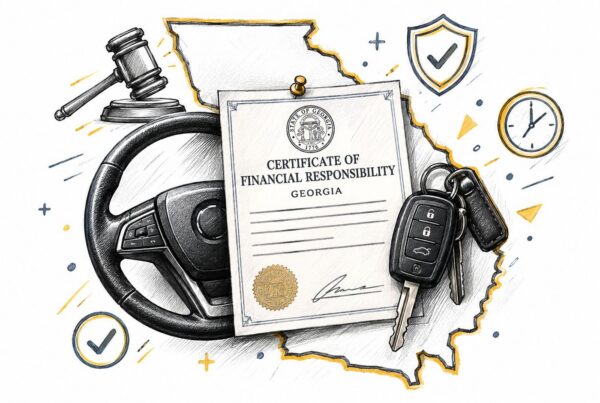

In Georgia, a DDS-certified 6-hour defensive driving course can remove up to 7 points from your driving record once every 5 years, but it doesn't erase the underlying violation. The course changes the point assessment connected with your record, not the fact that the ticket or conviction occurred.
Maybe a points notice arrived after a stop on I-285, or you received paperwork from a court in Athens and aren't sure what to do next. Many drivers assume the course automatically deletes the ticket, sends proof to every agency, or guarantees a lower insurance bill. Those assumptions can create another problem when a deadline is missed or the wrong certificate is submitted.
A defensive driving record is best understood as the paper trail connecting your course completion with your official Georgia driving history. It can include the course certificate, the request for point adjustment, and the information reviewed by DDS, a court, or an insurer. The details matter because each organization uses the certificate for a different purpose.
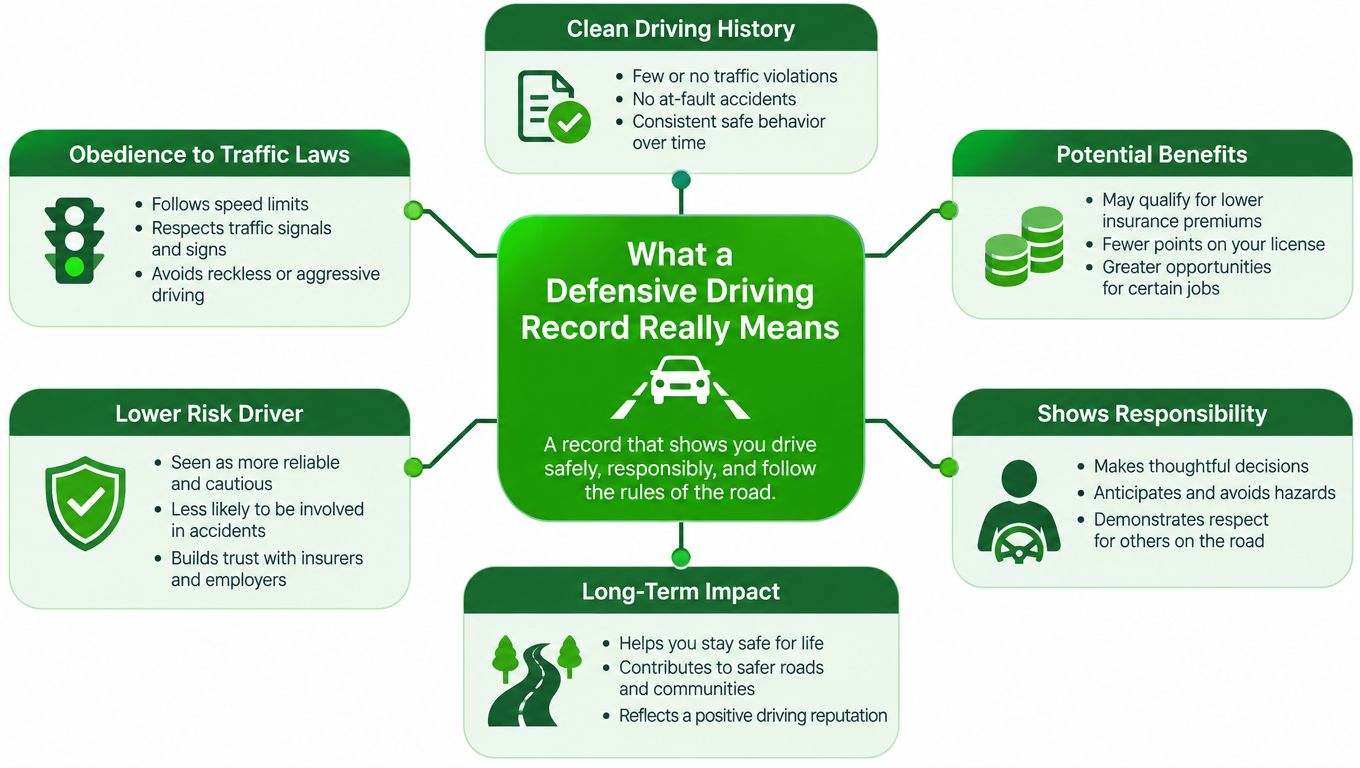
What a Defensive Driving Record Really Means
The record has more than one layer
Start with three separate questions:
- What happened in court? This is the underlying ticket, conviction, or court order.
- How many points are being assessed? This is the part a qualifying Georgia Driver Improvement course may reduce.
- Who needs proof? DDS, the court, and your insurer may each require documentation in a different way.
The course doesn't rewrite the court's history. If a driver receives a citation outside Athens and later completes defensive driving, the course may help with the point total, but it doesn't turn the citation into something that never happened. For a useful explanation of how Georgia's point system fits into license consequences, review the Georgia license points system.
That distinction is especially important for Atlanta commuters. A driver may see fewer assessed points for licensing purposes while an insurer still asks about the underlying violation. DDS, the court clerk, and the insurance company aren't maintaining one shared record with one universal purpose.
Why the certificate matters
The certificate is the bridge between education and administration. Without acceptable proof of completion, DDS can't apply the requested reduction, and a court may not be able to close a course requirement.
Practical rule: Treat your certificate like a document that controls a license decision, not like a class receipt.
The rest of the process comes down to mechanics. Georgia's reduction limit, the five-year use restriction, the handling of the original certificate, and the difference between points and violations determine what the course can accomplish. Insurance savings and court requirements then add separate questions, because a course can be worthwhile for one reason even when it offers little financial benefit for another.
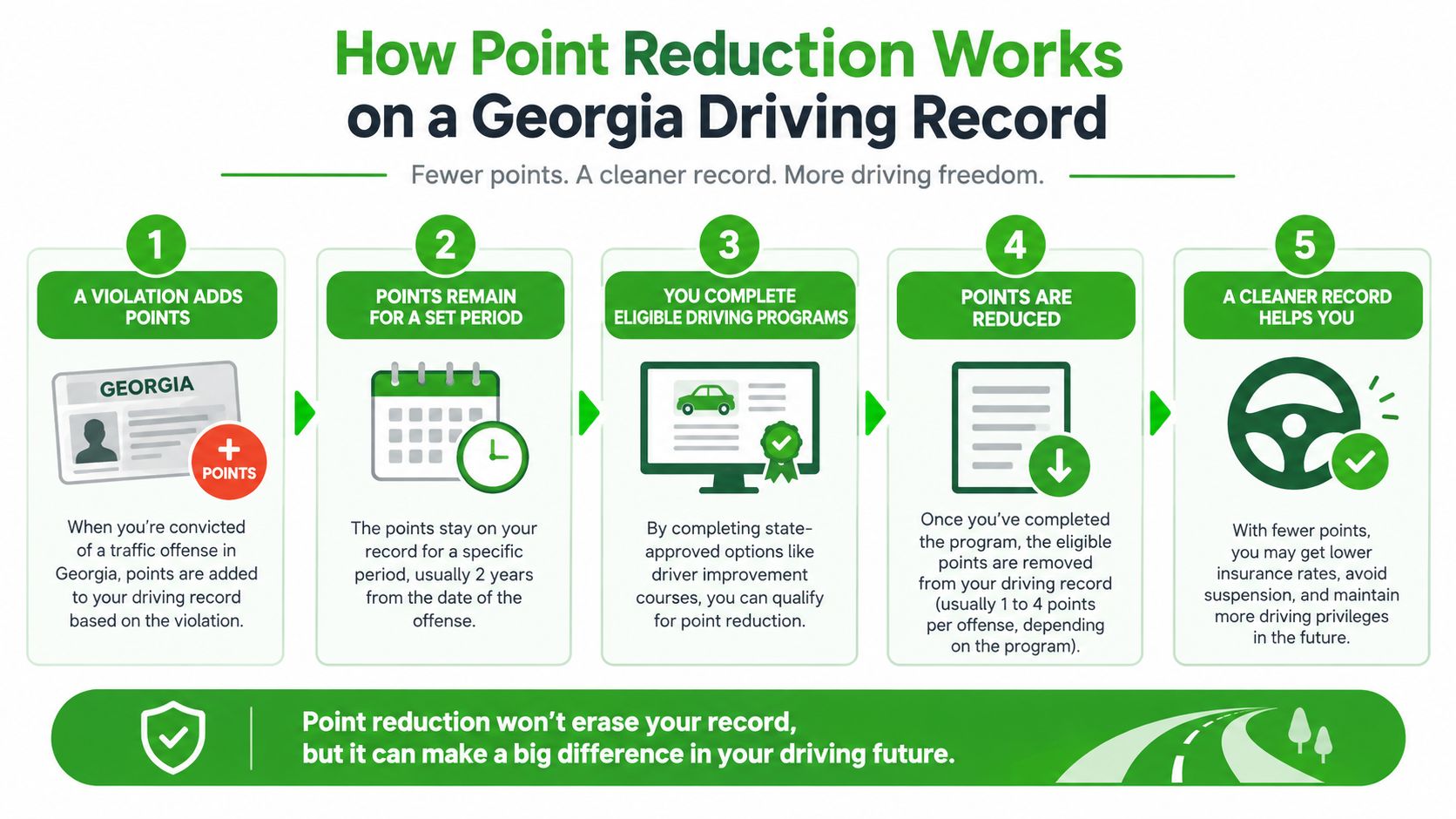
How Point Reduction Works on a Georgia Driving Record
Georgia permits a licensed resident to request a reduction of up to 7 points once every 5 years after completing a certified Driver Improvement course, according to the Georgia point-reduction and points schedule information. The course must come first. DDS then needs the original certificate presented or mailed for processing.
The rule doesn't mean a driver can choose any old class or request an informal adjustment. The course has to meet the approval requirement, and the certificate has to be handled correctly.
A simple example
Suppose a Georgia driver has 12 assessed points after several violations. If that driver qualifies, completes the certified course, and submits the original certificate properly, the requested reduction can lower the assessed total by up to 7 points. That leaves the driver with a lower point calculation, but the violations themselves don't disappear from the historical record.
The important word is up to. The reduction isn't a promise that every item will be deleted or that every record will look clean afterward. It changes the points used in the relevant administrative calculation.
The five-year limit also isn't a rolling invitation to take the class whenever a driver feels worried. Once the reduction option is used, the driver must wait until the applicable period allows another request. A second course may still provide education or satisfy a court order, but it doesn't automatically create another point reduction.
Don't confuse point relief with record erasure
Drivers often search for a way to remove the entire ticket. Georgia's defensive driving process is narrower. It can lower the assessed points, while the underlying violation remains part of the record history that may be reviewed by another organization.
For readers comparing state systems, a separate timeline for traffic citation removal can help explain why a point adjustment and a citation's record history aren't the same issue. For Georgia paperwork, the practical next step is to follow the certificate process described in how to remove points from a Georgia driving record.
Point Relief Versus Insurance Savings Versus Court Requirements
A defensive driving course can produce three different outcomes, and they shouldn't be blended together. Point relief concerns DDS and licensing risk. Insurance savings depend on the carrier and policy. Court or reinstatement compliance depends on the exact order issued in your case.
| Payoff | Who It Helps | What You Get |
|---|---|---|
| Point relief | A licensed Georgia resident with assessed points who qualifies under the state rule | A request for reduction of up to 7 points once every 5 years after an approved course and proper certificate submission |
| Insurance discount | A driver whose insurer and policy allow a defensive-driving discount | A possible premium reduction, subject to the insurer's rules, eligibility requirements, and proof |
| Court or licensing compliance | A driver ordered to complete defensive driving or required to use it for reinstatement | Documentation showing course completion for the court or licensing process |
Point relief may be the real value
For a driver nearing a suspension concern, reducing assessed points can matter more than a small premium change. The course may protect driving eligibility even when an insurer doesn't offer a discount.
That doesn't make the insurance question irrelevant. It means you should ask the insurer before enrolling if the discount is your only reason. Published coverage describes defensive-driving discounts as commonly ranging from 5% to 15% or 20%, depending on the insurer and state, and notes that some carriers focus eligibility on older drivers or states with specific requirements. Review the defensive driving insurance discount guidance rather than assuming the course will pay for itself.
New York illustrates how different a state program can be. Its DMV says an approved Point and Insurance Reduction Program course can reduce the points used to calculate a total by 4 points within the prior 18 months, and provide a 10% auto and motorcycle insurance premium reduction each year for 3 years. Other states listed by the same overview use different limits, including New Jersey, South Carolina, North Dakota, and West Virginia.
Georgia drivers shouldn't import another state's promise into their own policy. The right comparison is simple: How much point risk will the course address, what does my insurer offer, and what does my court require? The Georgia defensive driving course for lowering insurance can be a starting point for understanding the course option, but your carrier must confirm the financial result.
Eligibility and Choosing a DDS-Certified Course Format
Georgia calls its defensive driving course the Driver Improvement Program or Clinic. DDS describes it as a 6-hour, state-approved course that may be used for court orders, point reduction, license reinstatement, insurance premium reduction, or personal education, as explained on the Georgia DDS Driver Improvement Program page.
The certification check comes before the schedule check. DDS says only DDS-certified driving schools are approved for defensive driving and DUI programs. A class from an uncertified school won't be accepted for licensing, reinstatement, or court requirements.

Pick the format that matches the obligation
Georgia drivers commonly choose among three practical formats:
- Self-paced online: Useful if you work changing hours, commute between Atlanta and the suburbs, or need to study in separate blocks.
- Live virtual: A scheduled online class, often through Zoom, with an instructor and a set attendance period.
- Traditional classroom: A physical class that may suit drivers who learn better with direct discussion or need a local attendance option.
A driver in Athens may prefer a classroom session near home, while an Atlanta professional may choose a live virtual or online course to avoid traffic. Metro communities also offer weekday and weekend scheduling, so convenience doesn't need to override compliance.
Verify before paying
Look for the school's DDS certification and confirm that the specific course format is accepted for your purpose. A course may be educational but still fail your court or licensing requirement if the provider isn't approved.
Keep your court order, reinstatement notice, or insurer instructions available when you enroll. The correct course is the one that satisfies the agency asking for proof, not just the one with the shortest registration process.
How Course Completion Gets Reported and How to Prove It
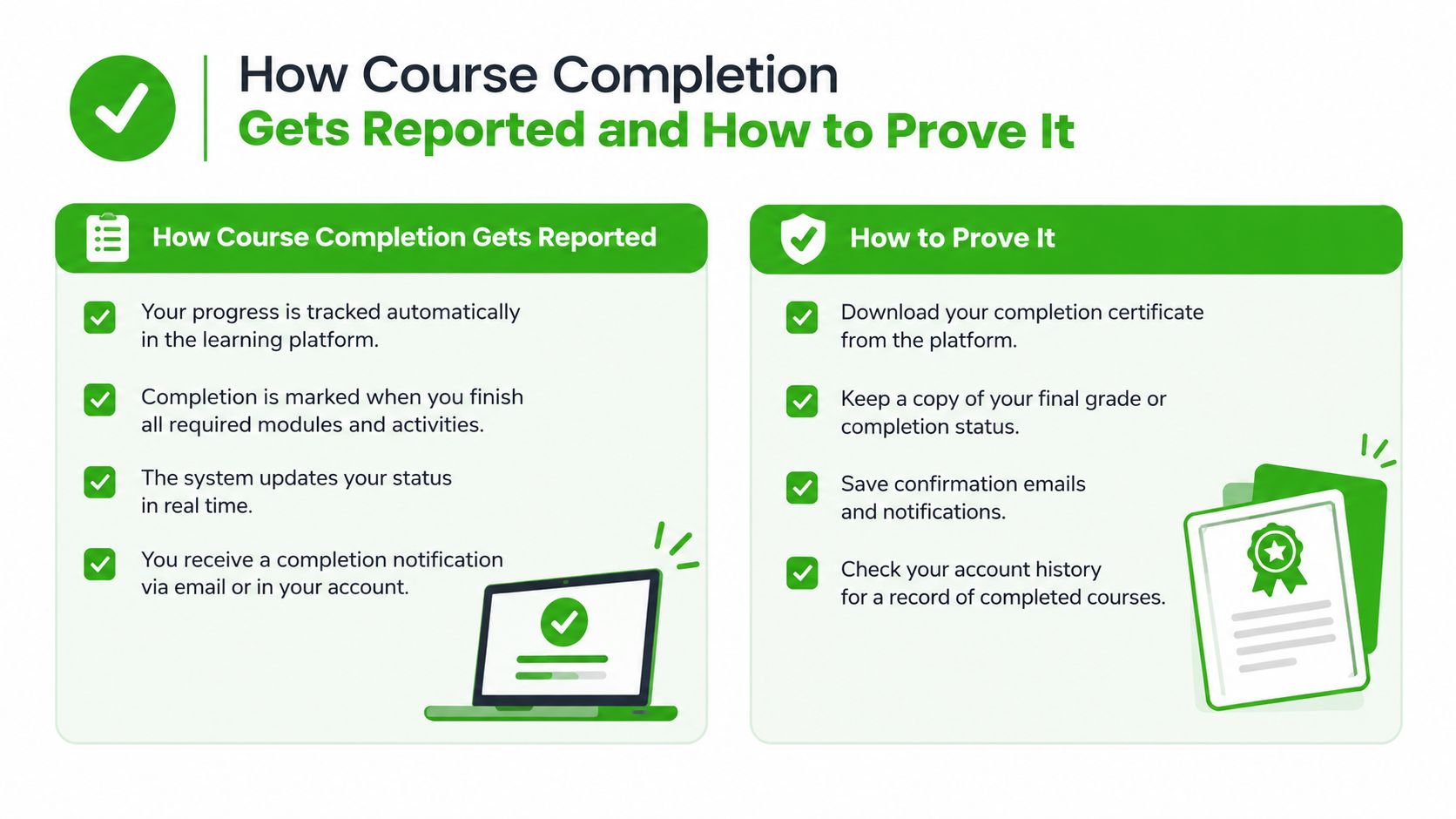
Finishing the class is only one part of managing a defensive driving record. The next job is moving the proof to the organization that needs it.
Follow the document trail
Use this sequence on the day you finish:
- Receive the original certificate. Check your name, course information, and completion details before leaving the provider's system or office.
- Make copies immediately. Keep a paper copy and a secure digital copy before sending the original anywhere.
- Submit the original to DDS for point reduction. Georgia's rule requires the original certificate to be presented to DDS or mailed for processing.
- Follow the court's delivery instructions. If a judge or court clerk ordered the course, provide the required proof by the stated deadline and method.
- Send a copy to your insurer if requested. Ask the carrier whether it needs the certificate, a form, or another confirmation before it applies any discount.
Separate DDS, court, and insurance submissions
Don't assume DDS will notify the court, or that the court will notify your insurer. A driver who completes a course for a municipal court in metro Atlanta may need to deliver proof directly to that court. The same applies to a driver handling a requirement through an Athens court.
The certificate's destination determines what you should keep. If the original goes to DDS, retain the copy and mailing or delivery confirmation. If a court accepts a copy, keep evidence that the clerk received it. If an insurer asks for proof, record the date of submission and the representative's instructions.
Keep the original under your control until you know where it must go. Once an agency requires it, send or present it exactly as directed, and preserve copies first.
A missing document can delay an otherwise completed course. A mismatched name, late delivery, or submission to the wrong office can create the impression that the driver never finished. Good record management is simple, but it has to be deliberate.
When Your Record Problem Is Bigger Than Points
Defensive driving is appropriate for a points issue, a qualifying court order, or education. It isn't a substitute for Georgia's separate DUI and substance-related requirements.
Georgia's DUI, Alcohol or Drug Use Risk Reduction program is mandated for people convicted of DUI, possession of illegal drugs, underage possession of alcohol while operating a motor vehicle, or boating under the influence. The program has two required parts, the Assessment Component, also called the NEEDS Assessment, and the Intervention Component. Both must be completed to receive a certificate, and the total fee is $360, consisting of $100 for the assessment, $235 for the intervention component, and $25 for a workbook, according to Georgia DDS DUI frequently asked questions.
Identify the correct track
A defensive driving course and a Risk Reduction program answer different administrative questions:
- Traffic points: Look at Driver Improvement and the Georgia point-reduction rule.
- DUI or specified substance-related conviction: Follow the Risk Reduction program and its required components.
- Court-ordered clinical services: Check whether the order separately requires an evaluation, treatment, or a Victim Impact Panel.
The Risk Reduction intervention component has a fixed 20-hour attendance requirement, while program instructors must complete at least 32 hours of continuing education in alcohol and drug training or group facilitation training every 4 years, under Georgia's program rules. Those requirements show why a standard defensive driving class can't replace DUI programming.
Take habitual violator notices seriously
Georgia's habitual violator rule applies when a driver is arrested and convicted 3 or more times within a 5-year period for qualifying offenses. DDS says the license is revoked for 5 years, and once the driver becomes eligible for reinstatement, a 12-month ignition interlock requirement applies, as described in the Georgia habitual violator guidance.
A seven-point reduction can be valuable, but it doesn't cancel a habitual violator determination or replace a DUI order. Read the exact notice and match the course to the legal problem before registering.
Taking Control of Your Driving Record in 2026
The best decision depends on what is threatening your driving privileges today. Use the record problem, not the course label, to choose your next step.
Match the response to the situation
You have assessed points. Check whether you qualify for the Georgia reduction option and whether you've already used it during the applicable five-year period. Completing the course before another violation can give you a clearer record position, but it won't undo the underlying ticket.
A court ordered the course. Contact the court handling the case and confirm the deadline, accepted format, and certificate delivery method. Don't rely on a provider's general instructions when the court order controls.
Insurance savings are your only goal. Call the insurer first. Ask whether your policy qualifies, how much the discount would be, how long it lasts, and what proof the carrier needs. Savings may be modest, unavailable, or limited by state and driver eligibility.
Your notice mentions DUI, reinstatement, or habitual violator status. Stop treating the matter as a routine point issue. The Risk Reduction program, clinical evaluation, treatment, Victim Impact Panel, ignition interlock, or another court condition may apply instead.
Drivers comparing record procedures across states should also be careful with outside examples. For instance, a resource about removing a ticket from your Texas driving record describes a different state's court process, so it shouldn't be used as a Georgia filing guide.
Georgia DUI Schools offers a DDS-approved defensive driving course in self-paced online, live virtual, and traditional classroom formats, with options serving Atlanta, Athens, and surrounding communities. Courses run seven days a week, with weekday and weekend availability, so a driver can select a format that fits the obligation without overlooking certification.
If your issue is points, start by confirming eligibility and gathering the documents DDS or your court requires. If the issue is DUI-related, identify the Risk Reduction and related requirements separately. The safest course is the one that matches the agency's written requirement and leaves you with proof of completion.
Georgia DUI Schools offers DDS-approved defensive driving courses for Georgia drivers working on point reduction, court documentation, reinstatement, or insurance questions. Choose an online, live virtual, or classroom format that fits your schedule, then visit Georgia DUI Schools to review the appropriate course and register.