

You've just opened a traffic citation from Cobb County, DeKalb County, or another Georgia court, and your first question is probably simple: Can I still drive to work tomorrow? A ticket doesn't always mean an immediate loss of driving privileges, but Georgia's drivers license points system can turn several convictions into an administrative suspension. The answer depends on the offense, when the conviction posts to your record, and whether another rule applies outside the ordinary point calculation.
Georgia uses points to track repeated violations, not merely to punish one mistake. The Georgia Department of Driver Services, or DDS, applies the state's thresholds, records suspensions, and processes approved point reductions. The most important details are easy to miss, especially the difference between a point total, an insurance record, a court disposition, and a separate habitual-violator revocation.
What the Georgia Points System Actually Does to Your License
A Marietta commuter receives a speeding citation for driving 19 miles per hour over the limit on I-75. She's less worried about the fine than about tomorrow morning. If the court convicts her, will DDS suspend her license immediately, or can she keep driving?
Usually, a citation by itself isn't the same as a conviction posted to the driving record. Georgia's point system operates through DDS under O.C.G.A. § 40-5-57 and § 40-5-86, and the administrative consequences generally follow the conviction or other reportable court disposition. The violation date matters for the history, but drivers should pay close attention to the date the conviction is entered because that date affects how the active accumulation period is calculated.
Points are an administrative tracking tool
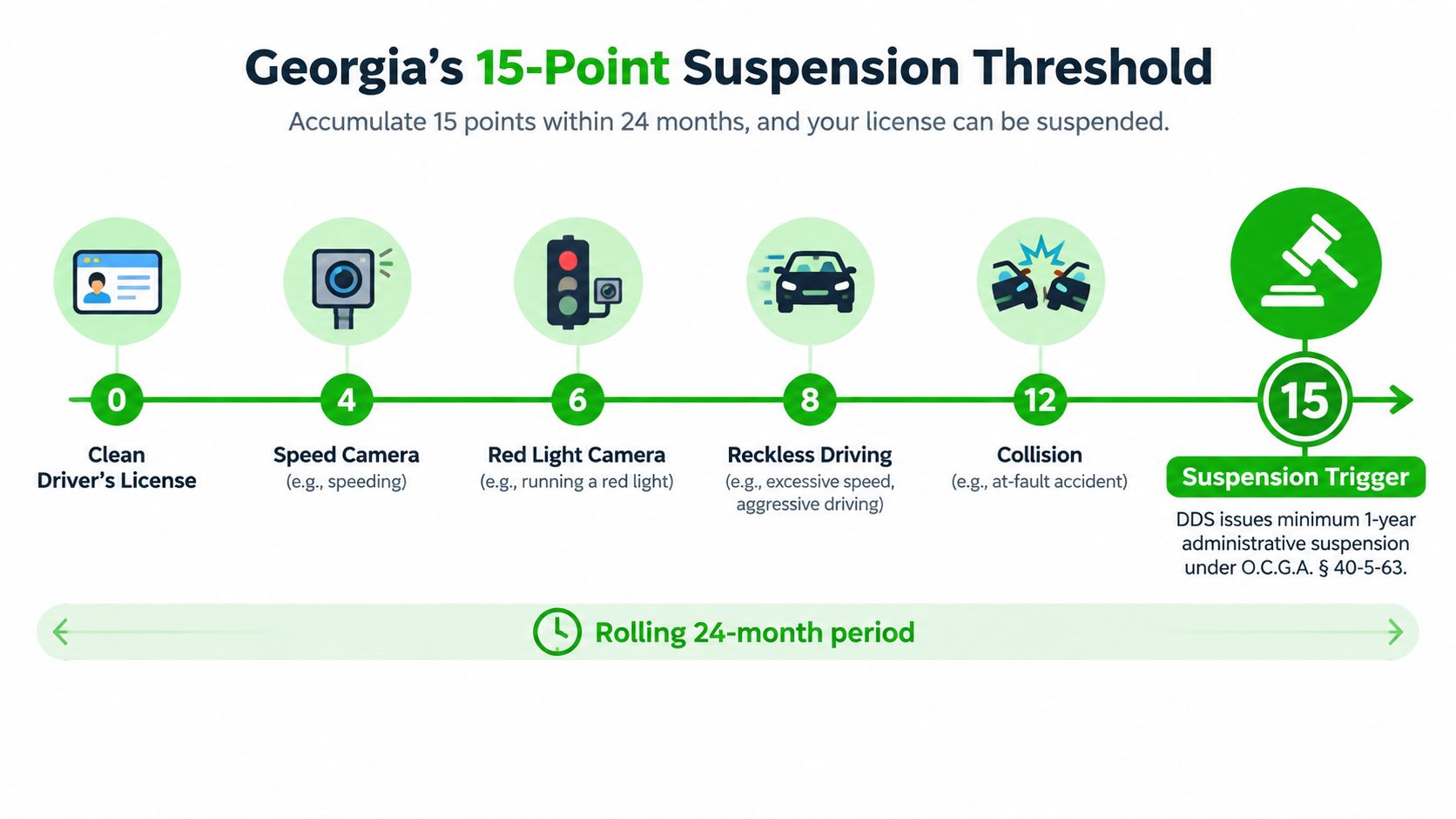
Georgia assigns points to qualifying violations according to the offense. Those points accumulate within a rolling 24-month period, and a driver who reaches the statutory threshold can face an administrative suspension. Georgia law connects suspension to 15 or more violation points in any consecutive 24-month period, as described in O.C.G.A. § 40-5-57.
That means a driver might have several convictions that look minor when viewed separately but become serious when they overlap in the same two-year window. DDS isn't asking only, “How bad was the newest ticket?” It's also asking, “How many qualifying points are active at the same time?”
Practical rule: Don't estimate your status from memory. Confirm the convictions, point values, and dates on the DDS record.
License points and insurance records aren't identical
Drivers often say, “I have points on my license,” when they mean one of two things. The DDS record reflects the state's administrative point calculation, while an insurer's motor vehicle report, or MVR, may display convictions and driving history under the insurer's own underwriting rules.
An insurance company can weigh a conviction differently from DDS. A course that qualifies for a Georgia point reduction may change the DDS point balance, but it doesn't guarantee that an insurer will treat the entire driving history as though the ticket never existed. If you're comparing your record with an insurance quote, ask what report the carrier reviewed and which conviction it evaluated.
The rest of the process turns on three questions: How many points did the offense add? Do those points overlap within 24 months? Does a separate DUI or habitual-violator rule apply?
Point Values for Common Georgia Traffic Violations
Georgia's official schedule assigns points based on the violation and its seriousness. A driver can use the schedule in DDS Rule 375-3-3-.01 to identify the likely category, but the conviction language matters. A negotiated disposition in court may not carry the same point result as the original citation, so compare the final court record with the DDS entry.
| Points | Violation Type | Georgia Code / Example |
|---|---|---|
| 2 | Speeding from 1 to 14 miles per hour over the limit, child restraint violations, and certain basic equipment failures | Georgia DDS point schedule, including speeding and equipment offenses |
| 3 | Speeding from 15 to 29 miles per hour over the limit, following too closely, and failure to yield | Georgia DDS point schedule |
| 4 | Speeding 30 or more miles per hour over the limit, reckless driving, and passing a school bus | Reckless driving, O.C.G.A. § 40-6-390, plus listed moving violations |
| 6 | DUI, hit and run, and vehicular homicide | DUI, O.C.G.A. § 40-6-391, plus serious listed offenses |
How to read the schedule
A speeding conviction for 15 to 29 miles per hour over falls into the 3-point category. A conviction for 30 or more miles per hour over falls into the 4-point category. Reckless driving under O.C.G.A. § 40-6-390 also belongs in the 4-point tier, while DUI under O.C.G.A. § 40-6-391 carries 6 points under the schedule.
The number attached to the original citation isn't always the number that reaches DDS. Courts may enter a different qualifying disposition, and DDS counts what it receives from the court. That's why the final record is more useful than the officer's initial estimate or a driver's recollection of the ticket.
Small violations can create a large balance
A 2-point offense may not feel urgent. Two or three low-level convictions can still become consequential if they're entered close enough together to overlap. A 3-point speeding conviction added to another 3-point moving violation doesn't trigger suspension by itself, but it reduces the remaining margin before the 15-point threshold.
Georgia also counts qualifying out-of-state convictions when DDS receives notice. Moving from Georgia to another state won't erase the Georgia history, and returning to Georgia won't create a clean slate. Keep copies of court dispositions, especially when an out-of-state matter was dismissed, reduced, or otherwise resolved differently from the original citation.
The 15-Point Suspension Threshold and How the 24-Month Window Works
The core rule is straightforward: 15 or more violation points in any consecutive 24-month period can trigger a Georgia license suspension. The difficulty comes from the dates. Drivers often count from the traffic-stop date, but DDS uses the conviction information posted to the record when determining the active accumulation window.
A rolling window catches overlapping convictions
Suppose a driver has a conviction entered in March of the previous year and another conviction entered in October of that same year. Both can fall inside the active 24-month period when DDS reviews the record. A conviction from 25 months earlier generally falls outside that particular rolling window, assuming no rule keeps it relevant for another administrative purpose.
The window doesn't operate like a calendar-year reset. January doesn't wipe out December, and a new year doesn't restart the calculation. DDS looks backward from the relevant conviction or administrative review and identifies which qualifying convictions remain inside the consecutive period.
Conviction date can change the outcome
A ticket issued in March might not become a conviction in March. If the court disposition is entered later, the DDS timeline can look different from the driver's personal timeline. That delay can surprise someone who assumes an older ticket has already aged out or that a recent ticket hasn't started counting.
Once DDS takes administrative action, read the notice carefully. Under Georgia's statutory framework, a first qualifying 15-point suspension is treated differently from later actions. A subsequent suspension within the relevant five-year period can carry a three-year length and may require reinstatement through DDS hearings. The applicable statutory provisions include O.C.G.A. § 40-5-63, so a driver shouldn't rely on general internet summaries when a suspension notice has arrived.
The reset isn't the same as erasing history
After a suspension period ends, Georgia's point-count rules can reset the active balance to zero in the circumstances described by state law. That doesn't mean every conviction disappears from every record, and it doesn't eliminate separate consequences for DUI, insurance underwriting, or habitual-violator review.
A driver facing a pending suspension should act before the effective date. Completing a defensive driving course after a suspension begins may not prevent the action, and sending a certificate to DDS without confirming the required procedure can leave the driver believing the balance changed when it hasn't.
How to Check Your Georgia Driving Record and Point Total
The safest way to answer “How many points do I have?” is to obtain the current DDS record. Don't rely on an old insurance document, a court website, or a ticket estimate. Each source may show a different stage of the case.
Use DDS records first
Georgia drivers can request their history through the DDS online Driver History portal, obtain a record in person at a DDS Customer Service Center with a valid Georgia license, or submit a mail request using Form DS-2870 to the DDS Records Department in Atlanta. The available request method may affect how quickly you receive the report and what identification or payment the agency requires, so follow the current DDS instructions before submitting anything.
Look for the conviction entry, the violation description, the point assessment, and the current license status. Pay attention to the difference between the violation date and the date the record was reported or posted. A report can also contain older convictions that no longer count toward an active 24-month point calculation.
For a plain-language explanation of how driving histories affect insurance decisions, review the Select Insurance Group driving record resource from Select Insurance Group, Inc. It can help you understand why an insurer's review may not look identical to your DDS point balance.
Reconcile the report with the court
Before assuming the total is final, compare the DDS record with pending court dispositions. If you paid a citation, received a reduction, completed a court-approved program, or had a case dismissed, verify that the final disposition reached DDS accurately.
You can also use this Georgia safe driving points balance guide as a practical checklist while reviewing the record. The important question isn't just the total printed on the page. Confirm which entries are active, which dates DDS used, and whether any suspension or reinstatement notice is already attached to the account.
If the record appears wrong, gather the court paperwork before contacting DDS. A clear disposition document gives the agency something concrete to review, while an explanation based only on memory is much harder to verify.
Three Ways to Reduce or Mitigate Points in Georgia
Georgia drivers have several ways to address points, but they aren't interchangeable. The most common mistake is assuming that any defensive driving course automatically erases points or that a court option and a DDS reduction can always be combined.
| Option | Eligibility | Frequency Limit | Point Impact | Stacking |
|---|---|---|---|---|
| DDS point reduction | Complete a certified 6-hour driver improvement or defensive driving course and submit the original certificate | Up to once every 5 years | Up to 7 points | Separate DDS transaction, not an automatic erase |
| Court-ordered defensive driving | Available for qualifying pointable offenses when the court orders or accepts course attendance | Depends on the court and case | Can eliminate point assessment in qualifying circumstances | Must follow the court's terms |
| Traffic education under O.C.G.A. § 40-5-86 | Applies when the court permits the statutory traffic-education option | Tied to the offense and court process | Can reduce the fine by 20% and may eliminate point assessment in qualifying cases | Cannot be stacked with the 7-point DDS reduction |
The five-year DDS reduction
Georgia residents may request a reduction of up to 7 points only once every 5 years, after completing a certified 6-hour driver improvement or defensive driving course. The official DDS process requires the driver to submit the original certificate in person or by mail, and DDS lists its Conyers mailing address for mailed certificates. See the Georgia DDS point-reduction requirements before enrolling because course completion alone doesn't change the record automatically.
This is a formal DDS transaction. Save the original certificate, make a copy, and confirm that DDS received and processed it. The five-year clock is a requalification limit, not a promise that points will remain active for five years.
Court-referred options work differently
A court can order defensive driving for certain pointable offenses. In some cases, the court may accept proof of course attendance before the court appearance, which can eliminate point assessment and reduce the fine by 20% under the circumstances described in O.C.G.A. § 40-5-86.
That option belongs to the ticket and court process. It isn't the same as requesting a DDS reduction after points have already posted. Ask the court or clerk whether the offense qualifies, what deadline applies, and whether the court needs the certificate before the disposition is entered.
For a focused explanation of the DDS process, review this guide on how to remove points from a Georgia driving record. Don't enroll based on the course title alone. Confirm that the provider and course format satisfy the specific requirement you're trying to meet.
How DUI and Repeat Offenses Trigger the Habitual Violator Track
A point suspension isn't the only way Georgia can restrict driving privileges. Habitual violator status is a separate legal track, and it looks at qualifying convictions over a longer history rather than adding points inside the ordinary 24-month window.
Georgia law provides that a person becomes a habitual violator after the third conviction of certain serious offenses within 5 years, with license revocation following under the habitual-violator statute. The rule is based on conviction count and timing, not just the standard 15-point calculation. Review O.C.G.A. § 40-5-57-1 and the related provisions before assuming a point reduction will solve the entire problem.
DUI consequences can run independently
DUI is especially important because it can produce consequences beyond the ordinary point balance. A DUI conviction can create an automatic license action under Georgia law, and the habitual-violator framework may apply when the conviction history meets the statutory requirements. A driver shouldn't treat a DUI as merely another 6-point entry.
The practical distinction is substantial. A point-based suspension is an administrative response to accumulated points within a defined window. Habitual violator status is a revocation track tied to repeated serious convictions, and it can require a different reinstatement process. Drivers may also face court-ordered DUI education, clinical evaluation, treatment, or a Victim Impact Panel depending on the case and the applicable court or DDS requirements.
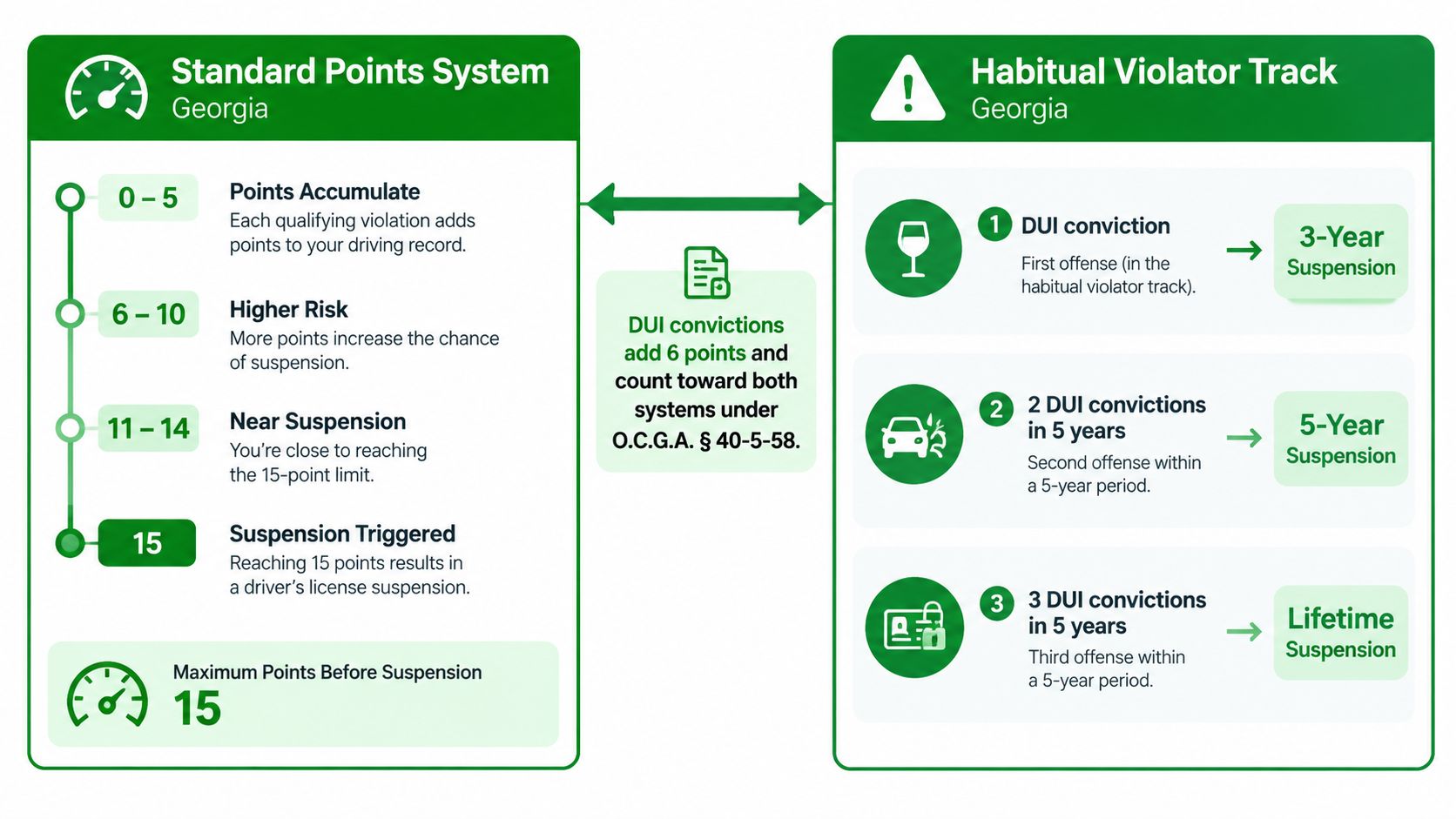
The multiple DUI offenses resource can help drivers identify why repeat DUI cases require more than a standard point-total review. Pull the complete conviction history and read the DDS notice carefully. The 24-month points clock and the five-year habitual-violator clock can operate in parallel, so one may remain relevant after the other changes.
A Practical Action Plan for Georgia Drivers
If you're worried about a Georgia suspension, take these steps this week rather than waiting for another notice.
Request the current DDS record. Use the online portal, visit a Customer Service Center, or submit the appropriate mail request. Keep the report with every court disposition and suspension notice.
Identify the final convictions. Write down the offense, point value, conviction date, and whether the entry came from Georgia or another state. Don't total the original citations if the court later changed the disposition.
Calculate the active window. Review which convictions overlap within the consecutive 24-month period. Mark the dates on a calendar, but remember that DDS may count from the conviction date rather than the traffic-stop date.
Separate the available remedies. Ask whether a court-referred defensive driving option applies to the ticket. Separately check whether you're eligible for the once-every-five-years DDS reduction of up to 7 points.
Protect your paperwork. Save the original course certificate, make a copy, and keep proof of delivery if you mail documents to DDS. A course finished after the suspension date may not prevent the suspension, and an unprocessed certificate doesn't change the record.
Check for a second legal track. If the record includes DUI convictions or other serious repeat offenses, review habitual-violator consequences instead of assuming the ordinary point total tells the whole story.
For drivers ready to take an approved course, Georgia DUI Schools offers defensive driving options in online, live virtual, and traditional classroom formats, with course scheduling designed for Georgia residents who need a practical way to address qualifying requirements.
Georgia DUI Schools provides Georgia DDS-approved defensive driving and DUI/Risk Reduction education, along with related clinical services such as evaluations, ASAM Level 1 treatment, and Victim Impact Panels when required. Visit Georgia DUI Schools to review the defensive driving course options, confirm the format that fits your situation, and enroll with your current DDS or court requirement in hand.