

You're sitting in a Georgia courtroom with a second or third DUI charge, while a DDS notice is already moving through the mail. Your attorney is discussing the criminal case, your employer is asking how you'll get to work, and you're trying to determine whether the license problem ends when court does. It usually doesn't.
Multiple DUI offenses create two separate problems: the criminal case and the administrative loss of driving privileges. Georgia's response becomes substantially more serious as prior offenses accumulate, especially when the record places you in habitual violator territory. The practical mistake I see most often is waiting for a court outcome before dealing with DDS, treatment, evaluations, and reinstatement documents.
Why Multiple DUI Offenses Change Everything
A driver in Atlanta may finish probation after a first DUI, then face a later arrest that appears familiar. Georgia treats the record differently. Prior convictions can change the license classification, court exposure, monitoring requirements, and the steps required to regain lawful driving privileges.
The practical issue is coordination. A repeat case creates a criminal case and a separate DDS problem, with deadlines, records, evaluations, treatment, and reinstatement documents that do not resolve themselves when court ends. Start reviewing the DDS file as soon as you receive a notice, not after sentencing.
Safety research helps explain why Georgia treats repeat offenders as a separate risk group. In 2010, 2.1% of licensed drivers had a prior DWI arrest within the preceding three years, while 8.0% of intoxicated drivers with a BAC at or above 0.08 involved in fatal crashes had a prior DWI conviction during that period. The NHTSA-linked analysis found that prior-offense drivers were 62% more likely to be involved in a fatal crash overall, and drivers at or above the legal limit were about 3.81 times as likely to appear in fatal-crash data when they had a prior DWI conviction. It also reported 6% versus 2% for prior impaired-driving convictions among alcohol-involved and non-alcohol-involved drivers in fatal crashes. (NHTSA and PubMed analysis)
Those figures do not determine an individual case. They explain why courts and licensing agencies examine the full conviction history instead of treating a new arrest as an isolated event.
The record drives the response
A Canadian federal review reported that up to three-quarters of people convicted of DWI offenses were repeat offenders, and about one-third of drinking drivers responsible for fatal crashes had previously been convicted of DWI. California data summarized by RAND showed recidivism rising from 28% for first-time offenders to 35% for second-time offenders and 43% for drivers with three or more convictions. RAND also noted that roughly 40% of fatally injured impaired drivers had a repeat DUI history. (Canadian federal review)
For a second or third case, build a record-based action plan. Confirm every prior conviction, determine how Georgia counts it, preserve each DDS deadline, and begin required compliance work before a missed document creates another delay.
Practical rule: Treat the DDS file, court file, and treatment file as separate projects. A completion certificate in one file does not automatically close the others.
Review how long a DUI stays on your record in Georgia for background on record consequences. Time alone does not erase administrative requirements.
Georgia's Escalating DUI Penalty Structure
A second or third DUI changes the license problem as much as the criminal case. Georgia DDS applies longer suspensions or revocations, higher reinstatement hurdles, and repeat-offense conditions that must be completed in the correct order. For drivers age 21 and over, the Georgia DDS DUI chart lists a 120-day suspension and a $210 reinstatement fee for a first DUI. A second DUI carries an 18-month suspension and a $210 reinstatement fee. A third DUI is tied to habitual violator status and a $410 reinstatement fee.
| Offense Number | License Suspension | Reinstatement Fee | Mandatory Jail Time | Additional Requirements |
|---|---|---|---|---|
| First DUI | 120-day suspension | $210 | Not specified in the DDS chart cited here | Follow the applicable court and DDS requirements |
| Second DUI | 18-month suspension | $210 | Not specified in the DDS chart cited here | Repeat-offense compliance and any required interlock or treatment |
| Third DUI | Habitual violator status with five-year revocation in the applicable Georgia guidance | $410 | Minimum mandatory 15 days | Minimum fine, community service, clinical evaluation, and treatment if indicated |
The third offense demands exact record review. Georgia's impaired-driving guidance states that a third offense within five years of the second offense triggers a five-year license revocation, at least 15 days in jail, a minimum $1,000 fine up to $5,000, and at least 30 days of community service. It also provides for habitual violator status and a mandatory clinical evaluation. Treatment becomes required when that evaluation indicates it. Review the Georgia impaired-driving laws before assuming that completing court conditions alone restores driving privileges.
Why the five-year window matters
Georgia's habitual violator statute focuses on three or more convictions within a five-year period. The period is measured from the dates of prior arrests that resulted in convictions to the date of the most recent arrest, for specified offenses that include DUI-related violations. (Georgia habitual violator statute)
Use official arrest and conviction records for this calculation. Do not rely on memory or the date of an old court appearance. Counsel should compare each relevant arrest date, conviction, and qualifying offense before advising you about habitual violator consequences.
Georgia DDS rules also distinguish revocations imposed on or after July 1, 2009 from older revocations. The rule lists a $410 reinstatement fee for later revocations and a $210 fee for older ones. It also requires surrender of previously issued licenses or permits, including habitual violator probationary licenses, at reinstatement. Check the Georgia DDS reinstatement rules for the document and surrender requirements that apply to your record.
Plan for more than the court fine. Set aside time for the evaluation, treatment, community service, paperwork, fees, license surrender, and any interlock condition. A complete reinstatement file prevents a finished sentence from becoming another avoidable DDS delay.
Navigating Criminal Court and DDS Administrative Actions
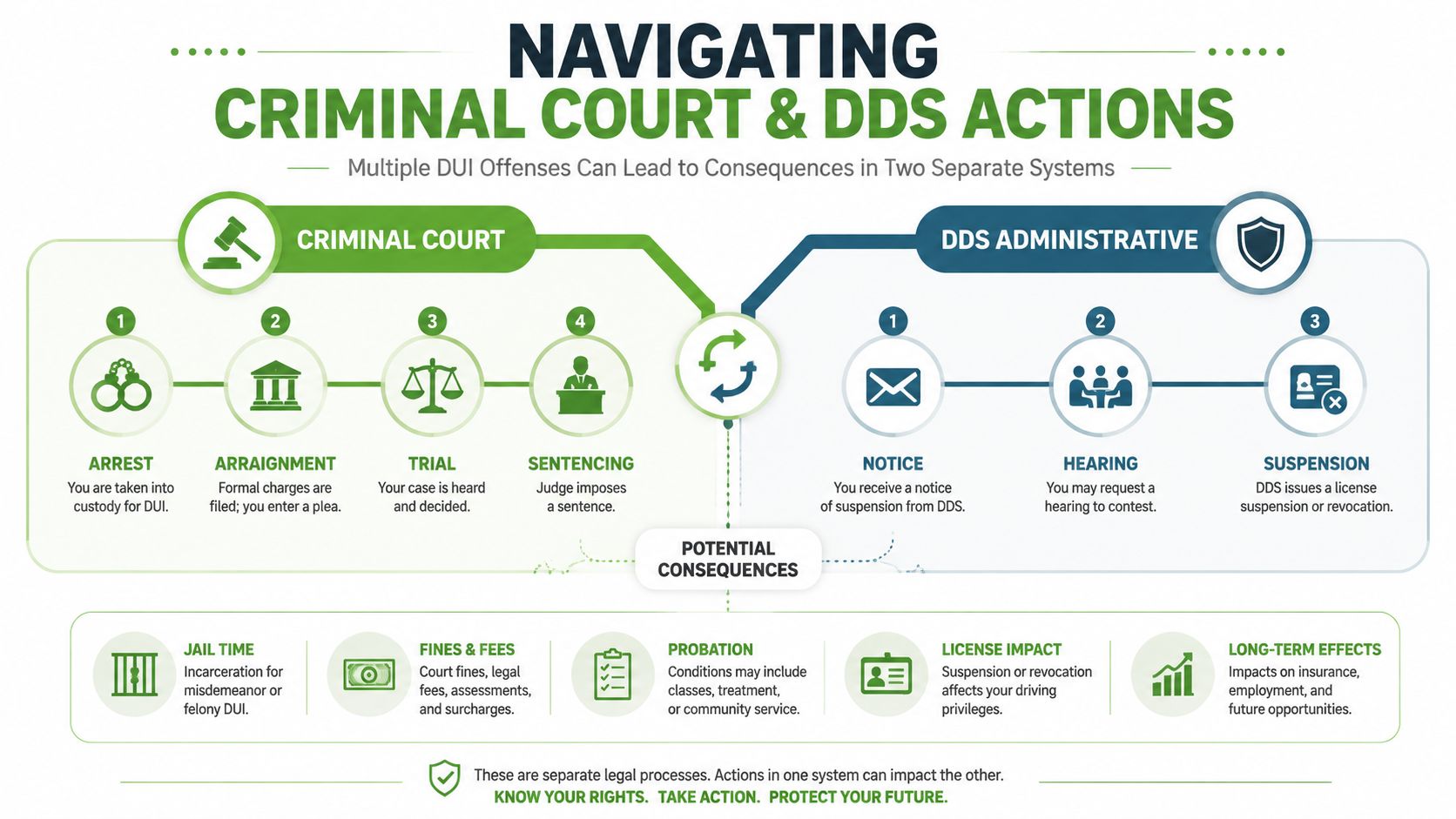
Your DUI case runs on two tracks. Criminal court decides the charge, plea, and sentence. DDS administers driving privileges under its own process. One track can move while the other remains unresolved.
A license action may begin before a criminal conviction. The notice you receive matters because administrative deadlines can be short, and missing a hearing request can leave you without a meaningful opportunity to challenge the action. Georgia drivers should speak with a Georgia DUI attorney promptly about the applicable deadline, including the commonly referenced 10-day period for requesting an administrative hearing. The exact trigger and available relief depend on the notice and circumstances, so read the document rather than relying on a general rule.
Keep the two files synchronized
Start with the DDS notice. Record the date you received it, the deadline printed on it, the suspension or revocation basis, and whether it mentions a hearing or permit. Send the notice to your attorney immediately.
Then build the criminal file separately. Your lawyer needs the arrest report, testing records, body-camera material, witness information, prior conviction documents, and any evidence affecting the traffic stop or chemical testing. A plea to reckless driving in court doesn't automatically restore a license if DDS has already imposed a separate administrative action.
Limited driving privileges, when available, come with conditions. Don't drive outside the permitted purpose, vehicle, time, or geographic limits. Driving while suspended or revoked can create a new charge and damage the reinstatement strategy you're trying to build.
Do not wait for the criminal case to finish before reading your DDS notice. Administrative default can create a license problem even when the court case later changes.
Coordinate with counsel, but take responsibility for document control. Keep a dated folder containing every notice, receipt, certificate, treatment record, court order, and DDS communication. That file becomes your evidence of compliance when a missing document threatens to delay reinstatement.
Required Clinical Evaluations and Treatment Programs
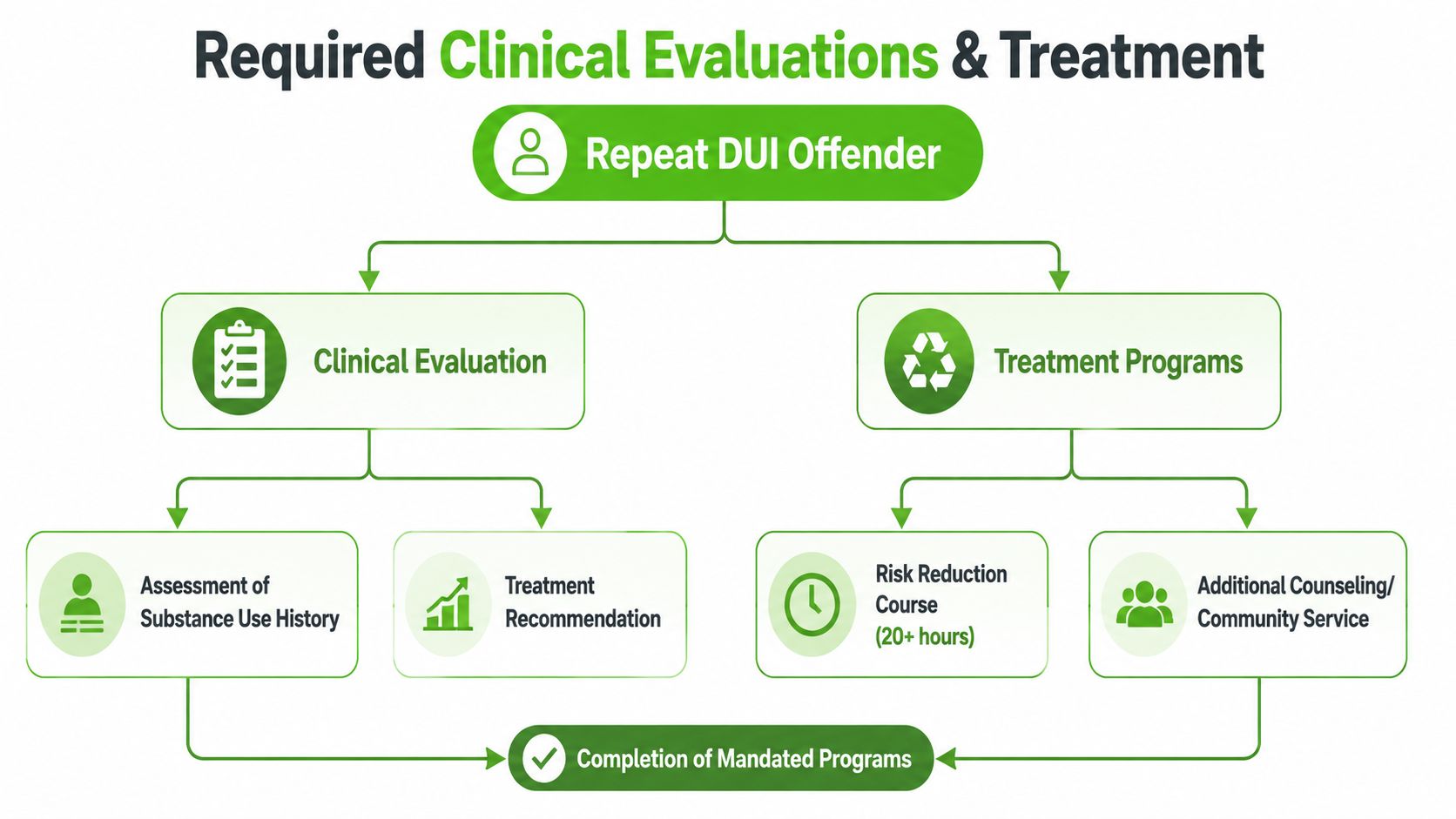
Repeat DUI cases often require more than an educational class. A Risk Reduction course teaches decision-making and impaired-driving consequences. A clinical evaluation assesses substance-use history and determines whether treatment is appropriate. They serve different purposes, and completing one doesn't replace the other.
A clinical evaluator reviews your alcohol and drug history, prior offenses, treatment background, current behavior, and related risks. The evaluator then recommends a level of care. That may include ASAM Level 1 treatment, additional counseling, or another intervention supported by the assessment. Don't shop for the shortest recommendation. A weak or incomplete evaluation can create problems with the court, probation, or DDS.
Complete the requirements in the right order
Use this sequence:
- Confirm the written requirements. Read the sentence, probation conditions, DDS notice, and any attorney instructions.
- Schedule the clinical evaluation. Ask whether the provider is qualified for the court or licensing requirement involved.
- Follow the recommendation. If treatment is indicated, enroll promptly and attend every required session.
- Complete Risk Reduction separately. The course is educational, not a substitute for therapy.
- Handle the Victim Impact Panel. Confirm the approved provider, attendance rules, and proof of completion.
- Collect original documentation. Keep certificates, attendance records, discharge paperwork, and payment receipts.
The Victim Impact Panel is not a box to check casually. It exposes participants to the consequences impaired driving causes other people and communities. Arrive prepared, follow the provider's rules, and obtain written proof.
If substance use intersects with mental-health concerns, a resource such as dual diagnosis treatment in Massachusetts can help explain how providers address co-occurring conditions. That resource isn't a substitute for a Georgia-approved evaluator, but it can clarify why one diagnosis may not tell the whole story.
For more detail on the assessment itself, review what a drug and alcohol evaluation involves. Start early because providers, courts, and probation offices may require documents in specific formats.
Step-by-Step License Reinstatement Process
Reinstatement is a document-driven process. The state won't restore driving privileges because you tell an employee that you completed treatment. DDS needs the required evidence, the correct fee, and compliance with the applicable suspension or revocation terms.
Build the file before submitting anything
Use this practical sequence:
- Finish court obligations. Complete jail, fines, community service, probation conditions, evaluations, panels, and treatment required by the sentence. Keep proof for each item.
- Complete required education and treatment. Obtain the Risk Reduction certificate, clinical evaluation, treatment completion records, and Victim Impact Panel documentation when required.
- Review your DDS status. Confirm whether the action is a suspension, revocation, or habitual violator-related restriction. Don't assume the court's order states the entire DDS process.
- Surrender old credentials when required. Georgia DDS rules require surrender of previously issued licenses or permits, including habitual violator probationary licenses, at reinstatement. (Georgia DDS reinstatement rules)
- Submit the application and supporting records. Use the method DDS identifies for your case and retain delivery or transaction confirmation.
- Pay the correct fee. The Georgia DDS chart lists $210 for the first and second offense categories described there, while the third-offense category carries a $410 fee. (Georgia DDS DUI chart)
- Address testing and vehicle restrictions. Complete any examination DDS requires and confirm whether ignition interlock installation, monitoring, or proof of compliance applies.
Suspension is not revocation
A suspension generally ends after the listed period and satisfaction of conditions. A revocation cancels the privilege and requires an affirmative reinstatement process. A five-year revocation connected to third-offense guidance demands long-range planning, not a last-minute trip to a DDS office.
Processing time depends on the completeness of the file, the type of action, provider documentation, and DDS review. Don't promise yourself a restoration date until DDS confirms eligibility. Submit early, use consistent legal names and case numbers, and fix discrepancies before they become a rejection.
For people whose jobs involve regulated driving, the return-to-duty process may provide a useful comparison, but commercial or employer requirements don't replace Georgia DDS reinstatement rules.
Keep a reinstatement checklist with one line per requirement and one document proving completion. Missing proof is often more damaging than failing to understand the requirement.
Defense Strategies and Mitigation Options for Repeat Offenders
Repeat cases still deserve a serious defense, but the strategy has to match the evidence. A lawyer should examine the traffic stop, the reason for detention, field sobriety testing, chemical testing, implied-consent procedures, officer observations, and the chain of custody. The existence of prior convictions doesn't make every new arrest valid.
Challenge the evidence, not just the punishment
A stop may be vulnerable if the officer lacked a lawful basis. Field sobriety results may require context, including medical limitations, uneven surfaces, footwear, weather, instructions, and whether the officer followed the protocol. Breath or blood evidence may raise questions about calibration, collection, timing, warrants, consent, or admissibility.
These challenges differ from mitigation. A suppression argument asks whether evidence should be excluded. Mitigation asks the prosecutor or judge to view the person as someone taking credible steps toward rehabilitation. Don't confuse a treatment enrollment receipt with a defense to the charge.
A reckless-driving plea may be possible in some cases, but repeat offenders usually face more resistance because the prior record changes the prosecutor's risk assessment. Your attorney must compare the proposed plea with the actual exposure, license consequences, probation terms, treatment obligations, and future use of the conviction.
Build mitigation that can be verified
Voluntary treatment, consistent attendance, sobriety support, character references, employment records, and a documented plan for transportation can help present a more responsible picture. Character letters should be specific and truthful. A generic letter praising someone's personality carries less weight than a focused account of changed conduct and reliable follow-through.
Mitigation works best when it appears before the court asks for it. Start legitimate compliance early, keep records, and let your attorney decide how to present it.
Never drive during a suspension or revocation. A new driving charge can undermine both the legal defense and the reinstatement application. If you're unsure whether a permit, interlock vehicle, or work-related trip is allowed, ask counsel or DDS before turning the key.
Your Action Plan and Available Resources
Within the first week, gather every DUI disposition, DDS notice, probation order, license document, and treatment requirement. Call a Georgia attorney who handles repeat DUI cases, calendar every administrative deadline, and schedule a qualified clinical evaluation.
During the first month, enroll in required treatment and Risk Reduction education, arrange the Victim Impact Panel, and create a compliance folder. Ask every provider what certificate or completion document it issues, then compare that list against the court and DDS requirements.
Throughout the process, don't rely on verbal assurances. Confirm your status with DDS, keep receipts, avoid unauthorized driving, and update your attorney when a provider changes a date or requirement. Georgia DUI Schools operates DDS-approved DUI and Risk Reduction programs, clinical evaluations, ASAM Level 1 treatment, and Victim Impact Panels through 18 locations, with online options available statewide. Its offerings include weekday and weekend scheduling, which can help people managing work, court, and probation obligations.
The goal isn't to finish a class. It's to produce a complete, credible record showing that you met every requirement and understand what lawful driving requires going forward.
Georgia DUI Schools offers Risk Reduction courses, clinical evaluations, ASAM Level 1 treatment, and Victim Impact Panels for Georgia drivers dealing with repeat DUI compliance requirements. Visit Georgia DUI Schools to review available course formats and start organizing the education and treatment documentation your reinstatement process may require.