You open the letter, email, or court paperwork and your stomach drops. Maybe it’s a DUI charge in Georgia. Maybe it’s a notice tied to a commercial driving job and a DOT drug or alcohol violation. Either way, the same questions hit fast: Can I still drive? What do I have to complete? Who do I call first? What happens if I miss a step?
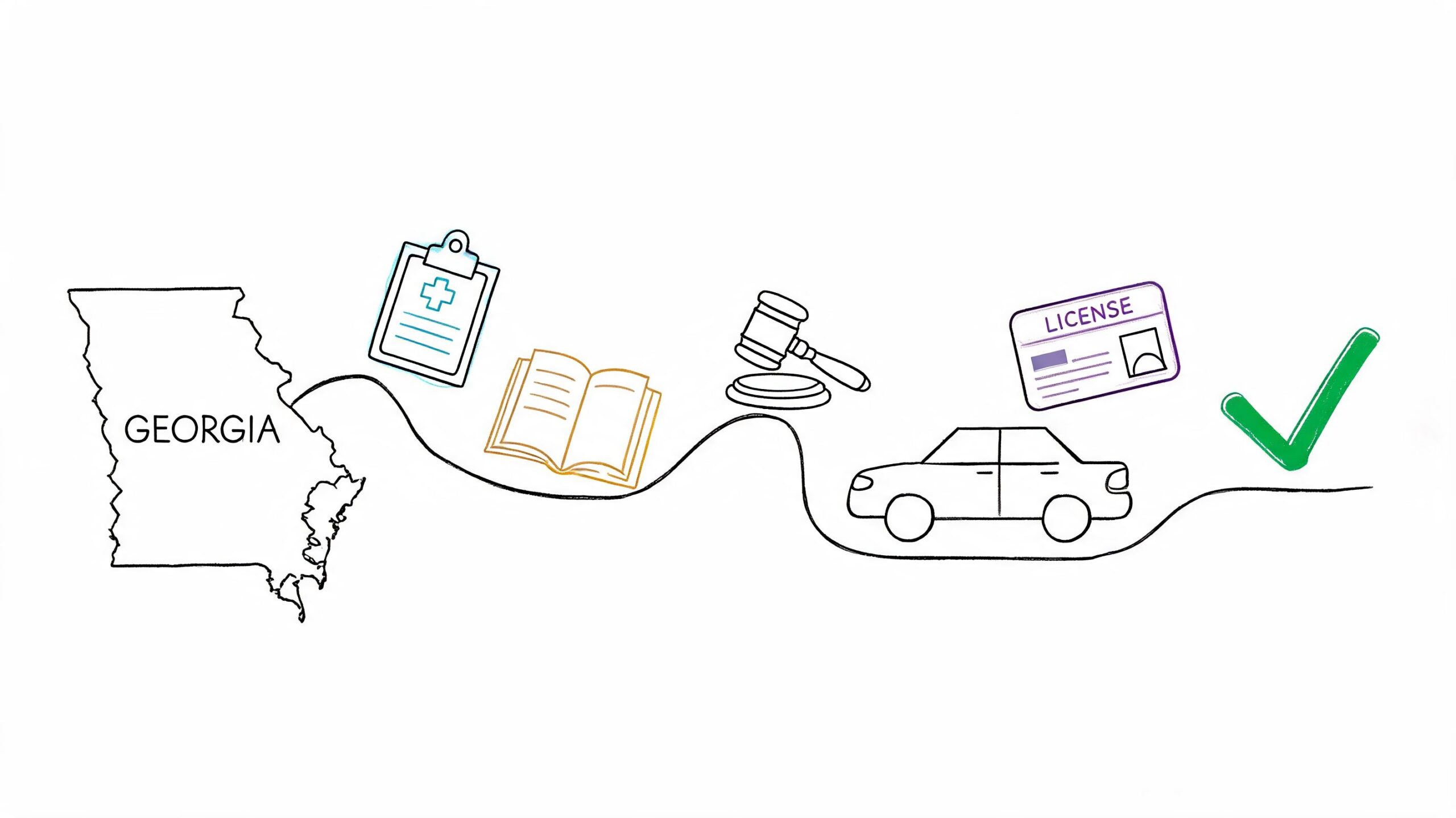
In practice, people often use the phrase return to duty process to describe two related but different tracks. For a CDL holder, it usually means the federal DOT process required before returning to safety-sensitive work. For a Georgia driver dealing with a DUI, it often means the larger path back to legal driving, including court compliance, clinical requirements, DDS reinstatement, and sometimes an ignition interlock requirement.
Those paths overlap in spirit. Both are built around evaluation, education or treatment, proof of completion, and careful documentation. Where people get in trouble isn’t usually the idea of compliance. It’s the paperwork, the timing, and the fact that one missing document can stall everything.
Navigating the Georgia Return to Duty Process After a DUI
The first thing to understand is that a Georgia DUI case and a DOT return to duty process are not the same system. They can happen at the same time, but they answer to different authorities.
A standard Georgia DUI case usually involves the court, the Georgia Department of Driver Services, and sometimes probation requirements. A DOT case involves federal rules for safety-sensitive employees, especially commercial drivers. Since the FMCSA Drug and Alcohol Clearinghouse launched on January 6, 2020, more than 75,000 drug and alcohol program violations have been reported, along with 6.2 million total queries checking driver status, which shows how central this system has become for commercial drivers under federal oversight (Acuity International overview of RTD requirements).
Two tracks that often run side by side
If you’re a non-CDL driver in Georgia, your path usually centers on:
- Court compliance: fines, reporting dates, probation terms, and any class or evaluation orders.
- DDS compliance: reinstatement steps, permit issues, and proof that state requirements are complete.
- Treatment compliance: clinical evaluation, recommended counseling or treatment, and course completion.
If you hold a CDL, add a second track:
- Federal compliance: SAP evaluation, treatment or education, Clearinghouse status, an observed return-to-duty test, and follow-up testing.
That’s where confusion starts. A person may finish the Georgia side and still not be cleared for commercial driving. Or they may complete federal RTD requirements and still have unresolved state license issues.
Practical rule: Treat the court, DDS, and DOT as separate checkpoints. Never assume one agency updates the others for you.
People also underestimate how stressful the legal side can feel in the first days after an arrest or citation. If you’re trying to understand timelines, court appearances, and the sequence of events, this guide on navigating the criminal justice system gives useful context for what happens around a charge before reinstatement questions are even resolved.
What the phrase really means in Georgia
In plain language, the return to duty process means this: you have to prove you’re eligible to drive again, and in some cases prove you’re eligible to work again.
That proof usually comes from a combination of evaluations, classes, treatment records, court compliance, DDS filings, and, for CDL holders, federal testing and Clearinghouse updates. The process is structured. It’s also unforgiving when people guess instead of verify.
Your First Step Mandatory Clinical and SAP Evaluations

Most delays begin right here. People want to jump straight to the class, the fine, or the DDS office. But in many cases, the first real step is an evaluation.
For a DOT-regulated commercial driver, the federal return to duty process starts with a Substance Abuse Professional, usually called a SAP. That isn’t optional. The process follows a required six-step method, and it begins with that initial SAP evaluation. Just as important, FMCSA Clearinghouse data cited in this industry summary shows that of roughly 65,000 drivers with violations, 41,029, or 63%, had not even started the process, often because they got stuck or confused at this first step (New Era Drug Testing on the six-step DOT RTD process).
For a Georgia DUI case, the first required assessment is often a clinical evaluation from a qualified provider. That evaluation helps determine whether the person needs education, treatment, or additional services.
What a SAP evaluation does
A SAP evaluation is focused on federal return-to-duty compliance. The SAP reviews the violation, substance use history, and other relevant information, then recommends what the driver must complete before moving forward.
The key point is simple:
- The SAP does not simply “sign you off.”
- The SAP sets the path you must complete.
- Without SAP clearance, the process does not advance.
A lot of CDL drivers lose time because they wait, hoping the problem will sort itself out. It won’t. The Clearinghouse record remains a barrier until the process is completed correctly.
What a Georgia clinical evaluation does
A Georgia DUI clinical evaluation serves a different purpose. It helps determine the appropriate level of intervention under state practice standards. Sometimes the recommendation is educational. Sometimes it points toward counseling or a higher level of care.
Expect questions about:
- Substance history: what happened, how often alcohol or drugs are used, and whether there’s a prior pattern
- Driving history: previous incidents, suspensions, or related legal issues
- Personal functioning: work, family, stressors, and whether substance use is affecting daily life
- Current legal requirements: what the court, probation, or DDS has ordered
If you want a practical overview of how evaluators approach substance-related DUI assessments, this Gerald Miller P.A. DUI evaluation guidance is helpful for understanding the kind of questions and concerns that often come up, even though Georgia uses its own providers and procedures.
Bring your paperwork, your ID, and your case details. People who show up guessing about dates, charges, or prior requirements usually create their own delays.
How to prepare before you book
Don’t go in with the goal of saying the perfect thing. Go in ready to be accurate.
A better approach is:
- Gather documents first. Court paperwork, probation instructions, license notices, and any employer documents matter.
- Confirm the provider type. A DOT SAP and a Georgia clinical evaluator are not interchangeable.
- Ask what the evaluation is for. Court, DDS, probation, or federal RTD all sound similar, but they are not.
- Use a compliant provider. For Georgia-specific evaluation services, review the available options through online drug and alcohol evaluation services.
The evaluation is the hinge point. If it’s done by the wrong provider or for the wrong purpose, everything downstream gets harder.
Completing Your Required DUI Education or Treatment

Once the evaluation is finished, the next question becomes practical: What exactly do I have to complete?
In Georgia, many drivers are directed into the DDS-approved Risk Reduction course, often called DUI School. It serves a rehabilitative purpose similar to the federal return to duty process. Established Georgia providers have guided over 100,000 participants through this curriculum over more than 38 years, which shows how central this course is to reinstatement and court compliance in the state (Georgia-related Risk Reduction background).
The most common education requirement
For many first-time DUI cases, the required educational step is the 20-hour Risk Reduction Program. In Georgia practice, this generally includes the assessment component and the classroom portion required by DDS rules.
What matters most is not just attending. It’s attending through a DDS-approved provider so the certificate is accepted where it needs to be accepted.
People get into trouble when they:
- Pick the wrong program: not every substance class satisfies a Georgia DUI order.
- Miss attendance rules: late arrivals and absences can force rescheduling.
- Fail to match the order: a court order for one requirement doesn’t automatically satisfy another agency.
A local option for this requirement is the DUI school in Lawrenceville, which reflects the kind of DDS-approved course structure Georgia drivers should look for.
When treatment is required instead of, or in addition to, class
Some evaluations recommend more than education. A person may be directed to ASAM Level 1 treatment or another counseling-based program rather than a classroom-only solution.
That changes the mindset. A class is finite and scheduled. Treatment requires ongoing participation, provider documentation, and completion standards that may depend on attendance, engagement, and discharge status.
Here’s the practical difference:
| Requirement | What it usually means |
|---|---|
| Risk Reduction course | State educational requirement tied to DUI and license reinstatement |
| ASAM Level 1 treatment | Outpatient treatment focused on substance use concerns identified in evaluation |
| Victim Impact Panel | Additional requirement sometimes ordered by court or probation |
| Additional counseling | Targeted follow-up based on evaluation findings or supervision terms |
A completion certificate only helps if it matches the exact requirement ordered. “Close enough” doesn’t work with courts, probation, or DDS.
What works and what doesn't
What works is a clean paper trail. Save every receipt, attendance sheet, discharge summary, and certificate. Keep digital copies too.
What doesn’t work is assuming the provider “sent everything over” and leaving it at that. Sometimes they did. Sometimes they sent it to one party but not another. Sometimes the court has it, but DDS doesn’t. Sometimes probation wants a different version.
A good habit is to ask three direct questions after any program ends:
- Who received my completion record?
- What document should I keep for myself?
- Is there any additional step before this counts as complete?
That level of follow-through saves people weeks of avoidable frustration.
Managing Court Requirements and DDS License Reinstatement
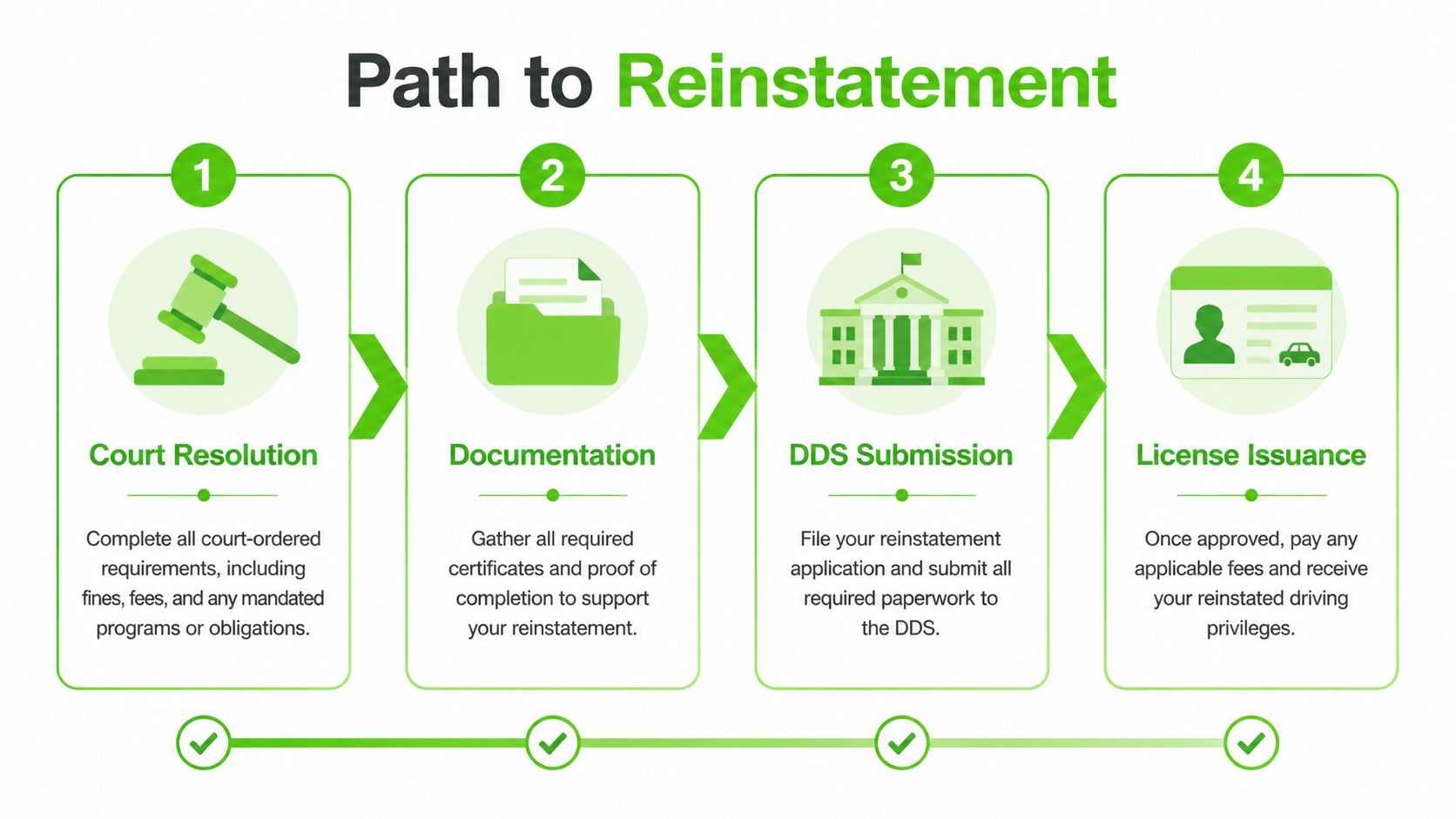
Finishing the class or treatment is a milestone. It is not the finish line.
The part that frustrates people most is usually the administrative side. They’ve done the hard work, but they’re still not legally back on the road because a certificate wasn’t filed, a reinstatement issue wasn’t resolved, or DDS still shows a hold.
That caution matters because RTD-related compliance stalls easily. One analysis highlighted a 16.3% completion rate, with 10,609 of roughly 65,000 drivers successfully completing the process, which is a strong reminder that bureaucratic follow-through matters just as much as the substantive requirement itself (TransComp Service on RTD completion barriers).
What the court usually expects
Every case is different, but the court side often includes proof that you completed what was ordered. That may include a Risk Reduction certificate, treatment discharge paperwork, payment records, probation compliance documents, or proof of other special conditions.
Use a folder and keep it current. Don’t hand over your only copy of anything.
A simple checklist helps:
- Court disposition in hand
- All class or treatment certificates copied
- Probation reporting complete
- Any special court conditions satisfied
- Deadlines written down, not memorized
What DDS usually cares about
DDS is focused on driving privilege. That means legal eligibility to reinstate, not whether your judge seemed satisfied in court.
Common DDS-related issues include:
- Suspension or revocation status
- Reinstatement eligibility
- Required fees
- Proof of course completion
- Permit or limited driving privilege questions
- Any ignition interlock or insurance-related condition
A lot of drivers assume the court “puts the license back.” Usually, it doesn’t work that way. The court may resolve the criminal case while DDS separately controls reinstatement.
For readers trying to sort out the federal side of this language, especially where SAP requirements fit into the larger picture, this overview of what the SAP program involves is useful context.
Administrative warning: Never drive because “everything should be clear by now.” Confirm reinstatement status directly before you get behind the wheel.
The practical paperwork approach
This is the method that prevents most reinstatement mistakes:
- Get every completion document in writing.
- Confirm whether the court, probation, and DDS each need separate proof.
- Check license status instead of assuming.
- Resolve insurance or ignition interlock requirements before driving.
- Keep copies after reinstatement too.
People who move carefully through these steps tend to get through the process with fewer surprises. People who rely on verbal assurances often end up making extra trips, paying extra fees, or waiting longer than necessary.
The Return to Duty Timeline Costs and Checklist
Two questions come up in almost every office conversation: how long will this take, and what will it cost?
The honest answer is that timelines vary because cases vary. A straightforward Georgia DUI reinstatement path may move steadily if the person books the evaluation quickly, completes the class on time, and handles DDS paperwork without delay. A CDL-related return to duty process can stretch longer because federal testing, SAP recommendations, employer coordination, and Clearinghouse status all have to line up.
The one cost figure that deserves special attention for commercial drivers is follow-up testing. Industry estimates in this guide place the series of follow-up tests alone between $500 and $2,000, and that burden is one reason many drivers never finish the RTD path (Delivered2Choices RTD follow-up testing guide).
Estimated Costs and Timelines for Georgia DUI Reinstatement
| Item | Typical Cost Range | Typical Timeframe |
|---|---|---|
| Clinical evaluation | Varies by provider | Usually scheduled early in the process |
| Risk Reduction course | Varies by provider | Typically completed once enrolled and attendance requirements are met |
| ASAM Level 1 treatment | Varies by provider and recommendation | Depends on treatment plan and attendance |
| Court fines and related legal costs | Varies by court and case | Based on the court schedule and compliance deadlines |
| DDS reinstatement fees | Varies by license status and DDS requirements | Paid when eligible to reinstate |
| SR-22 or related insurance costs | Varies by insurer and case | Starts when required and lasts per legal or administrative rules |
| Ignition interlock costs | Varies by vendor and duration | Begins after installation and continues while required |
| DOT follow-up test series for CDL drivers | $500 to $2,000 for the testing series cited above | Continues after return to duty under SAP plan |
Because most Georgia-specific fees and timelines depend on your court, provider, insurer, and driving record, the safest approach is to build your own checklist instead of relying on someone else’s estimate.
A checklist that actually helps
Use one page. Keep it current. Check off tasks only when you have proof.
- Evaluation completed: Keep the paperwork and confirm the recommendation.
- Education or treatment finished: Save the certificate or discharge summary.
- Court obligations satisfied: Verify fines, probation terms, and special conditions.
- DDS requirements confirmed: Check status directly before driving.
- Insurance and interlock handled: Complete these before assuming you’re clear.
- CDL federal items tracked separately: If DOT applies, keep those records in their own folder.
What slows people down
The biggest delays usually come from indecision and duplication. Someone books the wrong provider, waits too long to schedule, misses a class, or discovers late that the court and DDS wanted different proof.
A better rhythm is to handle the process in this order:
- Evaluation
- Assigned class or treatment
- Court compliance
- DDS reinstatement check
- CDL federal clearance, if applicable
That order won’t solve every case, but it prevents the most common mistakes.
Special Considerations for Georgia CDL Holders

If you hold a CDL, the return to duty process carries a different kind of pressure. For most Georgia drivers, reinstatement is about legal driving privileges. For CDL holders, it’s also about employment, federal compliance, and whether you can perform safety-sensitive work at all.
The center of that system is the FMCSA Clearinghouse. A violation there affects hiring, current employment, and your ability to return to duty. The process doesn’t end when you feel ready to get back in a truck. It ends when the required federal steps are completed and documented correctly.
The observed test and the follow-up plan
The RTD test is not just another drug or alcohol screen. It’s a required, directly observed test that must be passed before returning to safety-sensitive functions. After that, the SAP sets a follow-up testing plan, including at least six unannounced tests in the first 12 months, with the possibility of continued testing for a longer period under the federal rules described in the verified material.
That means CDL holders need to think beyond the first negative result. The true obligation is sustained compliance.
Here are the practical federal pressure points:
- Clearinghouse status matters: employers check it.
- Observation rules matter: shortcuts create invalid tests and delays.
- Follow-up tests matter: they don’t disappear because you changed employers.
- Employer discretion matters: a completed RTD process does not guarantee rehire.
The mistake that resets everything
The harshest rule in the federal process is the restart rule. If you fail an RTD test or a follow-up test, you do not pick up where you left off. FMCSA rules require you to restart from the beginning, including a new SAP evaluation and any further treatment or education required (FMCSA safety planner on RTD failure consequences).
If you’re a CDL holder, treat every follow-up test like your first and your last. A careless assumption can wipe out months of work.
For drivers trying to rebuild a commercial career after a setback, local workforce options matter too. If retraining or planning your next move is part of your situation, Patriot CDL Georgia training is one example of a Georgia-specific CDL training resource to keep in mind as you sort out the employment side.
Your Return to Duty Process Questions Answered
Can my employer still refuse to bring me back after I complete RTD?
Yes. Completing the federal return to duty process makes you eligible to return to safety-sensitive work under the rules. It does not force an employer to rehire or reinstate you. That decision still belongs to the employer.
If I’m not a CDL driver, do I still have a return to duty process?
In everyday Georgia practice, yes, people use that phrase broadly. It usually means your path back to lawful driving after a DUI. That path may involve a clinical evaluation, a Risk Reduction course, treatment, court compliance, DDS reinstatement, and sometimes additional requirements such as an ignition interlock.
What if my DUI happened out of state but I live in Georgia?
Treat it as a two-system problem. You may have obligations in the state where the offense occurred and separate consequences affecting your Georgia driving privilege. Don’t assume completion in one state automatically clears the other. Verify both.
What if I’m between jobs and I’m a CDL holder?
Federal RTD rules can still apply. Drivers in that position need to focus on the proper SAP process, Clearinghouse status, and lawful steps to complete the RTD pathway before returning to safety-sensitive work.
What’s the best way to avoid getting stuck?
Be organized and verify every step. Keep copies of everything. Confirm provider type before scheduling. Don’t assume a court requirement and a DDS requirement are identical. If DOT is involved, keep the federal process in its own lane and track it separately.
If you're ready to complete the Georgia requirement that most often stands between drivers and reinstatement, Georgia DUI Schools offers state-approved options for the course drivers often need after a DUI. You can review schedules and register through the Georgia DUI Risk Reduction course page.