Which Atlanta CDL school fits your life, not just your search results?
That is the right starting question. A good choice is not only about who is closest to home or who promises fast training. It is about matching the school to your budget, work schedule, permit status, and the kind of support you may need before and after class.
Atlanta gives new drivers real options. You will see private CDL schools with faster, career-focused training paths. You will also see public technical colleges that may cost less but run on a more structured academic schedule. The difference works a lot like choosing between an express lane and a local route. Both can get you to a CDL, but the time, cost, and pace can feel very different.
That is the framework this guide uses.
Instead of giving you another basic list, it compares Atlanta-area programs by the factors that usually decide whether a student finishes training and gets to work: tuition, scheduling flexibility, training format, location, and job placement support. If you are still early in the process, it also helps to review how to become a truck driver with no experience so you know what schools can, and cannot, do for a first-time driver.
One more factor gets ignored in many school roundups. Some students are not starting from a clean slate. They may also be handling Georgia license problems, DUI school requirements, probation terms, or defensive driving obligations while trying to enter CDL training. That can change which program is realistic for you. A school that looks affordable or convenient on paper may still be a poor fit if its schedule, admissions rules, or attendance expectations conflict with the rest of your responsibilities.
1. Roadmaster Drivers School in Atlanta Lithia Springs
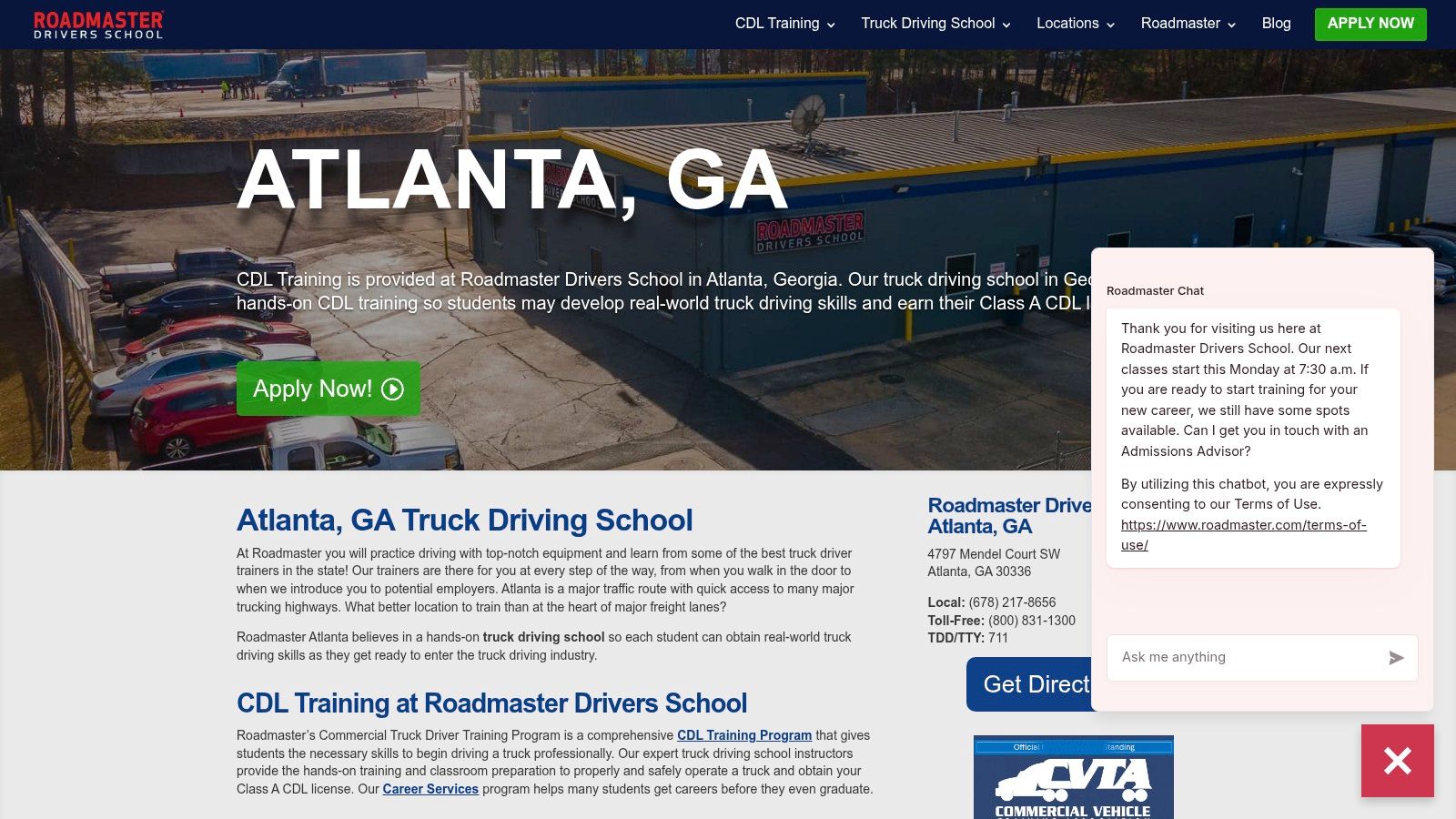
Roadmaster is one of the best-known private CDL brands in the country, and its Lithia Springs location gives west-metro students an Atlanta-area option with national name recognition. If you want a school that feels structured and career-focused from day one, this is one of the first places to consider.
Its appeal is simple. Roadmaster centers its program on Class A training, provides ELDT-compliant instruction, and promotes career services tied to carrier hiring. That makes it a practical pick for students who want a direct route from permit prep to test prep to entry-level job conversations.
Best fit for students who want a national brand
Roadmaster makes the most sense for students who prefer a large training provider over a smaller local operator. A larger school often has more standardized systems, more frequent class starts, and a clearer admissions process.
Helpful details to weigh:
- Training format: ELDT-compliant Class A theory plus hands-on range and road training.
- Practice environment: On-site equipment and a large training yard can make repetitive skills practice more straightforward.
- Career support: The school highlights hiring-partner relationships and career services.
- Schedule options: Weekday and weekend availability can help if you’re balancing work or family demands.
Practical rule: Ask any school how much time is spent on backing, public-road driving, and pre-trip repetition. “Fast” doesn’t always mean “well prepared.”
Roadmaster can also work for students who need a refresher path or want extra practice before testing. That matters more than many applicants think, especially if you’ve been away from structured study for a while or need extra time with inspection steps.
One more point. Before enrolling anywhere, make sure your permit timeline is realistic. If you need help understanding the first licensing step, review this guide on how to get your learner’s permit in Georgia.
Potential drawbacks are typical for a private school. Pricing isn’t listed publicly in a simple side-by-side way, and student reviews can vary by campus and instructor. Visit the school directly at Roadmaster Drivers School Atlanta.
2. Katlaw Truck Driving School in Austell
How easy is it to compare this school with your other Atlanta options before you ever make a phone call?
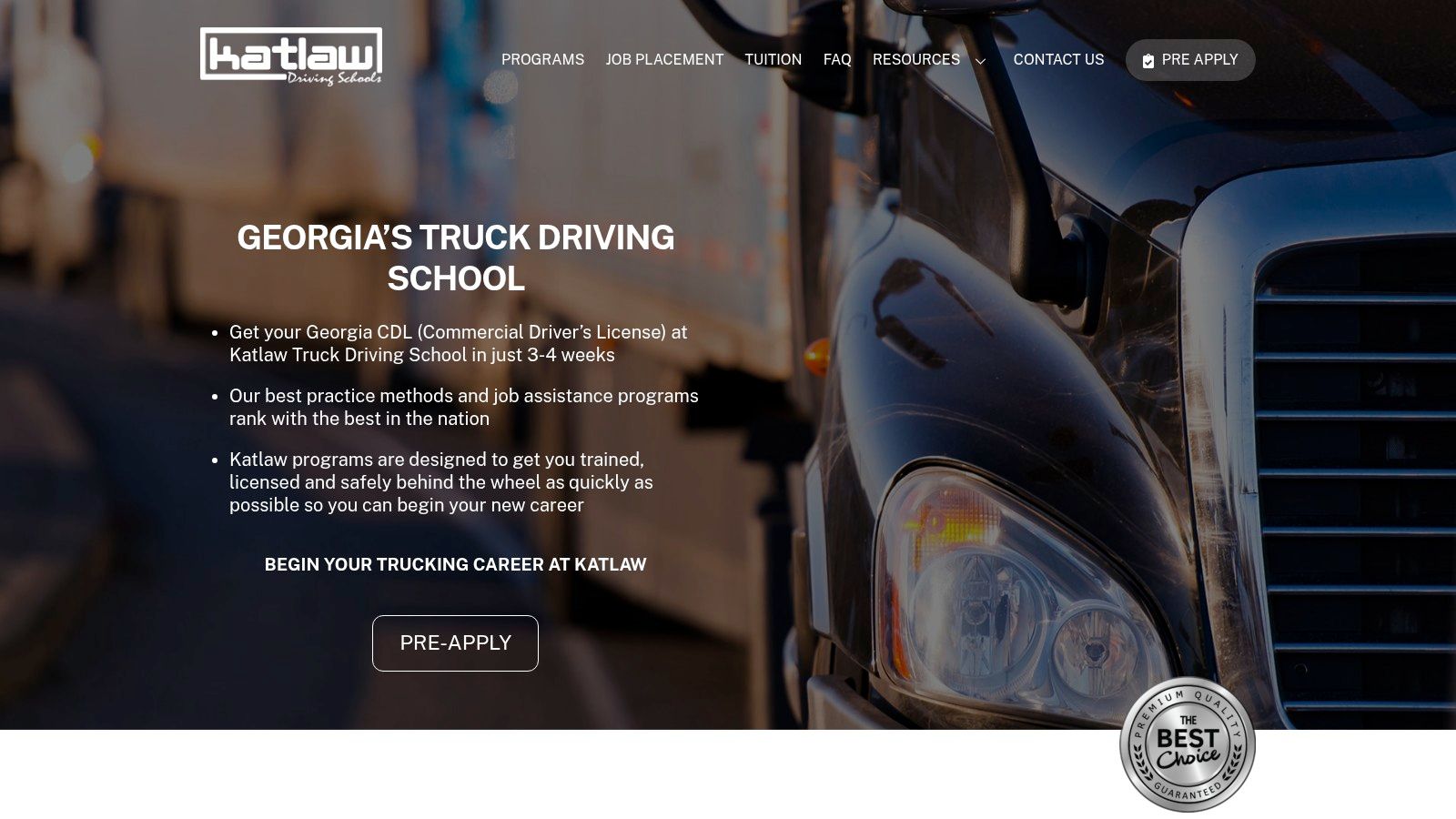
That question matters because private CDL schools can vary a lot in price, schedule, and support. Katlaw stands out for being easier to size up early. If you are trying to choose between a private school and a public technical college, that kind of clarity helps. A technical college may offer lower tuition, while a private program often appeals to students who want a faster start and more flexible attendance.
Katlaw offers Class A and Class B training with weekday and weekend options. For students in Austell, Mableton, Douglasville, and nearby west-metro areas, that location can remove a daily headache. Commute time is not a small issue in CDL training. A long drive to class can wear you down before you ever get to the range.
Best for students who want clearer up-front details
Katlaw makes sense for applicants who want fewer unknowns during the shopping stage. Instead of piecing together basic facts from multiple calls, you can review the program structure first and then focus your questions on what really affects training quality.
Here are the main factors to weigh:
- Program transparency: Katlaw publicly outlines its Class A and Class B paths, which makes side-by-side comparison easier.
- Schedule flexibility: Weekday and weekend attendance can work better for students who are keeping a job.
- License options: Class B availability helps if you are still deciding between tractor-trailer work and straight-truck routes.
- School status: The school describes its licensing and industry affiliations, which gives you a starting point for verification.
That last point is important. School marketing tells you what a program wants to highlight. Your job is to verify how it works in daily training. Ask how much time students spend on backing, road driving, pre-trip inspection practice, and test prep.
A simple way to judge Katlaw is to treat it like a scheduling-first option among private schools. If a public technical college is the budget pick, a private school like this may be the convenience pick. Neither is automatically better. The better choice depends on whether lower cost, faster entry, or a workable class schedule matters most to you.
The tradeoff is familiar. Private programs can be quicker to start, but you still need to confirm all funding choices and ask what job placement support looks like after graduation. Recruiter relationships are helpful, but a better question is this: which employers have recently hired graduates, and what endorsements or paperwork did those employers expect?
You should also make sure you understand the road rules that affect training and testing. This guide to Georgia driving laws and rules of the road is a useful refresher before you commit to any CDL program.
If your goal is to get licensed and road-ready without getting tripped up by testing details, this Georgia guide on passing your driver’s road test can help reinforce the testing mindset.
3. Atlanta Truck Driving School ATDS
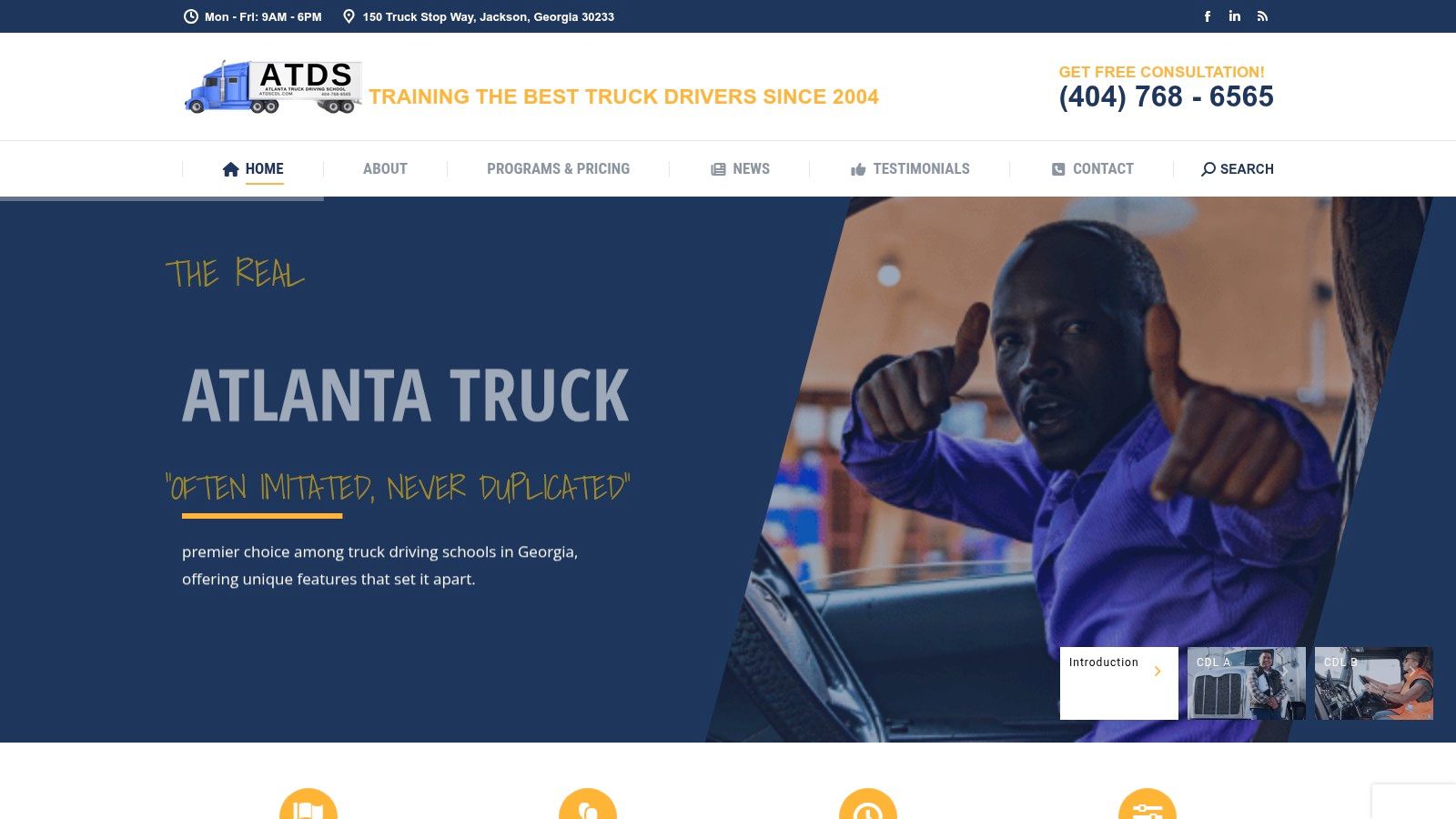
ATDS takes a different angle from many larger programs. Its main selling point is one-on-one behind-the-wheel instruction, which immediately changes the experience for students who learn best through individual coaching instead of rotating through group practice.
That model can matter a lot. In CDL training, the difference between watching and doing is huge. If you want more personalized time correcting turns, backing setup, or pre-trip flow, ATDS deserves a close look.
Best for individualized practice
The school offers CDL-A and CDL-B options and promotes flexible scheduling. It also uses online ELDT tools and 3D pre-trip preparation, which can help students who want to begin learning before stepping onto the range.
Why some students prefer it:
- One-on-one driving time: This is the school’s clearest differentiator.
- Flexible scheduling: Better for students keeping a current job.
- Online prep: ELDT and pre-trip support can reduce wasted in-person time.
- Multiple license paths: Helpful if you’re still deciding between A and B.
This setup is often a strong fit for students who know they don’t thrive in crowded training environments. If you get overwhelmed when too many students share one instructor’s attention, ATDS may feel more efficient even if the price ends up higher.
There’s also a practical benefit to the online prep approach. Students can start learning inspection patterns and terminology earlier, which often makes the first in-person days less intimidating.
What to ask admissions: “How is one-on-one time defined? Is it every drive period, or only part of the program?”
Because ATDS doesn’t publish straightforward pricing online, you’ll need to contact admissions for a quote and ask detailed questions. If you’ve had prior driving issues, it’s also smart to understand how state rules can affect your path into CDL training and employment. This summary of driving laws in Georgia is a useful starting point. School details are available at Atlanta Truck Driving School.
4. Georgia Driving Academy in Conyers
How do you choose a truck driving school if you are not starting from the same place as everyone else? Georgia Driving Academy in Conyers stands out for one simple reason. It gives students more than one path.
That matters in Atlanta’s CDL market. Some schools are built mainly for first-time Class A students who can attend a fast, fixed schedule. Georgia Driving Academy is a better school to compare if you need flexibility in the type of training, not just the class times.
The Conyers campus is a practical option for east-metro students, especially those coming from Rockdale County, Covington, or nearby parts of DeKalb. Less time in traffic can mean more reliable attendance, and that is not a small detail in CDL training. Missing a day in a short program can slow everything down.
Best for students who need more than one training path
Georgia Driving Academy offers Class A, Class B, and refresher training. That wider menu changes the decision. Private schools often work like express lanes. They can get the right student to the finish line quickly, but they are not always built for someone who needs a different route.
Here, the value is choice:
- Class A and Class B options: Useful if you are still deciding between long-haul tractor-trailer work and local straight-truck jobs.
- Refresher training: A better fit for returning drivers who do not need to start from zero.
- Online theory: Classroom work can often be handled before or alongside hands-on training.
- Job placement support: Employer outreach may help students who want help connecting training to actual hiring.
- Veteran benefit information: Helpful for applicants comparing how to pay for school.
This makes Georgia Driving Academy easier to compare against the public technical colleges later in this article. Public programs may offer lower-cost pathways and formal college credentials. A private school like this one usually appeals more to students who want speed, multiple program types, or a training option outside a college system.
There is another practical point to check before you enroll. If you have a DUI history, probation requirements, license issues, or other background concerns, do not assume the school schedule will line up neatly with your legal or reinstatement timeline. CDL training is only one part of the process. Hiring standards and licensing rules can create a second filter after graduation.
Ask direct questions before paying a deposit. Good examples include: “Do you train students with my license history?” “Will my record affect job placement help?” and “What should I clear up before classes begin?”
The main drawback is the same one you will see at several private schools in this market. Pricing is not laid out clearly online, so you need to request a quote and compare it carefully with what is included. Start with Georgia Driving Academy.
5. Atlanta Technical College Commercial Truck Driving
What if the best CDL training option for you is not the fastest one?
Atlanta Technical College deserves a serious look from students comparing truck driving schools atlanta options by cost, schedule, and support. Private schools often make the decision feel simple because they advertise speed and frequent start dates. A public technical college changes the math. You may trade some flexibility for a more formal admissions process, a college-issued credential, and possible access to public funding.
That difference matters because choosing a CDL school is a lot like choosing between a cash-price shortcut and a structured financing plan. One may get you on the road faster. The other may fit your budget better and give you more administrative support along the way.
Best for students comparing price against speed
Atlanta Technical College offers commercial truck driving training that leads to a Technical Certificate of Credit. For students who want a school with clearer institutional structure, that can be a real advantage. You are dealing with a college system, not just a training provider.
Here are the main reasons some students choose it:
- College credential: Training leads to a Technical Certificate of Credit.
- Structured program format: The admissions process is usually more formal than at many private CDL schools.
- Potential aid options: Eligible students may be able to use programs such as HOPE or WIOA.
- College support systems: Registration, advising, and other campus services may help students who want more guidance.
This option often fits three groups well. Students trying to keep tuition manageable. Younger applicants who are already comfortable with college paperwork and deadlines. Career changers who want a public-school setting instead of a fast sales call and a deposit request.
The tradeoff is timing. Public technical colleges often run on set schedules, and seats can fill before the next start date. If your goal is to begin training as soon as possible, a private school may still be the faster route. If your goal is to lower out-of-pocket cost and use available aid, Atlanta Technical College may be the stronger fit.
That is the key comparison point in this article. Private schools often compete on speed and convenience. Public technical colleges compete on price structure, credentialing, and funding access. Neither is automatically better. The better choice is the one that matches your work schedule, cash flow, and how quickly you need to get into CDL training.
You can review the program through Atlanta Technical College continuing education.
6. Chattahoochee Technical College Commercial Truck Driving
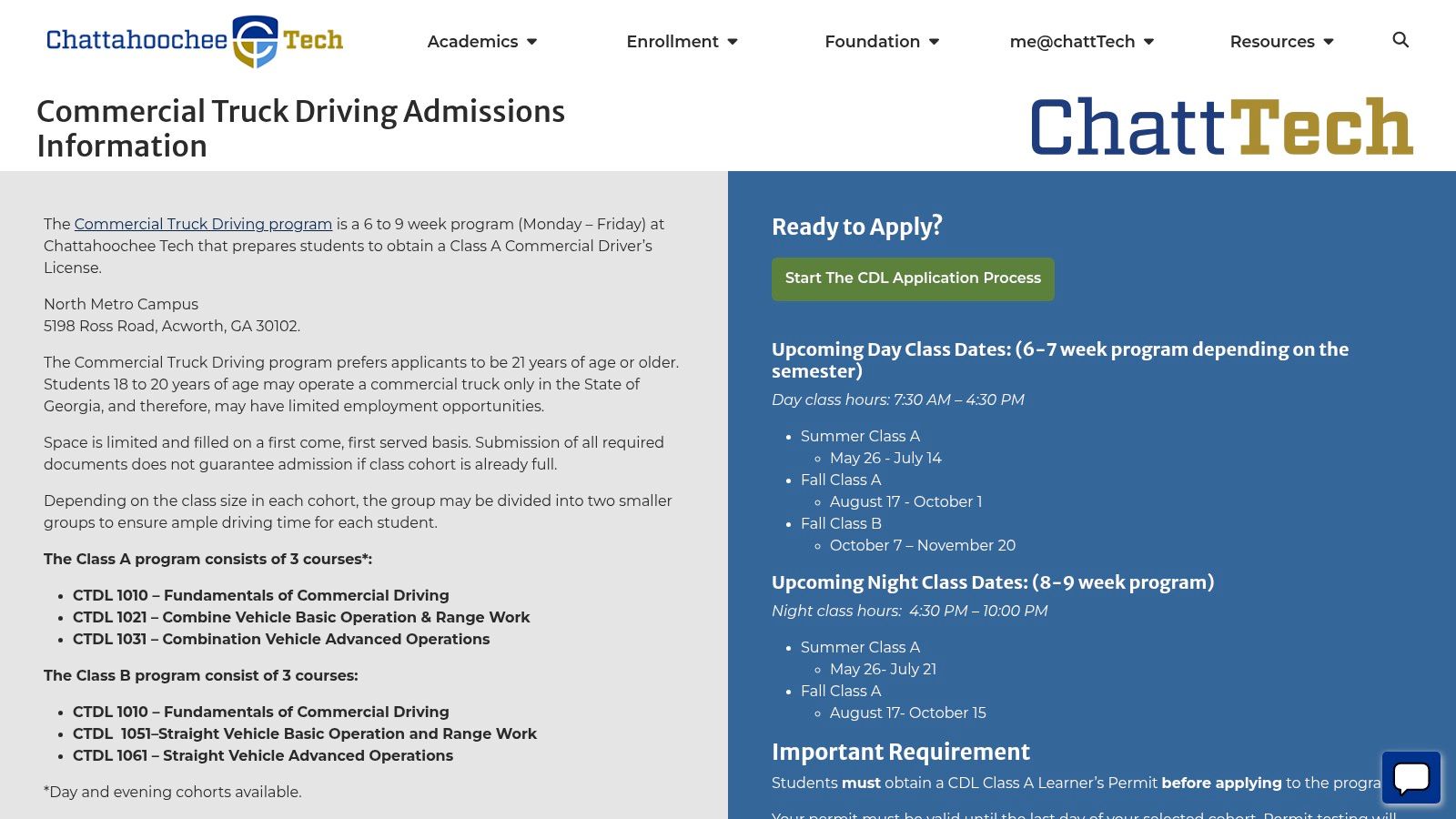
For north-metro students, Chattahoochee Technical College is one of the clearest public alternatives to private CDL schools. If you live in Acworth, Kennesaw, Marietta, Woodstock, or Cartersville, this option may save time and commuting stress while still giving you a state-college framework.
Its commercial truck driving program is built around a cohort model with range and road instruction at the North Metro Campus. That structure makes it easier to understand the admissions path before you commit.
Best for students who want state-college pricing
Chattahoochee Tech works well for applicants who are comfortable with a weekday school schedule and want a more predictable enrollment process. It also helps that the school posts admissions information clearly, including cohort details and counselor access.
A few points make it attractive:
- Cohort format: The program runs in a scheduled training block rather than rolling starts.
- Aid potential: Eligible students can explore state-supported grant options.
- Admissions support: Dedicated CDL admissions guidance can reduce confusion.
- Northwest metro access: A practical location for students outside the city core.
This kind of program often suits students who want lower-cost training and can commit to a school-first routine for several weeks. If you’re trying to work full-time at the same time, though, the weekday structure may be hard to sustain.
Public programs usually ask for more patience up front. In return, they may offer a better funding path and a more straightforward credential process.
Another important issue for north-metro applicants is marketing versus practice time. A review of Atlanta-area CDL offerings notes that many schools advertise short Class A programs but don’t break down actual behind-the-wheel repetition, backing practice, or simulator detail, leaving students to guess whether “fast track” training matches current standards and employer expectations. The same review points to TransTech’s Atlanta-area presence and notes that TransTech trains over 3,000 new truck drivers annually to meet regional demand, which shows how large some comparison points in the Southeast can be.
You can review admissions details at Chattahoochee Technical College CDL admissions information.
7. Daly’s Truck Driving School in Buford
Need the shortest path from training to a CDL test date?
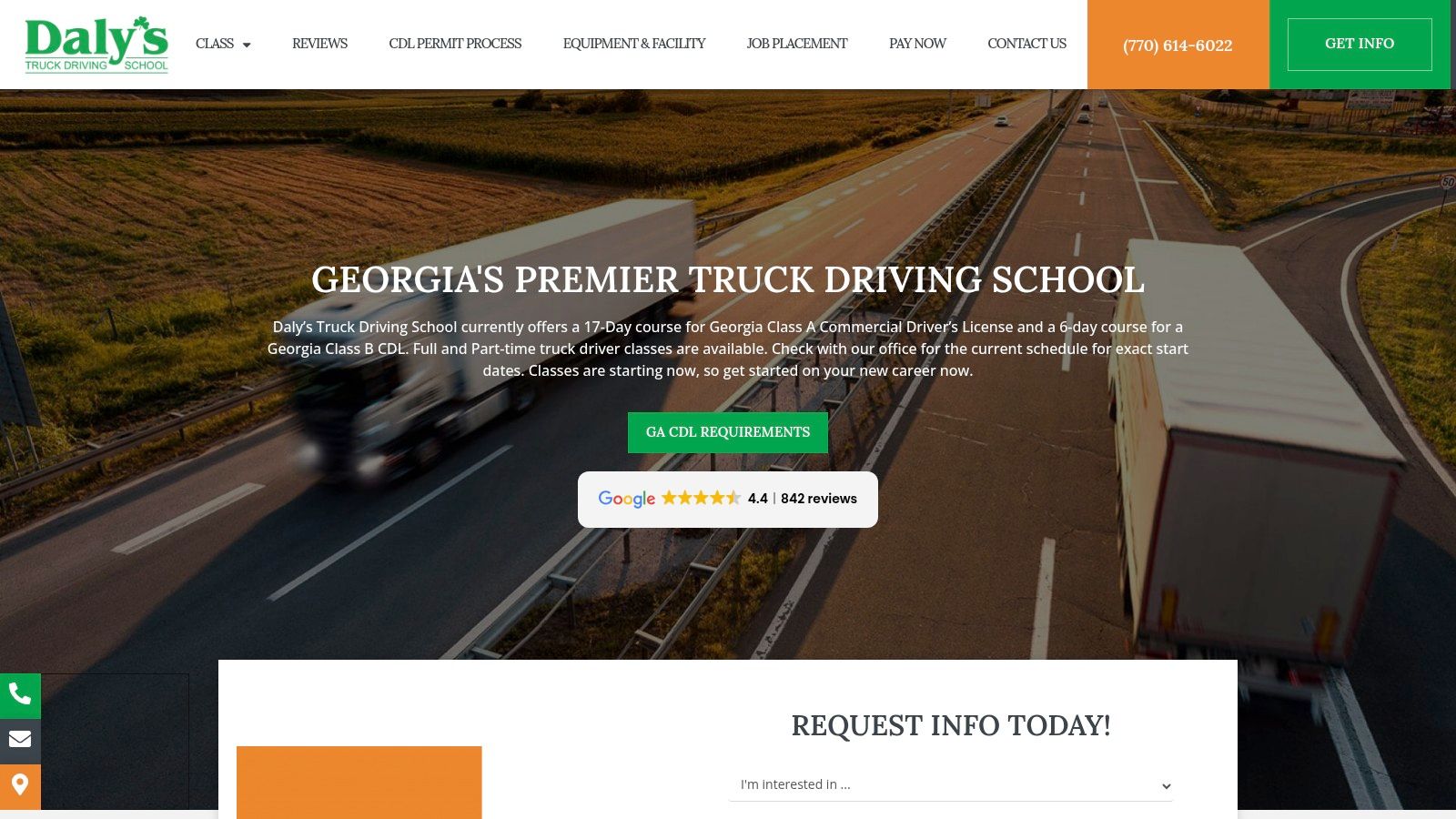
That question puts Daly’s in the right comparison bucket. Among Atlanta-area options, this school stands out for students who are choosing based on schedule speed first, then weighing whether the pace matches how they learn. If public technical college programs often feel like a semester model, Daly’s reads more like a compressed workshop. The tradeoff is simple. Less waiting can mean more pressure each day.
Buford also changes the commute equation. For students in Gwinnett, Hall, or north Fulton, a northside location may save hours each week compared with driving across metro Atlanta. That matters because CDL training is repetitive by design. A longer commute can drain time and focus before practice even starts.
Where Daly’s fits in your decision
Daly’s is easiest to evaluate through three factors: pace, license type, and support after training.
What stands out:
- Accelerated program structure: Daly’s promotes short Class A and Class B training paths, which will appeal to students with a firm timeline.
- Class A and Class B options: That gives you a clearer fork in the road if your target job does not require tractor-trailer work.
- Frequent start opportunities: Year-round availability may reduce the delay between enrollment and training.
- Job placement help: Support with employer connections can matter if you want a school that helps with the first step after licensing.
This setup can work well for students who already have their permit process handled and can treat training like a full-time commitment. It may also suit someone changing careers who wants a focused program instead of a longer college schedule.
Speed has a cost, though.
A short program only works if you can absorb skills quickly, show up consistently, and practice pre-trip inspection steps until they become automatic. CDL training works a lot like learning to back a trailer into a tight dock. Rushing is fine only if control stays sharp. If you know backing, shifting, or memorization takes you extra time, ask detailed questions about extra practice, retest policies, and whether additional instruction is available.
The main comparison points here are pricing visibility and commute fit. Tuition is not published as clearly as some competitors, so you may need a direct conversation before you can compare total cost against a public college or a larger private school. For a student using this article as a decision framework, Daly’s makes the most sense when a fast timeline matters more than maximum schedule flexibility or upfront price transparency.
Top 7 Atlanta Truck Driving Schools, Quick Comparison
| School | Implementation complexity | Resource requirements | Expected outcomes | Ideal use cases | Key advantages |
|---|---|---|---|---|---|
| Roadmaster Drivers School, Atlanta (Lithia Springs) | Moderate, ELDT-compliant curriculum with regular class starts | On-site trucks, large training yard, time commitment for Class A training | ELDT-compliant Class A training, skills testing, career placement opportunities | Students wanting a well-known multi‑campus provider with refresher options | National brand, on-site testing, strong carrier connections and career services |
| Katlaw Truck Driving School, Austell (West Metro) | Low–moderate, clear program outlines and published schedules | 160‑hour Class A program option, published tuition, financing guidance | Class A (160‑hr) or Class B certification with published cost expectations | Those who need transparent pricing and west‑metro access | Transparent tuition, financing/discount guidance, frequent recruiter visits |
| Atlanta Truck Driving School (ATDS) | Low, individualized one‑on‑one behind‑the‑wheel model | One‑on‑one BTW, online ELDT and 3D pre‑trip modules, flexible scheduling | Personalized driving competency for CDL‑A or CDL‑B | Working students or learners needing individual instruction and flexible hours | 100% one‑on‑one BTW, useful online prep resources |
| Georgia Driving Academy (GDA), Conyers (East Metro) | Moderate, blended online theory with scheduled BTW blocks | Online ELDT theory, scheduled behind‑the‑wheel, employer outreach, VA support | Class A/B training, refresher courses, job placement assistance | Students preferring online theory first or veterans seeking benefits support | Multiple program types, employer outreach, VA education assistance |
| Atlanta Technical College, Commercial Truck Driving (Atlanta) | Higher, academic cohort structure within college system | State college facilities, range and road training, access to HOPE/WIOA and financial aid | Technical Certificate of Credit plus ELDT‑aligned training and aid pathways | Students seeking affordable, credentialed pathway with public aid eligibility | Lower tuition than many privates, formal credential and public financial aid access |
| Chattahoochee Technical College, Commercial Truck Driving (Acworth/North Metro) | Moderate–high, 6–9 week weekday cohort model | State‑college pricing, HOPE Career Grant eligibility, scheduled M–F attendance | Class A certification through a state‑backed cohort program | Northwest‑metro residents who can attend weekday cohorts and want low cost | Regular cohorts, clear admissions process, lower‑cost state program |
| Daly’s Truck Driving School, Atlanta North (Buford) | Low, accelerated, frequent start dates (intensive schedule) | Intensive hands‑on practice, current equipment, short time commitment (17‑day A, 6‑day B) | Rapid completion of Class A or B with employer placement support | Learners wanting the fastest route to a CDL and frequent starts | Very accelerated timelines, longstanding regional provider with many graduates |
Protect Your Investment and Stay Compliant
Choosing among truck driving schools atlanta offers is only the first half of the decision. The second half is protecting the license and career you’re working to build. A CDL can open doors, but it also puts your driving record under much more scrutiny than most non-commercial drivers realize.
That’s why school selection and compliance planning should go together. If you’ve had a DUI, a suspension, court requirements, or a history that affects your driving privileges, deal with that before or alongside your CDL plan, not after you graduate. In Georgia, many Atlanta-area school sites still don’t clearly explain how DUI history, background checks, treatment obligations, or probation timing fit into CDL training and later employment. Students often discover the conflict too late.
Safe driving habits matter just as much after school. A clean record helps with employability, insurance, and confidence behind the wheel. Defensive driving isn’t only for drivers trying to erase a mistake. It’s also a practical way to sharpen judgment, reduce risk, and stay disciplined in traffic.
If your record already has points or you want to reinforce strong habits, a state-approved defensive driving course can be a smart next step. For Georgia drivers, that can support point reduction, insurance benefits in some situations, and a stronger safety mindset. Those outcomes matter even more for anyone planning to work in transportation.
Atlanta drivers also know the local pressure points. Heavy traffic around the Perimeter, merging on I-20, lane changes on I-85, and constant congestion near warehouse corridors all reward patience and hazard awareness. A professional driver can’t rely on luck. You need repeatable habits.
If you’re planning beyond your first job and thinking about independence in trucking, this guide on the roadmap to owner operator success is a useful next read.
The bottom line is simple. Pick the school that fits your real life, not the one with the best headline. Then protect that investment by staying compliant, keeping your record clean, and taking safety education seriously from the start.
If you need to complete a Georgia DUI or Risk Reduction requirement, get a clinical evaluation, attend a Victim Impact Panel, or strengthen your record with a defensive driving class, Georgia DUI Schools offers statewide online and in-person options built for busy drivers. For readers focused on protecting a CDL path or cleaning up a driving record before applying, the most relevant next step is the Georgia defensive driving course.