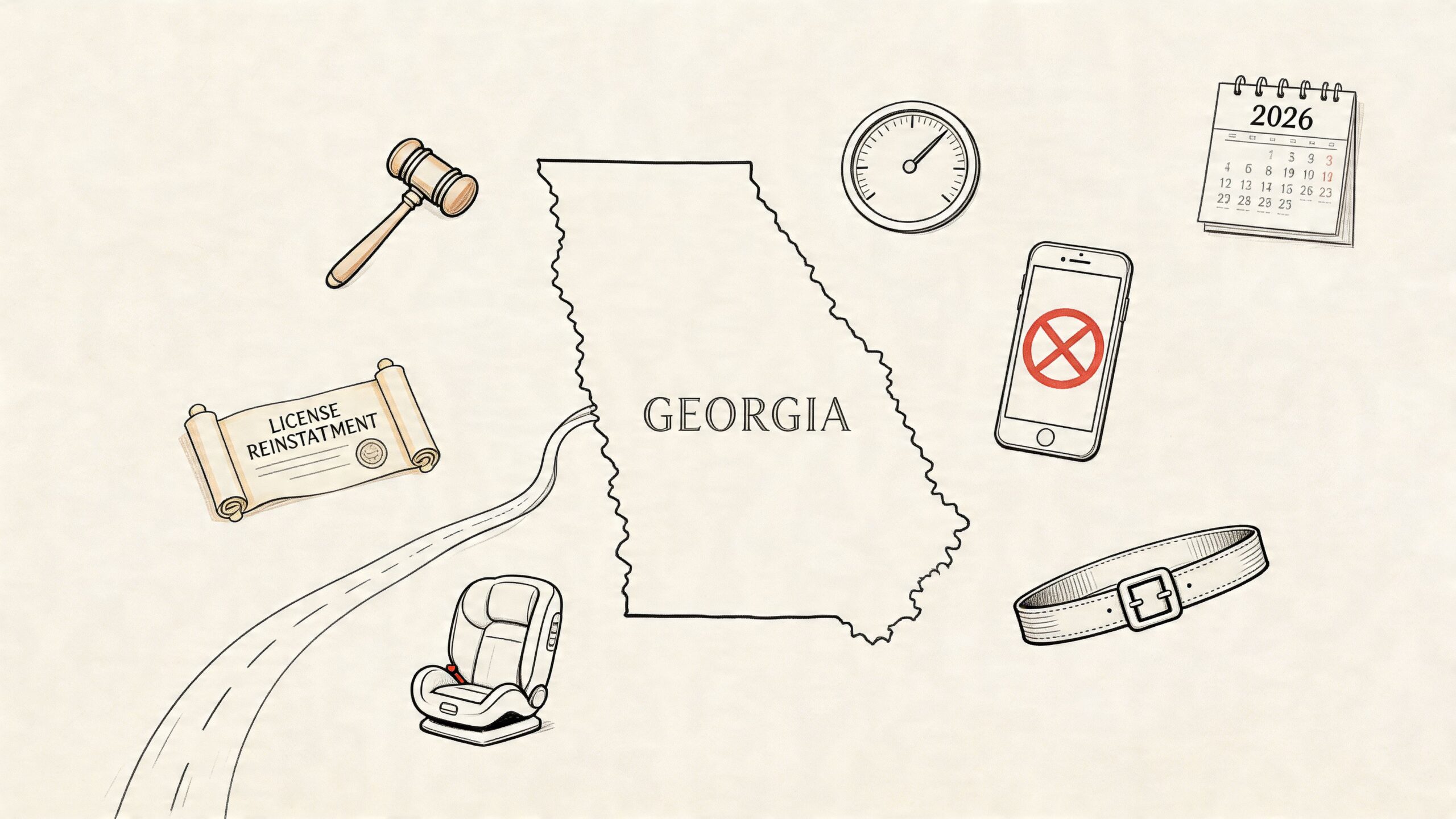
Blue lights in the mirror. A court date on the calendar. A letter from the Georgia DDS that doesn't read like normal English. That's where a lot of people start.
Most drivers don't go looking for guidance on driving laws in ga until something has already gone wrong. Maybe it was a DUI stop in Gwinnett, a distracted driving ticket on I-285, a suspension issue tied to a missed court date in a rural county, or a points problem that got worse faster than expected. The law can feel scattered because the consequences come from different places at once. The officer writes the citation. The court imposes requirements. DDS controls your license. Your insurer reacts later.
The good news is that Georgia's system, while strict, usually follows a pattern. If you know what bucket your problem falls into, DUI, points, distracted driving, suspended license, or reinstatement, you can stop guessing and start completing the right steps in the right order.
Navigating Your Rights and Responsibilities on Georgia Roads
The first mistake many individuals make is treating every traffic problem like it's just a ticket. In Georgia, that can cost you. A DUI charge, a hands-free citation, or a suspension notice can affect far more than the fine itself. It can affect your right to drive, your work schedule, your insurance, and the timeline for getting fully legal again.
If you've been arrested or detained during a traffic stop, it helps to understand the basics before you start making decisions. A practical primer on your rights when arrested in Georgia can give you that foundation and help you avoid making the situation worse in the first few hours.
A separate issue comes up after the stop. You need to know whether you're still legally allowed to drive and what proof you must carry. If that's unclear, review what documents you need to legally drive in Georgia before you get back behind the wheel.
Practical rule: Don't assume the court, DDS, and your insurance company are all looking at the same file. They aren't. You have to track each part yourself.
What works is simple, even if it isn't easy:
- Read every document carefully. Court paperwork, suspension notices, and DDS instructions don't always say the same thing.
- Match the violation to the requirement. DUI cases usually trigger education and reinstatement steps. Point cases often call for damage control before suspension.
- Act early. Waiting rarely improves a Georgia driving case.
- Keep proof. Save receipts, certificates, evaluations, and filing confirmations.
Drivers in Atlanta, Athens, Marietta, and smaller communities across the state run into the same issue. They know they have a problem, but they don't know which office or class fixes it. That's where clear sequencing matters.
Understanding Georgia DUI Laws and Penalties
A driver gets stopped after dinner, blows over the limit, and goes home thinking the main problem is court a few weeks later. In Georgia, that assumption causes a lot of avoidable damage. A DUI usually triggers two tracks at once: the criminal case and the license consequences through DDS. If you do not address both, you can finish one part of the case and still be unable to drive legally.
Georgia law sets the basic DUI standard at 0.08% BAC for drivers 21 and older and 0.02% for drivers under 21 under O.C.G.A. § 40-6-391. A first DUI is generally a misdemeanor, but that label misleads people. The practical fallout often includes a license suspension, court conditions, higher insurance costs, and completion of a state-approved Risk Reduction course before reinstatement can move forward.
I have seen the same mistake for years in DUI classrooms across Georgia. A driver waits for the court date, assumes nothing else can happen until then, and misses the steps that control whether DDS will restore driving privileges later. By the time they ask for help, the problem is no longer just the arrest. It is the paperwork they did not file, the class they did not complete, or the evaluation they did not know they needed.
BAC limits and what they trigger
The BAC number matters, but the number alone does not explain the whole case. Under-21 drivers get very little margin for error under Georgia's 0.02% standard. Adult drivers know the 0.08% number, yet many still do not realize that an arrest can start deadlines and administrative consequences before any conviction is entered.
That is why DUI cases feel more complicated than a typical traffic ticket. The stop leads to a criminal charge, but it also starts a compliance process. Depending on the facts, that process can involve a suspension, a permit issue, a Risk Reduction requirement, and sometimes a clinical evaluation or treatment recommendation.
For plain-language clarification, it also helps to understand the difference between DUI and DWI in Georgia, because Georgia law uses DUI and many drivers come in using terms from other states.
What a first DUI usually means
A first offense is often a misdemeanor, but it can still disrupt work, school, and family routines fast. Courts can impose fines, probation terms, community service, and other conditions. DDS can require separate action before you can lawfully drive again.
The part many drivers miss is the state-approved education piece. In Georgia, the Risk Reduction course is not a box to check whenever it feels convenient. In many DUI-related situations, it becomes part of the path to reinstatement, and timing matters. Finish it too late, and the rest of your reinstatement timeline gets pushed back with it.
One useful legal overview is 3 essential things every Georgia driver should know about DUI, especially for understanding how quickly a Georgia DUI can shift from a roadside stop to court and license trouble.
Georgia DUI penalties at a glance
Penalties rise with prior history, and courts do not treat repeat offenses lightly. Exact outcomes depend on the county, the judge, the prosecutor, and the facts of the stop, but the pattern is consistent. More prior DUI history usually means more restrictions, more scrutiny, and a harder road back to full driving privileges.
| Penalty | 1st Offense | 2nd Offense | 3rd Offense |
|---|---|---|---|
| Criminal classification | Misdemeanor | Misdemeanor | Misdemeanor |
| Fine exposure | Up to $1,000 | More severe than a first offense | More severe than a second offense |
| License consequences | Suspension risk and reinstatement requirements | Harsher licensing consequences | Harsher licensing consequences |
| Education requirement | State-approved Risk Reduction course required | Often part of broader court and DDS compliance | Often part of broader court and DDS compliance |
| Additional conditions | Case-specific court requirements may apply | Increased scrutiny and compliance demands | Increased scrutiny and compliance demands |
That table is useful, but the main issue is sequence. A driver with a first DUI often asks, "What do I do first?" The answer is usually: verify license status, read the DDS notice carefully, track the court case separately, then complete the state-required course and any other conditions tied to reinstatement.
The practical path after a DUI arrest
Drivers recover faster when they stop treating the case like one problem with one deadline.
- Check your current driving status with DDS. Do not rely on the fact that you still have the physical license in your wallet.
- Separate the court case from the license case. They affect each other, but they do not run on the same schedule.
- Find out whether a state-approved Risk Reduction course is required in your situation. If it is, complete it through a licensed Georgia DUI School and keep your certificate.
- Ask whether your case also requires a clinical evaluation or treatment referral. Some reinstatement cases stall right here.
- Keep copies of everything. Certificates, receipts, notices, and filings matter when DDS says something is missing.
That is the trade-off in Georgia DUI cases. Waiting feels safer because it avoids hard decisions for a few days. Acting early usually gives you more control over the reinstatement process and fewer surprises when it is time to get back on the road.
The Georgia Point System Speeding and Distracted Driving
A common Georgia license problem starts like this. A driver gets a speeding ticket on GA-400, pays it online, keeps driving, then picks up a hands-free citation a few months later. By the time DDS action shows up, the driver is no longer dealing with two isolated mistakes. The issue is now the driving record itself, and that record can affect what course options are available and how quickly the driver can clean things up.

Hands-free law means hands-free
Georgia's Hands-Free Law has been in effect since July 1, 2018, and drivers still misread it in the same ways I hear about in class every week. The biggest mistake is treating "I was stopped" or "I only touched it for a second" as a defense. In practice, holding or supporting the phone while operating the vehicle is what gets people cited.
These are the habits that cause the most trouble:
- Holding the phone at a red light. Stopped in traffic is still part of operating the vehicle.
- Using your hand to change music or a podcast. If you have to pick up or manually work the device, you are creating a citation risk.
- Reading a text without replying. Drivers often assume the problem starts only when they type. It doesn't.
- Assuming experience matters. The rule applies whether you've been driving six months or thirty years.
Bluetooth, voice commands, and dashboard-mounted use are the safer choices. The trade-off is convenience. A handheld phone feels faster in the moment, but that short shortcut can add a citation, points, higher insurance costs, and one more problem on a record that may already need repair.
Speeding is rarely a one-ticket problem
A single speeding citation does not always create a crisis. A pattern does.
That distinction matters because drivers often focus on the fine and ignore the record. DDS looks at the record. Insurance companies do too. If a driver is already trying to protect a license after another case, or trying to stay eligible for reinstatement, repeated moving violations make the path harder and more expensive.
The better move is early damage control. If points are already adding up, review how to reduce points on your Georgia license and verify whether a DDS-approved defensive driving course can still help based on your timing and history.
I tell drivers this all the time. Treat every citation as a record issue first and a payment issue second.
A defensive driving course can reduce points in some situations, but it is not a cure-all. It will not erase every consequence, and it does not fix a suspended license by itself. Still, for the right driver at the right time, it can be one of the few state-recognized steps that improves the record instead of just closing out the ticket.
What drivers usually misunderstand
Certain assumptions show up again and again, especially with commuters, younger drivers, and anyone who has been paying tickets online without looking at the long-term effect.
| Common belief | Reality in practice |
|---|---|
| "I was only checking a notification." | Handling the phone while driving can still lead to a hands-free citation. |
| "It was just one speeding ticket." | One ticket may be manageable. Several close together can create point trouble fast. |
| "I'll deal with it if DDS sends something." | Waiting usually limits your options and compresses your deadlines. |
The practical lesson is simple. Georgia does not treat speeding, distracted driving, and point accumulation as separate life problems. They connect on the same driving record. Once that record starts working against you, state-approved courses become more than a nice option. They become part of the compliance plan that helps you keep driving or get back to lawful status faster.
Other Critical Traffic Laws You Must Know
Some of the most frustrating Georgia citations come from laws drivers don't think about until they get stopped for violating them. These aren't "minor" in the sense that they can be ignored. They can add points, complicate a restricted license, and create new barriers when you're already trying to get reinstated.
The slowpoke law is real
Georgia's Slowpoke Law catches drivers who stay in the left lane and fail to yield to a faster-approaching vehicle from the rear, even if the slower driver is already traveling at the speed limit. The law applies on roads with at least two lanes in each direction, and violations can add points to a driver's record, which can complicate reinstatement, as described in this overview of Georgia driver laws including the Slowpoke Law.
That surprises people because they think "I'm doing the speed limit" is a complete defense. It isn't. On a multi-lane roadway, lane discipline matters.
Lane discipline and move-over habits
The left lane issue usually reflects a broader driving problem. Drivers get fixed on their own pace and stop reading traffic around them. That's also where move-over mistakes happen around emergency or service vehicles. Good drivers don't just avoid speeding. They stay aware of lane purpose, safe passing, and when the law expects them to shift position.
A few practical habits reduce a lot of unnecessary citations:
- Use the left lane to pass, not cruise. That habit alone prevents a surprising amount of trouble.
- Check behind you regularly. The law turns partly on whether you know or should know you're being overtaken.
- Don't argue with roadway design. If traffic conditions don't allow a move, adjust safely and prepare to stop if necessary.
- Treat work vehicles and roadside activity seriously. A casual response around roadside operations can become an avoidable citation.
Drivers with suspended or restricted privileges can't afford "small" violations. A point here and a point there can delay full restoration longer than the original driver expected.
Seat belts and child restraints
Georgia drivers also need to pay attention to occupant safety rules. Adults should make seat belt use automatic, and families need to be especially careful with child restraint compliance. In practice, these violations often show up during stops that began for something else.
If you're already under court or DDS scrutiny, avoid giving the officer a second reason to cite you. One stop can become several problems in a matter of minutes.
The Path to License Reinstatement in Georgia
A suspended license feels personal because it hits every part of daily life. Work. Child pickup. Probation reporting. Medical appointments. A lecture isn't what's needed at that point. A sequence is.
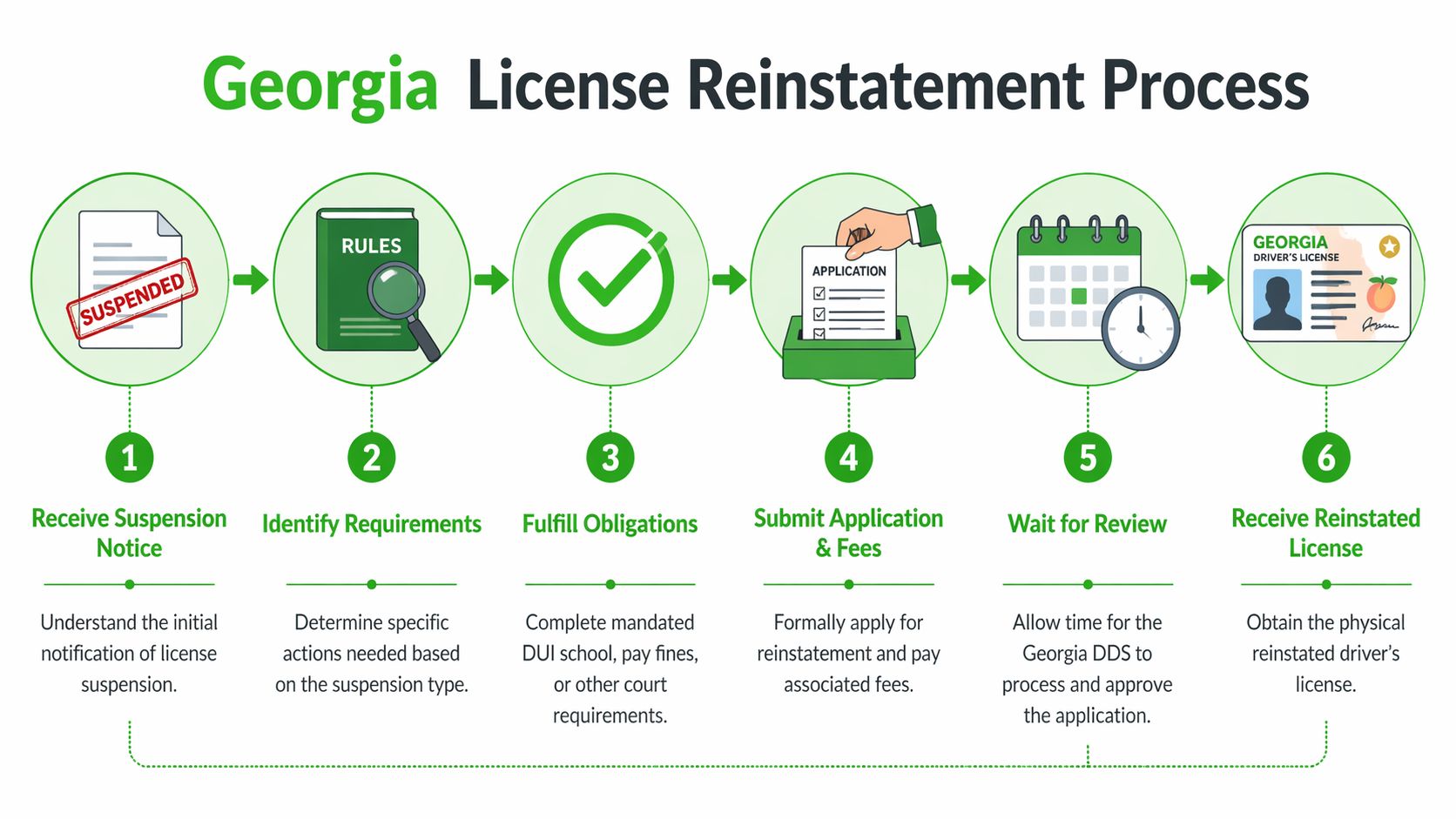
The right sequence starts with identifying why the license is suspended. A DUI suspension doesn't move the same way as a points suspension. A suspension tied to missed court doesn't move the same way as one tied to an unresolved alcohol or drug offense. The biggest delays happen when drivers complete the wrong task first.
Start with the cause, not the symptom
A suspended card in your wallet is only the symptom. The cause could be court nonappearance, unpaid obligations, accumulated violations, DUI-related requirements, or a combination of those.
That matters because reinstatement often requires multiple agencies to be satisfied. Court compliance alone may not restore your license. DDS may still need proof of course completion, proof that a hold has been lifted, or additional documentation tied to treatment or evaluation requirements.
A practical reinstatement workflow
The process usually works best when handled in this order:
- Read the suspension notice closely. Identify the stated reason and whether another agency must act before DDS can.
- Resolve any active court issue. If the case is open, missed, or unpaid, fix that first.
- Confirm every required program. This may include Risk Reduction, a clinical evaluation, treatment, or another court-ordered condition.
- Collect proof before you submit anything. Missing paperwork causes avoidable delays.
- Apply for reinstatement through the correct channel. Some drivers can do parts remotely. Others may face in-person hurdles.
- Do not drive until your status is restored. "I thought it had gone through" is one of the costliest sentences in this process.
| Reinstatement obstacle | Best response |
|---|---|
| Missed court or unresolved citation | Get the court matter reset or resolved before focusing on DDS |
| DUI-related hold | Complete the required education and any added conditions |
| Missing documentation | Gather certificates, evaluations, receipts, and identity documents before filing |
| Unclear eligibility to drive | Verify status directly rather than assuming based on old paperwork |
The real problem many drivers face
State law and agency practice don't always line up neatly in real life. A major example involves House Bill 926, which was designed to help low-income Georgians restore licenses suspended for missing court by allowing fee waivers and automatic reinstatement. But DDS-imposed in-person requirements have created barriers, especially for rural drivers, according to this analysis of how DDS implementation has complicated HB 926 relief.
That issue lands hardest on people who are already stretched thin. If you live outside a major metro area, don't have reliable transportation, and need your license back to work, an in-person requirement can become the very barrier that keeps you from completing the process.
Bureaucratic friction is part of the reinstatement process for many drivers. Planning around it is smarter than being surprised by it.
What works and what doesn't
What works is overpreparation. Bring more documentation than you think you'll need. Confirm office requirements before traveling. Keep copies of everything. If a court, probation office, or counselor gives you an instruction, write it down with the date and the person's name.
What doesn't work is assuming one agency can see another agency's updates in real time. It also doesn't work to complete a class and assume that completion has automatically solved every hold on your record. The class may be necessary, but it may not be the final step.
In cities like Atlanta, getting to a DDS office may be inconvenient. In rural Georgia, it can be a transportation crisis. Either way, a reinstatement plan has to account for the actual logistics of your life, not just the legal requirement on paper.
How Georgia DUI Schools Helps You Meet State Requirements
By the time most drivers reach this point, they don't need more theory. They need to match the state requirement to the correct service. That's the part many people get wrong. They know they need "a class" or "an evaluation," but they don't know which one satisfies which part of the case.
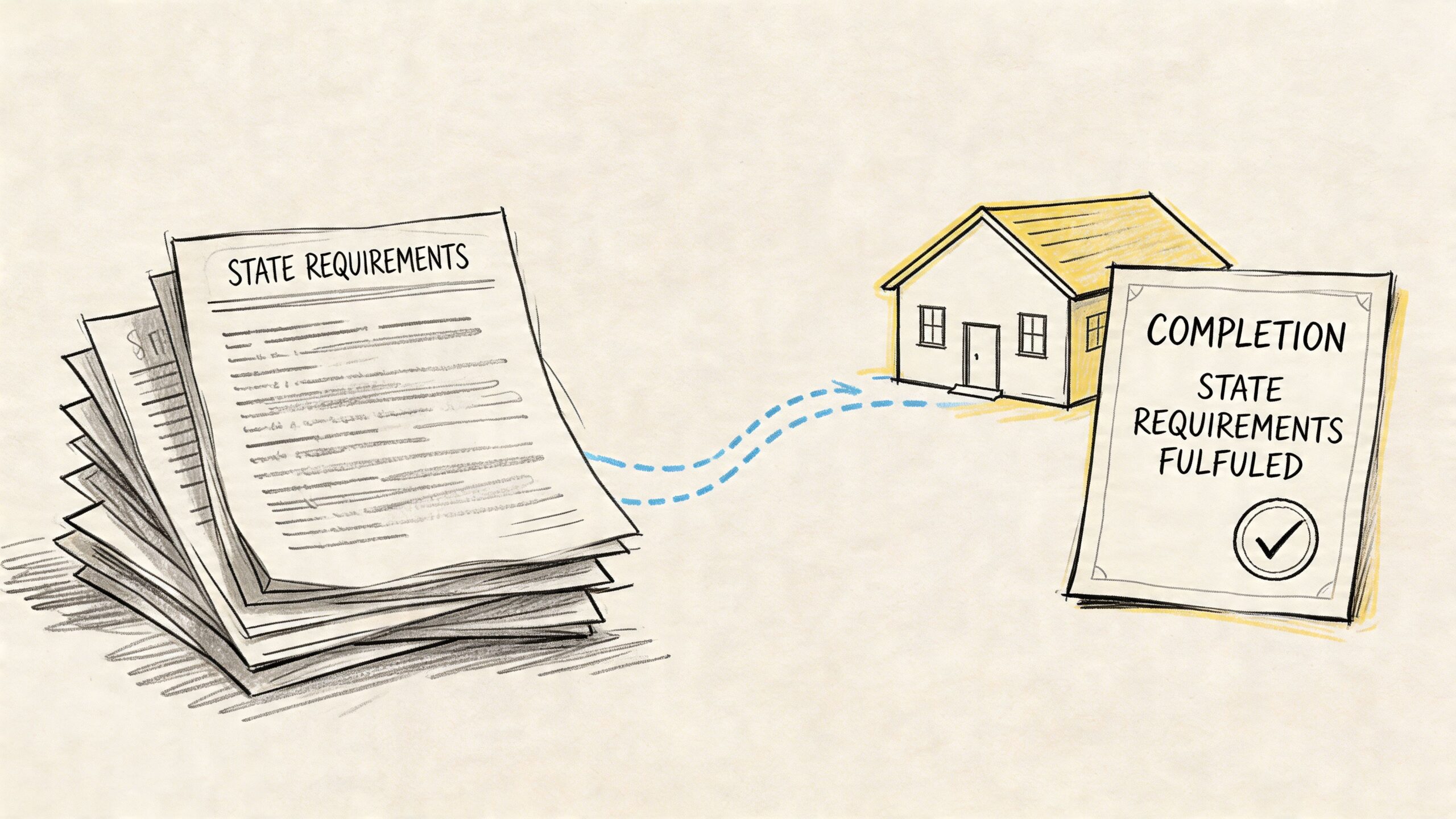
A Risk Reduction course is the core requirement in many DUI and drug-related driving cases. In Georgia, that isn't a generic driver improvement class. It's the state-approved intervention program that courts and DDS recognize for alcohol and drug-related offenses. For many drivers, this is the first required credential on the road back to reinstatement.
A defensive driving course serves a different purpose. It is commonly used by drivers who need point reduction, who want to address a traffic citation proactively, or who are trying to qualify for an insurance benefit if eligible. It doesn't replace a DUI intervention requirement. That's a common and expensive misunderstanding.
Matching the service to the problem
Use this simple decision guide:
- DUI or drug-related offense: You may need a state-approved Risk Reduction course.
- Points problem or traffic citation: A defensive driving course may help with point reduction and related compliance.
- Court says evaluation required: You likely need a clinical evaluation, not just a class.
- Evaluation recommends treatment: That can lead to ASAM Level 1 treatment or another counseling requirement.
- Victim-focused accountability requirement: Some cases call for a Victim Impact Panel.
These aren't interchangeable. Taking the wrong program first doesn't usually earn partial credit. It usually just costs more time.
Where people lose time
The biggest delays usually come from one of four mistakes:
- They enroll in the wrong course.
- They finish the class but don't keep proof of completion.
- They ignore the evaluation requirement because they think the class covers it.
- They wait until a court deadline is close, then discover classes, documents, and processing all take coordination.
For drivers who need one provider that offers multiple required services, Georgia DUI Schools provides DDS-approved Risk Reduction courses, defensive driving options, and clinical services including evaluations, ASAM Level 1 treatment, and Victim Impact Panels. That's useful when a case involves more than one layer of compliance and the driver wants fewer handoff problems.
The fastest path is usually the clearest one. Identify the exact requirement, complete the exact service, and keep proof for every step.
A better way to think about compliance
Don't think in terms of "checking boxes." Think in terms of clearing holds.
A court hold, an education requirement, and a clinical recommendation are three different barriers even if they came from one incident. Drivers who understand that distinction tend to move through the process with fewer restarts. Drivers who don't often end up repeating calls, trips, and filings they could have avoided.
If you're helping a family member, employee, or client, ask for the actual paperwork before recommending any class. In this area, verbal summaries are often incomplete.
Navigating New Georgia Driving Laws in 2026
Georgia driving law keeps moving, and that matters most to drivers already in the system. As of January 1, 2026, new laws such as electronic driver's licenses under HB 221 and increased uninsured motorist coverage mandates for DUI convictions under HB 404 are in effect, according to this report on new Georgia laws taking effect in 2026.
The practical takeaway is mixed.
Electronic credentials could make parts of verification easier for some drivers. If you're trying to prove identity or current status during enrollment, reinstatement steps, or court-related processing, digital licensing may remove some friction. But drivers shouldn't assume every court clerk, probation office, or third-party desk process will adapt at the same speed. When a legal deadline matters, it's still wise to confirm what form of ID or proof will be accepted.
The insurance side cuts the other direction. Increased uninsured motorist coverage mandates tied to DUI or reckless driving convictions can make the financial aftermath of a conviction heavier. That doesn't change the legal requirement to complete the necessary programs, but it does raise the cost of getting back to normal.
A lot of drivers think of compliance as an isolated legal expense. It isn't. In 2026 and beyond, it should be viewed as part of a broader recovery plan that includes licensing, documentation, and insurance impact.
Take Control and Get Back on the Road
Georgia traffic law is strict, but it isn't random. The system follows rules, deadlines, and required steps. Once you identify the specific issue, DUI, distracted driving, points, suspension, or reinstatement, the path gets clearer.
The most common failures aren't dramatic. They're ordinary mistakes. Taking the wrong class. Missing a document. Assuming DDS has already updated your record. Waiting too long because the paperwork looks confusing. Those mistakes keep people off the road longer than necessary.
The solution is steady compliance. Resolve the court side. Complete the right education or clinical requirement. Keep proof. Verify your status before you drive. If you do that, Georgia's system becomes manageable.
| CTA Text | URL |
|---|---|
| Start your state-required DUI intervention program | https://georgiaduischools.com/dui-risk-reduction/ |
If you need to satisfy a Georgia DUI or drug-related driving requirement, start with the state-approved DUI Risk Reduction course at Georgia DUI Schools. It's the most direct next step for many drivers working toward compliance, reinstatement, and a lawful return to the road.