Getting handed a court order for a drug or alcohol test in Dublin can make the whole case feel bigger overnight. While compliance itself is rarely a point of confusion, the intricacies that often puzzle individuals involve what test they need, where to go, what the collection site will do, and how that one appointment fits into everything else the court and DDS expect.
That confusion is common in Laurens County. The process looks simple on paper, but one wrong assumption can slow down your case. If you schedule the wrong test, show up without the right paperwork, or use a site that doesn’t handle the kind of collection your order requires, you can lose time you may not have.
Facing a Drug Test in Dublin GA Start Here
You leave court in Dublin with a deadline, a form that says drug test or alcohol test, and about ten unanswered questions. That is the point where people lose time. They assume any clinic can handle the order, then find out later the collection type, paperwork, or reporting instructions did not match what the court, probation office, or DDS required.

In Laurens County cases, testing is usually only one checkpoint. The result may need to support probation compliance, a substance use evaluation, license-related steps with the Georgia DDS, or all three. That is the gap many local testing searches do not explain. A collection site may handle the specimen correctly and still leave you guessing about what comes after it.
What trips people up first
The first problem is treating the test like the whole requirement instead of one document in a longer file. Courts and DDS processes often connect. A missed step after the test can hold up progress just as much as a missed appointment.
Bad advice causes the second problem. If you have been reading about what works for a drug test, separate recovery information from internet shortcuts. In a court-ordered setting, tricks create more risk than benefit. Dilute samples, missed reporting windows, and using the wrong collection site can all create new problems.
Practical rule: Read the exact wording on your order before scheduling anything. The test type, observation requirement, deadline, and reporting destination control the process.
Your first moves in Dublin
Start with the paperwork, not the location search. I tell people to verify four points before they book anything:
- Who ordered it: court, probation, attorney, employer, or treatment provider
- What test is named: urine, EtG, breath alcohol, hair, or another collection type
- Whether observation or chain of custody is required
- Where the result must be sent
Then gather what you need for the appointment:
- Court order, referral, or probation form
- Government-issued photo ID
- Any case number or officer information tied to the order
- Your reporting deadline
If the form is vague, stop and confirm it. Do not guess. The wrong test can cost you another fee, another trip, and in some cases an explanation to the court.
People often search for drug and alcohol testing of georgia dublin ga because they need a local site quickly. That search may help you find a collection point, but it does not explain how the result fits into the rest of your case. For that bigger picture, review the court-ordered drug test procedure in Georgia so you can line up the test with the next required step instead of treating it like a separate errand.
Decoding Your Test Order Urine Hair and Breath Tests
A lot of people get stuck here. The order says “drug test” or “alcohol test,” and they assume any test will satisfy the requirement. In court and DDS-related cases, that assumption creates avoidable problems.
The test named on your paperwork answers a specific question. Urine testing is usually ordered for recent drug use. EtG urine testing is commonly used when the court, probation, or a treatment provider wants to check for recent alcohol use. Breath alcohol testing measures current alcohol presence, which makes it useful for immediate sobriety checks. Hair testing is different. It is used when the concern is a longer pattern of use rather than what happened in the last day or two.
Urine, EtG, breath, and hair
A standard urine drug screen is still the test people see most often in Dublin-area court and probation matters. It is widely accepted, relatively easy to schedule, and straightforward to document when chain of custody is required. That makes it a practical choice for many judges, probation offices, and referral sources.
EtG urine testing serves a narrower purpose. It is typically used to detect recent alcohol consumption over a longer window than a breath test. If your order focuses on abstinence from alcohol, this is often the test that matters, not a basic drug panel.
A breath alcohol test, or BAT, is more about the present moment. It tells the requesting party whether alcohol is in your system at the time of testing. It does not provide the same historical picture as EtG or hair.
Hair testing usually comes up when the case calls for a broader review of substance use history. Courts and attorneys may request it when they want more than a recent snapshot, especially if there are concerns about repeated use or attempts to avoid detection.
Why the test type matters in a Georgia compliance case
Here is the trade-off. Urine is usually easier to access and often costs less, but it mainly addresses recent use. Hair gives a longer lookback period, but it may cost more and is not always what the order requires. Breath testing is quick, but only useful if the question is current alcohol use. EtG can be helpful for alcohol monitoring, but it still has to match the wording of the referral.
That distinction matters because a test result rarely stands alone in a Georgia DUI or court matter. The result may need to support a clinical evaluation, satisfy a probation condition, or fit into the paperwork for DDS reinstatement steps. That is where people lose time. They treat testing like an isolated errand instead of one part of a larger compliance process.
If you need help matching the order to the right collection and the next required step, review this court-ordered drug test procedure guide for Georgia cases. It explains how the test result fits with evaluations, reporting, and DUI school requirements.
Quick comparison of common court-ordered tests
| Test Type | Detection Window | Commonly Used For | Approx. Cost |
|---|---|---|---|
| Urine drug screen | Short-term window | General court or probation drug screening | Usually lower than hair |
| EtG urine | Short recent alcohol window | Alcohol abstinence monitoring | Varies by site |
| Breath alcohol test | Very recent alcohol use | Immediate sobriety checks | Varies by site |
| Hair follicle | Longer historical window | Probation, court, longer-use history | Usually higher than urine |
One practical warning. People sometimes assume a newer or stricter-sounding test is automatically the better option. Courts do not reward guesswork. They want the ordered test, collected the right way, with the right documentation.
If you are curious about how testing tools are changing, this blog post about marijuana breathalyzers gives useful context on why alcohol-style detection does not always translate cleanly to other substances.
Read the order exactly. Then match the test to the requirement. That is how you avoid paying twice and having to explain a rejected result later.
Where to Get Your Drug and Alcohol Test in Dublin
A common mistake happens right after someone reads the court order. They pick the closest testing site, get to the front desk, and find out the location cannot perform the exact collection the court, probation officer, or DDS process requires. That delay can cost a day, a filing deadline, or a second testing fee.
Known Dublin-area options
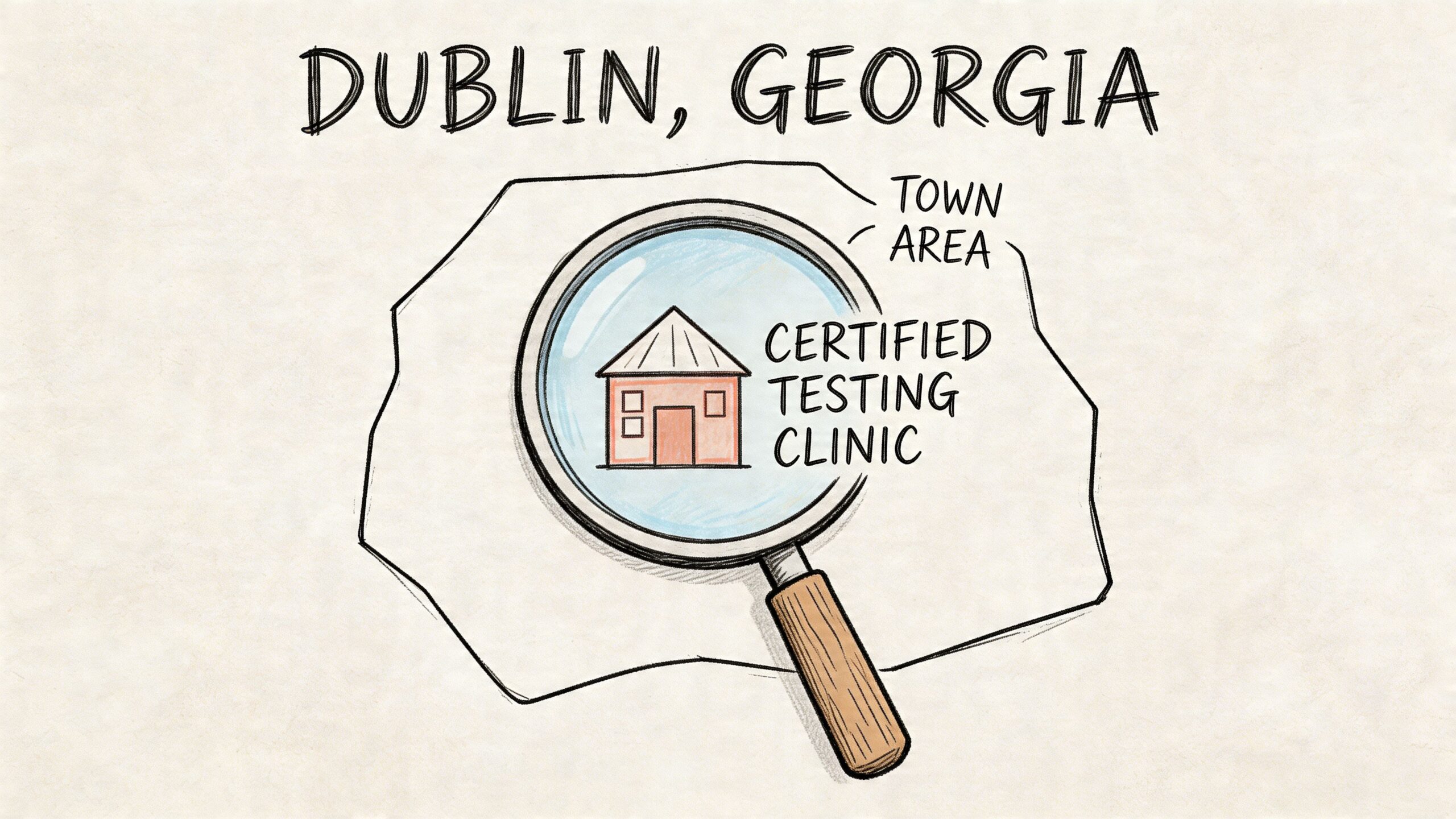
Dublin does have local collection options, including Drug and Alcohol Testing of Georgia, Inc. at 1022 Hillcrest Parkway, Suite 200. As noted earlier in this article, that site is commonly referenced for court-related testing such as observed urine collections, breath alcohol testing, and hair testing. It may not handle every regulated testing category, especially certain DOT follow-up or return-to-duty matters, so commercial drivers need to confirm details before booking.
You may also see Dublin-area testing availability listed through larger national networks and Quest-affiliated collection access points, including addresses such as Hillcrest Parkway and Bellevue Road. That can be useful for finding a nearby site, but proximity is not the primary concern. The fundamental challenge is whether the location can collect the exact test named in your paperwork and document it in a way your case will accept.
That distinction matters more than many people expect. A standalone testing facility may handle the specimen correctly and still leave you on your own for the next required step. In Georgia, the test result is often only one part of the process. You may still need a clinical evaluation, a Risk Reduction course, DDS compliance, or court reporting. That is the gap many drivers run into, and it is why it helps to line up the full process early instead of treating the drug screen like the whole case.
Questions to ask before you book
Call the site and ask specific questions. General questions lead to vague answers.
- Exact test match: Confirm the collection type listed on your order, such as observed urine, hair follicle, breath alcohol, or alcohol monitoring.
- Observed collection requirement: If your paperwork says observed, ask whether the site performs observed collections for court or probation cases.
- Chain-of-custody paperwork: Confirm the site uses formal collection paperwork and can provide the documentation your attorney, probation officer, or court may request.
- Reporting destination: Ask who receives the result and whether the site can send it where it needs to go.
- DOT versus non-DOT: If you hold a CDL or your case involves employer or federal rules, verify that point directly. Do not assume all testing sites handle both.
A legally usable test depends on more than producing a sample. The collection has to match the order, the identity checks have to be done correctly, and the reporting path has to fit the case.
What to bring, and what to line up next
Bring your photo ID, your court or probation paperwork, any registration details the site gave you, and a payment method the location accepts. Keep copies of everything. If the order includes a deadline, write it down and treat it seriously.
It also helps to deal with the assessment side before the testing result comes back and the next instruction lands on your desk. If your case may involve evaluation or reinstatement issues, review your options for a court-ordered alcohol assessment near me so the testing step does not leave you stalled.
The right site is the one that fits your order and your compliance path, not just the one closest to your house.
Your Guide to a Smooth Testing Appointment
You may be standing in a parking lot in Dublin with court papers in your hand, trying to make sure one simple appointment does not turn into a missed deadline or a result the court will not accept. That concern is reasonable. A testing appointment is usually straightforward, but small mistakes at check-in or during collection can create problems later.
What happens at check-in
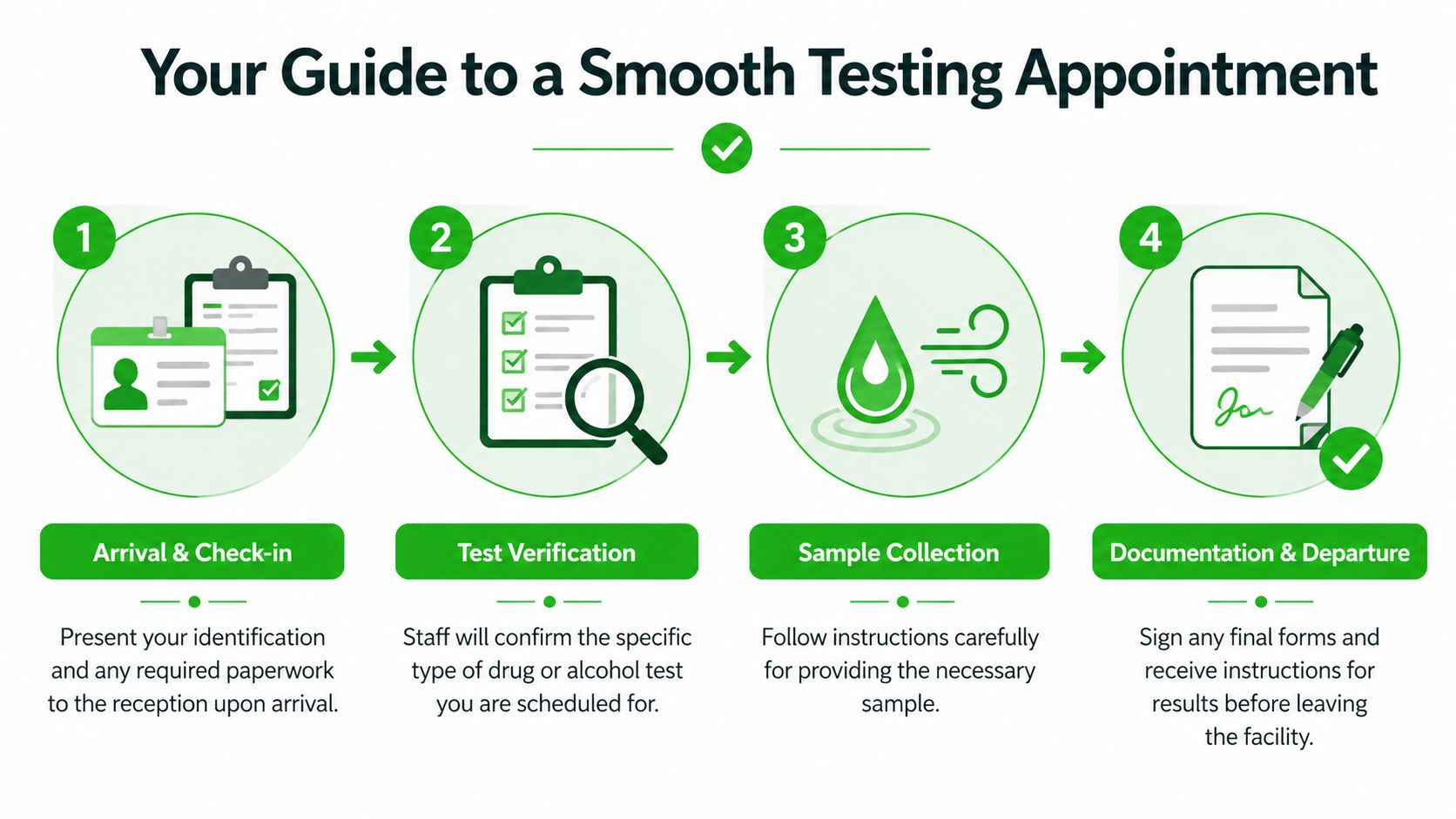
Expect the staff to verify your identity first, then match you to the order they received. Bring your ID out before you get to the counter, and keep your court, probation, or attorney paperwork easy to reach. If the test was scheduled through a registration number, barcode, or employer portal, have that ready too.
Name mismatches slow everything down. A missing middle name, an old last name, or paperwork that does not match your ID can stop the collection until the ordering party clears it up. I tell people to check those details before they leave home, because fixing them in the lobby is harder than it sounds.
What the collection usually looks like
Once staff confirm the order, the appointment becomes procedural. You will be told where to place your personal items, when to wash your hands if required, where to wait, and when to sign collection paperwork. Follow the sequence they give you. Court-ordered testing is built around documentation, identity control, and a sample that can be defended if anyone questions it later.
Urine testing is usually the most formal. The collector may use direct observation if your order requires it, check the sample promptly, label it in front of you, and have you confirm the information on the custody form. Hair testing is quicker for the donor, but the paperwork still matters because the sample has to be tied clearly to you and to the correct order. Breath alcohol testing is often the shortest appointment, though timing rules can matter if the order says the test must happen within a certain window.
Staff are not there to debate your case. Their job is to collect the sample correctly and preserve the record.
What helps the appointment go smoothly
A calm, prepared approach usually keeps things on track.
- Arrive a little early: Give yourself time for check-in, parking, and paperwork.
- Bring only what you need: Extra bags, drinks, or loose items can complicate the process.
- Listen closely to instructions: The order of each step matters in legal testing.
- Answer questions directly: If staff ask about medications or identification details, respond clearly and briefly.
- Do not try to explain the whole case at the counter: Collection staff usually cannot change the order or interpret what the court meant.
- Do not do anything that looks like tampering: An unusual delay, refusal to follow directions, or effort to bring prohibited items into the collection area can create a written incident report.
The best appointment is usually the quiet one. You check in, provide the sample as directed, review the paperwork carefully, and leave with no dispute about what happened.
Before you walk out
Do one final review before you leave. Make sure you understand whether the result goes directly to the court, probation, an attorney, an employer, or only to the ordering agency. Ask whether there is anything you still need to sign so the result can be released where it needs to go.
Then keep every document you received. Save the receipt, donor copy, registration confirmation, and any written discharge instructions. That file matters because the test itself is only one part of compliance in Georgia. The result often feeds into the next required step, whether that is a clinical evaluation, DDS-related paperwork, or enrollment in a Risk Reduction course.
What Happens After the Test Navigating Your Results
The part after collection is quieter, but it’s where many people start worrying. They assume silence means something went wrong. Usually, it means the lab is doing what labs do. The sample is processed, reviewed, and reported through the proper channel.
If your result is negative
A negative result is usually the cleanest outcome. It shows compliance and removes one immediate obstacle from your case. That doesn’t always mean you’re finished with every requirement, but it does mean this part of the process likely moved the way it was supposed to.
Still, don’t treat a negative result as permission to stop paying attention. Courts and DDS-related matters often involve multiple obligations with different deadlines.
If your screen is not negative
An initial non-negative screen is not always the final word. Collection and lab systems commonly use a screening stage first, then a more specific confirmation method if the result needs closer review. That distinction matters because screening is designed to flag, not to settle every dispute.
If a result is confirmed positive, the next issue is explanation. A valid prescription may matter. So may documentation from a treating physician. What helps is organized proof, not panic.
What actually helps after a positive result
People often make the process worse by arguing with staff who don’t control the final review. The productive move is to gather documents and respond promptly if a medical review or court follow-up happens.
Use this checklist:
- Keep prescription records ready: Pharmacy labels and prescribing information should be easy to access.
- Respond quickly to any reviewer: Delays can turn a manageable issue into an avoidable problem.
- Tell your attorney what happened: Especially if the result may affect probation, sentencing, or reinstatement timing.
- Prepare for the next compliance step: Positive findings often lead directly into evaluation or treatment requirements.
A positive result doesn’t end the process. It changes the process. People get back on track faster when they move into the next required step instead of denying the obvious.
In DUI-related cases, that next step is often a clinical evaluation. That evaluation looks beyond the lab result and asks a different question: what level of education, counseling, or treatment does this person need to satisfy the court and reduce future risk?
That’s where practical compliance starts to matter more than emotion. Courts want follow-through. If testing shows a problem, the solution is usually not to relitigate the sample. The solution is to complete the recommended requirements correctly and on time.
Putting It All Together Testing Evaluations and DUI School
You take the test in Dublin, assume the hard part is over, and then find out the court or DDS still expects an evaluation, a class, and sometimes treatment. That is where many people lose time. The problem usually is not the test itself. The problem is treating each requirement like a separate errand instead of one compliance file.
In DUI and license reinstatement cases, the lab result is only one piece of what the state wants to see. The court may want proof of testing. DDS may also require a clinical evaluation and a Risk Reduction course before your case is fully resolved. A standalone testing site can collect the sample, but it usually does not explain how that result fits into the next required steps.
The order that keeps people on track
The exact sequence depends on the wording of your paperwork, but this is the pattern that avoids the most common delays:
Confirm what agency is asking for what
Court, probation, and DDS do not always ask for the same document. Read each order carefully and match the requirement to the right agency.
Complete the test through a legally defensible process
The result needs to come from a site that can meet the collection and reporting standards tied to your case.
Schedule the clinical evaluation early
Do not wait until the last minute if you already know an evaluation will be required. The recommendation from that evaluation often determines whether you only need education or need treatment as well.
Finish the Risk Reduction course or treatment that applies to your case
This is the part many drivers in Dublin do not plan for. A clean or completed test does not automatically satisfy everything else.
Fragmentation causes real problems. One office handles the specimen. Another provider handles the evaluation. A different school handles the class. If nobody explains the order, people miss deadlines, bring the wrong paperwork, or complete a step that does not satisfy the agency reviewing the case.
That gap is why a search for drug and alcohol testing of georgia dublin ga only gets you part of the answer. It may help you find a collection site. It does not tell you what DDS will accept next, whether the court expects a substance use recommendation, or how to line up the evaluation and class so you are not starting over.
If the evaluation recommends treatment
Take the recommendation seriously and get clear on what level of care was ordered or advised. Some cases stop at education. Others involve counseling or a higher level of substance use treatment. In my experience, people get into more trouble by delaying the recommendation than by facing it directly.
Some evaluations also point to mental health concerns alongside substance use. If that applies to your case, this resource on treatment for co-occurring disorders gives useful background on why both issues often need to be addressed together.
Courts and DDS respond to completed paperwork, verified attendance, and finished requirements. Good intentions do not help much once a deadline passes.
If you still need the assessment piece, a formal online drug and alcohol evaluation in Georgia can help you get the recommendation documented correctly and line it up with the DUI school or treatment steps that follow. That is the practical advantage of working with a provider that understands the whole Georgia process instead of only the test.
Common Questions About Dublin GA Drug and Alcohol Testing
Can I use an at-home drug test for my court case
No. An at-home test does not give you the chain of custody a court or probation office expects. Court-ordered testing depends on identity verification, documented collection, sealed handling, and defensible reporting. If those steps aren’t in place, the result usually won’t carry legal weight.
What if I have a prescription that could affect the result
Don’t hide it, and don’t assume the front desk will sort it out. Keep your prescription information organized so you can provide it if a reviewer asks. What matters is whether the medication was validly prescribed and used in a way that matches that prescription.
How long do I have to complete the test after it’s ordered
Your deadline comes from the judge, probation officer, or referral paperwork. Some orders are very tight. Others give more room. The mistake is waiting because you think “soon” is good enough.
If the deadline isn’t clear, ask immediately. Don’t guess and don’t rely on what happened in someone else’s case.
Can I just walk in to any Dublin site
Sometimes yes, sometimes no. Some sites allow walk-ins, while others need pre-registration, a barcoded order, or a specific form. The safest move is to call first and confirm what they require before you leave home.
What if my paperwork says observed collection
Then you need a site that performs observed collections and understands court or probation requirements. Don’t assume every clinic does. Observation language is there for a reason, and using the wrong site can force you to retest.
Do I need the test before the evaluation or the class
That depends on your case, but many people move faster when they stop thinking in a straight line and start thinking in parallel. The test may be urgent for court compliance. The evaluation may be urgent for treatment recommendations. The class may be mandatory regardless. The smart move is to confirm the sequence with the ordering authority and start the parts you can complete now.
If you're trying to get compliant without bouncing between providers, Georgia DUI Schools can help you handle the DDS-approved Risk Reduction course and the related clinical requirements in one clear path.