
You search drivers ed columbus ga, and the results can feel mismatched to your real problem.
Maybe you're not a teen trying to get a first license. Maybe you just left court, got a ticket, need points addressed, or you're trying to get your license back after a DUI. In that moment, “drivers ed” becomes a catch-all term for several very different Georgia programs. If you pick the wrong one, you can lose time, money, and momentum.
That confusion is common in Columbus. One person needs a DUI Risk Reduction course. Another needs a Defensive Driving course for points or insurance. A parent searching the same phrase may need Joshua’s Law driver education for a teenager. Those are not interchangeable.
The good news is that Georgia’s system is structured. Once you know which course matches your situation, the next step gets much simpler.
Navigating Driving Courses in Columbus GA
When adults in Columbus say they need “drivers ed,” they usually don’t mean beginner driving lessons. They often mean a course tied to a legal requirement, a driving record issue, or an insurance question.
That matters because Georgia uses different programs for different problems. A court-ordered DUI case follows one track. A speeding ticket or point concern follows another. A teen trying to qualify for a first license follows a third path entirely.
Why the term drivers ed causes confusion
The phrase drivers ed columbus ga sounds broad, but Georgia treats these courses as separate categories with separate purposes.
A few examples make that clear:
- After a DUI arrest or conviction: you may be required to complete the state’s Risk Reduction program.
- After a ticket or rising insurance costs: a Defensive Driving course may be the right fit.
- For a teenager under Georgia licensing rules: Joshua’s Law education may apply instead.
People get stuck when they assume one certificate works for every need. It doesn’t.
Practical rule: Before you register for anything, match the course to the reason you need it. Court order, DDS requirement, insurance question, and teen licensing step are all different triggers.
What Columbus drivers usually need
For adults, the most common needs are practical. You want to satisfy a court, meet a reinstatement condition, reduce points, or understand whether a course might help with insurance costs.
In Columbus, there are local driving school options, but the course name matters more than the search term. If you're sorting through those choices, a local guide to driving school options in Columbus can help you narrow the list based on the actual requirement you’re trying to satisfy.
A simpler way to think about it
Use this shortcut:
| If your issue is… | The course to check first |
|---|---|
| DUI, drug-related driving issue, or reinstatement step | DUI Risk Reduction |
| Ticket, points, or possible insurance savings | Defensive Driving |
| First license for a teen | Teen Drivers Ed |
That one distinction solves most of the confusion.
Once you stop treating all “drivers ed” programs as the same, the process gets easier. You can ask better questions, bring the right paperwork, and avoid enrolling in a class that won’t help your situation.
DUI Class vs Defensive Driving vs Teen Drivers Ed
You search for "drivers ed columbus ga" after a stressful week. Maybe you have a court date coming up. Maybe you want to reduce points. Maybe your teenager is asking about a permit. The problem is that all three situations can lead you to classes with similar names, even though they solve very different problems.
That is where many adults get tripped up.
A simple way to sort it out is to ask what job the course is supposed to do. One course is tied to impaired-driving consequences. One is often used for tickets, points, or possible insurance benefits. One teaches beginners how to start driving safely and legally.
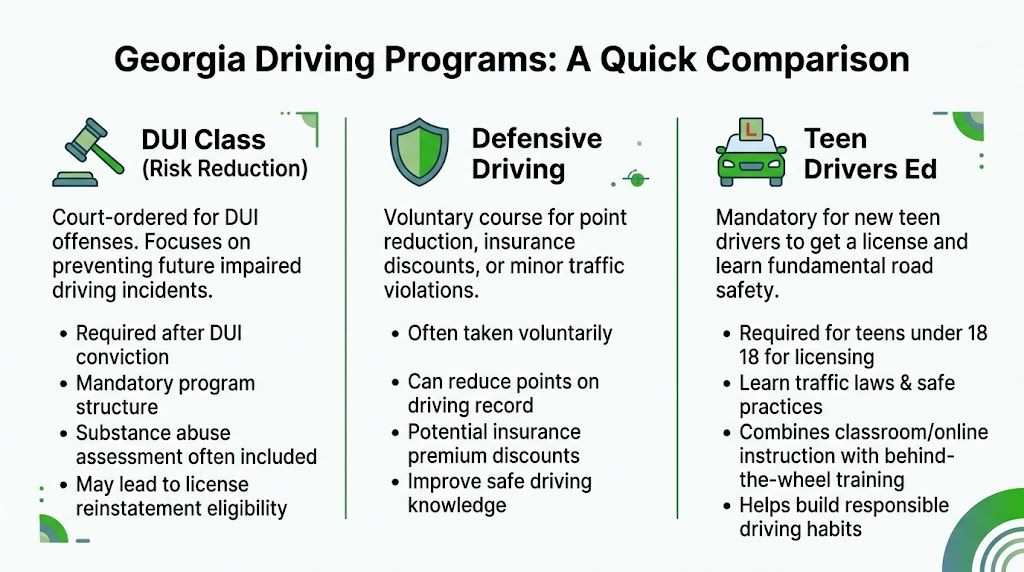
Side by side comparison
| Program | Who it’s for | Main purpose | Typical result |
|---|---|---|---|
| DUI Class or Risk Reduction | Drivers with a DUI-related or similar legal requirement | Meet a state or court requirement tied to impaired driving issues | Certificate used as part of compliance or reinstatement process |
| Defensive Driving | Drivers with tickets, point concerns, or insurance questions | Improve driving habits and address record or cost concerns | Certificate for court, DDS, or insurer, depending on need |
| Teen Drivers Ed | New teen drivers | Meet licensing education requirements and build basic road skills | Progress toward teen licensing requirements |
Teen Drivers Ed
Teen Drivers Ed is the course many people mean when they say "drivers ed." It is built for first-time drivers, especially teens working toward licensing requirements such as Joshua's Law steps. The focus is learning road rules, building safe habits, and getting supervised practice.
For an adult in Columbus dealing with a DUI case, a suspended license, or a court instruction, Teen Drivers Ed usually does not satisfy the requirement. It teaches beginner driving skills. It does not fill the same role as a state-required intervention course or a defensive driving class.
DUI Risk Reduction
DUI Risk Reduction is for a different situation entirely. This course is connected to alcohol- or drug-related driving issues and is often part of what a court, probation officer, or DDS requires. The goal is not beginner instruction. The goal is to address risky behavior and document compliance.
That difference matters. A person can complete Teen Drivers Ed and still have done nothing to satisfy a DUI-related requirement. In the same way, a Defensive Driving certificate usually does not replace DUI Risk Reduction either. The names sound similar, but the legal use is different.
Defensive Driving
Defensive Driving sits in the middle. It is not for teaching a brand-new teen driver how to start. It is also not the same as DUI Risk Reduction. Instead, it is usually the class adults take after a ticket, for point reduction purposes when allowed, to meet a court request, or to ask an insurer whether a discount applies.
If DUI Risk Reduction is like a court compliance tool, Defensive Driving is more like a correction and prevention tool. It helps drivers review judgment, spacing, hazard awareness, and decision-making on the road.
How adults in Columbus can tell the difference fast
Use the paperwork in your hand as your guide.
If the document mentions DUI, substance use, reinstatement, probation, or Risk Reduction, start with DUI Risk Reduction. If it mentions points, a ticket, court approval for a safer driving course, or an insurance question, check Defensive Driving. If the goal is helping a teen qualify for a first license, look at Teen Drivers Ed.
One wrong enrollment can cost time and money. A court clerk, DDS notice, or probation instruction usually gives the clearest clue about which course counts.
A quick self-check
Ask yourself these three questions:
- Did a court, probation officer, or DDS notice mention DUI, reinstatement, or Risk Reduction? Start with DUI Risk Reduction.
- Are you trying to deal with a ticket, points, or insurance costs? Defensive Driving is the likely fit.
- Is this about a teen getting licensed for the first time? That points to Teen Drivers Ed.
For many Columbus adults, the biggest mistake is assuming every driving class is a version of "drivers ed." Georgia treats these as separate programs because they solve separate problems. Once you match the course to the reason you need it, the next steps become much clearer.
Georgia's DUI Risk Reduction Program Explained
You get a court paper or DDS notice that says "Risk Reduction," and the first thought is often, "So I just sign up for a driving class." In Georgia, the process is more specific than that. The state treats DUI Risk Reduction as a regulated program with set parts, set rules, and a set price.

What the program actually includes
Georgia's DUI, or Risk Reduction, program has two required pieces that work together:
- Assessment: a required screening step completed before class
- Intervention course: the education portion of the program
The full program includes the assessment plus a 20-hour Intervention course, and the total state-set fee is $360. That matters because adults in Columbus sometimes waste time comparing providers as if each school offers a different version. For this program, the state decides the basic structure. The provider must be approved, but the required program itself stays the same.
Why this course is treated differently from ordinary drivers ed
Teen drivers ed teaches new drivers how to start driving safely. Defensive Driving reviews habits and traffic choices. DUI Risk Reduction serves a different purpose. It is tied to impaired driving concerns, court compliance, and license consequences.
A good comparison is this: teen drivers ed teaches the rules of the road, Defensive Driving reviews judgment on the road, and Risk Reduction addresses conduct that triggered a legal or licensing problem.
Because of that, details matter. Attendance matters. Timing matters. Your completion paperwork matters.
What "assessment plus class" means in plain language
The word "class" causes a lot of confusion. Many adult drivers hear it and expect one appointment, one certificate, and done. Georgia's Risk Reduction program works more like a two-part packet you must finish in the right order.
| Part of the program | What it does |
|---|---|
| Assessment | Screens for issues related to alcohol or drug risk and starts the formal process |
| Intervention course | Delivers the state-required education portion in the approved format |
If your papers say DUI school, Risk Reduction, or DUI Alcohol or Drug Use Risk Reduction Program, they are usually referring to this full program, not just the classroom hours.
Who usually needs this program
This requirement often applies to adults dealing with one of these situations:
- A DUI-related court order
- A DDS reinstatement requirement
- A drug or alcohol case where the court ordered Risk Reduction
- Directions from probation, an attorney, or a judge
One point causes trouble over and over. If your paperwork requires Risk Reduction, a Defensive Driving course does not count as a substitute.
How to approach it without making the process harder
Treat this as a legal compliance step, not a casual refresher course. Register with a state-approved provider. Confirm what identification or paperwork you need before you arrive. Follow attendance rules closely, and keep every document you receive.
That last part is easy to overlook. For many Columbus adults, the problem is not understanding the class itself. It is understanding that the certificate may be only one piece of the larger reinstatement or court process.
The Critical Path Through Clinical Evaluations and Treatment
For many Columbus drivers, the biggest surprise comes after they finish the Risk Reduction class. They assume the certificate ends the process, then learn there may be one more requirement standing between them and a valid license.
That missing step is often a clinical evaluation, and sometimes treatment recommendations follow from it.
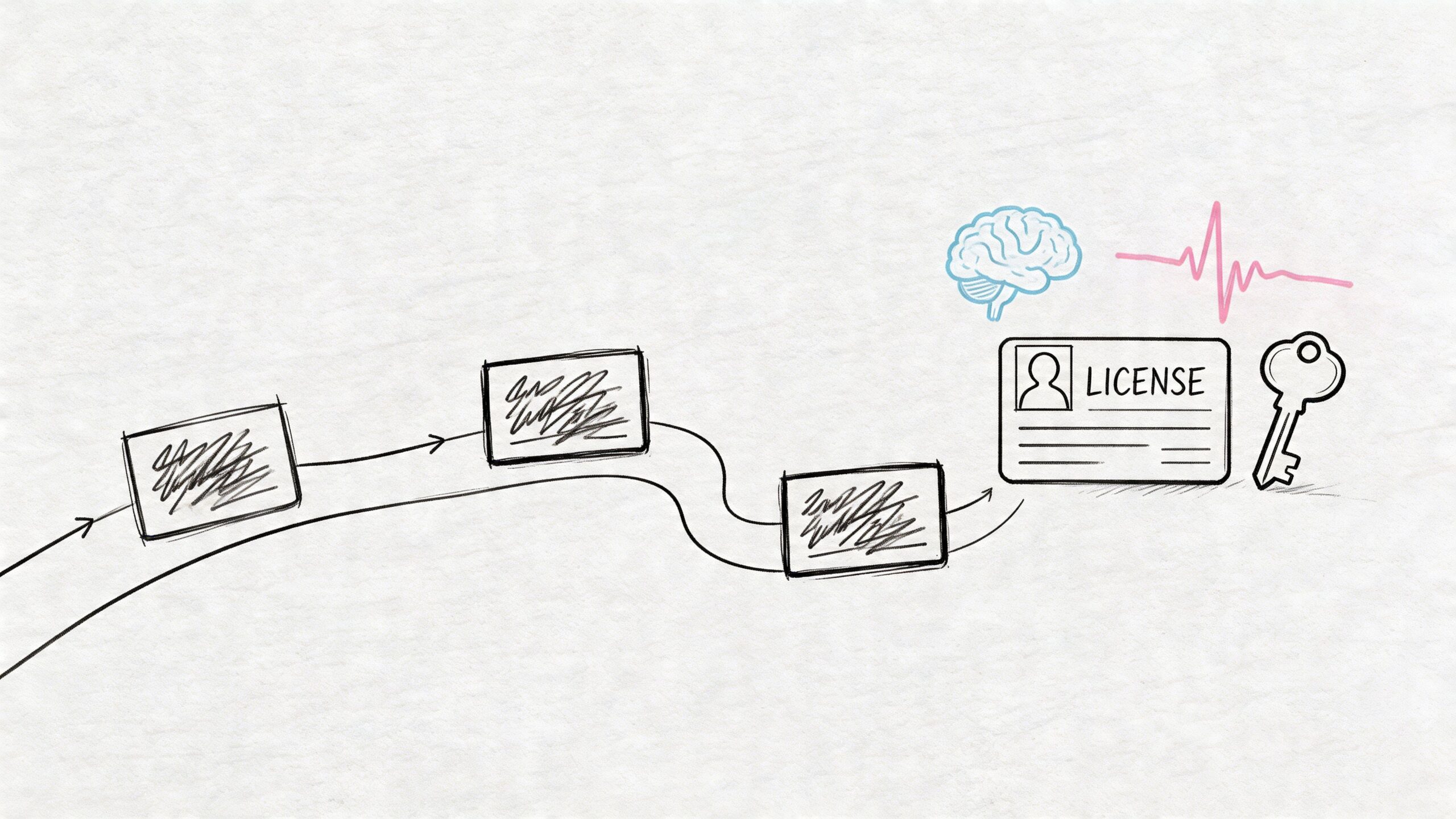
Why this step gets overlooked
Most public conversations about DUI classes stop at the course certificate. Real reinstatement problems often continue because the driver wasn’t told clearly how clinical requirements fit in.
Georgia’s own framework makes clear that, for many drivers with DUI convictions, the path to reinstatement can involve more than the Risk Reduction course. It may also require clinical evaluations and potential ASAM Level 1 treatment, as reflected in the Georgia DDS driver education and training information.
What a clinical evaluation does
A clinical evaluation is not the same thing as the Risk Reduction class. It serves a different role. The evaluation looks at whether further intervention is needed and, if so, what level of care is appropriate.
That’s why many people get confused. They think one educational requirement should cover everything. In reality, Georgia can treat the educational piece and the clinical piece as separate obligations.
A plain-language path
For many drivers, the path looks something like this:
- You learn a requirement exists through court paperwork, DDS instructions, or legal advice.
- You complete the Risk Reduction course if that step applies.
- You complete a clinical evaluation if your case requires one.
- You follow treatment recommendations if the evaluation indicates that treatment is necessary.
- You submit proof where required so your reinstatement process can move forward.
Not every driver will have every step. But many people lose weeks because they assume step two is the finish line.
If your paperwork mentions evaluation, treatment, or a clinical provider, don't wait until after class completion to ask questions. Those steps may affect your timeline just as much as the course itself.
What ASAM Level 1 usually means in practical terms
Drivers often hear “ASAM Level 1” and feel like they’ve been dropped into a language they don’t speak. The useful takeaway is simpler than the label. It refers to a structured treatment level used when a clinical evaluation determines more support is needed.
You don’t need to become an expert in treatment terminology. You do need to confirm whether your case requires it, who must provide it, and what proof must be turned in afterward.
Questions worth asking early
Use these questions before you assume you’re done:
- Does my court paperwork mention a clinical evaluation?
- Did DDS or my attorney say treatment may be part of reinstatement?
- Do I need both education and clinical documentation?
- Who receives my proof of completion?
That short list helps avoid one of the most common reinstatement mistakes in Georgia, which is completing the visible step and missing the hidden one.
Defensive Driving for Point Reduction and Insurance Savings
A lot of adults in Columbus reach this point after a very ordinary week. A ticket shows up. Insurance renewal arrives. Then one question follows both problems. Would a Defensive Driving course prove helpful, or is it just another class with a certificate?
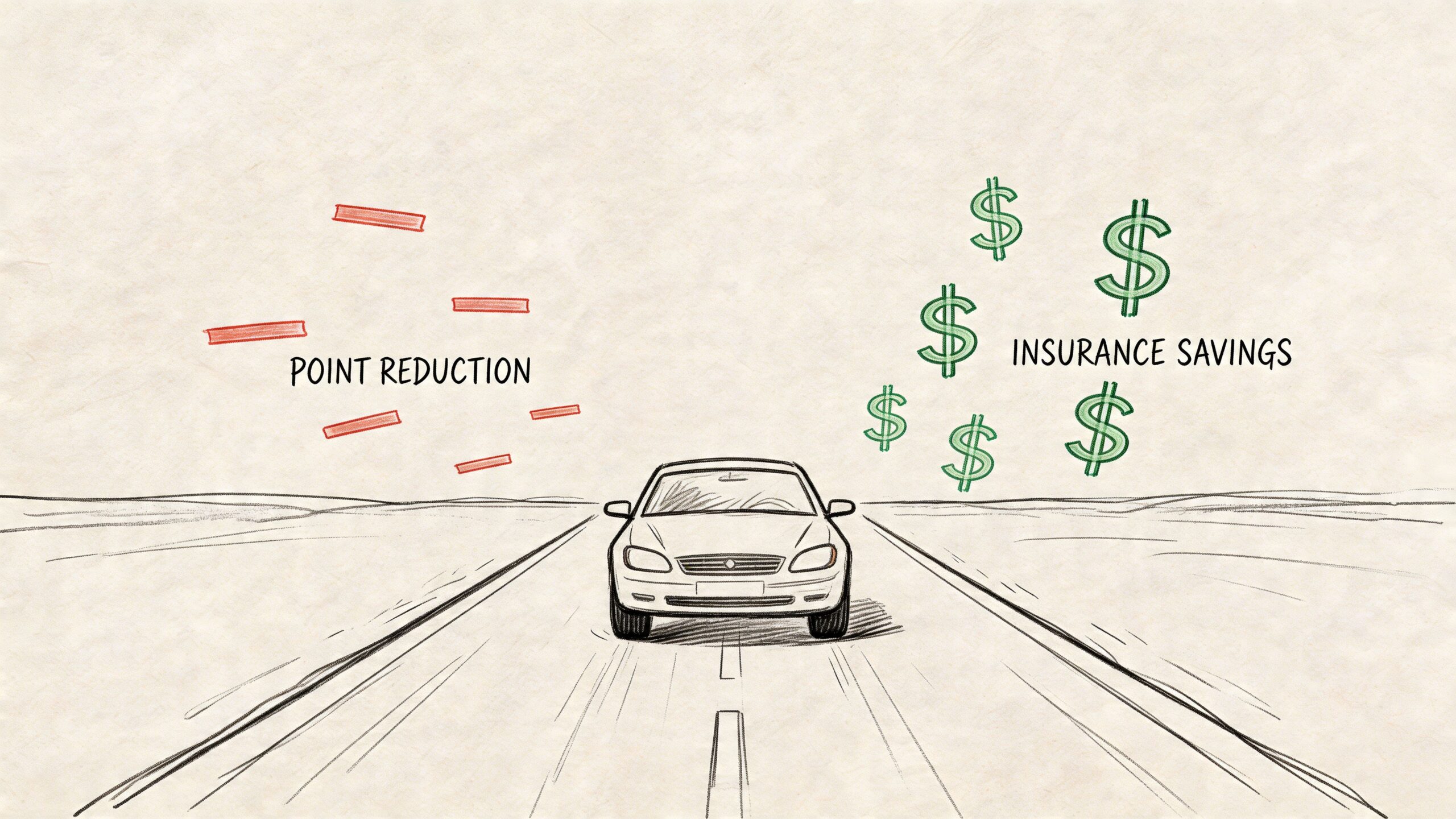
For many adult drivers, this is the Georgia course that can help after a mistake without pulling them into the DUI Risk Reduction process. It serves a different purpose. Defensive Driving focuses on safer choices behind the wheel, possible point relief in the right situation, and possible insurance savings if your carrier accepts the course.
When Defensive Driving makes sense
This course often fits adults who are trying to solve a practical problem, not teens working toward a first license. Common examples include drivers who:
- Recently received a ticket and want to limit the long-term effect
- Need to address points on a Georgia driving record
- Plan to ask an insurer about a premium discount
- Need a driver improvement course accepted by a court, employer, or another authority
If you're trying to understand how a speeding citation can affect your record, this guide on the legal implications of speeding points gives helpful context about why point-related decisions matter.
The two benefits adults usually ask about
Drivers usually care about two outcomes. First, can the course help with points? Second, can it lower insurance costs?
Those are fair questions, but the answer depends on who is reviewing your case. A court, DDS, or insurance company may each look at the same certificate for a different reason. That is why Defensive Driving works a bit like bringing the right document to the right office. The class may be useful, but the benefit only shows up if the decision-maker recognizes it.
Insurance discounts are possible, but you need to verify them
Many Georgia providers explain that insurers may offer a discount for completing a Defensive Driving course. The exact amount is usually not posted in a simple statewide chart. Ogeechee Technical College's course information, for instance, reflects that general expectation on its driver education page.
That uncertainty confuses people. They want a fixed promise. Insurance does not work that way. Your premium can be affected by your carrier, your policy details, your age, your driving history, and the other drivers on the policy.
A better approach is to call your insurer before you enroll and ask direct questions:
- Do you recognize this Defensive Driving course for a discount?
- How much could the discount be, if any?
- How long would it last?
- Do I send the certificate, or do you verify it another way?
Why the course can still be worth it
Even if your insurer offers only a small discount, the class can still pay off in other ways. It can improve the habits that led to the ticket in the first place. That matters more than many drivers expect. One avoidable citation often costs far more than the course itself once you add fines, time, and possible insurance effects.
If you want a closer look at eligibility, course formats, and what to ask before signing up, this guide to a defensive driving course to lower insurance is a useful next step.
Bottom line: Defensive Driving is often the right course for adults who want to clean up a smaller driving problem before it turns into a bigger one.
Your Step-by-Step Enrollment and Completion Process
Most driving course problems don’t come from the class itself. They come from simple missteps before or after the class, like choosing the wrong program, missing a session, or sending the certificate to the wrong place.
A steady process helps.
Step 1 Confirm the exact course name
Read every paper you’ve been given. Look for words like Risk Reduction, DUI, Defensive Driving, Driver Improvement, clinical evaluation, or Joshua’s Law.
If the wording isn’t clear, call the court, attorney, probation office, DDS, or insurer that gave you the instruction. Ask them to name the exact course they want. Don’t rely on assumptions based on search results.
Step 2 Check the format that fits your life
Some drivers do better in a classroom. Others need a virtual option because of work, childcare, or transportation limits. For Defensive Driving, online self-paced formats may also be available depending on the provider and the course rules.
Your goal is simple. Pick a format you can complete without rushing, missing time, or creating another problem.
Bring the same level of care to scheduling that you bring to paying the fee. A missed class can create more delay than the registration itself.
Step 3 Register with the right information
Use your legal name as it appears on your identification and case-related paperwork. Small mismatches can create headaches later when a court, DDS office, or insurer reviews your completion certificate.
Before you hit submit, double-check:
- Your full legal name
- Your contact information
- The course type
- The date and time
- Any case or court detail you were told to include
Step 4 Attend and complete every required part
For state-regulated classes, attendance rules matter. If the class is live, be present and on time. If the program includes multiple parts, complete them in the required order.
This sounds obvious, but it’s where people get tripped up. They assume partial attendance is close enough. It usually isn’t.
Step 5 Keep your completion records
After finishing, save your certificate carefully. Put a digital copy in your email or cloud storage if possible, and keep a paper copy if one is issued.
Use this quick checklist:
| After completion | What to do |
|---|---|
| Received certificate | Verify your name and course are correct |
| Need to report it | Send it to the court, DDS, insurer, or other required party |
| Not sure who gets it | Ask before deadlines pass |
| Need proof later | Keep your own copy even if someone else receives one |
Step 6 Follow through after class
A course only helps if the right office recognizes it. Some drivers finish class and stop there. Then they find out nobody received the proof.
That final handoff matters. Completion is one step. Proper submission is the one that closes the loop.
Choosing Your Course Format Schedule and Pricing
A Columbus driver often reaches this stage after a long week of phone calls, court papers, or DDS questions. Then one more decision shows up. Should you take a class online, live on Zoom, or in a classroom, and how much should you expect to pay?
The right format depends on the course type first, and your preferences second. That order matters. An adult trying to satisfy a DUI-related requirement does not always have the same flexibility as someone taking Defensive Driving on a voluntary basis.
Comparing the common formats
Georgia drivers usually see three course formats:
| Format | Best for | Things to consider |
|---|---|---|
| Self-paced online | Drivers who need flexibility, often for Defensive Driving | Works well if you can stay focused on your own and need to fit lessons around work or family time |
| Live virtual class | Drivers who want real-time instruction without driving across town | You must log in on time, stay present, and avoid internet or device problems |
| In-person classroom | Drivers who learn better face to face | Helpful if you want structure, direct questions, and fewer technical issues |
If you are starting with a flexible, non-DUI option, review online Georgia drivers ed options and then confirm that the course matches your exact requirement.
Matching the format to the real-life problem
Format works like the container. The course requirement is the content. If the container is convenient but the content is wrong, you still do not solve the problem.
For example, an adult in Columbus who wants an insurance discount may prefer a self-paced Defensive Driving course. An adult dealing with a court deadline may be better off choosing the format with the fewest chances for delay, even if it is less convenient. A driver who gets anxious with technology may finish faster in a classroom than in a virtual course that depends on passwords, camera access, and stable internet.
That is why the first question is never, “Which format sounds easiest?” The better question is, “Which format fits the rule I have to satisfy and my ability to finish it correctly?”
What to expect on pricing
Pricing depends on whether the course is state-regulated or provider-priced.
For DUI Risk Reduction, the cost is generally fixed by state rules, so you should expect less variation from one school to another. For Defensive Driving, prices often vary by provider, schedule, and format. Some schools charge more for live instruction or bundled services. Others keep the price lower for a basic online course.
Read the fee page carefully before you register. Check whether the posted amount includes the full class, any required materials, and the completion certificate. A low headline price can be misleading if extra fees appear later.
Schedule matters as much as price
A class only helps if you can finish it.
A Saturday session may look convenient until you remember child care, shift work, or a court date. A self-paced course may sound flexible, but it still requires uninterrupted time and enough focus to complete the material. Live classes require you to be present for the full session, not just part of it.
Before you choose, ask yourself:
- Can I attend or complete this course without rushing or missing time?
- If the class is live, can I protect that time from work calls, errands, or family interruptions?
- How soon do I need proof of completion?
- Does this format satisfy my exact court, DDS, or insurance requirement?
A practical schedule usually saves more stress than chasing the lowest price. For many adults in Columbus, especially those handling DUI-related obligations or follow-up steps like evaluation and treatment referrals, the best course is the one you can complete correctly the first time.
Frequently Asked Questions About Columbus Driving Courses
Can I live in Columbus and take an online course
Often, yes, depending on the course type and provider format. Defensive Driving commonly offers the most flexibility. For DUI-related requirements, always confirm whether your specific obligation allows the format you want before you enroll.
Is every driving course accepted for every legal issue
No. That’s one of the biggest misunderstandings. A Defensive Driving course does not automatically satisfy a DUI Risk Reduction requirement, and teen driver education does not substitute for an adult court-ordered course.
What if I miss part of a required class
For state-regulated or live classes, attendance rules usually matter a lot. If you miss time, arrive late, or leave early, you may need to reschedule or repeat part of the process. Ask about attendance policy before class day, not after a problem happens.
The safest assumption is that required course time must be completed exactly as instructed.
Can a Defensive Driving course help after an out-of-state ticket
Sometimes, but the answer depends on who needs to accept the certificate. If you got the ticket outside Georgia, verify acceptance with the court, insurer, or licensing authority involved. Don’t assume a Georgia-approved course will automatically apply in the same way everywhere.
If I finished Risk Reduction, am I done
Maybe, maybe not. Some drivers are done after the course. Others still need a clinical evaluation or follow-up treatment documentation before reinstatement can move forward. Check your paperwork carefully and confirm the full list of requirements.
How should I choose between classroom, virtual, and online
Choose the format you can complete reliably. If you need structure and direct interaction, classroom or live virtual may be better. If your schedule is unpredictable and the course rules allow it, online may be the easier fit.
What’s the smartest first step if I’m confused
Get the exact name of the course you need from the party requiring it. That one step clears up most of the confusion around drivers ed columbus ga searches.
If you need a clear next step for a DUI-related requirement, Georgia DUI Schools offers DDS-approved DUI Risk Reduction education with flexible scheduling options to help you move forward.