

You leave an Atlanta courthouse with a DUI order, a DDS notice, and several questions that nobody answered clearly. The phrase “risk reduction required” may sound like a general driving class, but Georgia's process is more specific. You're dealing with a state-regulated program, a required assessment, a structured education course, and documentation that may affect your ability to regain legal driving privileges.
The path becomes easier to manage once you separate the requirements. First, identify why the program applies to your case. Then complete the screening assessment before attending the class, choose an approved format and location, finish the required instruction, and preserve the completion documentation for your court and DDS follow-up. Atlanta drivers also need to account for local scheduling, online availability, clinical requirements, and habitual violator rules when those issues apply.
What the Atlanta DUI Risk Reduction Program Means
A driver leaving Fulton County court after a DUI conviction may assume “risk reduction” means signing up for an ordinary defensive driving class. It doesn't. Georgia's DUI Alcohol or Drug Use Risk Reduction Program is regulated by the Georgia Department of Driver Services and follows a standardized structure. The program combines a screening assessment with a DDS-approved therapeutic education course about alcohol, drug use, and driving. You can review the state's program description through the Georgia DDS DUI Alcohol or Drug Use Risk Reduction Program.
Think of the program as a locked gate on the road back to legal driving. Your court case may create one set of obligations, while DDS controls reinstatement requirements. Completing the state-approved program supplies one of the keys that may be needed to move through that process. It isn't optional education that you take only if you want more information. For people convicted of DUI or another alcohol- or drug-related driving offense, Georgia requires the 20-hour course, and the state sets the full program cost at $360.
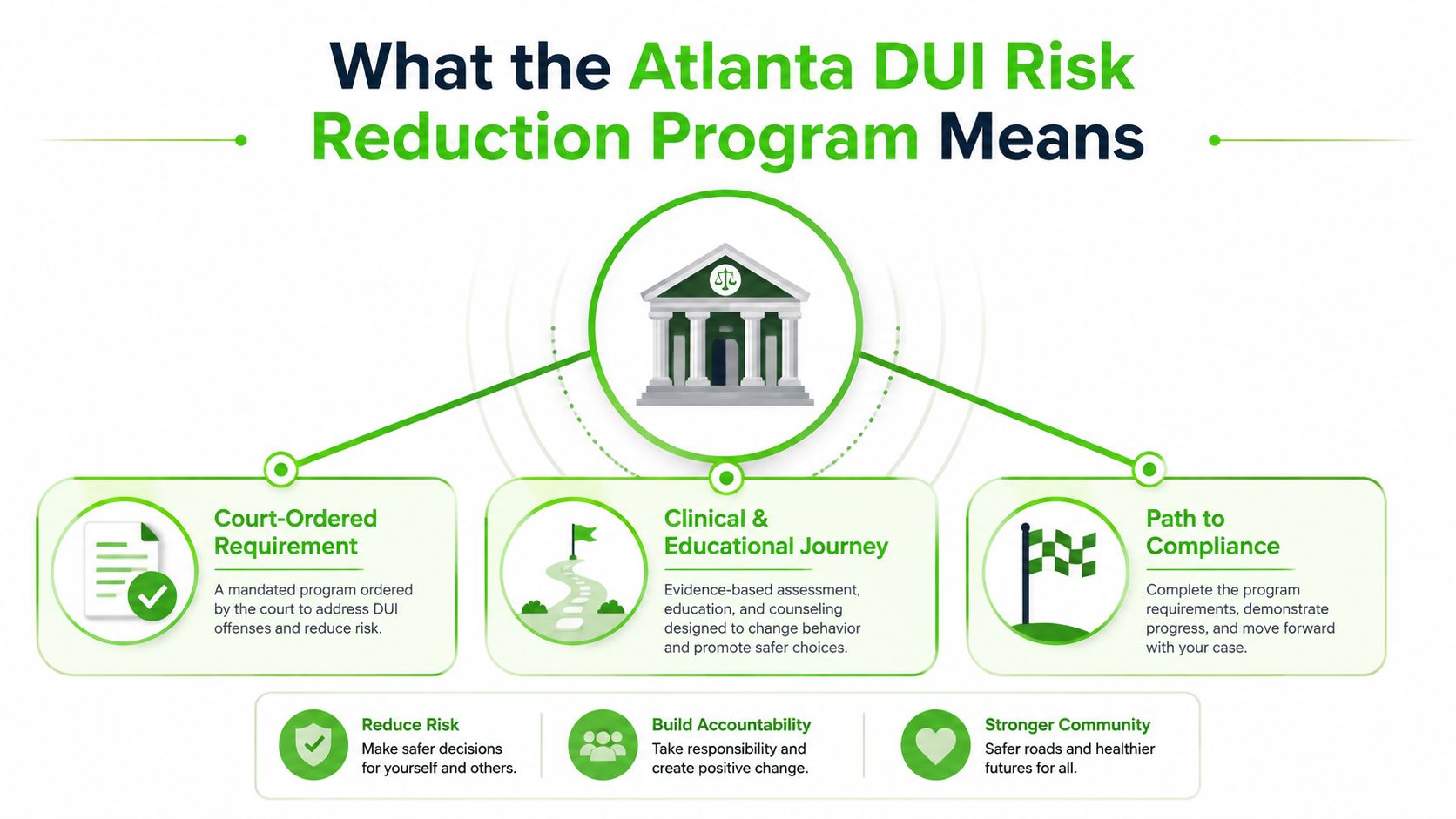
The two parts work in a fixed order
The assessment comes first. You can't treat it as paperwork to finish after class because the assessment must be completed before instruction begins. The education component then runs for 20 hours, typically over about 2½ days, giving the course a defined schedule rather than the feel of a casual online tutorial.
That order matters for an Atlanta driver facing a court deadline. Booking a class without confirming the assessment requirement can create a preventable delay. The provider may have a seat available, but you still need the required first step completed before class participation.
Practical rule: Treat the assessment and the 20-hour course as one compliance path, not as interchangeable classes.
The program's purpose is also broader than license paperwork. It addresses the relationship between alcohol, drugs, decision-making, and driving while requiring a formal completion record. For a plain-language explanation of the terminology, see this definition of Georgia's risk reduction program.
Who Must Enroll in Atlanta Metro
The key question isn't whether an arrest happened in Atlanta. It's what conviction or formal requirement appears in your case and DDS records. Georgia's required risk reduction program applies to people convicted of DUI and other listed alcohol- or drug-related driving offenses, so the program can affect more than the driver who thinks of the case as a typical first DUI.
A first-time offender may receive a court order requiring completion as part of the case resolution. A repeat offender may face the same education requirement alongside stricter license consequences. An underage driver can also enter a mandatory path when the underlying offense involves alcohol or drugs and operation of a motor vehicle. The exact obligations depend on the conviction, court order, and DDS status.
Read the paperwork as a checklist
An Atlanta driver may receive documents from a municipal or county court and separate communication from DDS. Those documents serve different functions:
- Court order: Shows what the judge, prosecutor, or probation arrangement requires.
- DDS requirement: Identifies what the state needs for licensing or reinstatement.
- Provider intake: Confirms which approved service matches the order and whether additional clinical services are needed.
The safest approach is to compare the language rather than guess from the word “DUI.” If the order mentions a clinical evaluation, treatment, a victim impact panel, or habitual violator status, the 20-hour course may be only one part of the overall path.
Underage cases need careful review
Underage drivers often assume the course depends on a particular blood alcohol number. That assumption can be wrong. An underage alcohol- or drug-related driving offense may trigger requirements even when the driver's situation doesn't resemble an adult DUI case.
Before enrolling, ask the provider to review the wording on your court or DDS paperwork.
The practical takeaway is simple. Know whether your case involves a first conviction, repeat convictions, an underage offense, or another listed alcohol- or drug-related driving violation before you request enrollment. That information helps an Atlanta provider direct you to the correct compliance service instead of treating every case as identical.
How to Enroll and Complete the Course
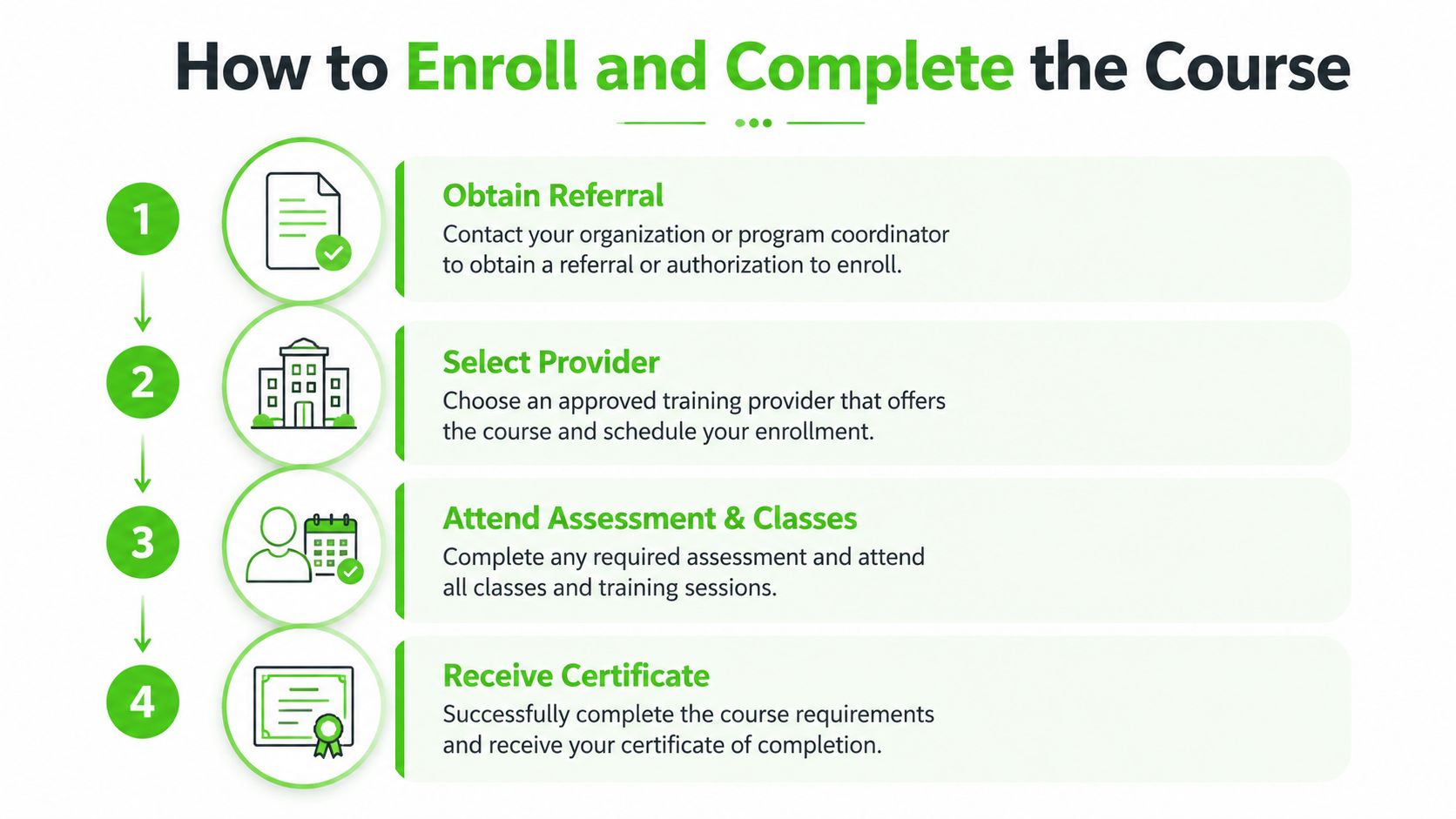
Enrollment works like a short sequence. Don't reverse the order, especially if your court or DDS deadline is close.
Start with the assessment
First, obtain your referral and case documents. Keep the court order, DDS notice, and any probation instructions nearby when you contact a provider. The wording may identify requirements beyond the standard education program.
Next, schedule the screening assessment. Georgia requires the assessment before the class begins. A provider serving Atlanta, Athens, and surrounding communities may offer access through local sites or online arrangements, including the network described by Georgia DUI Schools' online risk management course.
Choose the class only after the first step is clear
Then select the approved class format and date. Atlanta-area providers may offer classroom instruction, live virtual attendance, or self-paced online options, depending on the provider and the course arrangement. Confirm that the format is accepted for your case before paying or committing to dates.
Finally, attend all required instruction and secure completion documentation. The education component is the state-required 20-hour course, commonly delivered over about 2½ days. Missing a session can interfere with completion, so place every class meeting on your work and family calendar before you enroll.
A useful personal checklist looks like this:
- Referral ready: Court and DDS documents are available for review.
- Assessment scheduled: The screening step is complete before the first class session.
- Class reserved: The provider, format, and dates match your deadline.
- Certificate protected: Save the completion record and follow any court or DDS submission instructions.
The assessment isn't an administrative obstacle added by the school. It's part of the standardized Georgia program, which is why class entry depends on completing it first.
Atlanta Class Formats and Schedules
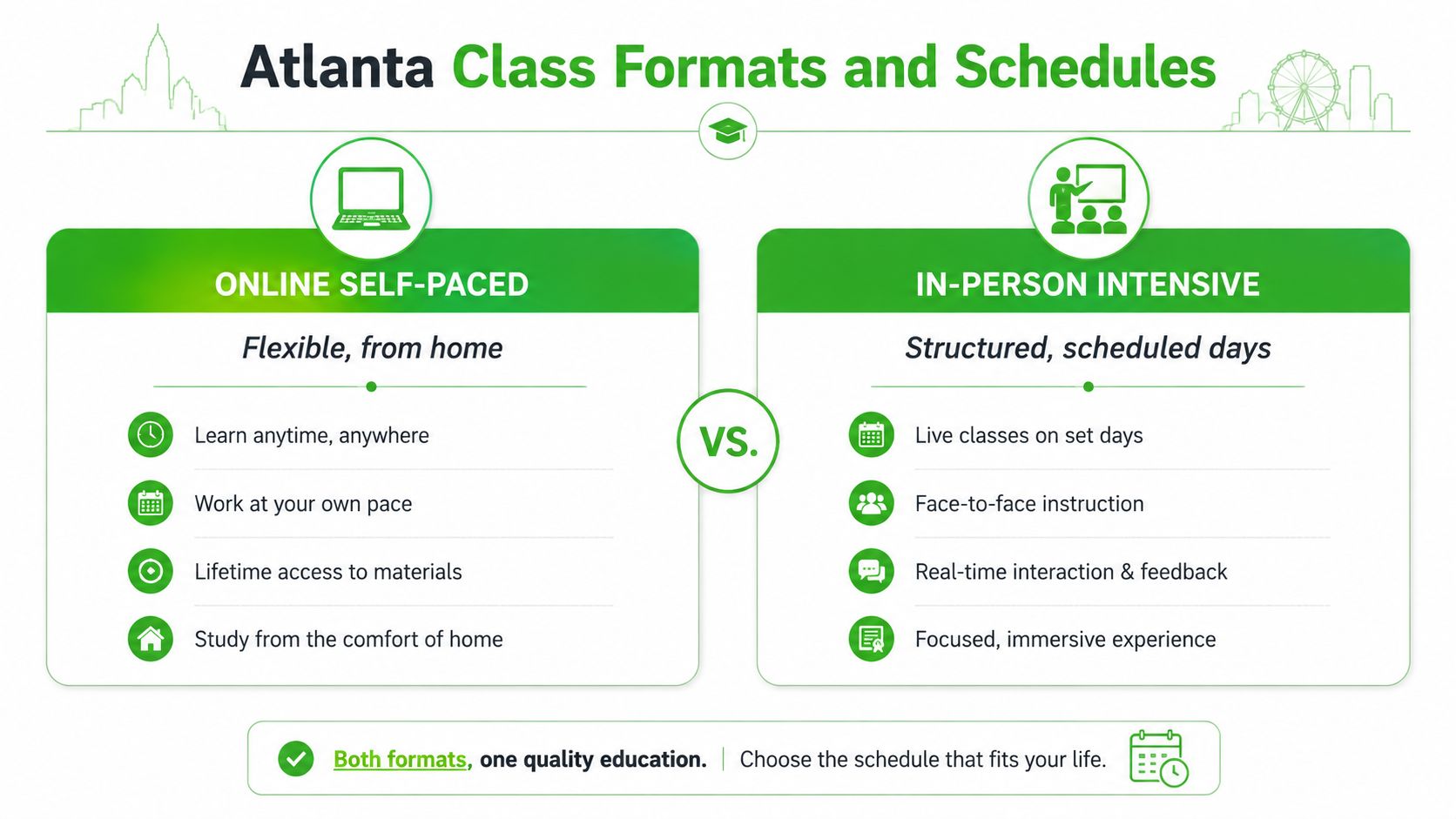
Atlanta drivers usually choose among three practical delivery models: a physical classroom, live Zoom instruction, or a self-paced online option. The right choice depends on your court instructions, work schedule, transportation, and comfort with structured attendance. You shouldn't assume that every online option has the same attendance rules, so confirm the details with the DDS-approved provider before registering.
| Format | What it may offer | What to confirm |
|---|---|---|
| Classroom | A scheduled setting at a metro Atlanta location, with direct instructor interaction. | Location, attendance times, required materials, and whether the site fits your deadline. |
| Live Zoom | Real-time participation from home, useful when commuting across the metro area is difficult. | Whether the provider's live virtual class is approved for your case and how attendance is recorded. |
| Self-paced online | More control over when you work through the course, which can help people with shifting schedules. | Completion rules, identity checks, deadlines, and whether your court accepts that specific format. |
Local coverage is broad. One DDS-approved provider operating in the Atlanta region lists 7 metro Atlanta locations, while another Georgia provider advertises 18 locations across Atlanta, Athens, and surrounding communities, along with online access statewide. The Atlanta DUI risk reduction course information also describes scheduling that can extend into evenings and weekends, with some live Zoom and self-paced formats available seven days a week.
That flexibility matters for people working standard hours or managing a court deadline. A driver in Marietta may prefer a nearby classroom, while someone commuting from South Atlanta may choose a live virtual session to avoid crossing the metro area. A student or shift worker may look for a self-paced option, but should verify that the specific course satisfies the court and DDS requirements.
Cost and License Reinstatement Rules
Georgia removes one major pricing variable from the decision. The state sets the complete DUI risk reduction program cost at $360, covering the standardized program rather than an optional add-on. Because the price is state-set, the more meaningful differences among providers involve location, schedule, delivery format, and support with the enrollment process.
Completion also has legal significance. It isn't merely proof that you attended an educational class. Georgia's reinstatement rules connect approved DUI education with the ability to move forward after a license revocation, so an Atlanta driver should keep the completion record with other court and DDS documents.
Habitual violator status changes the stakes
DDS says a driver can be declared a habitual violator after the third conviction for any combination of listed offenses within five years, including DUI. Under Georgia law, that status carries a five-year license revocation. The DDS explanation of Georgia's continued safety responsibility law provides the state's description of that framework.
The rules become especially important for a driver with three DUI violations inside that period. Georgia regulations state that a habitual violator revoked for three DUI violations within five years must submit proof of completing an approved DUI Drug or Alcohol Use Risk Reduction Program before a new license can be issued. The Georgia administrative rules on license reinstatement describe that connection between program completion and issuance of a new license.
A certificate is not a substitute for every reinstatement requirement, but it can be a required DDS document.
Court obligations and DDS obligations can overlap without being identical. Your attorney, probation officer, or DDS should clarify the remaining steps in your specific case. The safest practice is to confirm what must be filed, where it must be filed, and whether any separate fees, treatment, or waiting requirements remain.
Clinical Services and Victim Impact Panels
The standard education program doesn't automatically replace every clinical or restorative requirement in a DUI case. A court may order a clinical evaluation, ASAM Level 1 treatment, or a Victim Impact Panel as a separate obligation. These services answer different questions from the 20-hour course.
A clinical evaluation focuses on the person's alcohol or drug-use history and the evaluator's recommendations. ASAM Level 1 treatment concerns an outpatient level of care when that service is ordered. A Victim Impact Panel presents the consequences of impaired driving through personal accounts and structured discussion. None should be assumed to satisfy the others.

Match each service to the order
Read the nouns in your paperwork carefully. “Risk reduction course” identifies the state education requirement, while “clinical evaluation” identifies a professional assessment. “Treatment” may require a specific level or referral, and “victim impact panel” points to a separate restorative program.
A provider network serving Atlanta and Athens may allow a participant to arrange several services through the same local system. That can reduce the confusion of calling multiple offices, but it doesn't erase the need to verify what your court ordered. The Atlanta Victim Impact Panel is one example of a separate service to ask about when that phrase appears in your paperwork.
Why the combination matters
The education course gives you structured information about alcohol, drugs, driving, and safer decisions. Clinical services can address personal risk factors and treatment recommendations. A victim impact panel adds the human consequences that legal paperwork often leaves abstract.
For example, an Atlanta driver may finish the required class but still have an outstanding clinical evaluation. Another driver may need treatment and a panel in addition to the course. Treating these as separate boxes on one compliance checklist prevents the common mistake of assuming one certificate closes the entire case.
If your order lists a service by name, ask for that service by name.
Course Day and Reporting to Courts
Class day should feel less uncertain when you know the basic sequence. Before attending, confirm that the required assessment is complete, verify the address or virtual access instructions, and keep your identification and enrollment information available. If the provider requires specific materials or attendance procedures, follow those directions rather than relying on assumptions from another school.
The education component is a 20-hour DDS-approved course, generally delivered over about 2½ days. In a classroom, that means arriving at the assigned Atlanta-area location for each scheduled session. In a live virtual setting, it means joining the instructor-led sessions on time and remaining available for the provider's attendance process.
What happens after the final session
The provider records completion after you satisfy the assessment and class requirements. You should receive documentation showing that the required program was completed, then preserve it in more than one place. Save the electronic record, keep a printed copy if practical, and send it only through the channel your attorney, court, probation officer, or DDS identifies.
The reporting chain can involve several people:
- Provider: Confirms that you completed the approved program.
- Driver: Keeps the certificate and supplies it when instructed.
- Attorney or probation officer: Helps connect completion to case conditions.
- Court or DDS: Determines how the record affects the remaining legal or licensing steps.
Georgia DUI Schools reports completion for metro court and DDS obligations as part of its provider services, but you still need to confirm the submission process for your own case. A provider's completion record doesn't decide whether fines, probation terms, treatment, or other reinstatement conditions remain.
Avoid the last paperwork mistake
Don't assume that attending the final class automatically restores your license. Program completion can satisfy the risk reduction component, while DDS may require additional documentation or action. Check your case-specific instructions before driving, particularly if your license is suspended or revoked.
Finish the class, protect the certificate, and verify your legal driving status before getting behind the wheel.
Atlanta DUI Program FAQs and Next Step
Can an online course satisfy an Atlanta requirement?
It may, but the answer depends on the specific approved format and your case instructions. Atlanta-area providers advertise live Zoom and self-paced online availability, yet a driver should confirm acceptance with the provider, court, attorney, probation officer, or DDS before enrollment. “Online” describes delivery, not automatically the legal suitability of every course for every case.
Should I wait to book a weekend class?
Waiting can make deadline planning harder because weekend availability is limited by the provider's schedule and local demand. Atlanta access includes evening and weekend options, along with multiple locations and online choices, so compare dates early rather than assuming a preferred weekend will remain open. If your court order sets a deadline, use that date to work backward.
Does the program affect repeat-offense risk?
Independent Georgia evaluation data found that offenders who didn't attend recidivated at about twice the rate of attendees, 27.1% compared with 13.5%, according to the Georgia Risk Reduction Program evaluation report. The finding supports the value of structured intervention, but it doesn't mean attendance eliminates future risk. Personal decisions, treatment recommendations, and continued safe-driving behavior still matter.
What should I ask before registering?
Ask whether the provider is DDS-approved, whether the assessment must be completed before your selected class, which formats are available, and what completion documentation you'll receive. If your paperwork includes clinical evaluation, ASAM Level 1, or a victim impact panel, ask whether those services are available separately and how they fit into your court checklist.
Atlanta drivers don't need to solve the entire case from memory. Use the written order, verify the DDS requirement, and choose a course date that leaves enough room for the assessment and any additional services.
Georgia DUI Schools offers DDS-approved DUI and Risk Reduction education for Atlanta-area drivers, with local locations and online options for people managing work, transportation, or court deadlines. Visit Georgia DUI Schools to review the Atlanta course options, confirm the assessment-first process, and choose a compliant path toward completing your requirement.