

You're sitting in a parked car with a traffic ticket on the passenger seat, a court date circled on the calendar, and one urgent search open on your phone: traffic school online answers. That reaction is understandable. A citation can bring stress about court requirements, insurance, license points, and whether you'll finish an approved course before the deadline.
The problem is that answer-key websites and shortcut services often promise something they can't safely deliver. A legitimate course isn't designed around memorizing leaked questions. It's built around identity verification, progress tracking, quizzes, final-assessment rules, and a completion record that a court or the Georgia Department of Driver Services can recognize. The practical answer is learning how the course works, confirming that it fits your case, and preparing efficiently. For a useful comparison point, review these traffic school online reviews before enrolling.
Why Drivers Search for Traffic School Online Answers in the First Place
Most drivers don't search for answer keys because they want to become careless motorists. They're usually trying to solve an immediate problem. A ticket may have arrived during an already busy week, the court's instructions may use unfamiliar language, and the driver may not know whether an online class will satisfy the order.
That uncertainty creates a tempting shortcut. Search results can make it seem as though the course is just a test standing between you and a certificate. In practice, the certificate is only useful when the right person completes the right approved program under the conditions set by the court or DDS.
The search phrase hides several different questions
When someone types this phrase, they may really be asking:
- What will the quizzes cover? Usually, the material comes from the course lessons, including traffic laws, defensive driving principles, risk recognition, and responsible decision-making.
- Can I pause the course? Many legitimate programs save progress so students can return later, although the exact rules vary by provider.
- What happens if I miss an answer? A wrong response may lead to an explanation, a retake, or a course-specific consequence.
- Will the court accept my certificate? Acceptance depends on the jurisdiction, the order, the course type, and the provider's approval.
- Is this a ticket course or a DUI requirement? Georgia treats defensive driving and DUI Alcohol or Drug Use Risk Reduction as different programs with different purposes.
A search for answers often reflects stress, not dishonesty. Still, buying answers can turn a manageable compliance task into a record or court problem. The safer approach is to study the material, understand the assessment process, and verify every requirement before you pay or enroll.
How Online Traffic School Quizzes Are Built
A legitimate online course controls access in stages. Enrollment and identity verification come first, followed by learning modules and their assessments. The final exam becomes available only after the required earlier work is complete. This sequence creates a record that connects the enrolled driver with the instruction and testing.
Short modules create repeated checkpoints
Online traffic courses commonly divide instruction into short learning blocks instead of presenting one large lesson. A module may take roughly 15 to 25 minutes, depending on the provider and the student's pace. A quiz then checks understanding of that block before the next module opens.
The arrangement gives the platform several progress checks rather than relying entirely on one final exam. South Australia's government-run myLs learner course shows this format through quizzes, activities, and challenges across an online curriculum designed to take about four hours. The myLs course information offers an example of assessments placed throughout the course, although Georgia requirements control for Georgia drivers.
Questions may come from a randomized bank. Two students can complete the same course while seeing different questions or a different sequence. Shared answer sheets are therefore unreliable, apart from the compliance problems they can create.
Progress and identity checks protect the completion record
A legitimate platform may save your place after a module so you can return later. It may also use identity controls such as photo checkpoints, timed responses, or behavioral signals. Providers use different systems, so one course's rules cannot be assumed to apply to another.
A final exam typically opens only after the required module quizzes are complete. The staged process documents that the enrolled driver received the lessons and completed the assessments in the required order. For a Georgia driver comparing programs, the course mechanics matter as much as the advertised convenience.
Before enrolling, compare the delivery format, progress rules, retake policy, and approval information. A directory of BDISchool traffic school options can show how online course offerings are presented. Confirm that the specific program matches your Georgia court order or DDS requirement, since a convenient course is not automatically an acceptable one.
Risks of Cheating, Answer Keys, and Shortcut Services
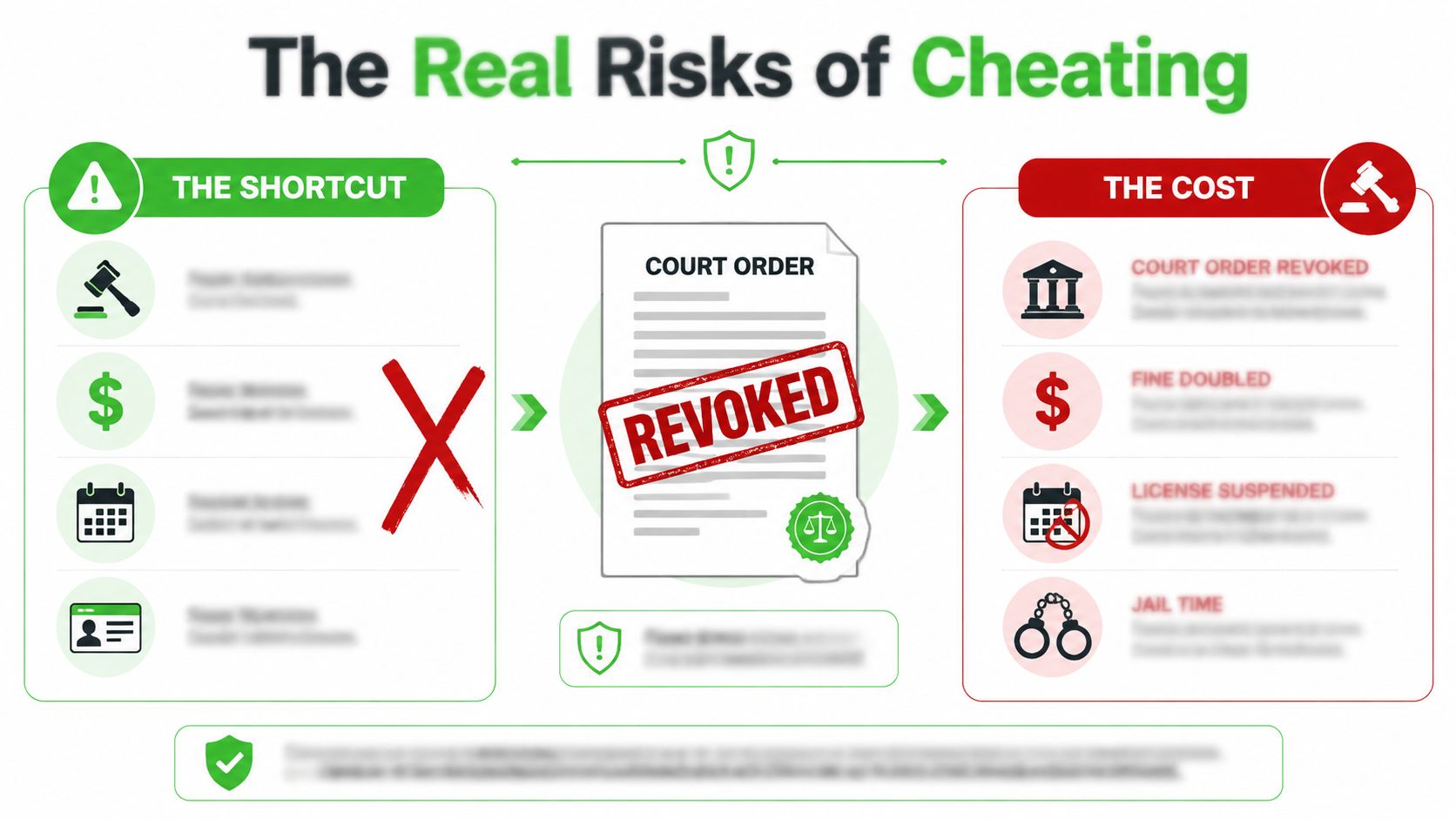
An answer key may seem convenient, but it can create compliance and legal problems if it helps you submit work you did not complete or a certificate that misrepresents your participation. The short-term time saved may disappear once someone must verify how the course was completed.
A shortcut can conflict with the court order
If a judge allowed traffic school instead of another consequence, completing the course is part of that arrangement. A fabricated or improperly earned certificate can lead the court to question whether you complied. Depending on the case and jurisdiction, the court may revoke the diversion arrangement, reinstate the citation, or consider contempt-related consequences.
Submitting a certificate earned by another person can also raise record-tampering concerns. In many jurisdictions, using a document that falsely identifies the person who completed training may expose a driver to allegations such as forgery or fraud. The specific charge depends on the facts and applicable law, so an online seller's promise does not provide legal protection.
Verification makes false completion risky
DDS offices, courts, and course providers can review completion records and identify inconsistencies. A mismatch involving identity, timing, participation, or assessment activity may lead to additional questions or an investigation. Recent reporting has documented situations in which driving schools or instructors falsified training documents, showing why completion verification matters in online driving education. The CBC Marketplace reporting on driving-school records provides context for that broader trust problem.
Insurance issues may follow. If a court rejects the certificate, the original violation may remain relevant to the driver's record and insurance history. Some shortcut websites also collect personal details, creating a separate privacy risk unrelated to studying.
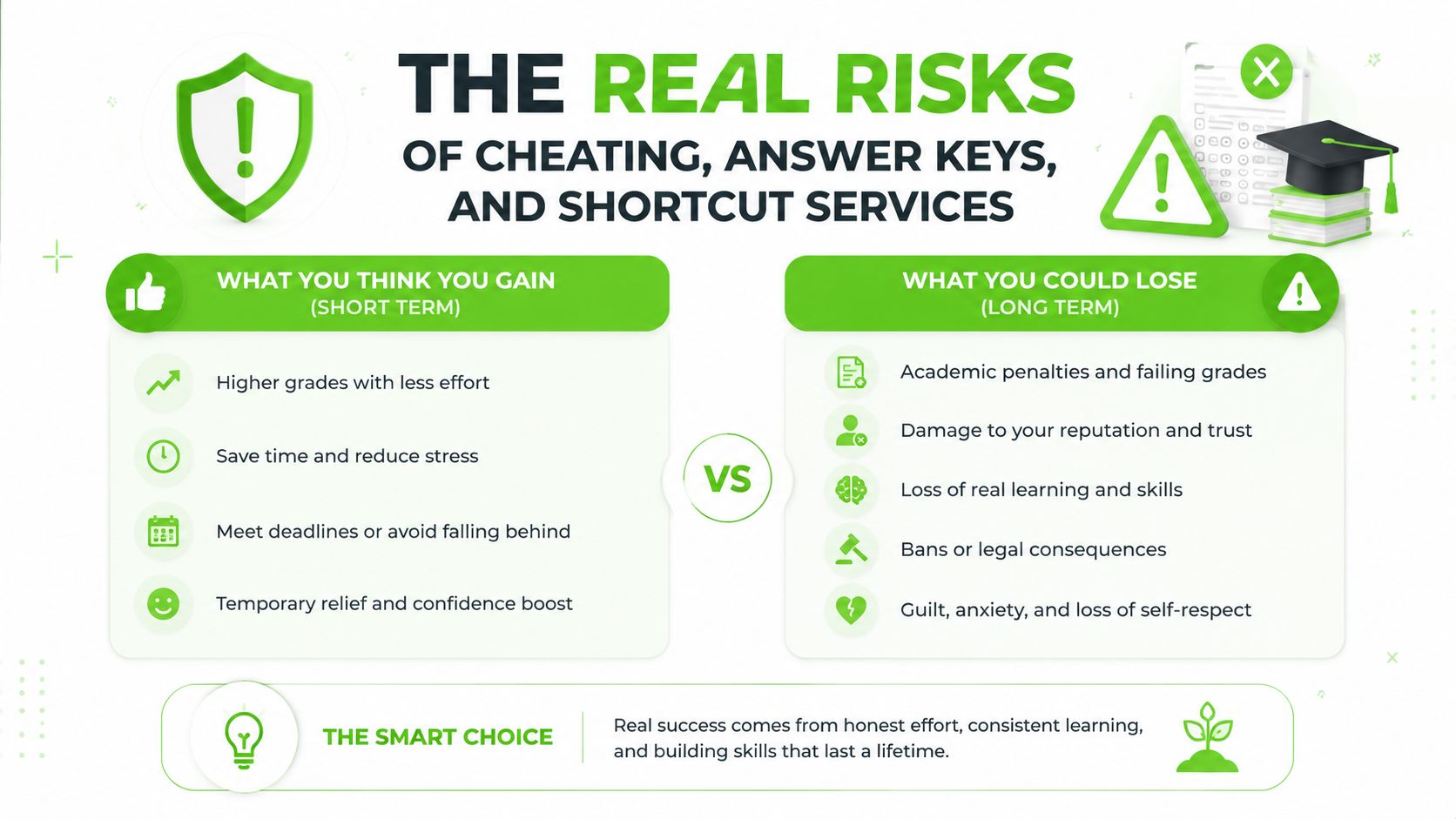
Practical rule: If a service promises to complete, impersonate, or bypass part of the course, walk away. The shortcut becomes harder to defend when you must explain it to a clerk, judge, insurer, or licensing agency.
For legitimate preparation, use course notes and approved study material. Georgia DUI Schools' guidance on defensive driving course answers can help clarify why answer keys are a poor substitute for completing the lessons and assessments yourself.
Sample Question Types You Will See in a Legitimate Course
Most legitimate defensive-driving assessments test recognition and judgment, not obscure trivia. The wording may change, but the underlying skills tend to remain familiar: reading signs, choosing a safe response, understanding legal duties, and recalling rules presented in the course.
Four common formats
Road signs and signals often use multiple choice. Example: “A red octagonal sign requires a driver to do what?” The correct response is to stop. Distractors such as slowing without stopping or yielding only seem plausible if the driver confuses a stop sign with a yield sign.
Scenario questions test judgment. Example: “You're approaching an intersection while another vehicle is already proceeding through it. What should you do?” The safe reasoning is to yield when required, scan for additional hazards, and avoid forcing your way through. The wrong choices usually reward speed, assumption, or aggressive positioning.
True-or-false items may address impaired-driving concepts, including BAC rules or implied-consent obligations. Don't guess from a slogan. Read the course's exact explanation, because the legal consequence may depend on the type of test, the driver's status, and the circumstances.
Recall questions can ask about a rule presented in the lesson, such as a speed limit in a school zone. Use the number and condition taught by the approved Georgia course, rather than importing a rule from another state.
A short self-test
| Question Stem | Choices | Correct Answer | Why |
|---|---|---|---|
| What does a stop sign require? | A. Slow down, B. Stop, C. Change lanes | B. Stop | The sign establishes a stopping requirement. |
| What should you do before changing lanes? | A. Signal and check, B. Accelerate blindly, C. Turn without signaling | A. Signal and check | Signaling doesn't replace mirror and blind-spot checks. |
| A safe following distance helps you do what? | A. React to hazards, B. Eliminate all risk, C. Drive faster | A. React to hazards | Space gives you more time to respond. |
| If another road user has the right of way, what is the safest response? | A. Yield, B. Compete for space, C. Ignore the conflict | A. Yield | Defensive driving avoids forcing another person to react. |
| What should you do with an unfamiliar rule? | A. Guess, B. Review the lesson, C. Copy an online answer | B. Review the lesson | The course material provides the relevant context. |
| What is the purpose of a final assessment? | A. Verify understanding, B. Replace all instruction, C. Test a leaked key | A. Verify understanding | The assessment documents course completion and comprehension. |
The point of this table isn't to predict exact exam wording. It helps you identify whether you need to review signs, right of way, spacing, impaired-driving law, or course-specific recall material.
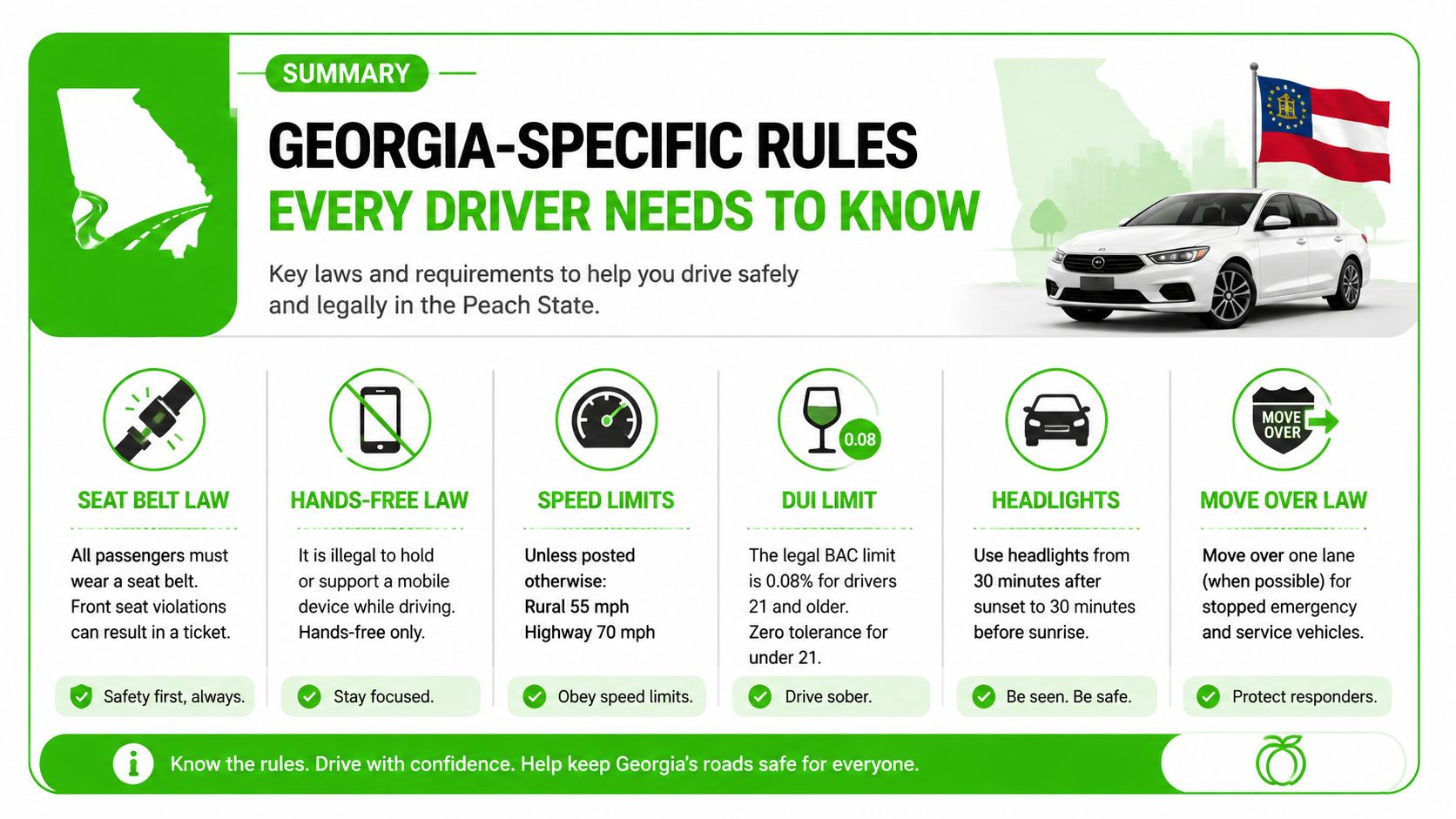
Georgia-Specific Rules Every Driver Needs to Know
Georgia drivers often use “traffic school” as a broad phrase for programs that serve different legal purposes. A Defensive Driving course may help with license points or a qualifying traffic matter. A DUI Alcohol or Drug Use Risk Reduction Program, commonly called DUI Risk Reduction, is tied to DUI and certain related convictions. Confusing the two can leave you with the wrong certificate.
Separate the programs before you enroll
Georgia's DUI Alcohol or Drug Use Risk Reduction Program has two required components, an assessment component and an intervention component. Both must be completed before the provider can issue the completion certificate, as explained by Georgia DDS DUI FAQs.
Georgia law also requires completion of the risk-reduction program within 120 days after conviction. If an incarcerated defendant can't complete it within that period, the statute provides a separate deadline of 90 days after release. The same law addresses a clinical evaluation and recommended substance-abuse treatment, so a DUI case may involve more than classroom or online coursework. Review Georgia Code Section 40-6-391 and confirm the order with your attorney, probation officer, court, or DDS.
A ticket-related defensive-driving requirement is different. Georgia DDS says participation in a certified defensive-driving course can reduce up to seven points from a driving record once every five years, according to the Georgia license-points explanation. That mechanic concerns point consequences, not automatic cancellation of every ticket or satisfaction of a DUI sentence.
Approval and certification matter
Georgia regulations state that a risk-reduction program can't operate without Department certification. The rules also address program-owner criminal-record standards, fingerprint-based checks, and Department training within six months of certification. Those requirements help explain why a court-approved provider matters more than a website offering copied answers. The Georgia program regulations provide the governing framework.
Before registration, ask three questions: Which program does my order require? Is the online format accepted for this case? How will completion be reported? Those answers protect you from completing a legitimate course that still doesn't match the court's specific instruction.
How Georgia DUI Schools Online Courses Meet Those Requirements
A compliant online course should make its process visible from the beginning. You should know who approves the program, which curriculum it follows, how the platform verifies participation, what triggers the final assessment, and how the completion record reaches the appropriate authority.
For a Georgia driver using Georgia DUI Schools, the practical path begins with enrollment and identity confirmation. The student selects the required course, provides the requested information, and works through the assigned modules. Progress saves between sessions, so a person with work, family, or probation obligations can return without treating every pause as a restart.
A typical completion path
- Confirm the course type. Defensive Driving and DUI Risk Reduction serve different legal purposes, so match the enrollment choice to the court or DDS requirement.
- Complete identity steps. The provider may request identity information or checkpoints designed to connect the coursework to the enrolled driver.
- Work through each module. Read the explanations, complete the activities, and take the quizzes instead of searching for a separate key.
- Finish the final assessment. Course-specific timing, monitoring, passing, and retake rules apply. Read them before you begin.
- Document completion. Keep the receipt or confirmation and verify how the certificate is transmitted or made available to the court or DDS.
Georgia DUI Schools offers DUI/Risk Reduction and defensive-driving education through online and classroom formats, with clinical evaluation, ASAM Level 1 treatment, and Victim Impact Panel services available for cases that require those steps. That combination can matter when a DUI order includes obligations beyond the education component.
If you're stopped or questioned during a DUI-related encounter, course enrollment isn't a substitute for legal advice. A resource discussing what to say at DUI stops can help you understand why you should handle the roadside interaction carefully and seek qualified counsel for case-specific questions.
A Smarter Study Plan for Passing Without Shortcuts
You can begin preparing the same night you enroll. Set aside a focused block for one module, silence notifications, and keep the course open long enough to understand the examples instead of racing through the screens.
Use a simple study system
A practical plan looks like this:
- Time-block one module: Reserve about 20 minutes per module as a starting block, then allow extra time when a topic needs review.
- Use two columns: Write the rule in one column and a driving example in the other. For instance, pair “leave space to react” with a situation involving a sudden stop on an Atlanta arterial.
- Review mistakes immediately: When a quiz answer is wrong, read the explanation and record the distinction that caused the miss.
- Treat retakes as feedback: A retake is a checkpoint. Identify the topic, revisit the lesson, and try again under the provider's rules.
- Protect your deadline: Put the completion date on your calendar, then leave room for technical problems, court processing, or a needed retake.
For broader quiz habits such as active recall and reducing test anxiety, this guide to acing quizzes stress-free offers study techniques that can complement, but not replace, the approved course material.
Check acceptance before you start
Before paying, confirm the provider's DDS approval status and ask the court whether it accepts the online format for your specific order. Verify whether the certificate is transmitted electronically, delivered to you, or handled through another process. Save the enrollment confirmation, completion receipt, and any course correspondence.
Don't confuse a search result with authorization. A page such as Georgia risk management basic course Quizlet may help you organize review, but your official course rules and approved lessons control the assessment.
The goal is to understand enough to recognize a hazard, make a lawful decision, and drive differently after the course. Choose a state-approved provider, set a start date, and commit to completing one module tonight.
Georgia DUI Schools provides Georgia-focused DUI/Risk Reduction and defensive-driving options in online and classroom formats, along with clinical evaluation and related services when a court order requires them. Visit Georgia DUI Schools to confirm the course that matches your requirement and begin with a legitimate study plan instead of risking an answer-key shortcut.