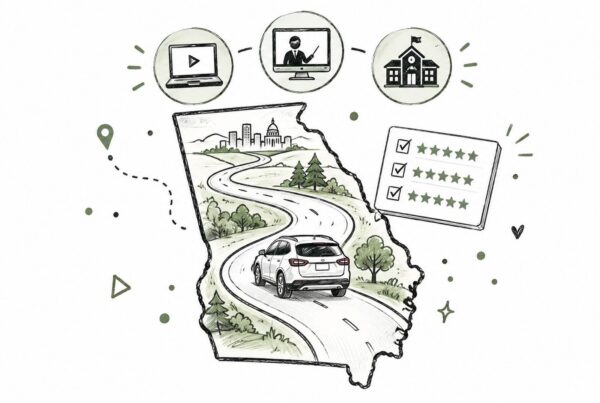

Facing a DUI or Risk Reduction deadline in Georgia means you don't need more noise, you need proof. Traffic school online reviews can help, but only if you use them the right way, as a filter for approval, certificate reliability, and support, not just star ratings. The safest move is to start with a DDS-approved provider, then compare how real users describe enrollment, verification, and completion. For a practical reputation step, you can also monitor and respond to reviews so you can separate real service patterns from marketing gloss.
For Georgia drivers, the priority is simple. If the school won't satisfy court or DDS requirements, the review score doesn't matter. If you're comparing online DUI, Risk Reduction, or defensive driving options, look for recent feedback, clear approval status, and evidence that certificates are delivered cleanly and on time.
1. Georgia DUI Schools
Georgia DUI Schools is the strongest local starting point for Georgia drivers who need a compliant path through DUI or Risk Reduction requirements. The school says it is Georgia DDS-approved, has 38+ years of experience, has served more than 100,000 drivers, and runs about 15,000+ classes per year. That combination matters because compliance courses are not the place to gamble on a provider with weak process or thin local credibility. The school also offers a dedicated page for Georgia drivers education classes if you want to see how its offerings are organized.
Why it stands out for compliance
The school covers the full range people need after a DUI or related court issue. It offers self-paced online courses, live virtual Zoom classes, and traditional in-person instruction at 18 Atlanta-area and Athens locations, plus clinical evaluations, ASAM Level 1 treatment, and Victim Impact Panels. That matters because the common failure point in this category is not the lesson content, it is administrative friction, the certificate, the evaluation, or the next required step.
Practical rule: For DUI and Risk Reduction work, the best review profile is the one that shows the provider can move you from enrollment to documented completion without delays.
Pricing is not listed on the site, so drivers need to call (770) 415-4384 or check the site for current rates and scheduling. That lack of transparent pricing is a downside, but it is easier to accept when the provider is built around compliance, not entertainment.
Pros
- DDS-approved programs for court and license needs.
- Multiple formats for busy drivers.
- Clinical services under one roof.
- Full-service support and deep local experience and recognition.
Cons
- No published pricing.
- In-person locations are concentrated in the Atlanta metro and Athens area.
2. Trustpilot
Trustpilot is the fastest way to see how a traffic school is behaving with real customers, but only if you read it like a vetting tool. For court-ordered drivers, the star score matters less than the pattern behind it. Check the volume of reviews, how current the feedback is, and whether the complaints point to problems with certificates, support, or deadline handling. The page for Traffic School Online shows 7,322 reviews and a 4.7/5 rating, and the profile says reviewers “overwhelmingly had a great experience.” Trustpilot's Traffic School Online profile is the place to start if you want a fast read on how a large review set looks. As discussed in our guide on the legitimacy of online defensive driving courses, you should treat that profile as a check on compliance, not as a sales page.
A rating alone will not save you. Read the recent comments and look for repeated themes. Slow certificate delivery, verification problems, or weak support are serious warnings for Georgia DUI and Risk Reduction students who have to finish on time and document completion correctly. The useful question is simple, does the feedback show a provider that handles court-related paperwork without confusion, or one that leaves students chasing answers.
Trustpilot is strongest as a trend detector. If the newest reviews keep raising the same issue, that issue is probably real. A large review pool matters because it gives you a broader picture than a few polished testimonials, and in this category, repeated customer experience tells you more than isolated praise.
A high score means little if the latest reviews describe slow processing or support delays.
Pros
- Large review counts make it easier to separate patterns from one-off comments.
- Recent reviews help you spot current service problems.
- Side-by-side brand pages make comparison direct.
Cons
- Business tools can affect how feedback is displayed.
- You still have to read carefully, because not every visible review carries the same context.
3. Better Business Bureau
The BBB is the site people skip, and that is a mistake. For traffic school selection, complaint handling matters as much as polished marketing, because compliance students need a school that resolves problems fast when something goes wrong. BBB profiles show complaint narratives, outcomes, accreditation and rating details, and time in business, which gives you a longer view than a simple star average. Use the BBB website to check how a provider handles disputes, not just how it advertises.
For Georgia drivers comparing options, our overview of online driving classes shows why operational discipline matters.
What BBB tells you that review sites miss
BBB is useful when you need to know whether a company has a pattern of dragging its feet on support or giving incomplete responses. That information is more valuable than a shiny average if you are buying a course tied to a deadline. If the provider has a history of unresolved complaints, treat it as a red flag even when other review pages look positive.
BBB also helps you check whether a business operates where it says it does. That matters when you are choosing between national traffic school brands and a Georgia-specific provider like Georgia DUI Schools. For court-mandated DUI and Risk Reduction courses, you want a provider that looks organized on paper and behaves that way in complaints.
Complaints often tell you more than praise, because they show how a company behaves when a student is stuck.
Pros
- Complaint records show how problems are handled.
- Accreditation and rating signals add another layer of credibility review.
- Time-in-business context helps you judge stability.
Cons
- Review volume is often lower than consumer review platforms.
- Some listings lean heavily toward complaints, so you need balance from other sources.
4. Reviews.io
A traffic school with a Reviews.io profile gives you a direct read on the enrollment experience. Use it to check whether the provider handles sign-up, course access, and certificate delivery without creating extra work. If a school places a Reviews.io widget on its site, treat it as a starting point, then open the full feedback set on the Reviews.io platform to see what students say after they pay.
How to use Reviews.io like a vetting tool
Read the reviews for compliance clues, not just satisfaction scores. Search for comments about login problems, identity checks, final exam flow, and certificate timing. Those details matter for court-ordered students, because a course that looks fine on the surface can still fail when the deadline is close.
Look for patterns, not isolated praise. A single comment about the course being easy is weak if the same review mentions delay in getting the certificate or trouble reaching support. The reviews that matter are the ones that describe the full process from enrollment to completion and show whether the provider keeps that process under control.
If you are comparing providers for Georgia DUI or Risk Reduction requirements, use Reviews.io to test reliability, not marketing. A school that answers complaints clearly and resolves access problems cleanly has more value than one that only collects short compliments. That is the kind of signal you want before you commit to a court-mandated course.
Pros
- Verified-review signals make the feedback easier to trust.
- Filtering by recency helps you focus on current student experiences.
- Course-level detail can reveal certificate, login, and usability problems.
Cons
- Not every provider uses it.
- Coverage varies, so you still need to compare it with other review sources.
5. TrafficSchoolCritics
TrafficSchoolCritics gives you a practical read on how a course performs before you enroll. It focuses on editorial reviews, side-by-side comparisons, and repeated notes about approvals, quiz format, and support quality. That matters when star ratings alone do not tell you whether a program is realistic under a court deadline. The TrafficSchoolCritics website is worth checking if you want a more hands-on comparison layer.
The site works best as a screening tool, not a final verdict. Use it to identify which schools sound easy to complete, which ones seem clunky, and which ones get called out for weak support or confusing quiz design. For Georgia DUI and Risk Reduction users, that filter is useful because the issue is compliance, not convenience. A course can be approved and still waste time if the structure slows you down or makes basic tasks harder than they should be.
Approval notes are the first thing to verify. Then check how the review explains the course flow, because a school that looks fine in a summary can still be annoying once you are inside the lesson system. If the writeup points to slow support, odd test wording, or certificate delays, treat that as a warning, especially if you need to finish for court.
Why editorial detail matters
Review platforms tell you what users liked or hated. Editorial sites help you interpret those comments. If a course is cheap but clunky, or fast but full of odd quiz phrasing, an editorial rundown makes that tradeoff clear before you spend money.
For Georgia DUI and Risk Reduction users, that kind of source matters because the stakes are legal, not casual. You are trying to meet a requirement cleanly, and a school that is technically approved but hard to use can still cost you time you do not have.
If you also need to delete Reddit content with expert help, that is a separate reputation issue and should be handled outside the course-selection process.
Pros
- Hands-on reviews show real course design issues.
- Comparative roundups make the differences easier to see.
- Support and speed notes help you spot practical problems.
Cons
- Smaller coverage than major review platforms.
- You should always cross-check with recent user feedback.
6. Reddit
A Georgia driver who needs a court-approved DUI or Risk Reduction course will find blunt, messy, and often useful traffic school online reviews on Reddit. People post about approval status, hidden fees, timer rules, customer support, and whether a course worked for their state or court. That makes Reddit a strong reality check, but only if you treat it as a discussion board, not a compliance authority. Use Reddit to gather names and problem reports, then verify every school against the official approval list.
Reddit is strongest when you need to spot friction before you enroll. Users often describe the parts polished review pages skip, such as a weird verification step, a certificate delay, or an upsell that appears after checkout. If you are comparing a national provider with a Georgia-focused option, those details matter because a school can look fine on paper and still create delays you cannot afford.
Search by the exact school name. Then read past the first angry comment and look for repeated complaints or repeated praise. One complaint can be noise. A pattern points to a real issue.
If you encounter damaging misinformation, you may need to delete Reddit content with expert help. That is a separate reputation problem, and it should be handled outside the course-selection process.
Use Reddit for signals, not decisions.
Pros
- Unfiltered user accounts can expose real friction.
- Current threads often surface recent issues quickly.
- Searchable archives help you compare brands.
Cons
- Anecdotes vary and can be misleading.
- You still need official approval confirmation before enrolling.
7. TrafficSchoolPicker
A Georgia driver who needs a court-approved DUI or Risk Reduction course should not start with random star ratings. Start with a shortlist that tells you which schools are being talked about, then verify each one against the official approval list before you spend a dollar. TrafficSchoolPicker site fits that role well because it organizes traffic schools by state, shows its ranking criteria, and keeps its best-of lists updated.
Use it as a filter, not a verdict
TrafficSchoolPicker is useful because it cuts down the noise fast. You can scan a few schools, see which names keep showing up, and decide where to spend your time on full review checks. That matters for Georgia DUI and Risk Reduction courses, where compliance comes first and convenience comes second.
Do not let price headlines steer the decision. A low fee means nothing if the course is not approved, the completion process is clumsy, or the certificate shows up late. Use the shortlist to identify candidates, then confirm the school's approval status and read recent user feedback before enrolling.
A clean workflow is simple. First, compare the schools that appear across review platforms. Then check the provider's current details. Last, enroll only after you confirm the course meets the Georgia requirement and the timing works for your case.
Pros
- State-specific guidance speeds up the first pass.
- Clear ranking criteria make the list easier to judge.
- Regular updates can surface newer providers before they are everywhere else.
Cons
- Editorial rankings still need a separate approval check.
- You still have to confirm state or court approval before enrolling.
Traffic School Online Reviews: 7-Source Comparison
| Item | Implementation complexity | Resource requirements | Expected outcomes | Ideal use cases | Key advantages |
|---|---|---|---|---|---|
| Georgia DUI Schools | Low, straightforward enrollment; multiple delivery formats (in‑person, live virtual, self‑paced) | Moderate, course fees, time commitment; travel if attending in‑person; possible clinical evaluation costs | Court‑compliant completion, license reinstatement, point reduction, potential insurance savings | Drivers needing state/court‑approved programs, license reinstatement, or clinical services after a DUI | State/DDS‑approved, comprehensive services, flexible scheduling, long track record |
| Trustpilot | Low, search and filter provider pages | Minimal, internet access; time to review ratings and comments | Broad sense of user sentiment, trend spotting, comparative ratings across providers | Quick reputation checks and spotting recent service issues | High review volume, recency filters, searchable brand pages |
| Better Business Bureau (BBB) | Low, lookup business profiles and complaints | Minimal, internet access; time to read complaint narratives and outcomes | Detailed complaint history and company response patterns; accreditation signal | Vetting reliability and dispute‑resolution over time | Shows complaint outcomes, accreditation/rating, longitudinal records |
| Reviews.io | Low, view verified reviews and provider widgets | Minimal, internet access; time to read verified feedback | Verified user feedback with course‑specific details (navigation, certificate timing) | Checking certificate delivery, course UX, and verified purchaser feedback | Verification markers, detailed course feedback, sortable filters |
| TrafficSchoolCritics | Low, read editorial reviews and roundups | Minimal, internet access; time for editorial content | Practical, hands‑on insights on UX, hidden fees, and state approvals | Deep dives on provider differences before enrolling | Editorial analysis highlighting practical differences and expectations |
| Reddit (topic-specific threads) | Moderate, locating relevant threads and evaluating anecdotal posts | Minimal, internet access; time and judgment to assess reliability | Unfiltered first‑hand accounts, tips, and recent user experiences | Finding real‑world tips, niche providers, and recent problem reports | Current, candid user experiences and practical tips not found in formal reviews |
| TrafficSchoolPicker | Low, consult state‑by‑state guides and rankings | Minimal, internet access; quick comparison reading | Curated shortlist with state coverage, pricing ballparks, and ranking rationale | Initial shortlisting of compliant providers by state | Consolidates core facts, transparent criteria, and updated "best of" lists |
Your Next Step Choose a Georgia-Approved DUI School
National review sites give you a useful first pass, but Georgia drivers with court-mandated requirements need a DDS-approved provider. That's the line that matters. A school can have strong reviews and still be wrong for your case if it isn't approved, doesn't issue documentation properly, or doesn't offer the right mix of DUI, Risk Reduction, and defensive driving options.
Georgia DUI Schools is the most practical local choice for drivers who need a compliant, flexible path. It offers online, live virtual, and in-person formats, along with clinical evaluations, ASAM Level 1 treatment, and Victim Impact Panels, so you can handle the whole process with one provider instead of piecing together multiple services. If you need a course that fits a real schedule and a real legal deadline, start with the state-approved DUI/Risk Reduction course schedule and choose the session that matches your requirement.
If you need a Georgia DUI, Risk Reduction, or defensive driving course, Georgia DUI Schools gives you a DDS-approved route that's built for compliance, not guesswork. Check the schedule, compare the delivery formats, and choose the option that fits your deadline by visiting Georgia DUI Schools.