You're driving home through Atlanta late on a Friday, maybe from dinner in Decatur or a game in Athens, and the lane ahead narrows into cones and flashing lights. Your stomach tightens even if you haven't been drinking. That's normal. A DUI checkpoint feels different from a regular traffic stop because you didn't do anything obvious to get pulled over, and you don't know what the officer expects at your window.
Knowing the sequence ahead of time helps. The roadside contact is usually brief, but the choices you make there, especially about a chemical test, can start a separate license process that lasts far longer. This guide walks through both parts in plain language, so you can stay calm, protect your rights, and handle any paperwork correctly afterward.
What Happens at a DUI Checkpoint, Step by Step
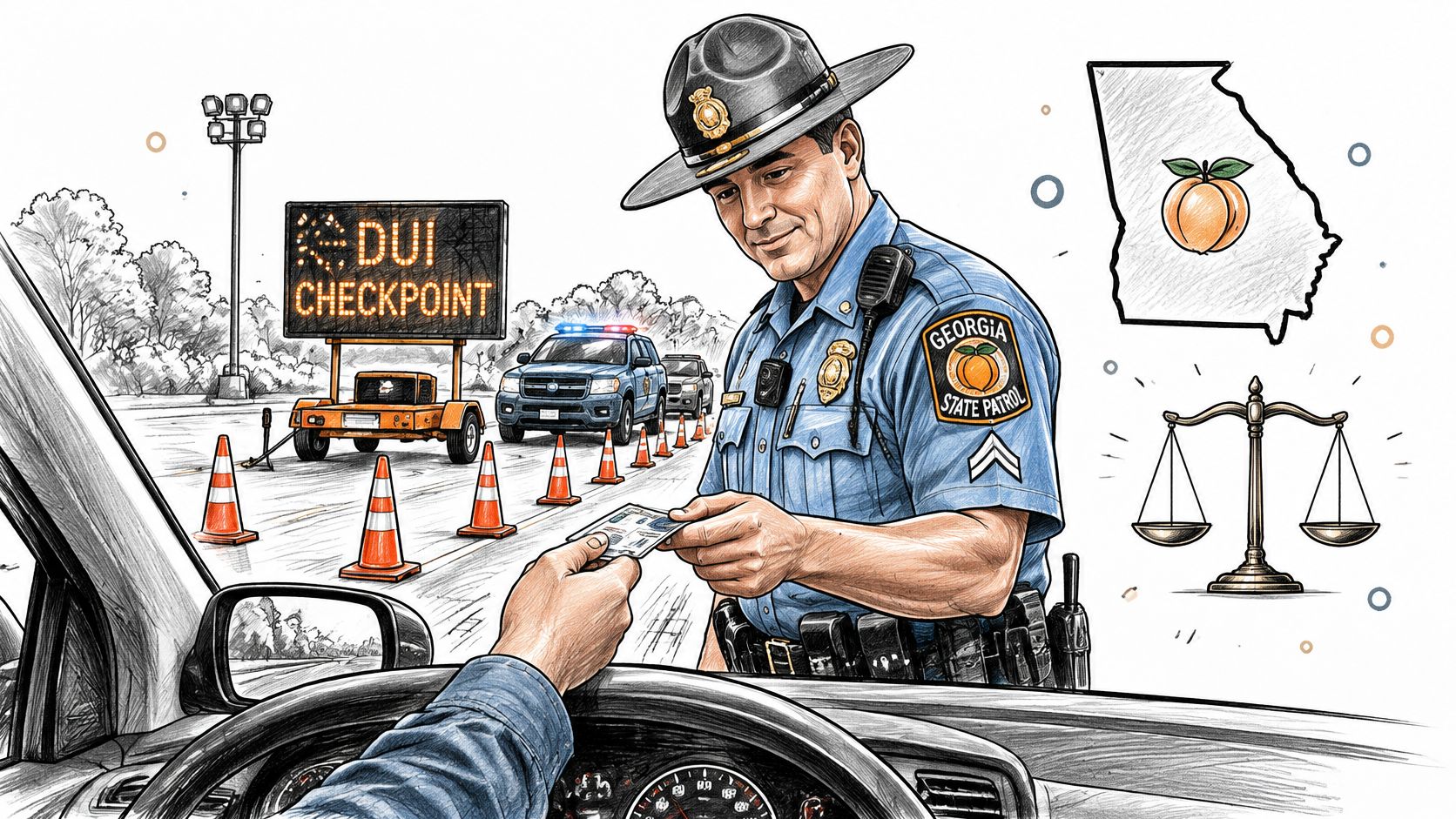
From the driver's seat, a checkpoint looks organized before it feels personal. You'll see signs first, then a slowed lane, then an officer at your window for a short check. Most drivers who show no signs of impairment move through quickly.
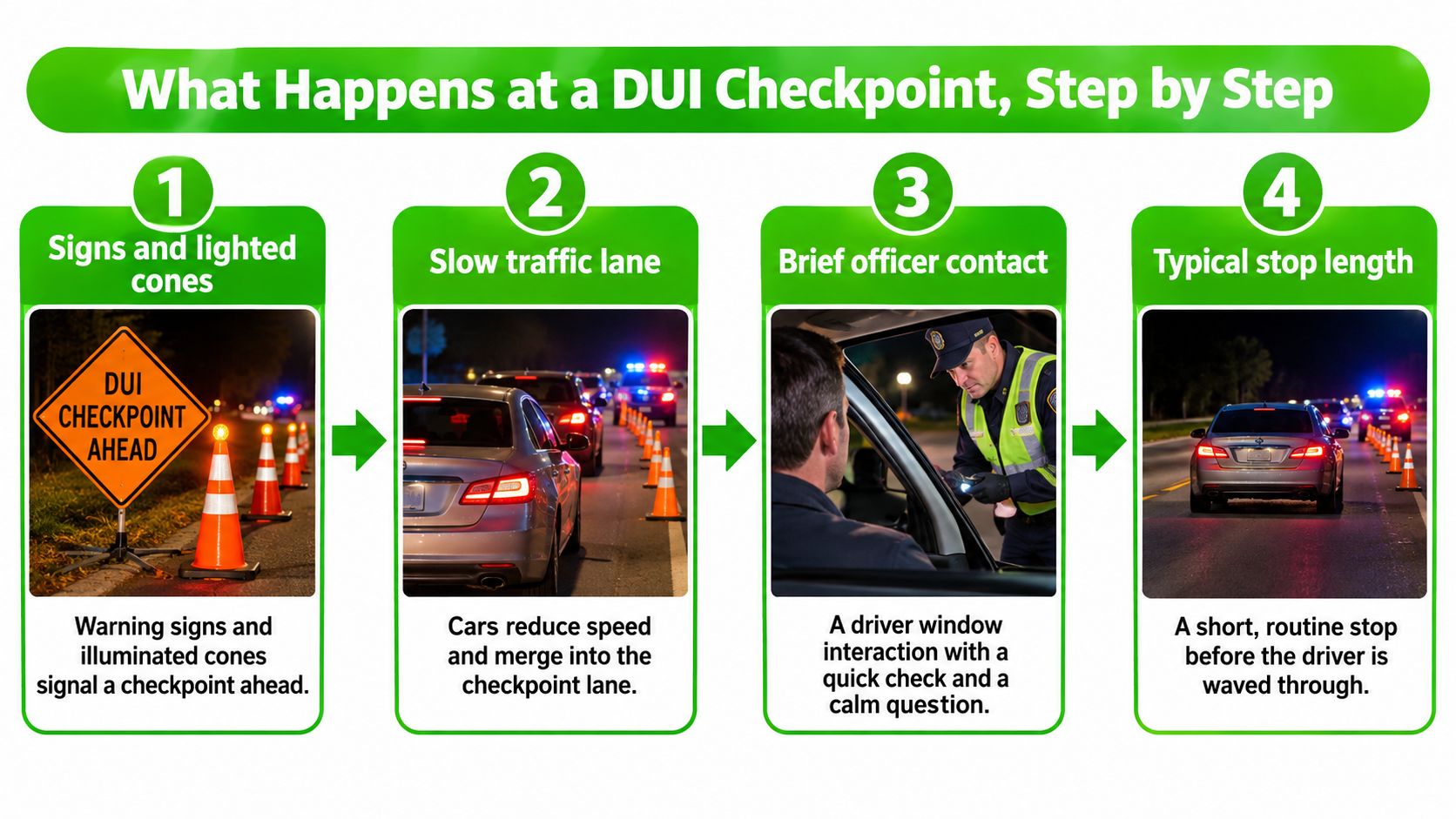
The graphic above outlines the flow in visual form, with its labels kept simple so the steps below carry the exact wording you need to remember.
The Sequence at the Window
- Signs and lighted cones. Warning signs and illuminated cones signal a checkpoint ahead, and traffic narrows to one lane. Slow down early, follow the lane markings, and don't make a sudden turn to avoid the line.
- Slow traffic lane. Cars reduce speed and merge in an orderly way. Keep a safe gap from the vehicle ahead because the line may stop and start several times.
- Brief officer contact. An officer approaches, asks for your license, registration, and proof of insurance, and looks for signs of impairment such as odor of alcohol, bloodshot eyes, or slurred speech. Keep your hands visible, turn on the interior light if it's dark, and answer identification questions plainly.
- Waved through or directed aside. Drivers with no signs of impairment are usually waved through within a short window. If the officer sees possible signs, you may be directed to a secondary area for a few more questions so traffic behind you keeps moving.
- Field sobriety tests if requested. In the secondary area, officers may ask you to perform tests while they watch balance, eye movement, and your ability to follow instructions. Listen to the full instruction before you start, and mention any medical condition, injury, or medication that affects balance or eyesight.
- Release, citation, or arrest. The stop ends in one of those three ways. If you're unsure whether the encounter is over, ask calmly whether you're free to leave rather than driving off on an assumption.
What It Feels Like in Practice
On a busy Atlanta arterial or a main road in Athens, the whole contact for a sober driver is often measured in minutes rather than hours. You'll notice clear signage, bright lighting, marked vehicles, and officers in reflective gear directing flow. That visibility isn't accidental. It's part of how the operation identifies itself as an official checkpoint and keeps the queue safe for everyone in line.
Staying calm isn't about being passive. It's about keeping the encounter short, clear, and easy to review later if questions arise.
Your Rights at a DUI Checkpoint
A checkpoint stop is a seizure under the law, but that doesn't give officers unlimited authority. They may stop cars under a lawful, neutral program without suspecting you personally. You still keep defined rights during that stop, and knowing where the line sits helps you comply where you must and pause where you can.
You must provide your valid license, registration, and proof of insurance when asked. Beyond identifying information, you keep the right to remain silent, the right to decline a voluntary search of your vehicle, the right to ask whether you're free to leave, and the right to request a lawyer before answering questions about drinking. If you're preparing for common roadside questions, review answers to sobriety test questions before you're ever in that lane, not while an officer waits at your window.
Practical rule: you're best protected when the stop stays polite and calm, your statements stay short, and any challenge to the stop is raised later through a lawyer rather than argued at the window.
What to Do at Each Stage of a Checkpoint Stop
| At the Window | What You Can Do | Why It Matters |
|---|---|---|
| Officer asks for license, registration or proof of insurance | Hand them over when asked and keep hands visible | Routine documents keep the stop short |
| Officer asks where you are coming from or how much you drank | Answer identifying questions and politely decline other questions | Statements can shape the next stage, so keep them brief |
| Officer asks you to step out or take field sobriety tests | Ask whether you are required to comply and whether you are free to leave | Whether tests were voluntary can matter in later review |
| Officer requests a breath or chemical test | Know Georgia implied-consent rules before you decide | A refusal triggers separate license consequences |
| Officer asks to search the vehicle | Decline a voluntary search clearly and calmly | Consent is a choice and can be limited |
Don't physically resist an officer's direction, even if you believe the checkpoint is unlawful. Note what happened, keep any paperwork, and let a lawyer evaluate the stop afterward with the full record. Roadside arguments rarely end a detention, and they often create new charges or safety risks that didn't exist when you rolled into the lane.
This summary is general information, not individualized legal advice. Outcomes turn on the exact facts, the charge filed, and what was said and done during your specific stop. A short consultation after an arrest is worth far more than guessing from a general guide like this one.
Is a DUI Checkpoint Legal in Georgia and Does It Work
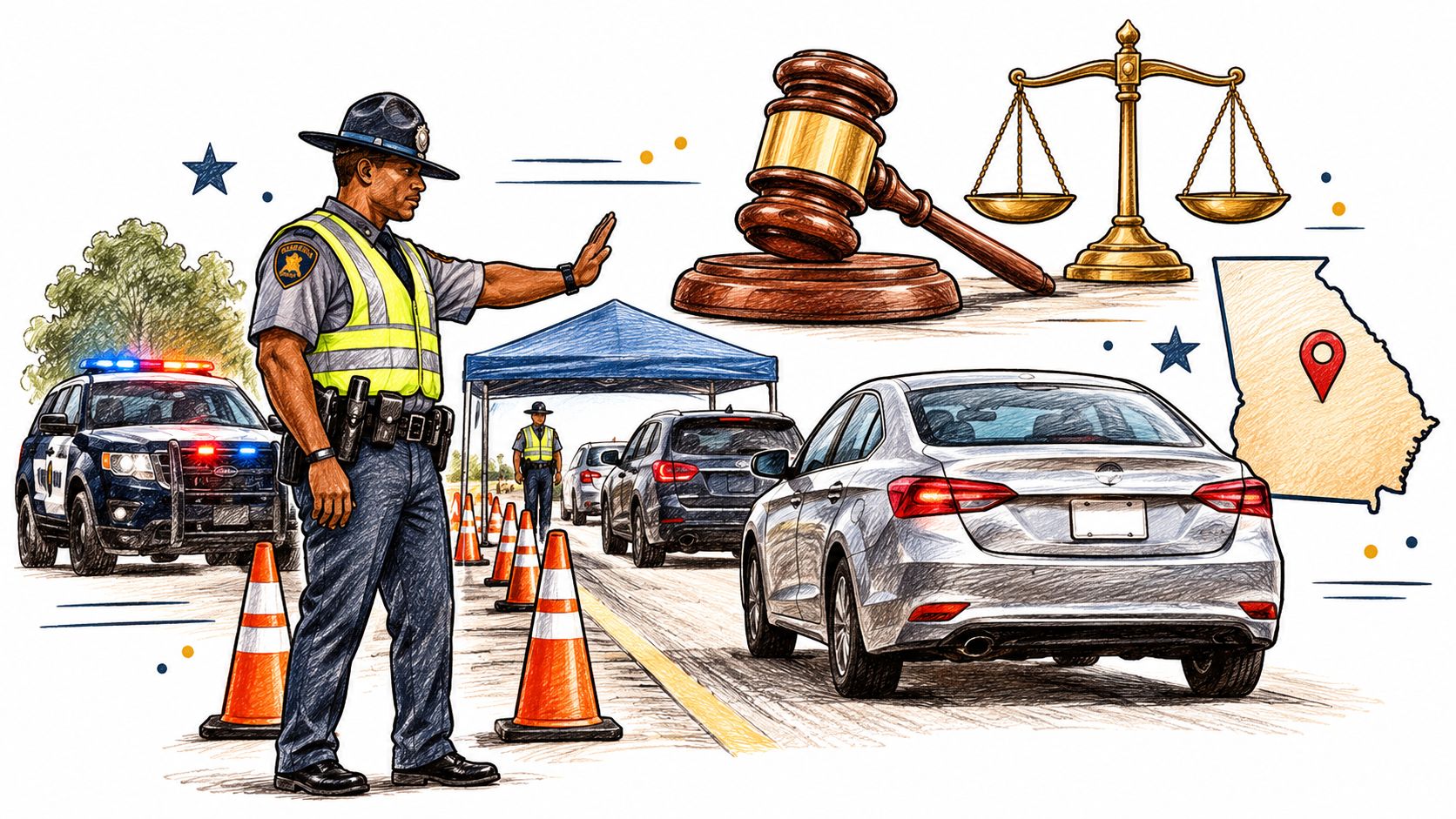
You approach a checkpoint, see officers directing cars into a lane, and wonder whether they can stop you without suspecting you of a crime. In Georgia, a DUI checkpoint can be legal when it follows a structured program that limits officer discretion and protects drivers. The cones and lights alone do not establish legality. Planning, neutral stopping rules, brief detention, and a genuine traffic-safety purpose matter.
The Supreme Court Case That Set the Framework
The national starting point is the Supreme Court's 1990 decision in Michigan Department of State Police v. Sitz. In the Michigan pilot checkpoint considered by the Court, officers processed 126 vehicles over 1 hour and 15 minutes, with an average delay of approximately 25 seconds per vehicle. Two drivers were detained for field sobriety testing, and one was arrested for driving under the influence of alcohol.
The Court upheld that program against a Fourth Amendment challenge. Brief, standardized stops served the government's substantial interest in preventing impaired driving while imposing limited intrusion. A checkpoint stop can therefore be constitutional without individualized suspicion, provided the program is properly structured.
That does not give officers unlimited power to stop motorists wherever they choose or detain them for any length of time. Checkpoint design, neutral procedures, supervisory control, safety, publicity, and the duration of each stop remain legally significant. A stop based on an officer's hunch, unclear procedures, or detention that extends beyond the checkpoint's purpose raises different questions from a brief, uniform contact.
State law can impose stricter limits than federal law. For Georgia drivers, the relevant question is whether the checkpoint complied with Georgia's rules, not whether a similar operation is permitted elsewhere.
What Georgia Courts Look For
Georgia authorities and court summaries focus on several features. A defensible checkpoint generally has supervisory authorization, rather than being a spontaneous decision by officers in the field. It uses a neutral stopping pattern, such as stopping every car or every nth car according to a set formula. Drivers who show no signs of impairment should face minimal delay, and the operation should serve a legitimate traffic-safety purpose rather than general crime hunting.
As you approach, note what is visible: signs announcing the operation, uniformed officers, adequate lighting, marked vehicles, and a defined lane with steady traffic flow. Those details do not establish whether every legal requirement was met behind the scenes. They can, however, help a lawyer assess the stop later, especially if the procedure seemed unclear or the detention unusually long.
Does the Deterrence Actually Work
Checkpoint effectiveness is measured by their broader effect on crashes, not just by the number of arrests made on one night. The Centers for Disease Control and Prevention checkpoint fact sheet describes evidence that checkpoint programs can reduce fatal and injury crashes associated with impaired driving. Their deterrent effect depends in part on drivers seeing enforcement as visible and recurring. When drivers expect impaired driving to be detected, some choose a sober ride or avoid driving after drinking.
The effect of an individual operation may be short-lived. Recurring, publicized enforcement helps keep the deterrent message visible; a single checkpoint may not sustain it.
For Georgia drivers, the legal and safety questions are distinct. Courts assess whether a checkpoint was brief, neutral, and properly supervised. Its deterrent value depends on visible enforcement that continues over time. If the stop seemed irregular, write down what you observed and have the checkpoint's procedures reviewed rather than assuming the result was automatically valid or invalid.
How a Checkpoint Stop Affects Your License
The stop itself may last minutes. A chemical test decision made during that stop can control your driving life for a year.
That's the part most checkpoint explainers leave out. Georgia runs two separate tracks after an arrest. One is the criminal case in court, where a judge or jury decides guilt. The other is an administrative license action through Georgia DDS, which moves on its own timeline and can affect your ability to drive before the criminal case ends. Understanding how implied consent works in Georgia helps you see why the paperwork handed to you that night matters as much as any court date.
The Georgia DDS guidance on license suspension states that refusing a state-administered chemical test can trigger a minimum one-year license suspension. Georgia law also provides a short deadline to seek review of that action, and the framework contemplates a temporary driving permit in some suspension situations. Don't rely on a deadline you half remember from a friend's case. Read your notice the same night and confirm the exact date directly with DDS.
How Each Checkpoint Stop Path Affects the License
| Stop Path | What Happens | License Consequence |
|---|---|---|
| Brief stop with no signs of impairment | Documents checked and driver released | None from the stop itself |
| Signs of impairment and field sobriety tests | Possible arrest and a chemical test request | Set by the test result and the charge filed |
| Chemical test completed | Results used in the criminal case and in administrative review | Administrative action possible before court |
| Chemical test refused | Officer may issue notice of implied-consent refusal | Minimum one-year suspension under Georgia DDS rules |
Your First Steps After Any Arrest
- Read every notice that night. Find the review deadline and circle it. Missing it can close off options regardless of how the criminal case goes.
- Confirm your license status with DDS. Don't assume you're clear to drive, or suspended, based on what someone at the scene said.
- Ask about a temporary permit. Whether one applies turns on your specific suspension situation, so ask directly rather than guessing.
- Keep copies of everything. Courts, DDS, your lawyer, and later a certified school may each need documents. If reinstatement requires Risk Reduction, remember the assessment must be completed before the class and takes between 25 and 45 minutes, and the Certificate of Completion issued after both components is the legal proof DDS and the court need.
Outcomes depend on the test requested, the notice you received, prior suspensions, and the exact charge. That's especially important if you drive for work, caregiving, school, or probation compliance in Atlanta, Athens, or anywhere else in Georgia. Get your specific timeline reviewed promptly, because the administrative clock won't wait for the criminal one.
Mistakes That Make a Checkpoint Stop Worse
The most harmful mistake happens before you reach the officer. A sudden U-turn or evasive lane change near the cones creates its own traffic risk and can give officers grounds for a separate stop based on that driving, even if the checkpoint itself would have waved you through in under a minute.
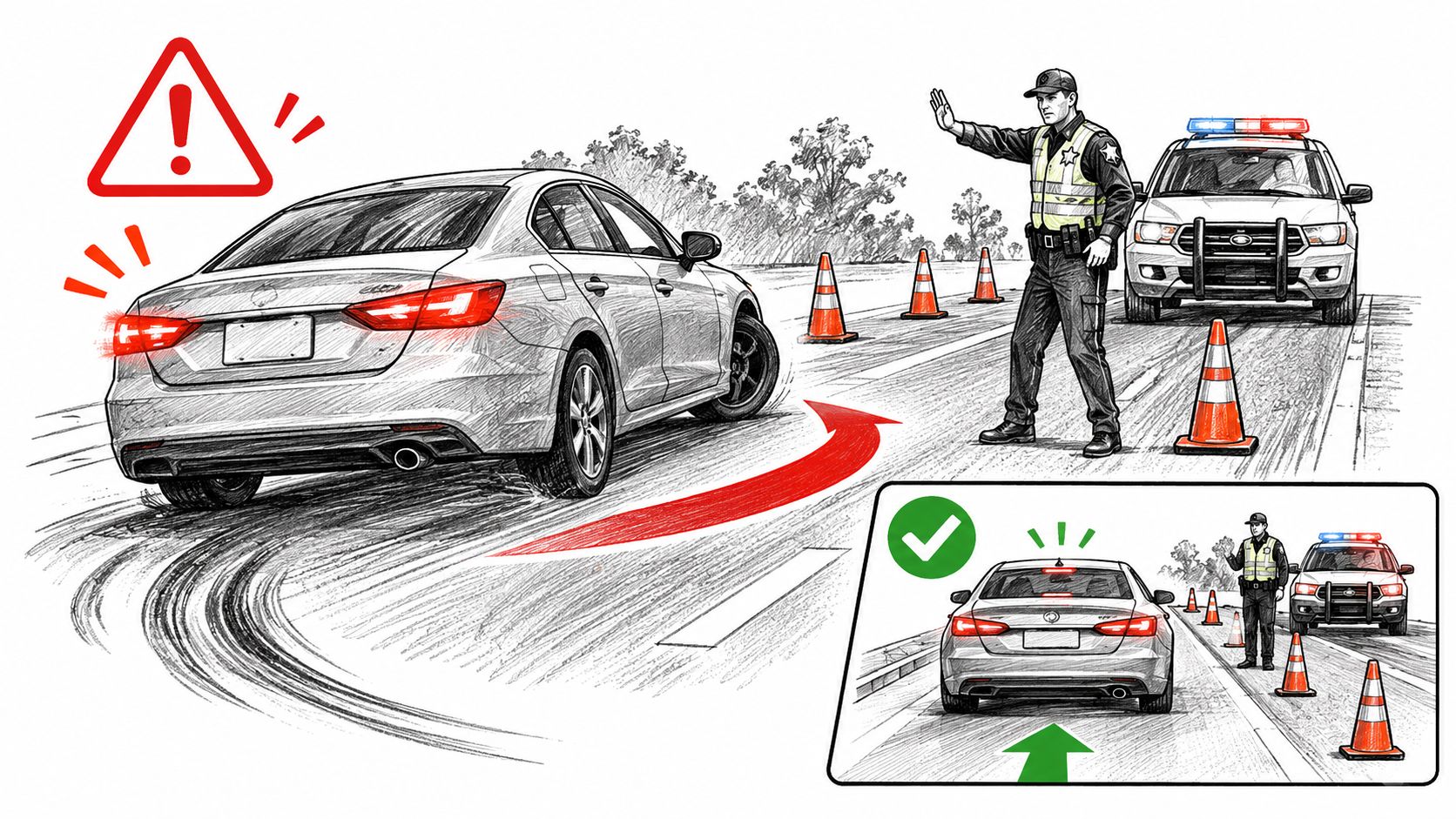
Guidance summarized in this overview of Georgia DUI checkpoint rights reflects the same safety-first point. Georgia authorities focus on supervisory authorization, a neutral stopping pattern, minimal delay, and a legitimate traffic safety purpose, but your job in the lane is simpler. Follow lawful directions, avoid sudden maneuvers, and save validity questions for later legal review.
Common Errors and the Better Move
- Stopping abruptly in the travel lane. Brake smoothly and follow the officer's hand signals instead of halting wherever anxiety hits. A hard stop in a narrowed lane invites a rear-end collision.
- Arguing legality at the window. You won't litigate supervisory authorization through an open window. Comply with lawful directions, note your concerns, and raise them afterward.
- Guessing at confusing questions. If you don't understand an instruction, say so and ask for clarification. A misunderstood field test instruction looks like poor performance.
- Struggling through a language barrier without speaking up. Request an interpreter if English isn't your strongest language. Nodding along to questions you didn't fully understand can create statements you never meant to make.
- Hiding a medical issue. Prescription or over-the-counter medication, fatigue, diabetes, and inner ear problems can produce impairment-like symptoms. Tell the officer about relevant conditions and keep medication information accessible in your vehicle.
When the Checkpoint Itself Feels Unsafe
Constitutional validity and respectful, accessible implementation are separate questions. A checkpoint can be legally authorized yet poorly run, with dangerous queues spilling into fast traffic, poor lighting, blocked exits, or communication barriers for older motorists and disabled drivers. If you notice conditions like those, don't stop in the lane to document them. Note the time, location, and specifics from a lawful, safe place later, and report them through proper channels.
Follow lawful directions in the moment, stay calm at the window, and move every dispute to a safer setting after the stop ends.
That single decision rule prevents most checkpoint regrets. It protects you physically in a narrowed lane at night, keeps the encounter from escalating, and preserves a clean record for any later review of whether the operation met Georgia's requirements.
Verify Your Status and Enroll in a Certified Course
A checkpoint stop and a license action are separate steps. Before enrolling in a course, check your license status and deadlines directly with DDS, and keep your court and DDS notices together. The notice tells you what action is required; the course certificate is proof of completion, not a substitute for checking your status.
Choose a DDS-certified school. Georgia DDS does not accept certificates from self-paced online DUI/Risk Reduction programs for license reinstatement or court purposes. If you are unsure what the required program involves, read this overview of Georgia's Risk Reduction program before enrolling.
The Required Sequence in Order
The DUI/Risk Reduction Program has two mandatory components, completed in sequence: the Assessment Component first, then the Intervention Component. The total cost is $360.00: $100.00 for the assessment, $235.00 for the intervention course, and $25.00 for the workbook.
- Complete the NEEDS Assessment first. This 130-question screening takes between 25 and 45 minutes. It is not a pass/fail test, but you must complete it before taking the class.
- Attend the full 20-hour Intervention Component. The classroom course is delivered over several days, often across a weekend or several evenings, and cannot be completed in one day. It includes education about alcohol and drug use and their effects on driving, along with peer group counseling. Arrive on time for every session: late students may be denied entry, cannot make up missed time, and must re-register and pay the full course fee to start again.
- Receive your Certificate of Completion. The certified school issues the official certificate only after both components are finished. This is the proof needed for court or DDS license reinstatement, so allow time to complete the program before your deadline.
Georgia DUI Schools offers classroom sessions in the Atlanta, Decatur, Athens, and Buford areas. The Decatur location is at 4712 Memorial Drive, Decatur GA 30032, and classes there are held every weekend. For drivers comparing school enrollment approaches, Dekodi's approach to driving school growth discusses a driving-school software partnership and business growth.
Check your DDS status and deadlines, then enroll in a certified program that follows the required order. Georgia DUI Schools offers DUI/Risk Reduction classes and clinical services at Georgia locations. Visit Georgia DUI Schools for program information and enrollment.