

Under Georgia's implied consent law, anyone driving on Georgia roads has already agreed to a chemical test after a lawful DUI arrest. Refusing that test triggers a minimum one-year administrative license suspension handled by Georgia DDS.
Maybe you're reading this after seeing blue lights in your mirror on I-285, Broad Street in Athens, or a county road outside Atlanta. You may be trying to remember whether the officer asked for a field sobriety exercise, a breath sample, or something different, and whether saying no protects you or creates a separate problem. Those decisions can affect your driving privileges and your criminal case at the same time.
Georgia's system can feel confusing because the license suspension and the DUI prosecution are separate tracks. The administrative case can move forward even before a court decides whether you're guilty. This guide explains how the law works, what happens after a refusal, why the 30-day hearing window matters, and how a DDS-approved Risk Reduction Program fits into the reinstatement process.
The Moment the Blue Lights Appear in Georgia
You're driving on I-285 near Atlanta when blue lights fill your rearview mirror. Your heart starts pounding. The officer approaches, asks where you're coming from, and notices an odor of alcohol. You may be asked to perform roadside exercises, answer questions, or provide a preliminary breath sample.
At this point, many drivers think the entire issue is whether they “pass” a field sobriety exercise. That's only part of the encounter. Implied consent becomes especially important after a DUI arrest, when the officer requests a state-administered chemical test and reads the required warning.

The roadside choice is not the post-arrest choice
Field sobriety exercises and chemical testing aren't the same thing. A roadside exercise may involve walking, balancing, or following an object with your eyes. The implied-consent decision concerns a chemical test of blood, breath, urine, or another bodily substance after the legal testing trigger occurs.
Georgia's framework comes from O.C.G.A. § 40-5-55, and the warning procedure is addressed through O.C.G.A. § 40-5-67.1. The statute treats anyone driving on Georgia roads as having consented to chemical testing after an arrest for an offense under Georgia's DUI statute, O.C.G.A. § 40-6-391, or after involvement in a crash causing serious injury or death. You can review the statutory language in this Georgia implied-consent statute.
Practical rule: Don't confuse a refusal decision with a guaranteed defense. Refusal creates its own licensing exposure, while the court case depends on the complete evidence and procedure.
The officer's warning matters because Georgia DDS states that refusing implied-consent testing brings a minimum one-year suspension. That suspension is administrative, so it can affect your license before the criminal DUI charge is resolved. Drivers who want to understand the kinds of questions officers may ask during the broader stop can review these Georgia sobriety test questions.
The issue also exists beyond Georgia. If you regularly drive between Georgia and Florida, a separate explanation of Florida implied consent law explained can help show why state-specific rules matter. For now, remember the central point: by driving on Georgia roads, you've already entered the statutory framework.
How Georgia's Implied Consent Law Actually Works
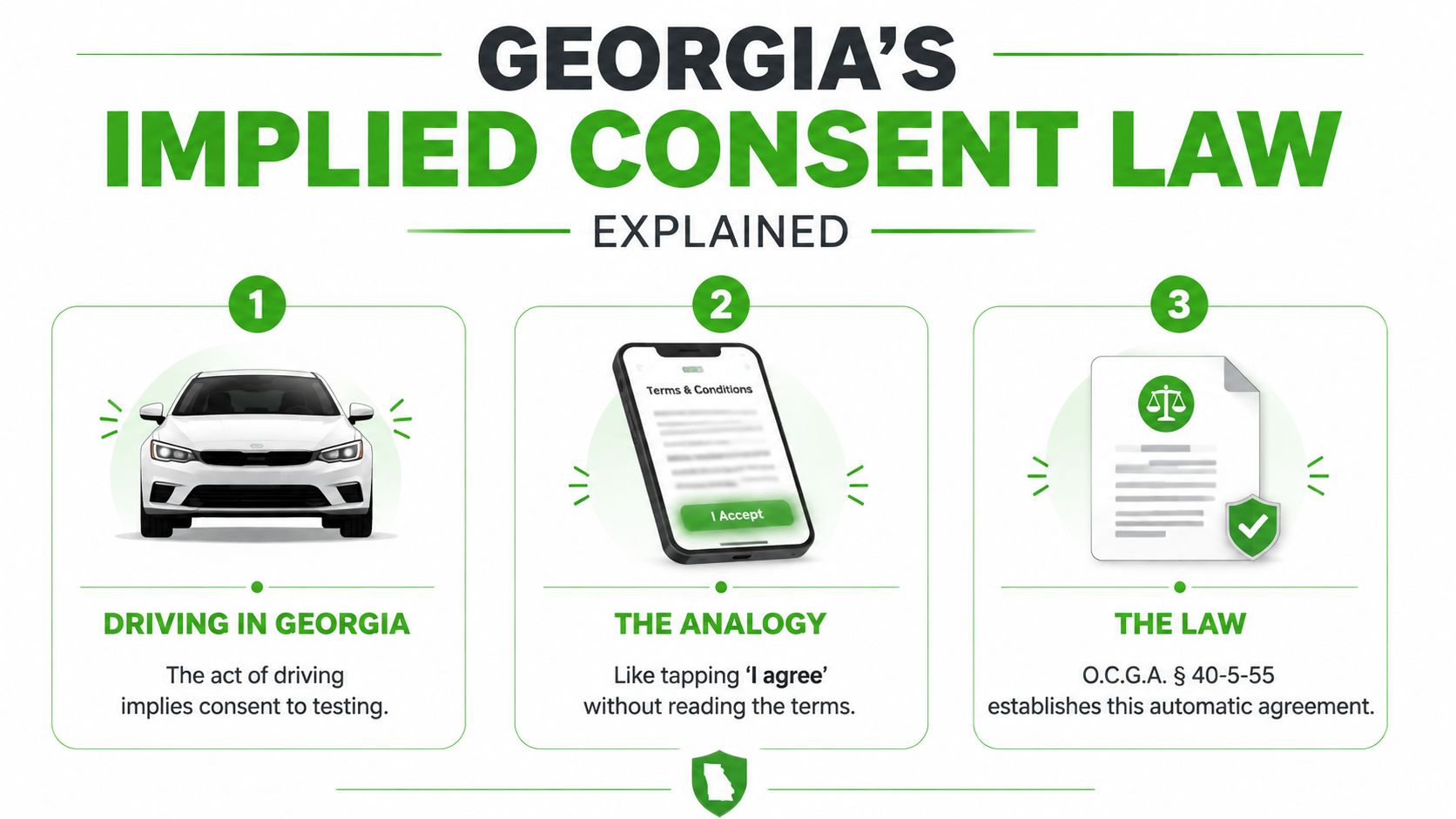
Think of implied consent like tapping “I accept” on a phone application without reading every term. The act of driving on Georgia roads creates advance consent to certain chemical testing, but only when the statutory conditions are met. It isn't blanket permission for an officer to test anyone at any time.
Under O.C.G.A. § 40-5-55, the testing framework applies when a driver is arrested for a qualifying DUI offense or is involved in a serious-injury or fatal crash. The possible specimens include blood, breath, urine, and other bodily substances. The officer must request the test and provide the required implied-consent notice at that point in the encounter.
The warning is a legal step, not casual conversation
The warning is designed to tell you that refusal carries a licensing consequence. Georgia DDS identifies the consequence as a minimum one-year suspension, and the Georgia Bureau of Investigation directs officers to use the current state-issued warning form, DS-354. The GBI also explains that the updated notice must be read at arrest and that breath-test refusals aren't admissible in criminal trials under the current notice structure. The current details are available in the Georgia Bureau of Investigation implied-consent FAQ.
The warning doesn't eliminate every legal question. A defense lawyer may examine whether the officer had lawful grounds for the arrest, whether the correct warning was used, whether it was read at the required time, and whether the requested specimen matched the applicable procedure. Those details can affect the administrative case and the criminal evidence.
Why the criminal and licensing cases split apart
A useful way to understand the system is to picture two files on two desks. One file is the criminal DUI case, handled through the court system. The other is the DDS licensing matter, which can impose a suspension based on the refusal itself.
That separation is why a driver shouldn't wait for a court date before learning about the license process. Alcohol-related driving concerns may also overlap with health or substance-use issues, and readers looking for general support can explore co-occurring depression alcohol care through a separate mental-health resource. It doesn't replace Georgia legal advice, but it may help someone address a broader concern alongside the legal requirements.
Breath, Blood, and Urine Testing Under Georgia Law
Georgia's implied-consent system recognizes several types of chemical testing, but the practical questions differ depending on the specimen. A breath request is familiar to many drivers. Blood and urine requests can raise additional questions about warrants, medical settings, suspected drugs, and serious crashes.
| Test type | What it generally involves | Why procedure matters |
|---|---|---|
| Breath | A breath sample requested after arrest | The current warning and testing process can affect refusal and evidentiary treatment |
| Blood | A biological sample collected for laboratory analysis | Warrant and constitutional issues may become important, especially in serious cases |
| Urine | A urine specimen used for chemical analysis | The request and collection process can affect the legal analysis |
Breath testing
Breath testing is often the specimen drivers associate most closely with a DUI arrest. The request may occur after the driver is taken into custody, rather than during the initial roadside conversation. The Georgia Bureau of Investigation explains that procedures for breath-test refusals changed after litigation and that breath-test refusals aren't admissible in criminal trials under the current notice structure.
That doesn't mean a refusal has no effect. Georgia DDS still treats refusal as a basis for the minimum one-year administrative suspension described in its guidance. For a plain-language review of the post-arrest breath-test issue, see this Georgia breathalyzer test information guide.
Blood and urine requests
Blood testing can become more prominent in serious-injury or fatal-crash investigations, or when officers suspect drug impairment. The statutory framework expressly reaches crashes involving serious injuries or fatalities, not only ordinary DUI arrests. The type of specimen can also influence whether officers seek a warrant before compelled collection.
Urine testing may be requested when drugs are suspected or when another specimen is considered more suitable. Don't assume that choosing one specimen makes the licensing issue disappear. Refusal is evaluated through the implied-consent process, while the legality and evidentiary value of the collection depend on the facts and procedures surrounding the request.
What Happens When You Refuse the Chemical Test
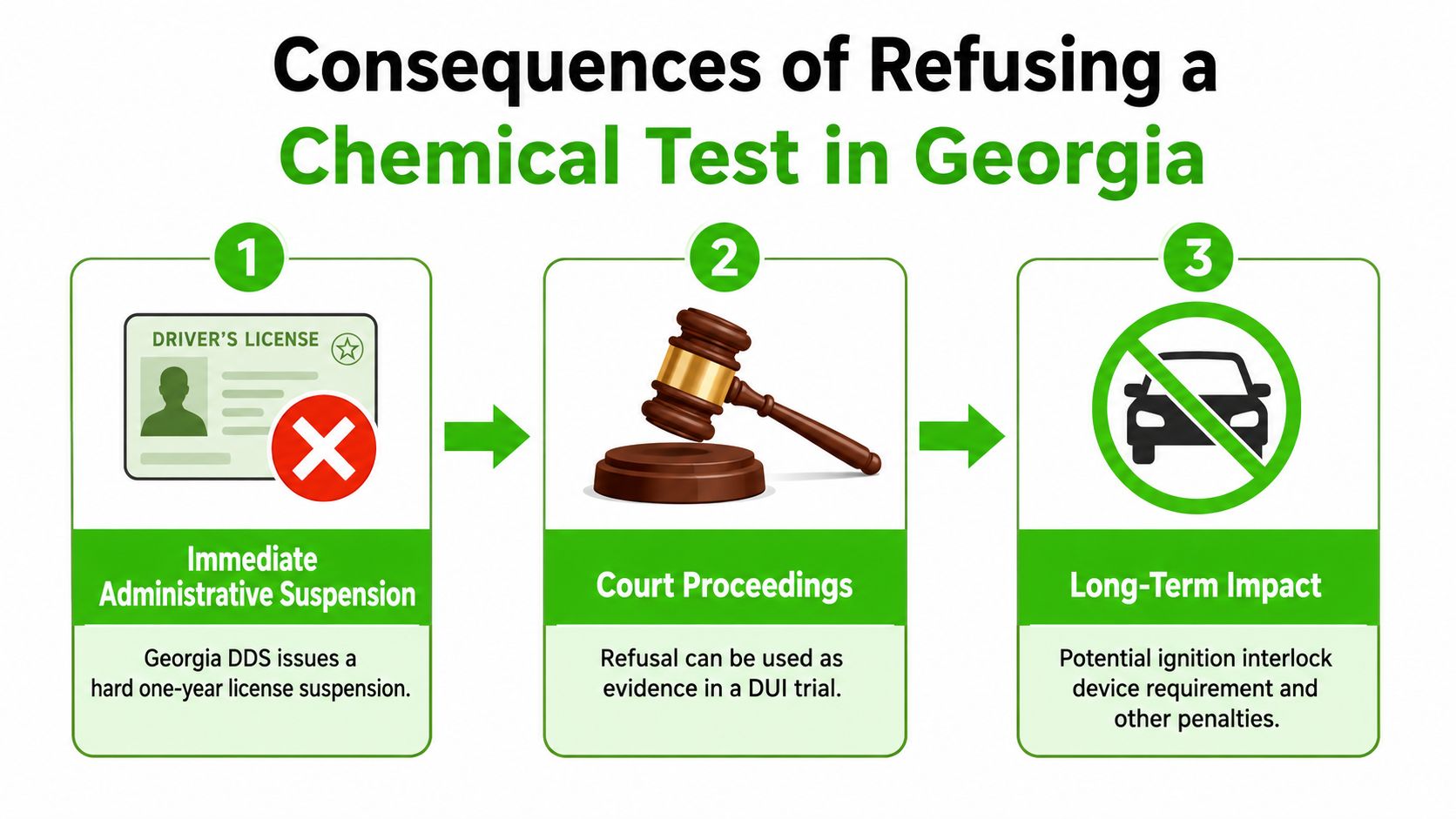
Refusal can create immediate licensing consequences even though the criminal case may take much longer. Georgia DDS states that a refusal brings a minimum one-year license suspension, and for a first DUI offense, the driver isn't eligible for a limited driving permit during that suspension period. The administrative action stands apart from the criminal prosecution.
The first track is administrative
The license issue doesn't wait for a judge to decide the DUI charge. DDS can process the refusal as an administrative matter, which is why a driver may face a suspension while still presumed innocent of the criminal accusation.
The exact notice, timing, arrest basis, and officer paperwork can matter. The statutory structure gives drivers a refusal option, but Georgia appellate decisions also recognize that no requested chemical test is given if the driver refuses. A lawyer can review whether the state followed the required steps.
The second track is criminal
The refusal question and the DUI charge are related, but they aren't identical. Evidence from the stop, officer observations, field sobriety exercises, statements, and any lawfully obtained chemical results may still shape the criminal case.
The GBI's current guidance is especially important for breath refusals because it states that those refusals aren't admissible in criminal trials under the current notice structure. That point doesn't automatically resolve every DUI case, and it doesn't erase the separate DDS suspension.
Remember: A refusal can be less useful to the prosecution in one setting while remaining highly consequential in the licensing system.
A court may also impose separate requirements after a conviction, depending on the charge, sentence, and individual circumstances. Don't treat the administrative suspension as the only issue, and don't assume the criminal case will automatically follow the same outcome.
A Realistic Timeline From Stop to License Reinstatement
At the traffic stop, the officer investigates, makes an arrest if legally justified, reads the implied-consent notice, and requests a chemical test. That moment is the starting point for both the evidence review and the DDS deadline.
The first days require document control
Keep every document you receive, including the citation, temporary driving paperwork, suspension notice, and court documents. Ask a Georgia DUI attorney to review the stop, arrest, warning, and refusal paperwork. If you qualify for appointed counsel, contact the public defender's office rather than waiting for the first court appearance.
The administrative deadline is the urgent one. Georgia drivers generally have 30 days to request a hearing to challenge the suspension, and the request must be made in writing through the applicable administrative process. The exact procedure can depend on the notice and case type, so confirm the current filing instructions with DDS, an attorney, or the Office of State Administrative Hearings.
Court and reinstatement move on a different calendar
The criminal case may involve an arraignment, motions, negotiations, and sentencing. A misdemeanor or felony classification can change the court process, and the final requirements depend on the charge and sentence. A driver should not assume that completing one requirement resolves every other obligation.
A reinstatement checklist may include:
- Risk Reduction education: DDS identifies the DUI Alcohol or Drug Use Risk Reduction Program as including a standardized screening assessment and a DDS-approved therapeutic education course focused on alcohol, drug use, and driving.
- Clinical evaluation: A court-ordered evaluation is separate from the education course and may lead to additional treatment requirements.
- Insurance documentation: Confirm whether the case requires SR-22 coverage and keep proof available.
- Ignition interlock compliance: Follow any interlock order or reinstatement condition that applies to the case.
- DDS paperwork and fees: Verify certificates, identity documents, insurance records, and the applicable reissuance requirements before applying.
The Georgia license reinstatement guide can help you organize the paperwork, but it isn't a substitute for legal advice about the 30-day hearing deadline.
Common Myths Georgia Drivers Still Believe About Refusal
Refusal decisions are often shaped by advice from friends who faced different arrests, different counties, or different specimens. Georgia's current rules make several popular shortcuts unreliable.
Myth one, refusal guarantees dismissal
It doesn't. A refusal may affect what the prosecution can use, particularly with breath-test refusal under the current GBI notice structure, but the state may still rely on other evidence. The officer's observations, driving pattern, statements, video, field sobriety evidence, and legally obtained testing can all matter.
Refusal also remains significant to DDS. The licensing suspension is administrative and can proceed separately from the criminal court case. Winning or resolving the DUI charge doesn't automatically mean the refusal suspension disappears without attention to the licensing process.
Myth two, officers always need a warrant for every blood draw
Blood testing raises constitutional and warrant questions, but the answer depends on the facts. Georgia litigation, including the Elliott decision referenced in state guidance and legal analysis, affected breath-testing procedures and the treatment of refusal evidence. Serious crashes, medical circumstances, suspected drugs, and the availability of a warrant can change the analysis.
The safe lesson isn't that every blood draw is lawful or unlawful. It's that the reason for the request, the officer's process, the notice, and any warrant should be reviewed together.
Myth three, an out-of-state license avoids Georgia consequences
A driver's home state may control the physical license, but a Georgia arrest can still create a Georgia driving-privilege problem. Don't assume an Alabama, Florida, or South Carolina license makes the DDS process irrelevant.
Myth four, refusing automatically beats a breath result
Refusal isn't a guaranteed strategic win. It creates the administrative exposure already discussed, while the criminal case turns on admissible evidence and legal procedure. The better response is prompt, case-specific advice and careful compliance with every valid requirement.
How Georgia DUI Schools Supports Your Reinstatement Path
Georgia's DDS-approved Risk Reduction Program isn't a generic driver class. DDS describes it as a regulated program with two components, a standardized screening assessment and an approved therapeutic education course addressing alcohol, drug use, and driving. A court or DDS requirement may also involve a clinical evaluation, treatment, or a Victim Impact Panel, and those are separate obligations.
Consider an Athens driver who uses a commercial license for work. That driver may need to coordinate the court case, employer concerns, clinical requirements, insurance documentation, and the Risk Reduction certificate without assuming that one certificate solves every issue. An Atlanta first-offender may face a different combination of court and licensing requirements, even if both drivers were arrested for DUI.
Matching the program to the requirement
Georgia DUI Schools offers the DDS-approved Risk Reduction Program through in-person and online options, including service for drivers in Atlanta, Athens, and surrounding communities. Online availability can be useful for a driver in a rural county, while an in-person class may be easier for someone who benefits from a classroom schedule and direct instructor support.
The provider also offers clinical services and Victim Impact Panels. Those offerings don't merge the requirements into one step. Instead, they can give a driver a single place to identify which items are educational, which are clinical, and which are ordered by the court.
Completion records still need attention
Ask how the certificate of completion will be documented and submitted, then keep your own copy. If an ignition interlock condition applies, follow the installation and monitoring requirements from the authorized provider and the applicable order. DDS may also require insurance proof and a reissuance payment before the driving privilege is restored.
A course certificate helps only when it matches the requirement and reaches the agency or court that needs it.
Start by comparing the written court order with the DDS notice. If the order requires a clinical evaluation, don't treat the Risk Reduction screening as a replacement. If a panel is required, schedule it separately and preserve the completion record.
Your Next Steps After a Georgia DUI Stop
The first 30 days deserve a written checklist, not memory. Start with the deadline that can affect your license before the criminal case is finished.
- Confirm the DDS deadline: Request the appropriate administrative hearing in writing before the 30-day window closes. Verify the current process with DDS or counsel.
- Get legal advice: Retain a Georgia DUI attorney, or contact the public defender if you qualify.
- Enroll early: Register for the DDS Risk Reduction Program so the course schedule fits the court and reinstatement timeline.
- Arrange the evaluation: Schedule a certified clinical evaluation if the court or DDS requires one.
- Follow interlock terms: If an ignition interlock condition applies, maintain every installation and monitoring obligation.
- Gather insurance proof: Obtain the required SR-22 documentation if it applies to your case.
- Prepare DDS payment and records: Confirm the reissuance fee, certificates, identification documents, and appointment process before seeking restoration.
Starting the course before the criminal case ends won't decide the legal outcome, but it can prevent an avoidable delay when education becomes part of reinstatement. Keep your attorney informed, follow the written order, and don't rely on a friend's experience from another Georgia county.
Georgia DUI Schools provides the DDS-approved Risk Reduction Program, clinical evaluation services, Victim Impact Panels, and flexible in-person or online scheduling for drivers working through Georgia DUI requirements. Review the available options and begin organizing your reinstatement steps by visiting Georgia DUI Schools.