
A court notice lands in your mailbox. Or your lawyer tells you the judge wants proof of a class. Or DDS flags your record and suddenly your next step depends on picking the right course fast. You search for a driving class online, and the results all sound the same.
They are not the same.
In Georgia, the wrong class wastes your time and money, and it may do nothing for your case, your license, or your deadline. The right class depends on why you need it. A DUI case, a drug-related requirement, a point reduction issue, and an insurance discount request are different problems. Georgia treats them differently, and you should too.
Navigating Your Georgia Driving Course Requirements
The biggest mistake I see is simple. A driver assumes any online class will satisfy any requirement. That's where people get stuck.
A generic page may say “online” or “virtual,” but that still doesn't answer the actual question. Will this count for your exact situation? Public guidance from outside Georgia has highlighted this same gap. Many providers describe delivery format but don't clearly tell drivers whether a course satisfies a court order, reinstatement need, point reduction issue, teen requirement, or insurance request, as noted by the Florida Safety Council's explanation of virtual driver education pathways.
What most Georgia drivers are actually dealing with
Usually, your situation falls into one of these buckets:
- DUI or drug-related requirement: You may need a DUI Risk Reduction Program, and that is not the same as a standard safe-driving class.
- Ticket, point, or minor traffic issue: You may need Defensive Driving, sometimes called a driver improvement course.
- License reinstatement steps: You may need more than one item, not just a class.
- Teen or first-time licensing questions: That's a separate category from DUI and defensive driving. If that's your issue, review the options for Georgia driver education courses.
Practical rule: Don't enroll until you can name the exact requirement in writing. Court order, DDS notice, probation instruction, or attorney guidance. One of those should control your decision.
The question you should ask first
Don't ask, “Can I take a driving class online?”
Ask, “Which Georgia-approved class satisfies my specific requirement?”
That wording changes everything. It pushes you away from marketing language and toward compliance language.
If your paperwork mentions DUI, Risk Reduction, drug possession, reinstatement after a DUI-related action, clinical evaluation, or another alcohol and drug education requirement, you are not shopping for a basic driving improvement course. If your goal is ticket dismissal, point reduction, or an insurance benefit, then Defensive Driving may be the right lane.
Stress makes people rush. Slow down long enough to match the class to the legal requirement. That one decision usually determines whether the rest of the process goes smoothly.
DUI Risk Reduction vs Defensive Driving in Georgia
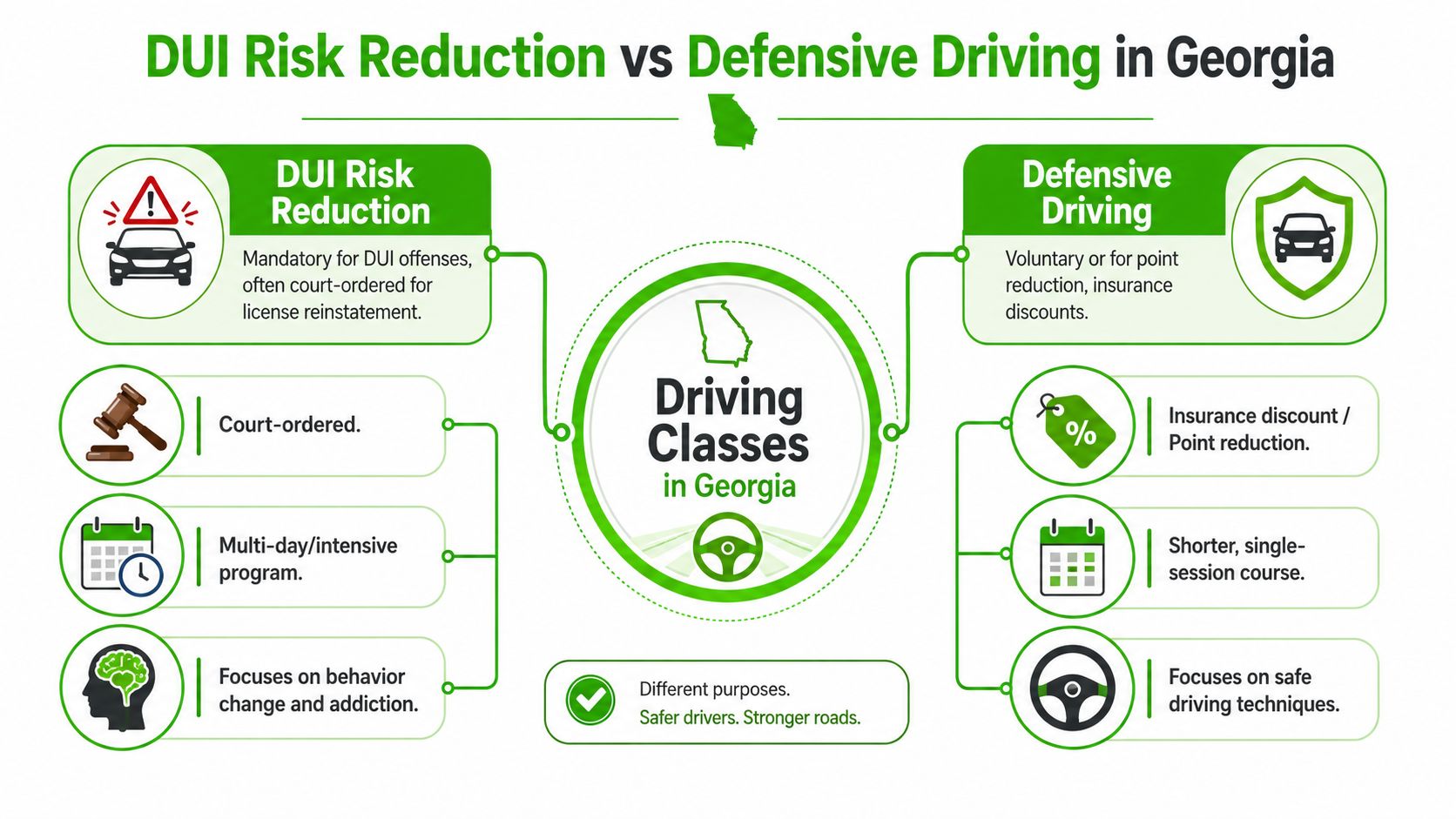
These two courses solve different problems. Treating them like substitutes is the fastest way to create a second problem.
What Defensive Driving is for
Defensive Driving is generally the course people mean when they search for a driving class online. Its purpose is driver improvement. Think safer decisions, hazard awareness, and better rule compliance.
That's not a new idea. The National Safety Council says it pioneered the nation's first Defensive Driving Course and has trained over 80 million drivers, showing that structured driver-safety education has a long history before online delivery. NSC also explains that the online format keeps the same core purpose of teaching hazard anticipation, safe decision-making, and rule compliance through its online defensive driving course overview.
In practical Georgia terms, Defensive Driving usually fits these situations:
- Minor traffic matters: Court-ordered improvement after a citation.
- Point concerns: A driver wants to address a record issue.
- Insurance questions: A driver is seeking an accepted safe-driving course for a possible discount.
What DUI Risk Reduction is for
DUI Risk Reduction is a different category entirely. It exists for drivers dealing with more serious alcohol or drug-related legal requirements. This is not a “good driving habits” class. It is a regulated intervention process tied to compliance, reinstatement, and accountability.
If that's your lane, start with a clear explanation of what a Risk Reduction course is in Georgia.
Go to the specialist, not the generalist. Defensive Driving helps with driving behavior and minor record issues. Risk Reduction addresses DUI and drug-related compliance.
The easiest way to remember the difference
Use this test.
| If your paperwork says | You're probably looking for |
|---|---|
| Ticket dismissal, points, insurance, driver improvement | Defensive Driving |
| DUI, alcohol, drugs, reinstatement, assessment, evaluation | DUI Risk Reduction |
Another useful check is the goal of the course.
- Defensive Driving aims to improve road behavior and compliance habits.
- Risk Reduction aims to address a legal and behavioral issue tied to substance use and public safety.
If you enroll in Defensive Driving when the court or DDS expects DUI Risk Reduction, that certificate may be useless for your case. If you enroll in Risk Reduction when all you needed was a traffic course, you've chosen a heavier process than necessary.
Don't guess. Read the order. Match the wording. Then enroll.
Choosing Your Class Format Online In Person or Virtual
You get a court notice, open your laptop, and search for a driving class online. Ten minutes later, you are staring at self-paced courses, Zoom classes, and classroom options that all sound acceptable. That is where people make expensive mistakes in Georgia.
Choose format after you confirm the requirement. Then choose the format you will complete by the deadline.
Georgia drivers usually have three realistic options. Self-paced online works well for Defensive Driving if the course is approved for your purpose. Live virtual gives you a set schedule without the drive. In-person classroom works better for people who need structure and fewer distractions. For many drivers trying to compare approved options, the Georgia online driving course page is a practical place to review format details for Defensive Driving. If your paperwork points to DUI Risk Reduction, stop treating it like a generic online class. That process is more controlled, and the format rules are different.
Choose based on completion risk, not convenience
Convenience matters less than finishing correctly. A flexible class is useless if you miss sessions, lose focus at home, or pick a format your court or DDS will not accept.
Here is the plain-language breakdown.
| Format | Best fit | Common problem | My recommendation |
|---|---|---|---|
| Self-Paced Online | Defensive Driving students with tight schedules and good follow-through | Procrastination, distractions, missed deadline | Pick this only if you reliably finish independent work |
| Live Virtual (Zoom) | Drivers who want structure without travel | Missing the scheduled session or logging in unprepared | Strong choice if you need accountability and real-time instruction |
| In-Person Classroom | Drivers who focus better outside the home | Commute, fixed schedule | Worth it if your home environment makes completion harder |
My advice for common situations
If you are organized, busy, and completing a Defensive Driving requirement, self-paced online is usually the smartest choice.
If you tend to put things off, do not pretend this time will be different. Register for live virtual or in-person and put the class on your calendar.
If your home is noisy, crowded, or full of interruptions, an in-person class often saves time because you are more likely to finish once instead of repeating steps.
If you are dealing with a DUI-related requirement, be stricter with yourself. Approval status, assessment steps, and class sequence matter more than comfort.
The Georgia difference people miss
Many articles become sloppy when they talk about "online driving classes" as if every Georgia requirement fits the same format. That is wrong.
Defensive Driving often gives you format flexibility. DUI Risk Reduction does not work that way. A person trying to reduce points or satisfy a minor traffic requirement may be able to complete an approved course online, virtually, or in person depending on the provider and the requirement. A person dealing with DUI compliance has to follow the Georgia rules for that specific program, not personal preference.
Other states also separate diversion or rehabilitation paths from standard traffic education. For example, programs described in discussions of a DUI second chance in Florida show the same basic principle. Substance-related requirements are handled differently from ordinary driver improvement.
Pick the format that matches both your legal requirement and your real-world habits. That is how you stay compliant and finish on time.
The Georgia DUI and Risk Reduction Process Explained
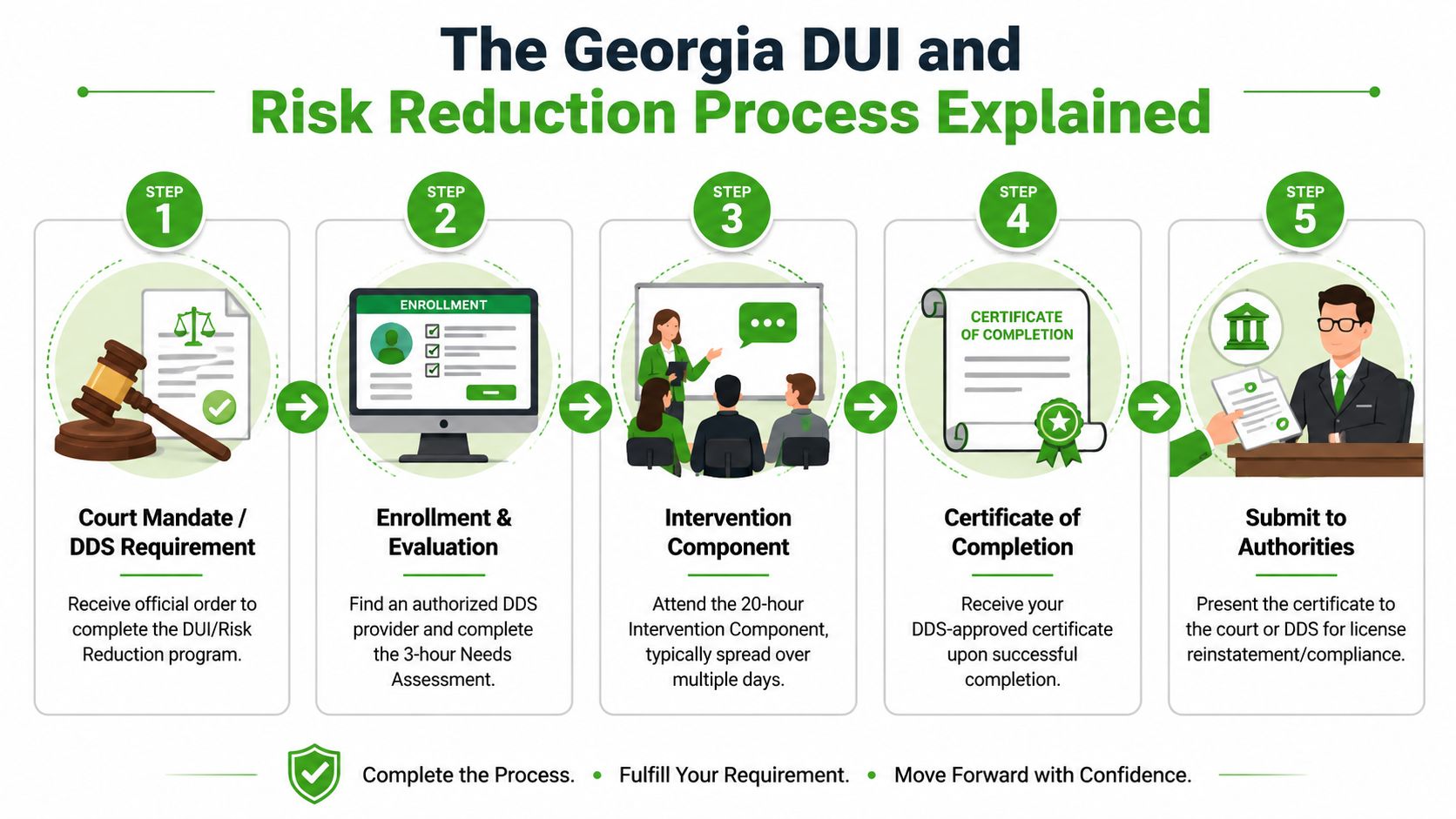
If you've been told to complete DUI Risk Reduction, think in terms of a process, not a single class. That mindset will keep you out of trouble.
People get frustrated because they assume they can click, pay, and be done. That's rarely how DUI-related compliance works. Georgia uses a structured sequence for a reason. Knowledge, accountability, and follow-up are treated as connected pieces.
The sequence matters
A useful way to understand this is to look at how other regulated driver programs are built. In Ohio's abbreviated adult online driver-education model, the required online portion is 4 hours and must be paired with additional behind-the-wheel instruction before the driver can attempt the road test again, showing that a knowledge module restores rule comprehension but does not replace supervised skill work, according to this Ohio adult online driver education course description. Georgia's DUI framework follows the same basic logic. One piece alone usually isn't the whole answer.
The usual flow in Georgia
Here's the practical path most drivers need to follow:
Confirm the mandate
Read the court order, DDS notice, probation paperwork, or attorney instruction carefully. You need the exact requirement, not your guess about it.Complete the assessment step
DUI Risk Reduction is tied to an assessment component. This isn't optional busywork. It helps determine what the next requirement is and whether follow-up action may be necessary.Complete the intervention course
The class portion is the formal educational component. It addresses law, decision-making, and substance-related risk in a regulated setting.Receive the completion certificate
This document is what proves you finished the required program element.Handle any follow-up requirements
Some drivers may need a clinical evaluation or additional treatment-related steps depending on their circumstances and results.
Don't treat a certificate as the finish line until you know whether your court, probation officer, or DDS expects anything else.
Why people get tripped up
The most common confusion is assuming “online” means “complete.” It doesn't. In DUI cases, online access may help with one stage, but the overall requirement may still include separate assessment, evaluation, or submission steps.
Another problem is borrowing advice from another state. That can be useful for perspective, but not for compliance. If you want an example of how alternative DUI pathways can exist elsewhere, Ticket Shield has a helpful overview of a DUI second chance in Florida. Read it as context, not as a template for Georgia.
The safest approach is simple. Follow the order exactly. If your paperwork mentions evaluation, treatment, victim impact, or reinstatement conditions, assume you may be dealing with multiple moving parts until a qualified provider or your attorney confirms otherwise.
How to Enroll and Complete Your Driving Class
Once you know the correct course, the rest should be mechanical. Keep it that way. Don't improvise.
Step by step without the confusion
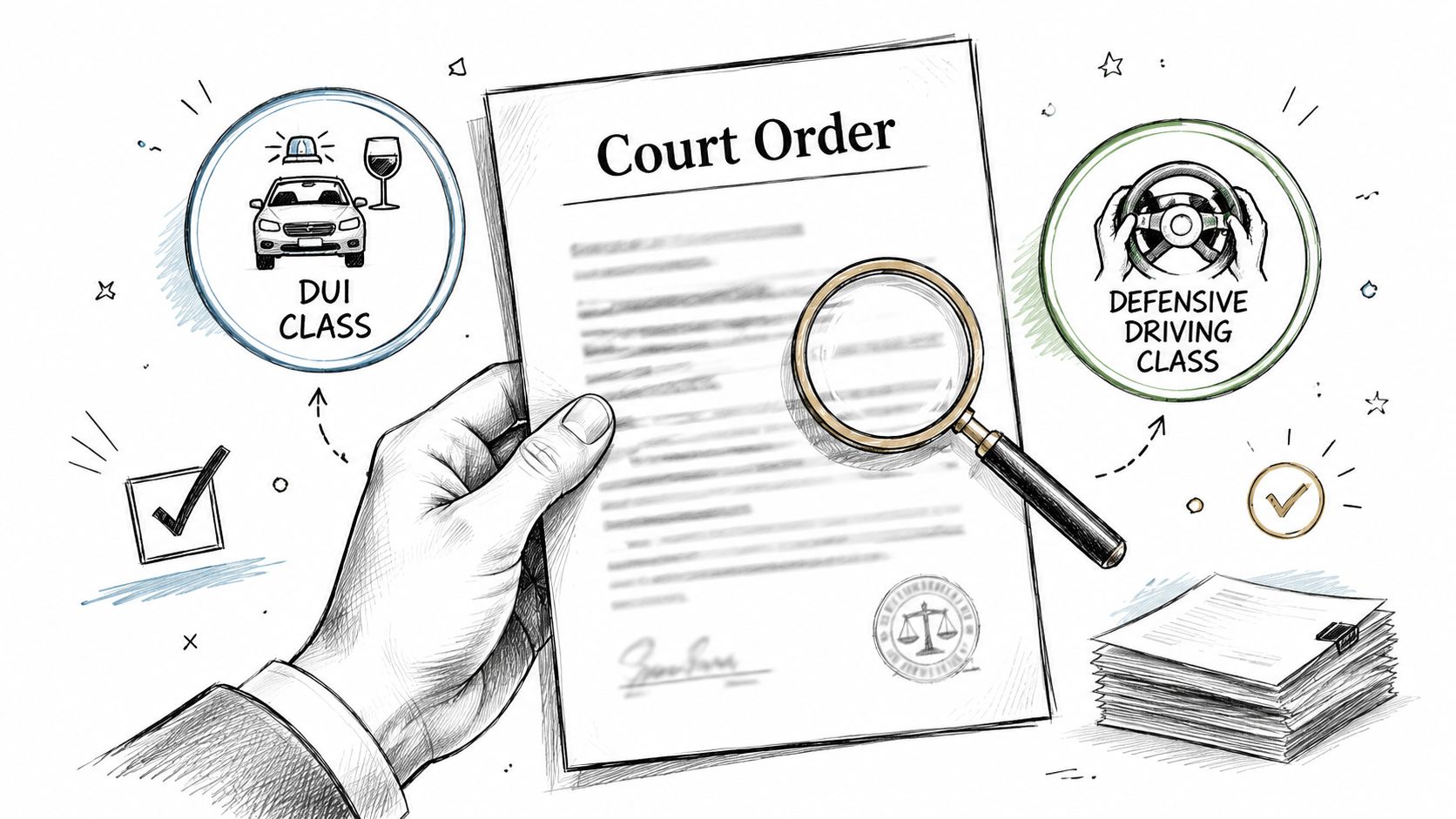
- Read the document, not your memory: Pull out the court order, DDS letter, probation instruction, or attorney email. Look for the exact course name or requirement language.
- Gather your identifiers: Have your driver's license information, case details, court name, and any reporting contact ready before you enroll.
- Choose the correct format: If your requirement allows flexibility, pick the format you're most likely to complete without delay.
- Enroll with complete information: Don't leave out case details if the provider needs them for proper documentation.
- Attend or complete every required part: If it's scheduled, show up on time. If it's self-paced, build your own deadline and stick to it.
- Keep proof of completion: Save the certificate and any confirmation emails or records.
Deadlines are not suggestions
People often find themselves incurring avoidable damage. Driving-course requirements are often tied to a clock. A good example from another state is Kentucky, where the online traffic-school option must be completed within 30 days of the referral or conviction date to avoid suspension, according to the Kentucky State Traffic School guidance.
Georgia orders and DDS requirements also need to be treated as deadline-driven. Even when your notice doesn't spell out every consequence in plain language, delay can affect your case status, your license, or your reinstatement timeline.
Deadline rule: Enroll as soon as you know the requirement. Waiting rarely improves your options.
A few practical habits that help
Some drivers finish smoothly because they do small things right.
- Set a calendar reminder: One for enrollment, one for attendance, one for certificate submission.
- Ask who receives the certificate: Sometimes you need to submit it yourself. Don't assume the provider sends it everywhere automatically.
- Keep a copy before you send it anywhere: Paper or digital. Both is better.
- If anything is unclear, ask before class day: Wrong course problems are easier to fix before attendance than after completion.
This process feels heavy when you're already dealing with court stress or license issues. But it becomes manageable when you handle it in order and stop treating the internet search results as your authority.
Frequently Asked Questions About Georgia Driving Classes
A lot of Georgia drivers get in trouble at this stage for one reason. They sign up for a class that sounds right, then learn too late that it does not satisfy the court, DDS, or probation requirement on their paperwork. The fix is simple. Match the exact Georgia requirement to the correct course type before you enroll.
Can I take every Georgia driving requirement online
No.
Georgia does not treat every driving-related requirement the same way. Defensive Driving may be available in an online format. DUI Risk Reduction follows stricter state rules and often involves a specific approved process, not just any internet class you can buy quickly.
If your paperwork mentions DUI, alcohol or drug use, reinstatement, evaluation, assessment, or treatment, stop calling it a general online driving class. Verify the exact Georgia-approved format first.
How do I know if I need Defensive Driving or Risk Reduction
Start with the reason you were ordered to attend.
Defensive Driving usually fits point reduction, ticket dismissal, insurance discounts, or general driver improvement. Risk Reduction is the Georgia program tied to DUI-related matters, drug or alcohol offenses, and many reinstatement issues. Those are not interchangeable, and the wrong certificate will not fix the problem.
Read the exact wording on your order, court notice, probation paperwork, or DDS notice. Then match the wording to the course. If the paperwork is unclear, call the issuing agency or the provider before you pay.
Will one certificate work for every agency involved in my case
Usually not.
A completion certificate shows that you finished one requirement. It does not guarantee that every office involved in your case has received it or considers your file complete. Courts, probation offices, and DDS often track different parts of the process.
Ask three questions before class day. Who needs proof, how do they want it submitted, and are there any separate steps still outstanding?
What if I live outside Georgia now
You still have to satisfy Georgia's requirement if the case, suspension, or reinstatement issue is in Georgia.
Residence does not control this. The Georgia requirement controls it. That is why out-of-state drivers need to be careful with course selection. A class accepted somewhere else may do nothing for a Georgia DUI or Georgia license issue.
Is a clinical evaluation the same as the class
No. They are separate requirements.
The class covers the educational program you were ordered to complete. A clinical evaluation is an assessment used to determine whether further treatment or counseling is recommended or required. If your paperwork lists both, plan for both. Finishing one does not satisfy the other.
Do I need a Victim Impact Panel too
Only if your court or supervision terms require it.
Some judges order it. Some do not. It is not automatically included with every Georgia driving class or every DUI-related requirement. If it appears on your paperwork as a separate item, treat it as a separate item and keep proof of attendance.
What if I miss my class or don't finish on time
Act the same day.
Contact the provider first to see what can still be corrected. Then contact the court, probation officer, or your attorney if your deadline is in danger. Waiting makes small scheduling problems turn into compliance problems.
Can I choose the cheapest class I find online
Only if you are willing to risk doing the class twice.
Low price does not matter if the course is wrong for your Georgia requirement. Approval, course type, and acceptance by the agency in your case matter more than a small difference in cost. Pay for the correct class once.
What's the safest way to make the right choice
Use a short screening process before you enroll:
- Match the class to the exact words on your order or notice.
- Confirm the provider offers the correct Georgia-approved course type.
- Make sure the format works for your specific requirement, especially if the case involves DUI or reinstatement.
- Ask how proof of completion is handled.
- Keep copies of every document and certificate.
That is the cleanest way to avoid delays, rejected certificates, and repeat enrollment.
If you need a Georgia-approved option for point reduction, ticket dismissal, or insurance-related driver improvement, start with Georgia DUI Schools' online defensive driving course. If your case involves DUI Risk Reduction, clinical evaluation, or another court-directed requirement, contact Georgia DUI Schools directly and confirm the exact program listed on your paperwork before you enroll.