
You leave court in Fulton, DeKalb, Cobb, Gwinnett, or another Georgia county with a sheet of paper in your hand. Somewhere on that page are words like “clinical evaluation,” “substance abuse assessment,” or “drug and alcohol evaluation.” Your first reaction is usually the same. What is this, where do I get it, and how much can one appointment affect my case?
That confusion is normal. In Georgia, people often hear about the DUI/Risk Reduction class first and assume that class covers everything. Sometimes it does. Sometimes it doesn't. A court, probation officer, attorney, or the licensing process may require a more detailed evaluation by a clinician, and that evaluation can shape what you must do next to satisfy the court and move toward reinstatement.
As a Georgia DUI/Risk Reduction instructor, I can tell you that the people who get through this process most smoothly are not the ones who try to guess their way through it. They're the ones who understand what kind of assessment they've been ordered to complete, bring the right documents, and treat the evaluation as both a legal requirement and a clinical process.
Why You Need a Drug and Alcohol Assessment in Georgia
For many Georgians, the order comes right after a DUI arrest or plea. You may have completed bond conditions, spoken with your lawyer, and started thinking about your license. Then you're told to get a drug and alcohol assessment. That can feel like one more hurdle. In reality, it's often the point where the legal system decides whether you only need education, or whether you also need treatment.

In Georgia, this usually shows up in familiar situations:
- After a DUI case: A judge may want a formal recommendation before sentencing or probation terms are finalized.
- During probation: A probation officer may require an evaluation if there are concerns about alcohol use, drug use, missed tests, or prior history.
- For DDS or reinstatement-related compliance: You may need documentation showing you completed the required steps and followed any recommendations.
- When an attorney seeks to strengthen their position: A lawyer may send a client for an evaluation early to show initiative and present a clearer picture to the court.
A court-ordered assessment matters because it can catch issues that a simple checklist won't. It can also document that no further treatment is clinically indicated, which is just as important in some cases.
Practical rule: Don't treat the evaluation as paperwork. Treat it as a decision point that can affect court compliance, probation terms, and what you must complete afterward.
The broader public-health picture explains why these assessments matter. The 2024 NSDUH summary discussed by Addiction Policy reports that over 46 million people met criteria for a substance use disorder in the past year, yet 94% received no treatment. Court-mandated assessments are one of the few places where people who might otherwise never get evaluated are brought into a formal process.
That doesn't mean every person ordered to complete a Georgia drug and alcohol assessment has a substance problem. It does mean the state and local courts use the assessment as a gatekeeping tool. In plain terms, they want a qualified clinician to sort out risk, severity, and what level of intervention fits the facts.
Understanding the Two Key Types of Assessment
Georgia drivers often use one phrase for two very different processes. That causes problems fast, especially when someone signs up for the wrong service and learns too late that the court wanted something else.
The screening inside the DUI Risk Reduction program
Every Georgia DUI/Risk Reduction Program includes the NEEDS Assessment. This is a screening component tied to the class process. Think of it as the quick checkup. It flags patterns and helps identify whether a participant may need more attention, but it is not the same thing as a standalone clinical diagnosis.
Screening tools have value because they are fast and structured. But screening has limits. As noted in this clinical review of substance-use screening and assessment tools, validated tools matter because reliability, validity, sensitivity, specificity, and clinical utility determine whether a tool can separate low-, moderate-, and high-risk use. That same review notes that brief instruments such as the AUDIT and AUDIT-C are widely used, while a positive screen should lead to a fuller clinical interview based on DSM-5-TR criteria.
The full clinical evaluation
A clinical evaluation is the deeper process. This is the specialist visit after the quick checkup suggests that a closer look is needed, or when the court orders that closer look from the start.
A clinician conducting a full drug and alcohol assessment is not only asking whether you drink or use drugs. The clinician is looking at pattern, severity, consequences, risk, and credibility of the information provided. The final recommendation may affect whether you need only education, outpatient counseling, or a higher level of care.
Here's the cleanest way to separate the two:
| Feature | NEEDS Assessment (Screening) | Clinical Evaluation (In-Depth Assessment) |
|---|---|---|
| Primary purpose | Brief screening | Diagnostic and treatment-planning review |
| Where it appears | DUI/Risk Reduction program | Court, probation, attorney, or DDS-related requirement |
| Depth | Limited | Detailed one-on-one interview |
| Outcome | Flags possible concern | Formal recommendation and level of care |
| Diagnostic role | Not enough by itself | Supports DSM-5-TR-based diagnosis through clinical interview |
When Georgia courts usually want the full evaluation
In practice, courts and probation officers often ask for a clinical evaluation when something about the case suggests more than a first-time, low-complexity situation. That can include a prior DUI, a drug-related arrest, a refused or high test result, probation concerns, inconsistent self-reporting, or a history that raises concern about ongoing use.
A screening asks, “Should we look closer?” A clinical evaluation asks, “What does the full picture show, and what needs to happen next?”
If your paperwork says “clinical evaluation,” “substance abuse evaluation,” or “drug and alcohol evaluation,” do not assume the DUI class screening satisfies that requirement. In Georgia, those are usually separate tasks.
The Georgia Drug and Alcohol Evaluation Process Step by Step
Individuals often calm down once they know the order of operations. The process is manageable when you handle it one step at a time.
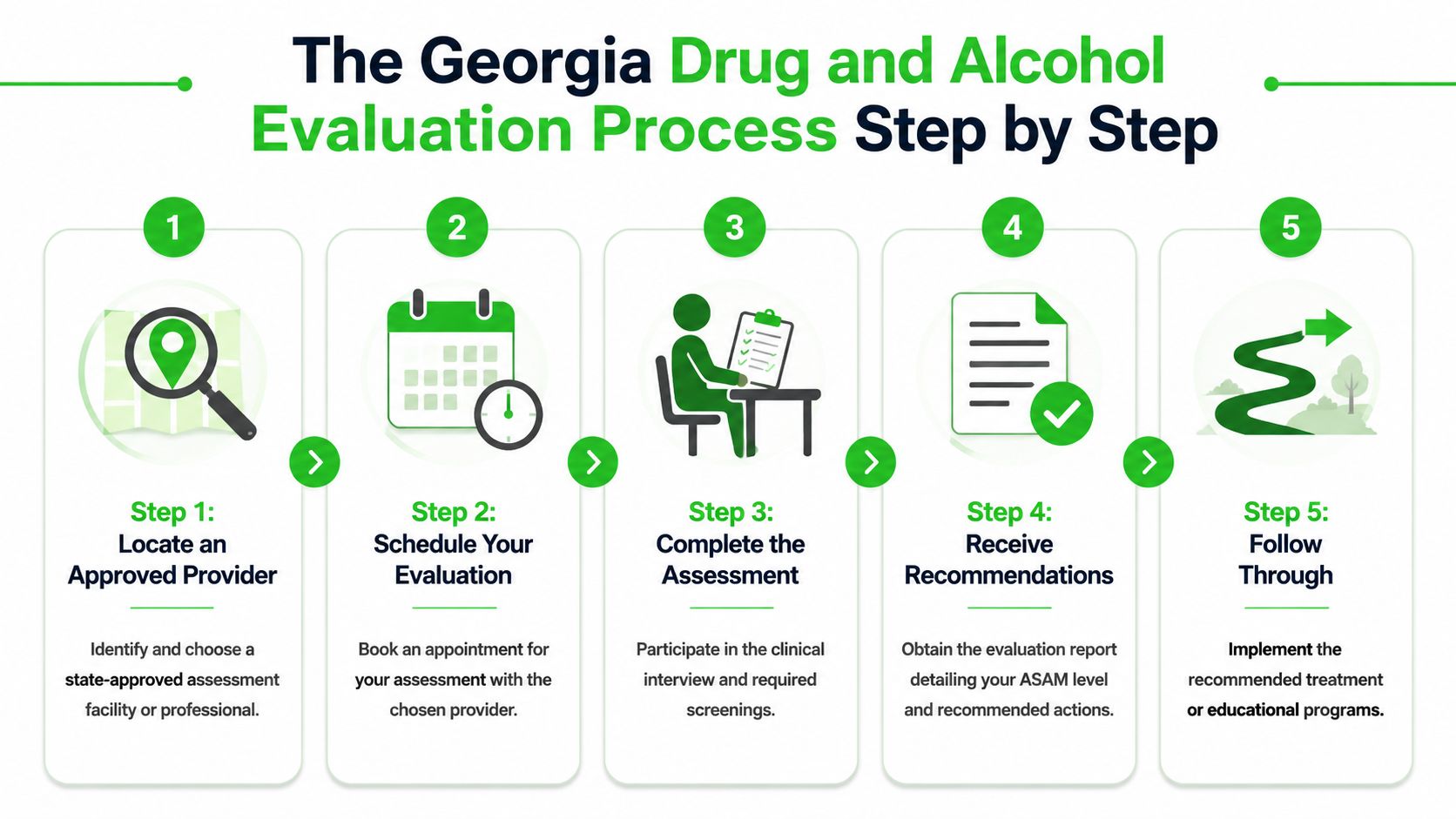
Step one is choosing a compliant provider
For a Georgia court or related legal requirement, the first question isn't convenience. It's compliance. You need a provider whose evaluation will be accepted. If the evaluator is not properly recognized for the type of service you need, you may end up paying twice and losing time with the court.
If you need a starting point, this court-ordered substance abuse evaluation page outlines the service and what it is typically used for in Georgia cases.
Before you book, confirm:
- Who ordered it: Court, probation, attorney, or another authority.
- What the order says: “Assessment,” “clinical evaluation,” and “treatment evaluation” are not always interchangeable in practice.
- Where the report needs to go: Some courts want it sent directly. Others allow you or your attorney to submit it.
- Whether timing matters: Deadlines tied to sentencing, probation review, or reinstatement can create avoidable trouble.
What happens during the evaluation
A proper drug and alcohol assessment is broader than an interview. According to guidance on substance-abuse evaluations, a robust assessment integrates multiple data streams, including substance-use history, legal records, observed behavior, medical and mental-health history, and risk assessment, because relying on self-report alone can lead to misclassification.
That matches what people experience in real Georgia cases. The evaluator may ask about:
- Your current charge and legal history
- Alcohol and drug use history
- Prior treatment or education
- Medical issues and medications
- Mental health history
- Employment, family, and living situation
- Patterns that suggest risk, denial, or instability
The interview may feel repetitive. That's not sloppy practice. It's deliberate. Clinicians often ask similar questions in different ways to test consistency and understand context.
What comes out of the process
After the interview and review, the evaluator prepares a report and recommendation. In Georgia cases, that recommendation often ties into ASAM-based placement language or another clinically recognized level-of-care recommendation.
A straightforward timeline usually looks like this:
- You call and schedule
- You gather paperwork
- You attend the evaluation
- The evaluator completes the report
- The report goes to you, your lawyer, probation, or the court, depending on the order
The biggest mistake I see is delay. People wait because they're anxious, then a court date gets close and the evaluation becomes an emergency instead of a routine compliance step.
How to Prepare for Your Clinical Evaluation
Preparation doesn't mean trying to game the process. It means showing up with complete information so the evaluator can make a sound recommendation. That matters in Georgia because incomplete records and inconsistent answers can create avoidable problems.
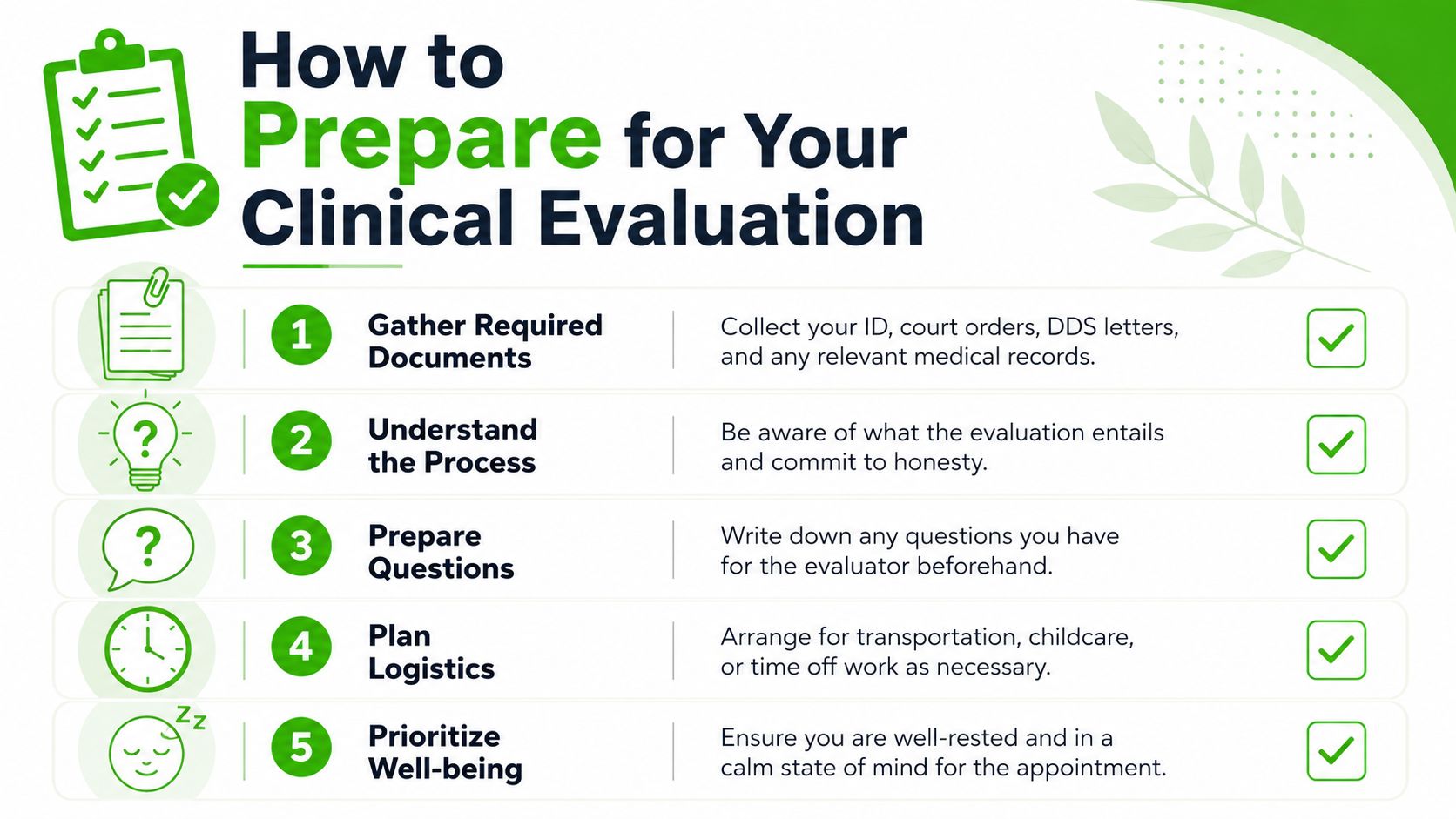
Bring records that answer the obvious questions
If the evaluator has to piece your case together from half a story and missing papers, your evaluation becomes harder than it needs to be. Bring what directly relates to the order and your history.
A solid document set usually includes:
- Court paperwork: The order requiring the evaluation, any sentencing sheet, and probation instructions.
- Identification: Government-issued ID and any booking or case identifiers you've been told to provide.
- Driving-related records: DDS letters or driving history if your case involves reinstatement or license consequences.
- Medication information: A list of prescribed medications and basic treatment history where relevant.
- Prior records: Earlier evaluations, treatment discharge papers, or class completion certificates if they exist.
If you want a more detailed preparation guide, this page on how to pass a drug and alcohol evaluation in Georgia addresses the practical side of showing up ready.
Honesty works better than strategy
People often think there's a “right” answer that will keep them out of treatment. That mindset usually backfires. Best-practice assessment guidance from Texas Christian University's screening and assessment overview notes that assessments may combine self-report with biological testing and collateral records such as correctional or drug-testing information. In other words, the evaluation is often wider than a conversation, and incomplete or inconsistent information can be challenged.
That's why honesty is the safest approach.
- If you drank, say so.
- If you've used marijuana or other substances, say so.
- If you already completed counseling before, disclose it.
- If you're prescribed medication, don't leave that out.
What hurts credibility most isn't admitting a problem. It's giving an answer that conflicts with records the evaluator already has or can obtain.
Practical day-of preparation
The day of the appointment matters more than people think.
- Be rested: Fatigue can make you sound evasive or irritable.
- Arrive early: Rushing in late raises stress and affects how you present.
- Avoid chaos: Arrange transportation, childcare, and time off work beforehand.
- Ask questions when needed: If you don't understand a question, say that. Don't guess.
This is not a pass-fail exam. It's a structured review of your situation. The cleaner and more consistent the information, the more defensible the result.
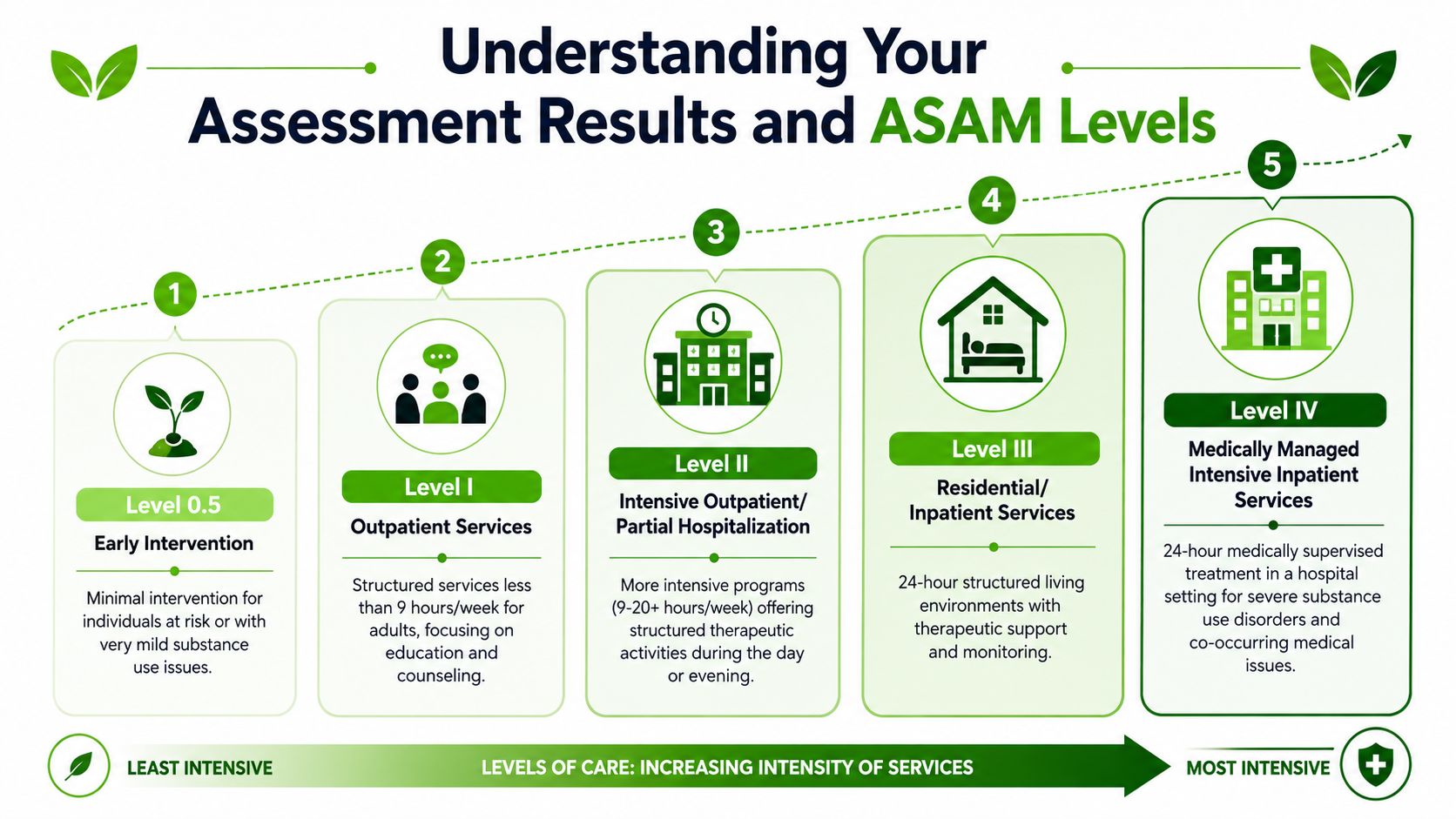
Understanding Your Assessment Results and ASAM Levels
Once the evaluation is finished, a common question arises: What did I get recommended? The report usually answers that in clinical language, often using ASAM levels of care. If you've never seen those terms before, they can sound more intimidating than they are.
What the recommendation is actually doing
The evaluator is matching the facts of your case to a level of intervention. That recommendation is not supposed to be punishment. It is supposed to reflect clinical need and risk.
Common outcomes in Georgia cases include:
- No treatment recommended: The evaluator doesn't find evidence supporting a treatment placement.
- Level 0.5 early intervention: This is low-intensity education or preventive intervention. In DUI-related settings, this often lines up conceptually with education-focused requirements.
- Level I outpatient services: Standard outpatient counseling, usually the most common treatment recommendation in court-related cases where treatment is needed.
- Higher levels of care: If the history shows significant severity, instability, or risk, the evaluator may recommend more structured services.
What Level 0.5 and Level I usually mean in real life
For most first-time Georgia readers, the practical difference is simple.
Level 0.5 usually means the evaluator sees risk that should be addressed, but not a pattern severe enough to justify standard outpatient treatment.
Level I usually means the evaluator believes there is a clinical basis for ongoing counseling or treatment, not just a single educational requirement.
That distinction matters because a court may adopt the recommendation as a condition of probation, and DDS-related progress often depends on completing what was ordered.
If the report recommends treatment, don't focus on whether the wording sounds harsh. Focus on whether the court expects proof of completion. That's what affects your timeline.
Why this recommendation stage matters
The treatment gap in alcohol-related care is large. According to the NIAAA summary of 2023 NSDUH data, 27.9 million people age 12 and older in the United States had an Alcohol Use Disorder in the past year, and only 7.9% received any alcohol use treatment. That gap is one reason the assessment stage matters so much. It's often where need is identified, formally documented, and turned into a concrete next step.
What to do after you receive the report
Don't let the report sit in your email or glove box. Once you have the recommendation:
- Read the exact wording
- Ask who needs a copy
- Confirm deadlines with your lawyer, probation officer, or court
- Schedule the recommended service if one is required
- Keep proof of every completed step
A recommendation only helps you if it gets converted into documented compliance.
Costs Insurance and Choosing a Provider in Georgia
The money question comes up early, and it should. A clinical evaluation is part of legal compliance, so you need to know what you're paying for and whether the result will count.
What people usually run into on cost and insurance
In Georgia, court-related evaluations are commonly paid out of pocket. Coverage through health insurance is often limited or unavailable for this type of legal requirement, so it's smart to ask in advance what the fee includes, whether payment is due upfront, and whether report delivery or follow-up letters cost extra.
If the evaluation leads to treatment, the financial conversation can change. For people trying to understand the broader issue of paying for care when insurance is limited, Still Water Wellness Group's guide on paying for rehab without insurance is a useful general resource.
For Georgia-specific pricing expectations on the evaluation itself, this page on drug and alcohol evaluation cost can help you compare what providers typically charge.
How to choose a provider without creating a new problem
The cheapest appointment is not the cheapest outcome if the court rejects the report. Ask direct questions before booking:
- Is the provider appropriate for court-ordered clinical evaluations in Georgia?
- Will the report include a clear recommendation the court can act on?
- Can the provider send paperwork where it needs to go?
- If treatment is recommended, does the provider also offer or coordinate the next step?
This last point matters more than people expect. Georgia DUI Schools is one example of a provider that offers clinical evaluations as well as follow-up services such as ASAM Level 1 treatment and related compliance programs. That can simplify scheduling and documentation, though it's still wise to compare options and confirm fit for your county and court.
The real trade-off
Convenience helps. Compliance matters more. A provider who answers the phone, explains the process clearly, and gives you a practical path from evaluation to completion is usually worth more than one who offers a vague low price and leaves you to sort out the rest.
Common Questions About Georgia Drug and Alcohol Assessments
Some questions don't show up until after the appointment is booked or the report comes back. These are the ones I hear most often from Georgia drivers.
Is the evaluation confidential
Partly, yes. But not in the way people often assume.
If the evaluation is tied to a court order, probation condition, or legal requirement, the evaluator may have authority or obligation to release the report or recommendation to the proper party. You should ask before the appointment who receives the report, what release forms you're signing, and whether your attorney will get a copy.
What if I disagree with the recommendation
Start by reading the report carefully. Sometimes people disagree with a recommendation because they misunderstood what was ordered. If you still believe the evaluation contains factual errors or reaches the wrong conclusion, talk with your attorney first. In some situations, a second opinion may be possible, but courts are not required to accept a different report because you prefer it.
The strongest challenge is usually fact-based. Missing records, incorrect legal history, or confusion about medications can matter.
Are online assessments valid in Georgia
That depends on the court, the provider, and the circumstances. Some remote services are used in Georgia-related cases, but you should never assume any online option will be accepted. Always verify acceptance before scheduling. If your order is specific about in-person attendance, follow the order exactly unless the court or referring authority approves a change.
How long is an evaluation good for
There isn't one universal answer that fits every court and every situation. A report can become stale if the case drags on, if new charges appear, if probation issues arise, or if the court wants updated information. Ask the court, your attorney, or the provider how your jurisdiction handles timing.
What happens after the assessment if treatment is recommended
Many people struggle to complete care, even after being assessed and referred. As explained in KFF's overview of worsening substance-use issues and access barriers, one study found treatment completion was only 42% among people who started treatment, and treatment search tools can contain inaccurate information. That's why provider choice matters. You don't just need an evaluation. You need a realistic next step you can complete.
Can I just do the class and skip the evaluation
Not if the court, probation officer, or another authority specifically ordered the clinical evaluation. The DUI/Risk Reduction class and a clinical evaluation serve different functions. Completing one does not automatically satisfy the other.
What should I do right now if I've just been ordered to get one
Do these three things first:
- Read the exact language of the order
- Call a compliant provider and ask what documents to bring
- Put the appointment on your calendar immediately
Delay creates more problems than the evaluation itself.
If you need to complete the Georgia DUI/Risk Reduction requirement that often goes hand in hand with court and DDS compliance, Georgia DUI Schools offers the Georgia DDS-approved DUI Risk Reduction course.