
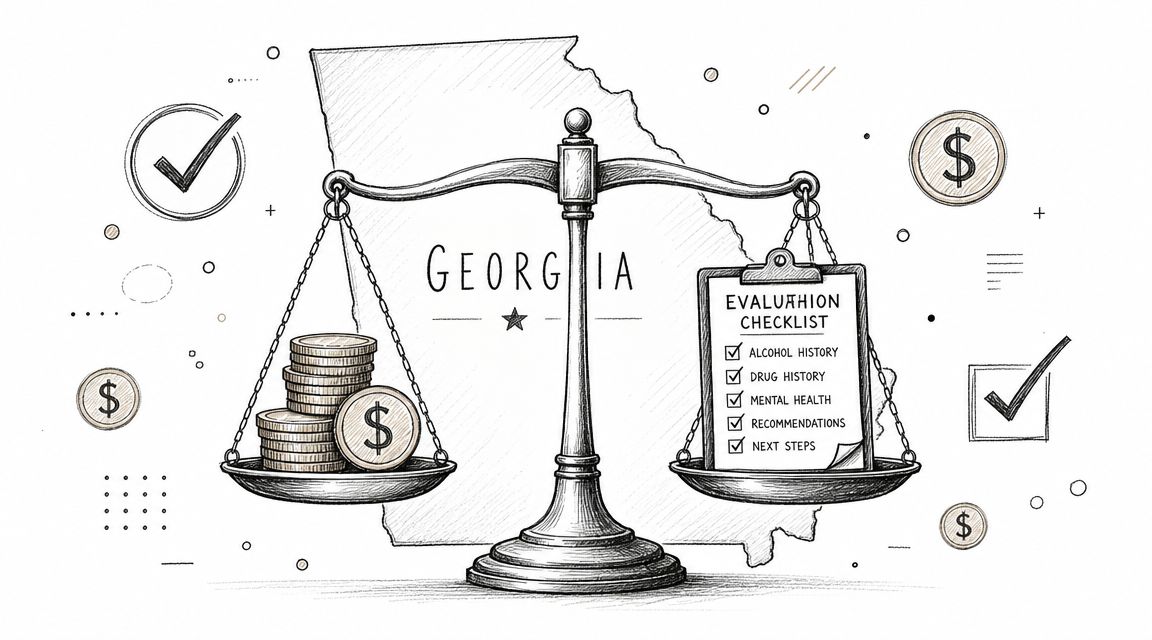
In Georgia, a court-ordered drug and alcohol evaluation is typically $200 to $300. That gives you a real starting point, and it also means the cheapest option isn't always the one that saves you money if the court, probation office, or DDS won't accept it.
If you're reading this, you're probably dealing with a deadline, a court requirement, license reinstatement, or pressure from an attorney, probation officer, or employer. Individuals often start with one question: what does it cost? That's fair. But after coordinating these services for DUI and related cases, I can tell you the better question is this: what are you paying for, and will the evaluation be accepted the first time?
That second question matters in Georgia. A report that doesn't meet the requirement can cost you more in missed deadlines, repeat appointments, extra paperwork, and another fee to redo the evaluation properly. A legitimate evaluation is not just a conversation about your history. It's a formal clinical service with screening, documentation, recommendations, and reporting that may affect what happens next in court or with your driving privileges.
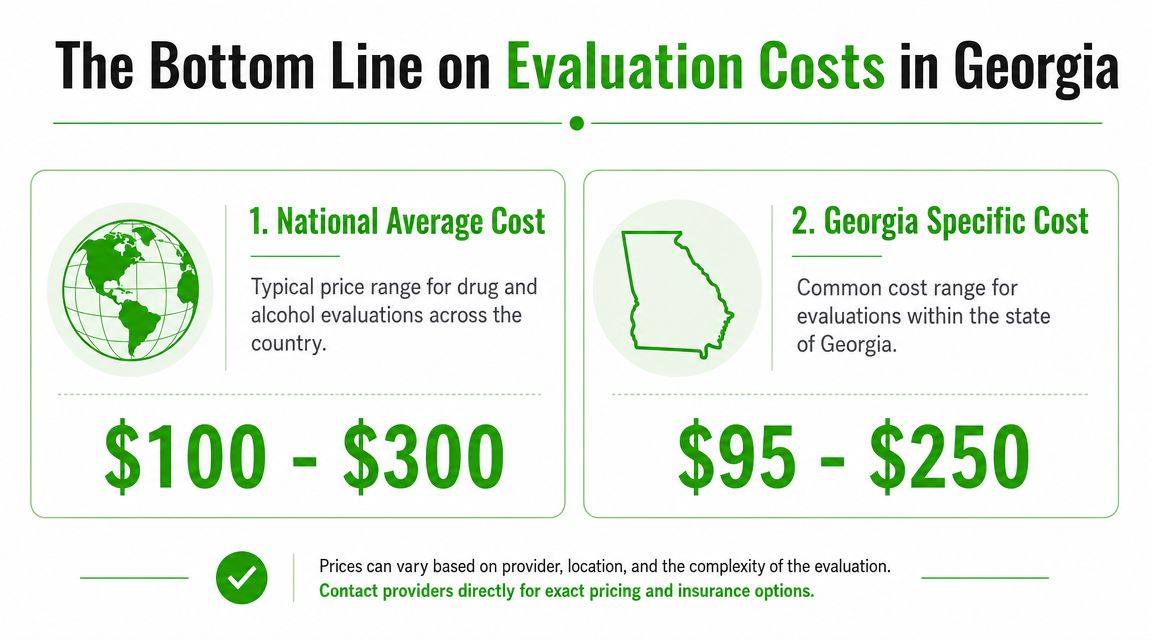
The Bottom Line on Evaluation Costs in Georgia
You call one provider and hear $200. Another says $300. A third quotes less, but cannot tell you whether the report will satisfy your court, probation officer, or license reinstatement requirement. That is where people lose time and end up paying twice.
In Georgia, a court-related drug and alcohol evaluation often falls in the $200 to $300 range, based on Atlanta-area evaluation pricing guidance. Use that as a starting budget, not as the only way to compare providers.
A primary consideration is whether the evaluation is legitimate and usable the first time. A proper substance abuse evaluation is a formal clinical service. For Georgia cases, that means the provider should be able to explain what is included, what documentation they produce, and whether the final report matches the requirement you have in front of you.
Price changes for practical reasons. Some appointments involve only the standard interview and screening. Others require added paperwork, review of court documents, a faster turnaround, or a report written for a specific legal or administrative purpose. Those differences affect the fee because they affect the work.
Here is the part I tell people every day. A lower quote is only a better deal if the evaluation is accepted without delays.
| Situation | What to expect |
|---|---|
| Standard court referral | Often falls near the common Georgia range |
| Extra paperwork or report details needed | Fee may be higher because the provider is doing added clinical and administrative work |
| Short deadline | Ask whether faster report delivery costs more |
| Unclear court, probation, or DDS requirement | Confirm acceptance before you book, not after |
A good provider will answer direct questions. Will this evaluation meet Georgia court expectations? What documents should you bring? How long does the report take? Is the quoted fee the full amount, or could anything else be added later?
If you want to compare against a Georgia-specific service, review what is included in this court-ordered substance abuse evaluation in Georgia and make sure any other quote offers the same level of documentation and acceptance standards.
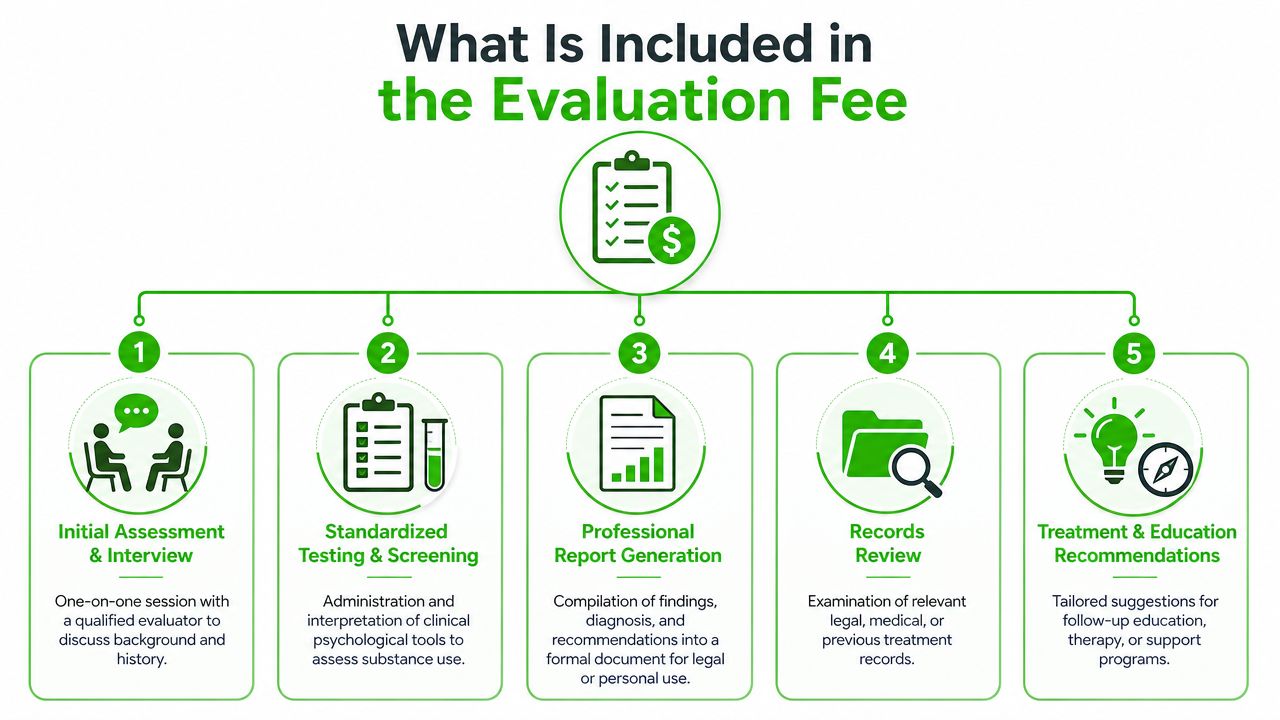
What Is Included in the Evaluation Fee
Many individuals look at the appointment length and wonder why the fee isn't lower. The answer is that you're not only paying for face-to-face time. You're paying for clinical judgment, documentation, screening, and a report that has to hold up under scrutiny.
A formal evaluation is often the decision point that determines whether someone is directed toward education, outpatient counseling, or a higher level of care. That's one reason the fee exists as a separate upfront service. In treatment economics research, broader care costs run far beyond the evaluation itself. Weekly costs were reported at $74 to $221 for non-methadone outpatient care, $243 to $598 for intensive outpatient/day treatment, and $87 to $112 for methadone maintenance, with episode costs ranging from $1,132 to $2,099 for non-methadone outpatient treatment and $4,277 to $13,395 for methadone maintenance in the reviewed data from this treatment economics analysis. That helps explain why the evaluator's job is to identify the right level of care instead of guessing.
What you're usually paying for
Think of the fee like an itemized professional service, even if the provider gives you one flat rate.
- Clinical interview. The evaluator reviews your history, current concerns, legal referral, and factors that may affect recommendations.
- Screening tools and interpretation. Standardized instruments matter because a court-ready report can't rely on casual impressions alone.
- Records review. Arrest paperwork, prior treatment documents, and related records may need to be examined.
- Written report. This is often the most overlooked part of the job. The evaluator has to organize findings, state recommendations, and prepare a document that another agency can read and use.
- Recommendation matching. The purpose isn't to punish you. It's to match the person to an appropriate next step.
Why a legitimate report costs more than a quick opinion
A quick phone conversation and a formal evaluation are not the same thing. If you want a broader consumer overview of what a substance abuse evaluation generally involves, that resource gives useful context on how these assessments are typically structured.
A low fee makes sense only if the service still includes the parts your referral actually requires.
What doesn't work is shopping by price alone and assuming every report carries the same weight. In practice, the value is in the evaluator's process. If the assessment is careful and the recommendations are clear, you avoid paying for the wrong next step.
Key Factors That Influence Your Final Cost
The final cost can move well above the number you first hear on the phone. That's why drug and alcohol evaluation cost is one of those topics where the advertised fee and the actual out-of-pocket fee are sometimes different.
A broader consumer review noted that while many sources repeat a narrow $100 to $250 estimate, the actual range can be $75 to $800+ once provider type, location, additional testing, and expedited reporting are factored in, as described in this evaluation cost overview. That wide range doesn't mean every Georgia court-ordered case will cost that much. It means you need to ask sharper questions before you book.
The four biggest price variables
Some cost drivers are predictable.
Type of referral
A straightforward DUI-related evaluation is usually easier to price than a more complex legal matter. If the referral involves multiple agencies, prior treatment history, or more detailed written findings, the fee often reflects that extra work.Additional testing
Some providers build basic screening into the fee. Others charge separately if extra testing is requested or required. If any biological testing or added screening is part of the process, ask whether it's included or billed on top.Turnaround time
Timing changes price in many markets. Available information on assessment turnaround shows reports can range from same-day to about 5 business days, and rush service can add roughly $225 in some markets, according to this assessment timing and fee example. If your reinstatement, court date, or probation deadline is close, this question matters.Paperwork burden
A provider may quote one fee for the evaluation itself and another for additional forms, letters, or agency-specific reporting. That's not automatically a red flag. It just needs to be clear upfront.
Questions that prevent surprise charges
Use these before you schedule:
- Ask what the fee includes. Does it cover the interview, scoring, report, and recommendations?
- Ask about delivery time. Will the report be ready under your deadline without a rush fee?
- Ask who the report is written for. Court, probation, attorney, employer, or DDS can all mean different documentation needs.
- Ask whether anything is billed separately. Extra testing, added paperwork, and reissued reports are common examples.
- Ask about acceptance history. A provider should be able to explain the type of referrals they regularly handle.
The expensive mistake isn't always paying more. Sometimes it's paying less for a report you have to replace.
What doesn't work is booking a same-day appointment with no discussion of what the court asked for. That usually creates the confusion people were trying to avoid in the first place.
Navigating Payment Insurance and Financial Options
Payment questions come up right away, especially when the evaluation wasn't part of your budget. The frustrating part is that court-ordered services don't always work like regular medical visits. Even when a person has health insurance, the evaluation may still be treated as an out-of-pocket legal or administrative requirement rather than a routine billable appointment.
Why insurance may not be simple
Insurance issues usually come down to purpose. If the evaluation is being done for court, probation, license reinstatement, or another external requirement, a provider may not bill it the same way they would a standard behavioral health visit. That's why two offices can handle payment very differently even if both offer similar clinical services.
That doesn't mean you shouldn't ask. It means you should ask carefully:
- Will you bill insurance for this specific evaluation?
- If not, why not?
- Can I get a receipt or documentation to submit myself?
- Is the quoted amount the total, or are there separate report fees?
Ways to make the cost more manageable
If the full amount feels hard to handle, ask practical questions instead of assuming the answer is no.
- Payment plans. Some providers allow split payments, especially if treatment or follow-up services are also involved.
- Sliding-scale options. Not every program offers them, but it's worth asking whether fees vary by income or circumstance.
- Accepted payment methods. Confirm card, cash, money order, or online payment before the appointment so you don't lose your slot.
- Bundled service questions. If you already know you'll need a class or another required step, ask whether the office can explain the total process cost clearly.
A lot of people are also budgeting for multiple Georgia requirements at once. If you're trying to understand the bigger picture, reviewing DUI school cost in Georgia can help you plan the course side separately from the clinical side.
If money is tight, the best call is the honest call. Tell the provider your deadline and your budget, then ask what options exist.
What doesn't help is waiting until the day before court and hoping the cheapest listing online will solve it. Payment flexibility is much easier to find when you ask early.
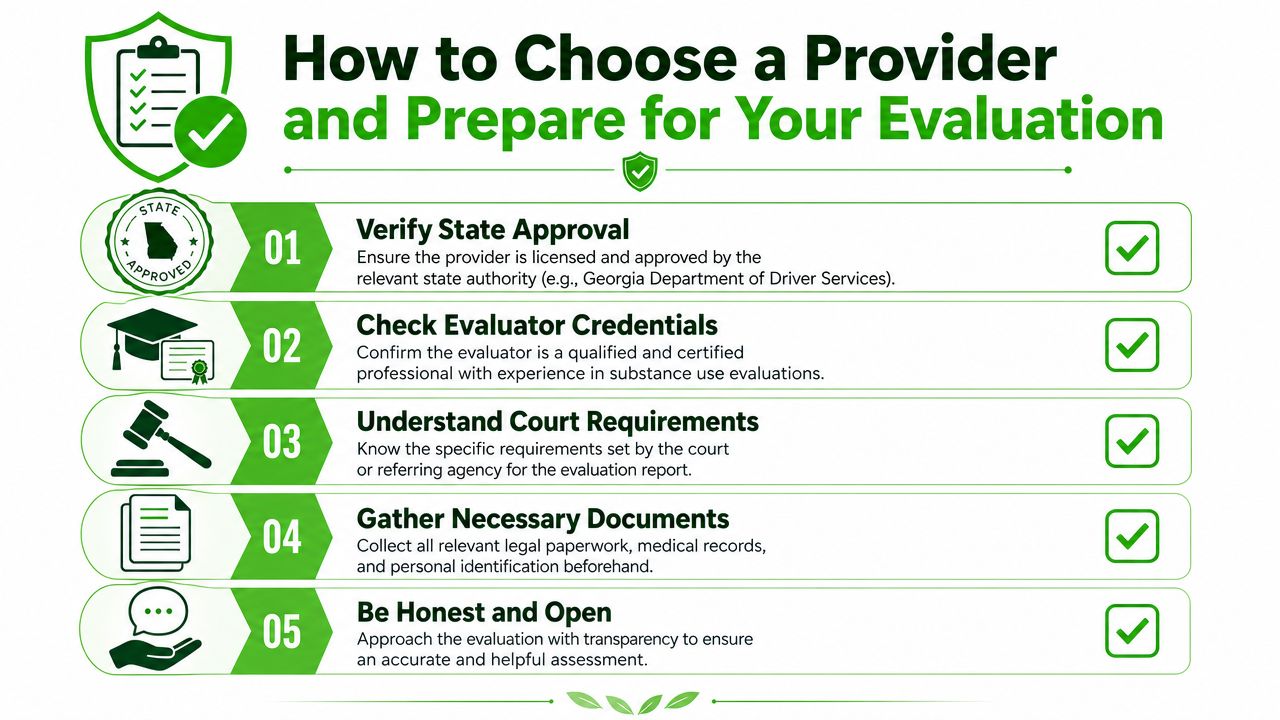
How to Choose a Provider and Prepare for Your Evaluation
The safest way to protect your money is to choose a provider whose work matches the requirement the first time. In Georgia, that means focusing on legitimacy, documentation, and fit. The right provider doesn't promise an outcome. The right provider explains the process, the credentials involved, and what kind of report you will receive.
How to vet the provider before you pay
Start with the basics and keep it practical.
- Verify approval status. Make sure the provider can perform evaluations that fit Georgia court or agency expectations.
- Ask about evaluator credentials. You want someone qualified to conduct substance use assessments and prepare formal recommendations.
- Confirm the report type. A general assessment and a court-acceptable report are not always the same thing.
- Avoid guaranteed outcomes. No ethical evaluator should promise you'll be classified a certain way before the assessment is done.
One Georgia option is online drug and alcohol evaluation services when remote access fits your situation, but the same rule applies: verify that the format and documentation meet your referral requirement before you book.
If you want another plain-language overview of how people typically get a formal assessment, this guide on how to get a substance abuse evaluation is useful for understanding the general process from first contact through scheduling.
What to bring and how to show up
Preparation helps more than people think. When clients arrive without paperwork, the evaluator often has to spend valuable time trying to reconstruct what the court or referring party asked for.
Bring what applies to your case:
- Photo ID. A current government-issued ID is the first thing most offices will request.
- Court paperwork. Bring the order, referral, probation instructions, or attorney notice that mentions the evaluation.
- Arrest or incident documents. If you have them, bring them.
- Prior evaluation or treatment records. Only if relevant and available.
- Payment method. Confirm this in advance.
- A clear timeline. Know your next court date, reporting date, or reinstatement deadline.
Show up ready to answer questions truthfully. That doesn't mean oversharing or trying to defend every detail. It means giving accurate information so the recommendation is based on reality.
Honesty usually saves time. Incomplete answers tend to create follow-up calls, delays, or a report that has to be revised later.
Your Next Steps Get Your Evaluation with Georgia DUI Schools
You may be at the point where the deadline feels closer than the answer. The right provider should be able to tell you, before you pay, whether the evaluation fits your court, probation, license, or treatment requirement and what paperwork you will receive afterward.
Large hospital systems use screening and assessment because untreated substance use problems often show up later in emergency and inpatient care. A study reported by JAMA Network Open estimated substantial hospital costs tied to substance use disorder, with alcohol-related disorders representing a large share. That context matters here for one reason. An evaluation is not just a formality about price. It is part of a documented clinical and legal process meant to identify the right level of care before the consequences become more expensive and harder to address.

For Georgia cases, legitimacy matters as much as convenience. Georgia DUI Schools is one available option for state-related clinical services, including evaluations and ASAM Level 1 treatment. The publisher states that it is a Georgia DDS-approved provider serving Atlanta, Athens, and surrounding metro communities, with 18 locations and decades of experience across its programs. For someone trying to keep a court date, limit time off work, and avoid paying twice because a report is rejected, that kind of structure can make the process simpler.
A useful evaluation does two jobs. It meets the requirement in front of you, and it gives a defensible recommendation based on your history, current situation, and referral source. If you are also trying to understand what may come after the assessment, this article on finding the right addiction care path explains how different levels of care fit together.
If you need a court-related evaluation in Georgia and want a clear next step, schedule your court-ordered substance abuse evaluation with Georgia DUI Schools. Review the service details, confirm what your referral requires, and get the process started with a provider focused on Georgia compliance.