
You may be here because a judge, probation officer, lawyer, or DDS office told you that you need a “risk management” certificate after a DUI. That phrase causes a lot of confusion. Many people start searching online, see corporate risk courses, insurance certificates, safety trainings, and generic DUI classes from other states, then wonder which one Georgia will accept.
In Georgia, the answer is usually much simpler than the search results make it seem. If your requirement is tied to a DUI, alcohol, or drug-related driving matter, you're almost always being directed to the state's official DUI Alcohol or Drug Use Risk Reduction Program. That's the certificate that matters for court compliance and many DDS-related steps.
The hard part isn't understanding that you need a certificate. The hard part is making sure you complete the right one, through the right provider, and turn it in the right way so you don't lose time or money.
Navigating Your Certificate Requirement in Georgia
A common Georgia scenario goes like this. You leave court with papers in your hand, your license situation feels uncertain, and someone says, “You need to complete the risk reduction course.” You go home and search for a risk management course certificate, and suddenly you're looking at business programs, workplace compliance courses, and national online classes that sound official but have nothing to do with your case.

That confusion makes sense. In the broader education market, “risk management” can mean a lot of things. Some programs are built for finance, insurance, or corporate governance. For example, formal certificate programs in the wider field can be extensive. Rutgers' Graduate Certificate in Risk Management requires five courses totaling 15 credits, and ABA's Certificate in Risk Management Frameworks uses nine courses, which shows how broad the term can be in academic and professional settings, according to Rutgers' graduate certificate overview.
But that is not what most Georgia DUI-related orders mean.
The Georgia meaning is narrower
When Georgia courts or DDS-related instructions refer to this kind of certificate, they usually mean the state-approved Risk Reduction Program. This is a specific program with specific rules. It is not a general educational topic you can satisfy with any course that has “risk” in the title.
Practical rule: If your issue comes from a Georgia DUI or related driving matter, assume you need the Georgia-approved DUI Risk Reduction certificate unless your paperwork clearly says otherwise.
Why people get tripped up
Most mistakes happen for one of three reasons:
- The course title sounds similar: A generic “risk management” certificate may be real, but it may have no value for Georgia court or DDS purposes.
- The provider is out of state: Some online DUI schools market nationally, but Georgia may not accept those certificates for Georgia requirements.
- The student acts before checking approval: Paying first and verifying later often leads to doing the class twice.
If you're trying to get your license reinstated, satisfy a probation condition, or complete a court order, the certificate has to match the requirement exactly. That's where people need a calm, step-by-step approach, not more jargon.
What Is a Georgia Risk Reduction Certificate
A Georgia Risk Reduction certificate is the completion document issued after you finish the state-required DUI Alcohol or Drug Use Risk Reduction Program. This isn't a vague educational badge. It's a regulated program tied to legal and administrative requirements in Georgia.
The easiest way to think about it is this. If a court or DDS needs a specific medication, a general vitamin won't substitute. In the same way, a generic risk management course certificate doesn't replace Georgia's required DUI Risk Reduction credential.
What the program includes
The program has two parts:
- An Assessment component
- A 20-hour Intervention component
Both matter. You don't just sit in a class and leave with paperwork. You first complete the required assessment process, then complete the intervention course through a qualified provider. If you want a plain-language overview of the program itself, this explanation of what risk reduction is in Georgia is a helpful starting point.
Who usually needs it
People often need this certificate in situations such as:
- A DUI conviction
- A drug-related driving offense
- A court order connected to a driving case
- A DDS requirement tied to restoring driving privileges
For a first DUI conviction in Georgia within five years, the legal consequences go beyond class attendance. Georgia DDS explains the requirement: O.C.G.A. § 40-6-391 mandates completion of the Risk Reduction Program, a 12-month license suspension (which can be reduced), 40 hours of community service, and a minimum of 24 hours in jail.
That's why the certificate matters so much. It isn't just educational. It can be part of the path toward satisfying legal obligations and moving your case forward.
Why the word “risk” is confusing
In professional education, risk management can mean cyber risk, financial exposure, governance, or workplace safety. ISC2 highlights that the World Economic Forum reports 72% of business executives say organizational cyber risks have increased, and CFI's Risk Management Specialization covers areas such as credit, market, operational, regulatory, stress testing, and scenario modeling, as described in ISC2's risk management certificate materials. That broader world is real, but it's a different world.
For Georgia DUI compliance, the phrase points to a state-defined program, not a corporate curriculum.
If your goal is court or DDS compliance, don't ask, “Is this a good course?” Ask, “Is this the exact Georgia-approved course my paperwork requires?”
That one question prevents most expensive mistakes.
Why a DDS-Approved Certificate Is Non-Negotiable
A certificate only helps you if the court or DDS accepts it. That's why DDS approval is the first thing to verify, not the last. A polished website, a low advertised price, or a fast completion promise won't make an invalid certificate usable in Georgia.
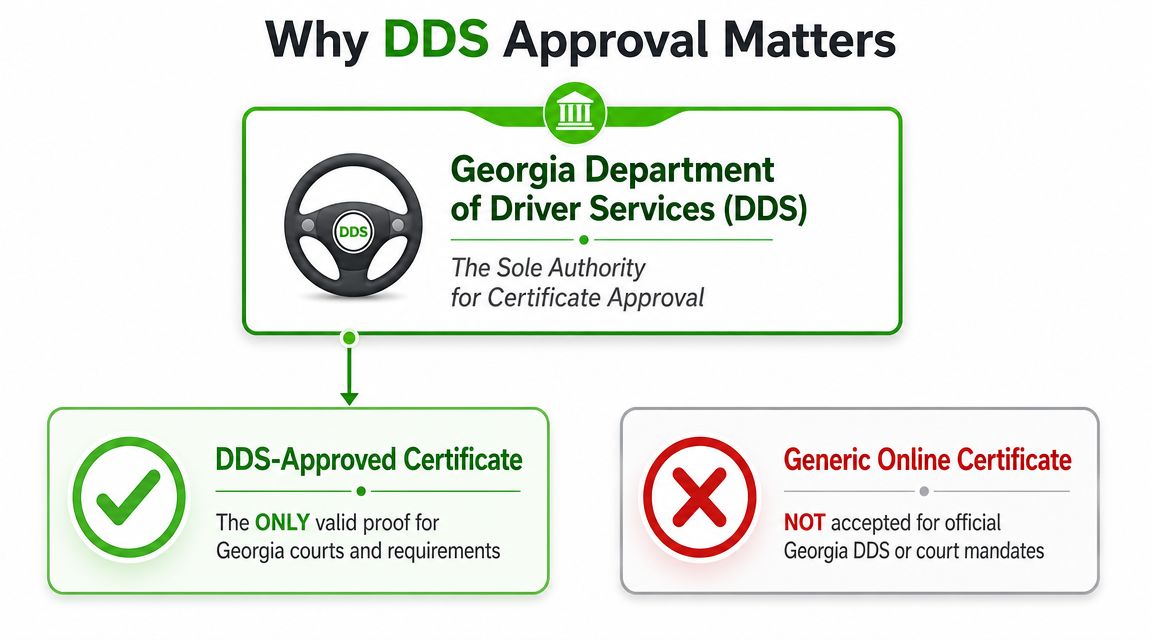
Georgia regulates this process closely. That protects students, but it also means you can't swap in a random course and hope the paperwork works out later.
What to check before you enroll
Use this checklist before you pay anyone:
- DDS approval status: The provider should clearly identify that it offers the Georgia-approved Risk Reduction Program.
- Correct program components: The school should explain both the assessment and intervention portions, not just “a DUI class.”
- State fee structure: Georgia DDS sets the statewide fee at $360, made up of $100 for the Assessment Component and $260 for the 20-hour Intervention Component.
- Clear completion process: You should know how attendance, identity verification, and certificate issuance work before class begins.
Why generic online courses create problems
A generic online certificate may be completely legitimate for another state, an employer, or a private requirement. It still may not count in Georgia. That's the issue. The problem usually isn't that the course is fake. The problem is that it's the wrong credential for your legal need.
Some readers also get confused because many professional certificates involve structured multi-course paths. For example, the National Alliance CRM sequence requires five 16-hour courses and 2.5-hour exams completed within five calendar years of the first exam, according to the National Alliance CRM program description. That level of structure shows how formal certificates can be in other industries. It does not make them interchangeable with Georgia's DUI Risk Reduction requirement.
A rejected certificate usually means more than disappointment. It can delay reinstatement, frustrate court compliance, and force you to pay again for the correct course.
A simple rule for Georgia drivers
If the class is supposed to satisfy a Georgia DUI-related obligation, treat DDS approval as mandatory. Don't rely on broad phrases like “nationally recognized,” “court accepted,” or “works in many states.” Georgia cases are handled under Georgia rules.
Your Step-by-Step Path to Getting the Certificate
A lot of Georgia drivers hit the same moment of confusion. You know you need a certificate, but every course name starts to sound alike, and one wrong registration can cost you time, money, and another delay with the court or DDS. The good news is that the Georgia Risk Reduction certificate follows a clear process once you know the order.
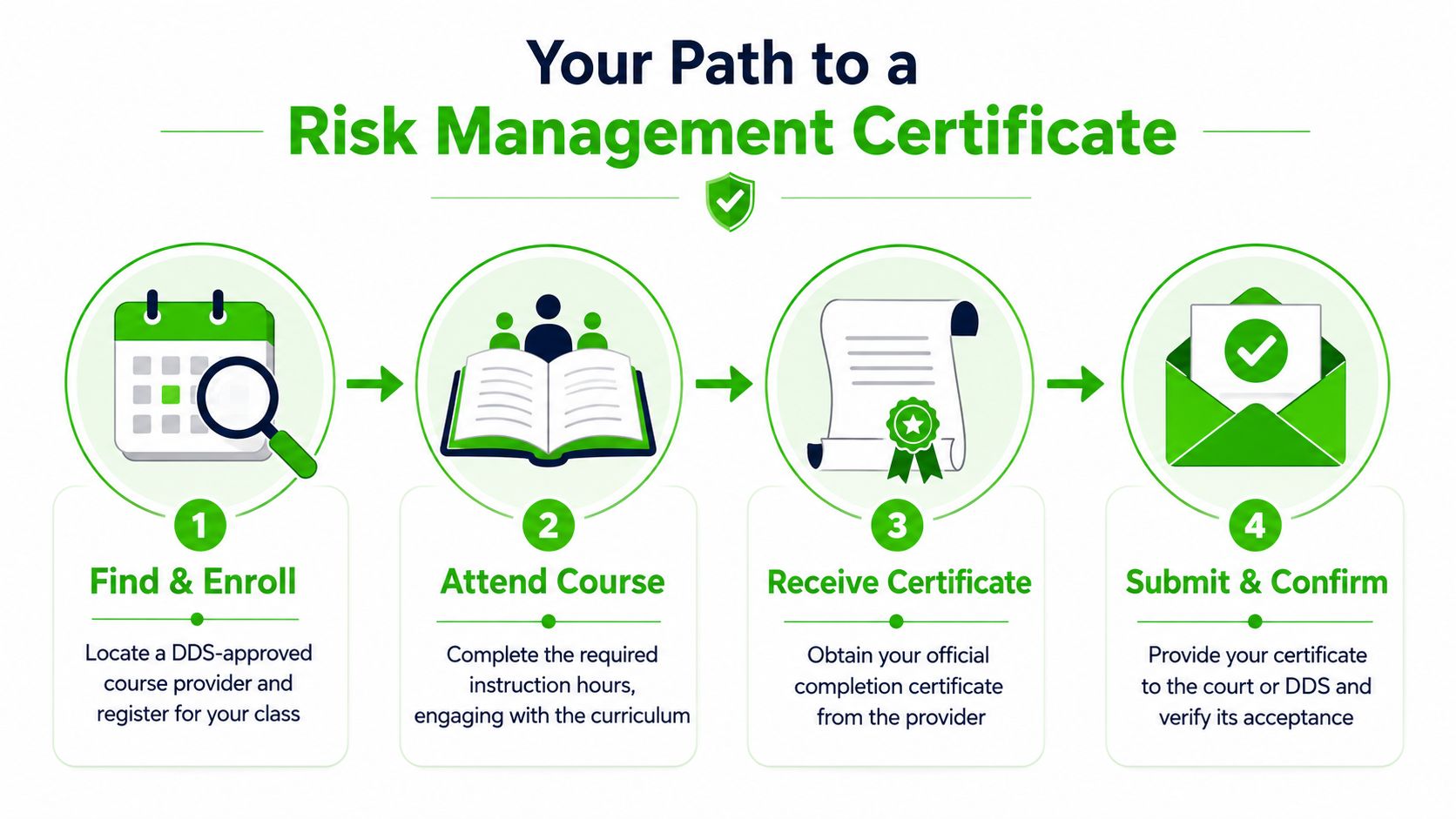
Step 1. Enroll in the correct Georgia program
Start with the course name, not the marketing language. You are looking for the Georgia Risk Reduction Program that leads to the state-recognized completion certificate for DUI-related court or DDS requirements.
That matters because many courses sound similar. Defensive driving, driver improvement, substance awareness, and corporate risk management classes may all be legitimate for other purposes. They do not automatically meet a Georgia DUI-related requirement.
Before you pay, ask the school direct questions:
- Is this the Georgia Risk Reduction Program?
- Does it include both the assessment and the intervention course?
- Will I receive the Georgia completion certificate used for court or DDS compliance?
- What do I need to bring to register?
Cost is part of the planning too. If you want a simple overview of the state-structured pricing, this Georgia Risk Reduction course fee page gives a helpful breakdown.
Step 2. Complete the assessment carefully
The assessment is not a throwaway form. It is a required part of the program, and it helps set up your record correctly before class completion is documented.
Use your legal name exactly as it appears on your license or court paperwork. A small spelling mistake at the beginning can follow you all the way to the certificate. That is why careful data entry matters in legal paperwork, and Matil on data validation offers a simple explanation of how small record errors create larger administrative problems.
If you are unsure what identification or documents to bring, call first. One short call can save you a wasted trip.
Step 3. Attend and finish the intervention course
After the assessment, you must complete the intervention portion of the Georgia Risk Reduction Program. This is the class many people mean when they say they need a DUI school certificate, but the certificate comes from completing the full approved process, not from signing up for something that sounds close.
A simple way to sort out the options is to compare the format with the requirement:
| Feature | In-Person Classroom | Instructor-Led Virtual Class | Self-Paced Online Course |
|---|---|---|---|
| What it feels like | You attend at a physical location with the instructor present | You join live from home at a scheduled time | You work on your own schedule |
| Best question to ask | Where do I report and what ID do I bring? | What technology, camera use, and ID checks are required? | Is this for defensive driving instead of Risk Reduction? |
| Why the difference matters | Often used for Georgia Risk Reduction when offered by an approved school | May be used if the format meets current approval rules | Often confused with the DUI requirement, even though it may serve a different purpose |
The easiest way to avoid trouble is to match the course to the requirement before class starts.
Step 4. Get the official completion certificate
Once you finish every required part, the school issues your certificate. Check it right away. Do not toss it in your car and assume everything is fine.
Review your name, completion details, and any instructions about who needs a copy. Some students need the certificate for court paperwork. Others need it for DDS reinstatement steps. Many need both, and almost everyone should keep a personal copy in a safe place.
This is the end of the class process, but not the end of the paperwork.
Verifying and Submitting Your Certificate Correctly
Finishing the course is a big step, but the process isn't complete until your certificate is checked and delivered where it needs to go. A valid certificate can still create problems if your name is wrong, a copy gets lost, or the wrong office receives it.
What to verify before you file it
Before you leave the school or finalize your paperwork, review the certificate carefully.
Use this checklist:
- Your full legal name is correct: Match it to your license or court records.
- The completion details are present: Don't assume every field is filled in correctly.
- The provider information is complete: The receiving office needs to see a properly issued certificate.
- You know which copy goes where: Ask before you walk out.
- You keep a personal copy: Store a paper copy and a digital copy if possible.
This kind of careful review is a practical form of data checking. If you want a simple explanation of why small record errors matter so much, Matil on data validation gives a useful overview that applies well to legal and administrative paperwork.
Where the certificate usually goes
Your submission path depends on why you took the class.
If the course was required for a court matter, you may need to provide the certificate to a probation officer, court clerk, or another court-designated office. Follow the instruction on your paperwork, not guesswork from friends or internet comments.
If the course is tied to your driving privileges, you may need to provide proof as part of a DDS-related reinstatement process. Because procedures can vary by case, it's smart to confirm the exact submission step with DDS or your legal representative before you rely on assumptions.
Bring order to the last step. One copy for the court if required, one for DDS if required, and one for your own records.
One more point people overlook
If you took more than one class in the same period, keep the paperwork separated. Risk Reduction, defensive driving, clinical evaluations, and other requirements serve different purposes. Mixing those documents in one folder without labels is a common reason people submit the wrong form.
If you need another driving-related class later, keep your records organized from the start. Some students use programs such as Drivers Ed To Go for separate educational needs, but those products don't replace your Risk Reduction certificate unless your paperwork specifically says they do.
Troubleshooting Common Certificate Issues
Most certificate problems can be fixed. The key is figuring out whether the issue is about the document itself, the provider, or the office receiving it.
I lost my certificate
Start with the school where you completed the course. In most cases, the original provider is the first place to request a replacement or duplicate record. Be ready to verify your identity and give enough information for staff to locate your completion record.
Don't wait until the day of court or the day you plan to handle reinstatement paperwork. Record retrieval takes less stress when you're not under a same-day deadline.
My certificate was rejected
When a certificate is rejected, the most likely questions are:
- Was the provider approved for Georgia Risk Reduction?
- Was the document filled out correctly?
- Did you submit it to the right office?
- Did you accidentally take a different course, such as defensive driving?
If the problem is the provider, the solution may be unpleasant but straightforward. You may need to complete the correct Georgia-approved program. If the problem is clerical, a corrected certificate or a clearer submission can solve it.
Don't argue from the course title alone. A certificate can say “DUI” or “risk” and still fail to satisfy a Georgia requirement if it came from the wrong program.
Does the certificate expire
People often ask this because they completed the course, set the paperwork aside, and are now returning to the issue later. The better way to think about it is this: the certificate may still exist, but the court or DDS may want current compliance based on your case timing or status.
That means you shouldn't assume an older certificate will work automatically. If a lot of time has passed, check before you act. It's far better to confirm early than to show up with a document that no longer satisfies the agency reviewing your file.
When to ask for help
Call the school if you have a paperwork issue. Call the court if the order is unclear. Contact DDS if the question is about reinstatement. And if you have an attorney or probation officer, use them. A short clarification can prevent a major delay.
How Georgia DUI Schools Ensures Your Compliance
A lot of Georgia drivers reach this point after doing real work, finishing a class, gathering paperwork, and still wondering, “Will the court or DDS accept this?” That uncertainty is understandable. The words on these programs can sound similar, but Georgia is looking for one specific thing: the state Risk Reduction program, completed through a DDS-approved provider.
Georgia DUI Schools helps keep that process clear and orderly. The school focuses on the Georgia Risk Reduction requirement tied to DUI, drug, and certain license or court issues. That matters because a generic corporate risk management course, a defensive driving class, or another alcohol education program may sound related and still not meet the state rule.
The process works a lot like using the right key for the right lock. If the provider is approved, the course components are completed in the required order, and the certificate is issued correctly, you are far less likely to face delays over paperwork.
As noted earlier, Georgia DUI Schools is a long-established DDS-certified provider. That experience matters in practical ways. Staff can explain what the Georgia Risk Reduction certificate is for, what it is not for, and what students usually need to do so the document is ready for court or DDS review.
If you are trying to satisfy a Georgia DUI or license requirement, the safest approach is simple. Match your paperwork to the exact Georgia Risk Reduction program, complete each required part carefully, check your certificate details before you leave, and keep a copy for your records.
If you still have questions about whether your situation calls for the Georgia Risk Reduction course, Georgia DUI Schools can help you confirm the requirement and start the correct state-approved process.