

The Georgia DDS-mandated fee for the 20-hour Risk Reduction course is $360 total, made up of a $100 assessment and a $260 course fee. That price is set by the state, so it's the same at every certified school in Georgia.
If you're reading this, there's a good chance you're trying to solve a problem fast. Maybe the court told you to complete DUI school. Maybe DDS listed it as part of getting your license back. Maybe a probation officer gave you a deadline and you're trying to figure out what this will really cost before you commit.
That confusion is completely normal. A lot of people see one number advertised, then later learn they may also need a clinical evaluation, treatment, a victim impact panel, or paperwork for court or probation. The result is stress at the exact moment you need clarity.
This guide gives you the no-surprises version. It separates the state-mandated Risk Reduction course fee from the other services that sometimes come with a Georgia DUI or drug-related case, so you can build a realistic budget and move forward with confidence.
Georgia's State-Mandated Risk Reduction Course Fee
The first thing to know is simple. Georgia's Risk Reduction Program fee is not a school-by-school pricing decision. DDS sets the required amount for certified providers.
That matters because many people shop for risk management course fees the same way they would compare ordinary classes. Georgia's DUI and Risk Reduction course doesn't work like that. In Atlanta, Athens, or another Georgia community, the core state fee stays the same when you're dealing with a DDS-certified school.
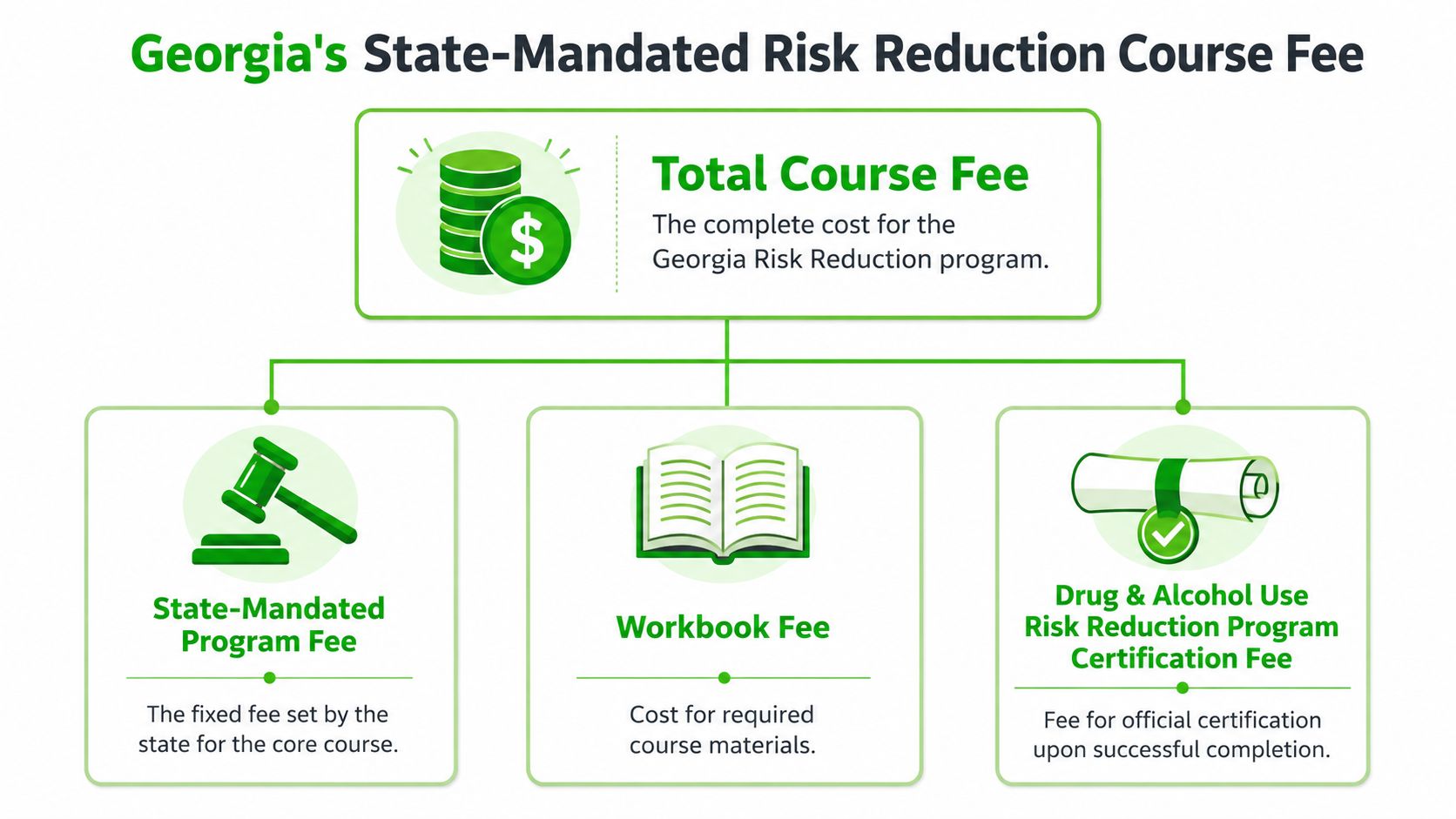
How the state fee is structured
The $360 total is made up of two parts:
- Assessment component: $100
- Course fee: $260
Some schools may show that breakdown in slightly different wording on their websites, but the total state-required amount remains the same for the standard 20-hour Georgia Risk Reduction Program. If you want a local example of how a certified provider presents that required pricing, Georgia DUI Schools shows the Georgia DUI school cost breakdown.
Practical rule: If a Georgia school is certified to offer the DDS Risk Reduction Program, the core course price should not be treated like a negotiable sale item.
Why this fee feels different from other course prices
In the wider professional education market, "risk management course fees" can mean very different things. One fee guide shows the FRM certification from GARP at about USD 400 for enrollment plus USD 550 to USD 750 per exam part, while PMI-RMP costs USD 520 for PMI members and USD 675 for non-members. By comparison, an undergraduate risk management program in the United States averaged USD 28,162 in tuition and fees for the 2024 to 2025 academic year, which shows how broad the phrase can be depending on whether someone is buying an exam path or a degree program (fee comparison overview).
Georgia's DUI Risk Reduction course is much more straightforward. It isn't a finance credential, a degree, or a multi-part exam sequence. It's a state-regulated requirement tied to driving privileges, court compliance, and alcohol or drug risk education.
People also often confuse the criminal side of a DUI case with the license and administrative side. If you need a plain-English overview of that distinction, this explainer on understanding DUI's civil effects can help you see why a required course may still apply even when you're focused on court outcomes.
What Is Included in the Standard Course Fee?
When you pay the standard Georgia fee, you're not paying for a vague enrollment slot. You're paying for a specific state-compliant package.

What you receive
Most students can think of the standard fee as covering four core pieces:
- The initial assessment: This is the required screening step completed before the course portion.
- The full 20-hour Risk Reduction class: This is the classroom requirement itself, whether offered in-person or in a format allowed by state rules.
- Required course materials: That commonly includes the workbook used during the program.
- Certificate of completion: After you successfully finish the program, you receive the documentation needed for DDS, the court, probation, or another requesting authority.
What students often misunderstand
The biggest misunderstanding is this. People sometimes assume the course fee only pays for seat time in class. In practice, the standard fee is tied to the full required educational process, not just the hours you spend listening to instruction.
A second point of confusion is transparency. In many industries, buyers now look closely at hidden charges before they pay. If you've ever had to compare providers for hidden payment fees, you already understand why that matters here too. You want to know whether the listed price includes the required materials and completion paperwork, not just the first step.
The standard Georgia fee should cover the ordinary course path from assessment through completion for the Risk Reduction Program itself.
What it doesn't automatically cover is every other requirement that might appear in your case. That's where total cost starts to vary from person to person.
Additional Services That Can Affect Your Total Cost
For many drivers, the base course fee is only part of the story. The actual total depends on what the court, probation, DDS, or a clinical recommendation requires in your specific case.
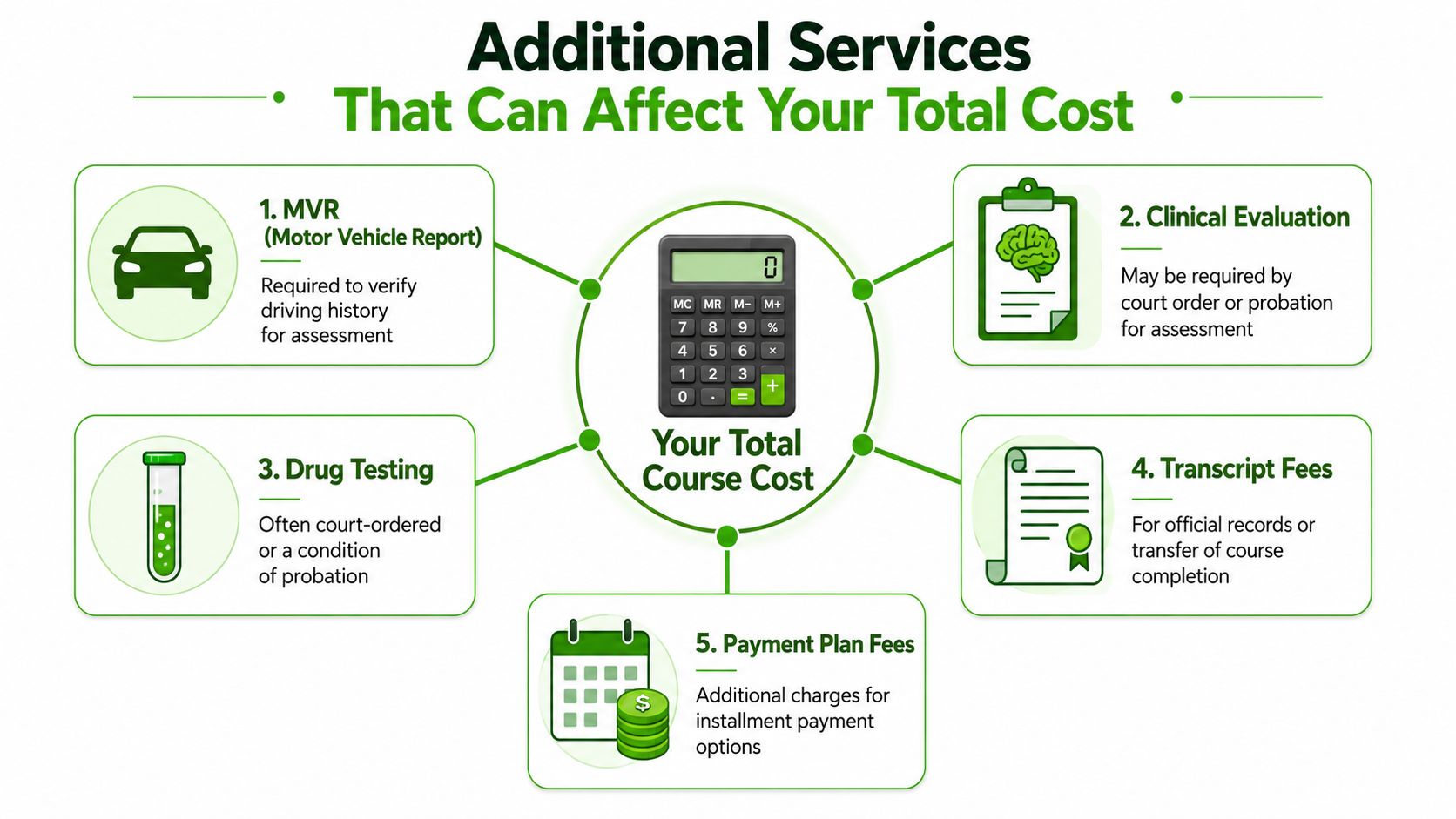
The most common add-on services
Some people finish only the standard Risk Reduction Program. Others need one or more of the following:
- Clinical evaluation: A court, probation officer, attorney, or treatment plan may require an alcohol and drug evaluation before the case can move forward.
- ASAM Level 1 treatment: If the evaluation recommends counseling or education beyond the course, treatment may be part of compliance.
- Victim Impact Panel: Some courts or probation terms include attendance at a panel as a separate requirement.
- Drug testing: In some cases, testing is ordered as part of probation or treatment monitoring.
- Driving record paperwork or transcripts: You may need records sent to an agency, court, employer, or another school.
Why these costs aren't bundled into the course
Many online articles about risk management course fees often fall short. They list a course price but don't help readers think about total cost. One verified market overview makes that exact point. Public pricing can range from no registration fee but separate course fees at ASSP, to $1,395 to $1,895 for ABA's certificate, to $1,850 for Harvard's 5-week course, while other offerings are only a few hundred dollars or less. The key lesson is that headline price alone can be misleading unless you compare the all-in budget and the credential involved (total-cost comparison example).
Georgia DUI compliance works the same way in principle. The course price answers only one question: what the standard DDS class costs. It does not answer whether your judge, probation officer, or evaluator has added more steps.
A simple way to budget your real total
Use this checklist before you enroll:
| Item | Usually part of the standard course fee | May be separate |
|---|---|---|
| DDS assessment | Yes | No |
| 20-hour course | Yes | No |
| Workbook or materials | Usually yes within the standard course package | Sometimes shown separately in provider descriptions |
| Completion certificate | Yes after successful completion | No |
| Clinical evaluation | No | Yes |
| Treatment or counseling | No | Yes |
| Victim Impact Panel | No | Yes |
| Drug testing | No | Yes |
| Transcript or record transfer | Not always | Yes in some situations |
Questions to ask before you pay anything
Call the school or service provider and ask:
- Is this only the Risk Reduction Program, or does it include other required services too?
- Has my court or probation officer ordered a clinical evaluation?
- If treatment is recommended, do I need to complete it before my case is considered satisfied?
- Will I need proof sent somewhere, and is there a separate records fee for that?
- Are there payment-plan charges for anything outside the state course fee?
A low advertised price can still turn into a higher real cost if it doesn't include the services your case actually requires.
That doesn't mean extra services are unfair. It means they solve a different problem. The class meets the state education requirement. An evaluation or treatment addresses whether your case calls for more support or monitoring.
Payment Options, Insurance and Potential Discounts
Once you know which services you need, the next question is usually how to pay for them without creating another headache.
The state-mandated Risk Reduction fee isn't negotiable in the usual sense. A certified school can't decide to slash the DDS course price like a seasonal promotion. What may vary is how a school handles registration timing, accepted payment methods, or fees tied to non-course services.
What payment flexibility usually looks like
Schools commonly accept standard forms of payment such as major credit or debit cards, and some may also allow other methods depending on location or format. Ask these questions before registering:
- When payment is due: Some services may require full payment up front, while others may allow staged payments.
- Whether a payment plan applies only to non-state services: That's especially relevant for evaluations or treatment.
- Whether there are extra charges tied to installments or missed appointments: These details matter when you're trying to avoid surprises.
What insurance may and may not cover
The Risk Reduction course itself is generally treated as a compliance-based education requirement, not ordinary medical care. That means people shouldn't assume insurance will pay for the class.
A clinical evaluation or treatment service may be different. Coverage depends on your health plan, the provider, and whether the service qualifies under your policy. The practical move is to call your insurer before scheduling and ask whether behavioral health, substance use assessment, or counseling benefits apply.
Where discounts usually enter the picture
If you're also trying to lower insurance costs after getting back on track, a separate defensive driving course may be worth looking at. Georgia drivers often ask about that option, and this guide to a defensive driving course for lower insurance explains how that type of class fits a different goal than DUI compliance.
One more reality check helps here. In the broader credential market, prices often rise with scope and specialization. A recent fee guide lists FRM preparation at about ₹1.4 lakh to ₹1.6 lakh excluding coaching, while a one-year postgraduate program in the same field was priced at approximately ₹4.9 lakh and covered 40+ modules, including cyber risk and ESG topics (risk course fee and duration comparison). Georgia's course isn't priced that way. It has a fixed legal purpose, and your real budgeting work is mostly about identifying any separate requirements around it.
How to Verify a School and Enroll with Confidence
The safest way to avoid wasted money is to verify the school before you register. If a provider isn't properly approved, the certificate may not satisfy DDS, the court, or probation.

What to verify first
Check for three things:
- DDS approval: The provider should clearly state that it offers the Georgia DDS-approved Risk Reduction Program.
- Course format: Make sure the class type you're choosing is accepted for your requirement.
- Local logistics: Confirm the location, schedule, start time, and attendance rules before paying.
If you're comparing online options, local metro choices, and scheduling formats, one example is Drivers Ed To Go options in Georgia, which shows how a provider may organize course access and enrollment information. The key point isn't brand preference. It's making sure the program you choose matches your actual requirement.
What to have ready before enrollment
Registration gets easier when you gather your information in advance. You should have:
- A valid photo ID or driver's license information
- Court paperwork if the class is court-ordered
- Probation details if a probation officer requested the course
- Your deadline
- Any paperwork mentioning a clinical evaluation, treatment, or panel requirement
Bring the exact wording from your court or probation documents. Small wording differences can change what you need.
How to avoid the most common mistake
Many students focus only on finding the earliest class date. That's understandable, especially around Atlanta, Athens, and surrounding communities where people may be juggling work, family, and court deadlines. But speed isn't enough if you register for the wrong service.
A careful provider should be able to tell you whether you're signing up for the Risk Reduction course only or whether you also need to arrange separate compliance items. Georgia DUI Schools is one provider that offers the course along with related services such as clinical evaluations, ASAM Level 1 treatment, and victim impact panels, which can make planning easier when multiple requirements apply.
Another useful lens comes from the professional credential world. Some expensive programs don't automatically produce better outcomes for every learner, and some low-cost options are perfectly appropriate when the goal is foundational knowledge or a specific requirement. A verified overview of PMI-RMP notes that application approval is required before the exam fee is paid, which shows that price alone doesn't tell you how useful a program will be for your needs (credential fit and value discussion). The same logic applies here. The right school is the one that is certified, clear about requirements, and aligned with your case.
Completing Your Requirement and Moving Forward
Finishing the class is a milestone, but it isn't the last step. What matters next is making sure your certificate of completion gets to the right place.
Depending on your case, that may be DDS, the court, your probation officer, your attorney, or more than one of them. Don't assume everyone receives it automatically. Ask who needs proof, how they want it delivered, and whether you need to keep a copy for your own records.
What success looks like after completion
Use this short checklist:
- Confirm you completed every required part
- Get your completion documentation
- Submit it to each required agency or person
- Keep copies of everything
- Follow up if your license reinstatement or court record isn't updated
A lot of stress around risk management course fees comes from not knowing the difference between the fixed course price and the variable total cost of a full DUI-related case. Once you separate those two, the path gets clearer. The class fee is predictable. The added services depend on your paperwork and recommendations.
You've already done the hardest part by looking for accurate information before spending money. The next step is choosing a certified course, confirming whether you need anything beyond the class, and finishing each requirement in order.
If you're ready to take care of the Georgia Risk Reduction requirement, view the Georgia DUI / Risk Reduction course schedule and enroll with Georgia DUI Schools.