
You got a court order in Georgia, or a notice from DDS, and the first thing you do is search online for a driving course that looks fast, familiar, and easy to start. A national name like drivers ed togo shows up, and at first glance it seems close enough.
That’s where a lot of people go wrong.
In Georgia, a teen driver education course and a court-ordered adult course are not interchangeable. If your paperwork involves DUI, Risk Reduction, Defensive Driving, license reinstatement, habitual offender issues, or related compliance steps, picking the wrong course can cost you time, money, and your deadline. The safest move is to match the course to the exact legal requirement, not the brand name you recognize.
Searching for Driving School After a Georgia Court Order
A common scenario in Georgia looks like this. Someone leaves court in Fulton, DeKalb, Gwinnett, Cobb, or a smaller county nearby with paperwork that says they must complete a driving-related class. They search “online driving school Georgia,” see drivers ed togo, and assume any online driving course should count.
It usually doesn’t.
The problem starts with the phrase driving school. In everyday conversation, people use it for everything from teen permit prep to point reduction to DUI compliance. Georgia doesn’t use those terms loosely. The state treats these as different programs with different rules, different certificates, and different approval standards.
A court clerk may say “take the class.” A probation officer may say “get enrolled this week.” Your insurance company may say “defensive driving.” None of that means a teen permit course will satisfy the requirement on your case.
What people often assume
- “It’s online, so it should count.” Course format alone means nothing. Approval is what matters.
- “It says state-approved.” That may refer to teen education approval, not DUI or Defensive Driving approval.
- “It’s a national company, so Georgia courts will accept it.” Georgia courts and DDS care about Georgia-specific compliance.
Practical rule: If your issue started with a ticket, a DUI arrest, a suspension, a court sentence, or a reinstatement notice, stop looking at teen permit courses first.
The expensive mistake isn’t enrolling in a bad course. It’s enrolling in the wrong kind of course.
What Is DriverEdToGo Actually For
A common mistake happens right after a court deadline lands. An adult driver searches for a class, sees a familiar national brand, and assumes any DDS-approved course will satisfy the order. That assumption causes problems in Georgia.
DriverEdToGo serves a legitimate purpose. Its lane is beginner driver education, especially for teens working toward a permit or first license. In Georgia, that usually means Joshua’s Law training and other entry-level coursework tied to learning how to drive, not resolving a court case or reinstatement issue.
One of its Georgia offerings is a teen online driver education program built around the standard subjects new drivers need before licensure:
- traffic laws and signs
- basic risk awareness
- safe driving habits
- permit and first-license preparation
- required classroom hours for teen driver education
That is useful training for a new driver. It is the wrong tool for someone trying to satisfy a DUI sentence, a Risk Reduction requirement, or a court-approved Defensive Driving order.
I see the confusion often. Parents shopping for a 16-year-old and adults dealing with a ticket both type in "driving school," but Georgia treats those as separate categories with separate approval paths. If you need context on the teen side, this overview of Georgia drivers education classes helps clarify what those courses are meant to do.
Who DriverEdToGo fits
DriverEdToGo fits people who are starting the licensing process, not people cleaning up a legal or administrative driving problem.
The typical fit includes:
- teens meeting Georgia driver education requirements
- families looking for an online permit-prep course
- first-time drivers who need classroom instruction before the road phase
The approval question that matters
Approved status only matters if it matches the requirement in front of you.
A teen course can be fully valid for a 15- or 16-year-old and still be unusable for an adult who must turn in a certificate to a court, probation office, employer, or the Georgia DDS. That is the point many drivers miss. The issue is not whether the course is good. The issue is whether it is approved for the specific Georgia compliance problem you need to fix.
Georgia Court Courses vs Teen Drivers Ed
A driver in Georgia can make an expensive mistake here. Someone gets a court order, searches for "driving school," sees a familiar online teen course brand, signs up, finishes the lessons, and then learns the certificate does not satisfy the judge, probation office, or DDS requirement.
That happens because these courses belong to different approval categories.
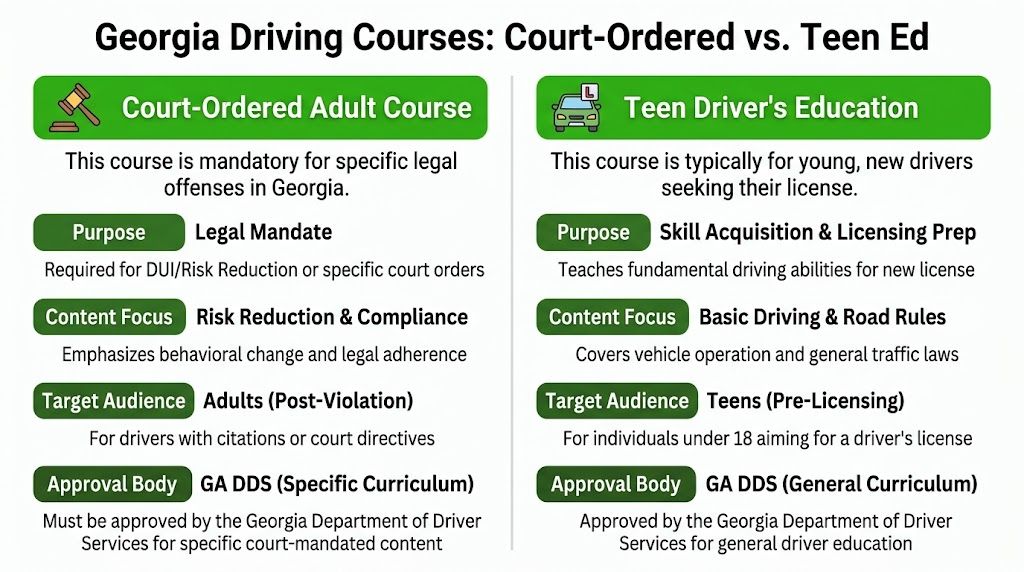
Teen driver's ed is built for first-time drivers who are working toward a permit or license. Georgia court courses serve a compliance purpose after a DUI arrest, a suspension issue, a point problem, or a judge's order. The course title may sound similar. The legal use is not.
That distinction controls three things that matter in real life: who the course is for, what the school is approved to teach, and whether the completion certificate will be accepted by the agency asking for it.
If you need background on the beginner side, this overview of drivers education classes in Georgia explains the role of teen licensing courses. It does not replace a Georgia-approved DUI, Risk Reduction, or court-ordered Defensive Driving program.
Teen Driver's Ed vs. Georgia Court-Ordered Courses
| Feature | Teen Driver's Ed (e.g., DriverEdToGo) | GA Court-Ordered Course (DUI/Defensive Driving) |
|---|---|---|
| Primary purpose | First license and permit preparation | Legal compliance after a violation or court order |
| Typical student | Teen, usually pre-licensing | Adult or licensed driver with a case, points, or reinstatement issue |
| Main subject matter | Basic rules of the road and beginner safety | Risk behavior, legal compliance, and corrective driving content |
| Outcome needed | Eligibility progress for licensing | Court or DDS-acceptable completion certificate |
| Use case | Joshua’s Law and beginner education | DUI matters, Risk Reduction, point reduction, insurance discount, reinstatement |
What changes once a court is involved
A teen course teaches driving fundamentals. A court course has to meet a specific Georgia requirement tied to a legal or administrative outcome.
From an administrator's side, people often get tripped up on this point. They assume any online driving class with quizzes, timed sections, and a certificate should count. Georgia does not treat those features as proof of compliance. Approval has to match the order.
A parent in Macon shopping for a 16-year-old is solving a licensing problem. An adult in Clayton County with a court deadline is solving a compliance problem. Those are separate lanes, with separate consequences if you choose the wrong school.
Why DriverEdToGo Fails Georgia Court Compliance
If your Georgia paperwork requires DUI School, Risk Reduction, or a court-ordered Defensive Driving course, drivers ed togo is the wrong choice.
That isn’t criticism of the teen course. It’s a compliance issue.
Under Joshua’s Law Method 1, teens complete 30 hours of instruction plus 6 hours of behind-the-wheel training with DDS-certified instructors, and that structure is different from the DUI course category, according to the Georgia DDS driver education FAQs.
That single fact clears up a lot of confusion. Teen education is one regulatory lane. Court intervention programs are another.
Why courts reject the substitution
Georgia court compliance depends on the specific program ordered. If the court ordered Risk Reduction, you need a Georgia-approved Risk Reduction program. If the court ordered Defensive Driving, you need a Georgia-approved Defensive Driving program.
A teen Joshua’s Law course does not become acceptable just because:
- it’s online
- it has timed pages
- it’s approved for teens
- it teaches safe driving concepts
- it issues a completion certificate
What doesn’t transfer over
The biggest mistake is assuming educational overlap creates legal overlap. It doesn’t.
A teen course may discuss traffic laws and safe habits. A court course exists to satisfy a legal requirement tied to a case, a violation history, or a DDS matter. Courts and agencies look for the right approval chain and the right certificate, not a close substitute.
What works and what doesn’t
What works
- Reading the order line by line
- Confirming the exact course name required
- Verifying that the provider is approved for that exact Georgia program
- Asking before you enroll if the certificate is accepted for your county or DDS issue
What doesn’t
- Picking the first online class that looks familiar
- Assuming “state-approved” means all-purpose approval
- Confusing teen licensing education with adult intervention courses
If your paperwork came from a judge, probation, DDS, or an attorney handling reinstatement, don’t rely on brand recognition. Rely on program type.
The High Cost of Choosing the Wrong Course
The first cost is obvious. You pay for a course that doesn’t help your case.
The second cost is worse. You still haven’t satisfied the order.
That means the clock keeps running while you figure out what went wrong, find the right provider, and start over. In Georgia, that delay can create real problems with probation compliance, reinstatement timing, work transportation, or insurance deadlines.
Where the damage shows up
- Rejected certificate. The court or agency won’t accept it for the requirement you have.
- Lost time. You may miss the date by which the class had to be finished.
- Duplicate effort. You still need the proper course and its official certificate.
- Stress around related requirements. If your matter also involves a clinical evaluation, treatment referral, or a Victim Impact Panel, a wrong course can throw off the whole sequence.
This is one reason structured, approved programs matter. In teen education, a University of Nebraska study of over 150,000 teens found formal driver’s ed graduates were 75% less likely to receive traffic tickets and 16% less likely to crash, according to Drive Smart Georgia’s summary of the study. The takeaway isn’t that teen education solves adult court cases. It’s that approved programs produce outcomes in the lane they were designed for.
A practical warning sign
If a provider’s marketing talks mostly about permits, first licenses, teen students, or Joshua’s Law, that should tell you what bucket the course belongs in.
The wrong course usually looks reasonable right up until you try to turn in the certificate.
That’s the moment many people realize they paid for convenience instead of compliance.
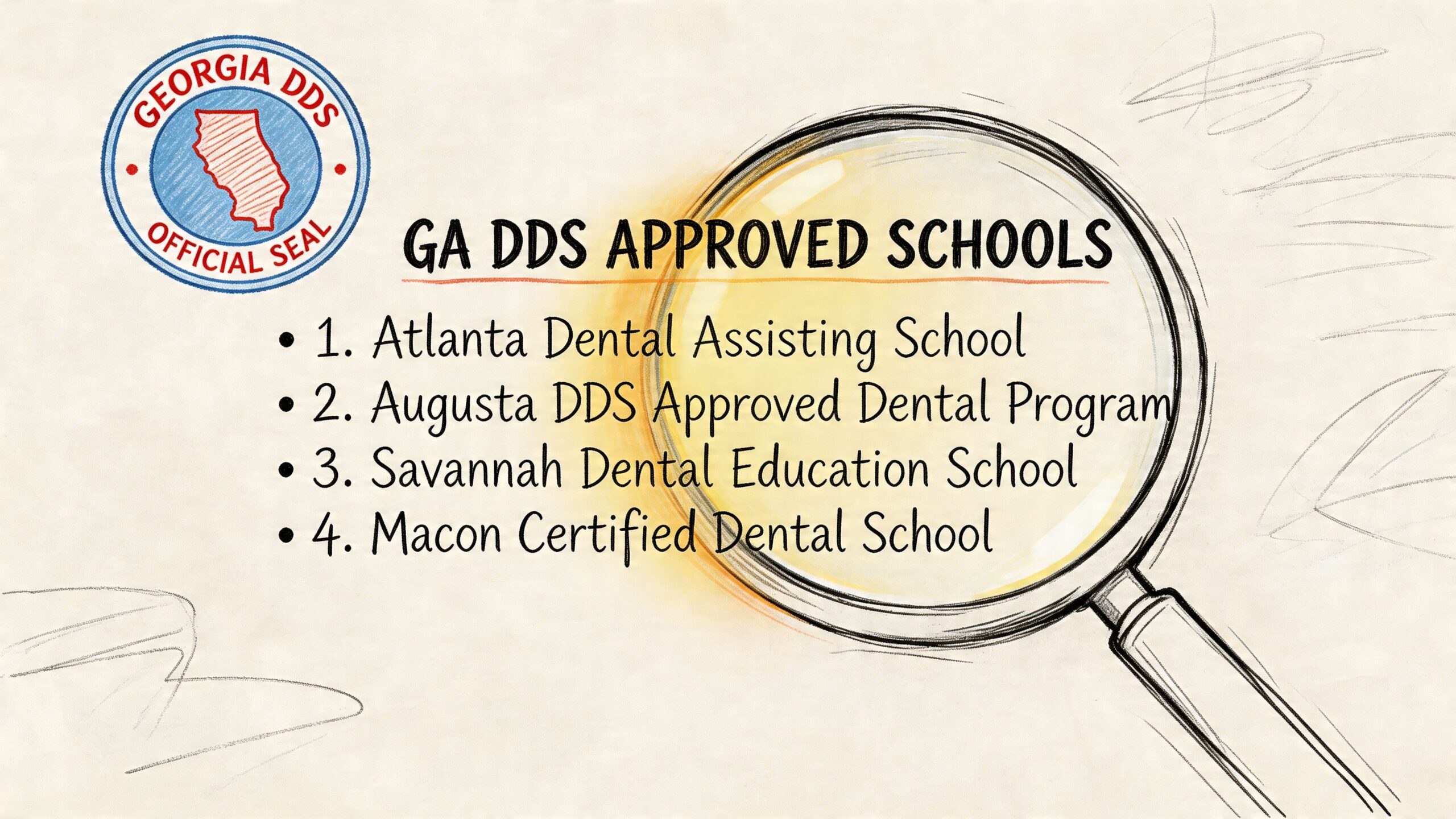
Finding a DDS-Approved School in Georgia
When your issue is legal compliance, the safest filter is simple. Check for a Georgia DDS-approved provider for the exact program you need.
That matters even more for adults outside the teen-driver market. Major online platforms often overlook older Georgia adults seeking Defensive Driving for insurance discounts and point reduction, even though a DDS-approved 6-hour course can qualify that group for up to a 20% insurance premium reduction, according to Driver’s Edge. That’s a different audience, and it needs a different type of provider.
What to verify before you enroll
Don’t stop at “approved” in a headline. Verify the program match.
- Course category. Is it Risk Reduction, Defensive Driving, clinical evaluation, treatment, or teen driver education?
- Attendance format. Some adult programs can be taken in different formats, but not every requirement can be satisfied by a self-paced course.
- Certificate use. Ask whether the certificate is accepted for your exact issue, such as court submission, point reduction, insurance discount, or a reinstatement-related step.
- Georgia focus. National providers may be strong at teen education while offering nothing usable for Georgia adult compliance.
Local realities in Georgia
Metro Atlanta drivers often need evening access. Rural drivers may need virtual options. Older drivers may want insurance-related Defensive Driving. Some DUI-related cases also involve evaluations, treatment follow-up, or proof sent to a third party.
Those needs don’t fit neatly into a teen permit platform.
For adults who need a compliant online option for point reduction or insurance purposes, this page on Georgia online defensive driving is the type of Georgia-specific resource worth reviewing.
The simplest test
Ask one question before you pay: Will this exact certificate satisfy my Georgia requirement?
If the answer is vague, keep looking.
Your Clear Path to Getting Back on the Road
If you’re sorting through paperwork, keep it mechanical. Don’t guess.
Start with the document you received. Read the exact words on the court order, probation instruction, or DDS notice. You’re looking for the formal program name, not your own shorthand for it.
A clean decision process
Identify the requirement exactly
Look for terms like Risk Reduction, Defensive Driving, clinical evaluation, treatment, or another named step.Match the course to the requirement
If it’s a court matter, don’t substitute a teen program because it’s faster to find.Confirm format before enrolling
Some people need a class they can complete from home. Others need live instruction or a program tied to additional compliance steps.Ask about connected obligations
In many DUI-related cases, the course is only one part of the file. Some drivers also need evaluations or related services. If your issue touches employment return-to-duty concerns, this overview of what the SAP program is may help you sort out a different but often-confused compliance category.Keep your completion records
Save the certificate and follow the submission instructions exactly.
What usually saves people the most trouble
Call before you enroll. A five-minute confirmation can prevent a full restart.
“I have a Georgia court order. Will your certificate satisfy this exact requirement?”
That question is better than any search result.
Drivers who stay precise get back on the road faster than drivers who shop by brand name alone.
Frequently Asked Questions
A lot of callers reach this point after they already bought the wrong course. They searched “drivers ed togo,” saw a familiar brand, and assumed any driving class would satisfy a Georgia court or DDS requirement. That is where mistakes get expensive.
FAQ
| Question | Answer |
|---|---|
| Is drivers ed togo accepted for a Georgia DUI or Risk Reduction requirement? | No. DriverEdToGo is known for teen driver education, not Georgia’s state-regulated DUI Risk Reduction program. If your paperwork involves a DUI, alcohol or drug offense, license reinstatement, or a court order, verify the exact program name before you enroll. |
| Can I use a Joshua’s Law course to satisfy a court order? | Joshua’s Law applies to teen licensing education. It does not substitute for a Georgia Risk Reduction class or a court-ordered Defensive Driving course. |
| If a course says DDS-approved, does that mean it works for everything? | No. Approval is tied to the course category. A school can be approved for one program and not another, so the right question is whether it is approved for your specific requirement. |
| I only need something online. Does that make drivers ed togo a safe choice? | Format comes second. Compliance comes first. If you need teen education, that may be fine. If you need a Georgia court, probation, or DDS program, convenience does not fix a category mismatch. |
| What if my court paperwork just says “driving school”? | Get clarification before you pay. Ask the court clerk, probation officer, attorney, or provider which exact Georgia program is required. “Driving school” can mean very different things depending on the case. |
| Is Defensive Driving the same as Risk Reduction? | No. Defensive Driving is generally used for point reduction, insurance purposes, or some court matters. Risk Reduction is the DUI School program used in DUI-related and certain serious traffic cases. They are separate programs with separate rules. |
| I’m older and mainly want an insurance discount. Should I still avoid teen courses? | Yes. An adult looking for an insurance-related course should choose a Georgia-approved Defensive Driving class, not a teen permit or Joshua’s Law course. |
| Can a national driving school brand still be legitimate? | Yes. The issue is not whether the brand is real. The issue is whether the certificate will satisfy a Georgia legal requirement. Those are two different questions. |
| What if I already paid for the wrong course? | Stop and confirm your requirement before spending more time. In my experience, people lose more money trying to force the wrong certificate to work than they do by restarting quickly with the correct program. |
| My case may also involve evaluation or treatment. Should I pick the class first? | Not always. Some DUI-related cases involve more than one step, including evaluations or treatment recommendations. Read your paperwork carefully and confirm the full list before you schedule anything. |
If you need a Georgia-approved course for Risk Reduction, Defensive Driving, clinical services, or related compliance steps, Georgia DUI Schools offers programs built for Georgia requirements. Visit Georgia DUI Schools.